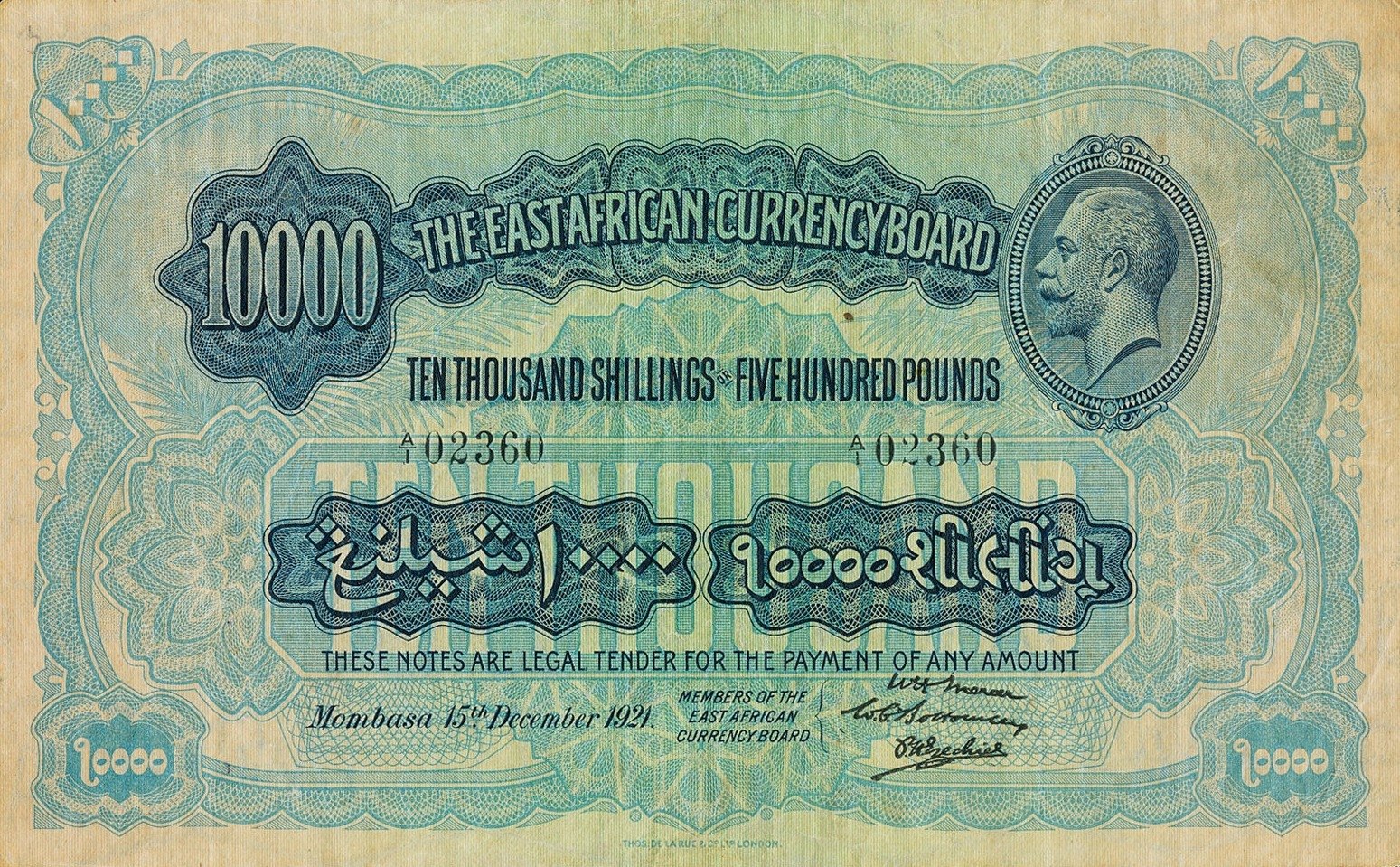
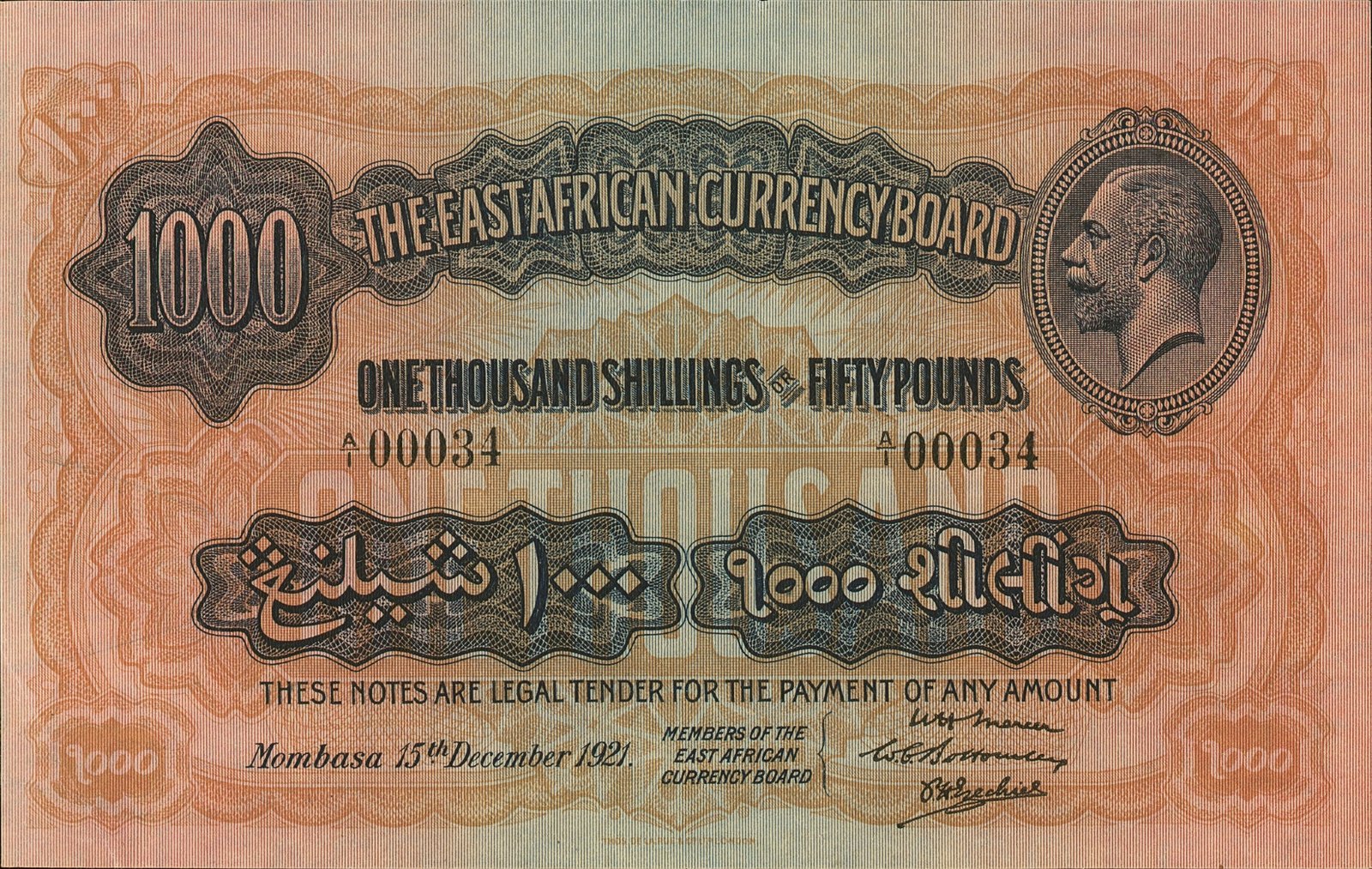
The East African Currency Board issued three notes above the 100 shillings: 200 shillings (10 pounds), 1,000 shillings (50 pounds) and 10,000 shillings (500 pounds). This article follows them from the first printing of 15th December 1921 to the Board's report that every 10,000 shillings had been recovered by the end of 1965. It is drawn from the catalogue's pages for these notes, which rest on the Kenya Blue Books, the annual reports on Kenya and Uganda, the Board's own reports, An Economic Survey of the Colonial Empire for 1937 and Dr. David Lott's article in Bank Note Reporter of March 1985, and from the descriptions of five auction lots.
The notes and their dates
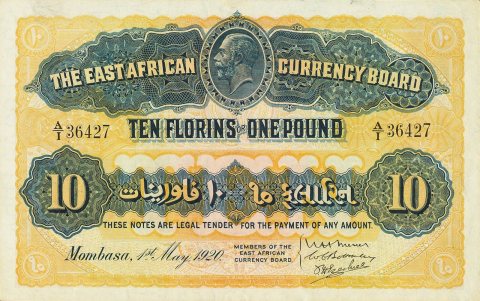
All three values first appear in the issue dated Mombasa, 15th December 1921, signed by Mercer, Bottomley and Ezechiel as Members of the East African Currency Board. The same designs were printed again dated Nairobi, 1st January 1933, with the signatures of Bottomley, Ezechiel and Kershaw. Only the two highest values were carried into the reign of King George VI. The catalogue gives Thomas de la Rue and Company as the printer of all of them.
| Value | 15th December 1921 | 1st January 1933 | King George VI |
|---|---|---|---|
| 200 shillings = 10 pounds | P-17 | P-24 | none |
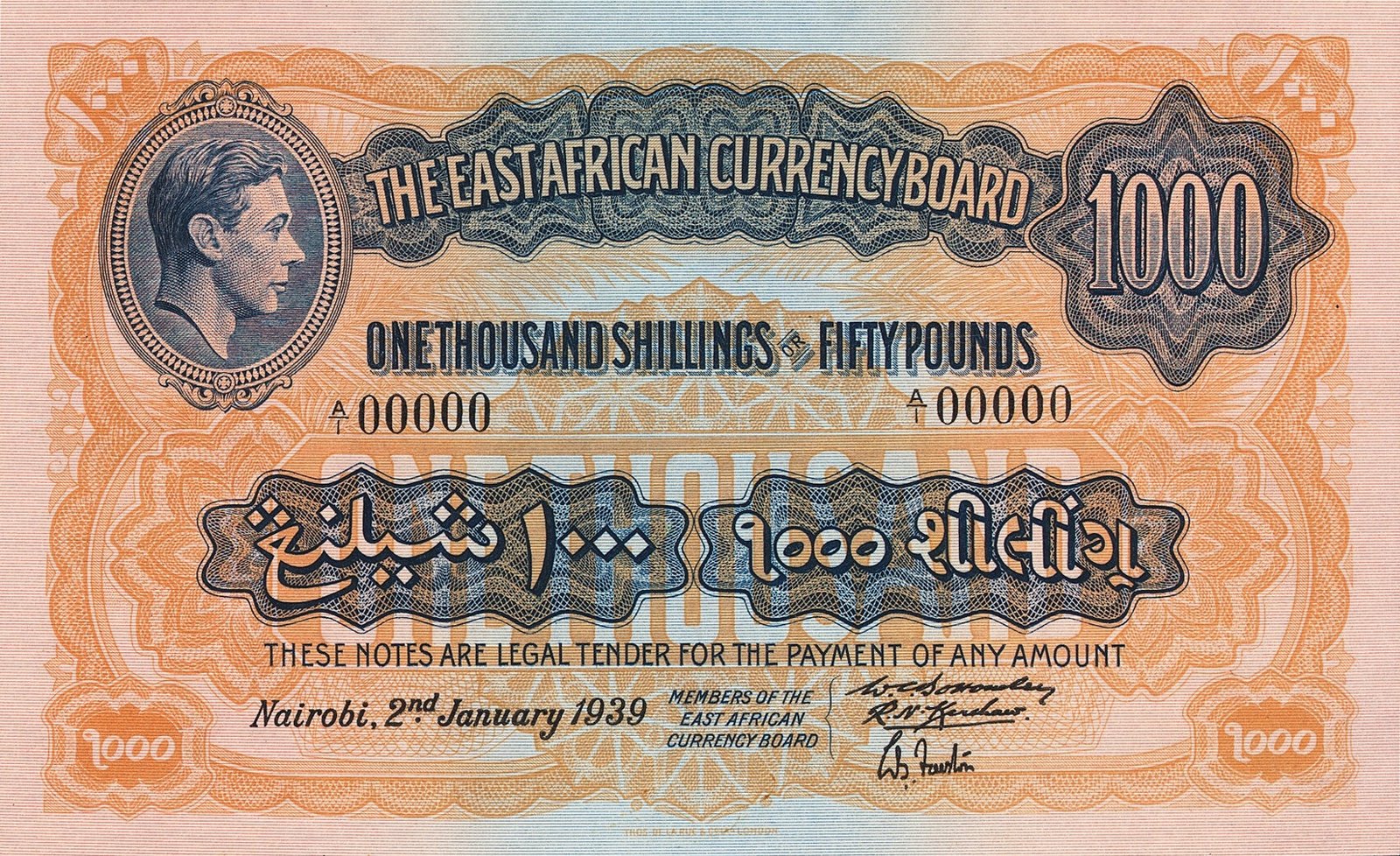
| 1,000 shillings = 50 pounds | P-18 | P-25 | P-31B, 2nd January 1939, specimens only |
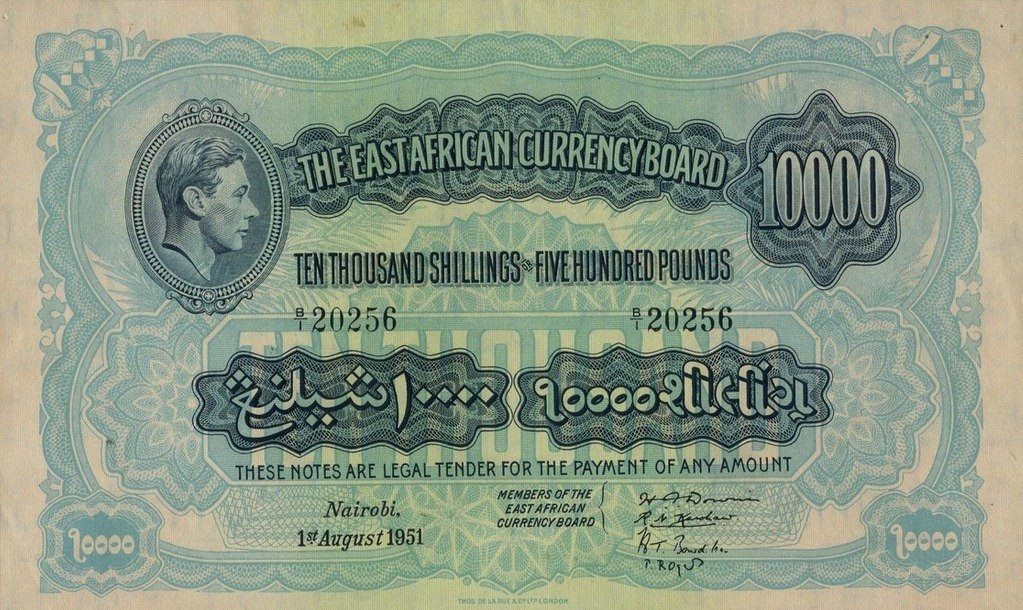
| 10,000 shillings = 500 pounds | P-19 | P-26 | P-32, four dates from 1939 to 1951 |
Dr. David Lott, writing in Bank Note Reporter in March 1985, says that in 1923 it was proposed to print the 200 shillings in grey-blue, to tell it apart from the lilac 100 shillings, and that whether this was done is not clear. Lott also says, from the Board's reports, that the 10,000 shillings, though dated 1921, was first issued in 1926.
The 10,000 shillings of King George VI was printed with four dates: 2nd January 1939 with the prefix A/1, then 1st June 1939, 1st January 1947 and 1st August 1951, all three with the prefix B/1. Issued notes are recorded in the catalogue only for 1st August 1951; the 1939 and 1947 dates are known from specimens. Every 1,000 shillings of 2nd January 1939 recorded is an A/1 00000 specimen, either with a horizontal CANCELLED perforation or with no overprint and no perforation.
The 200 shillings: few left by the 1930s
Sources mention that 20,500 notes of 200 shillings were shipped to Mombasa, of which 19,260 were issued, and that 13 issued notes were still unredeemed when the Board closed in 1972.
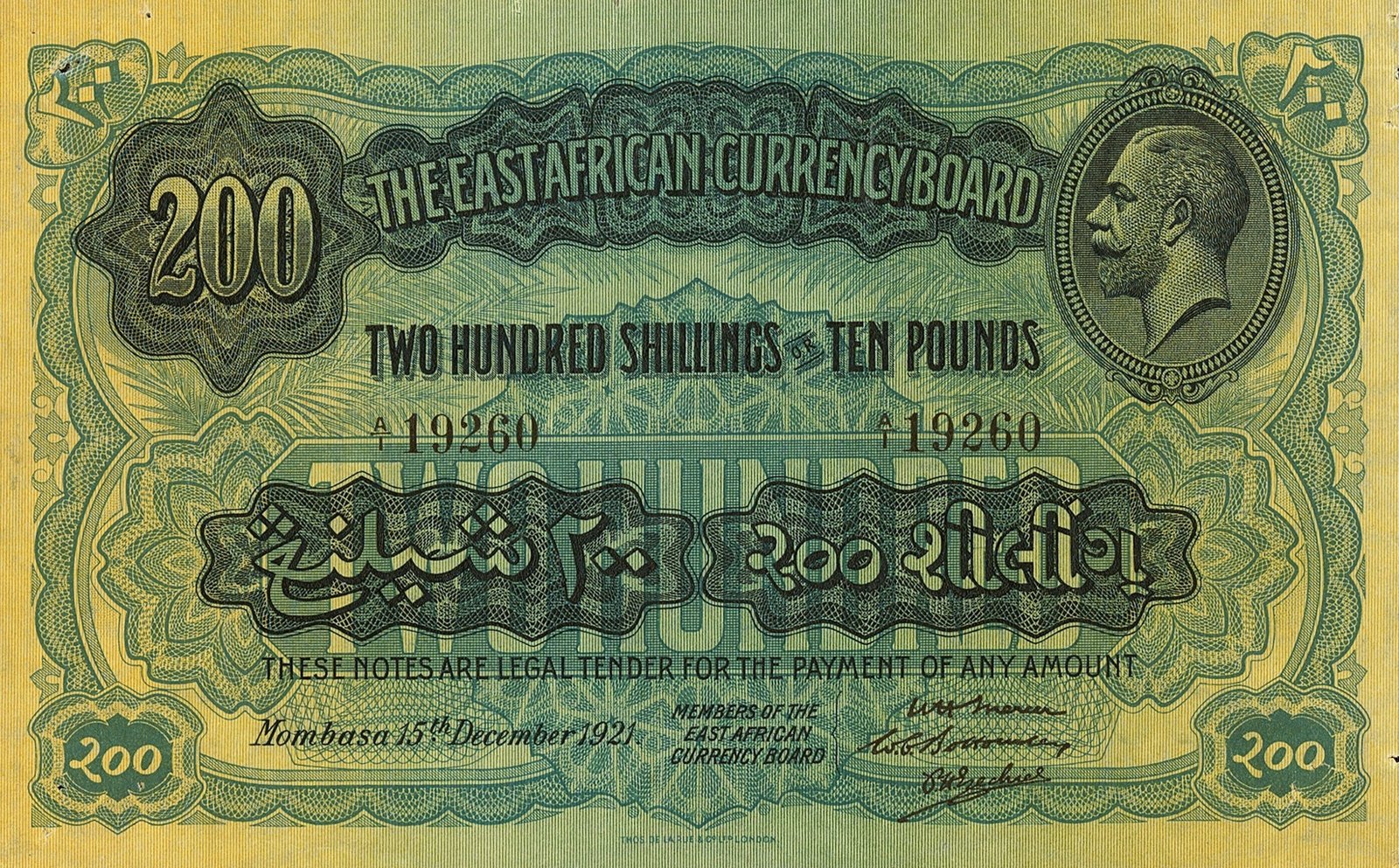
Few were left even in the 1930s. The Kenya Blue Books, which give the Board's notes in circulation by value, and later the annual reports on Kenya, which count the notes of 1921 and 1933 together, give these figures:
| Date | 200 shillings in circulation | Notes |
|---|---|---|
| 30th June 1933 | £1,930 | 193 |
| 30th June 1935 | £1,150 | 115 |
| end of 1946 | £180 | 18 |
| from 1950 | £150 | 15 |
| 1956 to 1962 | £140 | 14 |
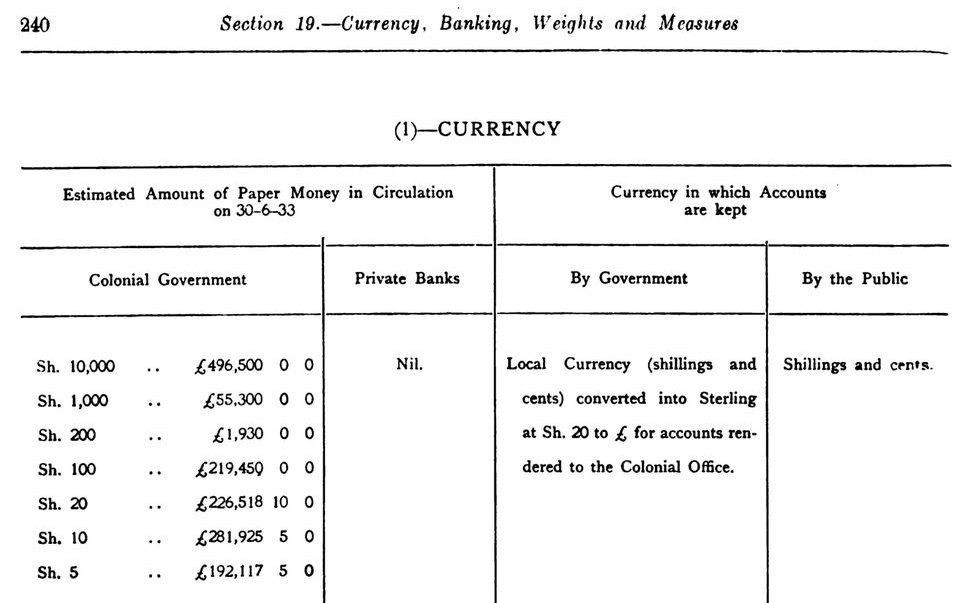
The annual report on Uganda for 1938 says that notes of 200 shillings were no longer kept for issue. From 1954 the Uganda reports add that none had been printed for many years and that those coming back to the Board were not reissued. The annual report on Kenya for 1961 says the 200 shillings was no longer issued and that notes received from the banks were destroyed.
The 14 notes of the Kenya reports for 1956 to 1962 and the 13 notes said to be unredeemed in 1972 are one apart, and the two figures come from different sources.
Heritage's description of lot 28367 in its sale of 5 September 2019, an issued 200 shillings of 1921, says that by the 1960s the Board was trying to have the remaining notes exchanged for newer issues.
The 1,000 and 10,000 shillings: notes for the banks
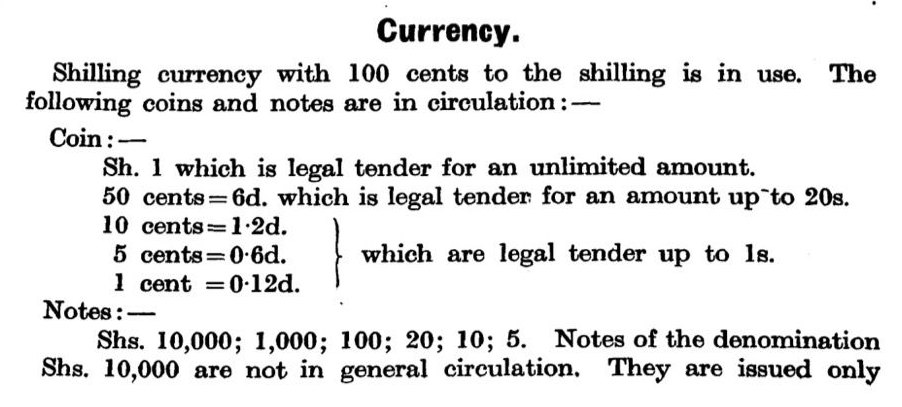
The 1,000 and 10,000 shillings were used mainly for transfers between banks. An Economic Survey of the Colonial Empire for 1937 and the annual report on Uganda for 1938 say that the 10,000 shillings notes were issued only to the banks, for local clearing, and were not in general circulation. The report on Uganda for 1951 says that the 1,000 and 10,000 shillings were used only between the banks and the Currency Board.
The counts that the sources give:
| Date | 10,000 shillings | 1,000 shillings | Source |
|---|---|---|---|
| June 1944 | 3,562 notes | not given | Lott, from the Board's reports |
| end of 1946 | £3,848,500 (7,697 notes) | £80,550 (1,611 notes) | annual report on Kenya |
| end of 1962 | £2,079,500 (4,159 notes) | £26,600 (532 notes) | annual report on Kenya |
Two auction descriptions say that some of these notes did pass outside the banks. Heritage (18 September 2020, lot 28219), on a 1,000 shillings of 1921, says that the evidence suggests some examples circulated. Heritage (18 September 2020, lot 28220), on a 10,000 shillings of 1921, says some notes were in private hands and were used for buying land. Neither names a source, and the reports quoted above say the opposite of the 10,000 shillings.
The withdrawal, 1964 and 1965
The Board's report for 1964 said that these high notes no longer served a purpose now that the banks held clearing accounts with the Board, that they were being withdrawn and that no more would be issued. By the end of 1965 every 10,000 shillings had been recovered, while the 1,000 shillings still in circulation were slow to come in.
Sources mention that all but 222 of the 1,000 shillings of 1921 and 1933 were redeemed. Heritage's description of lot 28368 in its sale of 5 September 2019 names where it read the figure: Linzmayer's The Banknote Book: East Africa, which according to Heritage says that all but 222 had been redeemed by 1965.
What survives, as each source puts it
The Board reported every 10,000 shillings recovered, and yet issued notes exist.
- 10,000 shillings of 1921. Heritage (18 September 2020, lot 28220) says the Board commented in 1964 that all were accounted for and redeemed but that a few were in private hands. The catalogue's page for the note holds issued notes of 15th December 1921, all with the prefix A/1.
- 10,000 shillings of King George VI. Stack's Bowers (2 October 2024, lot 20195) and Heritage (30 April 2021, lot 28269) both say that only a handful of issued notes, or fewer, are known, although the Board reported every note recovered. The issued notes recorded in the catalogue, B/1 20228 and B/1 20256, are both dated 1st August 1951.
- 1,000 shillings of 1921. Heritage sold the notes numbered 33 (5 September 2019, lot 28368) and 24 (18 September 2020, lot 28219), both with the prefix A/1.
- 1,000 shillings of 1939. Heritage (30 April 2021, lot 28265) says its specimen has signatures and a date and no overprinted cancellation, with a small handwritten date in the lower right margin of the back. No issued note of this date has been recorded.
- 200 shillings of 1921. The issued notes on the catalogue's page are numbered between A/1 19253 and A/1 19260, at the very end of the 19,260 said to have been issued.
Not settled
- Whether the 200 shillings was ever printed in grey-blue, as proposed in 1923.
- Whether any 1,000 shillings dated 2nd January 1939 was issued.
- How issued 10,000 shillings notes survive when the Board reported all of them recovered.
- The 222 notes of 1,000 shillings said to be unredeemed: no report of the Board is quoted for the figure on the pages.
Sources
- Kenya Blue Books, figures for 30th June 1933 and 30th June 1935.
- Annual reports on Kenya, 1946 to 1962.
- Annual reports on Uganda for 1938 and 1951, and from 1954.
- An Economic Survey of the Colonial Empire for 1937.
- East African Currency Board, report for 1964.
- Dr. David Lott, Bank Note Reporter, March 1985.
- Heritage Auctions, 5 September 2019, lots 28367 and 28368; 18 September 2020, lots 28219 and 28220; 30 April 2021, lots 28265 and 28269.
- Stack's Bowers, 2 October 2024, lot 20195.
Member comments
Log in or register to post a comment.