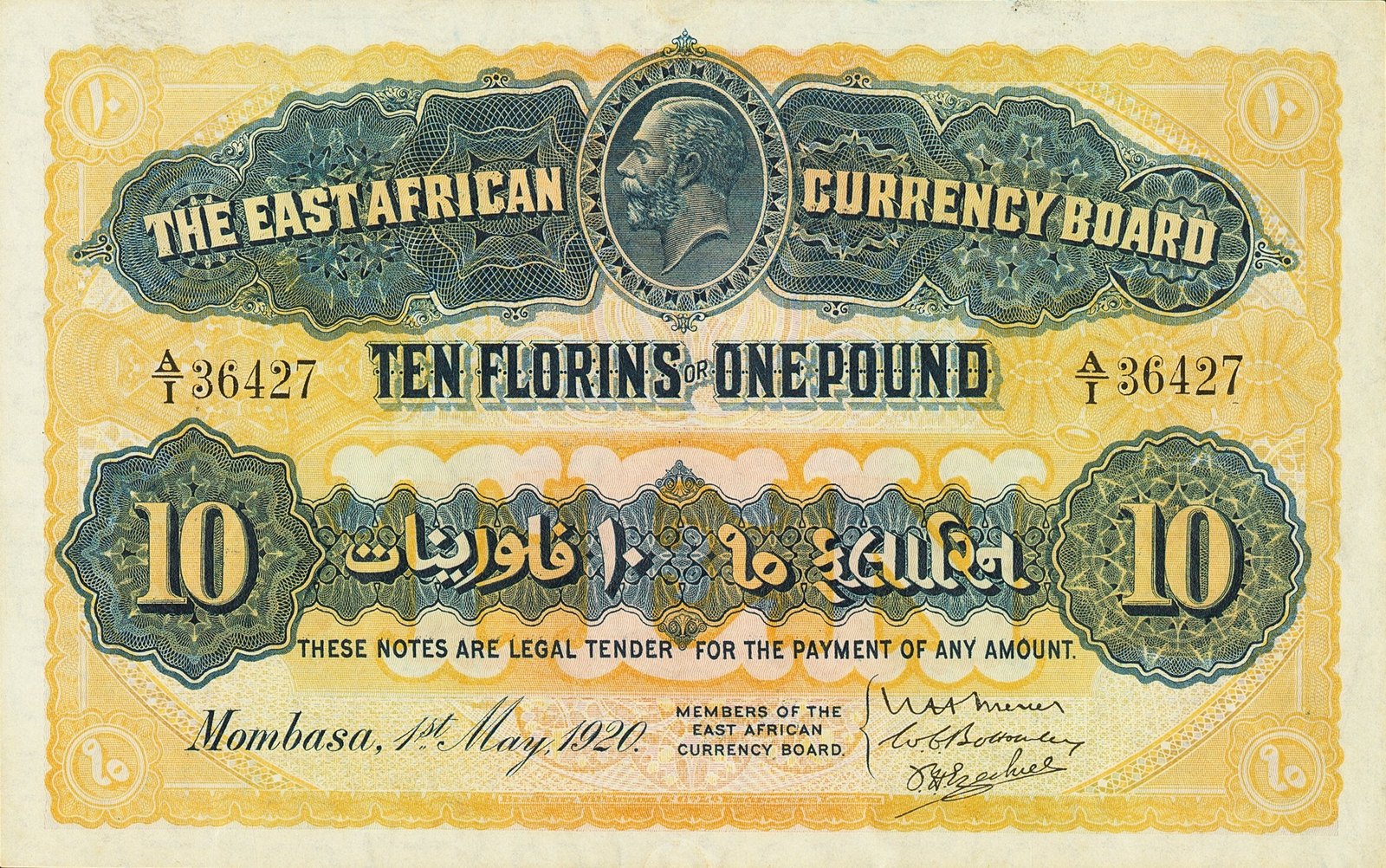
Much of what is repeated about the notes of East Africa goes back to a handful of articles in two collectors' journals. This article goes through them: four pieces in Bank Note Reporter between 1984 and 2006 and the articles of the IBNS Journal from 1975 to 2026 that touch East Africa. Each statement is set beside what the official papers say, where one was found: the Official Gazette, the East African Currency Board's report to 30th June 1921, the Blue Books and the annual reports. Nothing here decides a point the catalogue has left open.
The writers
- Fred Schwan, "War issue of East Africa added", Bank Note Reporter, May 1984, p. 28: the 1 shilling note of 1943 and the notes dated 1st August 1942, in a series on military and emergency issues.
- Dr. David Lott, "East African paper money has tangled history", Bank Note Reporter, March 1985, pp. 26 and 27. The paper says that Lott worked in East Africa for several years in the 1960s. The article runs from 1905 to 1972 and draws on the Board's annual reports, which Lott calls "tantalizingly brief and devoid of numismatic details".
- Neil Shafer, "Note of the Month", Bank Note Reporter, January 1990, p. 36, and a piece on pairs of notes in the issue of November 2006.
- The IBNS Journal: volume 14, number 2 (1975) on the 1 shilling note; 17:2 on the notes of 1953 to 1957; 38:1 (1999); 44:2 on the Queen's portraits; 45:1 (2006), an article by Symes on the shilling in Somalia; 48:3 on the 200 shillings; 49:4 (2010) on the Indian 1 rupee of 1917; 52:4 (2013) on the shilling in Ethiopia; 55:3 on the scripts of the notes; 56:4 (2017) on the Southern Nigeria essays of 1909; and 65:1 (2026) on the 1 shilling note, from the Board's own papers.
Lott's figures and the official papers
| What Lott wrote in 1985 | What the official papers say |
|---|---|
| The Order of 1905 authorised "rupee notes of five, 10, 50 and any multiple of 50", and the Protectorate "quickly decided" to add 100 and 500 rupees | The Order in Council of 10th February 1905 names 5, 10, 20, 50 rupees and multiples of 50. Lott's list lacks the 20 rupees, and 100 and 500 rupees are multiples of 50 |
| In 1908 the notes in circulation were 1,761,500 rupees: 45,440 of 5 rupees, 10,949 of 20, 4,371 of 50, 3,887 of 100 and 569 of 500 | The Commissioners' statement for 31st March 1908 (Official Gazette, 1st July 1908) has the same five counts and the same total, and one more line: 42,357 notes of 10 rupees |
| The Board was created in 1919, sat in London, and moved to Nairobi in 1960 | The Palestine Bulletin of 1st September 1926 says Ezechiel had been a member since 1919. The annual report on Kenya for 1960 is the first to say the headquarters are in Nairobi |
| Only 1 rupee notes were printed for the rupee currency, 2,400,000 of them | The Board's report to 30th June 1921, paragraph 2: "The rupee notes which had been printed (2,400,000) were sent out to East Africa, but no more were printed" |
| Florin notes issued in 1920 and 1921: 13,600,000 of 1 florin, 2,000,000 of 5 florins, 1,000,000, and 20,000; 10,000 each of 100 and 500 florins "in the hands of the board" | The same report, paragraph 4, gives the notes shipped: 1 florin 13,600,000; 5 florins 2,000,000; 10 florins 1,000,000; 20 florins 100,000; 50 florins 20,000; and 10,000 each of 100 and 500 florins still with the Board in England |
| The 10,000 shillings, though dated 1921, was issued in 1926 | No official paper read confirms the year. The report to the League of Nations on Tanganyika for 1922 lists notes of 5, 10, 20, 100, 200 and 1,000 shillings in use, with no 10,000 shillings; the annual report on Uganda for 1928 lists the 10,000 shillings |
| In June 1944 there were 3,562 notes of 10,000 shillings in circulation, and all notes came to 364,936,132 shillings | The Board's statement for 30th June 1944 (General Notice No. 459 of 1945) gives £18,246,806 12s. of notes, in pounds where Lott has shillings. The count of 10,000 shillings notes is not in the Gazette |
| "Over six million" notes of 1 shilling were issued; withdrawn in 1946; "about 10,000 pounds worth" still out; no sign of two printings | The Board's report for the year to 30th June 1943 records 4,094,000 printed. The annual reports on Kenya give £135,577 in circulation at the end of 1946 and £10,300 at the end of 1962 |
| From 1943 to 1960 the notes have four signatures; six members in 1960; seven in 1961, who all signed | The 1 shilling of 1st January 1943 has four signatures, the undated notes of 1958 to 1960 four and those of 1961 seven. The Bank of England Quarterly Bulletin of 1962 gives seven members from August 1960 |
Three things come out of the table. Where the Gazette or the Board's report can be set beside Lott's figures, they agree, the 10 florins apart. The 1908 figures are those of 31st March 1908, and the Gazette adds the 10 rupees that Lott's list lacks; the pages of the 5 rupees of 1905 and the other values quote the counts from Lott. And one line of the florin table raises a question of its own.
The 10 florins: the report and the specimen do not fit
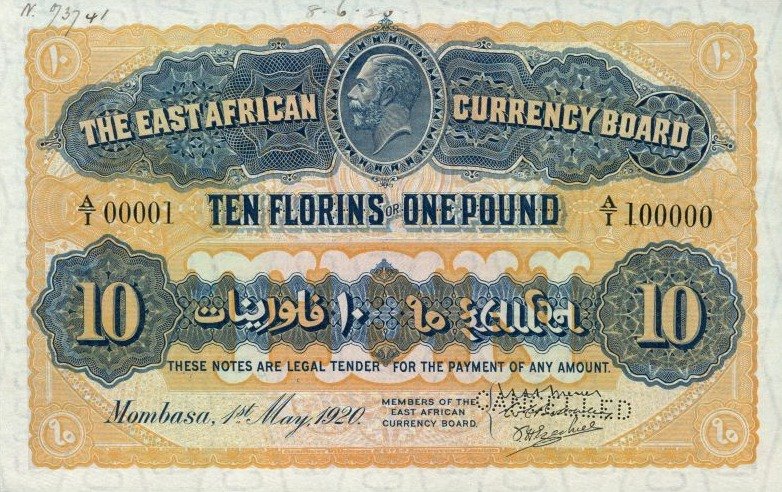
The Board's report gives 1,000,000 notes of 10 florins shipped, and Lott's table, which is broken in the scan, has the same figure in the third place. The specimen of the note prints the range of the issue as A/1 00001 to A/1 100000. For the other florin values the catalogue's pages set the report beside the specimen and find no difference: the page of the 5 florins says that all 2,000,000 notes of its range, A/1 00001 to B/10 100000, had been shipped by 30th June 1921, the page of the 20 florins all 100,000 notes of its range and the page of the 50 florins all 20,000. The page of the 10 florins gives the printed range and leaves the shipping figure off. No source explains the difference. An issued 10 florins with a prefix other than A/1 would bear on it; Heritage (24 April 2020, lot 26088) says only notes with the A/1 prefix are known.
Points Lott left open
- Two printings, with and without the printer's name. Lott had heard that most dates exist both with and without the De La Rue imprint and asked for more information. The catalogue finds this for one date only: the notes of 1st June 1939 exist with the imprint, and without it in a printing by Bradbury Wilkinson. See East Africa's wartime notes, 1939 to 1946.
- The 200 shillings in grey-blue. Lott found a proposal of 1923 to print the 200 shillings in grey-blue and could not say whether it was done. Nothing found since answers this.
- The framed proofs. Lott saw a set of uniface proofs of the notes of 15th December 1921, numbered 000 000, framed in the library of the Foreign Office in London. No other source mentions them.
- The first date of Queen Elizabeth II. The text of the article as scanned gives the first date as "March 3, 1953". The notes read 31st March 1953. A figure may have been lost in the printing or in the scan.
- Aden. Lott says Aden changed from the Indian rupee to the Board's shillings in 1949. The IBNS Journal, 38:1 (1999), p. 13, says the Board's shilling replaced the rupee in Southern Arabia in 1951. The annual reports on Kenya first count Aden in the Board's area in the report for 1953; the report for 1952 was not read.
Schwan and the wartime notes, 1984
Schwan gave the 1 shilling note two printings, on the authority of Gastone Sollner in Muenzen Review: 4,094,000 notes in 1942 and 12,739,400 completed in February 1944, 16,833,400 in all. Lott, a year later, "could find no suggestion of two separate issues". The first figure is the Board's own. The article in the IBNS Journal 65:1 (2026), pp. 49 and 50, gives a different account from the Board's papers: an order of twenty million notes, of which 4,094,000 went to the War Office and the balance, from A/41 94001, to the Board, with a run that went on to C/13 50000. The three reckonings are set out in the article on the wartime notes, and the page of the 1 shilling leaves them unreconciled.
Schwan also recorded that early editions of the Standard Catalog of World Paper Money had listed the 1 shilling with two dates, 1st August 1942 and 1st January 1943, and that the first was dropped from the fourth edition. The IBNS Journal 14:2 (1975), p. 84, had the same kind of report: every note the authors had seen was dated 1st January 1943, yet two IBNS auction catalogues each offered one dated 1st January 1947. The catalogue knows the one date only.
On the notes of 1st August 1942 Schwan was the first of these writers to say why they differ: the serial numbers are not those of De La Rue in London. Schwan called them the numbers "of the Federal Reserve Bank of India", used also on the Burma notes. The catalogue's pages, from the 5 shillings to the 100 shillings, give India Security Press as the printer. Schwan added that the 10 and 20 shillings of this date had only just been listed in the Standard Catalog.
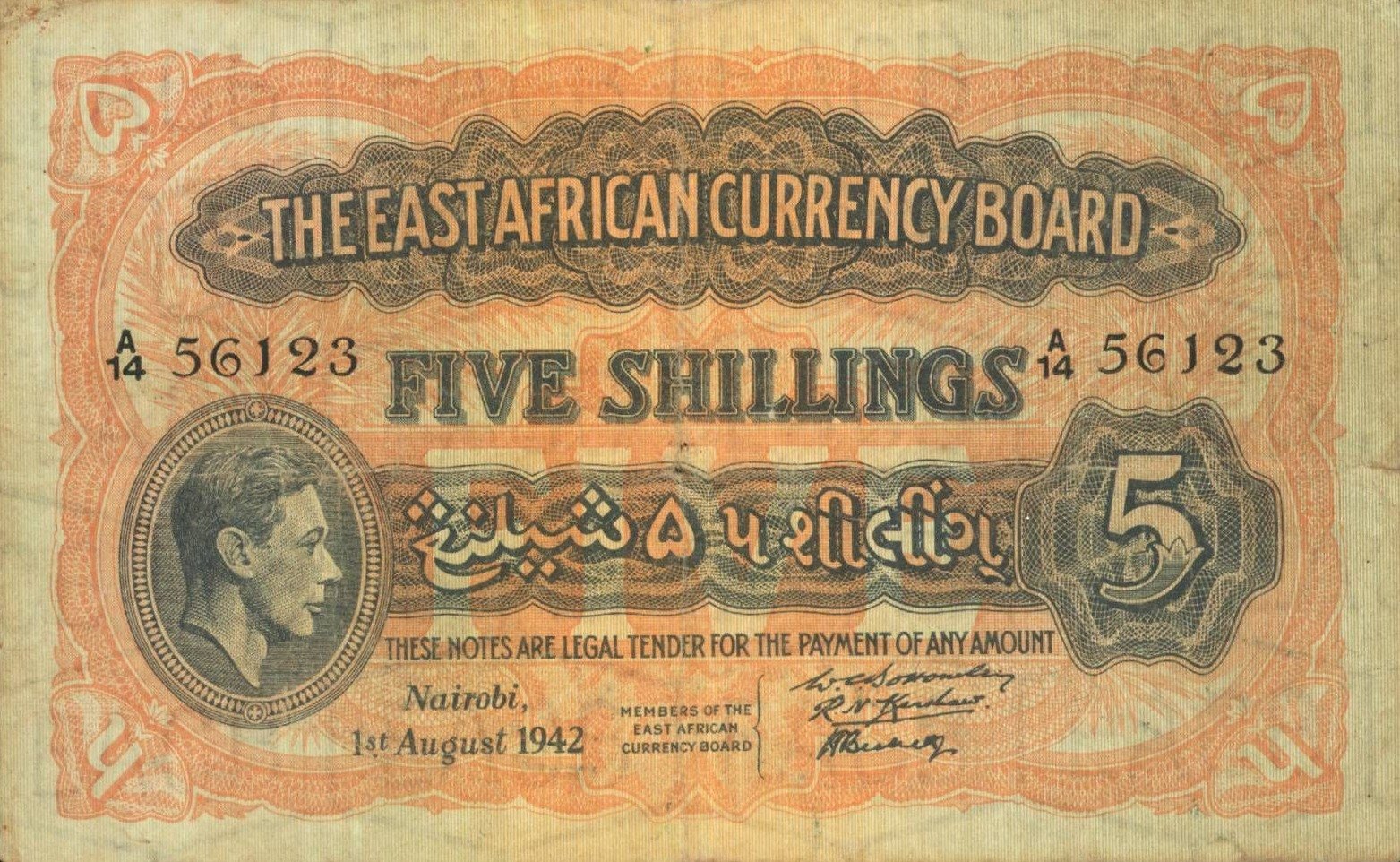
The catalogue and the official papers have two of Schwan's statements differently. The first is that earlier De La Rue printings also lack the imprint, making two varieties of the De La Rue notes. In the catalogue the notes without an imprint dated 1st June 1939 are given to Bradbury Wilkinson. The second is that the 10,000 shillings "was introduced on 1st January 1947" and that so high a value "was not used before or since". The Kenya Blue Book for 1933 counts £496,500 of 10,000 shillings notes in circulation on 30th June 1933, and An Economic Survey of the Colonial Empire for 1937 describes them as notes for the banks.
Shafer, 1990 and 2006
In January 1990 Shafer showed a 1,000 shillings of 1921, issued and cancelled, from the Wedbrooke collection, with a picture supplied by William B. Christensen, and called it "undoubtedly unique in collectors' hands at this point". The catalogue matches the note pictured, by its number and its punch holes, with the note Spink sold on 9th November 1989 from the Amon Carter collection. It was not the only one to come out: Heritage sold two other notes of 1,000 shillings of 1921, on 5 September 2019 (lot 28368) and 18 September 2020 (lot 28219).
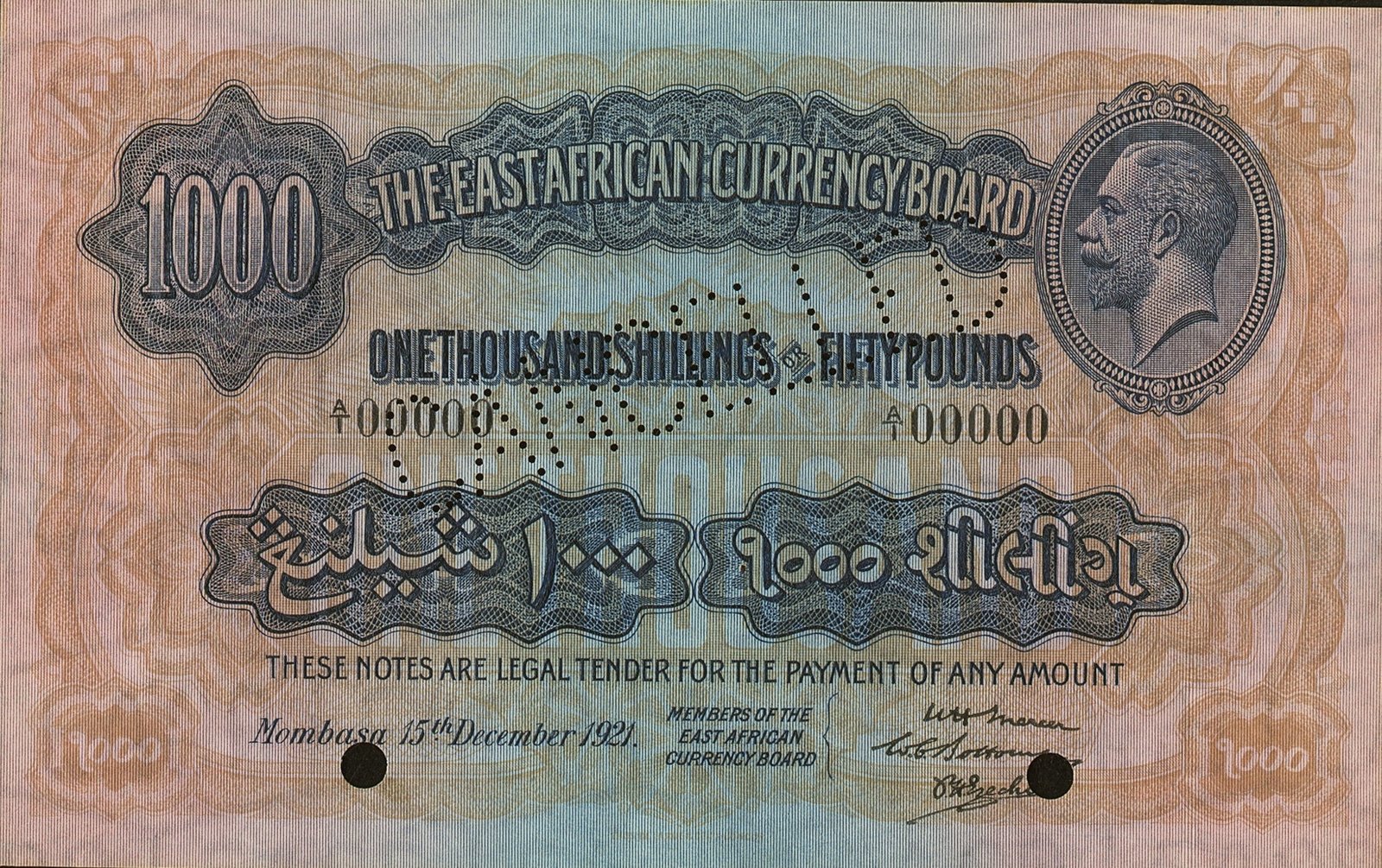
Shafer wrote that the issues of 1921, 1933 and 1947 went as high as 10,000 shillings and that the first two also had a 1,000 shillings. The catalogue adds a 10,000 shillings dated 1939 and 1951 and a 1,000 shillings of 2nd January 1939 known from specimens.
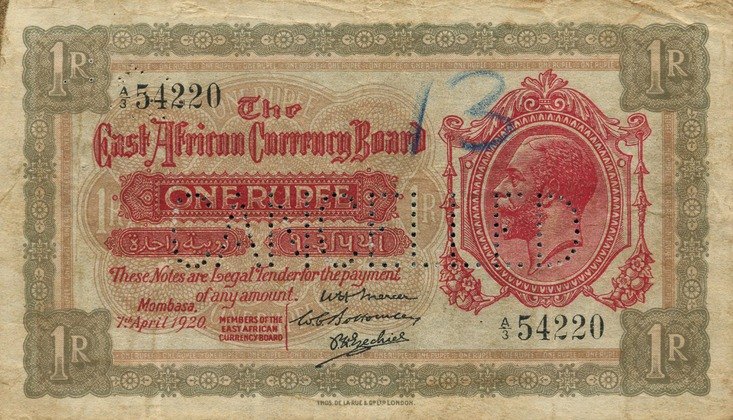
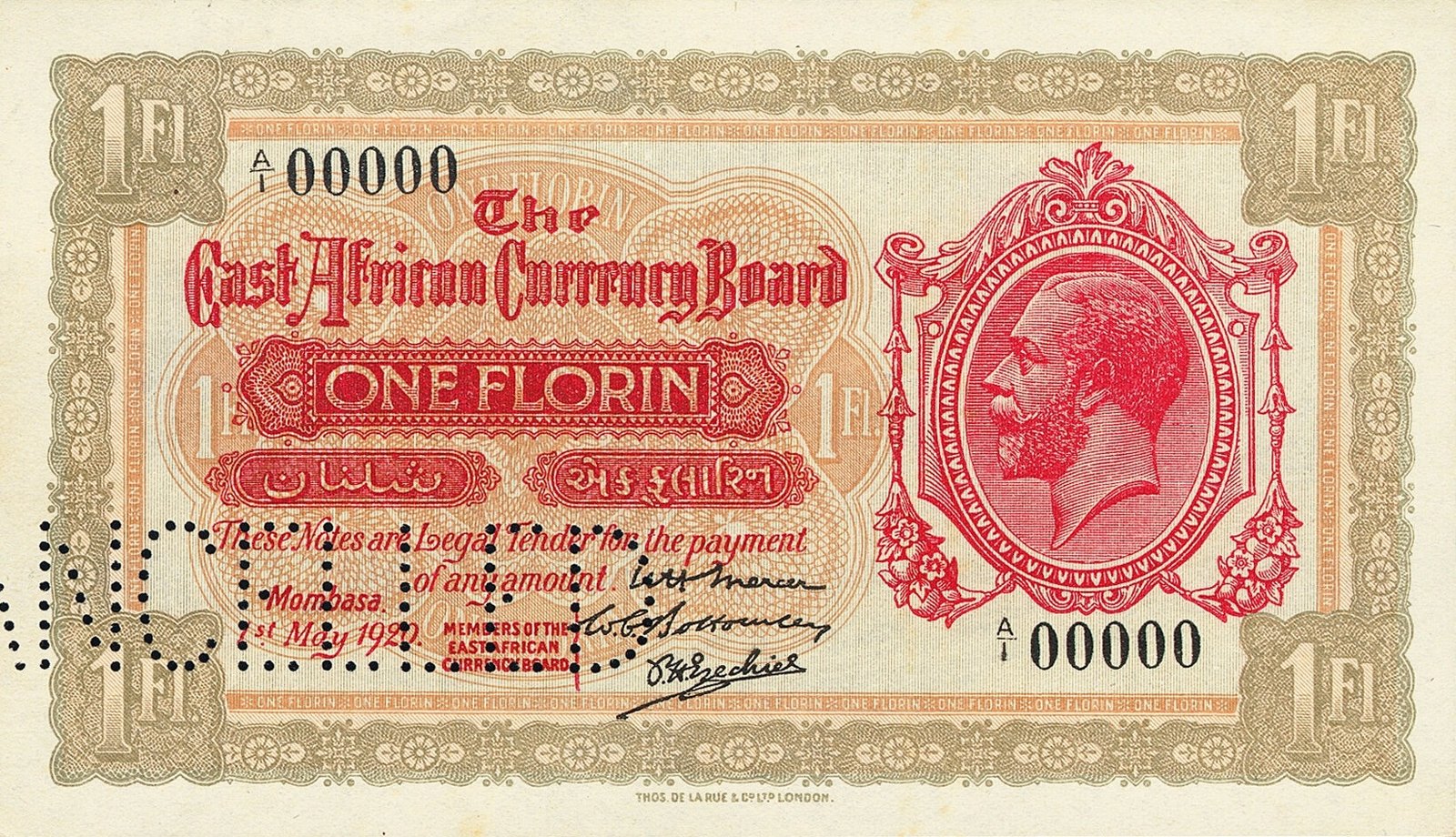
In November 2006 Shafer used the 1 rupee and the 1 florin as a pair: two notes of one design, dated less than a month apart, in two currencies. The caption says "the rupee note was issued on April 7, the florin note on May 1". Those are the dates printed on the notes. The Gazette shows the 1 rupee made legal tender by Proclamation No. 52 of 11th May 1920, and the florin Order in force only on 21st July 1920; no notice gives the day either note was first paid out.
The IBNS Journal, article by article
| Issue | What it says of East Africa | How it stands |
|---|---|---|
| 14:2 (1975), pp. 83 and 84 | the 1 shilling: 12.1 by 5.9 cm, purple, a lion before mountains; put into circulation on 15th February 1944; issue ended from 1st April 1946; 6,042,427 in circulation on 30th June 1944, 6,686,977 on 30th June 1945, 3,508,126 on 30th June 1946; 205,320 notes not recovered on 30th June 1966 | the annual report on Zanzibar for 1946 gives the same 1st April 1946; the annual reports on Kenya give £10,300 still out at the end of 1962 |
| 17:2, p. 63 | each of the 5, 10, 20 and 100 shillings bears each year from 1953 to 1957 | not borne out: no 20 shillings or 100 shillings dated 1st October 1957 has been recorded |
| 44:2, p. 14 | the portrait of 1953 to 1957 follows a 1952 photograph by Dorothy Wilding, in an engraving used only on these notes; the later one a photograph of 1954 | on the note pages as "sources mention"; no official paper read speaks of the portraits |
| 45:1 (2006), Symes, pp. 10 and 13 | East African currency given official status in the Somaliland Protectorate by Ordinance No. 25 of 1937; exchanged for the somalo in the Trust Territory from 22nd May to 22nd July 1950, 17,454,641.24 shillings taken in; legal tender in Somalia ended on 31st July 1961 by Decree No. 113 of 15th June 1961 | the annual reports on Kenya count "Somalia" in the Board's area in 1960 and no longer at the end of 1961 |
| 48:3, p. 26 | the 200 shillings of 1921: 20,500 shipped to Mombasa, 19,260 issued, 13 unredeemed when the Board closed in 1972 | the annual reports on Kenya count £140, which is 14 notes, from 1956 to 1962 |
| 49:4 (2010), Razack, p. 33, and 48:4, Bohora, p. 47 | Government of India 1 rupee notes with the prefixes X, Y and Z were used in British East Africa | the Gazette shows Indian 1 rupee notes legal tender from 15th May 1918 and 1,000,000 rupees of them in the Board's reserve in December 1918; it names no prefix |
| 52:4 (2013), pp. 17 to 24 | from 1941 the 5, 10, 20 and 100 shillings served in Ethiopia and Somalia; legal tender in Ethiopia from 31st October 1942; replaced by the Ethiopian dollar from 23rd July 1945, when about 22 million shillings in notes and coin went back to Nairobi | the Board's statements show its notes falling from £21,067,230 on 30th June 1945 to £16,540,047 on 31st December 1947 |
| 55:3, p. 9 | the 1 florin gives its value in Arabic as 2 shillings; the third script is Gujarati | on the note page as "sources mention" |
| 56:4 (2017), pp. 44 and 47 | the hippopotamus on the back of the 1 rupee and 1 florin mirrors one engraved by De La Rue in 1909 for Southern Nigeria; the paper offered then was that of the Mombasa rupee notes of 1905 | not tested: the pictures at hand are too small to confirm the mirror image |
| 65:1 (2026), pp. 49 to 52 | the 1 shilling from the Board's papers: decided in January 1943; first 2 million delivered to the War Office on 1st March 1943; shown to the public from 3rd January 1944; 6,000 notes stolen in January 1944; in circulation to 1960, with a peak of 6,686,977 in 1945 and 206,620 in 1960 | the peak is the figure of 14:2; the thefts are told in Stolen, lost, burnt and eaten |
On the 1 shilling notes that never came back the three sources stand close together: 205,320 notes on 30th June 1966 in the article of 1975, 206,620 in 1960 in the article of 2026, and £10,300 at the end of 1962 in the annual report on Kenya, which the note's page puts at some 206,000 notes.
What the comparison shows
- Statements that the writers took from the Board's reports agree with the official papers that could be set beside them: the 1908 counts, the 2,400,000 notes of 1 rupee, the florin shipments other than the 10 florins, the total of June 1944.
- Statements about which notes exist are the ones the catalogue's records now go against: the 10,000 shillings "introduced" in 1947, the 1,000 shillings thought the only one in collectors' hands, a note of every value for 1957.
- The days of issue are still what the journals could not supply. Lott found the Board's reports bare of such details, and the Kenya Gazette announced one note in sixty years, the 5 shillings of 1960.
- Lott ended with a wish to spend a day or two with the Board's detailed records, which were then in Nairobi. The IBNS Journal article of 2026 on the 1 shilling note shows how much the Board's own papers can add.
Sources
- Fred Schwan, "War issue of East Africa added", Bank Note Reporter, May 1984, p. 28.
- Dr. David Lott, "East African paper money has tangled history", Bank Note Reporter, March 1985, pp. 26 and 27.
- Neil Shafer, "Note of the Month", Bank Note Reporter, January 1990, p. 36; Neil Shafer on pairs of notes, Bank Note Reporter, November 2006.
- IBNS Journal: 14:2 (1975), pp. 83 and 84; 17:2, p. 63; 38:1 (1999), p. 13; 44:2, p. 14; 45:1 (2006), pp. 10 and 13; 48:3, p. 26; 48:4, p. 47; 49:4 (2010), p. 33; 52:4 (2013), pp. 17 to 24; 55:3, p. 9; 56:4 (2017), pp. 44 and 47; 65:1 (2026), pp. 49 to 52.
- East Africa and Uganda Order in Council of 10th February 1905.
- East African Currency Board, report for the period ended 30th June 1921, paragraphs 2 and 4; report for the year ended 30th June 1943.
- Official Gazette of the East Africa Protectorate, 1st July 1908; Proclamations No. 52 and No. 80 of 1920; the Board's abstract of 10th December 1918; General Notice No. 459 of 1945 and the Board's later statements in the Kenya Gazette.
- Kenya Blue Book for 1933; An Economic Survey of the Colonial Empire for 1937.
- Annual reports on Kenya, 1946 to 1962; annual report on Uganda for 1928; annual report on Zanzibar for 1946; report to the League of Nations on Tanganyika for 1922.
- Bank of England Quarterly Bulletin, 1962; The Palestine Bulletin, 1st September 1926, p. 1.
- Heritage Auctions, 24 April 2020, lot 26088; 5 September 2019, lot 28368; 18 September 2020, lot 28219. Spink, 9th November 1989, the Amon Carter collection.
Member comments
Log in or register to post a comment.