This article gathers what the sources say of notes of East Africa that were stolen, lost or destroyed, and of the rules made because of them. The small cases come from the notices of the Currency Commissioners and Currency Officers in the Official Gazette of the Protectorate and of Kenya and in the Tanganyika Territory Gazette. The three large thefts come from two collectors' journals: Dr. David Lott's article in Bank Note Reporter of March 1985, written from the reports of the East African Currency Board, and two articles in the IBNS Journal. The numbers of all the half and damaged notes in the Gazette are listed in 5,263 East African banknote numbers in the Kenya Gazette, 1907 to 1953. Here the subject is what happened to the notes.
The first cases, 1907 to 1910
The first notes were issued on 2nd April 1906. The Gazette of the next four years has these notices of notes gone astray.
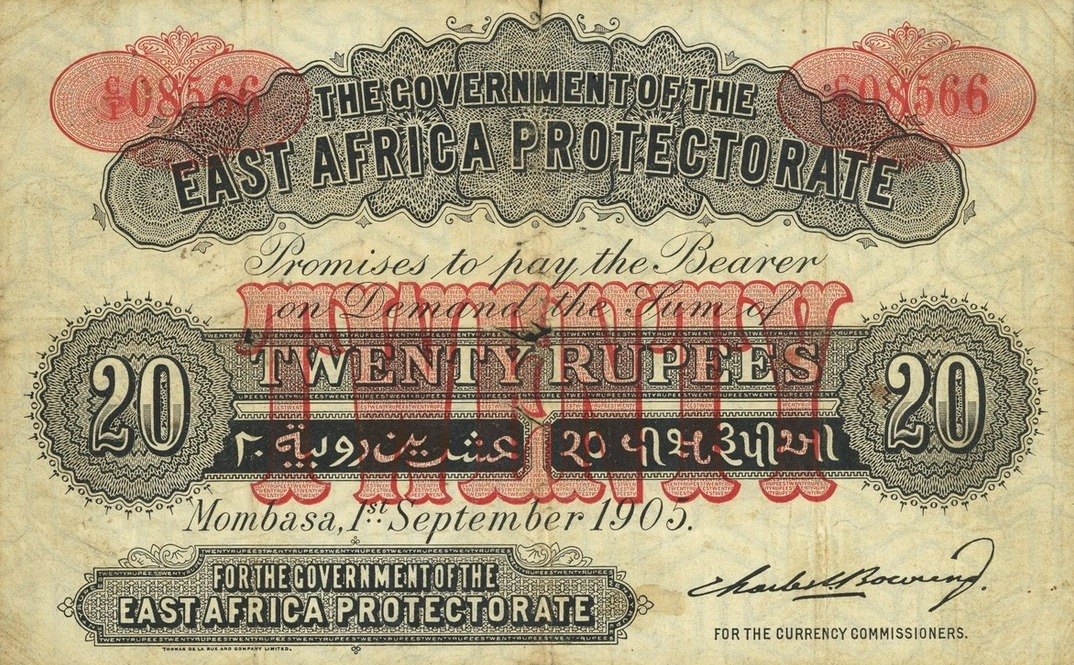
- A note found. A notice dated Naivasha, 6th August 1907, reports a 20 rupees note, A/1 08518, found near Naivasha (Official Gazette, 15th August 1907).
- Two notes cut in half. A notice of the Currency Commissioners in the Gazette of 1st November 1907 reports two notes, A/1 01204 and A/1 01128, halved by persons unknown, with one half of each presented. The notice was printed again on 1st May 1908. A later notice, of 15th March 1910, shows that both were 50 rupees notes.
- Half a note lost in the post. A notice dated Mombasa, 11th December 1907, reports half of note A/1 00094 lost in the post.
- A note nobody claimed. The police at Kisumu held an unclaimed note of 100 rupees from June 1909. The notice, in the Gazette of 15th March 1910, does not give its number.
The half-note rule of 1908 and the cutting rule of 1912
On 10th December 1908 the three Commissioners, C. C. Bowring, R. M. Combe and J. Gosling, signed the conditions on which a half note would be paid: the value less ten per cent, three months after a notice in the Gazette, and against a bond of indemnity. That rule is the reason the Gazette prints so many numbers. Each claim had to be advertised, with the number of the note, which half was presented and what had become of the other.
The claimants say what happened in a few words. In September 1910 Robin Kemp presented the left halves of four notes of 10 rupees, the other halves stolen. In May 1917 the Officer Commanding No. 1 A.T. Depot, Nairobi, presented the left halves of two 5 rupees notes, the other halves burnt (General Notice No. 420). Other halves were "lost", "mislaid" or "torn off". The banks at Mombasa appear again and again as claimants: the National Bank of India, the Standard Bank of South Africa and the National Bank of South Africa.
A rule of 22nd July 1912, made under the East Africa and Uganda (Currency) Order in Council, 1910, and in force from 31st August 1912, made it an offence to deface, tear or cut a currency note, with up to three months or a fine of 1,500 rupees. The Kenya law that followed, the Currency Notes Ordinance, 1920 (No. 24 of 1920), kept the offence in its section 8: wilful mutilation of a note, three months or £100.
Two 500 rupees notes stolen, 1912
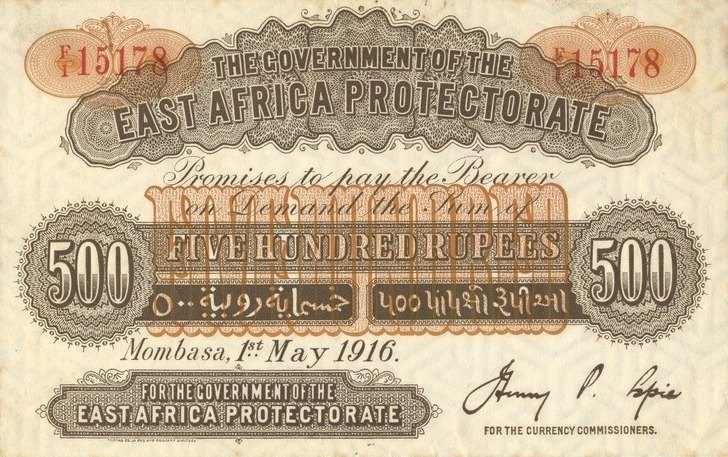
The Gazette of 1st December 1912, on its printed page 985, carries this notice of the Currency Board: "Notice is hereby given that Currency Notes Nos F/1 01031 and A 00018 for Rs 500/- each have been reported to have been stolen". The second number is printed with no figure under the A.
The 500 rupees was the highest note in use. The Commissioners' statements count 2,286 of them in circulation on 31st March 1912 and 2,873 a year later. The notice says nothing of where or from whom the two notes were taken, and no later notice reports them found. It is also one of the few places where a 500 rupees note is named by its number at all.
White ants, rats and a tea company, 1923 to 1935
After the change to the shilling the claims came through the Currency Officer.
- White ants. General Notice No. 4, dated Mombasa, 20th December 1923 and printed on 2nd January 1924, lists 47 half notes of 5 shillings: 32 left halves and 15 right halves, presented by Mr. P. F. Hatton through the Currency Officer at Dar es Salaam, who certified that the other halves had been "destroyed by white ants" while in the claimant's possession. The notes carry the prefixes A/3, A/4, A/5, A/6, A/8 and A/10.
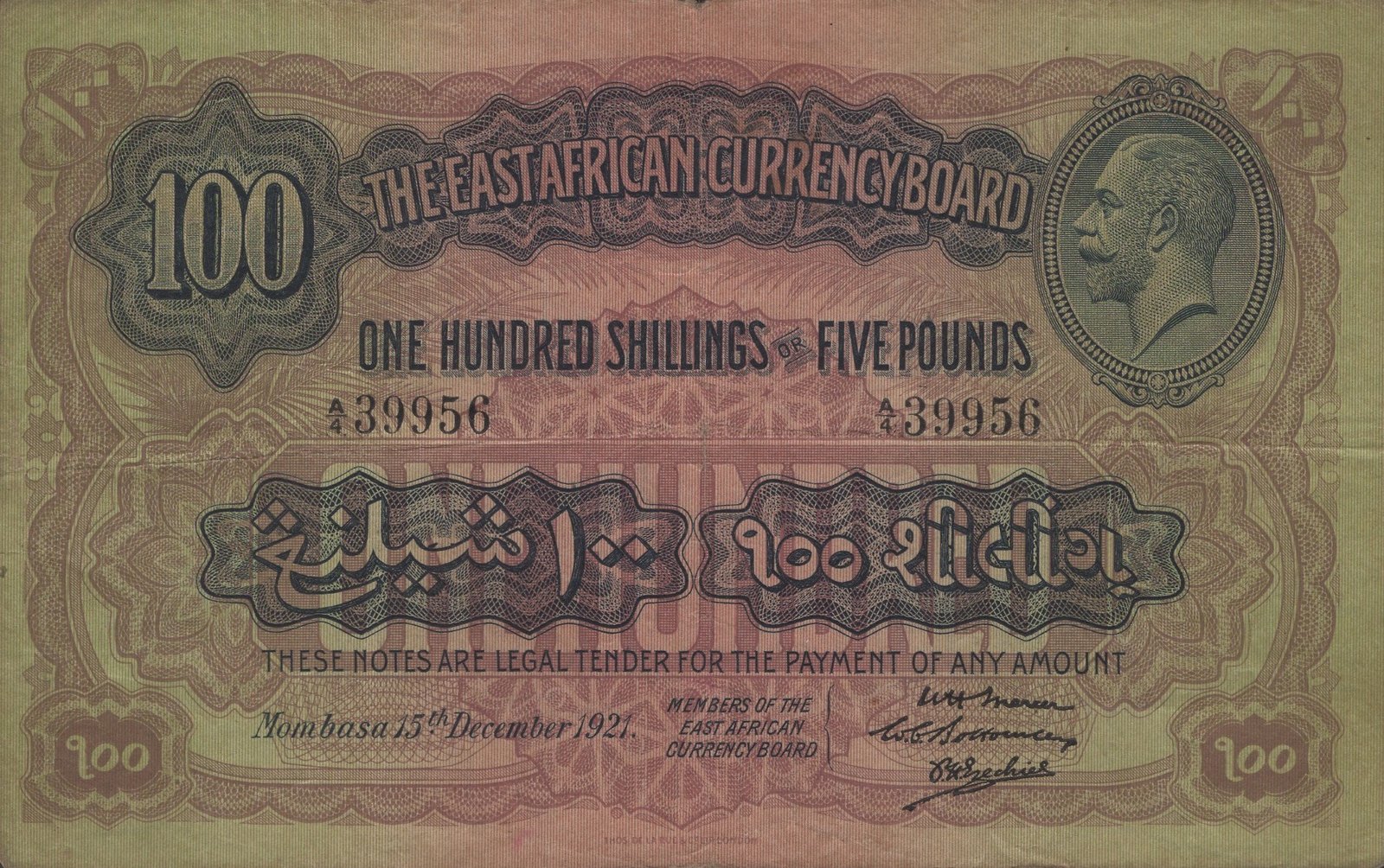
- A florin note, late. In March 1923, more than a year after the florin had ended, half of a 5 florins note was presented for payment (General Notice No. 256 of 1923). Three notes of 5 florins are named by number in the Gazette's notices in all.
- Three notes destroyed. A notice dated Nairobi, 6th June 1930, claims the value of three notes of 100 shillings with consecutive numbers, A/2 64701 to A/2 64703, destroyed. The claimant was Mr. William Alexander Lee, General Manager of the African Highlands Produce Co., Kericho (General Notice No. 870 in the Kenya Gazette, General Notice No. 624 in the Tanganyika Territory Gazette).
- Rats. A notice of 12th August 1931 in the Tanganyika Territory Gazette (General Notice No. 1011) claims on the right half of a 100 shillings note, the other half eaten by rats. The claimant was Dhulla Harischand of Nairobi.
- The last half-note notice found is of 15th October 1935.
From 1945 to 1953 the notices change. The Currency Officers at Nairobi, Dar es Salaam, Kampala and Zanzibar print long lists of mutilated notes whose value had been claimed, and they no longer say what had happened to each note.
The 1 shilling notes that never reached Dar es Salaam, 1944
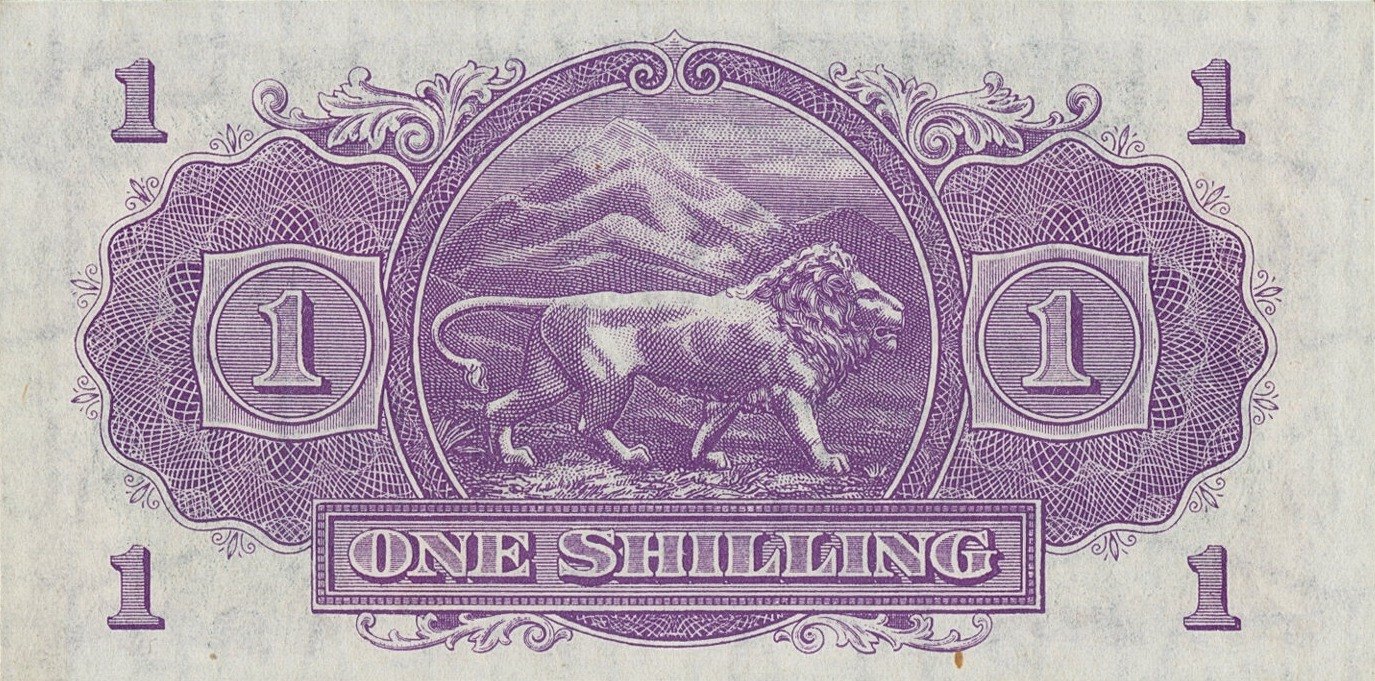
An article on the 1 shilling note of 1943 in the IBNS Journal, volume 65, number 1 (2026), written from the Board's papers, says on p. 51 that a case of the notes was found breached when it arrived on 8th January 1944, on the way to Dar es Salaam, a few weeks before the note was officially issued in East Africa on 15th February 1944. Six blocks of 1,000 notes each were confirmed stolen, 6,000 notes in all. The article cites a telegram of 8th January 1944 and gives the blocks as B/62 60001 to 61000, 65001 to 66000, 70001 to 71000, 85001 to 86000, 90001 to 91000 and 95001 to 96000.
The catalogue's page for the note says that the notes it records run from prefix A/1 to B/59. No source read says what became of the stolen notes.
Two thefts in the Board's reports, 1956 and 1959
Four cases of 20 shillings notes stolen from the printers, 1956
The theft from the printers is told by Dr. David Lott in Bank Note Reporter of March 1985. In July 1956, Lott says, four cases, each holding 25,000 notes of 20 shillings, were stolen from the security printers. The story is "only briefly touched on in official reports". Thirteen years later, in October 1969, after ten years of court cases in Italy, the Banca d'Italia in Milan handed over the remainder of the notes, which were officially counted, cancelled and destroyed by fire. There were 24,876 notes, the Board reported, not 24,878 as reported before.
Lott adds that the report seems to imply that the other 75,000 notes had been recovered earlier, and that this, like many of the Board's statements, is not entirely clear. Lott could find nothing on how the Banca d'Italia came into the matter.
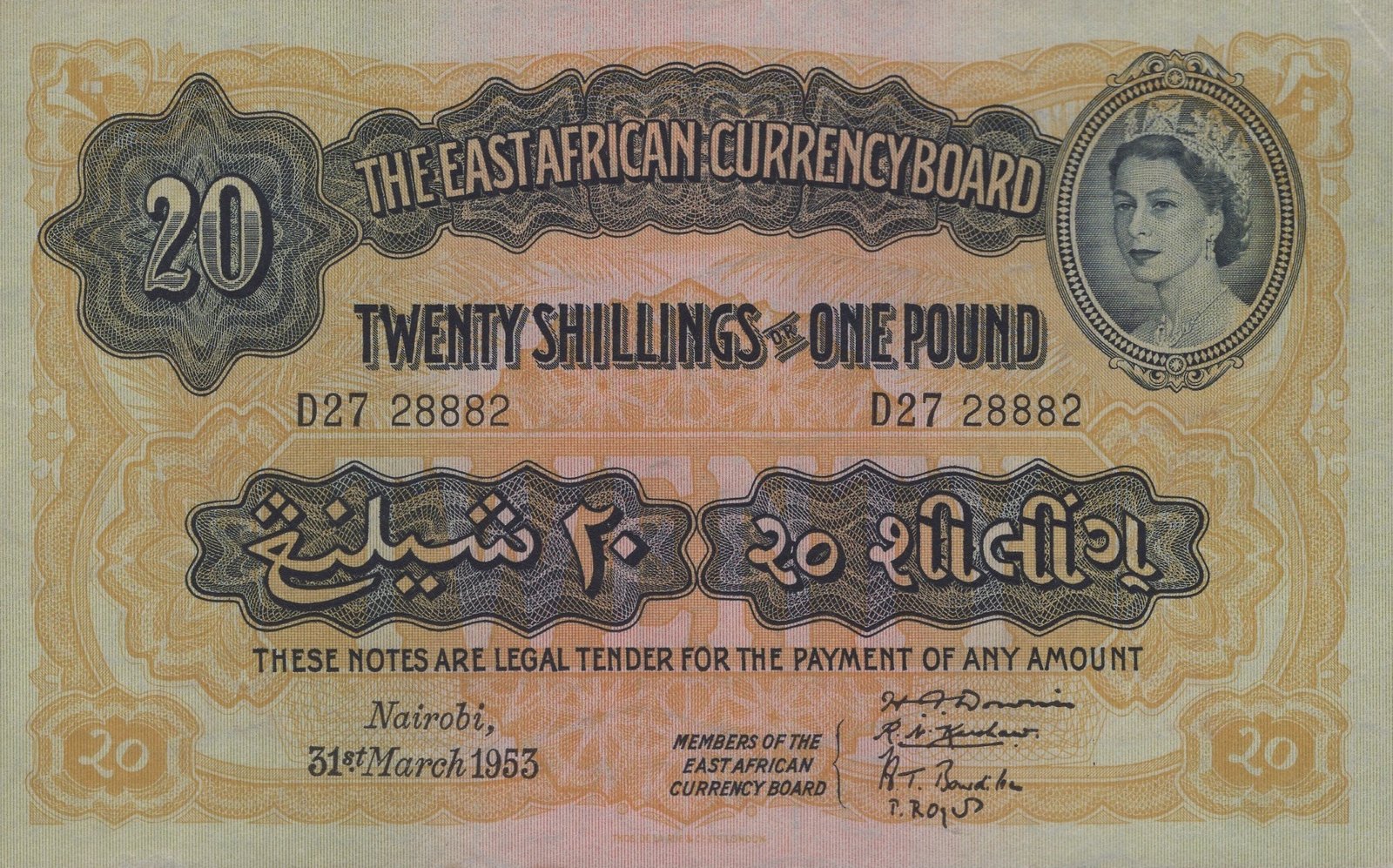
A second source touches the same theft. An article on the East African shilling in Ethiopia in the IBNS Journal, volume 52, number 4 (2013), quotes on p. 26 a letter from the British Embassy of January or February 1958. The letter says that some hundred thousand notes of 20 shillings had been stolen from De La Rue and had passed into circulation, some of them in Ethiopia. The letter is about the rivalry of printers, and it names no date, issue or prefix.
Both accounts speak of notes of 20 shillings: four cases of 25,000 notes in the one, some hundred thousand notes in the other. They differ on what became of the notes: recovered, as Lott reads the Board's report, or passed into circulation, as the letter has it. Neither says which notes they were. The catalogue tells Lott's account on the page of the 20 shillings of 1953 to 1956, and says there that the article does not give the date the stolen notes carried. No source gives a number of a stolen note.
The vault at Mwanza, 1959
Lott records one more theft from the Board's reports. In 1959 the sum of 103,155 East African pounds was stolen from a storage vault at Mwanza, Tanzania, as Lott writes. The police recovered 89,417 pounds fairly quickly. Whether the rest was recovered Lott did not know. The article does not say which notes were taken.
Forgery: a law, and no cases
The sources read for the catalogue hold laws against forgery and no forged East African note.
- The Penal Code of Kenya of 1930, section 331, made possessing a forged currency note a felony, with seven years (Official Gazette, 29th May 1930).
- A Bill of 6th October 1936 (Government Notice No. 613) was to make importing forged bank or currency notes an offence and to add a section against forgers' paper and moulds.
- No notice in the Kenya Gazette of 1906 to 1965 names a forgery of an East African note. The annual reports on Kenya from 1946 to 1962 have no passage on forged notes, and none was found in the Uganda or Tanganyika gazettes that were read.
Not settled
- Whether the two 500 rupees notes stolen in 1912 were ever recovered.
- What became of the 6,000 notes of 1 shilling stolen in January 1944.
- Which date and prefixes the notes of 20 shillings stolen in July 1956 carried, and how many of them passed into circulation. The Board's reports for 1956 to 1969, from which Lott worked, would be the place to look. Lott says that the Board's detailed records were by then in the hands of "the Bank of Kenya in Nairobi".
- Which notes were taken at Mwanza in 1959, and whether the part the police did not recover quickly was ever found.
Sources
- Official Gazette of the East Africa and Uganda Protectorates and of the East Africa Protectorate: notices of 15th August 1907, 1st November 1907, 15th December 1907, 15th December 1908, 15th March 1910, 15th September 1910, 1st August 1912 and 1st December 1912; General Notice No. 420 of 1917; the Commissioners' statements of 31st March 1912 and 1913.
- Official Gazette of the Colony and Protectorate of Kenya and the Kenya Gazette: General Notice No. 256 of 1923; General Notice No. 4 of 1924; General Notice No. 536 of 1925; the Penal Code, 29th May 1930; General Notice No. 870 of 1930; General Notice No. 1339 of 1935; Government Notice No. 613 of 1936; notices of mutilated notes, 1945 to 1953.
- Tanganyika Territory Gazette: General Notice No. 624 of 1930 and General Notice No. 1011 of 1931.
- Annual reports on Kenya, 1946 to 1962.
- Dr. David Lott, "East African paper money has tangled history", Bank Note Reporter, March 1985, pp. 26 and 27.
- IBNS Journal, volume 65, number 1 (2026), pp. 49 to 52, on the 1 shilling note.
- IBNS Journal, volume 52, number 4 (2013), pp. 17 to 26, on the East African shilling in Ethiopia.
Member comments
Log in or register to post a comment.