This article lists, in order of time, each law and official notice found for the paper money of East Africa: Orders in Council, Proclamations, Ordinances, the Board's Regulations and the notices of the Currency Commissioners and Currency Officers. It is drawn from the Official Gazette of the East Africa Protectorate and of Kenya for 1906 to 1965, the Uganda and Tanganyika gazettes, the Kenya Blue Book for 1930, the annual reports and Hansard. The steps of 1918 to 1932 are told as a story in Rupee, florin and shilling, 1918 to 1932. This is the full list, with the items that article leaves out and the years before and after it.
Before the Currency Board, 1898 to 1919
| Date | Instrument | What it did | Where it is printed or told |
|---|---|---|---|
| 1898 | Order in Council | made the silver rupee of British India the standard coin of the East Africa Protectorate | Brigadier-General Cockerill, House of Commons, 26th April 1920 |
| 10th February 1905 | East Africa and Uganda (Currency) Order in Council, 1905 | set up a Board of the Treasurer and two officers to issue notes of 5, 10, 20, 50 rupees and multiples of 50 rupees, legal tender in both Protectorates (Articles 3, 15 and 16) | the Order |
| 1st April 1906 | Proclamation, Mombasa | brought the Order into effect in the East Africa Protectorate | Official Gazette, 1st April 1906, p. 98 |
| 1st April 1906 | Proclamation, Entebbe | brought the Order into effect in Uganda, with Articles 5 (1) to (3), 6 to 10 and 12 excepted | the same Gazette, p. 107 |
| 2nd April 1906 | first issue | "the first issue of Currency Notes to the Public was made on April 2nd, 1906" | the Board's abstract, Official Gazette, 15th April 1906, p. 142 |
| 10th December 1908 | Notice of the Currency Board | a half note is paid, less ten per cent, three months after a notice in the Gazette and against a bond of indemnity | Official Gazette, 15th December 1908 |
| from 15th January 1910 | notices under paragraph 6 (2) of the Regulations | the number of every note the Commissioners cancelled is printed | Official Gazette, 1910 to 1915; Uganda Official Gazette, November and December 1917 |
| 29th April 1910 | Bank Ordinance, 1910 (No. 10 of 1910), section 10 | forbade the banks to issue notes of their own in the Protectorate | Official Gazette, 1st May 1910 |
| 22nd July 1912 | Rule under the East Africa and Uganda (Currency) Order in Council, 1910 | made it an offence to deface, tear or cut a currency note, with up to three months or a fine of 1,500 rupees | Official Gazette, 1st August 1912 |
| 31st August 1912 | Proclamation, Nairobi | brought that rule into force | Official Gazette, September 1912 |
| 13th April 1918 | East Africa and Uganda (Currency) Order, 1918 | Government of India 1 rupee notes "shall for all purposes of tender be regarded as the equivalent of the standard coin" | Government Notice No. 146, Official Gazette, 15th May 1918 |
| 11th May 1918 | Proclamation No. 39 | the Order of 1918 in operation in the East Africa Protectorate on 15th May 1918 | the same Gazette |
| 14th May 1918 | Proclamation No. 205, Entebbe | the Order in force in Uganda on 15th May 1918 | Uganda Official Gazette, 1918 |
| 1918 | Proclamation No. 5 of 1918 | Indian 1 rupee notes legal tender in occupied German East Africa | report to the League of Nations on Tanganyika for 1920, pp. 45 and 46 |
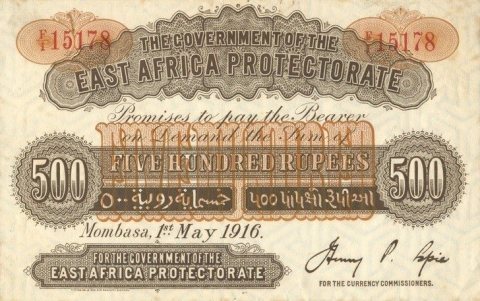
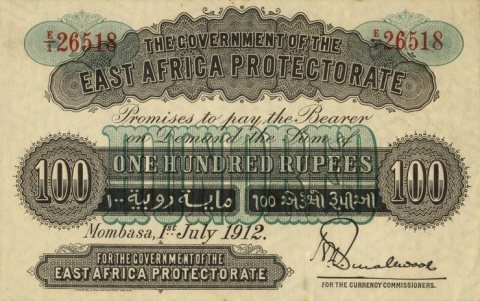
The Order of 1918 recites the Currency Orders of 1905, 1906, 1910 and 1911. The Orders of 1906, 1910 and 1911 themselves were not read. The notes issued under these laws are the rupee notes from the 5 rupees of 1905 to the 500 rupees of 1912 to 1919.
In the House of Commons on 26th April 1920 the Under-Secretary of State for the Colonies, Lieut.-Colonel Amery, put the beginning in these words: "In 1905 there was introduced a subsidiary nickel coinage for lower, and a paper currency for higher denominations". At the same time, the Under-Secretary said, the sovereign was made legal tender for 15 rupees.
1920: from the rupee to the florin
| Date | Instrument | What it did | Where it is printed |
|---|---|---|---|
| 11th February 1920 | Ordinance No. 14 of 1920 | made Bank of England notes and United Kingdom Treasury currency notes legal tender in the Protectorate at 8.50 rupees to the pound, and 9.25 rupees for rupee debts contracted before 21st November 1919 | Official Gazette, 11th February 1920, p. 103 |
| 2nd March 1920 | East Africa and Uganda (Currency) Order, 1920 | let the Governor suspend Article 14 (3) of the Order of 1905, the holder's right to coin for a note; confirmed Ordinance No. 14; by Article 4 allowed new currency notes with no right to coin | Government Notice No. 180, Official Gazette, 2nd June 1920 |
| 23rd March 1920 | Proclamation No. 29 | suspended Article 14 (3): the Protectorate's notes could no longer be turned into coin on demand | Official Gazette, 24th March 1920, p. 266 |
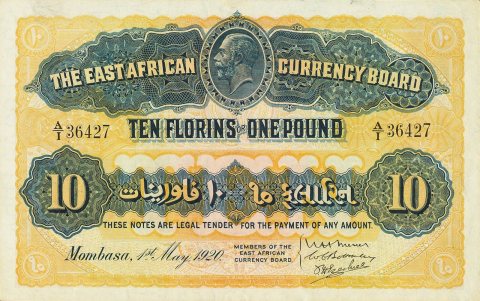
| 26th April 1920 | East Africa and Uganda (Currency) (No. 2) Order, 1920 | made the British East Africa florin the standard coin (Articles 1 and 2); read rupee contracts as florins (Article 7 (2)); kept every note then legal tender so, one rupee for one florin (Article 12 (3) (a)); told the Board of 1905 to hand over to a new Board of Commissioners of Currency (Article 9) | Government Notice No. 181, Official Gazette, 2nd June 1920 |
| 11th May 1920 | Proclamation No. 52 | "the new currency notes issued by the East African Currency Board of the denomination of one rupee shall be current and legal tender for the payment of any amount within the East Africa Protectorate" | Special Gazette, 15th May 1920 |
| 19th July 1920 | Proclamation No. 79, under the Customs Ordinance, 1910 | prohibited the import of Indian silver rupees and Government of India 1 rupee notes | special issue of the Gazette, 19th July 1920 |
| 21st July 1920 | Proclamation No. 80 | brought the No. 2 Order into operation in the East Africa Protectorate | Official Gazette, 21st July 1920 |
| 19th August 1920 | General Notice No. 942 | the Currency Officer at Mombasa exchanges the Board's notes and coin for sterling in London at ten florins to the pound, with a charge of 5 florins for each £100 | Official Gazette, 25th August 1920 |
| 1920 | Currency Notes Ordinance, 1920 (No. 24 of 1920) | the Kenya law for the Board's notes; its section 8 made wilful mutilation of a currency note an offence, with three months or a fine of £100 | known from Ordinance No. 4 of 1922 and General Notice No. 536 of 1925 |
Proclamation No. 52 is the only one in the whole run that names a note of the Board: the 1 rupee of 7th April 1920. No notice was found that names the florin notes, from the 1 florin to the 500 florins, or puts them into circulation. The copy of the Gazette that was read has no issue between 8th September 1920 and 5th January 1921, and the text of the Currency Notes Ordinance, 1920, falls in the same gap.
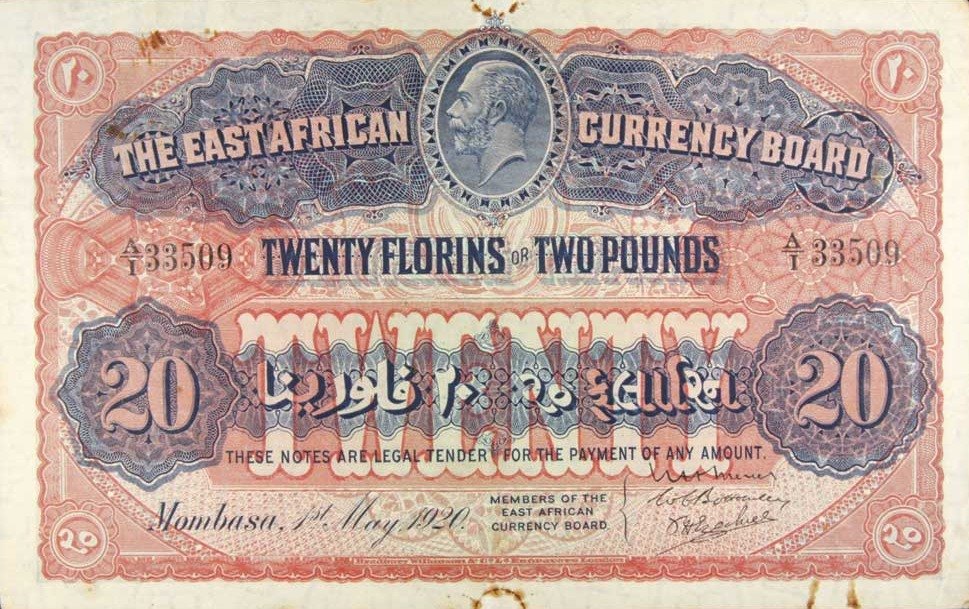
Two papers of that spring speak of sterling notes in East Africa. The Currency Board's abstract of 10th May 1920 lists "Sterling Notes" held locally, £91,000, among the securities of the Note Guarantee Fund. And in the Commons on 26th April 1920 Brigadier-General Cockerill, who attacked the new rate, said: "I cordially applaud the steps which the Government has already taken in the issue of the £1 note and the new currency." The speech does not say which note is meant.
1921 and 1922: from florin to shilling
| Date | Instrument | What it did | Where it is printed |
|---|---|---|---|
| 1st March 1921 | Government Notice No. 65 of 1921 | the notice calls the Government of India 1 rupee notes "demonetised" and warns that persons who pay natives in them as the equal of florins are liable to prosecution; the instrument that demonetised them is not on the page | Official Gazette, 2nd March 1921, p. 182 |
| 2nd March 1921 | Government Notice No. 79 | an Advisory Board on currency: the Treasurer and the Nairobi managers of three banks | Official Gazette, 9th March 1921, p. 199 |
| 7th June 1921 | Proclamation No. 74 | silver rupees ceased to be legal tender at midnight on 22nd June 1921 and were exchanged at the banks from 23rd June to 22nd July 1921 for florin notes, one note for one rupee; district officers could redeem holdings for five more months | Official Gazette, 8th June 1921, p. 488 |
| 10th August 1921 | Kenya and Uganda (Currency) Order, 1921 | made the British East Africa shilling the standard coin (Articles 1 and 2); read rupee and florin contracts at twice the number of shillings (Article 5 (2)); kept the rupee and florin notes legal tender at two shillings until a Proclamation (Article 9 (3)) | Government Notice No. 461, Special Gazette, 16th December 1921 |
| 7th November 1921 | Order in Council | changed the rate for the florin cent coins only | Government Notice No. 462, the same Gazette |
| 16th December 1921 | Proclamation No. 177 | brought the Order of 10th August 1921 into operation in Kenya on 1st January 1922 | the same Gazette, p. 1066 |
| 1921 | Metallic Currency Ordinance, 1921, of Tanganyika | made the East African shilling the standard coin of the Territory from 1st January 1922 | report to the League of Nations on Tanganyika for 1922, pp. 18 and 19 |
| 24th March 1922 | Currency Interpretation Ordinance, 1922 | fixed the periods in law: the florin from 21st July 1920 to 31st December 1921, the shilling from 1st January 1922 | Official Gazette, 29th March 1922 |
| 31st March 1922 | Ordinance No. 4 of 1922 | widened section 3 (2) of the Currency Notes Ordinance, 1920, to notes expressed in shillings, or in pounds at 20 shillings to the pound, or in both | Official Gazette, 5th April 1922 |
The proviso to Article 9 (3) of the Order of 1921 is the sentence on which the old notes hung for ten years: "all coins and all currency notes which at the said date are legal tender thereunder shall, unless and until declared not to be legal tender by Proclamation made by the Governor, remain legal tender ... at the rate of one rupee or one florin for two shillings."
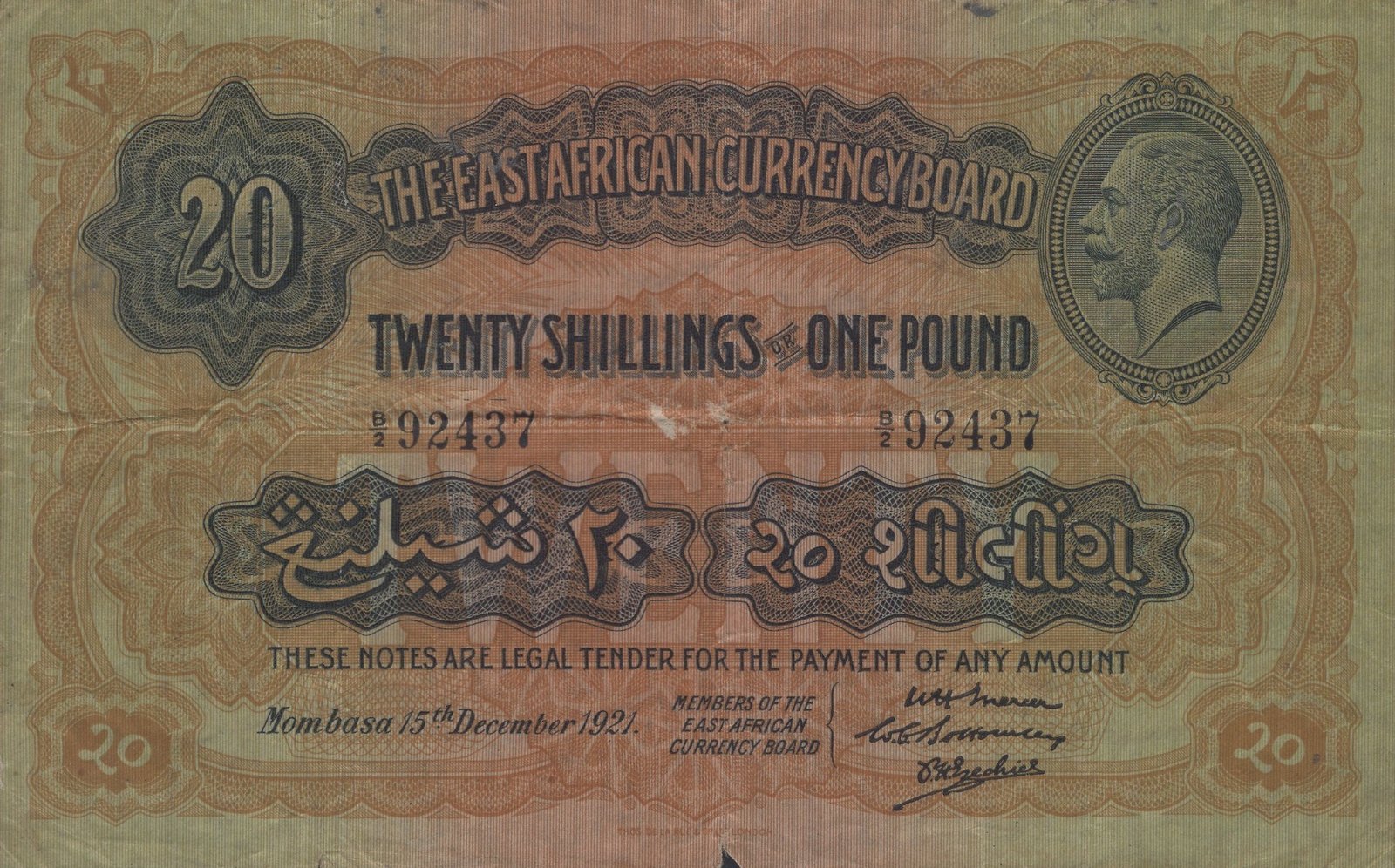
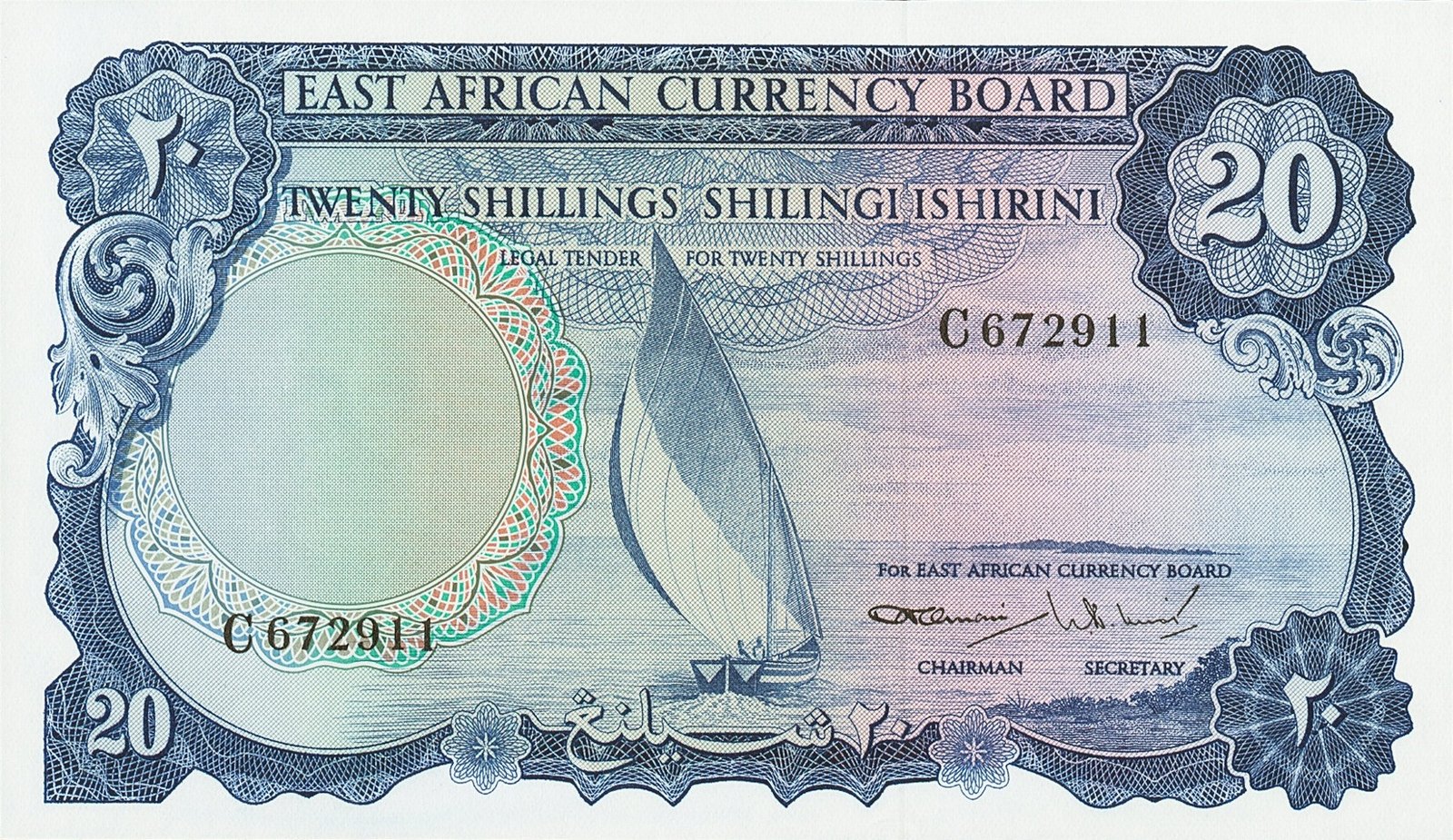
Ordinance No. 4 of 1922 is the law behind the wording of the higher shilling notes, which give their value twice, as on the 20 shillings = 1 pound and the 100 shillings = 5 pounds dated 15th December 1921. That date is the eve of the Special Gazette of 16th December 1921. No notice describes the shilling notes or gives their first day of issue. The first shilling note named by number in the Gazette is a 5 shillings in a half-note notice dated 5th August 1922.
What the House of Commons was told, 1920 and 1921
Three sittings bear on these laws.
26th April 1920. On the Colonial Office vote Brigadier-General Cockerill spoke to a motion tabled in order to attack the decision "to substitute for a rupee, which had a legal value of 1s. 4d., a florin of 2s.", with debts in rupees to be paid in florins. Cockerill's history of the matter is where the Order of 1898 is named. The speech also quotes a return of the note reserve: "If you turn to the currency note reserve you will find that there is a deficit of £240,000", which on the old rate of 1s. 4d. would have been a surplus of £42,000. Lieut.-Colonel Amery, in reply, said that "the legal unit of value, the statutory unit of account in East Africa has always been the Indian rupee".
30th May 1921. Mr. Churchill, Secretary of State for the Colonies, said that the position rested on "the East Africa and Uganda Order in Council of the 26th April, 1920", prepared when the Indian rupee had risen to about 2s. 9d., and went on: "the standard coin will be, not a florin, but a shilling, in order to prevent too abrupt fluctuations in local values". The Indian rupee coin was to be redeemed "during a limited period, after which the Indian coin will be demonetised". Asked whether Indian currency would be done away with, Churchill answered: "It is intended to assimilate the currency to the British type."
2nd June 1921. Mr. Wood said that the new shilling would be divided into cents, "a cent being the hundredth part of a shilling", and would be the standard coin, legal tender for any amount, slightly larger than the English shilling and materially less in size than the Indian rupee. A statement printed with the answer puts the 1, 5 and 10 cent pieces then in circulation at a face value of 1,074,327 rupees and explains that they would be marked down to half their face value, not replaced.
Neither answer of 1921 names the East African Currency Board, the notes, or the day on which the rupee and florin notes would cease to be legal tender.
1924 to 1936: Regulations, the end of the old notes, a loan
| Date | Instrument | What it did | Where it is printed |
|---|---|---|---|
| 16th July 1924 | Regulations of the East African Currency Board | members and Secretary are appointed by the Secretary of State; the notes carry facsimile signatures of the members in office; designs need the Secretary of State's approval; the Board took over the Board of 1905 under section 9 of the No. 2 Order of 1920; old coins and notes are exchanged "so long as these remain legal tender" | Government Notice No. 257, Official Gazette, 23rd July 1924 |
| 3rd February 1925 | Regulations reissued | Tanganyika Territory added to the Board's area; the text of 1924 named Kenya and Uganda only | Government Notice No. 43 of 1925 |
| 1930 | Penal Code of Kenya, section 331 | possessing a forged currency note a felony, with seven years | Official Gazette, 29th May 1930 |
| 3rd September 1930 | General Notice No. 910, Dar es Salaam | "It has been decided to withdraw all East African Rupee and Florin currency, notes as well as coin"; exchange at two shillings from 1st January to 31st December 1931 | Tanganyika Territory Gazette, 1930, p. 470 |
| 26th November 1930 | Proclamation No. 102 of 1930, Kenya | "from midnight on Thursday the 31st December, 1931, certain Coins and Notes shall cease to be Legal Tender in the Colony" | Kenya Blue Book for 1930, list of Proclamations |
| 15th April 1931 | Proclamation No. 5 of 1931, Tanganyika, under the Currency Notes Ordinance (Cap. 54) | the florin notes of 50, 20, 10, 5 and 1 florin cease to be legal tender in the Territory from the same midnight | Government Notice No. 43, Tanganyika Gazette Supplement, 1931 |
| 15th April 1931 | General Notice No. 439 | lists the coins and notes "being demonetised in Kenya and Uganda": rupee notes of 500, 100, 50, 20, 10 and 5 rupees, the Board's 1 rupee note and the florin notes of 50, 20, 10, 5 and 1 florin | Tanganyika Territory Gazette, 24th April 1931, p. 258 |
| 11th July 1932 | Regulations of the Board, made by the Secretary of State | the notes to bear facsimile signatures of the members for the time being | gazetted 13th September 1932; cited in Government Notice No. 91 of 1933 |
| 1933 | Currency Loan Ordinance, No. 16 of 1933 | let Kenya lend the Board up to £650,000 so that it could meet further redemptions of currency | the Bill is Government Notice No. 91, Kenya Gazette, 14th February 1933 |
| 1st January 1936 | Currency Decree, 1935, of Zanzibar | the Board's notes took the place of the Zanzibar rupee notes, which ceased to be legal tender on 6th April 1936 | annual report on Zanzibar for 1936 |
| 6th October 1936 | Bill to amend the Penal Code | to make importing forged bank or currency notes an offence and to add a section against forgers' paper and moulds | Government Notice No. 613, Kenya Gazette |
The Proclamation of 26th November 1930 is known from the list of the year's Proclamations in the Kenya Blue Book, where it stands between Nos. 87 and 105. The copy of the Kenya Gazette that was read stops on 24th June 1930 and has no issue for 1931 or 1932, so the text of the Proclamation itself has not been seen. Neither Tanganyika list names a note of 100 florins or 500 florins, and neither names the 1,000 rupees.

1959 to 1964
| Date | Instrument | What it did | Where it is printed |
|---|---|---|---|
| 15th December 1959 | Gazette Notice No. 4943 | "the new Sh. 5 note will be issued on 15th March, 1960"; the old notes keep their legal status but are not issued again once they come back to a bank | Kenya Gazette, 15th December 1959, p. 1454 |
| 1961 | East African Currency Board (Amendment) Regulations, 1961 | not read | Legal Notice 723, listed in the contents of the Gazette of 26th December 1961 |
| 1963 | East African Currency Board (Amendment) Regulations, 1963 | not read | Legal Notice 59, listed in the contents of the Gazette of 22nd January 1963 |
| 7th October 1964 | Gazette Notice No. 3584 | the Board's fiduciary issue raised from £25 million to £35 million from 6th October 1964, by agreement of the Governments | Kenya Gazette, October 1964 |
| 7th December 1964 | Legal Notice 367, under the Kenya and Uganda (Currency) Order, 1921 | not read | listed in the contents of the Gazette of 8th December 1964 |
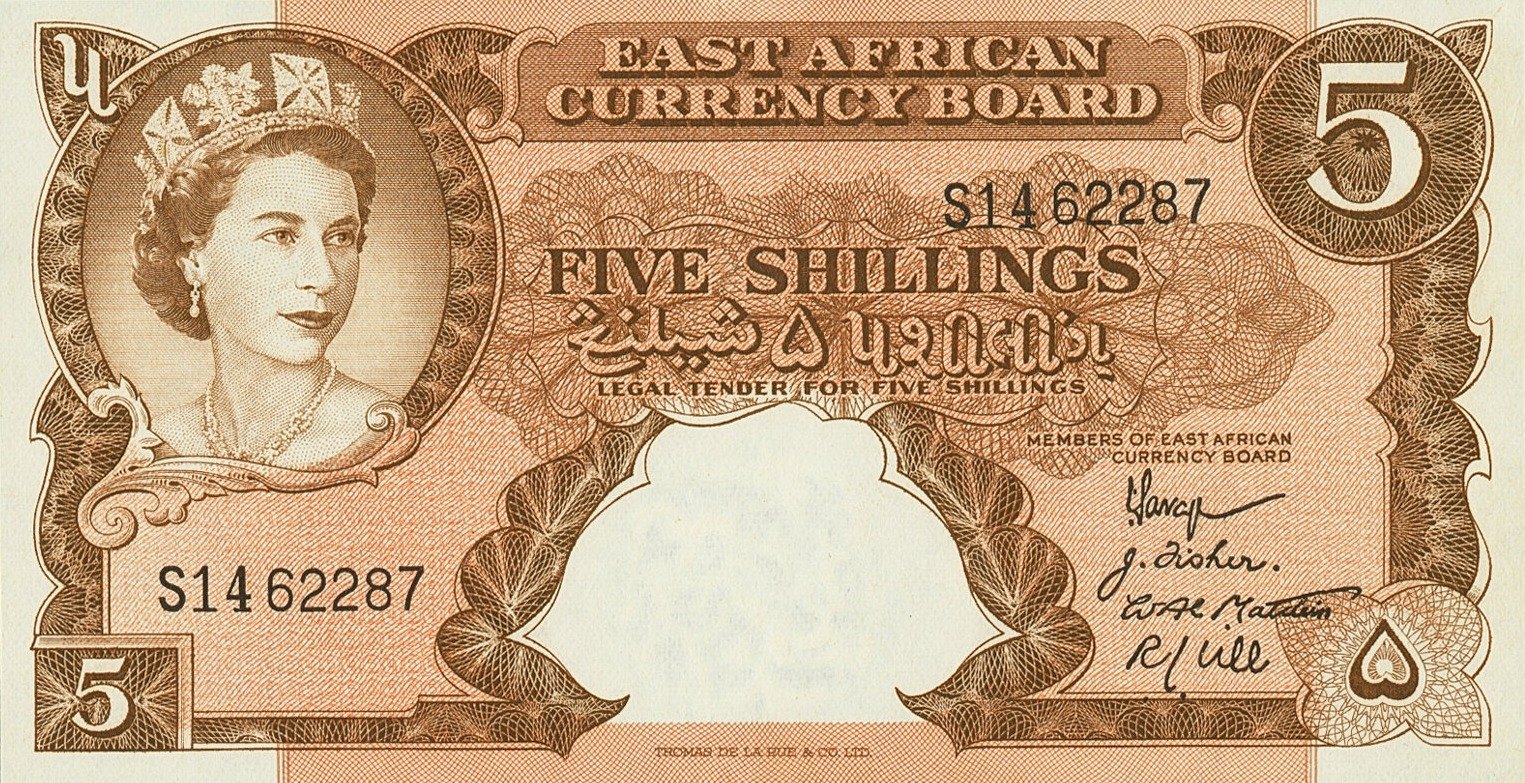
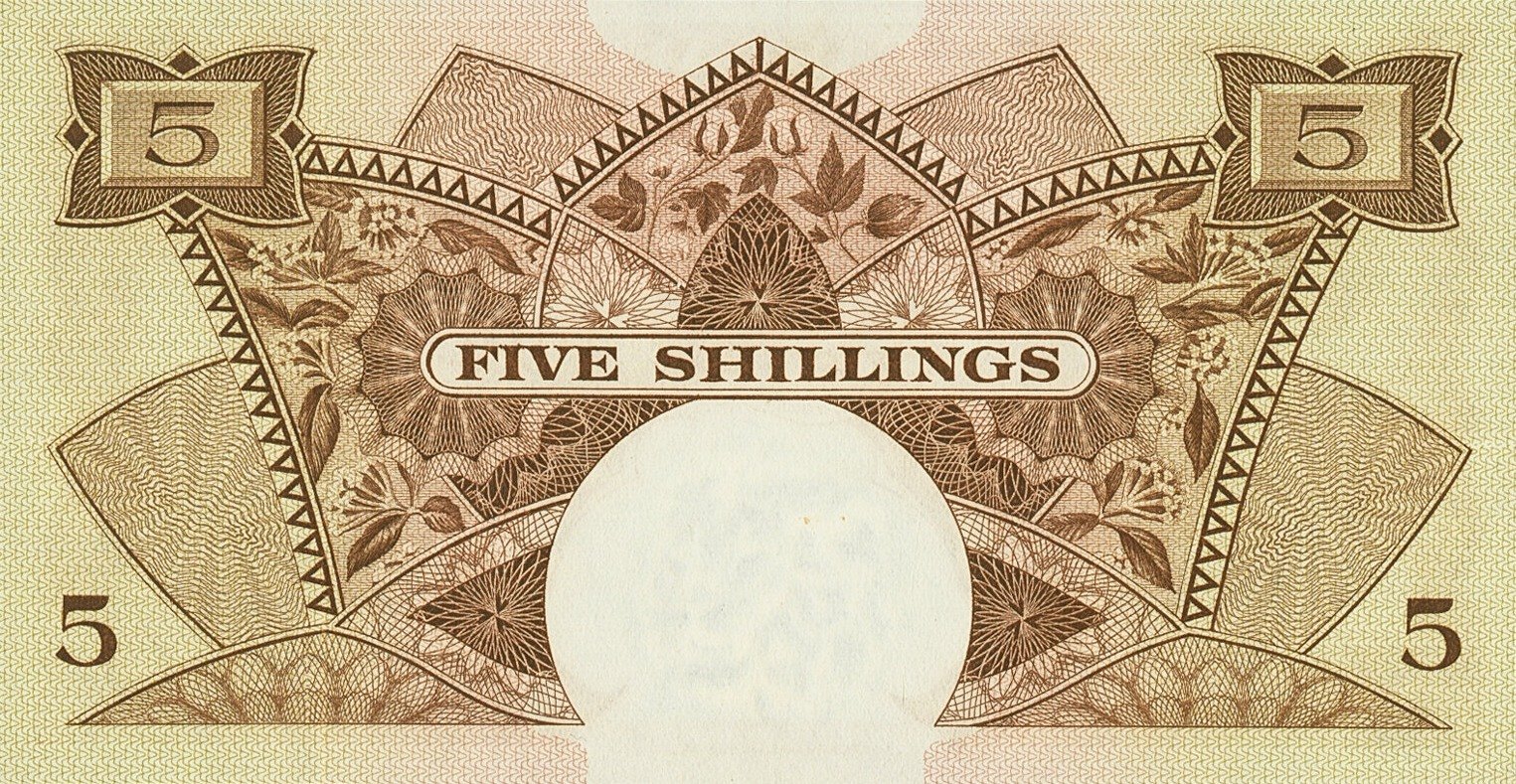
Gazette Notice No. 4943 is the one notice of a new note in sixty years of the Gazette. It refers to "the announcement made on 16th June, 1958, regarding the issue of currency notes of a new design", and describes the 5 shillings: 5¼ by 2¾ inches; brown, with dark pink and pink tints on the front and green and red on the back; the Queen in an oval at the top left; a lion's head watermark and a security thread at the right; on the back a cotton panel at the top centre and cloves at either side. The announcement of 16th June 1958 itself was not found.
What the Gazette never announced
The Kenya Gazette was searched for each new issue of notes. For most there is nothing.
- 1920 and 1921: no notice names or describes the florin notes or the first shilling notes, or gives a first day of issue.
- 1933: nothing on the notes dated Nairobi, 1st January 1933, on their signatures or on the move from Mombasa, in 40 issues searched.
- 1938: nothing on the notes of King George VI, in 63 issues searched.
- 1953: nothing on the notes of Queen Elizabeth II or on the calling-in of the older notes.
- 1964: nothing on the last notes, such as the 20 shillings, in a year volume of 1,599 pages.
- No notice ends the legal tender of the shilling notes of 1921, 1933, 1938 to 1952 or 1953 to 1957, and none withdraws the 1 shilling note of 1943.
The only notices that call notes in are for other countries' notes: United Kingdom Treasury notes in 1933, the larger Bank of England notes in 1945 (General Notice No. 1274 of 28th August 1945) and Belgian franc notes in 1946 (General Notice No. 5 of 2nd January 1946).
Not settled
- The text of Proclamation No. 102 of 1930. The Kenya Gazette of July to December 1930 would print it.
- Uganda. The annual report on Kenya for 1932 speaks of "the Colony". The Tanganyika notice of April 1931 says the notes were being demonetised "in Kenya and Uganda", but no Uganda Proclamation was read: no Uganda gazette of 1920 to 1928 was held.
- Legal Notice 367 of 1964. It was made under the Order of 1921, the Order under which a Governor could end the legal tender of a note. What it did is not known.
- The Currency Notes Ordinance, 1920. Its number and two of its sections are known from later notices. Its text was not found.
- Indian 1 rupee notes in Uganda. The Uganda Blue Book for 1921 lists a Proclamation that they "shall not be legal tender"; its date could not be read.
Sources
- East Africa and Uganda (Currency) Order in Council, 1905; the Orders of 13th April 1918, 2nd March 1920, 26th April 1920, 10th August 1921 and 7th November 1921.
- Official Gazette of the East Africa and Uganda Protectorates, of the East Africa Protectorate and of the Colony and Protectorate of Kenya, and the Kenya Gazette, 1906 to 1964: the Proclamations, Ordinances and notices named in the tables.
- Uganda Official Gazette, 1918: No. 204 and Proclamation No. 205. Uganda Blue Book for 1921.
- Tanganyika Territory Gazette: General Notice No. 910 of 1930, General Notice No. 439 of 1931 and Government Notice No. 43 of 1931 (Proclamation No. 5).
- Kenya Blue Book for 1930.
- Reports to the League of Nations on Tanganyika for 1920 and 1922.
- Annual reports on Kenya for 1921 and 1932; annual report on Zanzibar for 1936.
- Hansard, House of Commons: 26th April 1920 (Colonial Office vote); 30th May 1921, volume 142, columns 596 to 598; 2nd June 1921, volume 142, columns 1243 to 1245.
Member comments
Log in or register to post a comment.