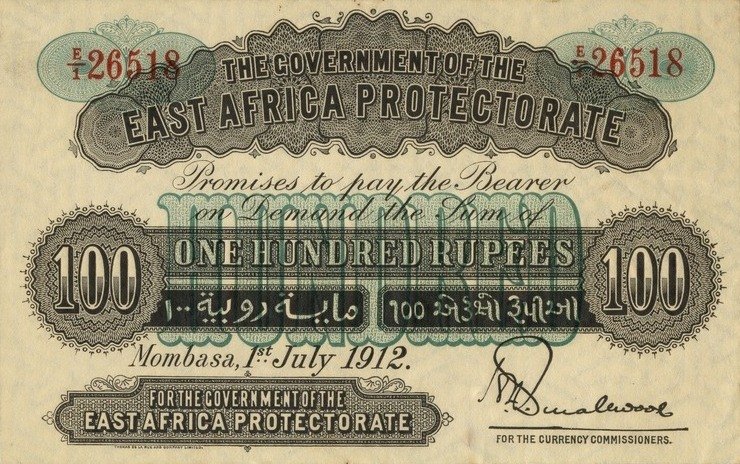
The Currency Commissioners of the East Africa Protectorate, and after them the East African Currency Board, published what they had in circulation: monthly at first, then twice a year. This article brings those figures together for East Africa, from the first abstract of 10th April 1906 to the returns of 1964. The sources are the Official Gazette of the Protectorate and of Kenya, the Uganda Official Gazette, the Tanganyika Territory Gazette, the Kenya Blue Books and the annual reports on Kenya. Parts of these tables are quoted in the articles on the Protectorate's rupee notes, the 200, 1,000 and 10,000 shillings and the wartime notes. Here they are in full.
Two warnings apply throughout. The figures count notes of a value, never notes of one date or one prefix. And the Gazette prints rupees in the Indian way, in lakhs ("Rs 123,35,500"); they are written here in the ordinary way.
The monthly abstracts, 1906 to 1920
The Board's first abstract is dated Mombasa, 10th April 1906, and carries the line "N.B. the first issue of Currency Notes to the Public was made on April 2nd, 1906." Each abstract gives the notes in circulation on the 10th of the month. About eighty of them were read. A selection:
| Date of return | Rupee notes in circulation |
|---|---|
| 10th April 1906 | 200,000 |
| 10th July 1906 | 600,000 |
| 10th October 1906 | 1,035,000 |
| 10th January 1907 | 1,235,000 |
| 10th June 1907 | 1,761,500 |
| 10th October 1907 | 1,661,500 |
| 10th April 1908 | 1,761,500 |
| 10th May 1908 | 1,360,500 |
| 10th November 1908 | 1,360,500 |
| 10th January 1910 | 1,632,500 |
| 10th August 1910 | 1,842,500 |
| 10th April 1912 | 3,871,995 |
| 10th August 1912 | 4,661,000 |
| 10th December 1912 | 4,706,000 |
| 10th December 1913 | 4,331,000 |
| 10th July 1914 | 4,209,000 |
| 10th February 1915 | 6,416,000 |
| 10th March 1915 | 6,866,000 |
| 10th January 1917 | 10,029,500 |
| 10th March 1918 | 8,560,500 |
| 10th September 1918 | 10,668,500 |
| 10th December 1918 | 12,335,500 |
| 10th December 1919 | 11,633,000 |
| 10th February 1920 | 8,483,000 |
| 10th May 1920 | 13,338,000 |
| 10th July 1920 | 9,938,000 |
The figure stood unchanged at 1,761,500 rupees in nearly every return from June 1907 to April 1908, and at 1,360,500 rupees from May to November 1908. The Red Book of 1909 gives the same 1,360,500 rupees for 31st October 1908. The annual report on the East Africa Protectorate for 1908-9 remarks that a large part of the notes was really held by the banks as a reserve.
The abstracts also show what stood behind the notes. On 10th April 1906 the coin portion of the Note Guarantee Fund was 200,000 rupees, the whole of the issue. By 31st March 1907 the Fund held 1,070,000 rupees in coin and 525,000 rupees invested, in Transvaal 3 per cent Guaranteed Stock. On 10th December 1918, the peak, the coin portion was 8,261,597 rupees 31 cents, made up of gold (2,177,500 rupees), silver (5,084,097 rupees 31 cents) and 1,000,000 rupees in Government of India 1 rupee notes.
Notes by value, 1907 to 1919
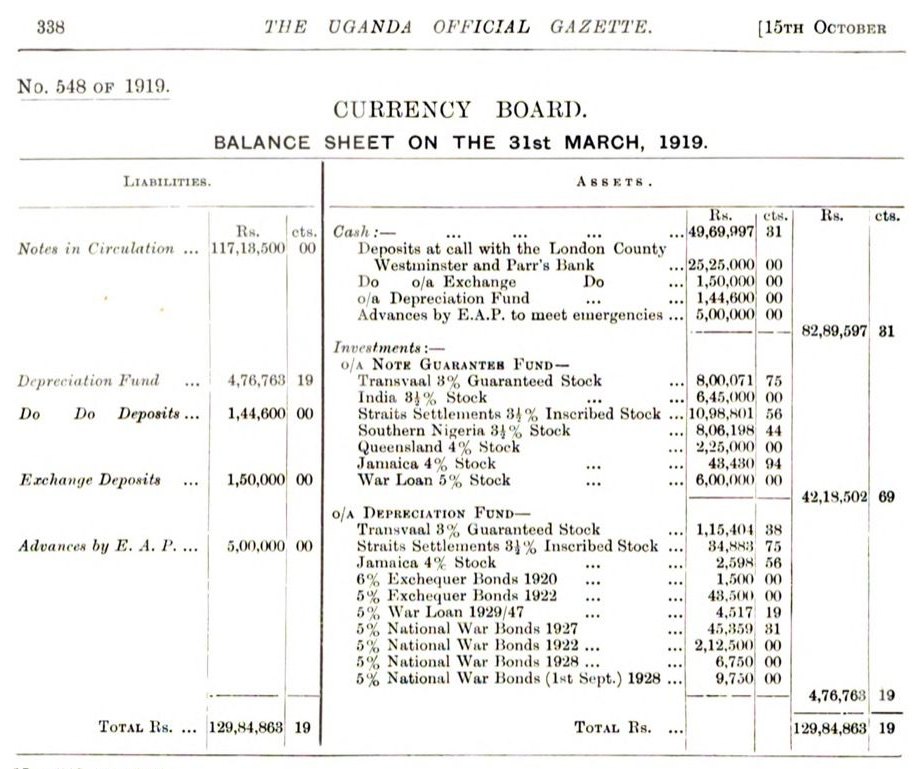
Each year the three Commissioners signed an audited statement of the notes by value on 31st March. Those of 1907 to 1913 were read in the Official Gazette, those of 1914 to 1919 in the Uganda Official Gazette, which reprinted them. The 1907 statement gives the notes issued for cash in the Board's first year, the others the notes in circulation.
| 31st March | 5 rupees | 10 rupees | 20 rupees | 50 rupees | 100 rupees | 500 rupees | All notes | Value in rupees |
|---|---|---|---|---|---|---|---|---|
| 1907 (issued) | 47,996 | 44,998 | 10,252 | 4,600 | 2,000 | 540 | not given | 1,595,000 |
| 1908 | 45,440 | 42,357 | 10,949 | 4,371 | 3,887 | 569 | not given | 1,761,500 |
| 1910 | 26,328 | 40,110 | 17,588 | 6,994 | 2,453 | 706 | not given | 1,832,500 |
| 1912 | 44,583 | 72,478 | 30,835 | 13,716 | 4,788 | 2,286 | 168,686 | 3,871,995 |
| 1913 | 44,012 | 80,497 | 32,066 | 13,417 | 7,913 | 2,873 | 180,778 | 4,565,000 |
| 1914 | 40,426 | 65,209 | 30,619 | 9,860 | 5,494 | 3,660 | 155,268 | 4,339,000 |
| 1917 | 111,022 | 166,870 | 57,057 | 10,159 | 13,246 | 7,514 | 365,868 | 8,954,500 |
| 1918 | 79,504 | 160,118 | 47,380 | 7,842 | 7,696 | 8,445 | 310,985 | 8,330,500 |
| 1919 | 72,216 | 201,250 | 68,796 | 9,156 | 7,927 | 13,427 | 372,772 | 11,713,500 |
For three years only a total was found: 6,866,000 rupees on 31st March 1915 and about 7,987,500 rupees on 31st March 1916, both from the Blue Books of the Protectorate, and 11,088,000 rupees on 31st March 1920, from a Colonial Report for 1919-20. All three were taken from the machine text of those volumes and not seen on the page, and the 1916 figure is printed there as "79,87,5000".
What the table shows:
- No statement lists a note of 1,000 rupees. The 1,000 rupees is recorded in the catalogue from a proof alone.
- In the 1907 statement the first figure of each count is cut off in the scan, and the counts were worked out from the rupee amounts printed beside them, which are clear.
- Dr. David Lott, in Bank Note Reporter of March 1985, gave the 1908 counts for five values and the total of 1,761,500 rupees. The Gazette statement of 15th June 1908 has the same five counts and the same total, and supplies the one Lott left out: 42,357 notes of 10 rupees.
- The 5 rupees fell from 45,440 notes in 1908 to 26,328 in 1910. The lists of cancelled notes in the Gazette of 15th January and 1st March 1910 are of 5 rupees notes: about 500 numbers in the first and about 1,200 in the second.
- The 500 rupees rose from 540 notes issued in the first year to 13,427 in circulation in 1919.
The same statement of 1907 gives two costs: the notes themselves had cost the Board 25,917 rupees 12 annas, and a strong room for currency notes 4,480 rupees 1 anna.
Rupee, florin and shilling notes side by side, 1921 to 1927
From 1921 the statements are half-yearly and come from the Currency Officer of the East African Currency Board.
| Date | Notes in circulation | Notice |
|---|---|---|
| 30th June 1921 | 10,679,910 rupees or florins | General Notice No. 363 of 1922 |
| 31st December 1921 | 20,284,808 rupees or florins | General Notice No. 917 of 1922 |
| 30th June 1922 | rupee and florin notes 10,019,236 (£1,001,923 12s.); shilling notes 7,074,820 shillings (£353,741); together £1,355,664 12s. | General Notice No. 1040 of 1922 |
| 30th June 1924 | East Africa Protectorate notes £25,650; the Board's notes £1,247,846 18s.; together £1,273,496 18s. | General Notice No. 108 of 1925 |
| 31st December 1924 | Protectorate notes £18,774; the Board's notes £1,364,082; together £1,382,856 | General Notice No. 1028 of 1925 |
| 30th June 1926 | Protectorate notes £13,804 3s.; the Board's notes £1,687,267 7s.; together £1,701,071 10s. | General Notice No. 83 of 1927 |
| 31st December 1927 | Protectorate and Board notes together £1,742,599 4s. | General Notice No. 750 of 1928 |
For 30th June 1921 the machine text of the Gazette reads 10,675,910 and the page itself 10,679,910. The second is used.
The old Protectorate rupee notes were counted apart until 30th June 1926 and are merged with the Board's notes from the end of 1927. Two smaller figures were noted from other volumes and not seen on the page: florin notes worth 3,558,370 shillings still out in Tanganyika at the end of 1924, from the Tanganyika Territory Blue Book for 1924 (the book for 1927 has a figure close to it that could not be read with certainty), and £1,391 of the Board's 1 rupee notes still out at the end of 1931, from a table of the Kenya Blue Book for 1931 that is printed sideways. No source gives figures by value for the florin notes.
The Board's half-yearly statements, 1928 to 1962
The statements were printed in the gazettes of all three territories. Those of 31st December 1929 to 31st December 1931 were read in the Tanganyika Territory Gazette only, those of 1928, June 1929 and 1932 in both gazettes, and the rest in the Kenya Gazette. The copy of the Kenya Gazette that was read lacks 1931, 1932, 1939, 1940, 1942, 1943 and 1957, and the statements of some other half-years were not met.
| Date | Currency notes in circulation |
|---|---|
| 30th June 1928 | £1,522,533 |
| 31st December 1928 | £1,541,536 |
| 30th June 1929 | £1,405,198 |
| 31st December 1929 | £1,869,650 |
| 30th June 1930 | £1,585,675 |
| 31st December 1930 | £1,848,050 |
| 31st December 1931 | £1,468,212 |
| 30th June 1932 | £1,319,170 |
| 31st December 1932 | £1,454,834 |
| 30th June 1933 | £1,473,740 |
| 31st December 1933 | £1,639,826 |
| 30th June 1934 | £1,565,293 |
| 31st December 1934 | £1,609,617 |
| 30th June 1935 | £1,416,777 |
| 31st December 1935 | £1,896,513 |
| 30th June 1936 | £1,935,021 |
| 31st December 1937 | £2,019,928 |
| 31st December 1939 | £3,023,383 |
| 30th June 1940 | £3,436,802 |
| 30th June 1944 | £18,246,806 |
| 31st December 1944 | £20,209,929 |
| 30th June 1945 | £21,067,230 |
| 31st December 1945 | £19,683,492 |
| 30th June 1946 | £17,317,029 |
| 31st December 1946 | £17,352,150 |
| 30th June 1947 | £17,028,922 |
| 31st December 1947 | £16,540,047 |
| 31st December 1948 | £16,857,839 |
| 30th June 1949 | £18,864,485 |
| 31st December 1949 | £17,981,966 |
| 30th June 1950 | £20,634,836 |
| 31st December 1950 | £25,020,679 |
| 30th June 1951 | £28,429,948 |
| 31st December 1951 | £33,058,074 |
| 31st December 1952 | £37,261,994 |
| 30th June 1953 | £37,258,891 |
| 31st December 1959 | £55,252,395 |
| 30th June 1960 | £51,051,289 |
| 31st December 1960 | £56,895,784 |
| 30th June 1961 | £50,452,834 |
| 31st December 1961 | £54,368,233 |
| 31st December 1962 | £60,889,595 |
Shillings and cents are left off. The statement for 30th June 1937 reads £2,163,2?5, with one figure not legible. That for 31st December 1931, the night the rupee and florin notes ceased to be legal tender, was read in the machine text only.
The statements of 1933 show the Board under strain. It had borrowed £344,000 by 30th June 1932 and £440,000 by the end of that year, reduced to £80,000 by 30th June 1933, and the statement for 31st December 1933 says the last £73,000 had since been repaid. A Bill printed in the Gazette of 14th February 1933 let Kenya lend the Board up to £650,000 so that it could go on redeeming its currency.
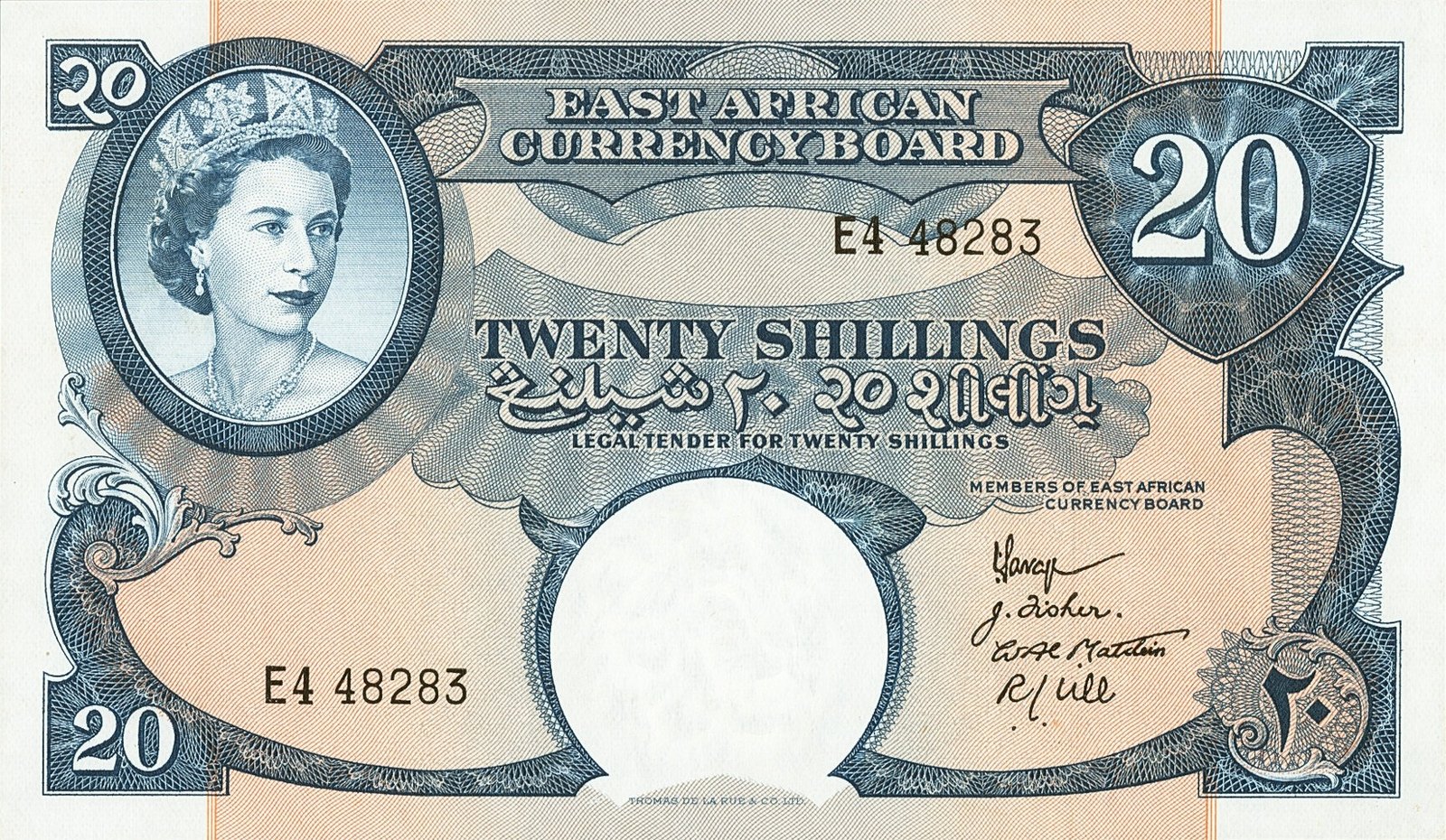
The statement for 30th June 1953 falls three months after the date on the first notes of Queen Elizabeth II, such as the 20 shillings of 1953 to 1956. It shows the circulation all but unchanged from six months before.
From the end of 1963 the returns are monthly and give notes and coin in one sum: £75,656,174 on 31st December 1963 and £78,177,456 on 30th November 1964. One paper still divides them. The Board's balance sheet for 31st December 1963, signed on 25th February 1964, gives notes £66,397,016 and coin £9,259,149. Its column for the year before gives notes £58,951,445, which is not the £60,889,595 of the statement for 31st December 1962. Both were read on the page, and the Gazette does not explain the difference.
Notes by value, 1933 to 1936
The Kenya Blue Books print an "Estimated Amount of Paper Money in Circulation" by value on 30th June. The books of 1930 and 1932 say the figures include Uganda and Tanganyika.
| 30th June | 5 shillings | 10 shillings | 20 shillings | 100 shillings | 200 shillings | 1,000 shillings | 10,000 shillings |
|---|---|---|---|---|---|---|---|
| 1933 | £192,117 | £281,925 | £226,518 | £219,450 | £1,930 | £55,300 | £496,500 |
| 1934 | £203,850 | £283,972 | £221,776 | £220,235 | £1,460 | £71,000 | £563,000 |
| 1935 | £216,896 | £291,576 | £240,785 | £231,370 | £1,150 | £48,500 | £386,500 |
| 1936 | £282,132 | £364,757 | £306,967 | £360,885 | about £1,030 | not read | not read |
Only the 1933 table was read on the page. The others come from the machine text of the Blue Books, in which the 1934 figure for the 200 shillings is printed "41,460" and the labels of the two highest values of 1936 are lost. The tables of 1930 to 1932 are printed sideways and could not be read.
These are the years of the Nairobi issue dated 1st January 1933. On 30th June 1933, six months after that date, the 200 shillings in circulation came to £1,930, and the sum fell in each of the next three years. In the same table the 10,000 shillings, a note issued only to the banks, stood at £496,500, where the Board's statement for the same day gives £1,473,740 for all its notes.
Notes by value, 1946 to 1962
The annual reports on Kenya print a table of the notes in circulation on 31st December, for the whole currency area. The reports for 1939 to 1945, 1952 and 1955 were not in the set that was read; the 1955 figures come from the report for 1956. Shillings and cents are left off.
| Year | 1 shilling | 5 shillings | 10 shillings | 20 shillings | 100 shillings | 200 shillings | 1,000 shillings | 10,000 shillings | All notes |
|---|---|---|---|---|---|---|---|---|---|
| 1946 | £135,577 | £2,254,562 | £3,425,967 | £5,767,165 | £3,294,855 | £180 | £80,550 | £3,848,500 | £18,807,357 |
| 1947 | £64,573 | £1,653,923 | £2,651,372 | £4,933,543 | £3,278,905 | £180 | £60,700 | £3,909,500 | £16,552,697 |
| 1948 | £39,837 | £2,111,097 | £3,267,208 | £5,827,976 | £4,117,410 | £180 | £53,800 | £1,469,000 | £16,886,509 |
| 1949 | £22,616 | £2,262,059 | £3,160,556 | £6,173,969 | £4,636,555 | £180 | £57,200 | £1,619,500 | £17,932,636 |
| 1950 | £13,550 | £2,939,609 | £4,444,226 | £8,201,348 | £5,897,010 | £150 | £177,600 | £2,793,000 | £24,466,493 |
| 1951 | £11,995 | £3,416,076 | £5,271,939 | £10,595,667 | £7,323,760 | £150 | £155,900 | £2,484,500 | £29,259,987 |
| 1953 | £10,836 | £3,916,390 | £6,922,631 | £14,464,352 | £13,074,475 | £150 | £69,200 | £2,108,000 | £40,566,035 |
| 1954 | £10,708 | £4,257,754 | £7,711,361 | £17,518,263 | £15,549,065 | £150 | £51,950 | £1,824,000 | £46,923,251 |
| 1955 | £10,534 | £4,737,273 | £7,356,057 | £18,254,252 | £19,446,395 | £150 | £77,300 | £689,000 | £50,570,961 |
| 1956 | £10,495 | £4,874,660 | £7,263,940 | £17,746,218 | £19,936,805 | £140 | £60,300 | £1,830,500 | £51,723,058 |
| 1957 | £10,459 | £5,464,956 | £7,951,259 | £19,242,900 | £21,284,595 | £140 | £44,400 | £1,613,500 | £55,612,209 |
| 1958 | £10,411 | £5,204,625 | £7,531,897 | £18,621,333 | £20,600,735 | £140 | £37,450 | £2,765,500 | £54,772,091 |
From 1959 the reports divide each of the four lower values between the older design and the "New Issue", the undated notes announced on 16th June 1958.
| Year | 5 shillings, old | 5 shillings, new | 10 shillings, old | 10 shillings, new | 20 shillings, old | 20 shillings, new | 100 shillings, old | 100 shillings, new |
|---|---|---|---|---|---|---|---|---|
| 1958 | £5,204,625 | none yet | £7,531,897 | none yet | £18,621,333 | none yet | £7,515,215 | £13,085,520 |
| 1959 | £5,052,079 | none yet | £3,753,509 | £4,327,814 | £4,487,642 | £14,037,892 | £2,390,470 | £20,787,975 |
| 1960 | £849,017 | £4,355,122 | £959,344 | £7,085,413 | £1,941,465 | £15,986,380 | £1,163,840 | £22,355,320 |
| 1961 | £459,100 | £4,040,050 | £585,714 | £6,489,880 | £1,164,501 | £14,909,302 | £744,545 | £23,209,530 |
| 1962 | £341,110 | £4,881,328 | £427,929 | £7,851,721 | £759,376 | £17,163,087 | £548,555 | £26,530,975 |
| Year | 1 shilling | 200 shillings | 1,000 shillings | 10,000 shillings | All notes |
|---|---|---|---|---|---|
| 1959 | £10,365 | £140 | £32,350 | £1,549,500 | £56,429,736 |
| 1960 | £10,329 | £140 | £28,250 | £2,017,500 | £56,752,120 |
| 1961 | £10,308 | £140 | £29,700 | £1,798,000 | £53,440,770 |
| 1962 | £10,300 | £140 | £26,600 | £2,079,500 | £60,620,621 |
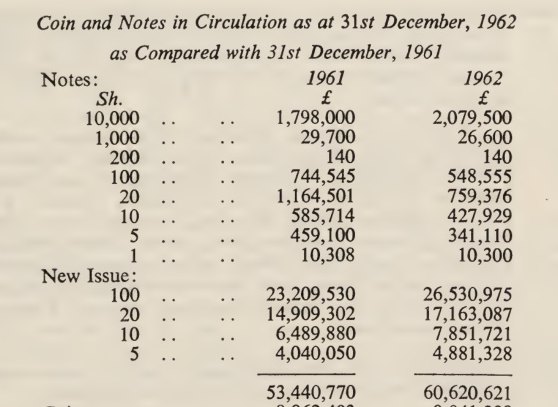
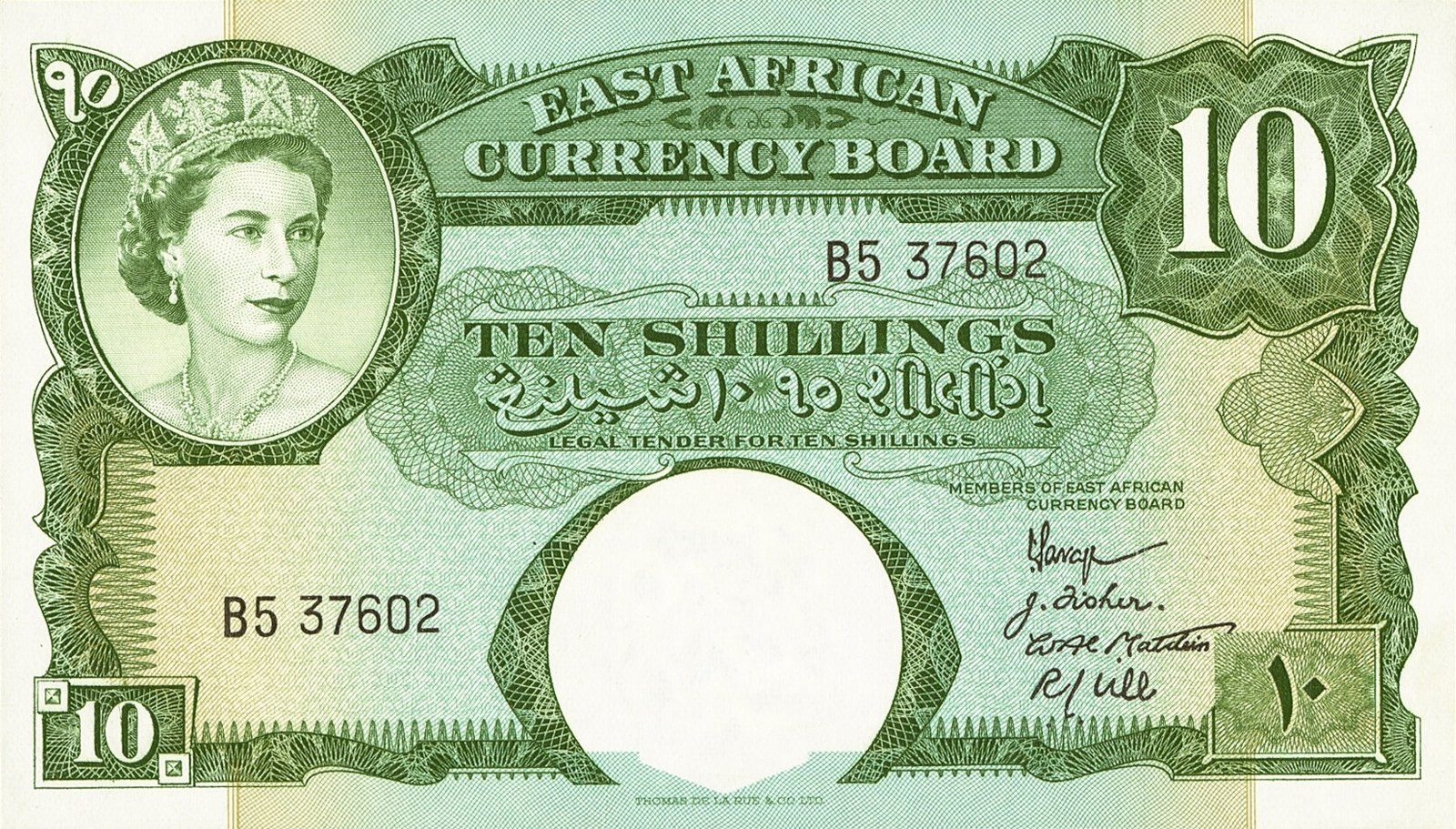
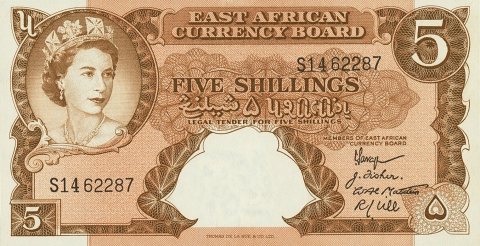
The four notes of the new design are the 100 shillings, put into circulation on 15th September 1958, the 20 shillings of 16th March 1959, the 10 shillings of 15th September 1959 and the 5 shillings of 15th March 1960. The second table shows how fast each replaced the older note: by the end of 1962 the older design was down to £341,110 of 5 shillings and £548,555 of 100 shillings.
A note under each year's table says what the figures cover: Kenya, Uganda, Tanganyika and Zanzibar in 1946; with "the occupied territories" in 1948; with the Occupied Territories Administration and Somaliland in 1949; with Aden in the report for 1953; "Somalia" in place of British Somaliland in 1960; and Kenya, Uganda, Tanganyika, Zanzibar and Aden alone at the end of 1961.
Where two official sources differ
The annual reports on Kenya and the Board's statements in the Gazette both give a total of notes on 31st December. They do not agree in any year in which both were read.
| 31st December | Board's statement in the Kenya Gazette | Annual report on Kenya |
|---|---|---|
| 1946 | £17,352,150 | £18,807,357 |
| 1947 | £16,540,047 | £16,552,697 |
| 1948 | £16,857,839 | £16,886,509 |
| 1949 | £17,981,966 | £17,932,636 |
| 1950 | £25,020,679 | £24,466,493 |
| 1951 | £33,058,074 | £29,259,987 |
| 1959 | £55,252,395 | £56,429,736 |
| 1960 | £56,895,784 | £56,752,120 |
| 1961 | £54,368,233 | £53,440,770 |
| 1962 | £60,889,595 | £60,620,621 |
Neither source says why. The figures are set side by side here and no choice is made between them.
The annual reports on Uganda give a table of their own, which the report for 1961 heads "net issues to Uganda". That heading points to a book figure of notes sent to Uganda, not a count of notes in hands, and the table is not set against those above. It gives, for example, £8,010 of 200 shillings notes in every year from 1947 to 1950 and £8,000 from 1951 to 1961, where the Kenya reports give £180 to £140 for the whole area. The Uganda report for 1960 divides the notes in the same way as the Kenya reports: £17,514,000 of the new notes with the Queen's portrait and £16,797,000 of the old issue.
What the figures do not tell
- How many notes of any value were printed. No official paper read for the catalogue gives a printing figure by prefix.
- How many notes of one date were in circulation. A count of 20 shillings notes in 1951 covers every date from 1921 onwards.
- Anything by value between 1919 and 1933, between 1936 and 1946, or for the florin notes at any time.
- Notes by value after 1962.
Sources
- Official Gazette of the East Africa and Uganda Protectorates and of the East Africa Protectorate: the Currency Board's monthly abstracts, 1906 to 1920; the yearly statements of 1st July 1907, 1st July 1908, 15th July 1910, 15th July 1912 and 15th July 1913 (General Notice No. 399).
- Uganda Official Gazette: Notices No. 426 of 1914, No. 401 of 1917, No. 562 of 1918 and No. 550 of 1919.
- Official Gazette of the Colony and Protectorate of Kenya and the Kenya Gazette: General Notices Nos. 363, 917 and 1040 of 1922, 108 and 1028 of 1925, 83 of 1927 and 750 of 1928; General Notice No. 431 of 1929 and the Board's other half-yearly statements, 1928 to 1962; Government Notice No. 91 of 1933; Gazette Notice No. 684 of 1964 and the monthly returns of 1964.
- Tanganyika Territory Gazette, 1929 to 1933: the Board's half-yearly statements.
- Blue Books of the East Africa Protectorate for 1914-15 and 1915-16; Kenya Blue Books for 1930 to 1936; Tanganyika Territory Blue Books for 1924 and 1927.
- Annual report on the East Africa Protectorate for 1908-9 and for 1919-20; the Red Book of 1909.
- Annual reports on Kenya, 1946 to 1962.
- Annual reports on Uganda, 1947 to 1961.
- Dr. David Lott, Bank Note Reporter, March 1985, p. 26.
Member comments
Log in or register to post a comment.