Between 1939 and 1946 the notes of the East African Currency Board were printed by three printers in two countries, and a 1 shilling note was added. This article sets out the three printings dated 1st June 1939, the printing of 1st August 1942 made in India, and the 1 shilling note of 1st January 1943 with its printing figures and its withdrawal. It is drawn from the catalogue's pages for these notes, which rest on the notes themselves, the Board's reports, the Kenya Gazette, the annual reports on Kenya, Uganda and Zanzibar and Fred Schwan's article in Bank Note Reporter of May 1984, and from four auction descriptions.
The notes of King George VI before the war
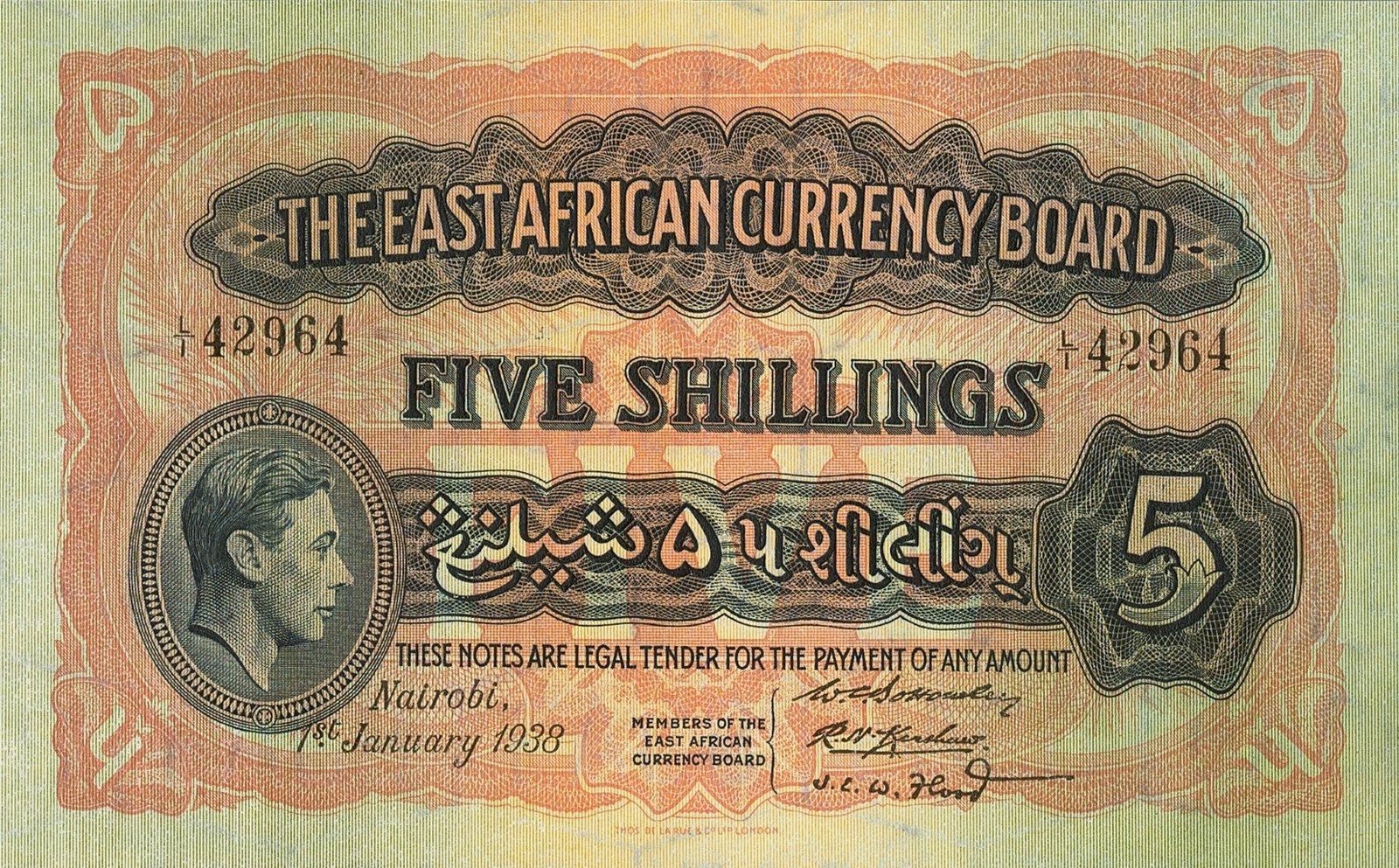
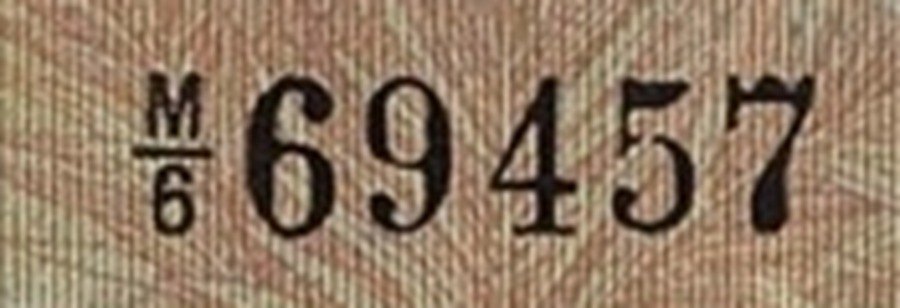
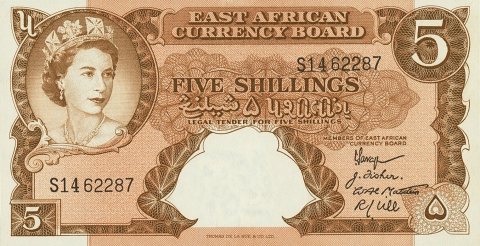
The King George VI notes of 5 shillings, 10 shillings, 20 shillings and 100 shillings begin with the date 1st January 1938, followed by 2nd January 1939. They were printed by Thomas de la Rue. The whole date is printed in italics, and the serial number is in a variable-weight font, its digits drawn with thick and thin strokes.
Three printings dated 1st June 1939
The 5, 10 and 20 shillings dated 1st June 1939 were each printed three times. The pages of the second and third printings give their signers as Bottomley, Kershaw and Boyd.
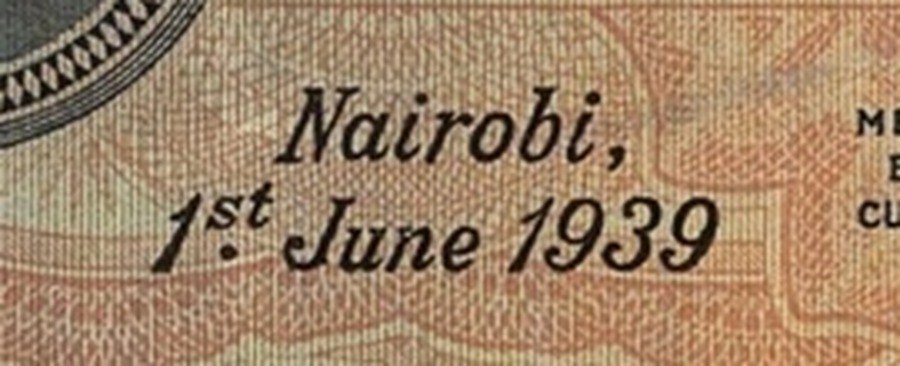
- The first printing still has the whole date in italics, like the notes of 1938 and January 1939, and carries the De La Rue imprint. The catalogue keeps it with those notes.
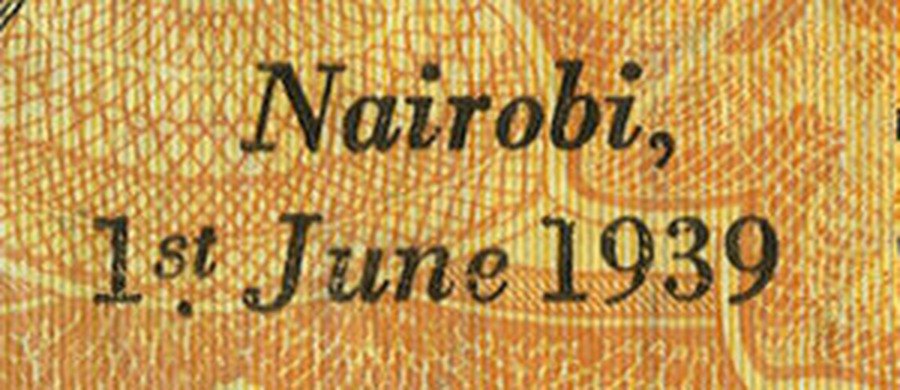
- The second printing changed the date style: only "June" is in italics, "1st" and "1939" are upright. It still carries the imprint THOS DE LA RUE & CO LTD LONDON in small capitals under the border at lower centre.
- The third printing has the new date style and no imprint. It was printed by Bradbury Wilkinson.
| Value | First printing | Second printing, with imprint | Third printing, no imprint |
|---|---|---|---|
| 5 shillings | P-28a3, M/3 to N/3 | P-26Aa, N/3 to Q/3 | P-26Ab, Q/3 to S/3 |
| 10 shillings | P-29a3, J/2 to J/5 | P-26Ba, J/7 to K/8 | P-26Bb, K/8 to M/1 |
| 20 shillings | P-30a3, D/6 to D/8 | P-26Ca, D/8 to E/8 | P-26Cb, E/8 to F/1 |
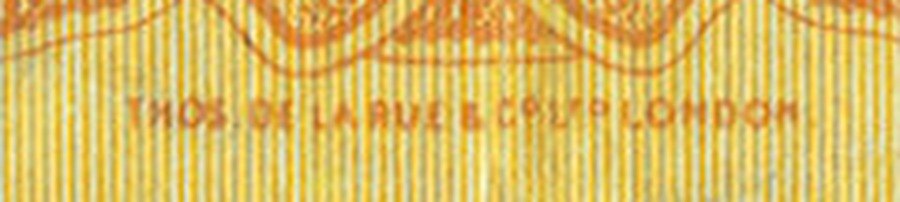

One prefix of each value is shared by the second and third printings: Q/3, K/8 and E/8. On the 10 shillings a Bradbury Wilkinson specimen prints the range K/8 50001 to L/5 100000, so the change of printer falls inside K/8. The pages warn that the printer lines on grading-company holders are not reliable for these notes: a 20 shillings with prefix D/8 holdered as a Bradbury Wilkinson printing carries the De La Rue imprint.
The 100 shillings has no such later printings. Its note of 1st June 1939, with the whole date in italics, stays with the 1938 and January 1939 notes. Sources mention the three printings of the 5 and of the 10 shillings as three printings of one note, and list every King George VI note of the value, the later printings with them, under one entry.
A new serial number font, 1st July 1941
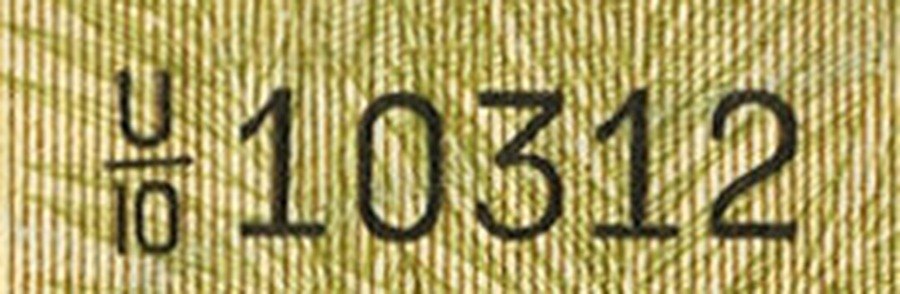
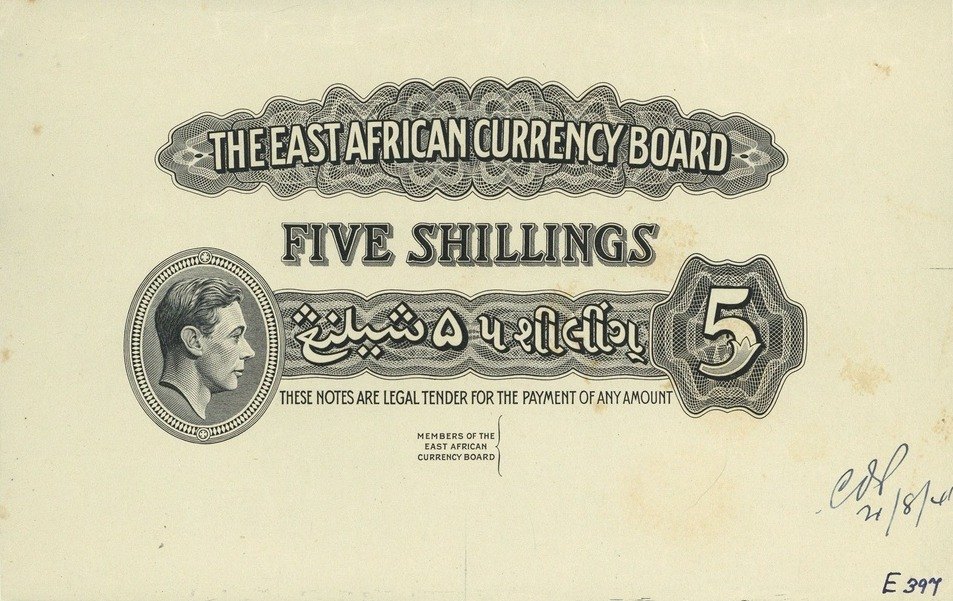
From the notes dated 1st July 1941 De La Rue changed to a monoweight serial number font, every stroke the same thickness. The catalogue lists a die proof of each of the four values under 1941; the black and white die proof of the 5 shillings is dated from its ink date 21/8/41. The full-colour front proof of the 5 shillings is undated and is placed in 1938 from the ink date 1.4.38 in its lower right margin.
Printed in India, 1st August 1942
The notes dated 1st August 1942 were printed by India Security Press while De La Rue could not supply Nairobi during the war. There are four values: 5 shillings, 10 shillings, 20 shillings and 100 shillings.
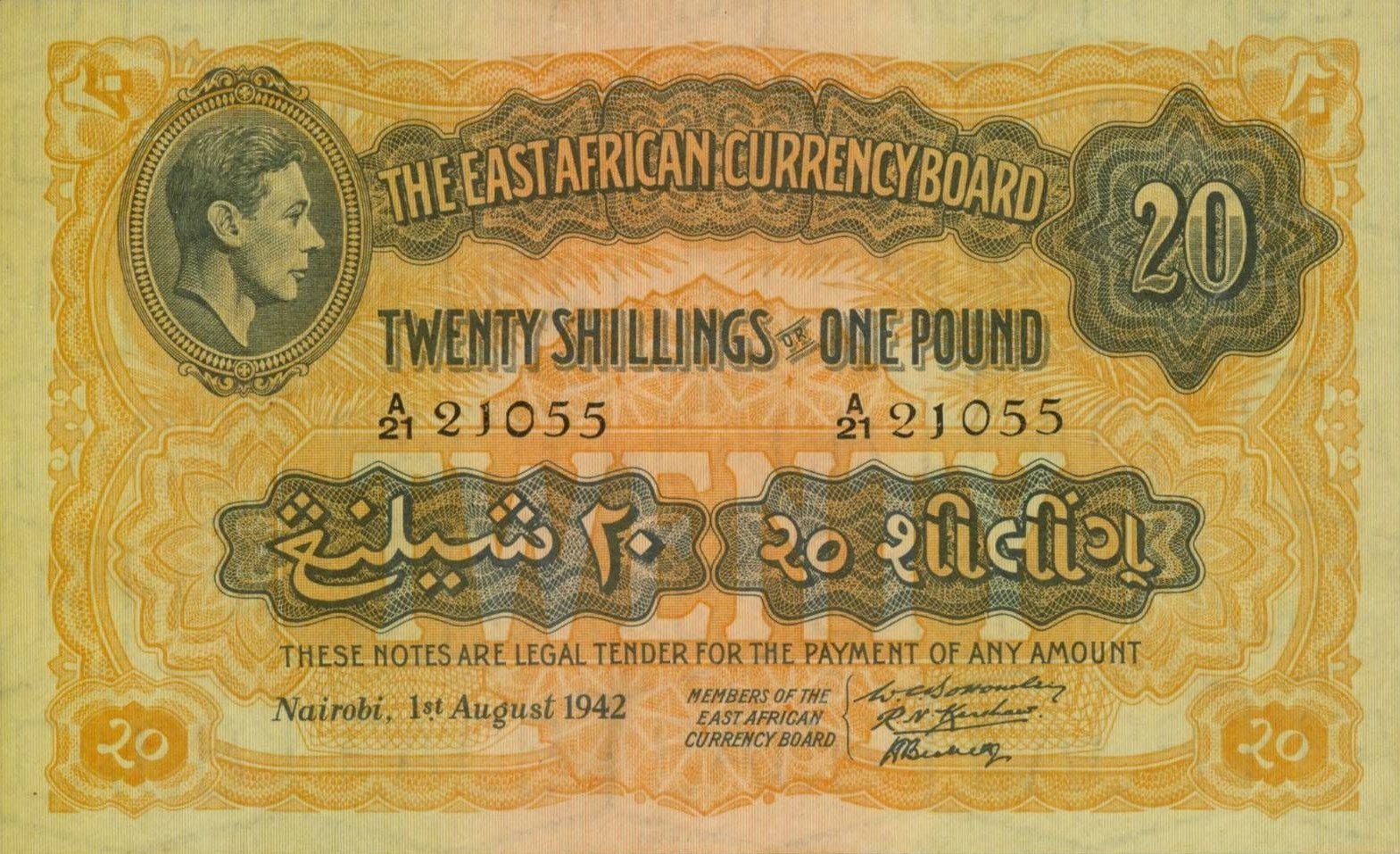
Two things mark them: no printer's imprint at the foot of the note, and Indian-style serial numbers in a font unlike both the variable-weight font of the 1938 and 1939 notes and the monoweight font De La Rue used from 1941.
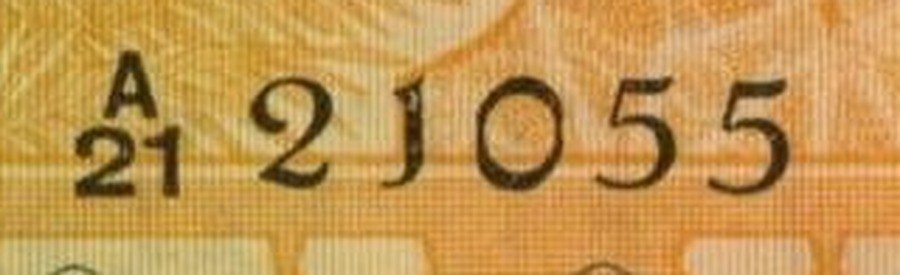
Heritage (30 April 2021, lot 28256) and Stack's Bowers (6 September 2026, lot 31100) say the De La Rue printing plates were sent from England to India for these notes. Stack's Bowers adds, in that description and in that of lot 31099 of the same sale, that the font is the one India Security Press used on Indian notes, and that a holder naming Thomas de la Rue as the printer of such a note is wrong.
The 1 shilling note of 1st January 1943
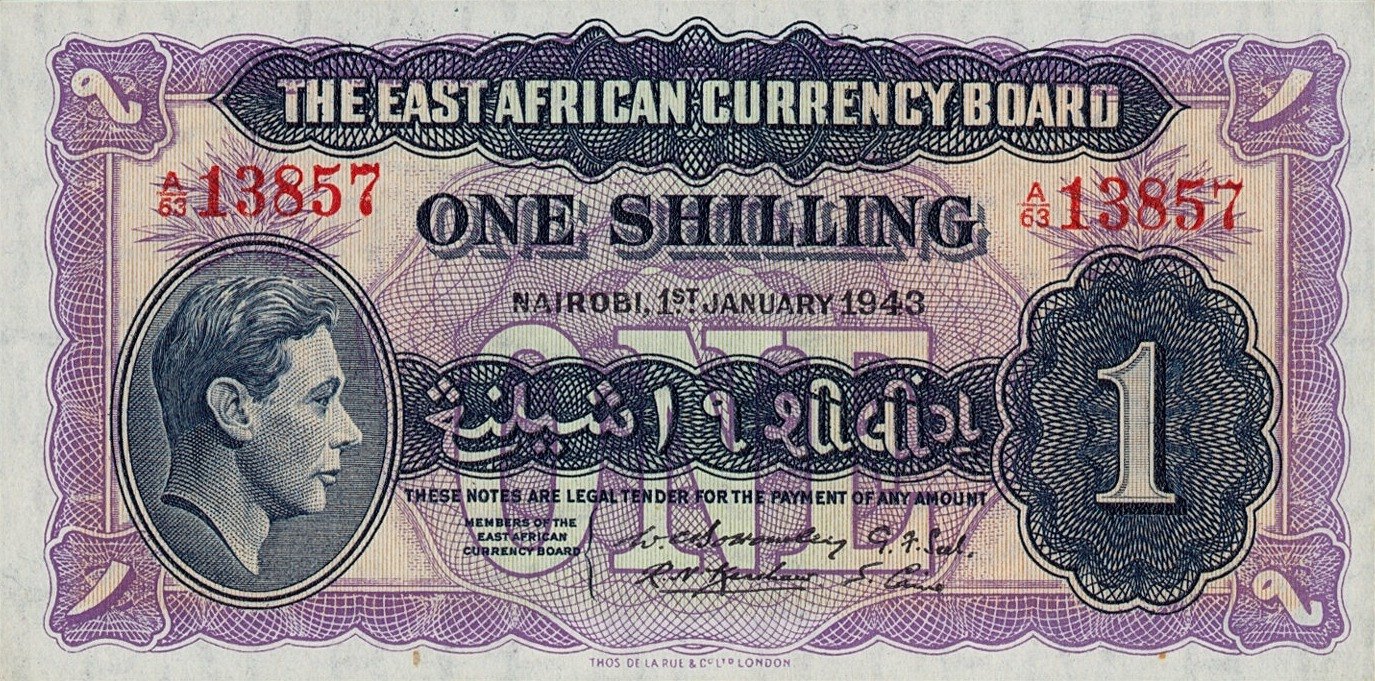
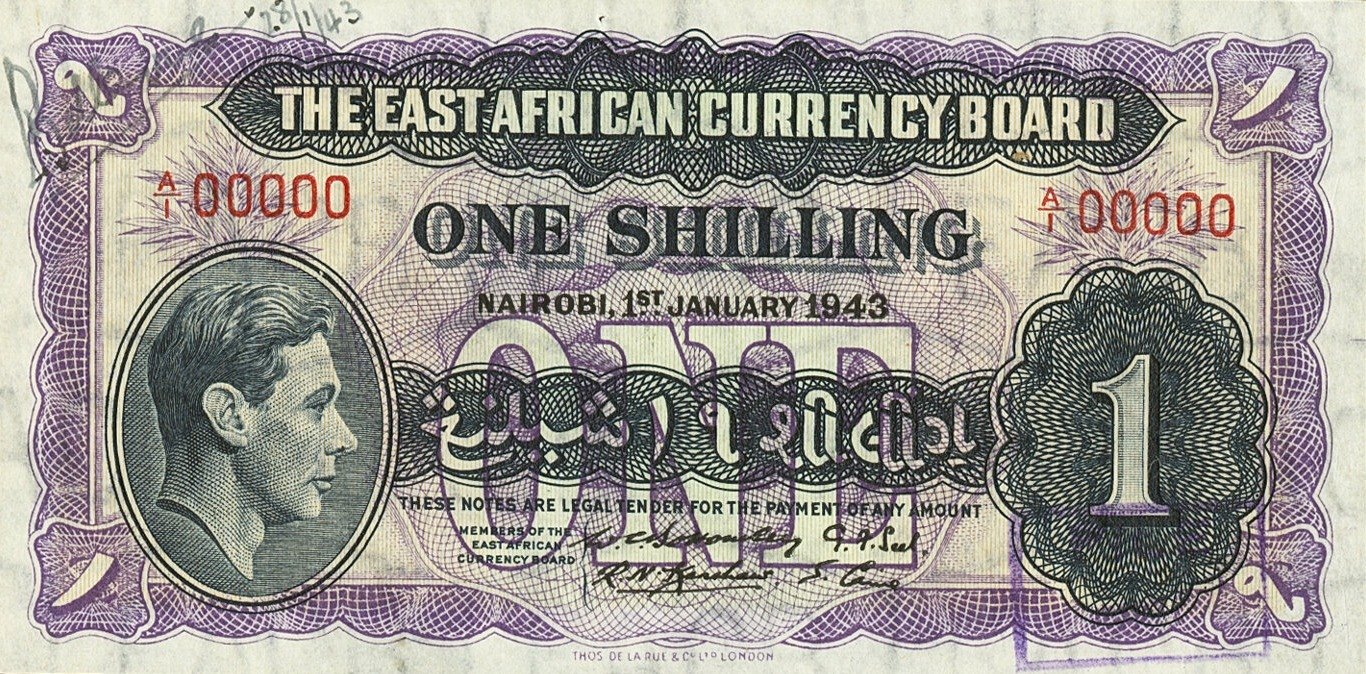
During the Second World War the troops from East Africa who took Italian Somaliland and then occupied Eritrea and Ethiopia were paid in East African currency, and silver coin ran short. The 1 shilling note was printed to supplement the coinage. It is purple on both sides, with a lion before mountains on the back, and measures 121 by 59 mm.
The printing
Sources mention that De La Rue printed the note from engraved plates, the Board having decided in January 1943 against a lithographed issue like the 1941 notes from India.
The Board's report for the year ended 30 June 1943 records 4,094,000 of these notes printed and issued to the Occupied Territories Administration. Fred Schwan, writing in Bank Note Reporter in May 1984 and citing Gastone Sollner in Muenzen Review, gives two printings: 4,094,000 notes in 1942 and a second printing of 12,739,400 notes completed in February 1944, 16,833,400 in all.
Sources mention an order of twenty million notes, with A/1 00001 to A/41 94000 for the Occupied Territories and the rest, from A/41 94001, for the Board. The first block is 4,094,000 notes, the figure of the Board's report. Sources also mention prefixes up to C/13 50000, beyond the twenty million ordered, and suggest without proof that C/3 to C/13 replaced spoiled A and B sheets. The Kenya Gazette's notices of mutilated notes name 1 shilling notes with prefixes C/3, C/4, C/5 and C/6, claimed in Uganda in 1946 and 1947, so notes of the C prefixes were in circulation.
The three figures do not agree: 16,833,400 printed according to Schwan, twenty million ordered, and prefixes that run past twenty million.
The dates of issue
Sources mention that the first 2 million notes reached the War Office on 1 March 1943 for the Occupied Territories, and that in East Africa the note was shown to the public from 3 January 1944 and officially issued on 15 February 1944.
The note has a single date, Nairobi, 1st January 1943, and is signed by the four members of the board at that date: Bottomley, Kershaw, Seel and Caine. No other East African note carries this board; the notes of 1st September 1943 have Downie in place of Bottomley. Sources mention specimens with prefix B/6, printed in June 1943.
The withdrawal
Sources mention that the issue ended from 1 April 1946, when enough 1 shilling coins could be supplied. The annual report on Zanzibar for 1946 says that the notes, which were not popular, were withdrawn from circulation there from that day.
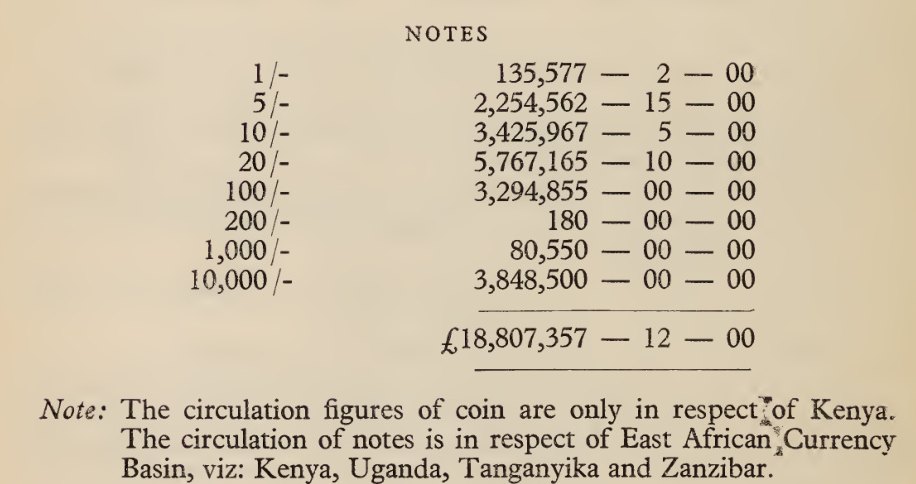
The annual reports on Kenya show the notes coming back:
| End of year | 1 shilling notes in circulation |
|---|---|
| 1946 | £135,577, about 2.7 million notes |
| 1949 | £22,616 |
| 1953 | £10,836 |
| 1962 | about £10,300, some 206,000 notes |
The annual reports on Uganda had already said in 1949 that no more 1 shilling notes were being issued, and from 1954 that none had been printed for many years and that those coming back to the Board were not reissued. The annual report on Kenya for 1961 says the 1 shilling was no longer issued and that notes received from the banks were destroyed.
All notes in circulation, 1944 to 1952
The Board's half-yearly statements in the Kenya Gazette give the whole of its notes in circulation:
| Date | Notes in circulation |
|---|---|
| 30th June 1944 | 18.2 million pounds |
| 30th June 1945 | 21.1 million pounds |
| 31st December 1947 | 16.5 million pounds |
| 31st December 1952 | 37.3 million pounds |
Not settled
- How many 1 shilling notes were printed: the sources give 16,833,400, twenty million and prefixes beyond twenty million.
- Whether the C prefixes of the 1 shilling replaced spoiled sheets. The sources suggest it without proof.
- No June 1939 note of 10 shillings with prefix J/6 or J/7 is recorded, so the first prefix of the second printing is open.
- No specimen of the Bradbury Wilkinson printing of the 5 or the 20 shillings has been recorded.
Sources
- East African Currency Board, report for the year ended 30 June 1943.
- The Board's half-yearly statements in the Kenya Gazette, 1944 to 1952; the Kenya Gazette's notices of mutilated notes, 1946 and 1947.
- Annual reports on Kenya, 1946 to 1962.
- Annual reports on Uganda for 1949 and from 1954.
- Annual report on Zanzibar for 1946.
- Fred Schwan, Bank Note Reporter, May 1984, citing Gastone Sollner in Muenzen Review.
- Heritage Auctions, 30 April 2021, lot 28256.
- Stack's Bowers, 6 September 2026, lots 31099 and 31100.
Member comments
Log in or register to post a comment.