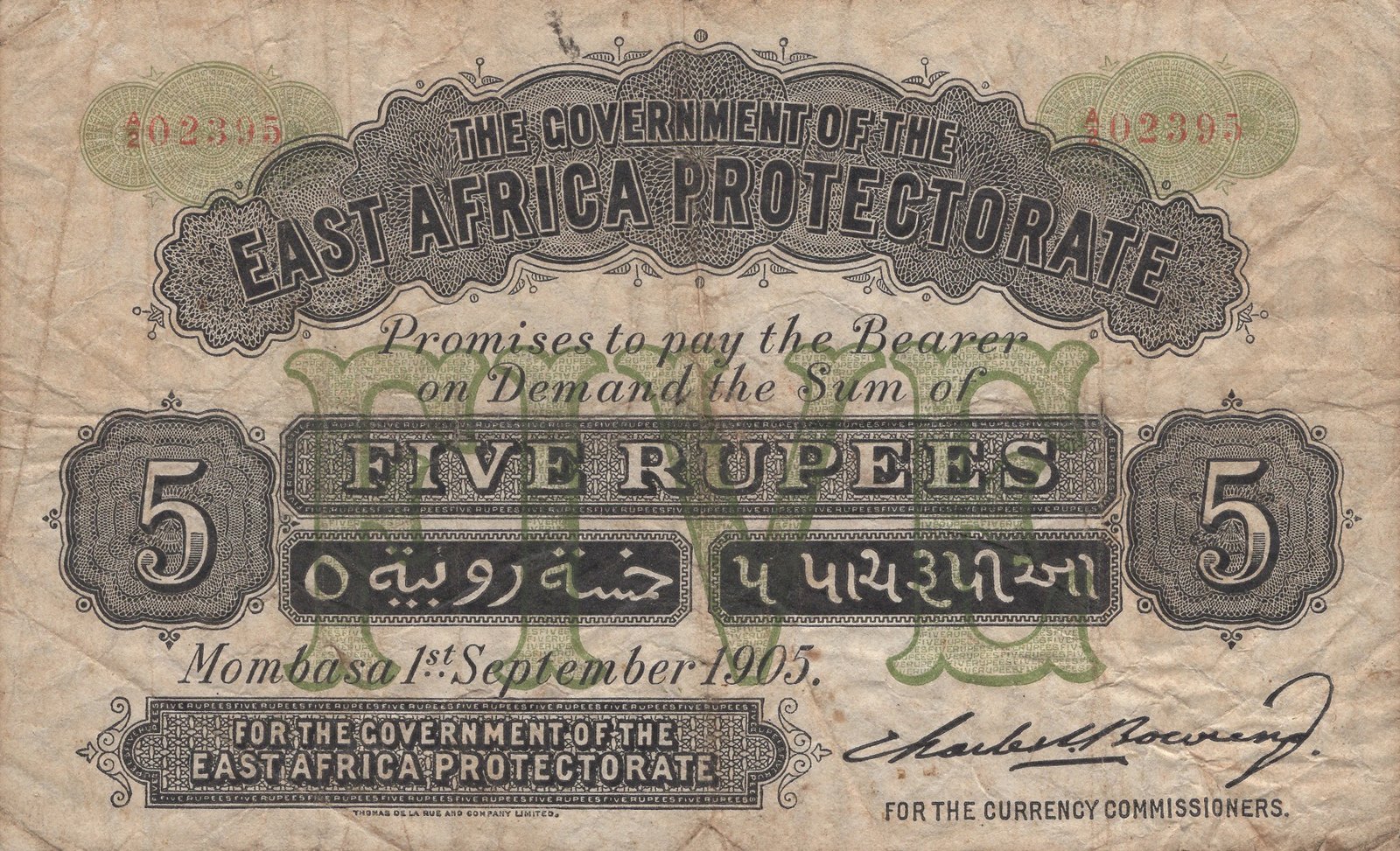
This article covers the rupee notes of the Government of the East Africa Protectorate, the first paper money of East Africa: the Order in Council behind them, the Currency Commissioners, the dates, signers and prefixes of each value, and the Board's own counts of notes issued and in circulation from 1906 to 1919. It is drawn from the catalogue's thirteen pages for these notes, which rest on the Official Gazette of the Protectorate, the Uganda Official Gazette, the Blue Books, the Colonial Office Lists and an article by Dr. David Lott in Bank Note Reporter of March 1985. How the notes ceased to be legal tender at the end of 1931 is told in Rupee, florin and shilling, 1918 to 1932.
The Order in Council of 1905
The rupee notes were issued under the East Africa and Uganda Order in Council of 10th February 1905. The issuer was a body of Commissioners of Currency, made up of the Treasurer of the East Africa Protectorate and two other officials. The notes were legal tender in the Uganda Protectorate as well as in East Africa.
The Order came into force in the East Africa Protectorate and in Uganda on 1st April 1906, by proclamations printed in the Official Gazette of that day. On the same day the first Currency Commissioners were appointed: C. C. Bowring, the Treasurer, with R. M. Combe and A. Marsden. The Colonial Office List for 1913 gives Bowring as Treasurer of the East Africa Protectorate from 1st October 1901 until the appointment as Chief Secretary in April 1911.
The Board's first abstract, in the Gazette of 15th April 1906, records that the first notes were issued to the public on 2nd April 1906. The abstracts put the notes in circulation at 200,000 rupees on 10th April 1906. The notes themselves carry an earlier date, 1st September 1905, and the catalogue gives Thomas de la Rue and Company as the printer of every value.
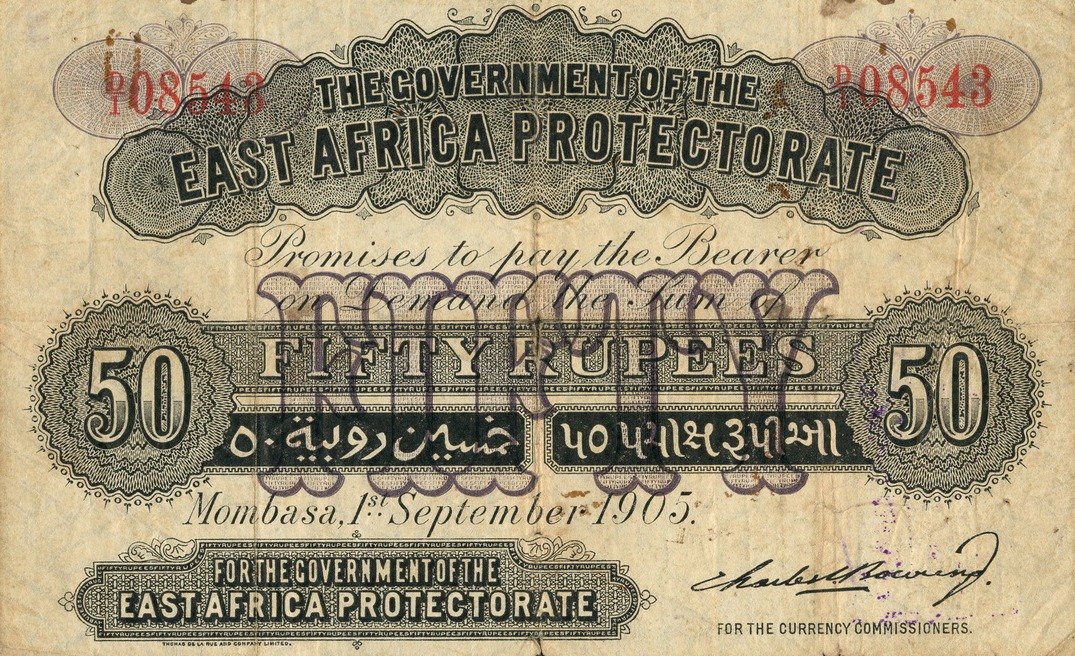
Seven values dated 1st September 1905
The catalogue keeps the 1st September 1905 printing of each value on a page of its own, apart from the later dates of the same design:
- 5 rupees of 1905, 172 by 108 mm
- 10 rupees of 1905, 204 by 127 mm
- 20 rupees of 1905, 206 by 130 mm, as are all the higher values
- 50 rupees of 1905
- 100 rupees of 1905
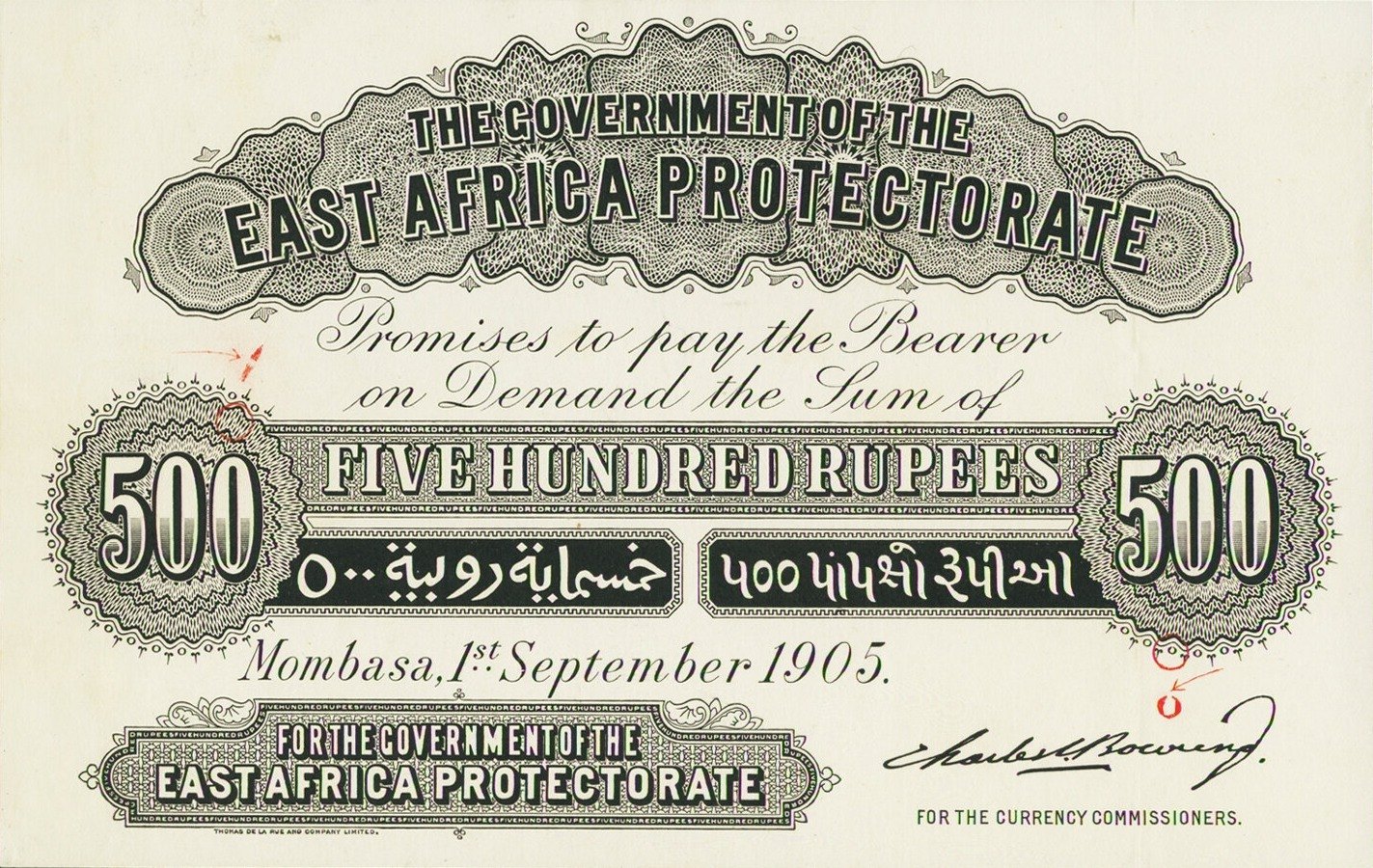
- 500 rupees of 1905
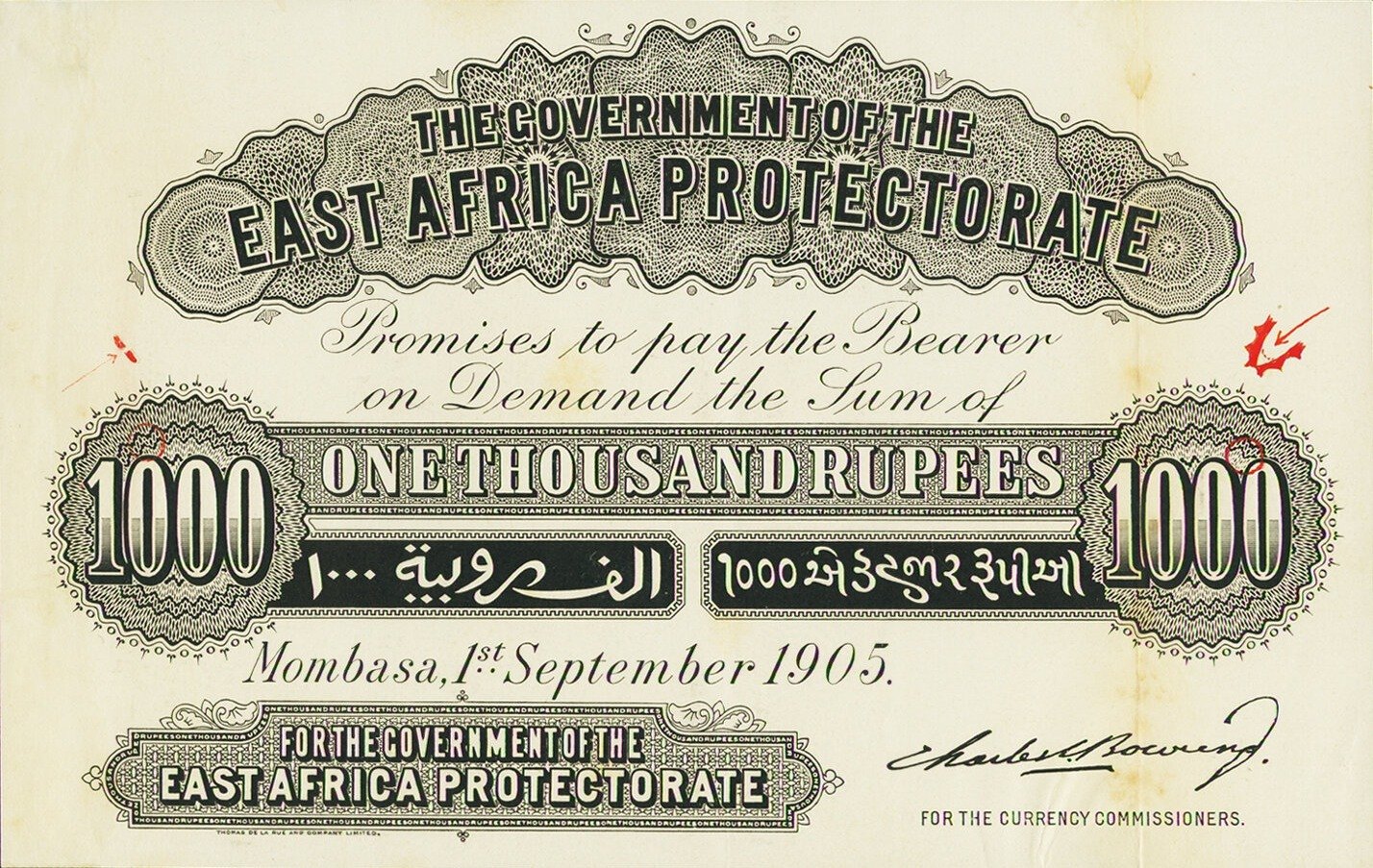
- 1,000 rupees of 1905
For the 100 and the 500 rupees no issued note dated 1st September 1905 has been recorded in the catalogue, and the pages show the black proof. The 1,000 rupees is recorded from the 1st September 1905 proof alone, and sources mention no other date. The Board's statements of notes by value for 31st March 1907, 1908, 1910, 1912 and 1913, printed in the Official Gazette, list notes of 5 to 500 rupees only, so no 1,000 rupees note had been issued by 1913. Whether one was issued after that the pages do not say.
The Board's counts, 1907 to 1912
The Board's statements in the Official Gazette give the notes issued in its first year, to 31st March 1907, and the notes in circulation on 31st March 1912. Dr. David Lott, writing in Bank Note Reporter in March 1985, gives the notes in circulation in 1908.
| Value | Issued to 31st March 1907 | In circulation in 1908 (Lott) | In circulation on 31st March 1912 |
|---|---|---|---|
| 5 rupees | 47,996 | 45,440 | 44,583 |
| 10 rupees | 44,998 | not on the note's page | 72,478 |
| 20 rupees | 10,252 | 10,949 | 30,835 |
| 50 rupees | 4,600 | 4,371 | 13,716 |
| 100 rupees | 2,000 | 3,887 | 4,788 |
| 500 rupees | 540 | 569 | 2,286 |
Lott puts the notes of 1908 at 1,761,500 rupees in all. The five values quoted from the article come to 1,337,930 rupees, which leaves 423,570 rupees for the 10 rupees: that is arithmetic from the figures above, not a number read in the article. The six counts for 31st March 1912 multiply out to 3,871,995 rupees, which is exactly the total the Board's abstract gives for that day.
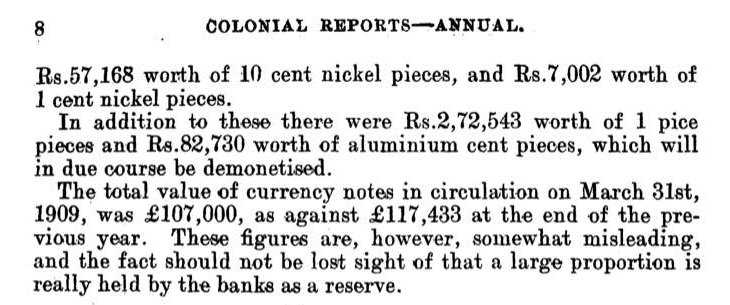
The annual report on the East Africa Protectorate for 1908-9 puts the notes in circulation at 107,000 pounds on 31st March 1909 against 117,433 pounds a year before, and remarks that a large part was really held by the banks as a reserve.
The first prefixes, from the Gazette
The Official Gazette's notices of found, half and cancelled notes show how the first notes of four values were numbered.
- 20 rupees. The first notes were numbered with prefix A/1: A/1 08518 was found near Naivasha in August 1907, and the list of cancelled notes of 15th February 1910 runs from A/1 00325 to A/1 15020. Prefix C/1 was in use by January 1912, when the half of C/1 00100 was presented beside four A/1 notes.
- 50 rupees. The first notes were numbered with prefix A/1 (A/1 01128, A/1 01204 and A/1 05286 in notices of 1907 and 1910). Prefix D/1 was in use by January 1912, when the half of D/1 00536 was presented.
- 100 rupees. The lists of cancelled notes show the first notes numbered A/1, in an unbroken run to A/1 05000 by January 1915, after which the lists move to prefix E/1.
- 500 rupees. The Gazette names notes with prefix A/1 (A/1 00189 cancelled by February 1910) and, in December 1912, one with prefix F/1 (F/1 01031).
The pages of the 20 and the 50 rupees add that no note with prefix A/1 has been recorded in the catalogue.
The later dates and the three signers, 1912 to 1919
The same designs were printed again with later dates. The catalogue puts these on the pages P-2 to P-6.
| Value | Dates, signers and prefixes as the pages give them |
|---|---|
| 5 rupees | 1st May 1916, Espie (A/2 to A/4); 1st December 1918, Espie (A/4) or Kempe (A/5) |
| 10 rupees | 1st July 1912 and 15th January 1914, Smallwood; 1st May 1916, Espie; 1st December 1918, Espie (B/3 to B/5) or Kempe (B/5 to B/9) |
| 20 rupees | 1st July 1912, Smallwood (C/1); 1st May 1916, Espie (C/1 and C/2); 1st December 1918, Espie (C/2) or Kempe (C/3) |
| 50 rupees | 1st July 1912; 1st May 1919, Kempe |
| 100 rupees | 1st July 1912; 1st May 1919, Kempe |
| 500 rupees | 1st July 1912; 1st May 1916; 1st May 1919 |
The prefixes run on across the dates, so several prefixes carry two dates or two signers. On the 10 rupees, B/1 carries 1912 and 1916 notes, B/3 carries 1916 and 1918 notes, and B/5 is listed for both signers of 1918. On the 20 rupees, C/2 carries both Espie dates. On the 5 rupees, A/4 is listed for both the 1916 and the 1918 Espie notes.
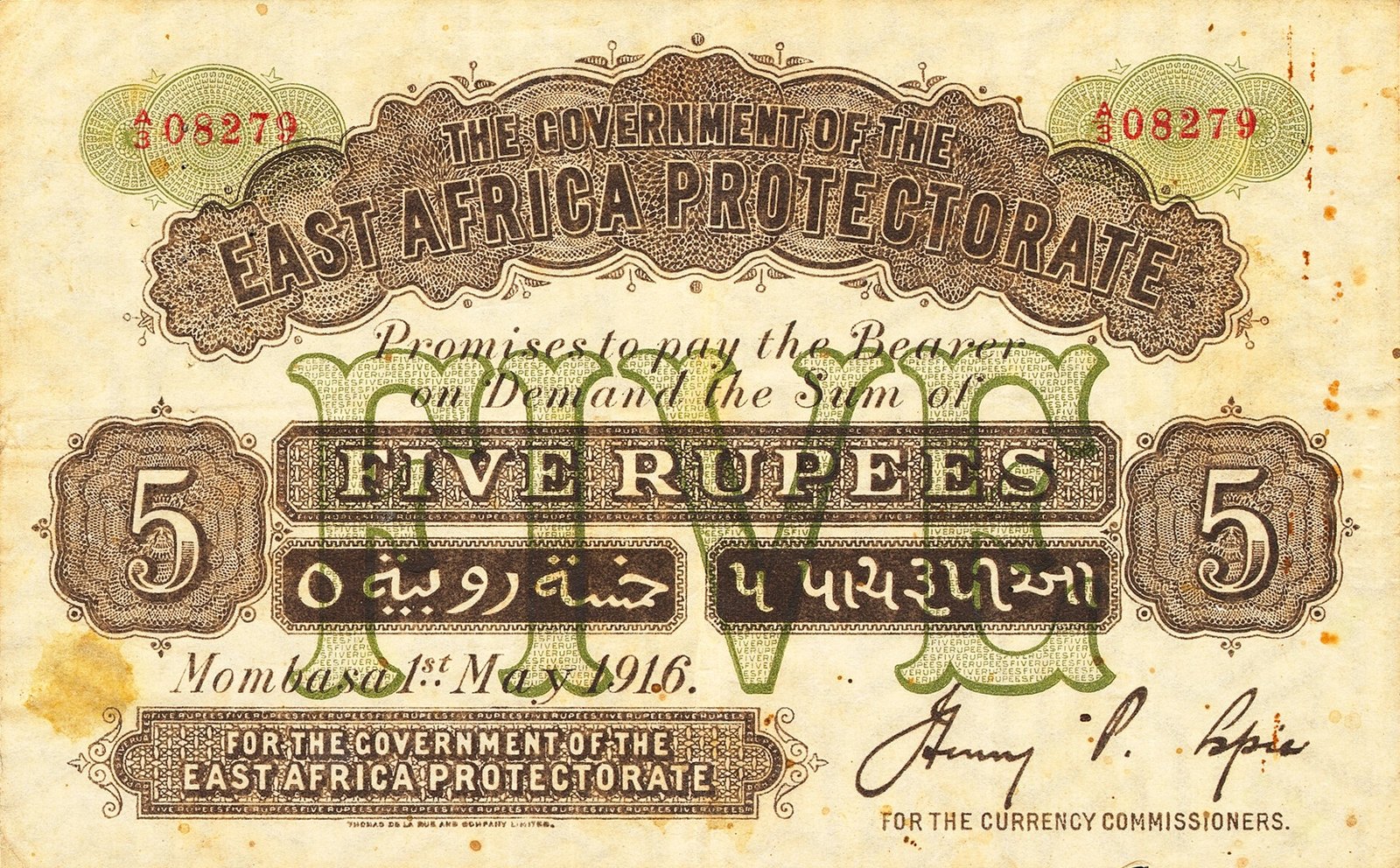
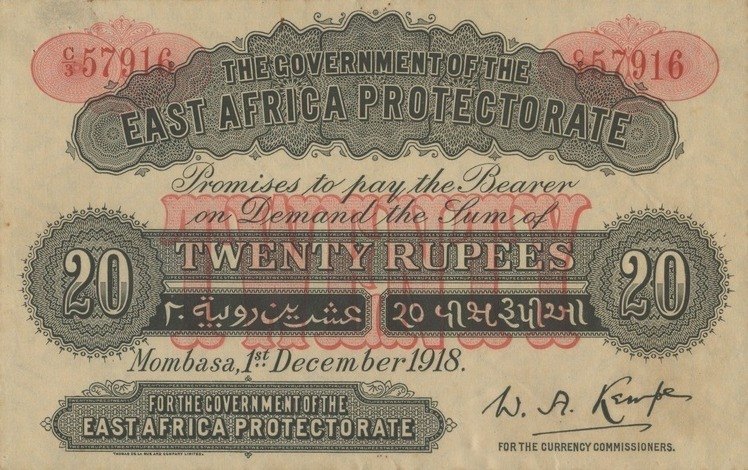
The offices of the three signers come from the Blue Books and the Colonial Office Lists:
- Smallwood was Treasurer of the Protectorate from 14th September 1911 (Blue Book for 1913-14) until a transfer to the Federated Malay States. H. A. Smallwood signed the Board's statement of 28th June 1912 as one of the three Currency Commissioners, with F. W. Major and William Radford (Official Gazette, 15th July 1912).
- Espie, Deputy Treasurer since 1903, became Treasurer on 30th March 1915, and already sat as one of the three Currency Commissioners in July 1914 (Uganda Official Gazette).
- Kempe became Deputy Treasurer on 30th March 1915 and was acting Treasurer in 1919 (Blue Book for 1914-15; Colonial Office List for 1920).
Notes in circulation, 1914 to 1919
The Board's statements of notes in circulation, reprinted in the Uganda Official Gazette, count the notes of each value, of every date together.
| Value | 31st March 1914 | 1917 | 1918 | 31st March 1919 |
|---|---|---|---|---|
| 5 rupees | 40,426 | 111,022 | 79,504 | 72,216 |
| 10 rupees | 65,209 | 166,870 | 160,118 | 201,250 |
| 20 rupees | 30,619 | 57,057 | 47,380 | 68,796 |
| 50 rupees | 9,860 | 10,159 | 7,842 | 9,156 |
| 100 rupees | 5,494 | 13,246 | 7,696 | 7,927 |
| 500 rupees | 3,660 | 7,514 | 8,445 | 13,427 |
On 31st March 1919 the 500 rupees notes, worth 6,713,500 rupees, made up more than half of the 11,713,500 rupees of the Protectorate's notes in circulation; the six counts of that day multiply out to the same 11,713,500 rupees. The Board's abstracts in the Official Gazette show the peak a few months earlier: 12,335,500 rupees on 10th December 1918.
Half notes and cancelled notes
From December 1908 the Commissioners paid a half note, less ten per cent, three months after a notice in the Official Gazette. From January 1910 to 1915 the Gazette printed the numbers of the notes the Commissioners cancelled. The Uganda Official Gazette, which reprinted the Commissioners' notices, printed more such lists in November and December 1917, of 5 rupees notes with the prefixes A/1 and A/2 and 10 rupees notes with the prefix A/1. A rule in force from 31st August 1912 made it an offence to cut or deface a note.
The numbers printed in these notices are listed note by note in 5,263 East African banknote numbers in the Kenya Gazette, 1907 to 1953. A notice does not say which date a note carried, so each list is shared between the 1905 page and the later page of the value.
Specimens, trials and what the houses say of survivors
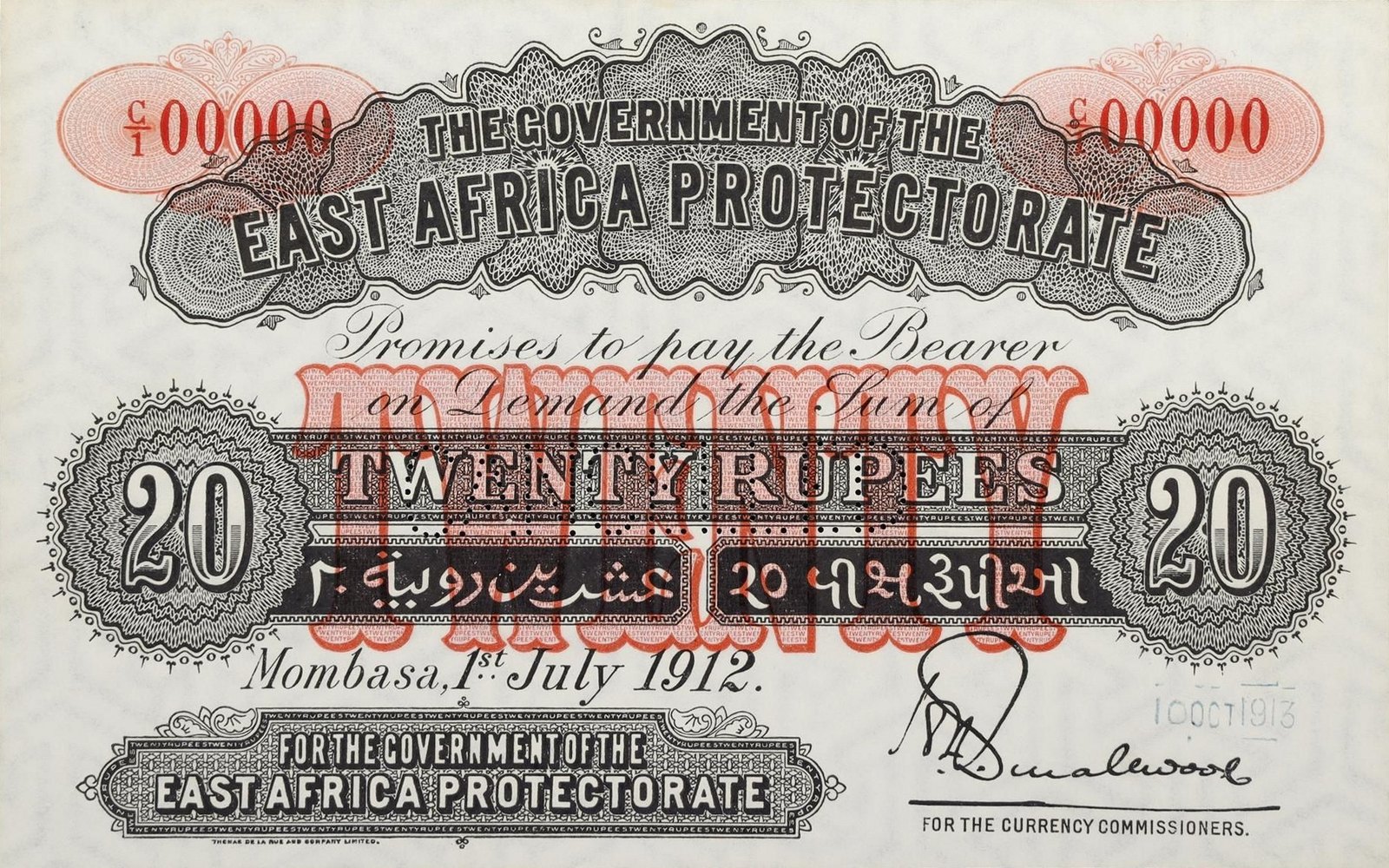
The colour trials and the specimens of the 20 rupees all carry the 1st July 1912 date and Smallwood's signature. The colour trials print the black design over an underprint in another colour in place of the issued red, and have no serial number; the specimens have a red all-zero C/1 serial number. Stack's Bowers' description of lot 20184 in its sale of 2 October 2024, a 20 rupees specimen of that date, says the piece carries a small stamp with a 1913 date and was kept for the archive.
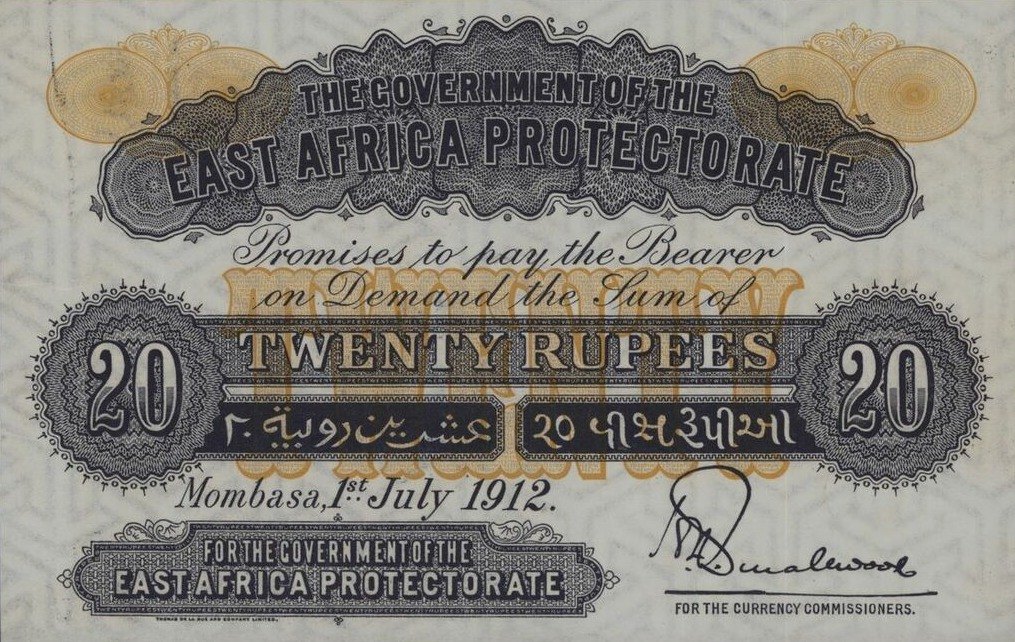
Three house statements bear on the issued notes:
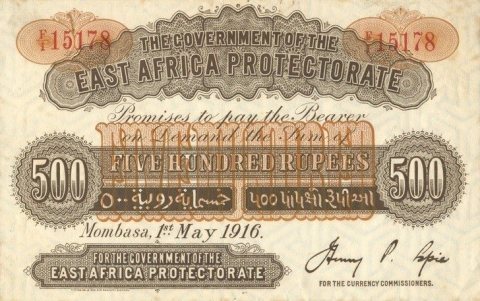
- Spink (2 October 2019, lot 828) believed its 500 rupees of 1st May 1916, F/1 15178, to be probably the only issued note of this type.
- Stack's Bowers (2 October 2024, lot 20185), describing a 500 rupees specimen of 1st July 1912, says the house knows of at least one issued 500 rupees, and that the notes were issued at Mombasa.
- Heritage (30 April 2021, lot 28224; the same note was lot 21386 on 24 April 2014 and lot 24125 on 17 October 2024) describes a 10 rupees of 1st July 1912, prefix B/1, from the Ruth W. Hill Collection, sold with a letter to Mrs. Hill from B. M. Ishmail of The Standard Bank Ltd. of Zanzibar dated 18 December 1964 about the purchase of the note and the notes of the early British administration. Heritage says the notes are uniface and on heavily watermarked paper.
Not settled
- Sources mention a 10 rupees dated 15th January 1914; none has been recorded in the catalogue, so its prefix is not known.
- Sources mention a 5 rupees of 1st December 1918 signed by Espie on prefix A/4; none has been recorded.
- Whether a 1,000 rupees note was ever issued. The Board's statements to 1913 list none.
- The pages name the signers of the 1912 to 1919 notes. They do not say whose signature the notes of 1st September 1905 carry.
Sources
- The Official Gazette of the East Africa Protectorate: proclamations of 1st April 1906; the Board's abstract in the issue of 15th April 1906; the Board's statements of notes by value for 31st March 1907, 1908, 1910, 1912 and 1913; the statement of 28th June 1912 (issue of 15th July 1912); notices of half, found and cancelled notes, 1907 to 1915.
- The Uganda Official Gazette: the Board's statements of notes in circulation, 1914 to 1919; lists of cancelled notes, November and December 1917; the Commissioners of July 1914.
- Annual report on the East Africa Protectorate for 1908-9.
- Blue Books of the East Africa Protectorate for 1913-14 and 1914-15.
- The Colonial Office List for 1913 and for 1920.
- Dr. David Lott, Bank Note Reporter, March 1985.
- Spink, 2 October 2019, lot 828.
- Stack's Bowers, 2 October 2024, lots 20184 and 20185.
- Heritage Auctions, 24 April 2014, lot 21386; 30 April 2021, lot 28224; 17 October 2024, lot 24125.
Member comments
Log in or register to post a comment.