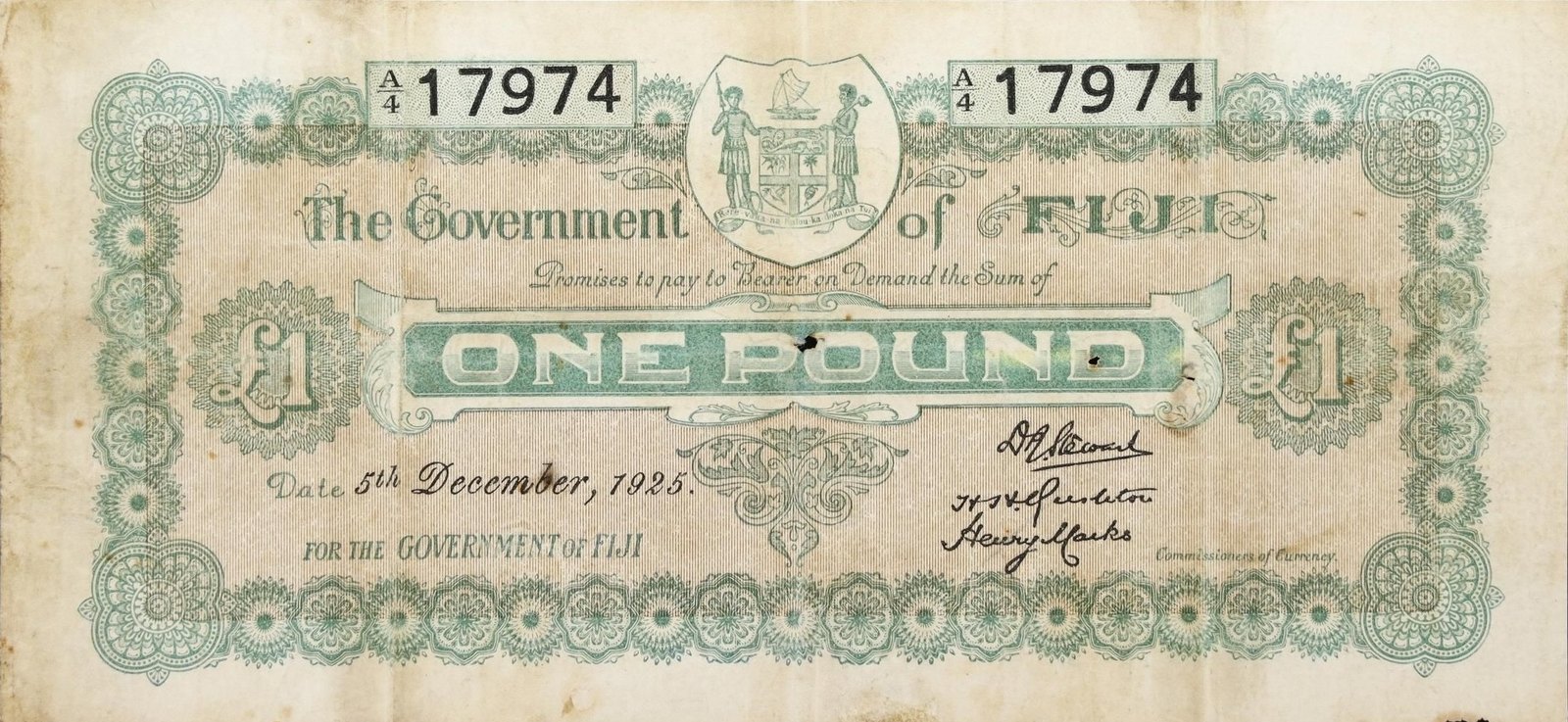
This article gathers what the Pick pages of the first Government issue of Fiji say about the law, the men who signed, the first days of the issue and the amounts in circulation. The figures come from the annual reports on the Colony that the pages name. Which dates of each value have a note behind them is the subject of another article, Fiji's first government notes, 1914 to 1933: a census, and is not repeated here.
Before the Government notes
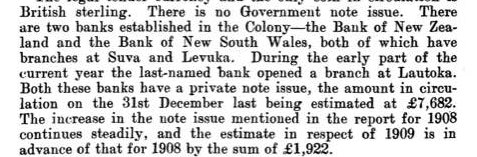
The annual report for 1909 says that the Colony had no Government notes. Two banks, the Bank of New Zealand and the Bank of New South Wales, each had a private note issue in Fiji, and the report estimates the two together at 7,682 pounds in circulation on 31st December 1909.
The Ordinance of 1913
The notes were issued under the Government Currency Notes Ordinance 1913 (No. 30 of 1913, dated 18th November 1913). It put the issue in the hands of three Commissioners of Currency: the Colonial Secretary, the Receiver-General and one member named by the Governor. The ordinance provided for notes of 1, 5, 10 and 20 pounds and any other value the Governor in Council approved. The Reserve Bank of Fiji, on its page "A History of Fiji's Currency", dates the Fiji Currency Board to 1914 and describes its work as managing Fiji's monetary affairs and issuing and redeeming currency.
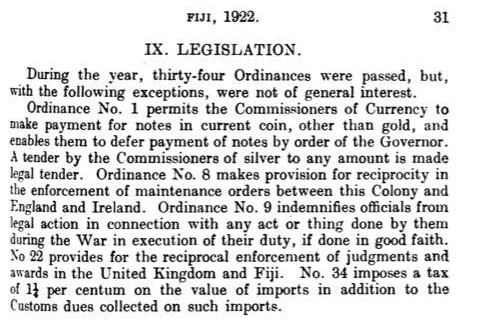
A second law changed what a holder could demand for a note. The annual report for 1922 says that Ordinance No. 1 of that year allowed the Commissioners to pay notes in current coin other than gold and to put off payment by order of the Governor, and made silver tendered by the Commissioners legal tender to any amount.
December 1914: the first stock
The first notes went into circulation in December 1914. The Commissioners of Currency held a first stock of £20,000 in notes on 4th December 1914, and £10,010 of it was in circulation by 10th December 1914. The Pick pages give these figures without naming their source.
The four values the ordinance named were the 1 pound, the 5 pounds, the 10 pounds and the 20 pounds. The earliest 1 pound row is dated 4th December 1914, the day of the first stock. The earliest rows of the three higher values are dated 1st April 1914.
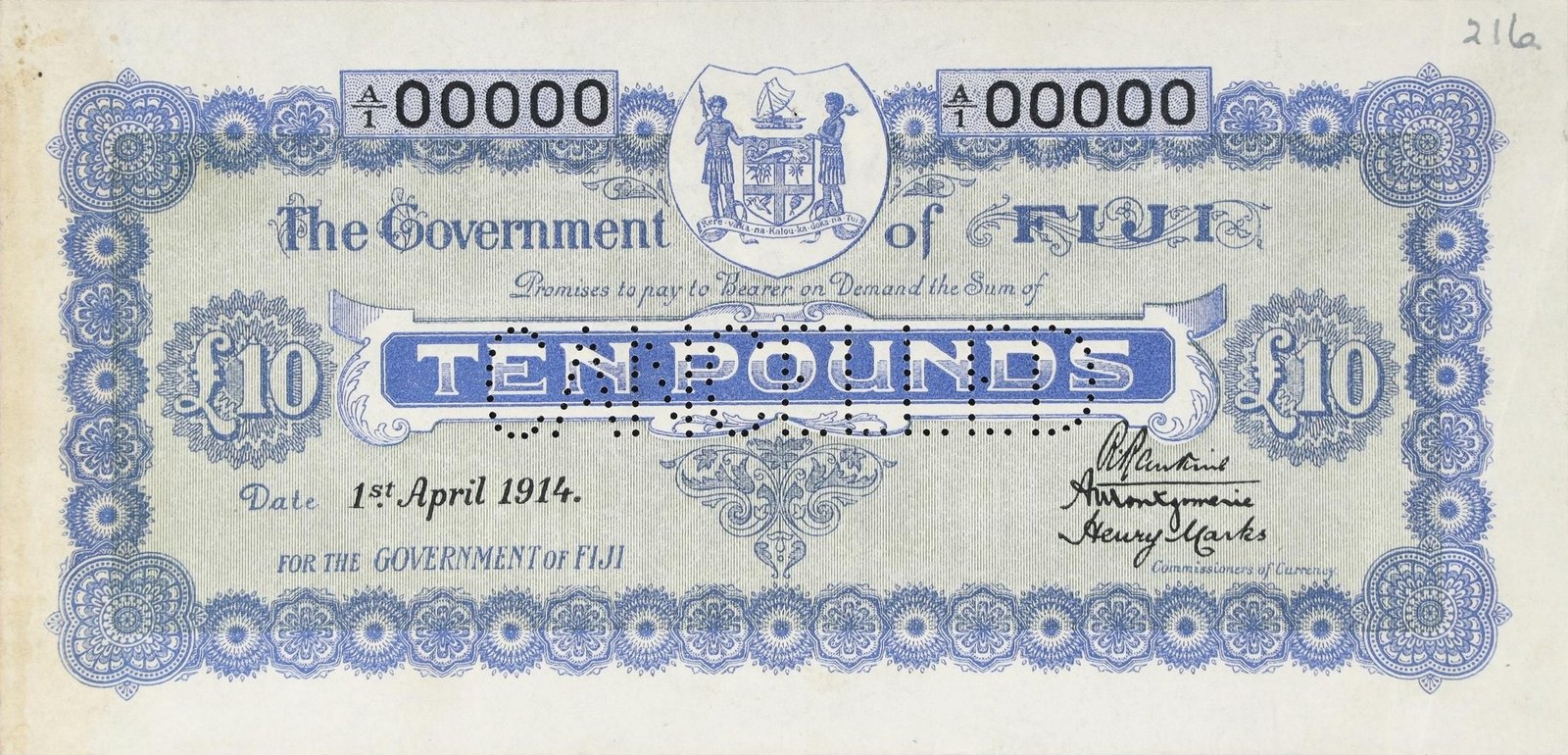
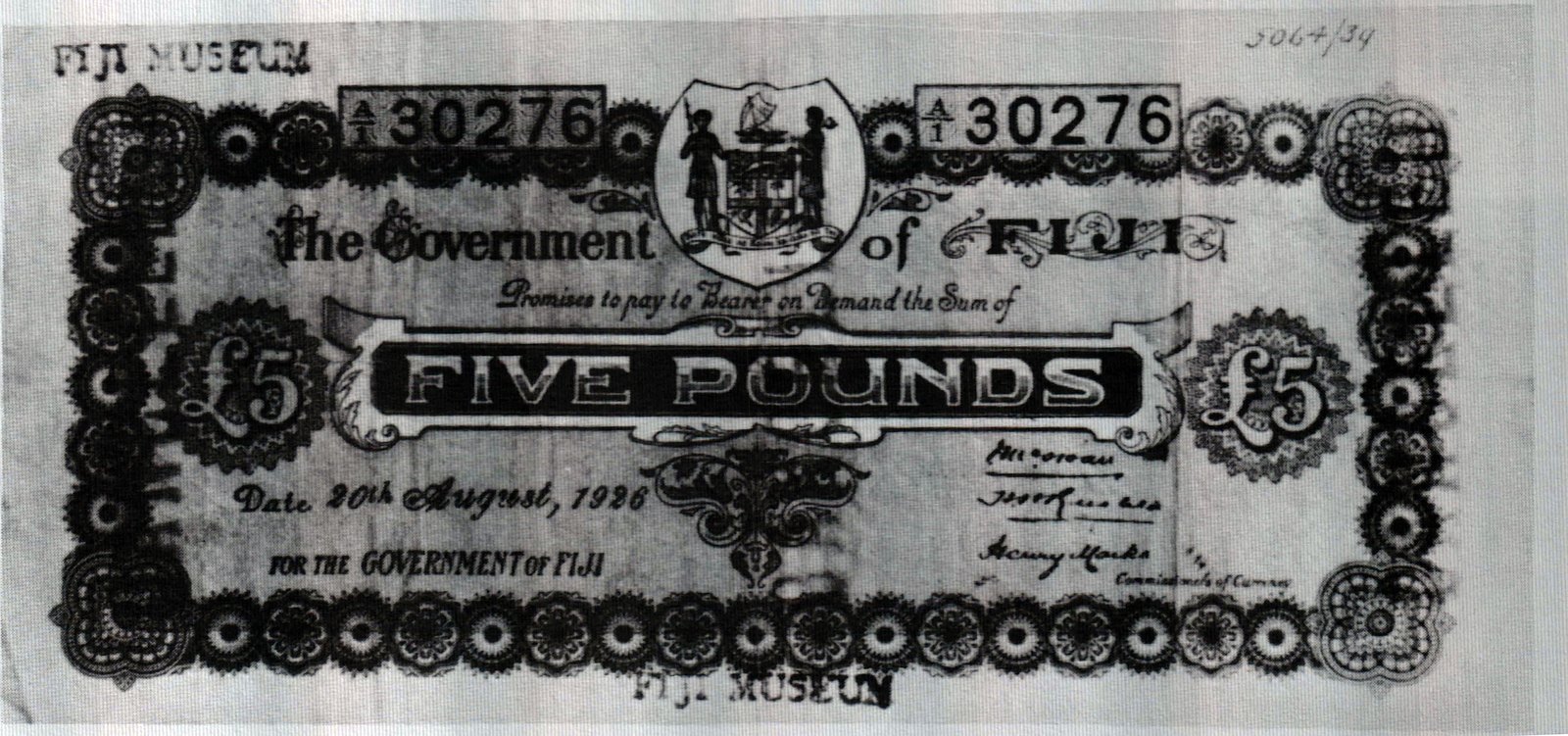
That earlier date is not the day those notes were signed. Sources mention that Rankine and Montgomerie first served together as Commissioners of Currency, as acting Colonial Secretary and acting Receiver-General, from 13th August 1915, so notes dated 1st April 1914 with their signatures were signed after their printed date.
The printer and the paper
All the notes of the issue were printed by Thomas de la Rue, on one side only. The 5 and 10 shillings carry the printer's imprint; the pound notes have none. The four pound values share one size, 197 by 93 mm; the 10 shillings measures 130 by 85 mm and the 5 shillings 136 by 77 mm.
The annual report for 1925 says that from December 1925 the notes in circulation began to be withdrawn and replaced by notes of the same designs and values on paper of better quality. The catalogue has rows dated 5th December 1925 for the 5 shillings, the 10 shillings, the 1 pound and the 10 pounds. The report does not describe the old paper or the new, and the Pick pages do not say how a note on the better paper is told from an earlier one.

Two smaller values: 10 shillings and 5 shillings
The ordinance left room for other values, and two were added.
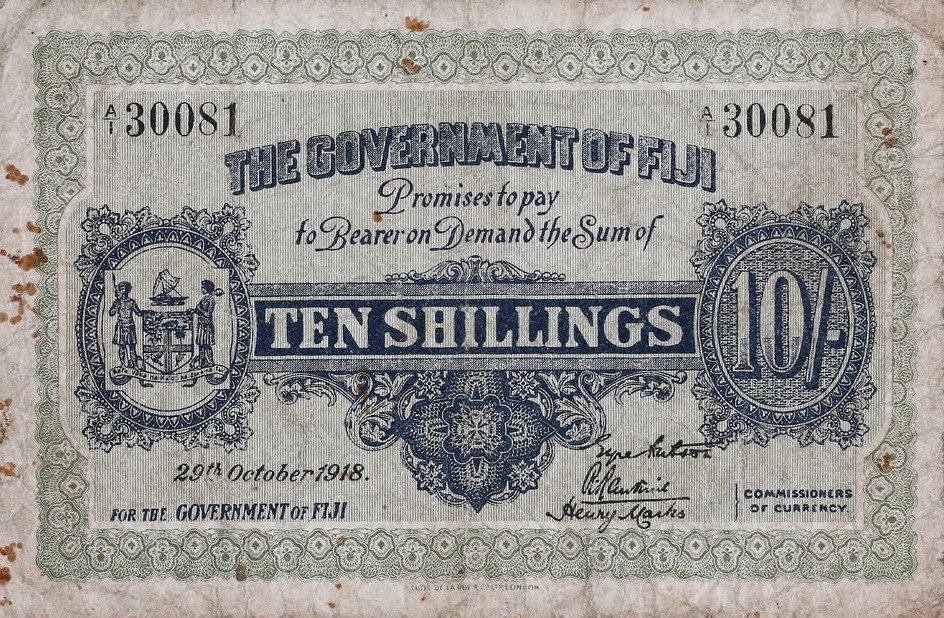
Sources mention that the Commissioners proposed a 10 shillings note in March 1918, and that the first 10 shillings notes were issued on 23rd May 1919. The earliest row of the value is dated 29th October 1918, nearly seven months before that day of issue.
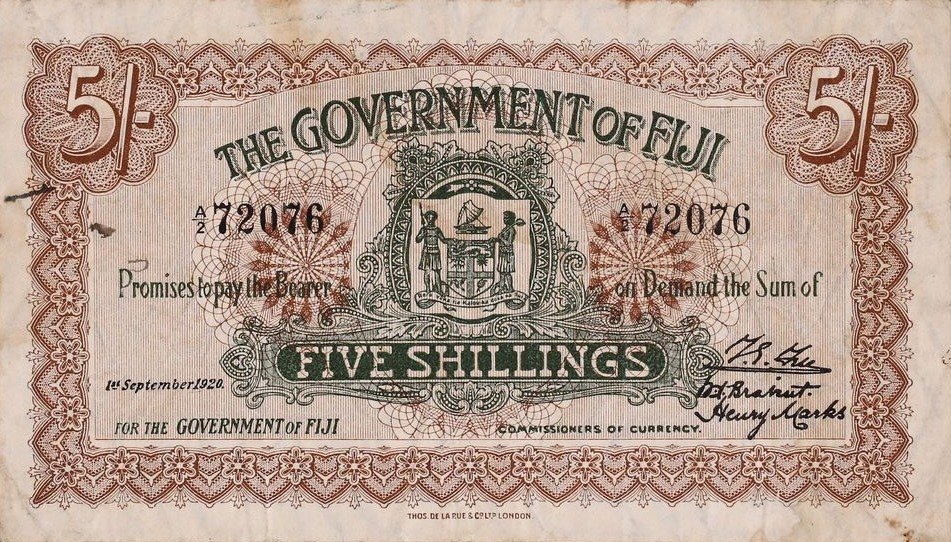
Sources mention that the 5 shillings was proposed in October 1919, when the gold reserves were running low, as a note backed by silver. Its earliest row is dated 1st January 1920. Heritage, describing lot 26105 of its sale of 24 April 2020, reckons from the printing figures that about 400,000 of the 5 shillings were issued.
What the annual reports counted
The reports give the notes in circulation at the end of a year, and in most years the value of what was held against them. The figure for 1909 is the two banks' issue; the rest are the Government notes.
| 31st December | Notes in circulation | Held against them | Source |
|---|---|---|---|
| 1909 | 7,682 pounds (bank notes, estimated) | not given | annual report for 1909 |
| 1922 | 326,945 pounds | 366,655 pounds | annual report for 1922 |
| 1925 | 355,199 pounds | not given on the pages | annual report for 1925 |
| 1928 | 431,583 pounds | 488,155 pounds | annual report for 1928 |
| 1929 | 441,583 pounds | 524,072 pounds | annual report for 1929 |
| 1931 | 405,384 pounds | 483,427 pounds | annual report for 1931 |
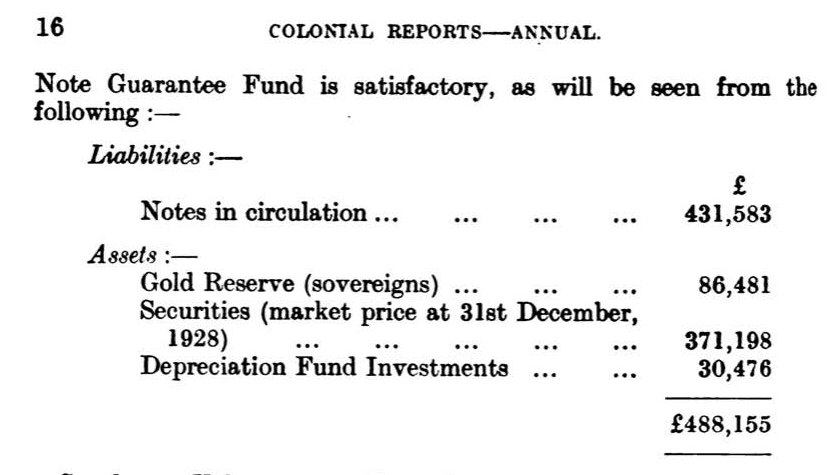
For 1922, 1928 and 1929 the reports describe the cover as gold sovereigns and securities. The report for 1931 names it: a Currency Notes Guarantee Fund of gold sovereigns and securities worth 483,427 pounds. In every year for which both figures are given, the fund was worth more than the notes outstanding.
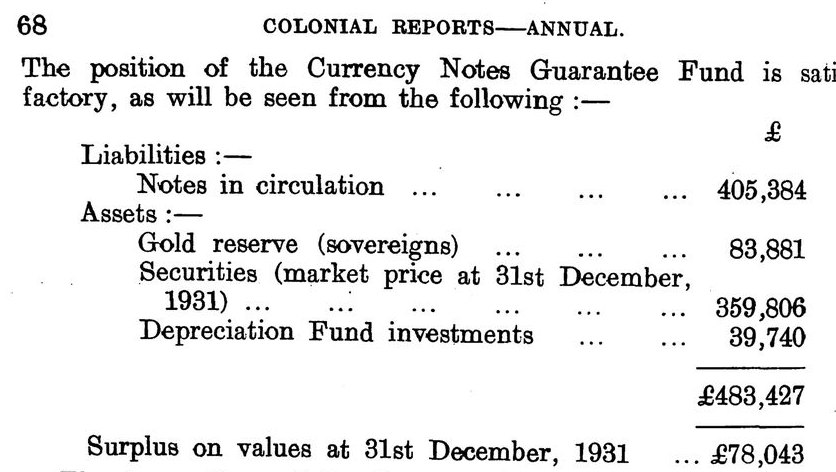
The pages hold no figure for the years 1914 to 1921, for 1923, 1924, 1926, 1927 or 1930, or for 1932 and 1933. None of the reports quoted breaks the total down by value.
The signatures as a clock
The notes carry the signatures of the Commissioners, and the men in office on the printed date are a test of that date.
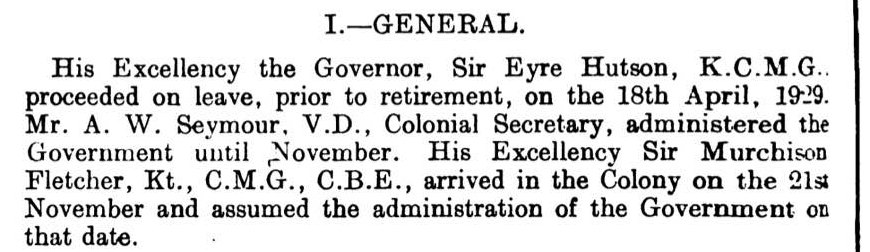
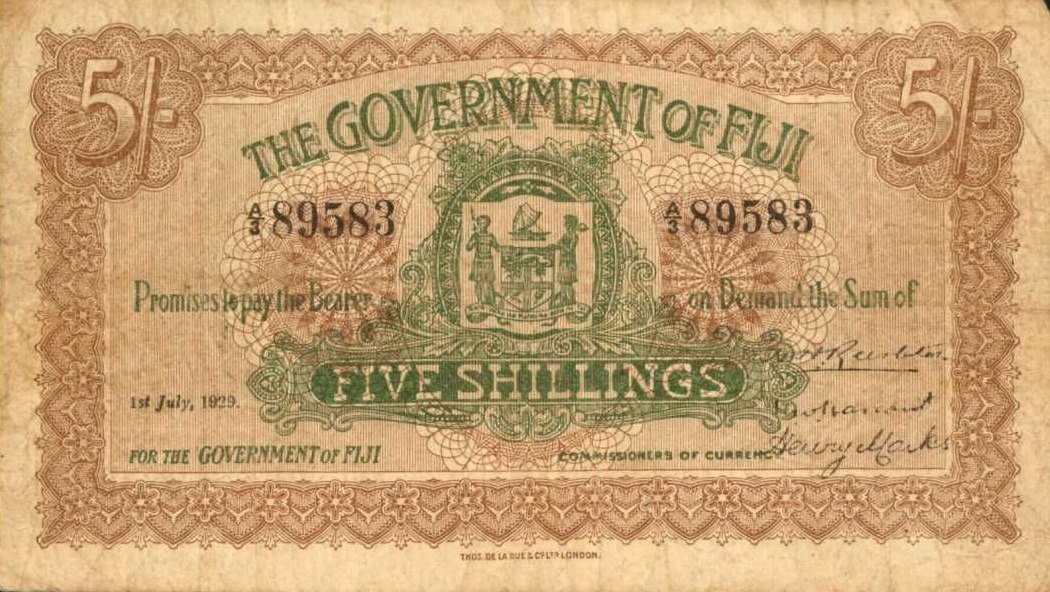
The annual reports for 1928 and 1929 say that A. W. Seymour, the Colonial Secretary, acted as Governor until 14th April 1928 and again from 18th April 1929 until November. The notes dated 4th February 1928 and 1st July 1929 fall in those months, and they carry another signature in the Colonial Secretary's place: McOwan on the first and Rushton on the second. The catalogue has rows of 4th February 1928 for every value but the 20 pounds; the date 1st July 1929 is on the 5 shillings alone.
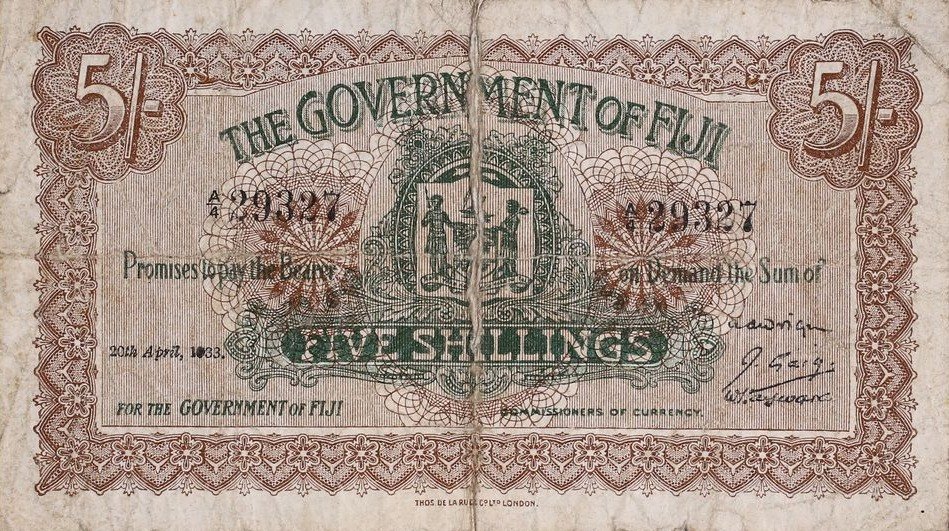
The same test supports two dates of the 5 shillings that not all sources mention. Notes of 20th April 1933 and 3rd July 1933, both with prefix A/4, are recorded from auction sales. Sources list Wright, Craig and Hayward as the Commissioners in office in April 1933 and Wright, Chamberlain and Hayward from 30th June 1933, and those are the signatures the two notes carry.
Dates that rest on a specimen or a single report
Several dates are in the catalogue on thin evidence, and the Pick pages say so:
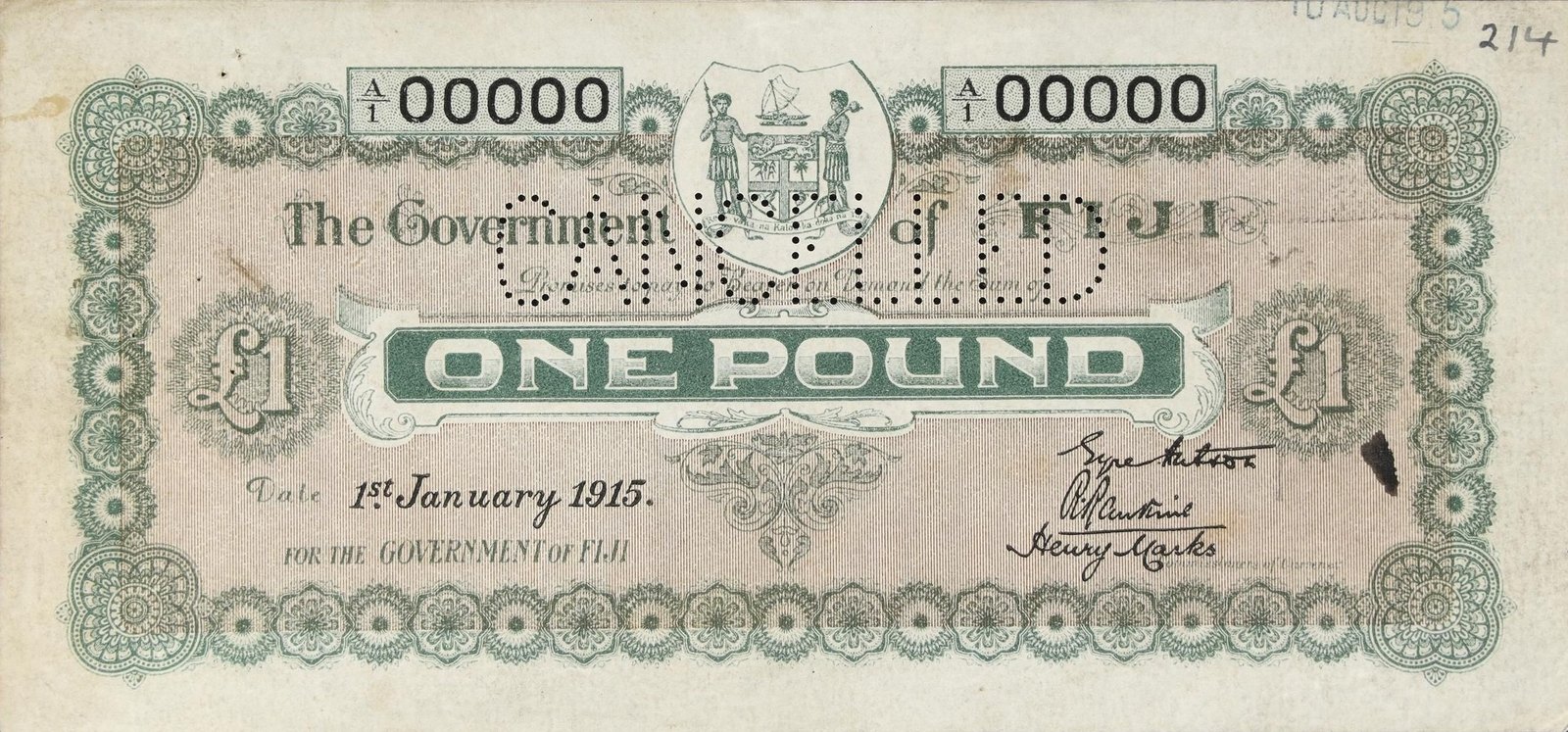
- 1 pound, 1st January 1915, prefix A/1: recorded from a note seen at auction. Stack's Bowers, describing a specimen of this date (17 January 2025, lot 20344), says that the Banknote Book lists eight dates for the 1 pound between 1914 and 1930 and leaves this one out, though the house had seen at least one issued note of the date.
- 1 pound, 1st March 1921, prefix A/3: recorded from specimens. No issued note has been seen.
- 5 pounds, 1st January 1915 and 1st August 1920, prefix A/1: both from specimens. No issued note of either date has been seen.
- 10 pounds, 1st August 1920, prefix A/1: from a specimen. One note of 5th December 1925 is reported graded, but no photograph has been seen.
- 5 shillings, 8th December 1933: from one published photograph.
The specimens Stack's Bowers sold on 17 January 2025 (lots 20344 to 20347, one of each pound value) are perforated CANCELLED and carry all-zero serial numbers. Of the 20 pounds specimen dated 1st April 1914 (lot 20347) the house wrote that it was unclear whether that date was ever issued. The catalogue has a row for an issued 20 pounds of that date.
The end of the issue
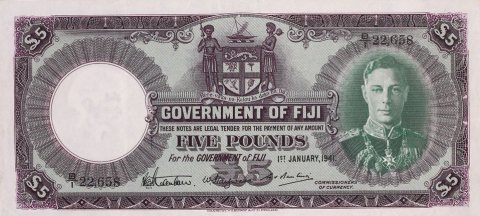
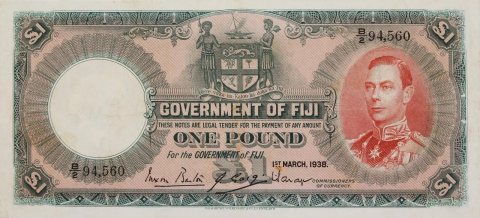
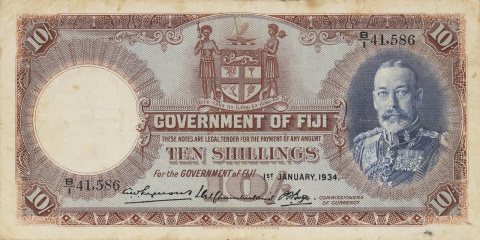
The last dates of the issue are of 1933. On 25th July 1933 a new law was assented to, the Fiji Currency Notes Ordinance 1933 (No. 6 of 1933), and the notes from 1934 were issued under it: the portrait notes of King George V, printed by Bradbury Wilkinson, the lowest value being the 5 shillings of 1934. Heritage (24 April 2020, lot 26105) says most of the uniface notes were withdrawn when those notes came in.
The Pick pages give no day on which the uniface notes ceased to be legal tender, and no count of the notes printed for any value but the 5 shillings.
Sources
- The annual reports on Fiji for 1909, 1922, 1925, 1928, 1929 and 1931, as quoted on the Pick pages.
- The Government Currency Notes Ordinance 1913 (No. 30 of 1913) and the Fiji Currency Notes Ordinance 1933 (No. 6 of 1933), as cited on the Pick pages.
- The Pick pages of this catalogue for P-25 to P-30, with their rows and specimens.
- Heritage, 24 April 2020, lot 26105.
- Stack's Bowers, 17 January 2025, lots 20344 to 20347.
- Reserve Bank of Fiji, "A History of Fiji's Currency", https://www.rbf.gov.fj/core-functions/currency-management/a-history-of-fijis-currency/
Member comments
Log in or register to post a comment.