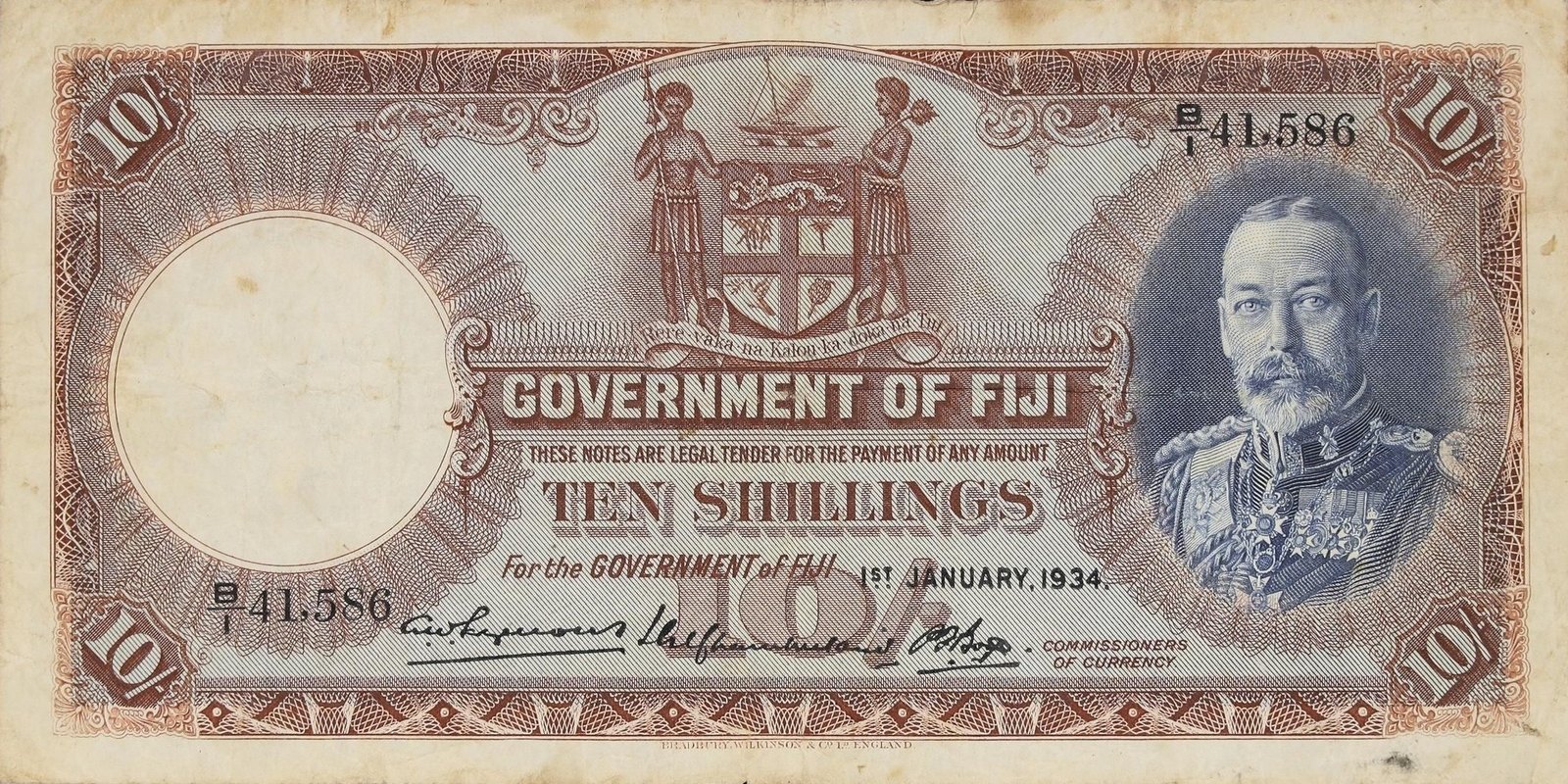
The Pick pages of Fiji name two ordinances, of 1913 and 1933, and the wartime regulations. The currency laws themselves, the Fiji Royal Gazette, the annual reports and the articles of Kerry Rodgers in the IBNS Journal hold a longer chain. This article sets the laws in order of time and says, for each, where it is to be found. The story of the notes is told in The paper money of Fiji, 1914 to 2013.
Before the Colony: the Legal Tender Act of 1872
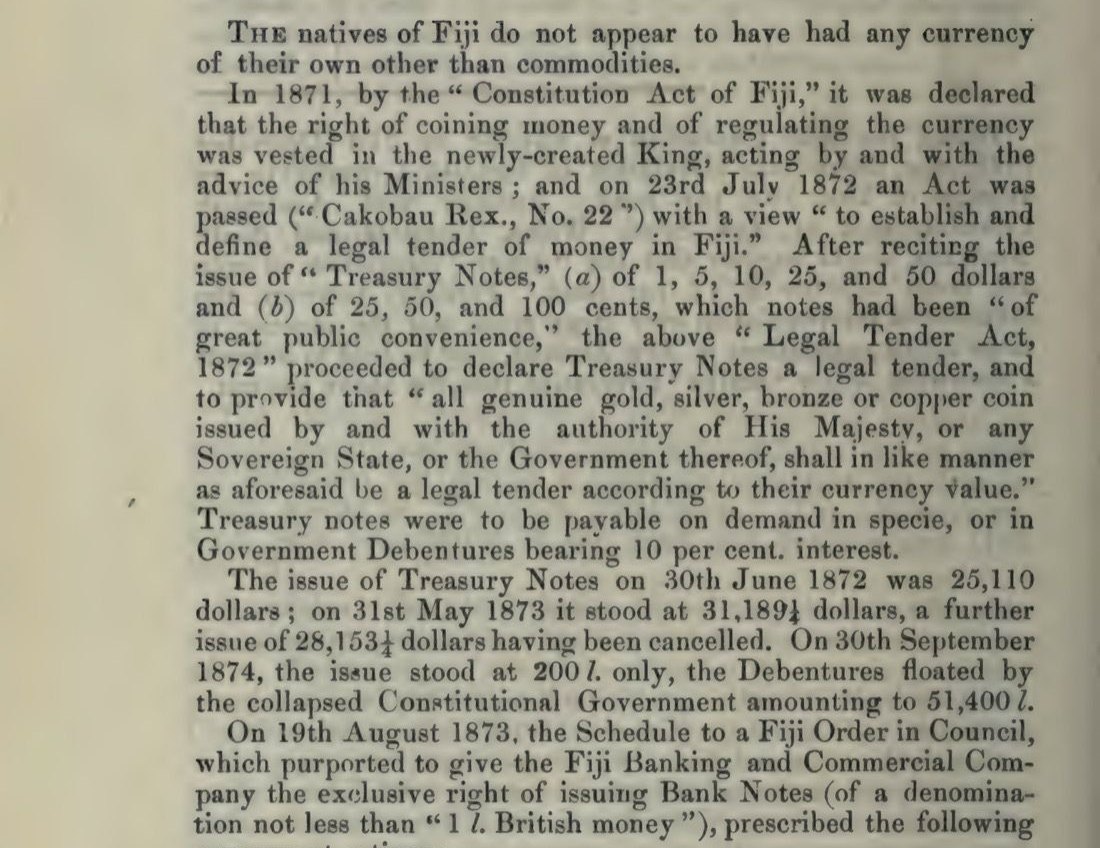
Robert Chalmers, in A History of Currency in the British Colonies (London, 1893, chapter XXX, p. 292), records the paper money of the government of King Cakobau. The Legal Tender Act of 23rd July 1872 ("Cakobau Rex., No. 22") made legal tender the Treasury Notes of 1, 5, 10, 25 and 50 dollars and of 25, 50 and 100 cents, payable on demand in specie or in Government Debentures bearing 10 per cent. Chalmers gives 25,110 dollars of them out on 30th June 1872, 31,189 1/4 dollars on 31st May 1873, and "200 l. only" on 30th September 1874. An Order of 19th August 1873 gave the Fiji Banking and Commercial Company the sole right to issue notes of 1 pound and upwards.
Kerry Rodgers, in "Fiji's Debentures of 1871-3: currency or no?" (IBNS Journal, volume 45, number 4, 2006, pp. 24 to 26), adds the debentures: a Loans Act of December 1871, a first issue on 15th December 1871 at 10 per cent interest, and about 7,500 pounds (37,500 Fiji dollars) of government paper outstanding in May 1872. These notes are older than the Colony and have no pages in this catalogue, which begins with the Government notes of 1914.
The Government Currency Notes Ordinance 1913
The texts of the ordinances used here are the printed copies in the file of currency board laws of the Johns Hopkins currency board archive, called the currency laws below. Ordinance No. XXX of 1913 is dated 18th November 1913 (the currency laws, pp. 194 to 200). It provided:
- three Commissioners of Currency, the Colonial Secretary, the Receiver-General and one other person named by the Governor, with an office in Suva;
- notes of 1, 5, 10 and 20 pounds and of any other value approved by the Governor in Council;
- form, design, plate, paper and signatures, or facsimiles of signatures, as the Secretary of State approved;
- that the notes were legal tender;
- that the ordinance came into force on a day to be proclaimed, once the King's pleasure not to disallow it was known.
K. A. Rodgers and Carol Cantrell, in "Fiji's Commissioners of Currency I: 1914 - 1933" (IBNS Journal, volume 29, number 1, 1990, p. 4), say the ordinance was passed on 6th November 1913, was modelled on the law of Jamaica, and that the issue was proclaimed on 4th December 1914. That is the day on which the first Gazette statement gives a stock of £20,000, and the date of the earliest 1 pound. The working paper "Evaluating the Fijian Board of Commissioners of Currency" (SAE 116, p. 14 and appendix), held in the Johns Hopkins currency board archive, adds that the notes were exchangeable for gold coin.
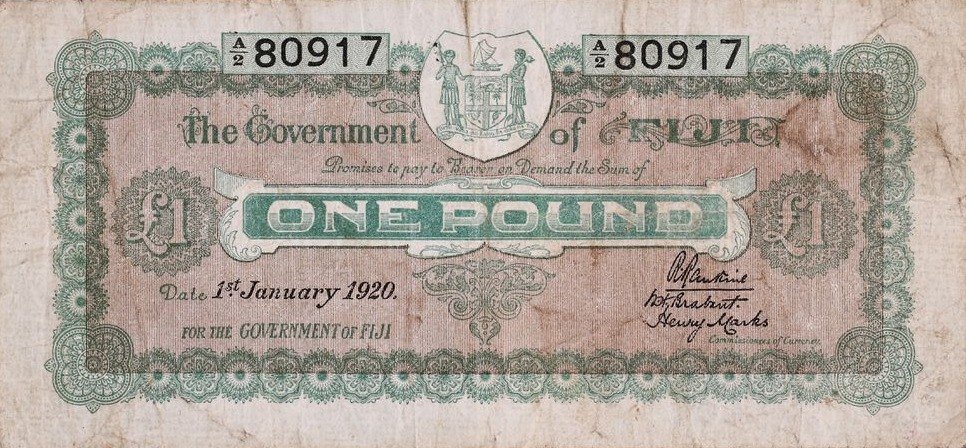
The printed ordinance is dated 18th November 1913 and Rodgers and Cantrell give 6th November 1913 as the day the law was passed. No source read explains the two dates.
One trap for a reader of the Gazette: the abstracts of 1933 cite "section 10(5) of Ordinance No. 9 of 1913", and the margin of the 1933 ordinance also cites the law of 1913 as No. 9. This is the same law under a later numbering, probably that of a revised edition of the laws.
Amendments, 1917 to 1932
| Law | Date | What it did | Source |
|---|---|---|---|
| Ordinance No. 19 of 1918, "to amend the Government Currency Notes Ordinance" | 1918 | not given in the notice | Fiji Royal Gazette 1919: notice, after a telegram of 25th July 1919, that the King would not be advised to disallow it (read in the machine-read text only) |
| Government Currency Notes Amendment Ordinance 1920 | 19th November 1920 | notes could also be issued against silver coin; notes below 10 shillings could be paid in silver instead of gold | the currency laws |
| Amendment Ordinance 1922 | 1st June 1922 | the Governor in Council could allow the Commissioners to put off payment of notes for a set period; silver tendered by the Commissioners was legal tender to any amount | the currency laws |
| Currency Notes (Amendment) Ordinance 1932, No. 42 of 1932 | 13th December 1932 | for six months the Commissioners could issue notes against New Zealand currency or drafts on New Zealand, those notes being redeemable in New Zealand currency; notes issued earlier outside the rules of section 4(1) were declared validly issued | the currency laws |
The annual report for 1922 (No. 1171, p. 31) describes an Ordinance No. 1 of that year in nearly the same words: it "permits the Commissioners of Currency to make payment for notes in current coin, other than gold, and enables them to defer payment of notes by order of the Governor", and makes a tender of silver by the Commissioners legal tender to any amount. The report gives neither the short title nor the day of that ordinance.
The currency laws also hold amendments of 14th February 1917 (the note fund might be invested in Fiji War Loan debentures), 20th December 1918 and 10th May 1921. As they were read, these three change only the rules of the fund.
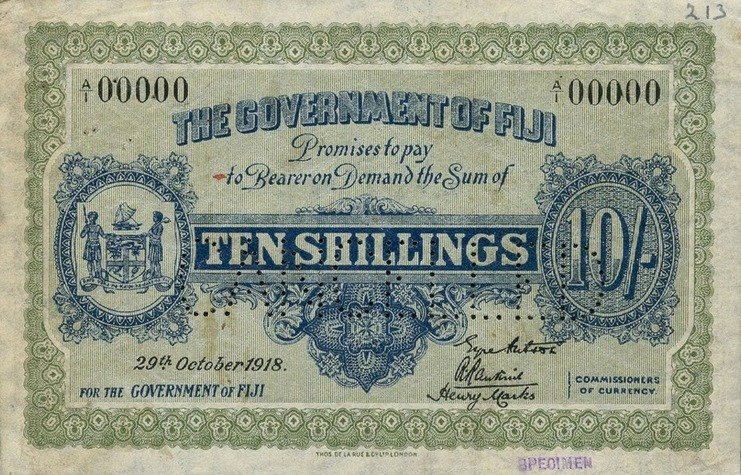
The amendment of 1918 falls in the year of the first 10 shillings, dated 29th October 1918. Rodgers and Cantrell (p. 6) write that a 10 shillings note was recommended on 11th March 1918. But the Gazette notice gives only the title of the ordinance. Whether Ordinance No. 19 of 1918 is the amendment of 20th December 1918, which touched only the fund, is not said in the sources read.
The amendment of 1920 concerns one note: the only value below 10 shillings was the 5 shillings, first dated 1st January 1920. Rodgers and Cantrell (p. 6), from the Board's records, date the proposal to 1st October 1919, when the gold reserves were dwindling and a 5 shillings note backed by silver was recommended.
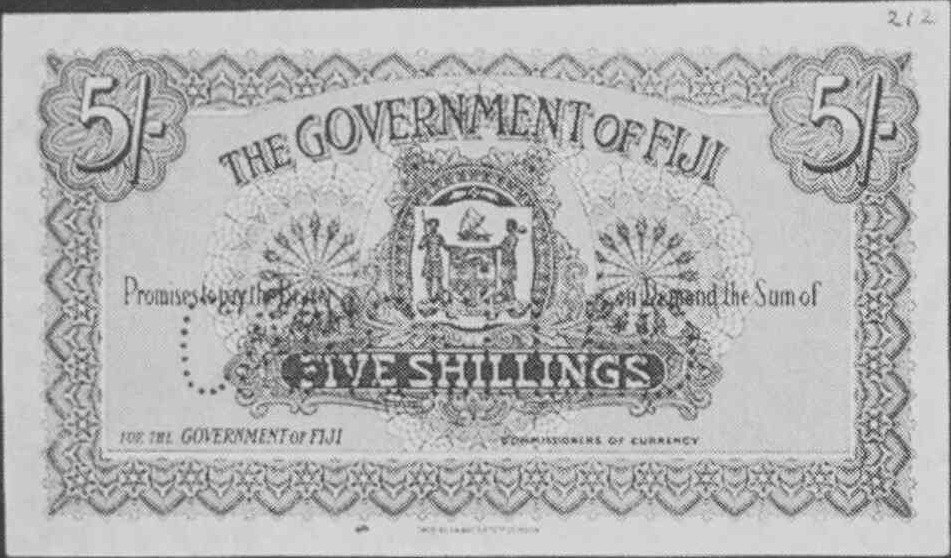
The ordinance of 1932 was passed during the last months of the uniface notes, for which the catalogue has many dates of 1932 and 1933. It names no note, date or series.
The Fiji Currency Notes Ordinance 1933
| Step | Date | Source |
|---|---|---|
| "A bill to provide for the Issue of Government Currency Notes" listed among the bills to be presented to the Legislative Council | 23rd June 1933 | Fiji Royal Gazette No. 32, p. 223 (machine-read text) |
| Ordinance No. 6 of 1933 assented to | 25th July 1933 | the currency laws |
| Date printed on the ordinance | 1st November 1933 | the currency laws |
| In force | "a date proclaimed" in the law; 1st November 1933 in the working paper SAE 116, p. 14 | as named |
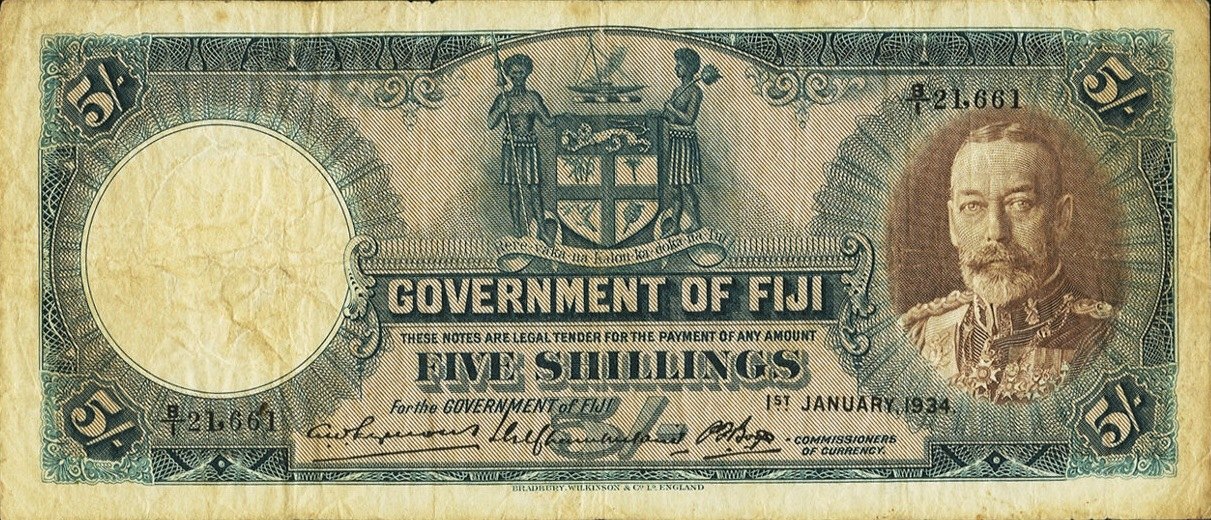
The Board was now the Colonial Secretary, the Colonial Treasurer and one other person named by the Governor. Values and designs were as the Secretary of State approved. Notes were issued at 111 Fiji pounds for 100 pounds sterling lodged with the Crown Agents, and the working paper notes that the law no longer speaks of gold or silver. Rules made under it could call in and demonetise the notes of the ordinances of 1913 and 1932. The annual reports for 1933 and 1934 put the rate of 111 to 100 from the end of March 1933, and speak of a new issue of 20, 10, 5 and 1 pounds, 10 shillings and 5 shillings at the beginning of 1934, together with the new Fiji coinage. Those are the George V notes, from the 5 shillings to the 20 pounds.
The Gazette No. 43 of 25th August 1939 lists a bill to amend the ordinance of 1933 (read in the machine-read text only). Its content was not read.
The war: regulations, notices and a proclamation
| Law or notice | Date | What it did | Source |
|---|---|---|---|
| Defence (Currency Notes) Regulations 1942 | made at Suva, 19th January 1942 | made the overprinted New Zealand notes legal tender | K. A. Rodgers, "Fiji's World War II Currencies: the Official Records", Part I, IBNS Journal, volume 36, number 2 (1997), p. 39, with the notice reproduced |
| Secretary of State's approval of notes of low value in place of coin | requested 16th May 1942, approval received 26th May 1942 | allowed the shilling notes to be made | the same, pp. 33 and 34 |
| Defence (Currency Notes) (No. 2) Regulations; Treasury notice | 6th June 1942 | allowed notes under five shillings, legal tender up to limited amounts | Part II of the same, IBNS Journal, volume 36, number 3 (1997), p. 15 |
| Treasury notice | 22nd September 1942 | announced the 1 shilling with yellow background and the letters A and B | the same, p. 15 |
| Treasury notice in the Fiji Royal Gazette | 1st October 1942 | a large supply of penny notes had been issued; merchants' tokens were not legal tender | Kerry A. Rodgers and Carol Cantrell, IBNS Journal, volume 26, number 4 (1987), p. 105 |
| Proclamation No. 10 of 1947 | 18th August 1947 | the notes under five shillings ceased to be legal tender on 1st October 1947 | Rodgers, IBNS Journal, volume 36, number 3, p. 16 |
| Ordinance on notes issued under the Defence (Currency Notes) Regulations 1942 | published 3rd December 1947 | those notes remained legal tender after 31st December 1947 | Fiji Royal Gazette Extraordinary No. 60, notice 811, p. 345 |
The notice of 1st October 1942 was signed by Robertson as Chairman of the Commissioners of Currency. The notices concern the overprinted 1 pound and its fellows, the 1 penny and the shilling notes; their story is in Fiji's emergency notes of 1942.
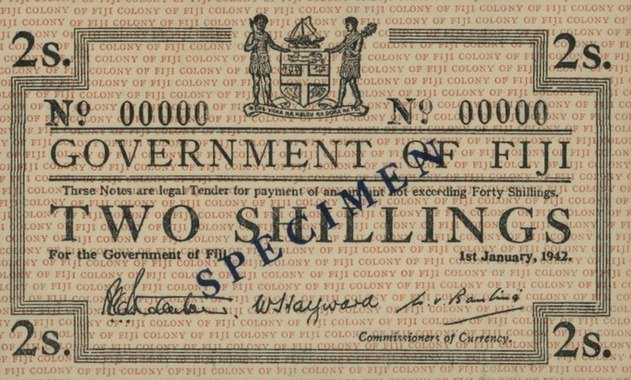
The Gazette of 3rd December 1947 prints no number for the ordinance and lists beside it a matching ordinance for the Defence coinage of 1942. Rodgers (IBNS Journal, volume 36, number 4, p. 25) has the notes deemed to be notes issued under the Fiji Currency Notes Ordinance from 1st January 1948, the date the Pick pages give.
1948 to 1969
- 23rd August 1948: K. A. Rodgers, in "Fiji's Colonial Issues of Queen Elizabeth II" (IBNS Journal, volume 35, number 4, 1996, p. 10), records an amendment to the Fiji Currency Notes Ordinance (Cap. 166), passed through all its stages at an emergency meeting of the Legislative Council on this day, that did no more than put the word "may" for "shall". A cable of 8th September 1948 then ordered 1,000,000 pounds in 20 pounds notes, half to come by air. The order is told in The 20 pounds notes of Fiji.
- No date given: An Economic Survey of the Colonial Territories, 1951 (volumes VI and VII, 1953; read in the machine-read text only) says the ordinance was amended "from an unconditional direction that the Currency Commissioners 'shall' sell Fiji currency in exchange for sterling, to a discretionary power". It gives no date. The description fits the amendment of 23rd August 1948 as Rodgers tells it.
- By 30th June 1967: the half-yearly abstract for that day is the first in the Gazette headed THE CURRENCY BOARD; all earlier ones are by the Commissioners of Currency. The law that made the change was not among the papers read.
- 1969: the Currency Board's audit report for 1969 (Gazette of 1970) cites regulation 19(3) of the Currency Regulations, which required four Boards of Survey a year; only three were held in 1969.
- 15th January 1969 and 1st July 1969: Rodgers (IBNS Journal, volume 35, number 4, p. 12, and volume 36, number 4, p. 25) gives the first as the day the whole stock of pounds, shillings and pence notes was burned and the second as the day all such notes still outstanding lost legal tender. No Gazette notice of either was found in the extracts read.
1973 to 1984
The Central Monetary Authority Act is given two dates of assent. The Pick pages have 5 April 1973. Kerry Rodgers, in "A Preliminary Survey: Fiji's Second Decimal Currency Notes" (IBNS Journal, volume 24, number 3, 1985, p. 84), has 5 May 1973. The Gazette of 1974 (p. 23 of the extract) settles a different point: the Authority took over the assets and liabilities of the Currency Board on 1st July 1973.
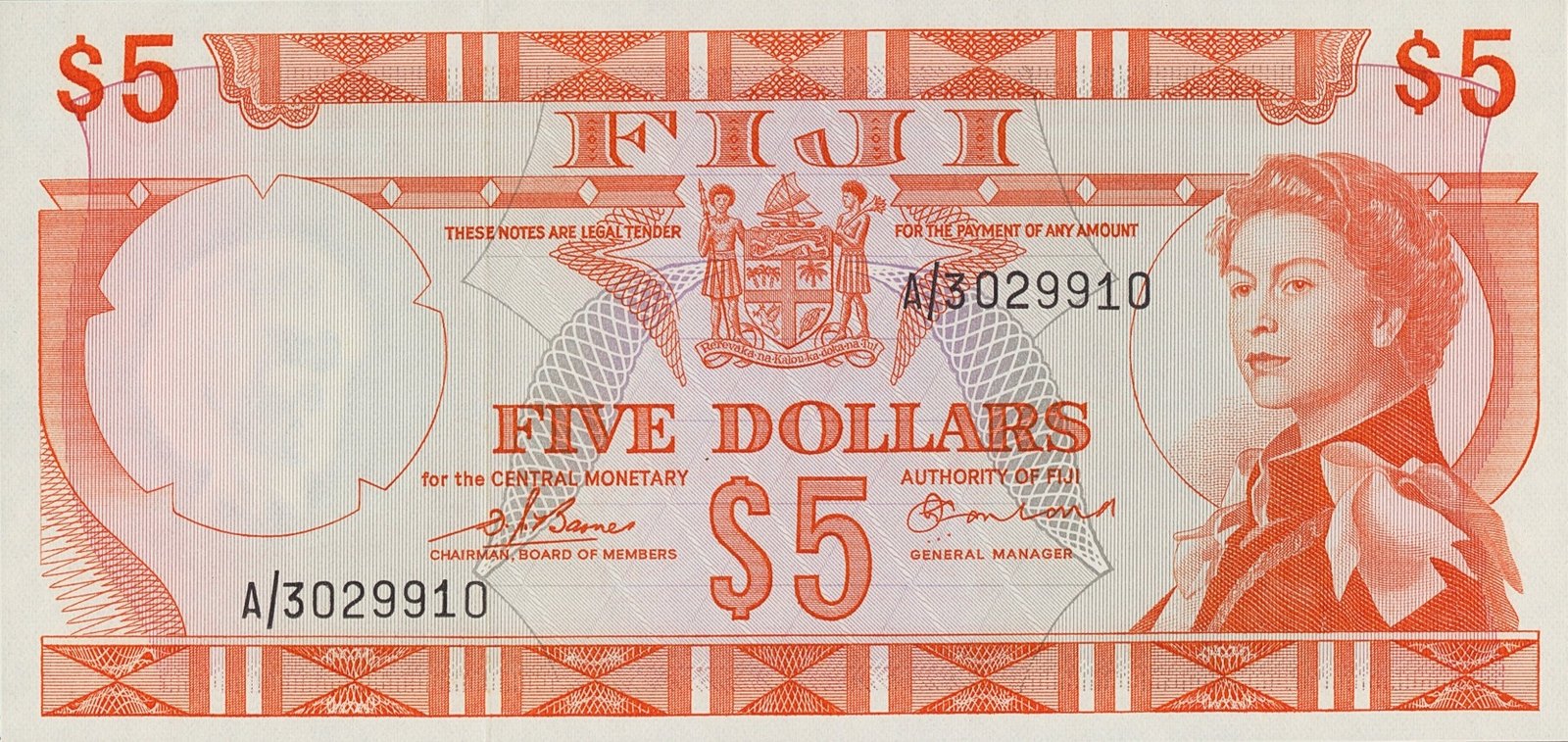
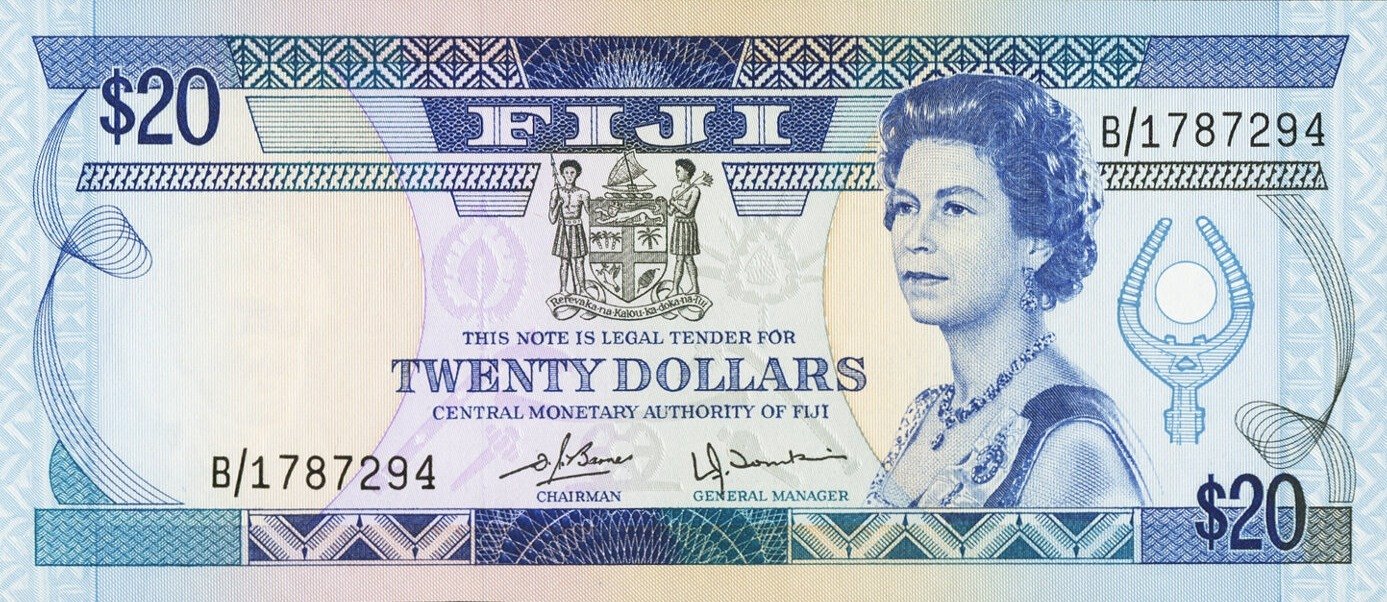
Rodgers (the same article, pp. 84 and 85) gives three later dates. A 50 cents coin was released on 3rd March 1975, and the 50 cents notes, such as the Currency Board's, ceased to be legal tender on 7th February 1976, although, Rodgers adds, they were not demonetised. The notes of the new design were issued from 25th June 1980; the old 20 dollars ceased to be legal tender on 31st October 1980 and the other old values on 30th September 1981. Writing in the IBNS Journal in 1987 (volume 26, number 1, p. 19), Rodgers gives 1st January 1984 as the day the Reserve Bank of Fiji took over, with Siwatibau as its first Governor.
What is missing
No source read gives the text of Ordinance No. 19 of 1918 under that number, the 1939 amendment, the law that set up the Currency Board, or the law that brought in the dollar. The proclamation that brought the 1913 ordinance into force was not seen; its date rests on Rodgers and Cantrell.
Sources
- Robert Chalmers, A History of Currency in the British Colonies (London, HMSO, 1893), chapter XXX, p. 292.
- The currency laws of Fiji, as held in the Johns Hopkins currency board archive: Ordinance No. XXX of 1913; the amendments of 1917, 1918 and 1921; the Amendment Ordinances of 1920 and 1922; the Currency Notes (Amendment) Ordinance 1932, No. 42 of 1932; the Fiji Currency Notes Ordinance 1933, No. 6 of 1933.
- Fiji Royal Gazette: 1914, p. 885; the notice of 1919 on Ordinance No. 19 of 1918; No. 32 of 23rd June 1933, p. 223; No. 43 of 25th August 1939; Extraordinary No. 60 of 3rd December 1947, notice 811, p. 345; the abstract at 30th June 1967; the Currency Board's audit report for 1969; the Gazette of 1974.
- Colonial Reports, Annual: Fiji, 1922 (No. 1171, p. 31), 1933 and 1934; An Economic Survey of the Colonial Territories, 1951, volumes VI and VII (1953).
- "Evaluating the Fijian Board of Commissioners of Currency", working paper SAE 116 in the Johns Hopkins currency board archive, p. 14 and appendix.
- IBNS Journal: volume 24, number 3 (1985), Kerry Rodgers, "A Preliminary Survey: Fiji's Second Decimal Currency Notes"; volume 26, number 1 (1987), Kerry A. Rodgers, "Fiji Decimal Banknotes: an Update"; volume 26, number 4 (1987), Kerry A. Rodgers and Carol Cantrell, "Illegal Currency Tokens of World War II Fiji"; volume 29, number 1 (1990), K. A. Rodgers and Carol Cantrell, "Fiji's Commissioners of Currency I: 1914 - 1933"; volume 35, number 4 (1996), K. A. Rodgers, "Fiji's Colonial Issues of Queen Elizabeth II"; volume 36, numbers 2, 3 and 4 (1997), K. A. Rodgers, "Fiji's World War II Currencies: the Official Records", Parts I to III; volume 45, number 4 (2006), Kerry Rodgers, "Fiji's Debentures of 1871-3: currency or no?".
Member comments
Log in or register to post a comment.