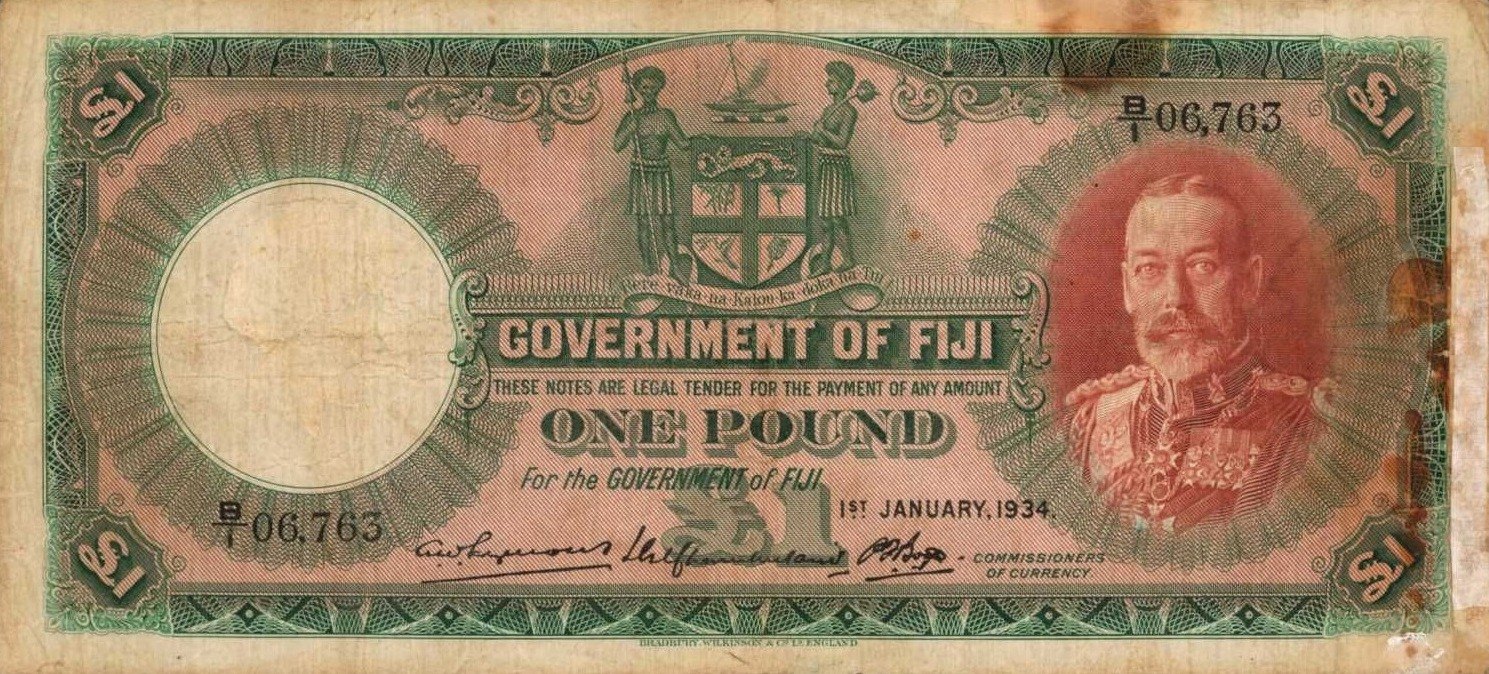
This article sets the notes of Fiji in order of time, from the first Government notes of December 1914 to the end of the notes with the Queen's portrait. It is drawn from the Pick pages of this catalogue, which name the annual reports, the specimens and the articles of Kerry Rodgers in Bank Note Reporter that they rest on, and from two pages of the Reserve Bank of Fiji. Three subjects have articles of their own: the first notes of 1914 to 1933, the emergency notes of 1942 and the 20 pounds notes.
Before 1914: two banks' notes
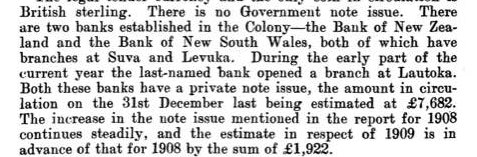
The annual report on Fiji for 1909 says that the Colony had no Government notes, and that the Bank of New Zealand and the Bank of New South Wales each had a private note issue there, estimated together at 7,682 pounds in circulation on 31st December 1909. The article Whose paper passed? follows the same reports through other colonies.
1914 to 1933: the uniface notes of the Commissioners of Currency
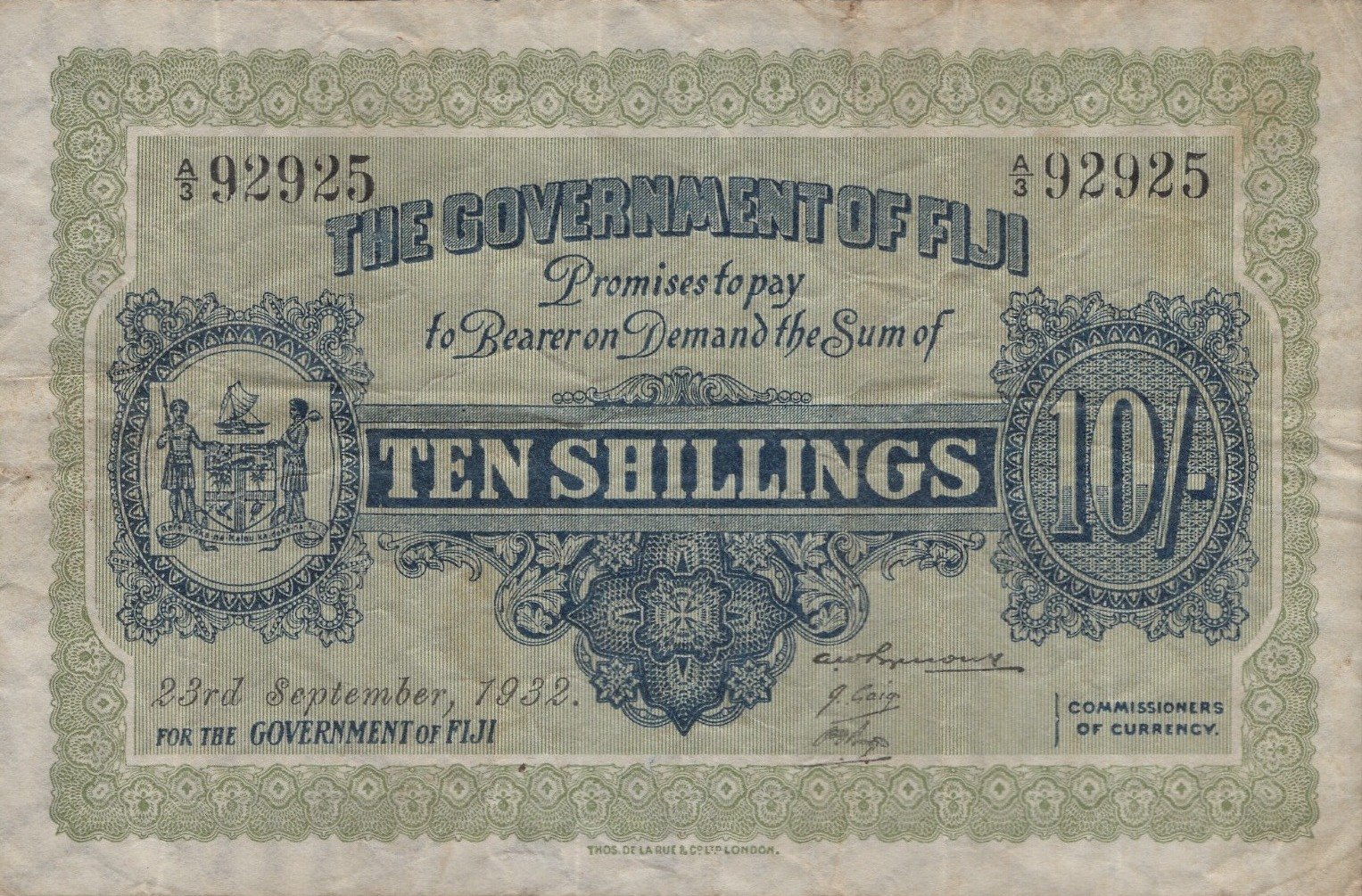
The Government Currency Notes Ordinance 1913 (No. 30 of 1913, dated 18th November 1913) set up three Commissioners of Currency: the Colonial Secretary, the Receiver-General and one member named by the Governor. The Reserve Bank of Fiji, on its page "A History of Fiji's Currency", gives 1914 as the year the Fiji Currency Board was established to manage Fiji's monetary affairs and to issue and redeem currency.
The first stock of notes, £20,000, was in the Commissioners' hands on 4th December 1914. The notes are uniface, printed by Thomas de la Rue: the 1 pound, 5 pounds, 10 pounds and 20 pounds from 1914, the 10 shillings from 1918 and the 5 shillings from 1920. The last dates recorded are of 1933.
1934 to 1951: portrait notes of George V and George VI
The notes from 1934 were issued under the Fiji Currency Notes Ordinance 1933 (No. 6 of 1933, assented to on 25th July 1933), by Commissioners of Currency made up of the Colonial Secretary, the Colonial Treasurer and one member named by the Governor. Notes were issued at 111 Fiji pounds for 100 pounds sterling. The printer was now Bradbury Wilkinson. The Reserve Bank of Fiji's history page puts Fiji's first coinage, of pennies and shillings, in the same year, 1934.
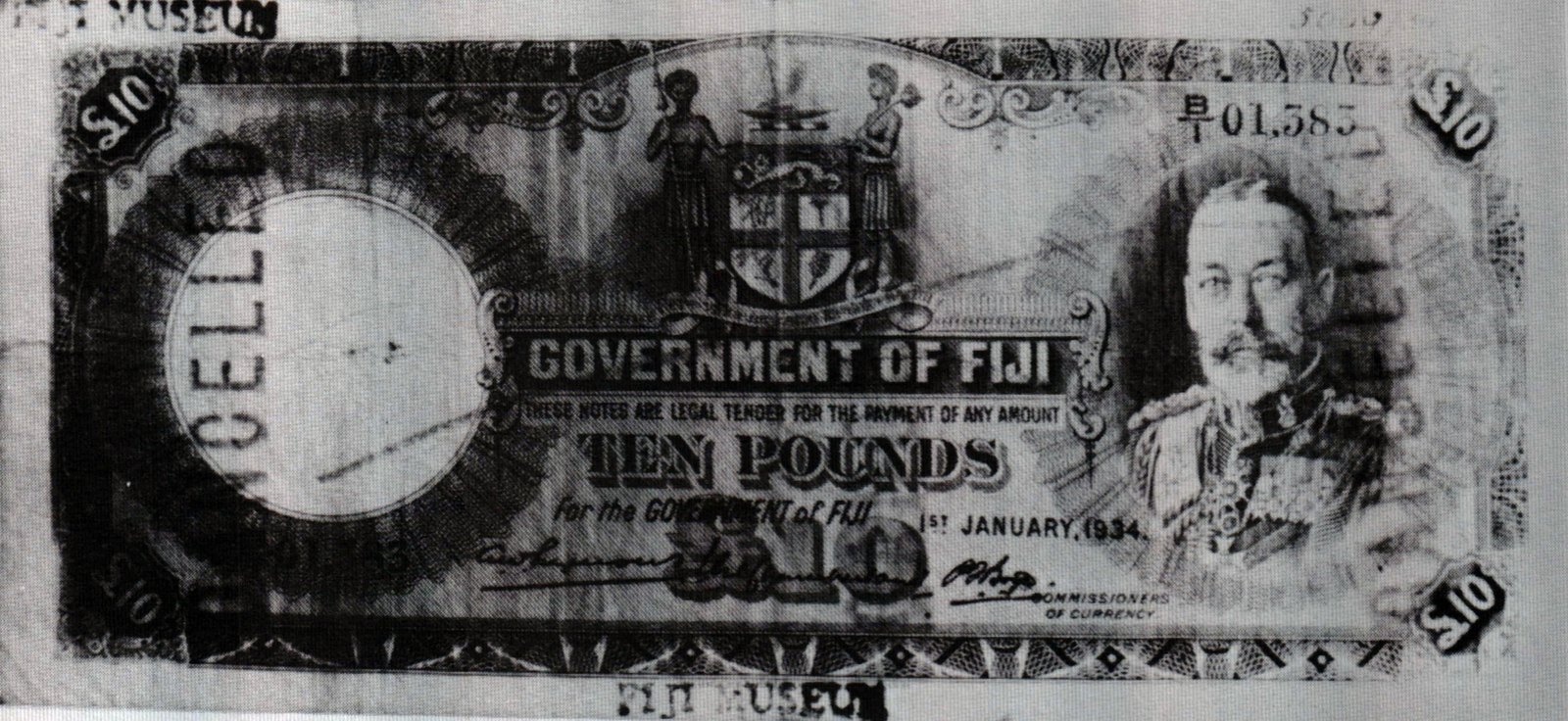
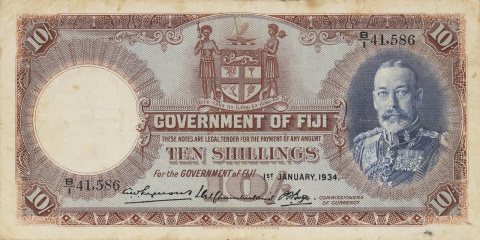
The George V notes run from the 5 shillings to the 20 pounds. All carry the prefix B/1, and the printer's specimens give the printings. On the 5 shillings the specimens show B/1 60,001 to B/1 140,000 for 1st June 1934 and B/1 140,001 to B/1 180,000 for 1st March 1935, so the notes of 1st January 1934, signed by Seymour, Chamberlain and Boyd, lie below B/1 60,001. The 10 shillings reached B/1 120,000 and the 1 pound B/1 165,000 by the printings dated 1st March 1935. The notes of 1st June 1934 are signed by Wright, Craig and Boyd. The numbers of the high values are small: the first printing of the 10 pounds was B/1 00,001 to B/1 06,000, on a specimen with the ink date 27.10.33. Notes held in the Fiji Museum archives, shown in archive photographs, are on record for the 5 pounds of 13th September 1934 (B/1 05133) and the 10 pounds of 1st January 1934 (B/1 01383).
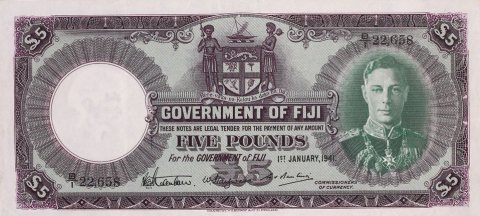
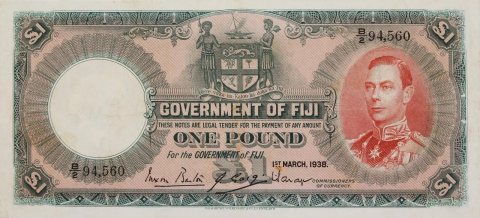
The George VI notes began with the date 1st March 1937 and carried the numbering on: the 10 shillings starts at B/1 120,001, where the George V note stopped. The first design shows the King in left profile. It was issued on the 1 pound of 1937 to 1940; a 20 pounds is known as a specimen, a colour trial and proofs, a 10 pounds only as stage and die proofs, and a 5 pounds has not been recorded in any form. From 1941 the King faces forward: the 1 pound of 1941 to 1951, the 5 pounds, the 10 pounds and the 20 pounds. The 5 shillings and the 10 shillings are each listed as one type from 1937 to 1951.
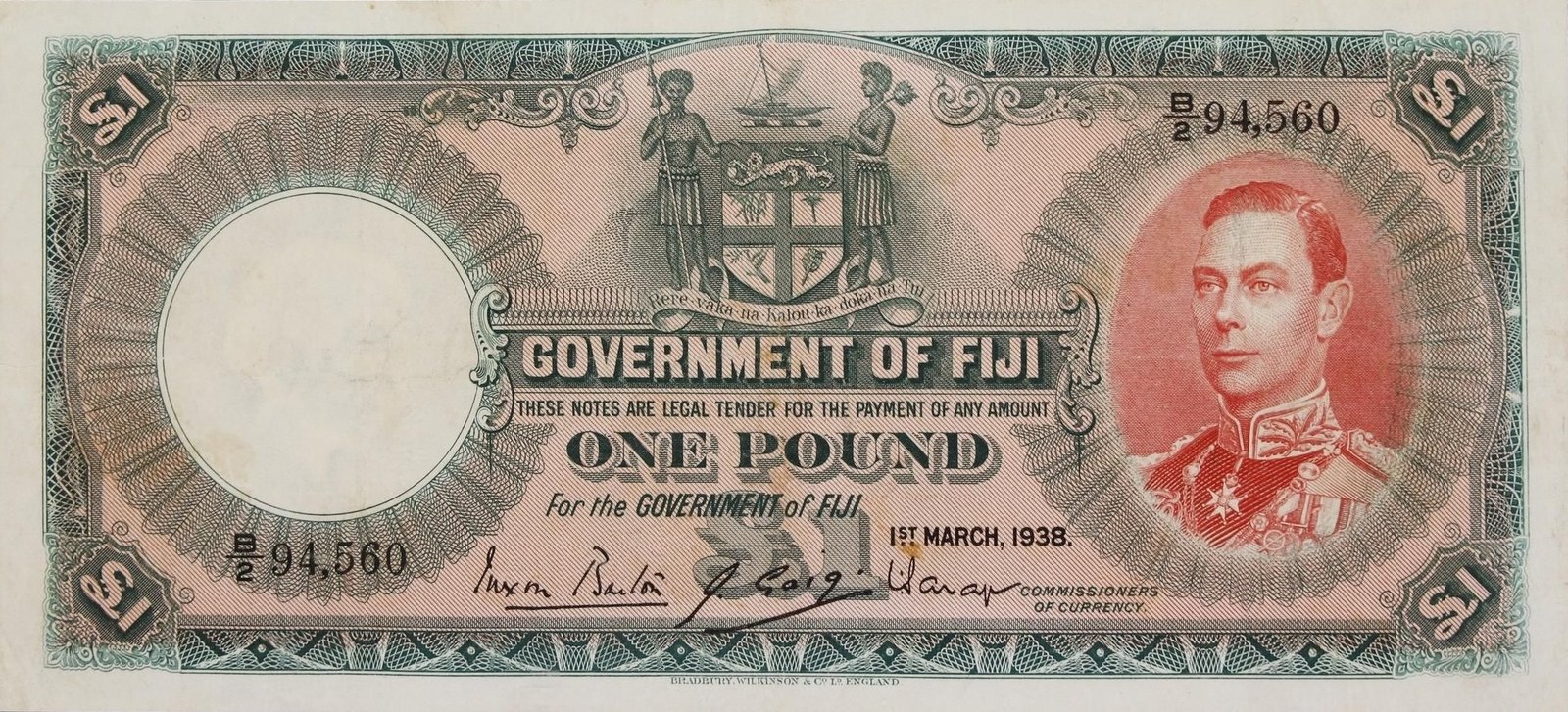
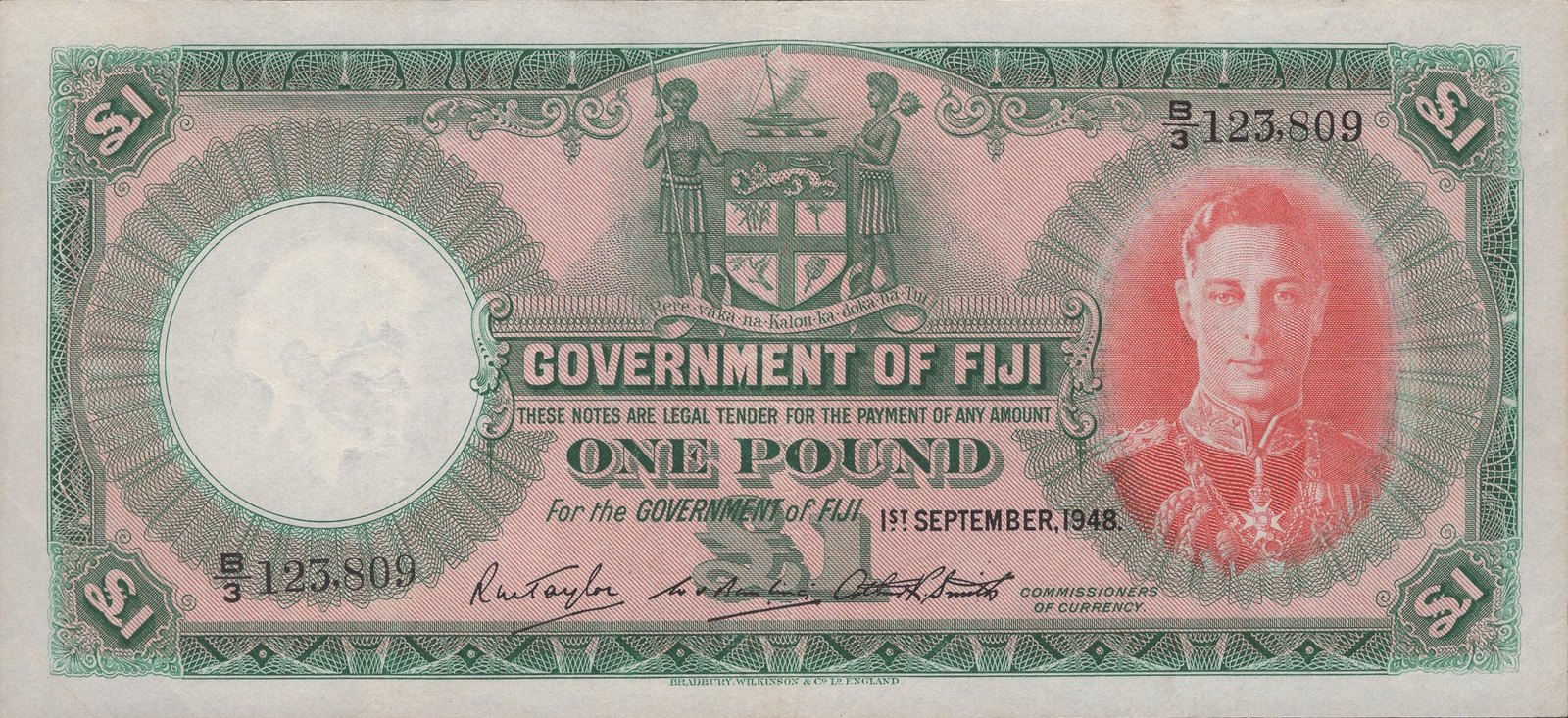
The printed date is not the day of printing. The 5 pounds page gives an example: sources mention that the full-face notes dated 1st January 1941 were ordered from London only in November 1941, and that the third signer took office only in May of that year. Sources also mention that the 5 and 10 shillings blocks dated 1st October 1940 reached Fiji on 16th April 1941.
The three signatures change with the date. The 10 shillings page gives the order: Barton, Craig and Savage (1937, 1938); Robertson, Hayward and Ackland (1940); Robertson, Hayward and Banting (1941); Robertson, Banting and Allen (1943); Robertson, Banting and Hayward (1946); Taylor, Banting and Smith (1948 to 1950); Taylor, Donovan and Smith (1951).
1942: emergency notes
Notes ordered from London did not come, troops were stationed in Fiji, and coin ran short. Fiji took overprinted notes of the Reserve Bank of New Zealand (10 shillings, 1 pound and 5 pounds), a 1 penny note printed in Australia, and 1 shilling and 2 shillings notes from the Government Printer, Fiji. The small notes ceased to be legal tender on 1st October 1947. The article on the emergency notes has the detail.
1953 to 1969: the Queen's pound notes
The first note with the Queen's portrait was the 20 pounds of 1st January 1953, ordered by cable in March 1953. The new series followed with the date 1st July 1954 on the 1 pound, the 5 pounds, the 10 pounds and the red 20 pounds, and 1st June 1957 on the 5 shillings and the 10 shillings. Sources mention that the portrait follows a 1952 photograph by Dorothy Wilding, engraved by Bradbury Wilkinson, and that the notes were printed from a single plate over a ground tint, on mould-made paper keeping the earlier watermark, with a different back design for each value.
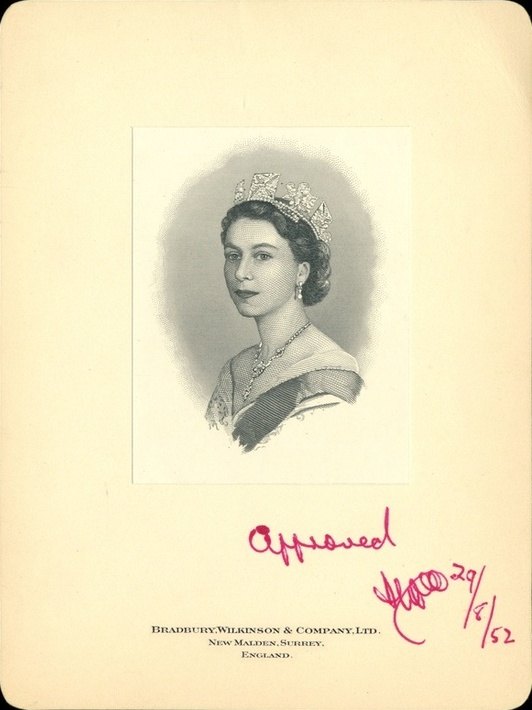
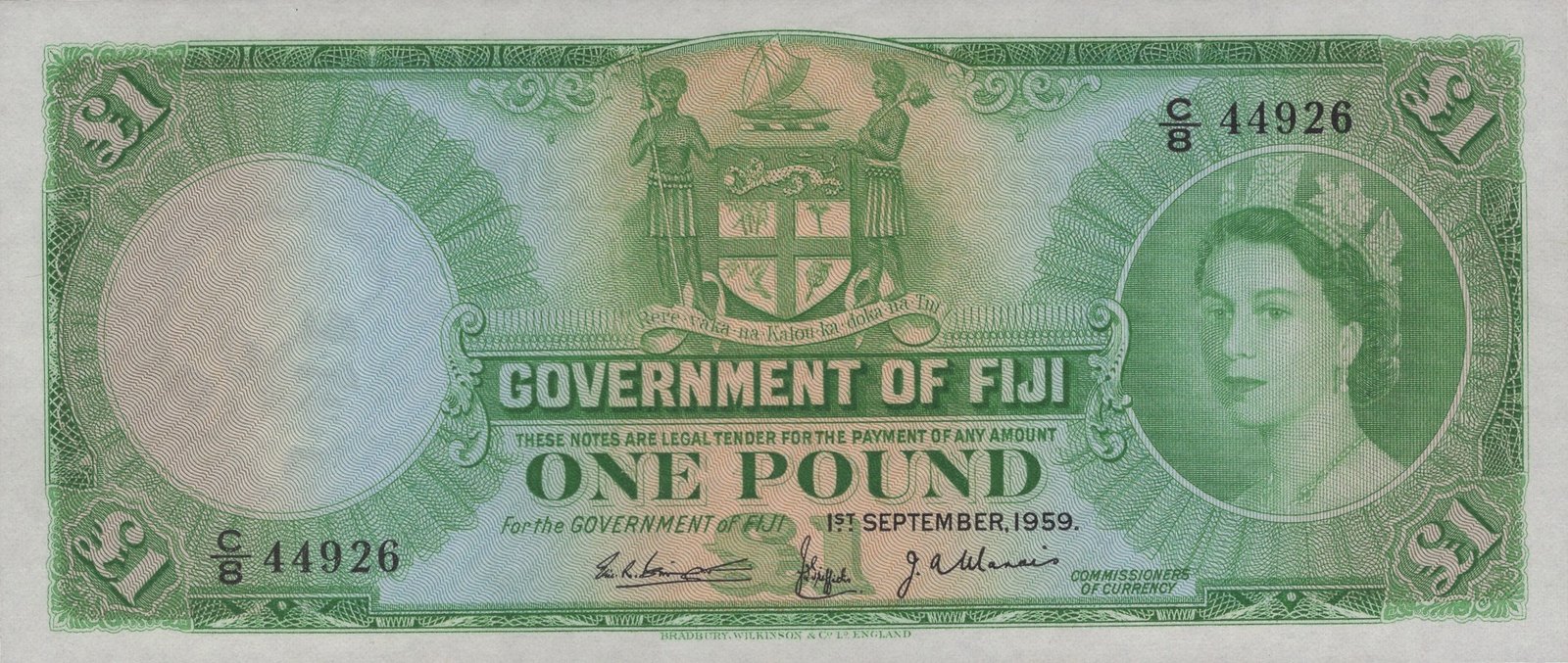
The dates on the notes run well ahead of the days of release that sources mention: the 1 pound went into circulation on 14th February 1956, the 10 shillings on 9th December 1958 and the 10 pounds, the last value of the series, on 19th December 1959. Sources mention that the 1 pound notes dated 1st July 1954 came in two orders, C/1 00,001 to C/2 50,000 in June 1954 and C/2 50,001 to C/3 100,000 at the end of May 1955, and that the 5 pounds of the same date was ordered at the end of May 1955.
The 5 shillings is signed by Davidson, Griffiths and Marais in 1957, by Bevington, Griffiths and Cruickshank in 1961, and by Ritchie, Griffiths and Cruickshank from 1962 to 1965.
The numbers printed, as the sources behind the Pick pages give them:
| Value | Numbers printed, by printed date |
|---|---|
| 5 shillings | 600,000 of 1957, 600,000 of 1961, 600,000 of 1962, 800,000 of 1964, 800,000 of 1965 |
| 10 shillings | 400,000 of 1957, 400,000 of 1961, 300,000 of 1962, 400,000 of 1964, 400,000 of 1965 |
| 1 pound | 500,000 for most dates, 750,000 for 1st December 1961, 400,000 for 1st December 1962, 700,000 for 1st January 1967; C/1 00,001 to C/25 50,000 in all |
| 5 pounds | 50,000 of 1954, 50,000 of 1959, 80,000 of 1960, 80,000 of 1962, 100,000 of 1964, 100,000 of 1967 |
| 10 pounds | 25,000 of 1954, 100,000 of 1959, 150,000 of 1960, 100,000 of January 1964, 50,000 of June 1964, 50,000 of 1965 |
| 20 pounds | 50,000 of 1953 (not all issued), 25,000 of 1954, 25,000 of 1958 |
Two details of the printing are on record. Kerry Rodgers, writing in Bank Note Reporter in May 2005, says that by August 1962 Bradbury Wilkinson had finished printing 250,000 of the 1 pound notes dated 1st December 1961, numbered C/11 00,001 to C/11 200,000 and C/12 00,001 to C/12 50,000. Sources mention that in the same month the printer could not account for note C/12 41,000, and asked to print a replacement marked with a small dot in the round hole of the diamond in the border below the first two digits of the lower left serial. Sources also mention that the 10 pounds order dated 1st October 1960 was raised twice, the last 50,000 notes being added in March 1961.
Sources mention that the remaining stock was burned at Suva on 15th January 1969, just after Fiji went decimal, and that all pounds, shillings and pence notes ceased to be legal tender on 1st July 1969.
1969 to 1983: dollars under three issuers
The dollar notes of 1969 were printed by Thomas de la Rue. Sources mention that the portrait is De La Rue's own engraving of the Annigoni portrait. Bradbury Wilkinson had also drawn for the order: Heritage (6 September 2018, lot 26562) and Lyn Knight (8 November 2012, lot 399) each sold face and back paste-up models of a 10 dollars with Bradbury Wilkinson's imprint, and Heritage's description reads them as that firm's losing bid.
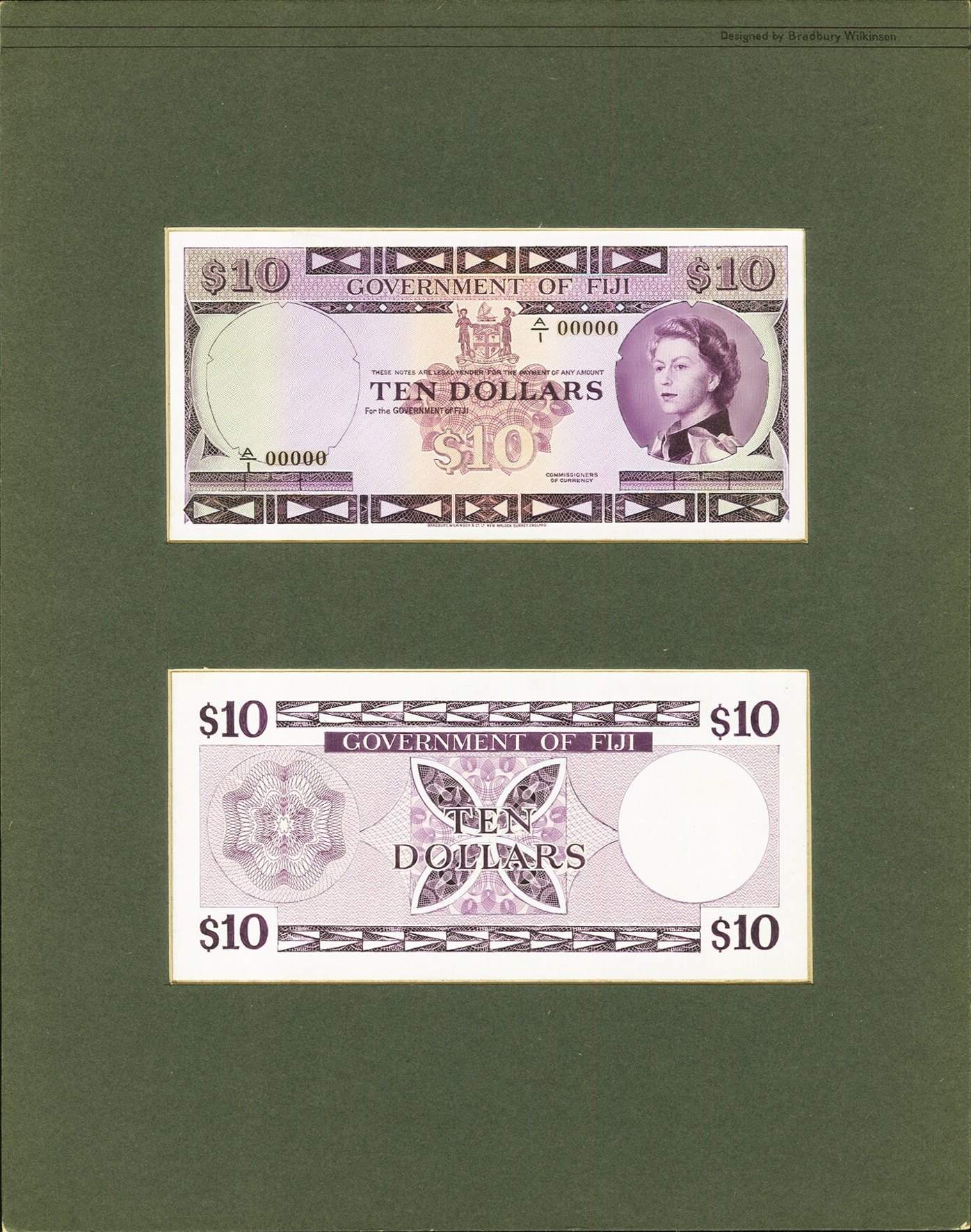
One design served three issuers, and the front tells them apart:
- Government of Fiji, 1969: the title GOVERNMENT OF FIJI and two signatures without titles. Values from 50 cents and 1 dollar to 20 dollars; the 5 dollars is listed as of 1970.
- Currency Board, 1971: the same title, with a single signature over CHAIRMAN, CURRENCY BOARD. Sources mention Barrett signing as Minister of Finance and Chairman of the Currency Board from mid-1970 to at least August 1971, after Ritchie, and Stinson from May 1972 until the Board's last accounts, to 30th June 1973. Both signed the 50 cents and most other values; every Currency Board 2 dollars recorded so far is signed by Barrett. For the 20 dollars, Spink (28 April 2015, lot 211) says perhaps 50,000 notes with the Barrett signature were issued, and Heritage (10 September 2018, lot 29018) says a few hundred thousand of the type were printed.
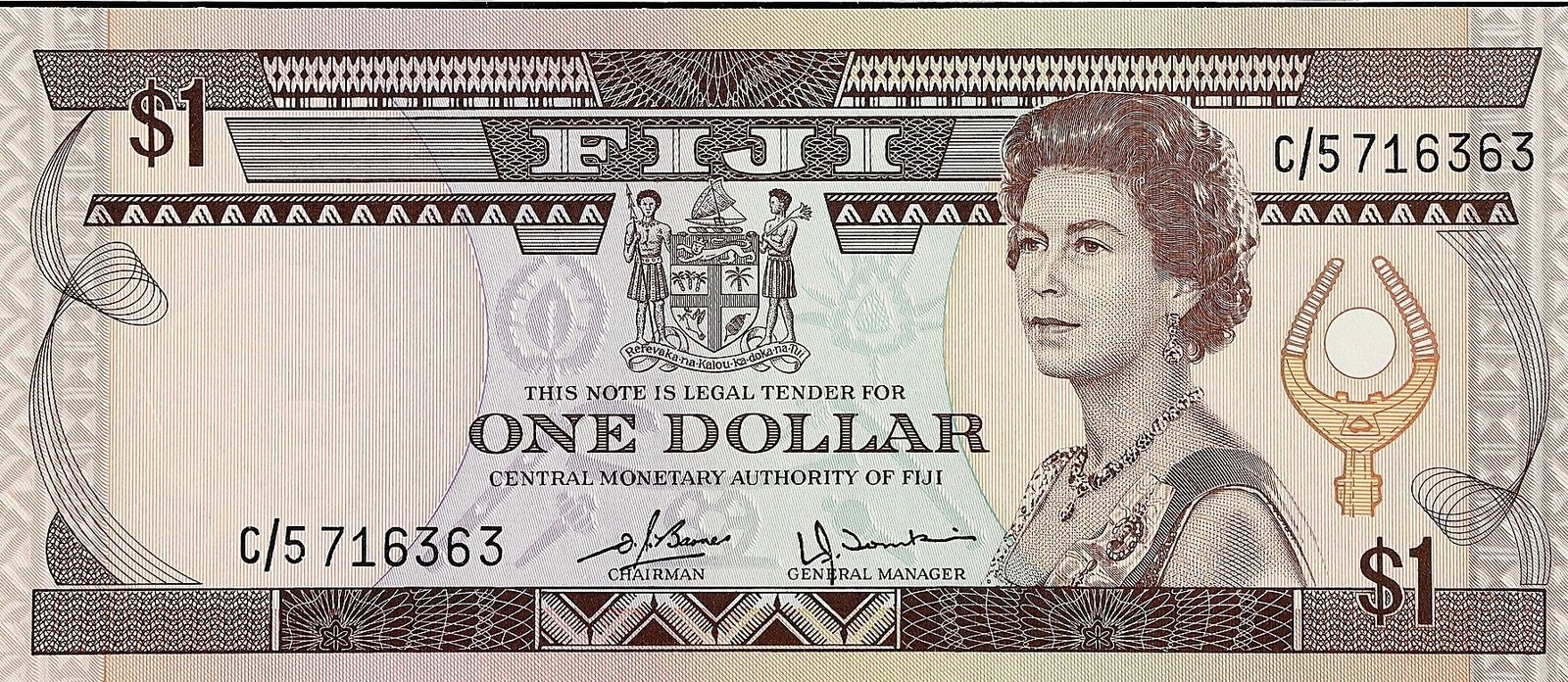
- Central Monetary Authority of Fiji, 1974: the title FIJI and two signatures, over CHAIRMAN, BOARD OF MEMBERS and GENERAL MANAGER. The Authority took over from the Currency Board under the Central Monetary Authority Act, assented to on 5 April 1973. Barnes signs every note as Chairman; the General Managers are Craik, Earland and Tomkins in turn. The 1 dollar was not issued with the Craik signature, and on the 20 dollars the signers change inside two prefixes, A/1 and A/3.
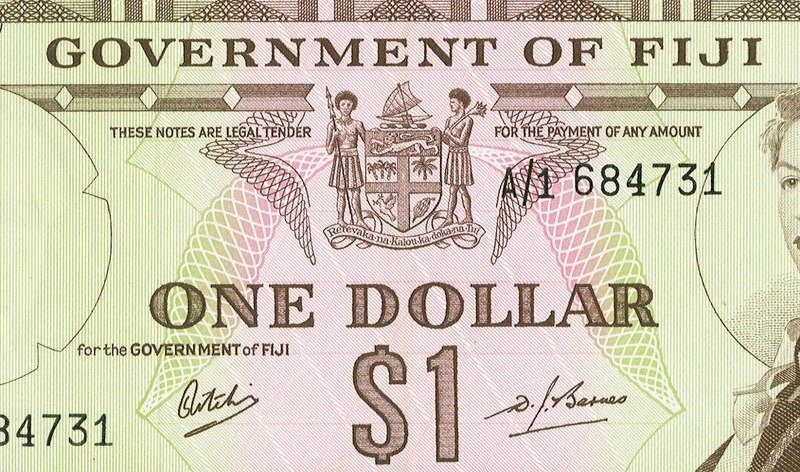
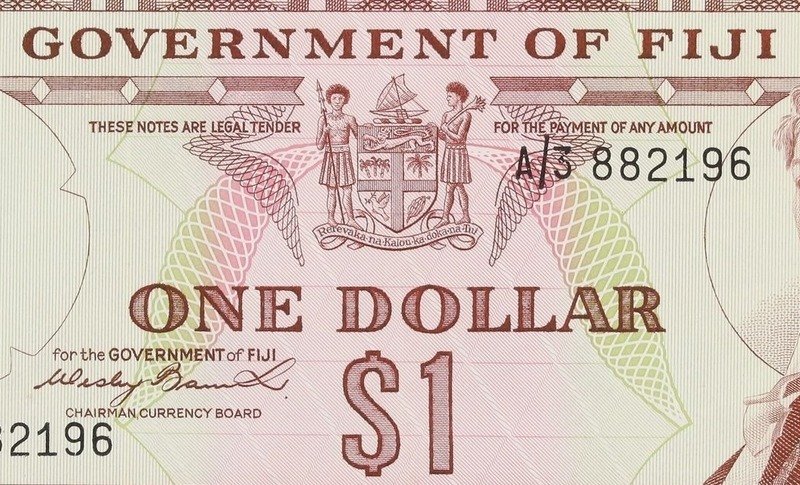
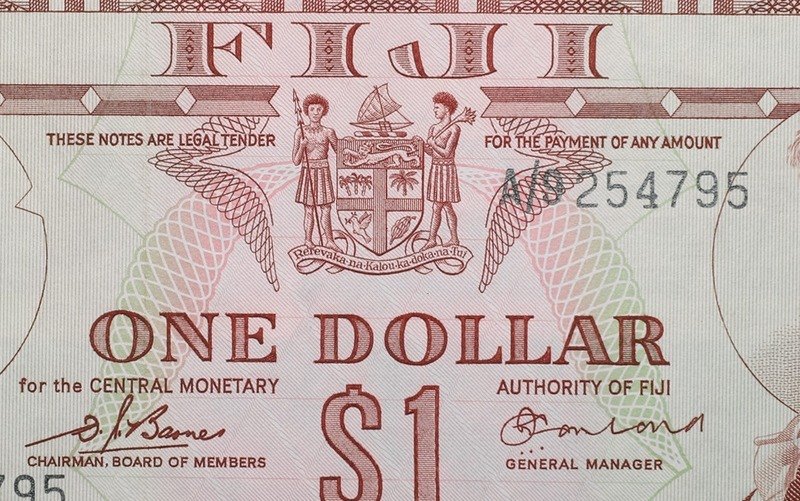
The Authority's 50 cents was prepared and never issued; it is known only as specimens. Sources mention that a 50 cents coin replaced the note from 3rd March 1975. The article Central banks that never opened shows designs drawn at this time for a "Central Bank of Fiji".
A new design went into circulation from June 1980, as sources mention, with a portrait after a photograph by Anthony Buckley of about 1966 in De La Rue's engraving. The first notes are signed by Barnes and Tomkins. Sources mention that Siwatibau became General Manager in 1981, so the notes signed by Barnes and Siwatibau are from 1981 or later; their value figures in the corners are larger, about 9.5 mm high against 8 mm. Sources mention good forgeries of the 10 dollars found in the mid-1980s, lithographed in four colours with the front and back well registered. The issue copied is not named, so it may be the 10 dollars of Barnes and Siwatibau or the earlier one.
1984 to 2013: the Reserve Bank of Fiji
Sources mention that the Reserve Bank of Fiji took over from the Authority on 1st January 1984. Its first note, the 1 dollar, was released on 4th September 1986; the delay used up the remaining Authority notes. The serial numbers carry on from the Authority's notes, and the Reserve Bank no longer used Z-prefix replacement notes. Kerry Rodgers, writing in Bank Note Reporter in June 1988, says the 2 dollars was released in 1987, between the coups of May and September of that year.
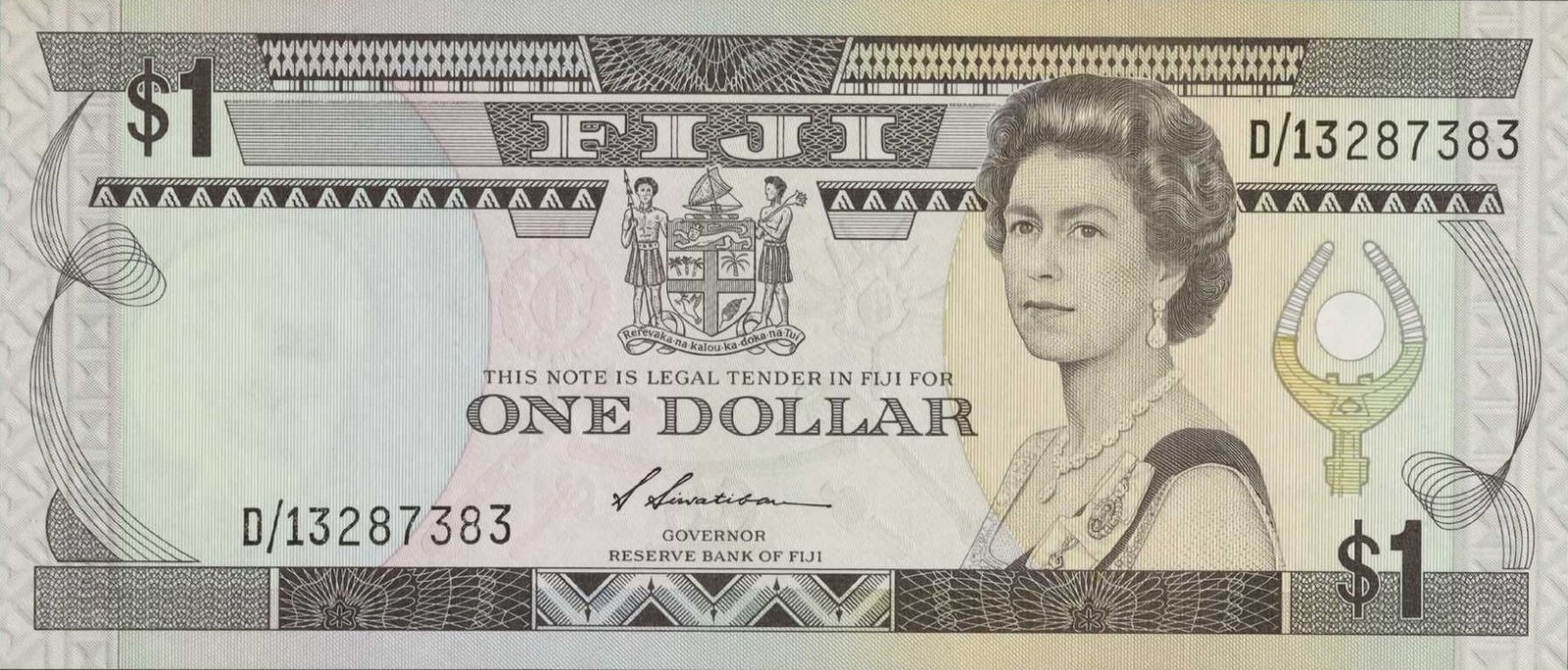
These notes have one signature, the Governor's, and a portrait from the same Buckley photograph in Bradbury Wilkinson's engraving, with the head at a slightly different angle. The 1 and 2 dollars signed by Siwatibau carry the imprint BRADBURY WILKINSON on the back; sources mention that they were printed at the Bradbury Wilkinson works at Whangarei, New Zealand, after De La Rue had taken over that firm. Those signed by Kubuabola carry the imprint of THOMAS DE LA RUE. The year of the Kubuabola 5 dollars and 10 dollars is not settled: sources give about 1991 for the first and 1989 for the second, and houses often date both 1989. Later printings of the 5, 10 and 20 dollars have a single-letter prefix and a windowed thread.
The next design carries a portrait which, as sources mention, follows a photograph by Terry O'Neill taken in April 1992, engraved by Alan Dow of De La Rue. It is used from the 2 dollars to the 50 dollars. The catalogue dates the 50 dollars ND (1996); the Reserve Bank of Fiji's history page says that a 50 dollars denomination was introduced in November 1995. Kerry Rodgers, writing in Bank Note Reporter in February 2015, says that Narube followed Kubuabola as Governor on 15 May 2000, and that in 2001 the Reserve Bank, fearing that the 5 and 50 dollars would run short, ordered a further printing of the 50 dollars and of the 5 dollars from the existing plates and paper.
K.A. Rodgers, writing in Bank Note Reporter in March 2003, gives 2 September 2002 as the day the Reserve Bank launched the next series of 2, 5, 10, 20 and 50 dollars, and 16 September 2002 as the day the notes reached the public through the commercial banks. On these the serial grows taller from left to right, and the 50 dollars has a hologram.
The last notes with the Queen's portrait came in 2007. Kerry Rodgers, writing in Bank Note Reporter in June 2006, gives August 2005 as the month the Fijian cabinet approved the series; writing again in May 2007, Rodgers reports that the notes were unveiled on 9th March 2007, that the backs were designed by George Bennett, and that the Reserve Bank sold sets of the six notes with matching serial numbers at 399 Fiji dollars. Sources mention that the notes from 2 dollars to 100 dollars were issued together on 10 April 2007. Notes of the 20 dollars numbered EB 450,001 to EB 500,000 were stolen from Suva Kings Wharf on 4 September 2010; sources mention that the Reserve Bank first declared these notes not legal tender, then told the banks to accept them from customers holding them in good faith. Rodgers, writing in June 2012, says the 2, 5 and 10 dollars were released with Whiteside's signature on 5 December 2011, a stopgap because stocks were running short.
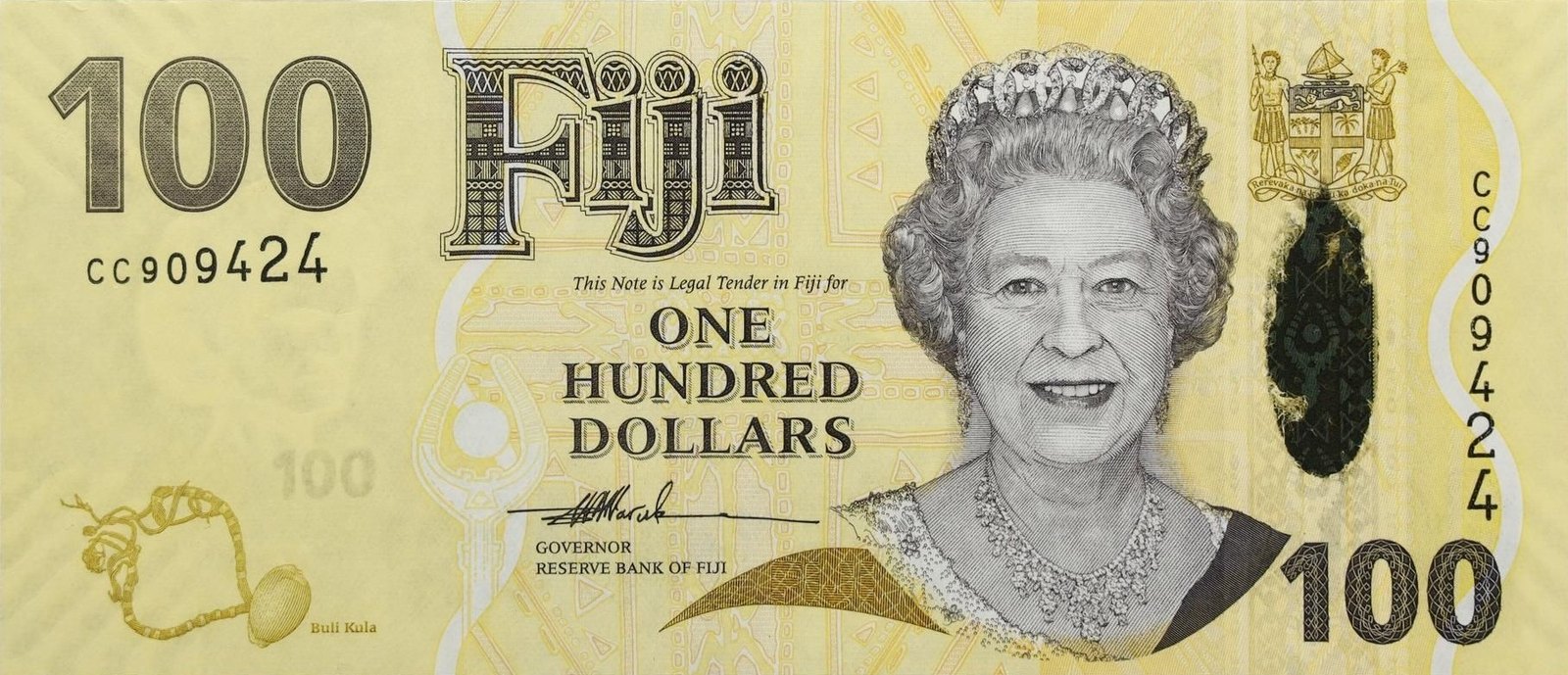
The Reserve Bank of Fiji's history page says that in December 2012 Fiji launched a completely new family of notes and coins. Its Press Release No. 36/2012 of 11 December 2012 announced the unveiling for 12 December 2012 and the issue into circulation from 2 January 2013. The catalogue gives the 2 dollars of 2007 as withdrawn in 2013 and the 5 dollars on 30.06.2013.
What the pages do not say
No Pick page gives the day the dollar replaced the pound, or the rate: the pages say only that the old stock was burned on 15th January 1969, "just after Fiji went decimal". The numbers printed are on record for the Queen's pound notes and for some earlier printings, but not for any dollar note. The terms of office of the Commissioners of Currency are given only where they date a note. For the Currency Board the pages name no law.
Sources
- The Pick pages of this catalogue for Fiji, P-25 to P-114 and the three unlisted George VI designs, with the printer's specimens they record.
- The annual report on Fiji for 1909.
- Kerry Rodgers (K.A. Rodgers) in Bank Note Reporter: June 1988, March 2003, May 2005, June 2006, May 2007, June 2012 and February 2015.
- Heritage, 6 September 2018, lot 26562, and 10 September 2018, lot 29018; Lyn Knight, 8 November 2012, lot 399; Spink, 28 April 2015, lot 211.
- Reserve Bank of Fiji, "A History of Fiji's Currency", https://www.rbf.gov.fj/core-functions/currency-management/a-history-of-fijis-currency/
- Reserve Bank of Fiji, Press Release No. 36/2012, 11 December 2012, https://www.rbf.gov.fj/?p=2414
Member comments
Log in or register to post a comment.