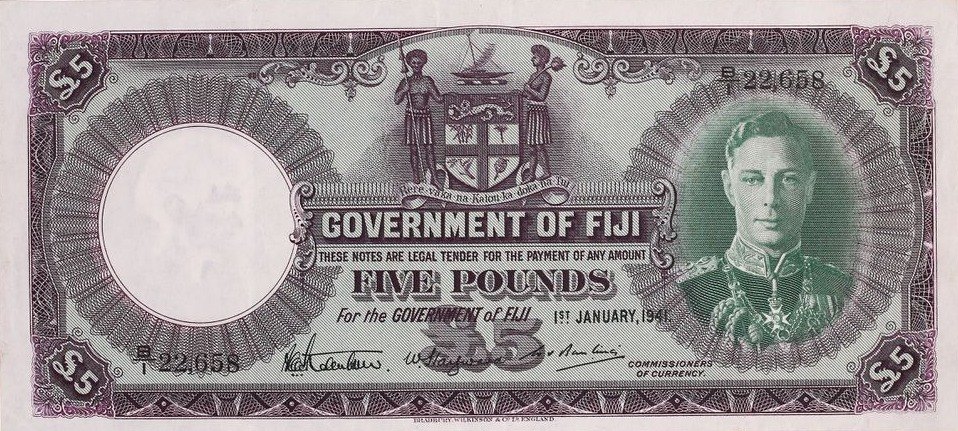
The article Fiji's emergency notes of 1942 describes the seven emergency notes of Fiji. This one puts the events in order of days. Nearly all of the dates come from K. A. Rodgers's three-part article "Fiji's World War II Currencies: the Official Records" in the IBNS Journal of 1997 (volume 36, numbers 2, 3 and 4, cited below as 36:2, 36:3 and 36:4), which was written from the files of the Reserve Bank of Fiji. Other writers had told parts of the story from other evidence, and the last section sets out where each differs.
1941: orders to London that did not arrive
| Day | Event | Source |
|---|---|---|
| 16th April 1941 | The ship Serooskark brings £15,000 of 5 shillings notes (B/2 180,001 to B/2 200,000 and B/3 00,001 to B/3 40,000) and £25,000 of 10 shillings notes (B/2 60,001 to B/2 110,000) | Rodgers, 36:2, p. 33 |
| 3rd November 1941 | Order advised to the Crown Agents for a new 5 pounds with the full-face head, and for 1 pound and 5 shillings notes, to be dated 1st January 1941 and signed Robertson, Hayward and Banting | 36:2, p. 39 |
| about 30th November 1941 | Immediate order cabled for notes dated 1st January 1942: £30,000 in 5 pounds, £94,000 in 1 pound, £25,000 in 10 shillings and £50,000 in 5 shillings | 36:2, p. 33 |
| 3rd December 1941 | Fiji asks New Zealand for 30,000 notes of 5 pounds and 50,000 of 1 pound | 36:2, p. 39 |
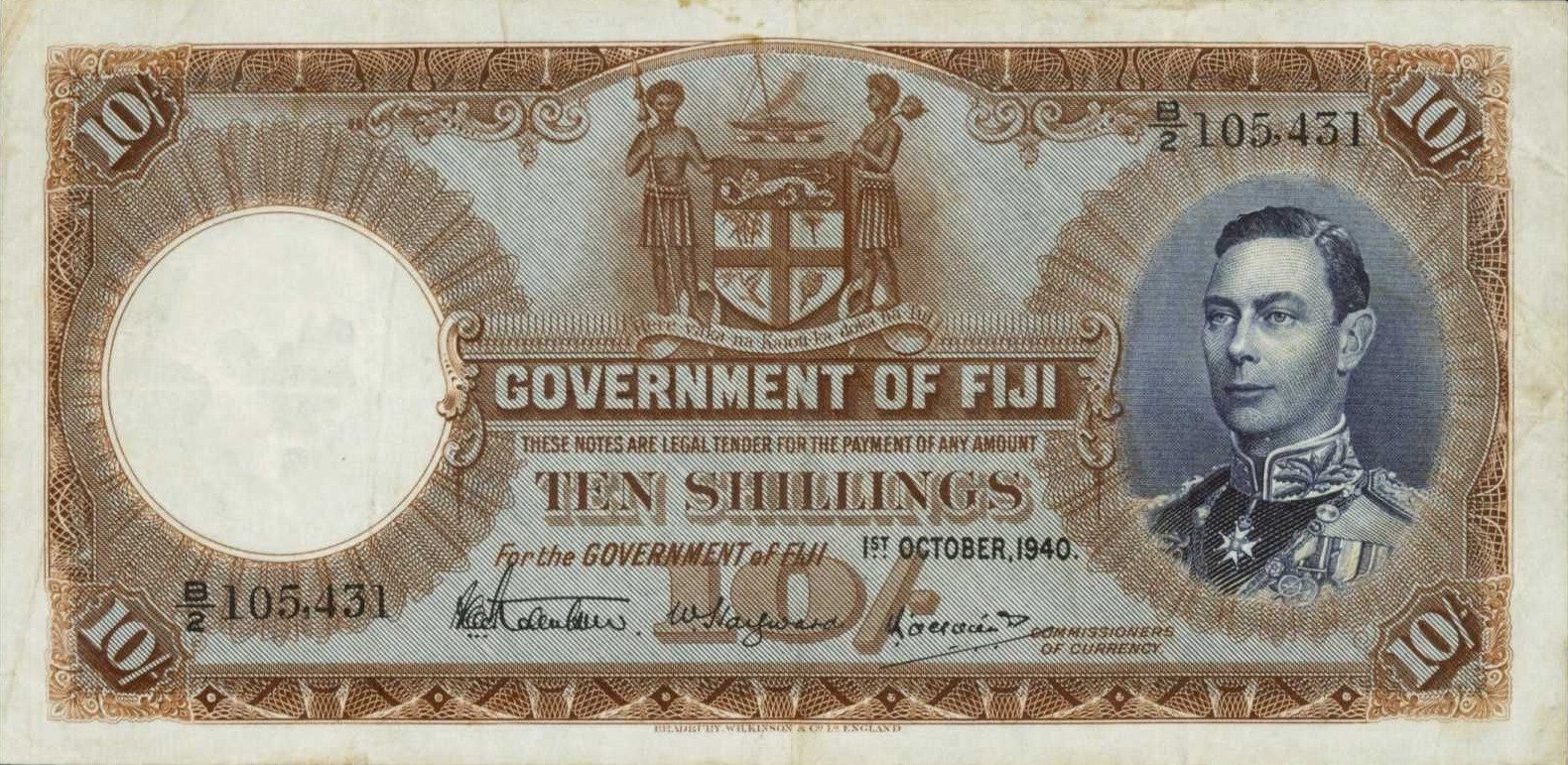
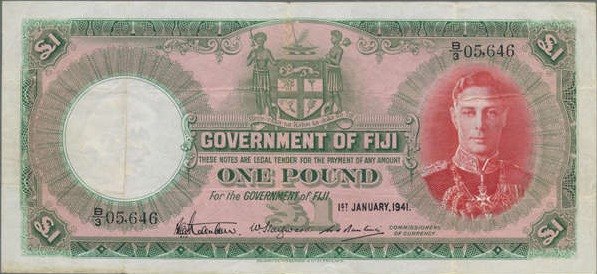
The notes of 16th April 1941 are the 5 shillings and 10 shillings dated 1st October 1940; the article does not give the dates on them, and the blocks are matched from the printer's specimens. Of the London orders Rodgers says that months passed before they arrived, and that in April 1942 the Crown Agents' orders of 1941 had still not left Britain. The 5 pounds and 1 pound dated 1st January 1941 belong to the order of 3rd November.
January to July 1942: New Zealand notes and local shillings
| Day | Event | Source |
|---|---|---|
| 9th January 1942 | First delivery by sea: 50,000 notes of 1 pound, 1D 560,001 to 1D 610,000, and the 5 pounds 4K 825,001 to 4K 831,000 | 36:2, p. 39; 36:4, p. 25 |
| 19th January 1942 | The Defence (Currency Notes) Regulations 1942 are made at Suva | 36:2, p. 39 |
| 17th April 1942 | A further 5,000 notes of 5 pounds and 25,000 of 1 pound asked of New Zealand | 36:2, p. 41 |
| 16th May 1942 | Leave asked for notes of low value in place of coin | 36:2, pp. 33 and 34 |
| 26th May 1942 | The approval is received | 36:2, pp. 33 and 34 |
| 4th June 1942 | Delivered: 1 pound 6D 990,001 to 6D 1,000,000 and 5 pounds 5K 859,001 to 5K 864,000 | 36:4, p. 25 |
| 5th and 6th June 1942 | The first 1 shilling is printed by the Government Printer in Suva under Treasury supervision | 36:2, p. 35 |
| 6th and 7th June 1942 | The first of those notes are numbered | 36:2, p. 35 |
| 6th June 1942 | Treasury notice; the (No. 2) Regulations allow notes under five shillings | 36:3, p. 15 |
| 9th June 1942 | The 1 shilling is issued to the banks and put into circulation | 36:2, pp. 33 and 34 |
| 14th June 1942 | The numbering of the 1 shilling is complete | 36:2, p. 35 |
| 17th June 1942 | 5,158 large sheets of Cowan Extra Strong white bond arrive | 36:2, pp. 35 and 36 |
| 23rd June 1942 | Delivered: £15,000 of overprinted 1 pound notes, 6D 975,001 to 6D 990,000 | 36:2, p. 41; 36:4, p. 25 |
| 23rd to 27th June 1942 | The 2 shillings is printed | 36:2, p. 36 |
| 29th and 30th June 1942 | 30,000 notes of 2 shillings delivered on the 29th and in circulation on the 30th; 150,000 more "the following Monday" | 36:2, p. 36 |
| 30th June 1942 | Plate and paper for a penny note requested in Australia | 36:3, p. 13 |
| 10th July 1942 | Delivered: 1 pound 6D 925,001 to 6D 945,000 | 36:4, p. 25 |
| 15th July 1942 | Delivered: 1 pound 6D 945,001 to 6D 975,000 | 36:4, p. 25 |
| 16th July 1942 | Six finished specimens of the penny are sent | 36:3, p. 14 |
| 28th July 1942 | A report of the day has the 1 and 5 pounds overprints already issued and the 10 shillings "to be issued shortly" | 36:3, pp. 12 and 14 |
| 1st August 1942 | Delivered: 1 pound 6D 875,001 to 6D 925,000 | 36:4, p. 25 |
For the three deliveries of July and August, Part II of the same article (36:3, p. 11) gives 9th July, 16th July and 6th August, with one range misprinted. Part III has the days shown in the table. The paragraph on the delivery of 9th January gives the count of the 4K notes as both 6,000 and 5,000.
The overprinted 1 pound of prefixes 1D and 6D thus came in the lots listed, from January to August 1942. In June 1942 the banks also asked for 50,000 notes of 5 shillings; Rodgers (36:3, p. 10) says no suitable samples could be found.
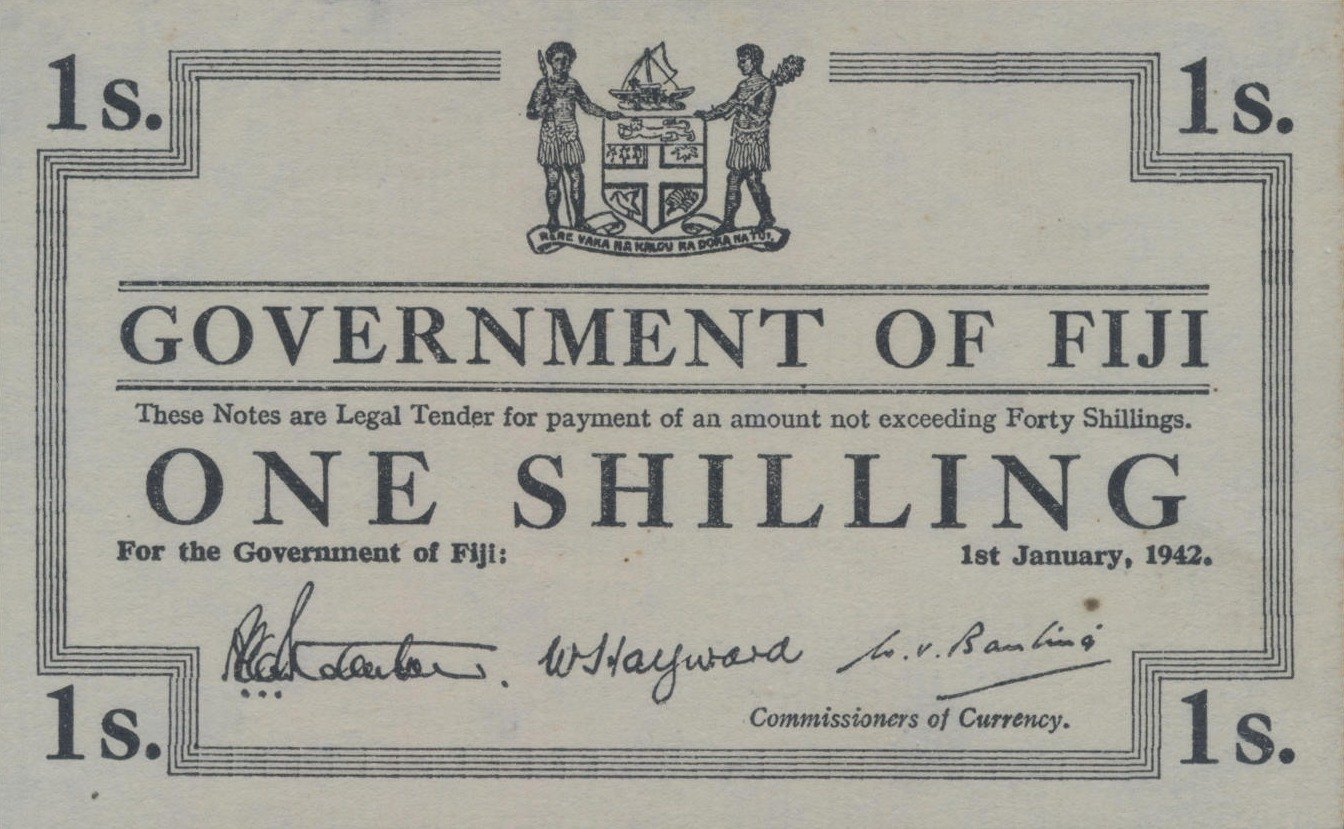
Two details of the first 1 shilling are in Part I alone. The paper was a laid paper of T. Edmonds & Co., "Devon Valley or possibly Eden Valley Parchment", with a monogram of about 10 by 7 cm showing a lion rampant. And of the 15,000 sheets, 116 unnumbered sheets of six remained, 58 soiled or defective ones having been taken out and 14 destroyed. Writing ten years later in Bank Note Reporter (July 2007), Rodgers gives the soiled or defective sheets as 56 and the job as finished by 12th June.
August to November 1942: Australian printings
| Day | Event | Source |
|---|---|---|
| 26th August 1942 | Cable: 1 pound FI/O 1 to 60,000 and 10 shillings FX/O 1 to 60,000 sent by United States Army plane; the first penny notes, P/1 000,001 to P/1 240,000, arrive | 36:3, pp. 11, 13 and 14; 36:4, p. 25 |
| 10th to 12th September 1942 | The second 1 shilling is printed: A 00001 to A 96000 in 96 bundles, B 00001 to B 75000 in 75 bundles; 34 sheets received the underprint only | 36:2, p. 38 |
| 14th to 16th September 1942 | Those notes are numbered | 36:2, p. 38 |
| 15th September 1942 | Advised: 1 pound FI/O 60,001 to 324,000 and 10 shillings FX/O 60,001 to 324,000 on the SS Hermion; penny notes P/1 240,001 to P/1 1,000,000 sent | 36:3, pp. 11 and 15; 36:4, p. 25 |
| 22nd September 1942 | Treasury notice of the 1 shilling with yellow background and the letters A and B; issued that day | 36:3, p. 15; 36:4, p. 24 |
| 1st October 1942 | Treasury notice in the Gazette, signed by Robertson: a large supply of penny notes already issued; merchants' tokens not legal tender | Rodgers and Cantrell, IBNS Journal 26:4 (1987), p. 105 |
| 28th October 1942 | 19,997 notes of 5 pounds sent by air, 5K 831,004 to 5K 851,000; three forms spoiled | 36:3, p. 11 |
| 4th November 1942 | Those 5 pounds notes received | 36:4, p. 25 |
| 10th November 1942 | The Governor writes that one million penny notes are in circulation | 36:3, p. 15 |
| November 1942 | The Legislative Council is told the 10 shillings notes are in the vaults, held for an emergency | Rodgers, IBNS Journal 25:4 (1986), p. 101 |
Rodgers's article of 1986 (25:4, p. 101) has the 10 shillings received in September 1942. The paper is given in the table of Part III (36:4, p. 26): the 1D, 6D, 4K and 5K notes are on Portals watermarked paper, and the 10 shillings FX/O on bond paper watermarked with a crowned A; Part II (36:3, p. 11) has the Australian printings on Commonwealth Bank bond paper with a repeating crown over A. Part III (p. 25) explains the letters: F for Fiji, I for one pound, X for ten shillings, P for penny. For the penny, Part II (pp. 13 and 14) adds that a sixpence with a blue background was planned and dropped after £2,000 of Australian sixpences were found. For the second 1 shilling, Part I (p. 37) presumes the paper to be a lot flown in on 20th June 1942.
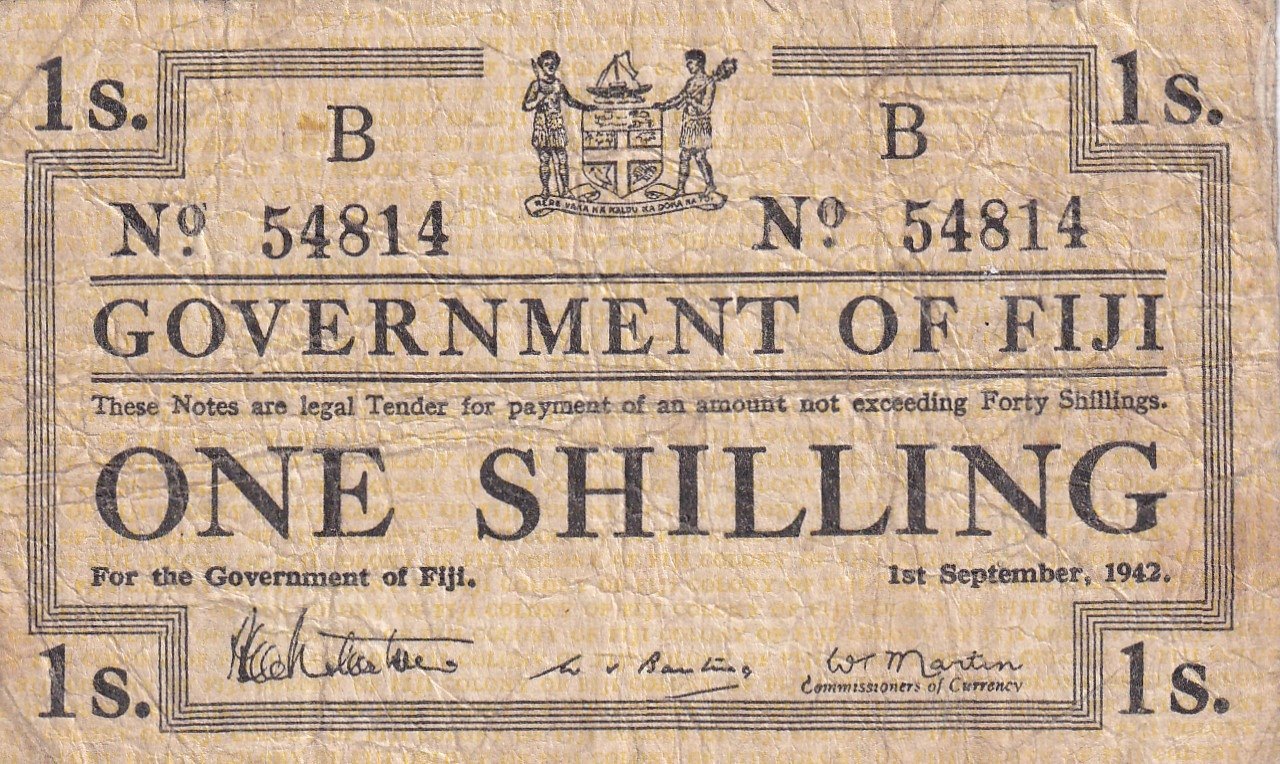
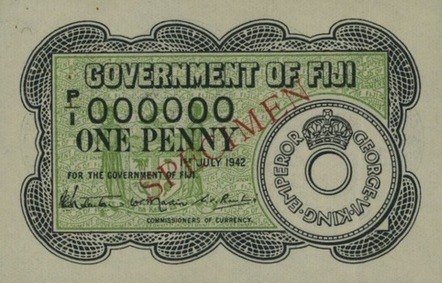
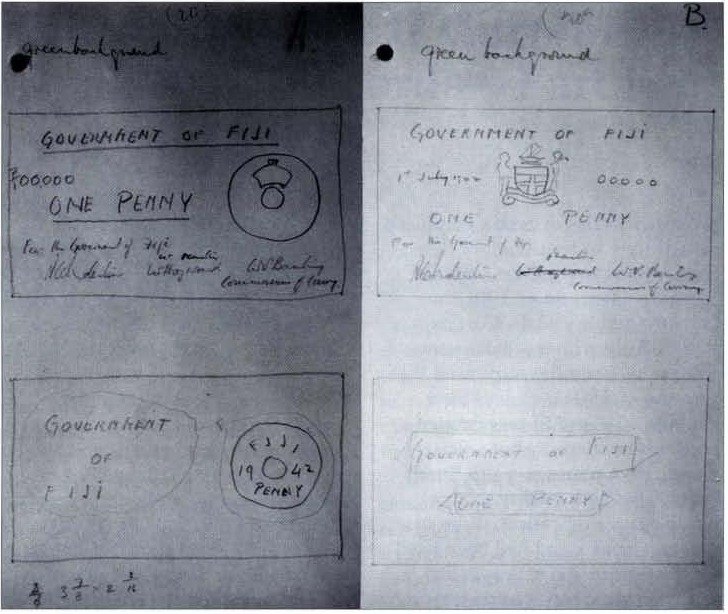
Of the specimens, Part II (p. 11) says thirty six were prepared of the 2 shillings, and that a similar number of the first 1 shilling "might be assumed".
1943 to 1956: winding up
| Day | Event | Source |
|---|---|---|
| December 1943 | A speech puts the rise in 5 pounds notes in circulation from September 1939 to October 1943 at 274 per cent | 36:4, p. 22 |
| beginning of December 1945 | Regular deliveries of notes from England start again; the 5 and 10 shillings begin to be replaced | 36:4, p. 22 |
| 7th October 1946 | Letter from the Colonial Sugar Refining Company about the overprinted 5 pounds | 36:4, p. 22 |
| 14th October 1946 | A report of the Acting Accountant-General: 30,997 overprinted 5 pounds notes (£154,985) were received from New Zealand in 1942 and all were issued to the banks | 36:4, p. 22 |
| 21st November 1946 | The Commissioners ask for at least £200,000 of new notes | 36:4, p. 22 |
| 18th August 1947 | Proclamation No. 10 of 1947: the small notes cease to be legal tender on 1st October 1947 | 36:3, p. 16 |
| 3rd December 1947 | Ordinance keeping the overprinted notes legal tender, deemed to run from 1st January 1948 | 36:4, p. 25 |
| August 1948 | All 324,000 of the 10 shillings FX/O are issued to a trading bank in exchange for sterling | 36:4, p. 22; 25:4, p. 101 |
| May 1949 | The bank sells back 60,000, exchanged for 20,000 new 10 shillings of prefix B/3 and 1,000 notes of 20 pounds | 25:4, p. 101 |
| 22nd June 1949 | A report of the Commissioners to the Reserve Bank of New Zealand: £499,000 in overprinted 1 pound notes and £154,985 in 5 pounds notes put into circulation since 1942 | 36:4, p. 22 |
| September 1949 | The bank sells back the other 264,000, burnt on 19th September 1949 | 36:4, p. 22 |
| May 1956 | The 60,000 are burnt | 36:4, p. 22 |
The 5 pounds is the note the letter of October 1946 complained of. Why a bank bought the whole stock of the 10 shillings in 1948 is not known. In the IBNS Journal of 1986 (25:4, p. 101) Rodgers reports the view of Hardie, Deputy Governor of the Reserve Bank of Fiji, that the bank bought them as a hedge against a revaluation of the Fiji pound after New Zealand's revaluation of 1948, and doubts it.
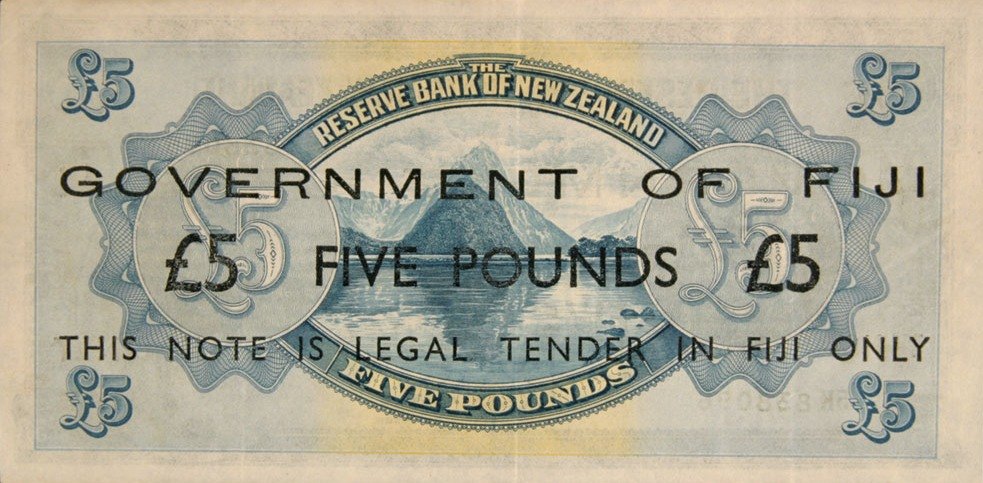
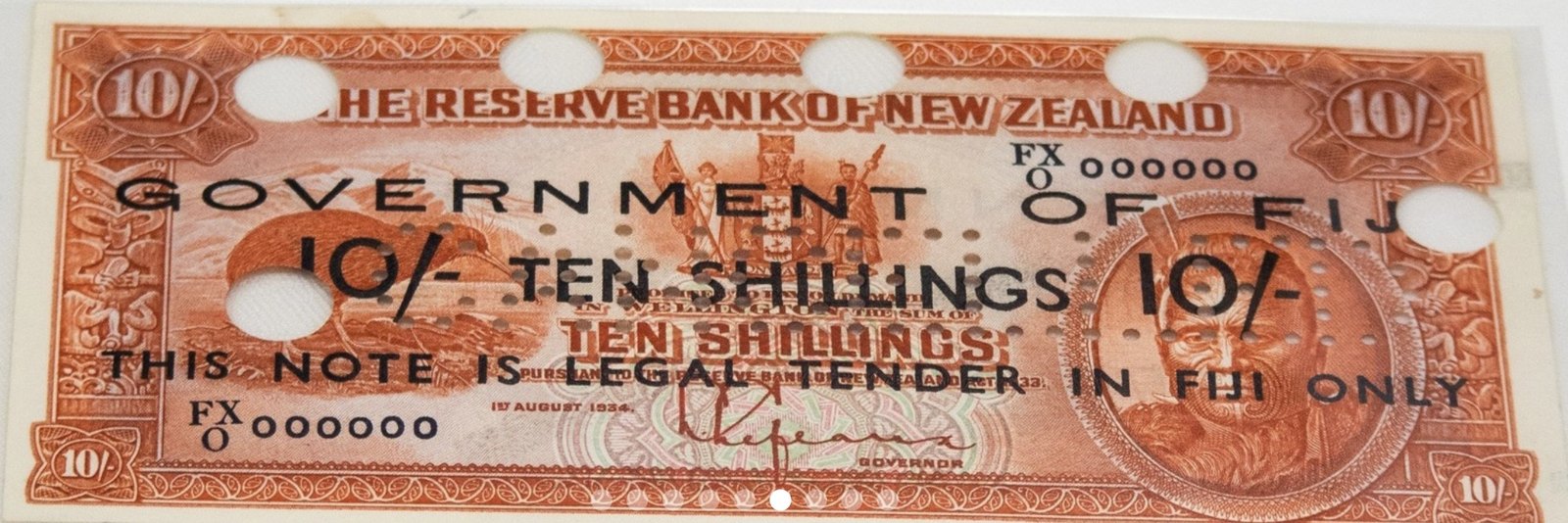
One 10 shillings note escaped. Rodgers's article of 1986, "Fiji Islands Update: Fabulous Fiji Find!", tells of its discovery that year on a field trip in the Pacific, and Part I of 1997 (p. 41) shows a plate of FX/O 117473 with the caption "Apparently, the last remaining, non-specimen, overprinted RBNZ 10/- note. Note burnt corners!" The Pick page records it as now held in the archives of the Reserve Bank of Fiji.
Where the writers disagree
Five other accounts are set beside Rodgers's here: H. J. Lorimer, "New Zealand Bank Notes Overprinted for Fiji" (IBNS Journal, volume 10, number 3, March 1971); Austin Sprake, "Fiji's Wartime Emergency Notes" (IBNS Journal, volume 12, number 2, 1973); Brian Kemp, "Fiji: the story of its currency" (IBNS Journal, volume 16, number 1, 1977); Fred Schwan, "Fiji's WWII Currency" (Bank Note Reporter, May 1983); and Fred Schwan, "More on Fiji World War II Currency" (IBNS Journal, volume 38, number 1, 1999).
| Point | Earlier writer | Rodgers from the files, or the notes themselves |
|---|---|---|
| The 5 pounds of prefix 5K | Lorimer, p. 117: 5K 831,001 to 5K 851,000 | 5K 831,004 to 5K 851,000; three forms spoiled |
| Paper of the 1D and 6D pound | Sprake, p. 23: unwatermarked | every New Zealand overprinted note Rodgers examined has the Reserve Bank of New Zealand watermark (36:2, p. 41) |
| The penny notes | Sprake, p. 21: £1,000 worth received in Suva on 4th September 1942 and £3,166 13s. 4d. worth on 24th September, 1,000,000 notes in all. Kemp, p. 7: some four million printed | the first lot arrived on 26th August and the rest was sent on 15th September 1942 (36:3, pp. 13 to 15); one million in all |
| The 10 shillings | Sprake, p. 22: 324,000 arrived in September 1942, were never issued and all burned in Suva. Schwan, May 1983: delivered in September 1942, not issued, reported burned in Suva | issued to a bank in August 1948 and bought back in 1949 |
| The second 1 shilling | Schwan, May 1983: "Sprake reports that 170,000 notes were issued". Sprake's own article (p. 21) has 171,000 issued | 171,000 (36:4, p. 26) |
| Date of the first shilling notes | Kemp, p. 7: the first 1 and 2 shillings were dated 1st September 1942 and numbered from 1 | the first 1 shilling and the 2 shillings are dated 1st January 1942 |
| The underprint | Kemp, p. 7: a background of the words Government of Fiji | the Pick page records the words COLONY OF FIJI on the 2 shillings |
| Supplies from London | Kemp, pp. 6 and 8: the notes of 1940 and 1941 were the last from the United Kingdom until the end of the war in Europe | regular deliveries began again at the beginning of December 1945 |
Some things in the other articles are not contradicted by the files as Rodgers gives them. Kemp (p. 6) tells that the light aircraft carrying the first consignment of overprinted New Zealand notes on to Suva made a forced landing in a marsh at Navua. Kemp (pp. 7 and 8) also describes the guard on the shilling printing: the only block of the arms in Fiji was locked in the currency vault, Customs was told to seize any that was imported, other work stopped and a guard was posted, and no forgeries were known. Lorimer (p. 117) says that by 1950 most of the overprinted notes had been withdrawn, the rest of the 5 pounds called in, and the rest of the 1 pounds expected to follow shortly. Schwan's article of 1999 (p. 39) notes that the two numbers on one first 1 shilling note can differ in typeface, with a square or a round full stop after "No.", and that leading zeros were not printed.
On survivors of the overprinted 5 pounds the count has moved. Schwan in May 1983 (p. 18) knew three notes. The Pick page gives eight. Kerry Rodgers, reporting a sale in Bank Note Reporter of January 2009 ("Shinplasters and WWII issues top billing"), writes that 10 are known to be extant, with no more than seven in private hands.
Rodgers summed up the files in a note of 1992, "Nota Vitiensis" (IBNS Journal, volume 31, number 4, p. 34): all the notes and coins the Commissioners ordered during the war reached Fiji, and none was lost through enemy action.
Sources
- K. A. Rodgers, "Fiji's World War II Currencies: the Official Records", Parts I to III, IBNS Journal, volume 36, numbers 2, 3 and 4 (1997).
- Kerry A. Rodgers, "Fiji Islands Update: Fabulous Fiji Find!", IBNS Journal, volume 25, number 4 (1986), p. 101.
- Kerry A. Rodgers and Carol Cantrell, "Illegal Currency Tokens of World War II Fiji", IBNS Journal, volume 26, number 4 (1987), p. 105.
- Kerry Rodgers, "Nota Vitiensis", IBNS Journal, volume 31, number 4 (1992), pp. 33 and 34.
- H. J. Lorimer, "New Zealand Bank Notes Overprinted for Fiji", IBNS Journal, volume 10, number 3 (March 1971), pp. 116 and 117.
- Austin Sprake, "Fiji's Wartime Emergency Notes", IBNS Journal, volume 12, number 2 (1973), pp. 20 to 23.
- Brian Kemp, "Fiji: the story of its currency", IBNS Journal, volume 16, number 1 (1977), pp. 5 to 9.
- Fred Schwan, "More on Fiji World War II Currency", IBNS Journal, volume 38, number 1 (1999), p. 39.
- Fred Schwan, "Fiji's WWII Currency", Bank Note Reporter, May 1983.
- Kerry Rodgers, "Surprising depth found in World War II remainders", Bank Note Reporter, July 2007.
- Kerry Rodgers, "Shinplasters and WWII issues top billing", Bank Note Reporter, January 2009.
- The Pick pages of this catalogue for P-37, P-38, P-40, P-41 and P-44 to P-50.
Member comments
Log in or register to post a comment.