Seven notes of Fiji owe their existence to the war: three overprints on Reserve Bank of New Zealand designs, a 1 penny, two 1 shilling notes and a 2 shillings. This article puts together what their Pick pages say, most of it from the printing records as Kerry Rodgers reported them in Bank Note Reporter in February 2005 and July 2007, and from sources the pages do not name more closely.
Why notes and coin ran short
Fiji was never occupied in the Second World War, but many Commonwealth and American troops were stationed there from 1941 to 1943. The Pick pages give two effects. Notes went missing: the wartime shortage of currency was caused largely by Allied service personnel taking notes away as souvenirs. And coin ran short, which is why notes of a penny, a shilling and two shillings were made at all.
There was a third cause. Sources mention that Fiji asked New Zealand for notes on 3rd December 1941 because notes ordered from London had not come.
Two sets of regulations
Sources mention that the overprinted New Zealand notes became legal tender under the Defence (Currency Notes) Regulations 1942, made at Suva on 19th January 1942.
The small notes needed a second authority. Kerry Rodgers, writing in Bank Note Reporter in July 2007, gives 26th May 1942 as the day the Secretary of State's approval for notes of low value in place of coin was received in Fiji. Sources mention that notes under five shillings were then allowed by the Defence (Currency Notes) (No. 2) Regulations of 6th June 1942, and that they were legal tender only up to limited amounts: under 40 shillings, or 1 shilling for notes under 6 pence.
The New Zealand overprints
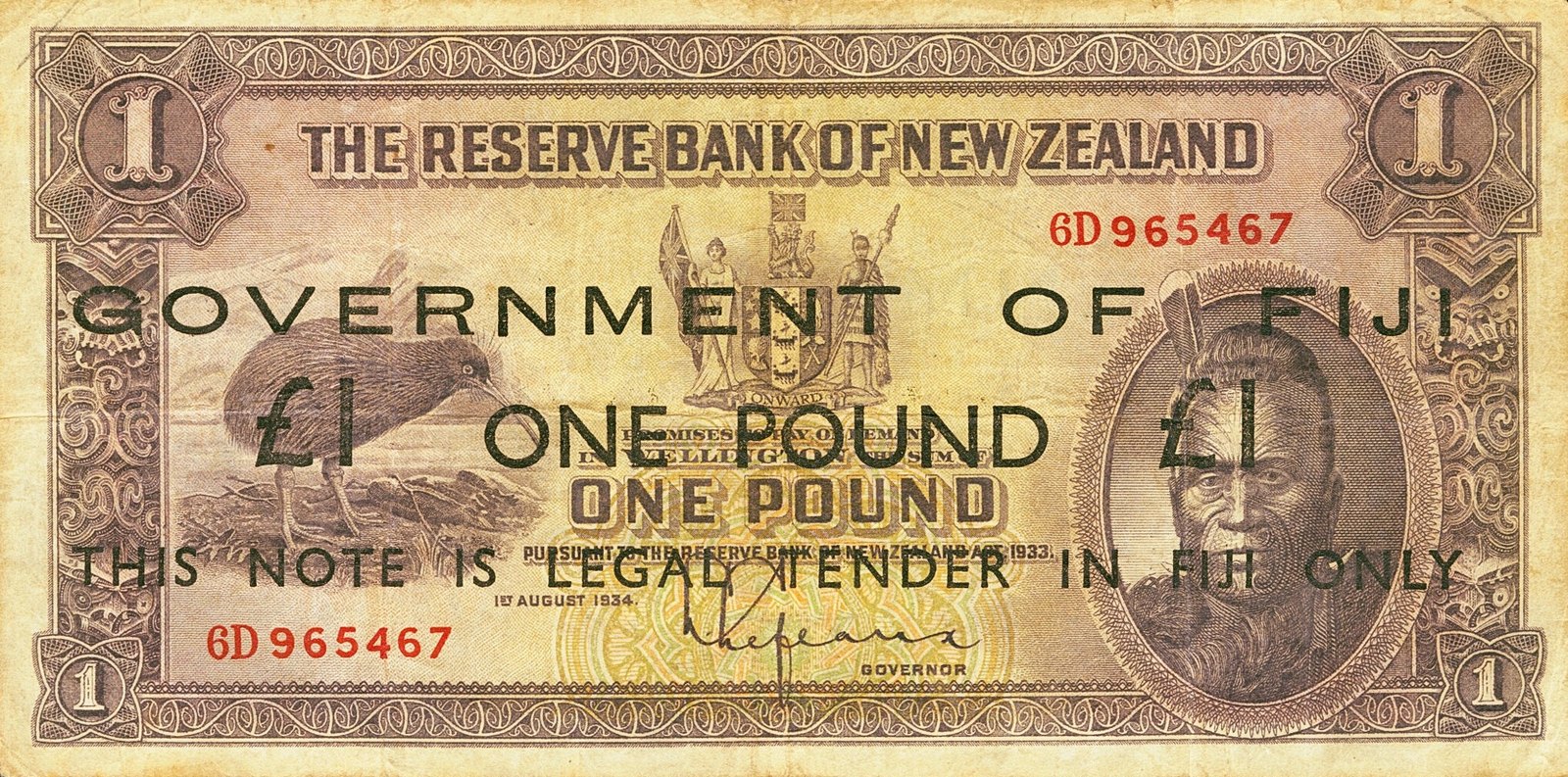
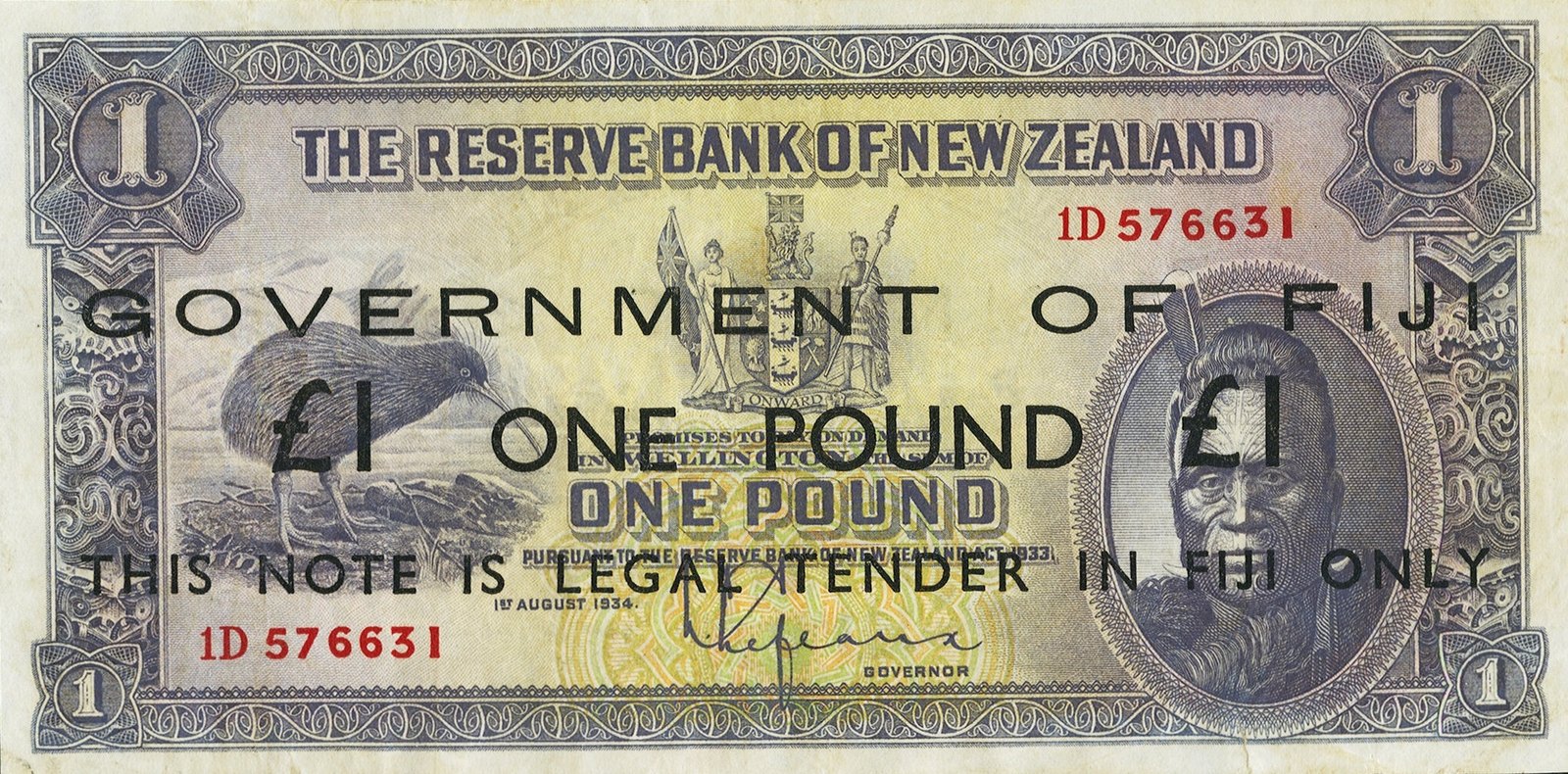
The Reserve Bank of New Zealand's first issue, signed by Lefeaux, had been printed by the Commonwealth Bank of Australia in Melbourne, on paper held in Wellington and Melbourne, as an emergency supply for possible issue in New Zealand. Sources mention that this reserve was printed in case notes from the London printer were held up by bomb damage or lost at sea through enemy action. It was found not to be needed. At the Fijian Government's request the Government Printer in Wellington overprinted 1 pound notes of prefixes 1D and 6D and 5 pounds notes of prefixes 4K and 5K for emergency issue in Fiji. The catalogue lists the overprinted 10 shillings and 1 pound under the date 1st August 1934, with 1942 as the year of issue.
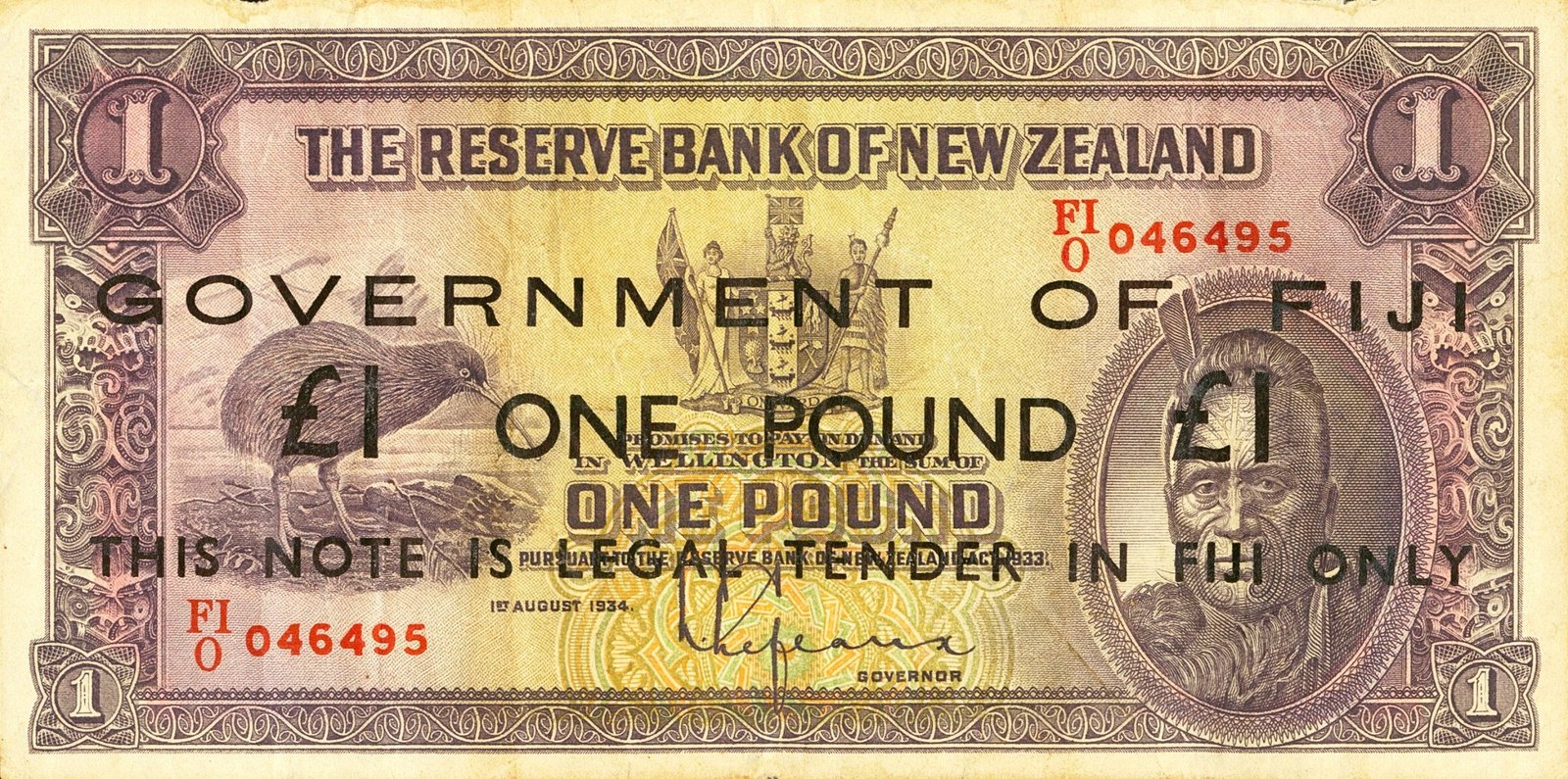
The 1 pound exists with a third prefix, FI/O. Those notes were not New Zealand stock: they were printed and overprinted by the Commonwealth Bank of Australia on its own bond security paper, which sources mention was also used for Australian securities, war bonds and stamps. Sources mention that the overprint sits in a different position on the FI/O notes than on 1D and 6D. Sources mention an official report of 1949 recording 499,000 of the 1 pound notes put into circulation, which is all three prefixes in full.
Of the 5 pounds, sources mention that only 30,997 were received, in three runs:
| Received | Numbers |
|---|---|
| January 1942 | 4K 825,001 to 4K 831,000 |
| June 1942 | 5K 859,001 to 5K 864,000 |
| November 1942 | 5K 831,004 to 5K 851,000 |
Forms 5K 831,001 to 5K 831,003 were spoiled in printing and kept for destruction. Official reports of 1946 and 1949 record all 30,997 as issued to the banks. Most had been withdrawn from circulation by 1950, and sources mention eight surviving notes, two of prefix 4K and six of prefix 5K.
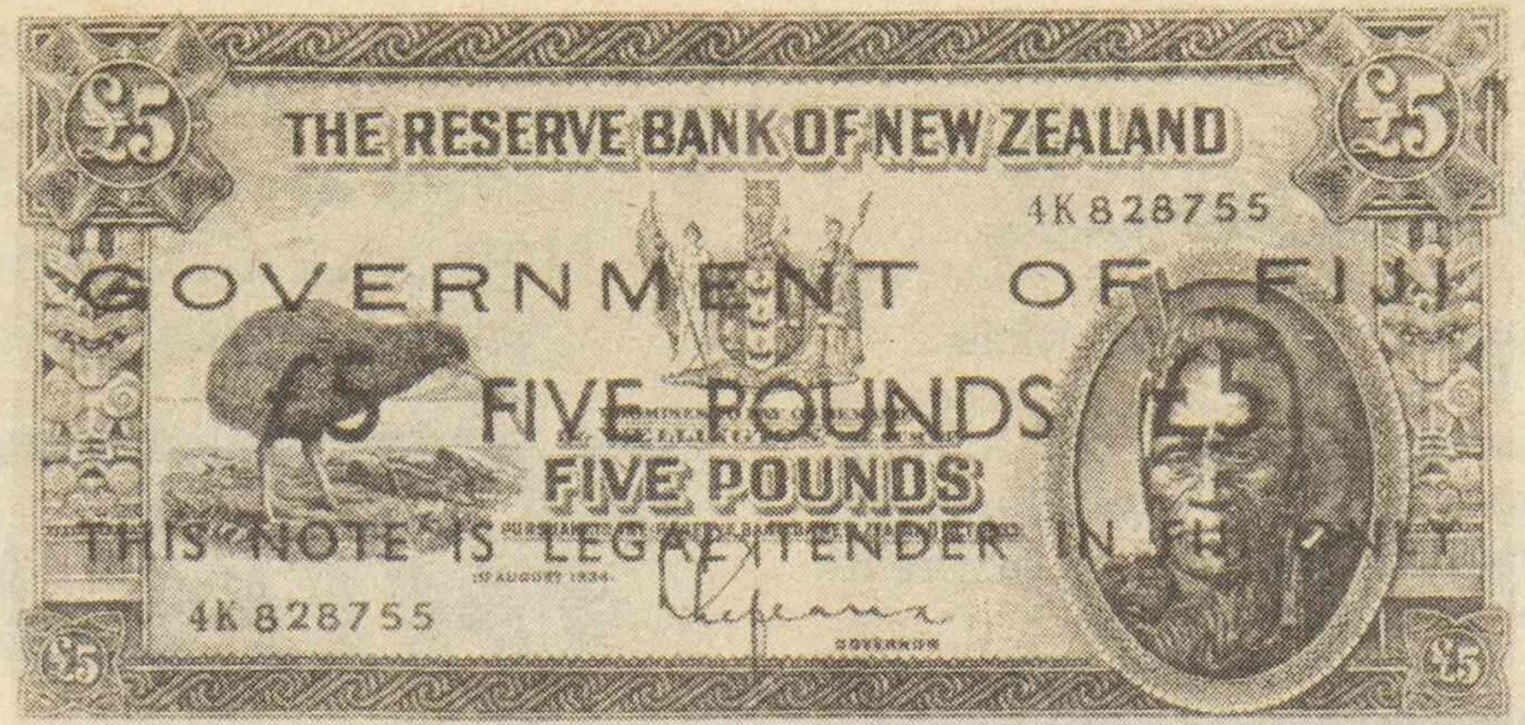
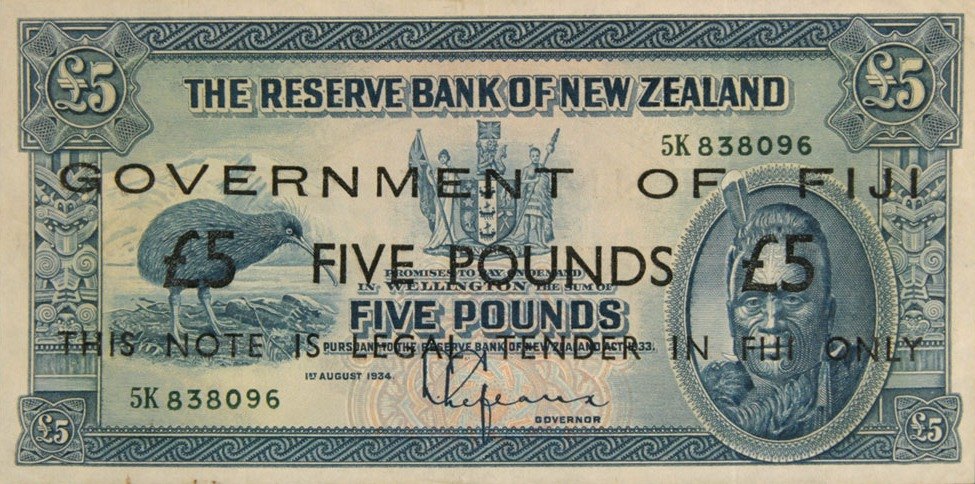
Paper and watermark. Sources mention that the paper of all the notes overprinted in Wellington, prefixes 1D, 6D, 4K and 5K, was made by Portals. Those notes carry the RESERVE BANK OF NEW ZEALAND watermark across the centre, level with ONE POUND on the 1 pound and above FIVE POUNDS on the 5 pounds. The statement found in some sources that all overprinted denominations are unwatermarked is mistaken. Sources mention notes of both 5 pounds prefixes on the watermarked paper, which suggests that the paper supplied from Wellington was watermarked and that supplied by the Commonwealth Bank of Australia was not.
A forgery and a complaint. Sources mention forged overprints on first issue Reserve Bank of New Zealand 5 pounds, reported at Auckland in 1982. They carry the line THOMAS DE LA RUE & COY. LTD. LONDON at the foot of the back. That line was removed from the plates before the genuine notes were printed, and sources mention that no overprinted note, of any value, has the De La Rue imprint there.
The overprinted 5 pounds had a fault in use. Sources mention complaints in 1946 that it was confused with the 10 pounds of Fiji, and that in November 1946 the Currency Commissioners asked for new notes so that the overprints could be withdrawn.
The 10 shillings that stayed in the vault
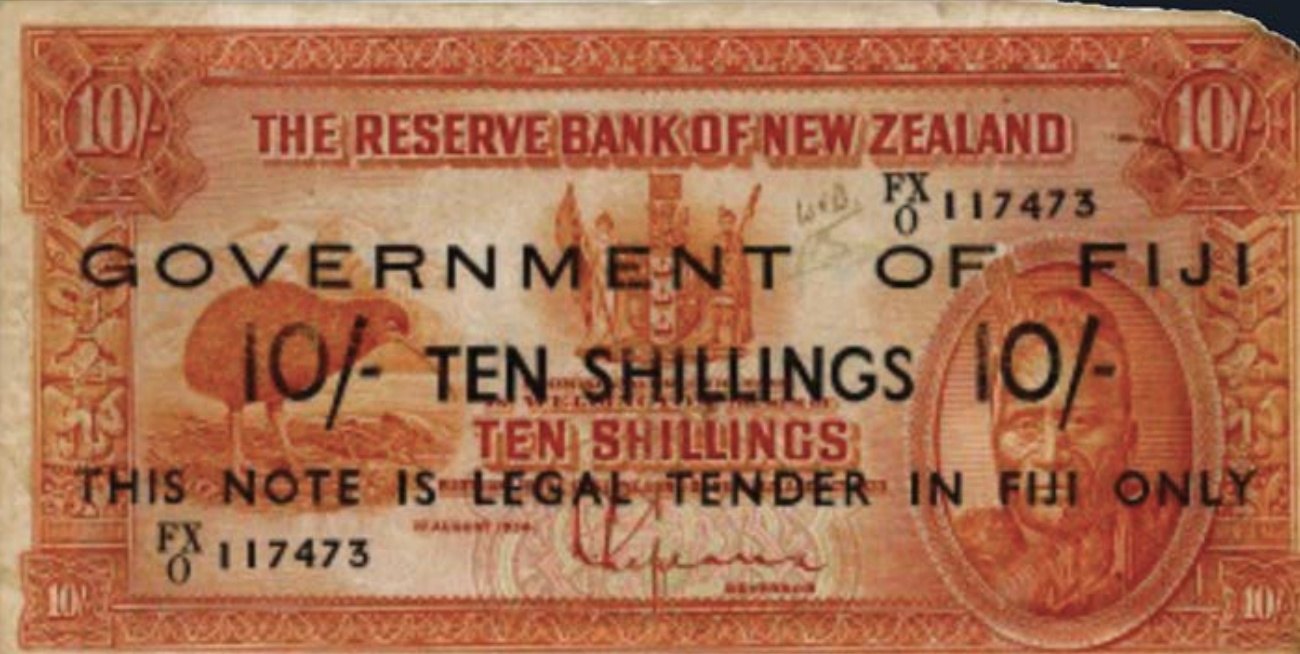
The 10 shillings, prefix FX/O, was like the FI/O pound: printed and overprinted by the Commonwealth Bank of Australia on its own bond security paper, not overprinted New Zealand stock. 324,000 notes were made. Sources mention that in November 1942 the Legislative Council was told the notes were already in the vaults, held for an emergency.
The emergency did not come. The notes were held in storage until August 1948, when all were "issued" to a bank, though they never circulated in public. Sources mention that the bank sold them back to the Currency Commissioners in 1949, 60,000 in May and 264,000 in September. Sources mention that the 60,000 returned in May 1949 were exchanged for 20,000 new 10 shillings notes of prefix B/3 and 1,000 notes of 20 pounds; the two sums are equal, 30,000 pounds. Sources also mention that the 264,000 were burnt on 19th September 1949 and the 60,000 in May 1956. Only one issued note is known to survive, in the archives of the Reserve Bank of Fiji.
The penny, printed in Australia
The 1 penny is dated 1st July 1942. Sources mention printing in Australia by the Commonwealth Bank, the plate and paper being requested on 30th June 1942. Kerry Rodgers, writing in Bank Note Reporter in February 2005, tells that Captain Robertson, whose signature is on the note, sketched two possible designs for it on office stationery while in Australia arranging the printing. The sketches, with handwritten notes of size and colour, are in the archives of the Reserve Bank of Fiji.
One million notes were printed, all with prefix P/1. P/1 000,001 to P/1 240,000 reached Fiji on 26th August 1942, and P/1 240,001 to P/1 1,000,000 were sent on 15th September 1942. The notes were first issued by 1st October 1942, when a Treasury notice from Suva said that a large supply of penny notes had already been issued, and all one million were in circulation by 10th November 1942.
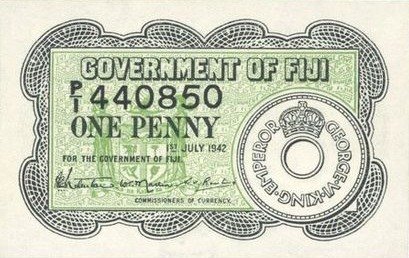
The notes were printed on sheets of watermarked paper, so depending on its place in the sheet a note shows part of the watermark or none at all. Sources mention fragments of the paper maker's watermark including the words BRITAIN and EXTRA STRONG; most notes show none.
Sources mention that a matching 6 pence note was designed but never printed, once Australian sixpences had been obtained. The article Values that were never issued shows it.
The Government Printer's 1 and 2 shillings
Sources mention that the Government Printer, F. W. Smith, proposed and designed the shilling notes. All three were printed by the Government Printer, Fiji, on sheets of watermarked paper, so that a note shows part of the watermark or none at all, depending on its place in the sheet.
The 1 shilling dated 1st January 1942
The first 1 shilling is signed by Robertson, Hayward and Banting and printed in black, with no underprint and no letter above the number. Although it is dated 1st January 1942, sources mention that the notes were printed from 5th June 1942 and first went into circulation on 9th June 1942. Printing therefore began a day before the date of the regulations that allowed notes under five shillings.
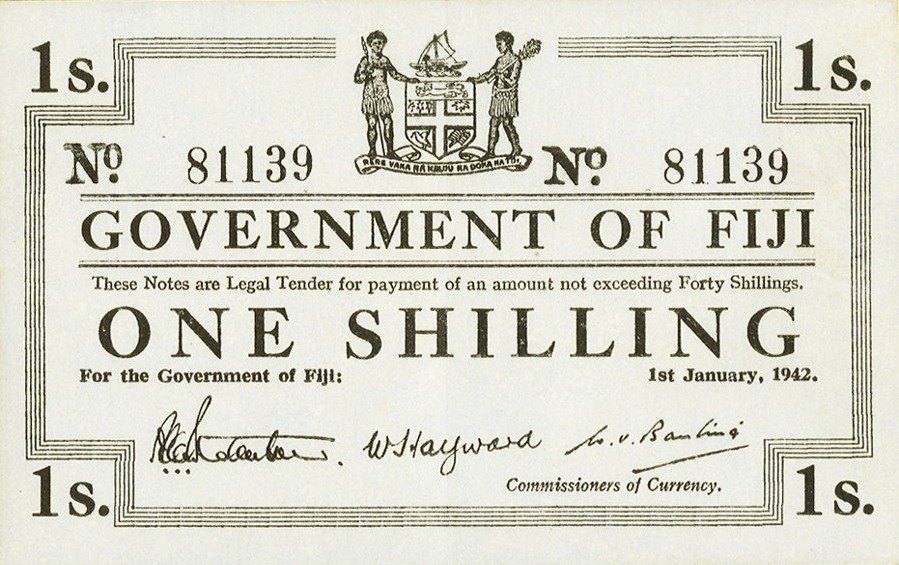
Sources mention printing by letterpress, with the parallel-line borders built up from pieces of type, so the joints in the border differ from one position of the sheet of six to another. Sources mention laid paper by T. Edmonds & Co., watermarked with a crowned lion monogram, the scroll TE, the firm's name and a date, 1923 or 1929. The sheets went through the press any way round, so a note may show any part of this, in any direction, or only the laid lines.
Kerry Rodgers, writing in Bank Note Reporter in July 2007, says from the printing records that the whole job was finished by 12th June 1942. Faulty notes found while the packets of 1,000 were made up were replaced by good notes, numbered one at a time, from spare printed sheets. Of the 15,000 sheets, 56 soiled or defective ones were taken out, 14 of them destroyed, while 116 sheets were left unnumbered.
The 2 shillings dated 1st January 1942
The 2 shillings was first issued on 30th June 1942. 180,000 notes were printed, with no serial prefix and a number of one to six digits. Sources mention Cowan Extra Strong paper, with a pink underprint of the repeating words COLONY OF FIJI on both sides in place of a continuous watermark.
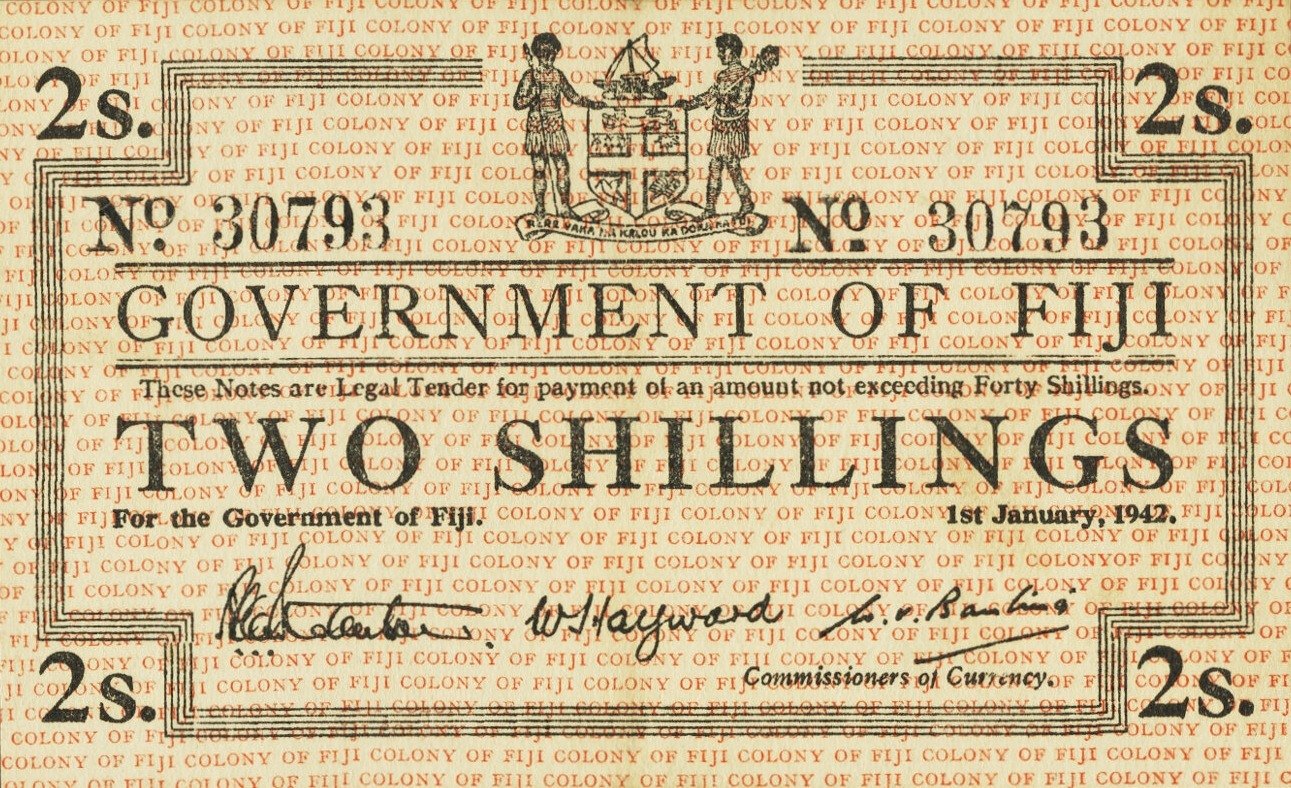
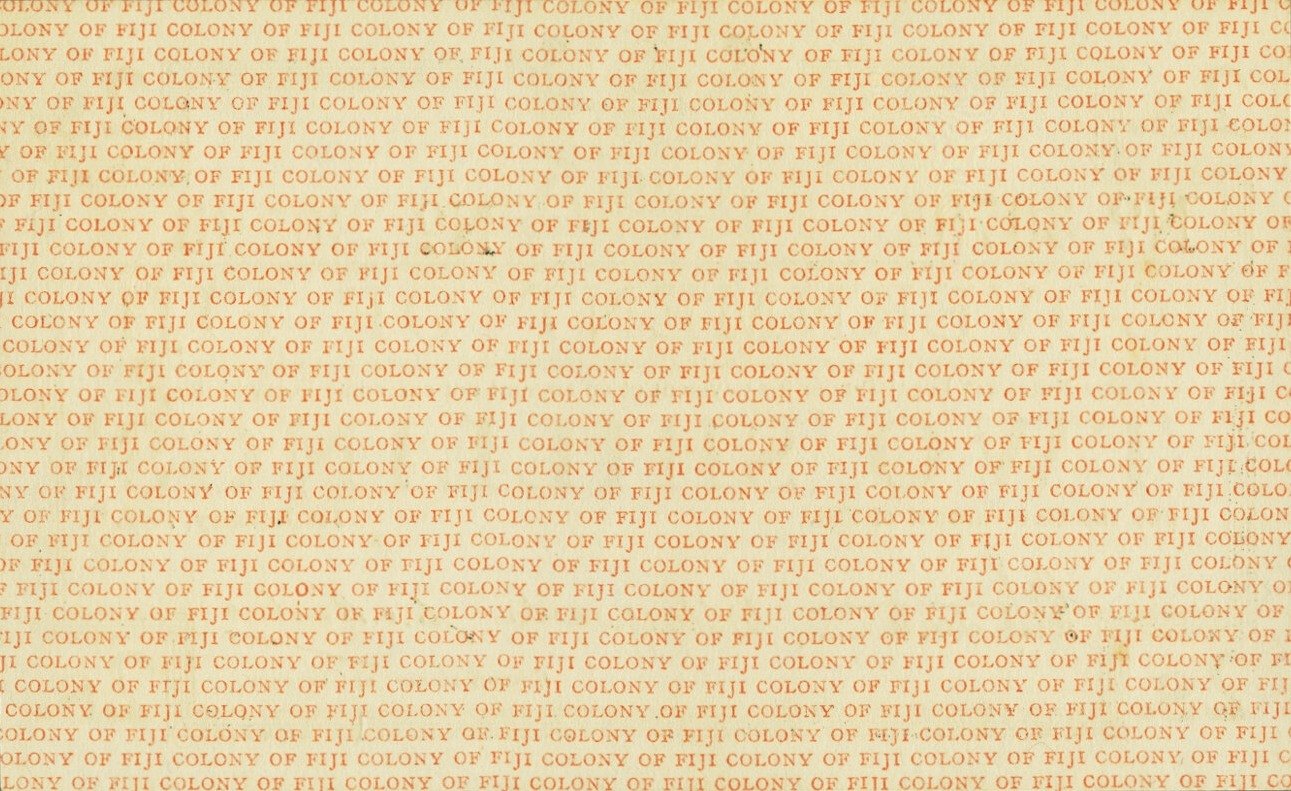
Rodgers, in the same article of July 2007, says that 332 sheets were destroyed in the work, that two sheets of specimens (12 notes) went to the Financial Secretary and four specimen sheets stayed with the Government Printer. 600 unnumbered sheets were left over. Rodgers adds that afterwards the forme of the 1 shilling was handed to the Commissioners of Currency and that of the 2 shillings was broken up.
The 1 shilling dated 1st September 1942
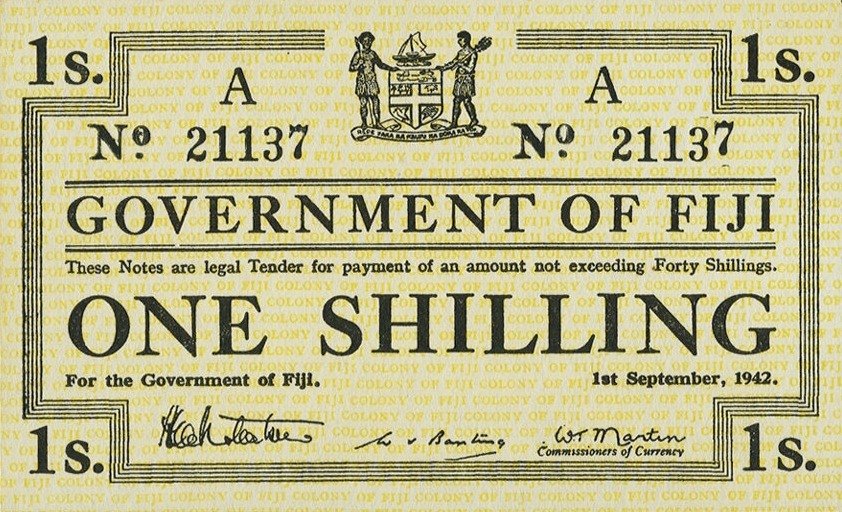
The second 1 shilling has a yellow underprint and a block letter, A or B, and is signed by Robertson, Banting and Martin. It was printed on Cowan "Extra Strong" paper and numbered in September 1942: A 00001 to A 96000 and B 00001 to B 75000, 171,000 notes in all. Sources mention a Treasury notice of 22nd September 1942 announcing these notes. Specimens exist for both prefixes.
The unnumbered sheets and where they come from
Unissued remainders without serial numbers exist of the first 1 shilling and of the 2 shillings; those of the 2 shillings survive as hand-cut single notes, uncut pairs and uncut sheets of six. Kerry Rodgers, writing in Bank Note Reporter in July 2007, gives their history in two parts.
Open-printed, unnumbered sheets of six of both values first reached dealers in the 1980s, sold by a dealer in Suva from the estate of the man who had headed the Government Printer during the war. About ten years later Rodgers was asked to sell a second group, 15 sheets of the 1 shilling and 16 of the 2 shillings, from another estate; at least one set of them had come from a former manager of the Bank of New Zealand in Suva.
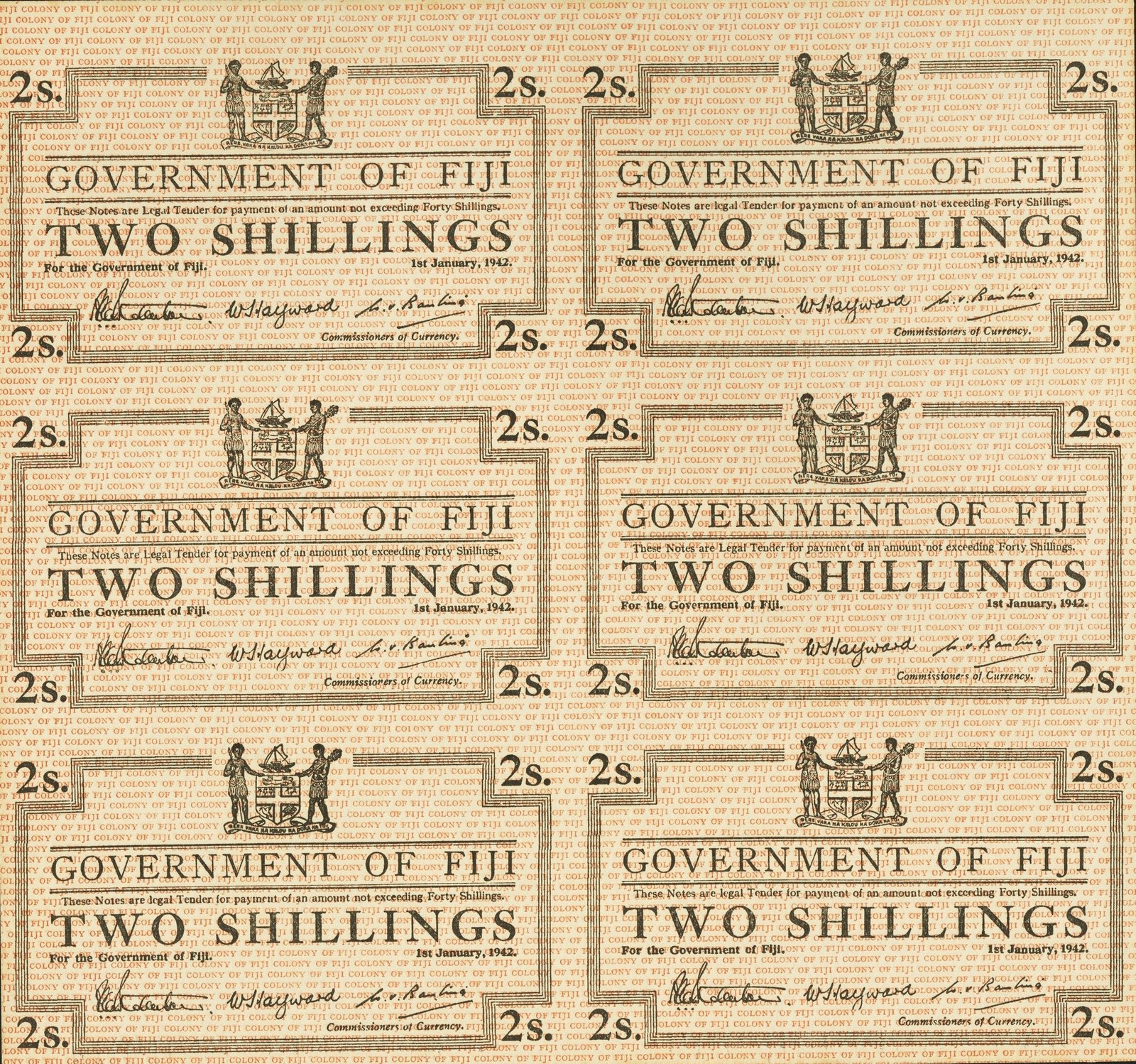
Some sheets of both groups were cut up. The single unnumbered notes now on the market therefore date, as single notes, from the 1980s or later.
The seven notes side by side
| Note | Made by | How many | In use from |
|---|---|---|---|
| 10 shillings, FX/O | Commonwealth Bank of Australia | 324,000 made | never circulated |
| 1 pound, 1D, 6D and FI/O | Commonwealth Bank of Australia; 1D and 6D overprinted at Wellington | 499,000 put into circulation | legal tender under regulations of 19th January 1942 |
| 5 pounds, 4K and 5K | Commonwealth Bank of Australia; overprinted at Wellington | 30,997 received | January 1942, first run received |
| 1 penny, P/1 | Commonwealth Bank, Australia | 1,000,000 | by 1st October 1942 |
| 1 shilling, 1st January 1942 | Government Printer, Fiji | 15,000 sheets of six worked | 9th June 1942 |
| 2 shillings, 1st January 1942 | Government Printer, Fiji | 180,000 | 30th June 1942 |
| 1 shilling, 1st September 1942 | Government Printer, Fiji | 171,000 | announced 22nd September 1942 |
Withdrawal
Sources mention that the penny and the shilling notes ceased to be legal tender on 1st October 1947, by a proclamation of 18th August 1947.
The overprinted notes lasted longer in law. Sources mention that they came under the Currency Notes Ordinance from 1st January 1948, and that they ceased to be legal tender with all other pounds, shillings and pence notes on 1st July 1969.
What is not settled
The Pick pages do not give the number of 1 shilling notes of 1st January 1942 that were issued, only the count of sheets. They do not say how many 1 pound notes were of each prefix.
The Reserve Bank of Fiji's own short history, "A History of Fiji's Currency", tells the same story briefly and adds no figures: in 1942, when some normal notes ran short, the Reserve Bank of New Zealand agreed that its 1 pound and 5 pounds notes, then being printed by the Commonwealth Bank of Australia, be overprinted for local use by the Government Printer; the Government Printer printed a supply of notes of one shilling and two shillings; and some one penny notes were printed in Australia. It does not mention the overprinted 10 shillings, and it gives no dates beyond the year.
For more pieces from these years, see Wartime and occupation: what the design archive keeps from 1914 to 1945.
Sources
- The Pick pages of this catalogue for P-44 to P-50.
- Kerry Rodgers in Bank Note Reporter, February 2005 (the penny sketches) and July 2007 (the Secretary of State's approval, the printing records of the shilling notes, the unnumbered sheets).
- The Defence (Currency Notes) Regulations 1942 of 19th January 1942 and the Defence (Currency Notes) (No. 2) Regulations of 6th June 1942, as the Pick pages cite them.
- Official reports of 1946 and 1949, a Treasury notice of 22nd September 1942, a Treasury notice from Suva on the penny notes and the proclamation of 18th August 1947, as the Pick pages cite them.
- Reserve Bank of Fiji, "A History of Fiji's Currency", https://www.rbf.gov.fj/core-functions/currency-management/a-history-of-fijis-currency/
Member comments
Log in or register to post a comment.