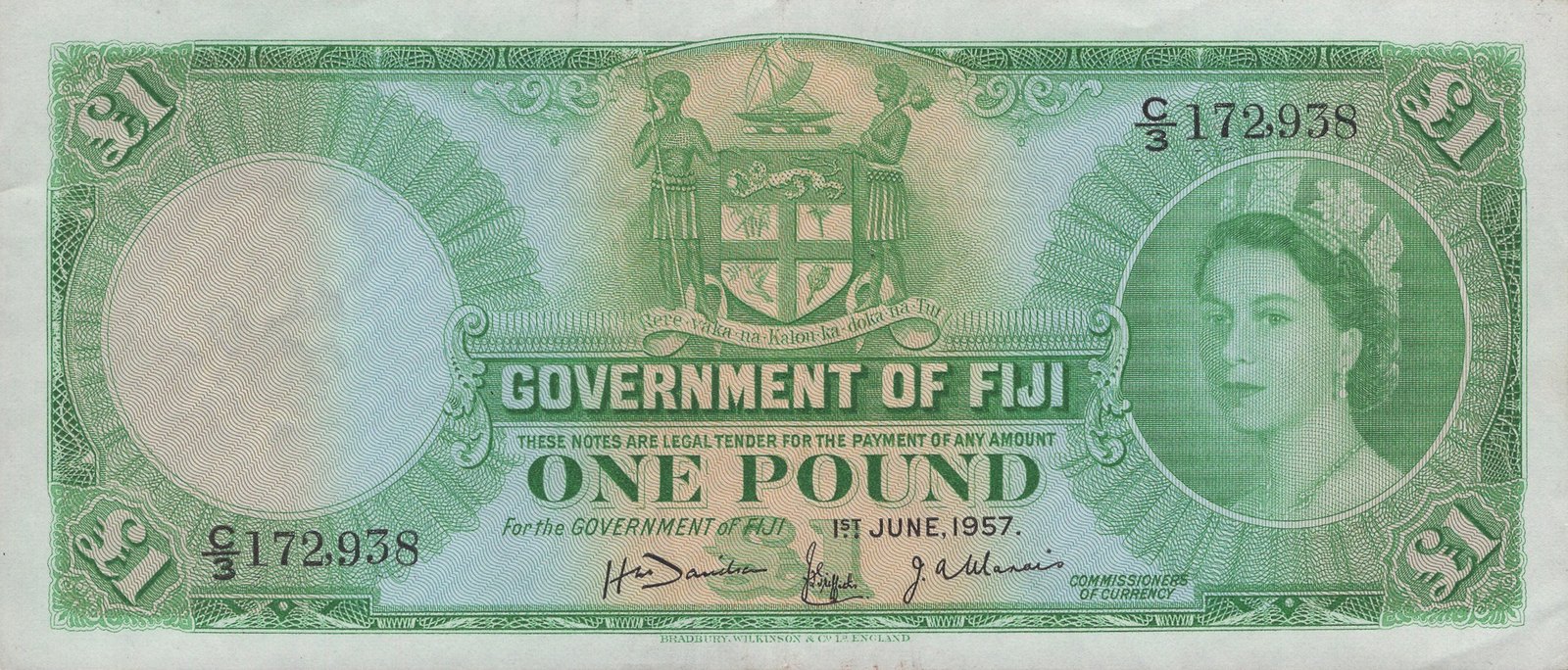
The article on the first Government notes gives six year-end figures of notes in circulation in Fiji. The printed sources hold many more. This article sets out all of them: the Colonial Reports (the yearly reports on the Colony), the statements of the Commissioners of Currency in the Fiji Royal Gazette, and the Accountant-General's reports of the 1960s. No source gives a single figure by value of note, and that limit is set out at the end.
The banks' notes, 1909 to 1921
The annual report on Fiji for 1909 (Colonial Reports, Annual No. 657, p. 6) says: "There is no Government note issue." The Bank of New Zealand and the Bank of New South Wales each had a private note issue, and the report says the estimate for 1909 was 1,922 pounds above that for 1908. Later reports give the banks' notes again, the last of them as being withdrawn.
| Date | Banks' notes in circulation | Source |
|---|---|---|
| 31st December 1909 | 7,682 pounds, estimated | annual report for 1909, No. 657, p. 6 |
| 31st December 1912 | 1,790 pounds | annual report for 1913 |
| 31st December 1913 | 2,400 pounds, "not recognized officially" | annual report for 1913 |
| 31st December 1920 | 39,818 pounds | annual report for 1920, text only |
| 31st December 1921 | 7,768 pounds, being withdrawn | annual report for 1921 |
The figures of 1912 and 1913 are far below the estimate of 1909, and no reason was found in the reports as read. The figure of 1920 was taken from the machine-read text of the report and not checked on the page. The annual report for 1922 (No. 1171, p. 22) still names the two banks, the Bank of New South Wales with three establishments and the Bank of New Zealand with two, and says nothing of bank notes. K. A. Rodgers and Carol Cantrell, in the IBNS Journal (volume 29, number 1, 1990, p. 6), write that on 20th June 1918 the two banks were asked to stop issuing their own notes above 10 shillings.
The first statements in the Gazette, 1914 to 1921
From 1914 to 1922 the Commissioners of Currency published a statement every month in the Fiji Royal Gazette, each headed as made under section 10(4) of Ordinance No. XXX of 1913. The first, in the Gazette of 1914, p. 885, is for the period ending 10th December 1914. It gives a total stock of notes of £20,000 on 4th December 1914, none received or destroyed since, and on 10th December £9,990 in the vault and £10,010 in circulation. These are the notes of the first issue: the 1 pound, the 5 pounds, the 10 pounds and the 20 pounds.
Until 1919 the monthly statements also give, by value, the stock of notes received and the notes destroyed. As the statements were read, they show:
| Date of statement | Stock of notes |
|---|---|
| 4th December 1914 | £20,000 |
| by 10th September 1915 | £15,000 more received |
| by 10th May 1916 | £40,000 |
| by 11th December 1916 | £65,000 |
| by 10th April 1918 | £95,000 |
| by 10th May 1919 | £113,000 |
Notes destroyed stood at £4,517 in 1915 and had risen to £7,132 in 1918 and 1919.
The circulation in the same statements:
| Date | Notes in circulation | Source |
|---|---|---|
| 10th December 1914 | £10,010 | Gazette 1914, p. 885 |
| February 1918 | £63,696 | monthly statement |
| 10th September 1918 | £63,696 | monthly statement |
| 11th November 1918 | £94,932 | monthly statement |
| January 1919 | £107,868 | monthly statement |
| May 1919 | £125,868 | monthly abstract |
| March 1921 | £415,368 | monthly abstract |
The statement of December 1914 was read on the page. For the later Gazette figures the reading does not say whether they were checked on the page or taken from the machine-read text.
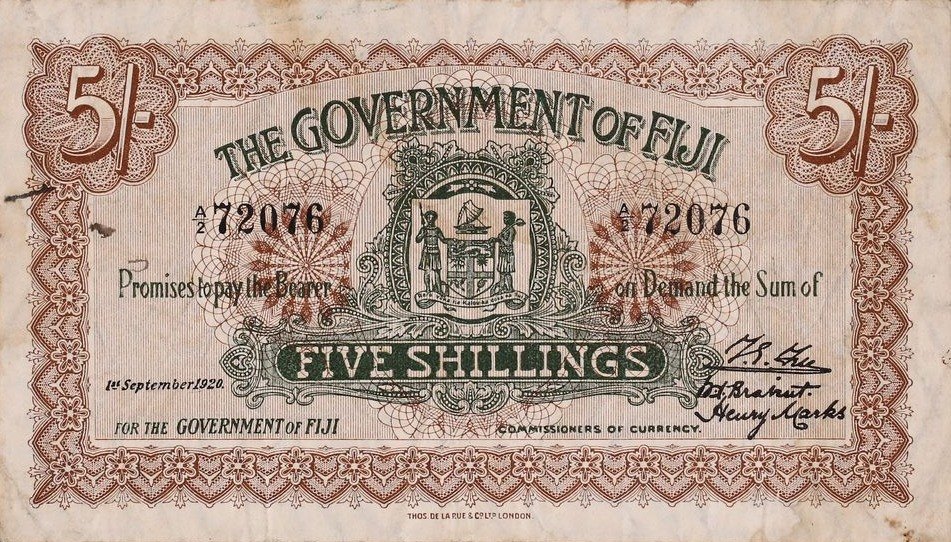
Two rises stand out. Between 10th September and 11th November 1918 the circulation went from £63,696 to £94,932 while no new stock was received. The earliest 10 shillings is dated 29th October 1918, and Rodgers and Cantrell give 23rd May 1919 as the day the first 10 shillings notes were issued; the Gazette does not say what the rise of late 1918 was made of. Between May 1919 and March 1921 the circulation went from £125,868 to £415,368. The earliest 5 shillings is dated 1st January 1920, inside those months. No notice of the first issue of either value was found in the Gazette extracts that were read.
Year by year, 1919 to 1938
The annual reports give the notes in circulation on 31st December and, in most years, the Currency Note Guarantee Fund held against them: gold sovereigns, securities at their market price, and the investments of a Depreciation Fund. All figures are in pounds.
| 31st December | Notes in circulation | Gold (sovereigns) | Securities | Depreciation Fund | Total of the fund | Source |
|---|---|---|---|---|---|---|
| 1919 | 149,868 | annual report for 1919 | ||||
| 1920 | 372,868 | annual report for 1920 | ||||
| 1921 | 419,827 | annual report for 1921 | ||||
| 1922 | 326,945 | 80,827 | 277,538 | 8,290 | 366,655 | annual report for 1922, No. 1171, p. 21 |
| 1924 | 318,397 | 72,896 | 290,049 | 14,577 | 377,522 | annual report for 1924 |
| 1925 | 355,199 | 72,896 | 300,327 | 17,842 | 391,065 | annual report for 1925, p. 9 |
| 1927 | 367,399 | 73,481 | 347,303 | 25,931 | not read | annual report for 1927 |
| 1928 | 431,583 | 86,481 | 371,198 | 30,476 | 488,155 | annual report for 1928, No. 1453, p. 16 |
| 1929 | 441,583 | 88,481 | 399,975 | 35,616 | 524,072 | annual report for 1929, No. 1497, p. 13 |
| 1930 | 437,983 | 518,213 | annual report for 1930 | |||
| 1931 | 405,384 | 83,881 | 359,806 | 39,740 | 483,427 | annual report for 1931, No. 1604, p. 68 |
| 1932 | 467,150 | 85,881 | annual report and Economic Survey for 1932 | |||
| 1933 | 504,401 | Economic Survey for 1933 | ||||
| 1934 | 506,876 15s. | annual report for 1934 | ||||
| 1935 | 506,866 | annual report for 1935 | ||||
| 1936 | 597,862 5s. | Colonial Reports, text only | ||||
| 1938 | 665,427 15s. (Fiji pounds) | 755,538 10s. 9d. (Fiji pounds) | annual report for 1938 |
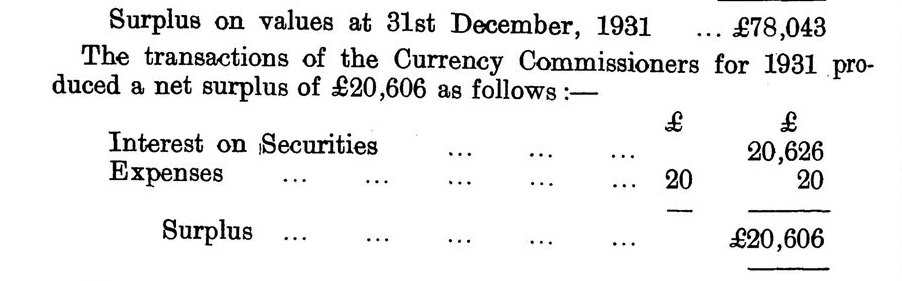
The figures of 1919, 1920, 1921, 1927, 1935 and 1936 were taken from the machine-read text of the reports and not checked on the page; the others were read on the page. The reports print a "surplus on values", the fund less the notes: 39,710 pounds in 1922, 59,125 in 1924, 79,316 in 1927, 56,572 in 1928 and 78,043 in 1931.
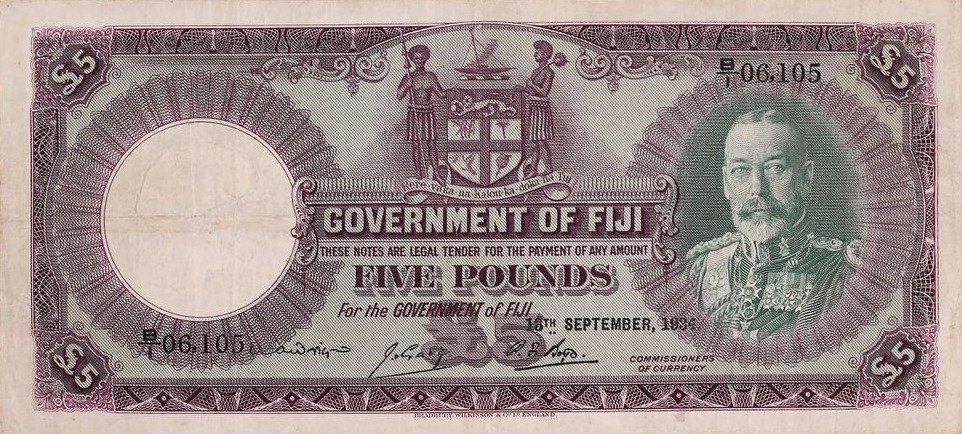
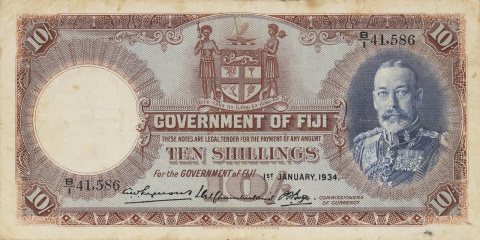
The figures read from the report for 1938 show no gold. Its Note Security Fund is given in two currencies: an invested portion of 649,133 pounds 16s. 4d. sterling (720,538 pounds 10s. 9d. Fiji) and cash with the Colonial Treasurer and the Crown Agents of 31,531 pounds 11s. sterling (35,000 pounds Fiji), in all 680,665 pounds 7s. 4d. sterling. The Fiji Currency Notes Ordinance 1933 had by then put the issue on sterling, at 111 Fiji pounds for 100 pounds sterling. The notes then in use were the portrait notes that begin with the 5 shillings of 1934.
The Gazette's own statements give two more points for these years: £504,414 in circulation in August 1933 and £949,662 in June 1942.
What the Commissioners earned
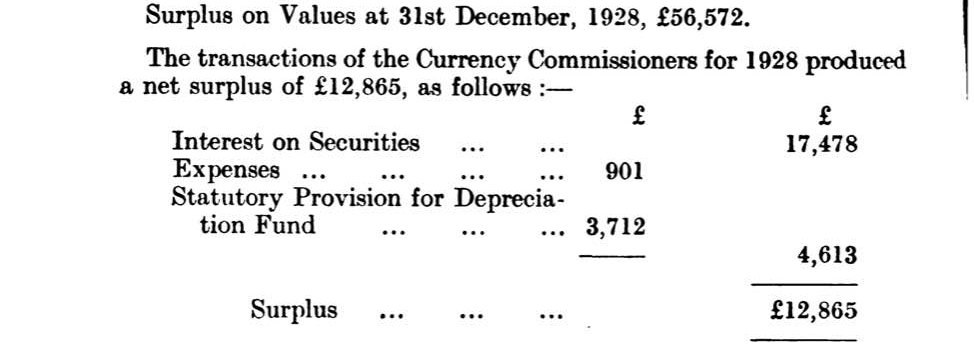
The securities paid interest, and the reports give the Commissioners' net surplus for some years: 14,371 pounds for 1922, 10,269 for 1924, 9,944 for 1925, 12,865 for 1928 and 20,606 for 1931. The report for 1931 shows how the last was made up: interest of 20,626 pounds less expenses of 20 pounds. For 1934 the surplus of 23,157 pounds 14s. 5d. was paid to the revenue of the Colony.
The paper of 1925
The report for 1925 adds one sentence about the notes themselves: "As from December, 1925, a start was made to withdraw from circulation the old issue of Currency notes from 1909 onwards and replacing them by an issue similar in designs and denominations but on a better quality of paper." The year 1909 is odd, since the Government notes began in 1914 and the report for 1909 says there were none. The report does not explain it.
The war and after
For the war years the sources read give only single points. The Gazette abstract of June 1942 has £949,662 in circulation. Kerry Rodgers, in the IBNS Journal (volume 36, number 4, 1997, p. 22), quotes a speech of December 1943 that put the rise in 5 pounds notes in circulation between September 1939 and October 1943 at 274 per cent. An Economic Survey of the Colonial Territories, 1951 (volumes VI and VII, 1953), gives 3,564,437 pounds as the currency in active circulation on 31st December 1950; this figure was read in the machine-read text only.
The 1960s and the first dollars
The Accountant-General's reports in the Fiji Accounts for 1965, 1966 and 1968 give the notes in circulation at the end of each year. These are the notes of the Queen's pound series, such as the 1 pound of 1954 to 1967.
| 31st December | Notes in circulation | Source |
|---|---|---|
| 1964 | £5,287,121 | Fiji Accounts 1965 (p. 8), 1966 (p. 7) and 1968 (pp. 11 and 12) |
| 1965 | £4,428,016 | Fiji Accounts 1965 (p. 8), 1966 (p. 7) and 1968 (pp. 11 and 12) |
| 1966 | £4,300,960 | Fiji Accounts 1965 (p. 8), 1966 (p. 7) and 1968 (pp. 11 and 12) |
| 1967 | £4,555,719 | Fiji Accounts 1965 (p. 8), 1966 (p. 7) and 1968 (pp. 11 and 12) |
| 1968 | £4,450,005 | Fiji Accounts 1965 (p. 8), 1966 (p. 7) and 1968 (pp. 11 and 12) |
| 1970 | 12,145,772 dollars | Fiji Currency Accounts for 1971, Gazette of 1973 |
| 1971 | 14,523,387 dollars | Fiji Currency Accounts for 1971, Gazette of 1973 |
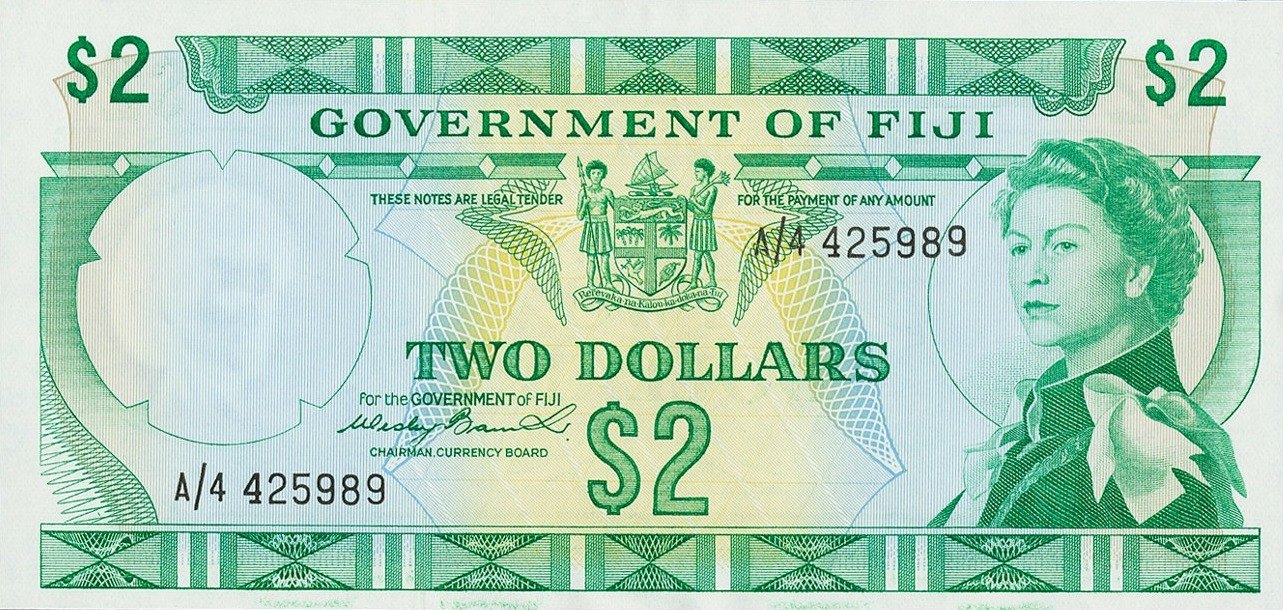
The Fiji Accounts for 1965 (p. 8, paragraph 31) note that "Local notes are now excluded from circulation" in the coinage figures. The report does not say which notes are meant. The notes under five shillings of 1942, such as the 1 penny, are one possible reading, and it is only a reading.
What the figures do not tell
- No value of note. Every statement, abstract and report gives one total. None says how much of the circulation was in 5 shillings, 1 pound or 20 pounds notes, and none gives a count of notes.
- No numbers. No statement that was read gives a serial number, a range of numbers destroyed or a count of notes printed.
- Gaps. The yearly table has no figure for 1914 to 1918, 1923, 1926, 1937 or 1939 to 1949. The Gazette printed monthly statements to 1933 and half-yearly abstracts after that, and they hold the missing years; only the points given above were copied from them when the Gazette was read.
- Two kinds of figure. The Gazette's are the Commissioners' own balance on a named day; the annual reports' are year-end figures. Where both exist for a year they were not set against each other.
Sources
- Colonial Reports, Annual: Fiji, the reports for 1909 (No. 657), 1913, 1919, 1920, 1921, 1922 (No. 1171), 1924, 1925, 1927, 1928 (No. 1453), 1929 (No. 1497), 1930, 1931 (No. 1604), 1932, 1934, 1935 and 1938, and the figure for 1936 as met in the bound volumes; the Economic Surveys for 1932 and 1933; An Economic Survey of the Colonial Territories, 1951, volumes VI and VII (1953).
- Fiji Royal Gazette: the first monthly statement of the Commissioners of Currency (1914, p. 885), the monthly statements and abstracts of 1915 to 1933, and the half-yearly abstract of June 1942.
- Fiji Accounts 1965 (p. 8), 1966 (p. 7) and 1968 (pp. 11 and 12): the Accountant-General's reports.
- Fiji Currency Accounts for 1971, signed 11th May 1972, as printed in the Gazette.
- K. A. Rodgers and Carol Cantrell, "Fiji's Commissioners of Currency I: 1914 - 1933", IBNS Journal, volume 29, number 1 (1990), p. 6.
- K. A. Rodgers, "Fiji's World War II Currencies: the Official Records", Part III, IBNS Journal, volume 36, number 4 (1997), p. 22.
Member comments
Log in or register to post a comment.