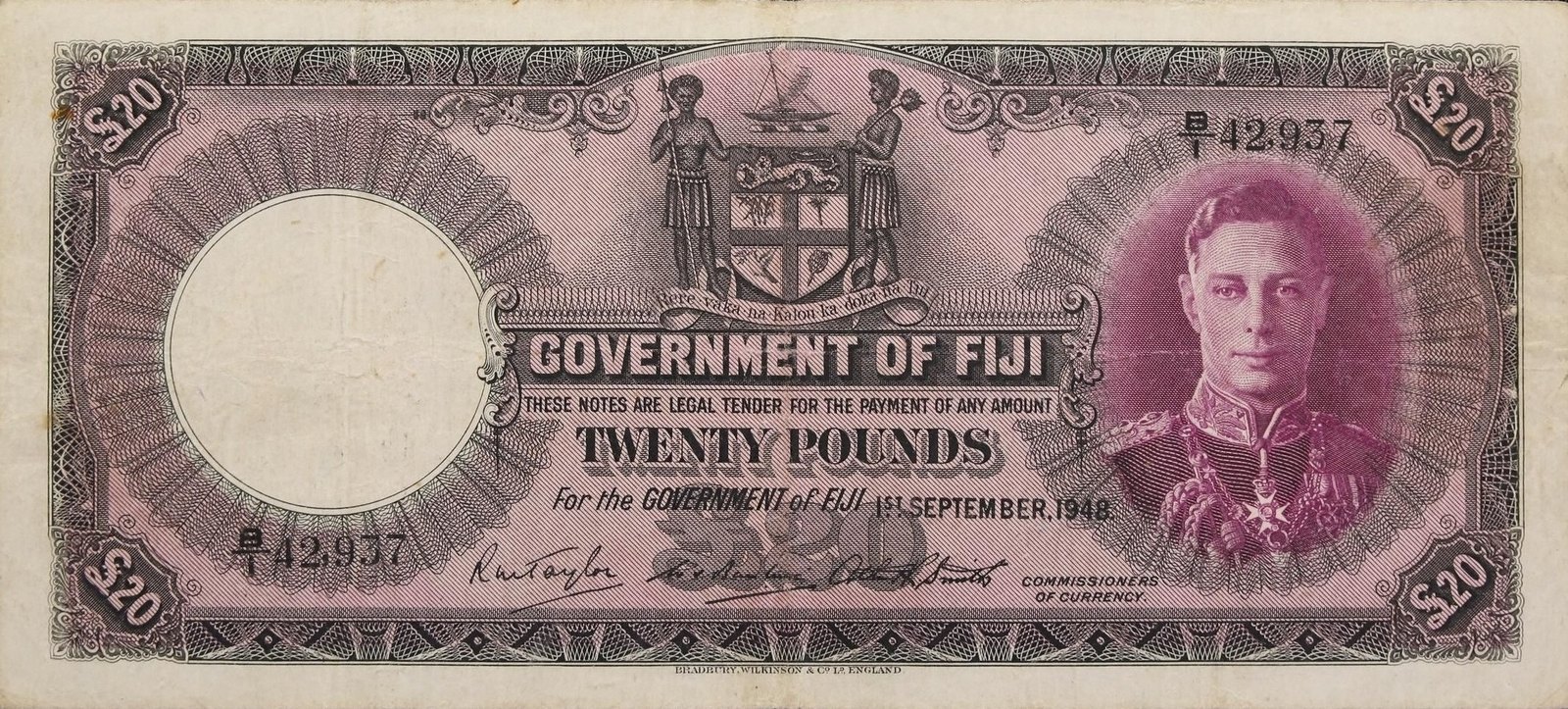
From 1914 until the dollar came, the 20 pounds was the highest value of Fiji. This article follows it through six designs, from the Pick pages and the printer's specimens they record, a study drawn from the colonial archives of the Reserve Bank of Fiji that the pages cite, and what the auction houses wrote when a note or a specimen was sold.
The six designs
| Design | Dates on the rows | Printer | Numbers |
|---|---|---|---|
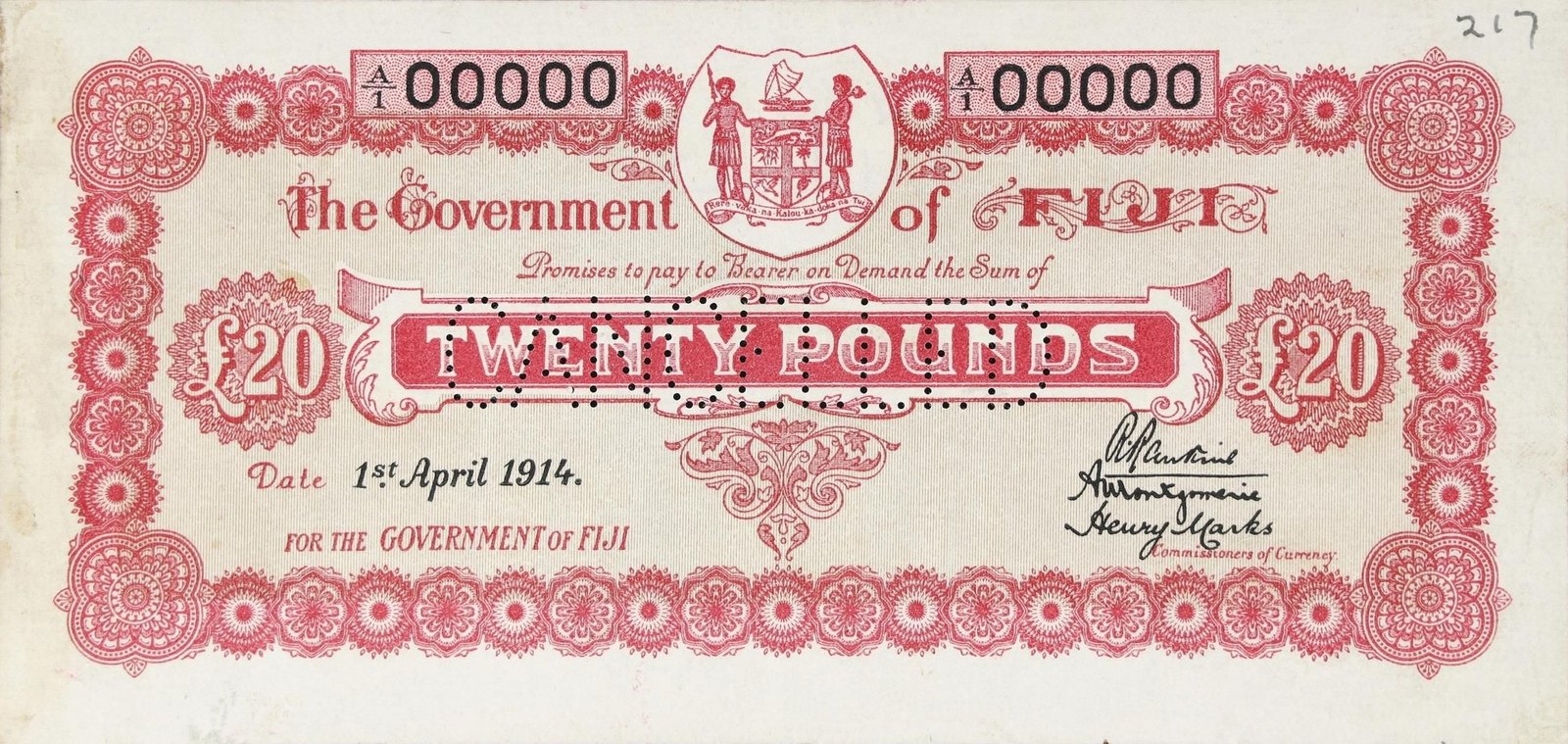
| Uniface, 1914 to 1926 | 1st April 1914, 1st March 1917, 1st August 1920, 20th August 1926 | Thomas de la Rue | prefix A/1; no count on record |
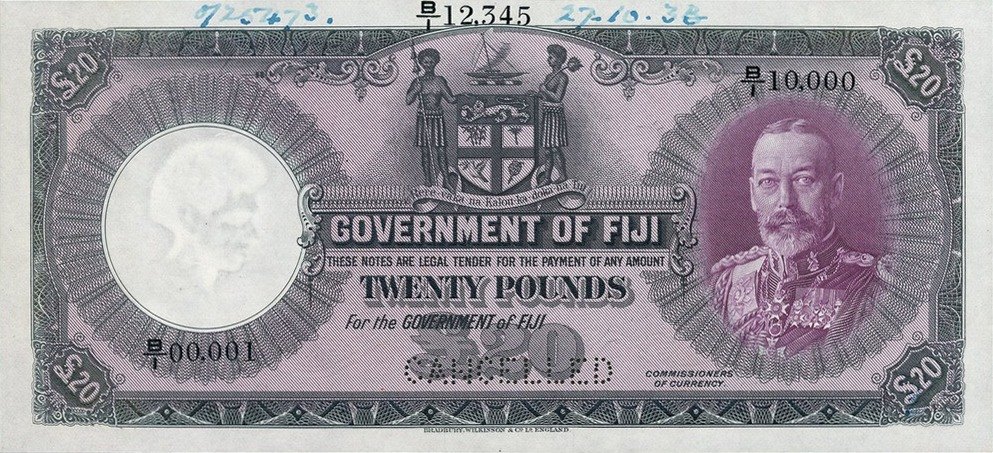
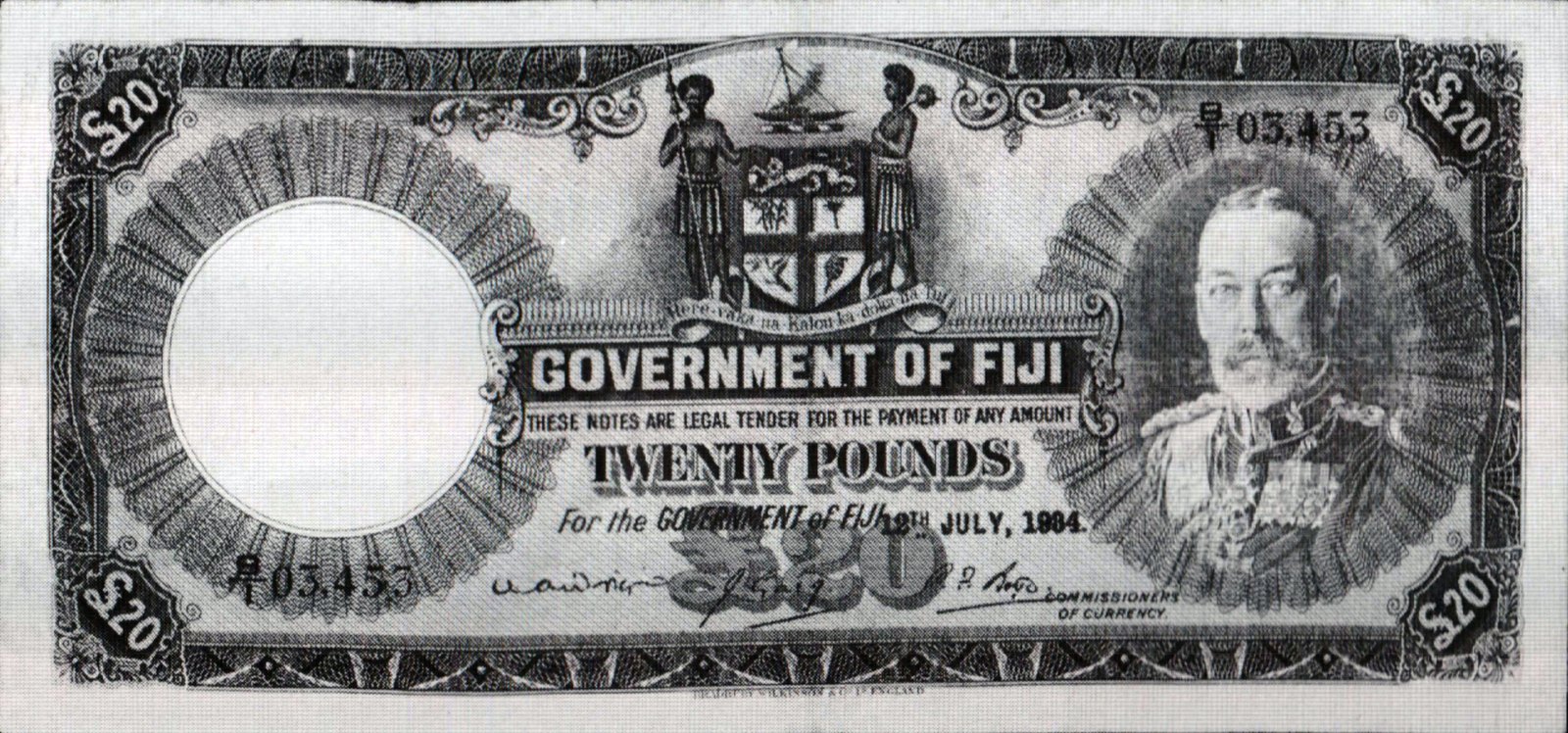
| George V, 1934 | 12th July 1934; 3rd August and 2nd September 1934 not confirmed | Bradbury Wilkinson | B/1 00,001 to B/1 10,000 |
| George VI in left profile, 1937 | 1st March 1937 | Bradbury Wilkinson | B/1 10,001 to B/1 15,000 |
| George VI facing forward, 1943 to 1951 | 1st July 1943, 1st January 1946, 1st September 1948, 1st June 1951 | Bradbury Wilkinson | B/1 15,001 to B/1 96,250 |
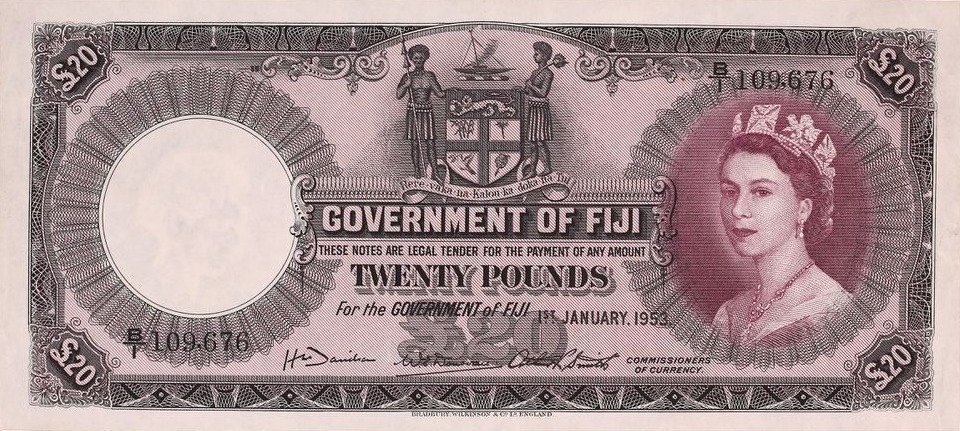
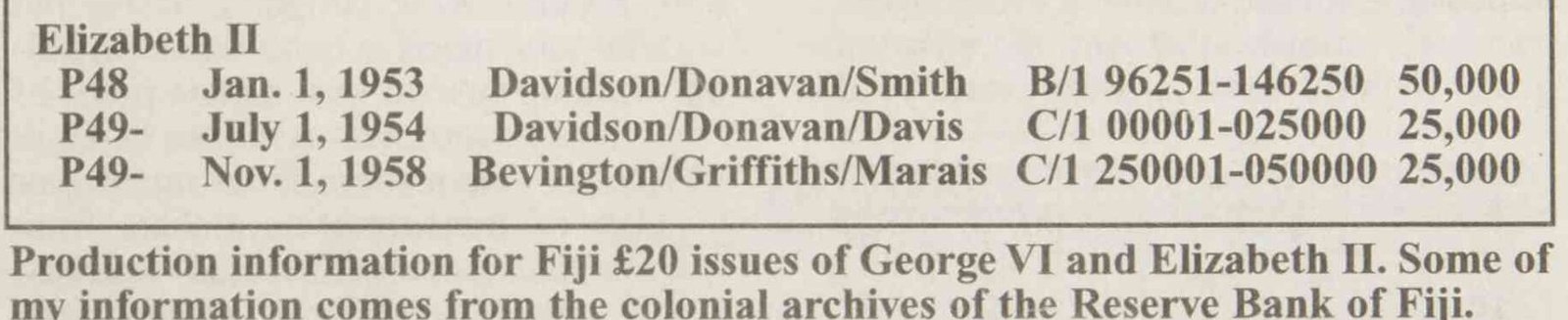
| Elizabeth II, black on purple, 1953 | 1st January 1953 | Bradbury Wilkinson | B/1 96,251 to B/1 146,250 |
| Elizabeth II, red, 1954 and 1958 | 1st July 1954, 1st November 1958 | Bradbury Wilkinson | C/1 00,001 to C/1 50,000 |
From 1934 to 1953 the numbers form one unbroken B/1 series across four designs and three reigns. That run is what settles the questions below.
1914 to 1936: the uniface note and the George V note
The uniface 20 pounds was one of the four values named in the Government Currency Notes Ordinance 1913. Its history is told with the rest of that issue in The Government of Fiji's first notes, 1914 to 1933, and the article Fiji's first government notes, 1914 to 1933: a census says which dates have a note behind them.
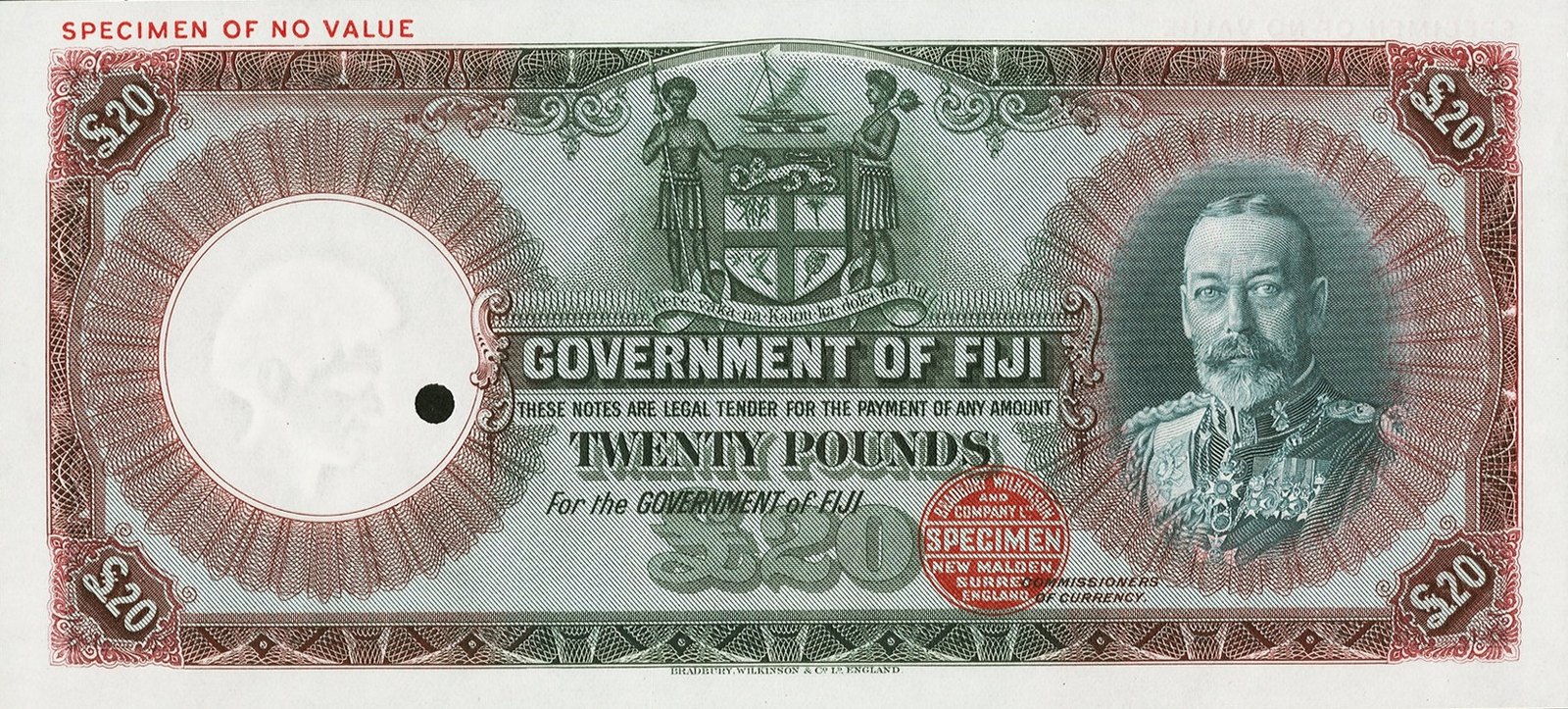
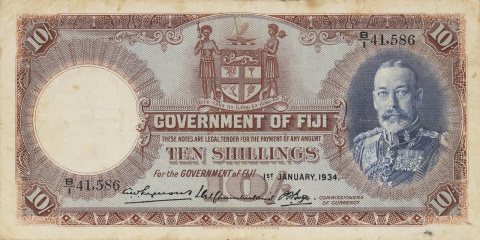
For the George V note an undated specimen gives the first printing, B/1 00,001 to B/1 10,000. No issued note has been traced at auction. An archive photograph shows B/1 03453, a note held in the Fiji Museum archives. Heritage, describing a colour trial specimen in mauve and teal (17 August 2018, lot 28085), says the colour chosen for the issued note was a single dark green, and that the piece was then the only example of the whole design, issued or specimen, in the PMG census. Stack's Bowers sold another colour trial of the type on 2 October 2024 (lot 20305).
1937: a design with numbers that was replaced
The first George VI design shows the King in left profile. A specimen dated 1st March 1937, a colour trial and proofs are known; no issued note has been seen, though sources mention one. The colour trial's specimen number is written in pencil on the back, not printed; 21 is recorded.
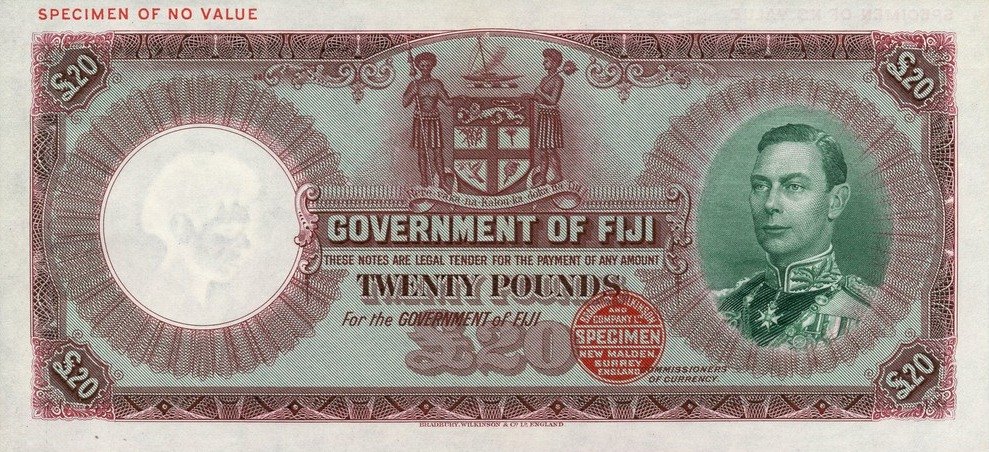
The specimen carries a full range of numbers, B/1 10,001 to B/1 15,000, and the signatures of Barton, Craig and Savage. Stack's Bowers, describing it on 13 January 2024 (lot 60276), noted that a number range is unusual on a design that was not adopted, and supposed that printing was about to start when the portrait was changed. The study drawn from the colonial archives of the Reserve Bank of Fiji goes further: it gives 5,000 notes dated 1st March 1937, B/1 10,001 to B/1 15,000, and counts them among the notes printed before the end of the war. The matter is not settled.
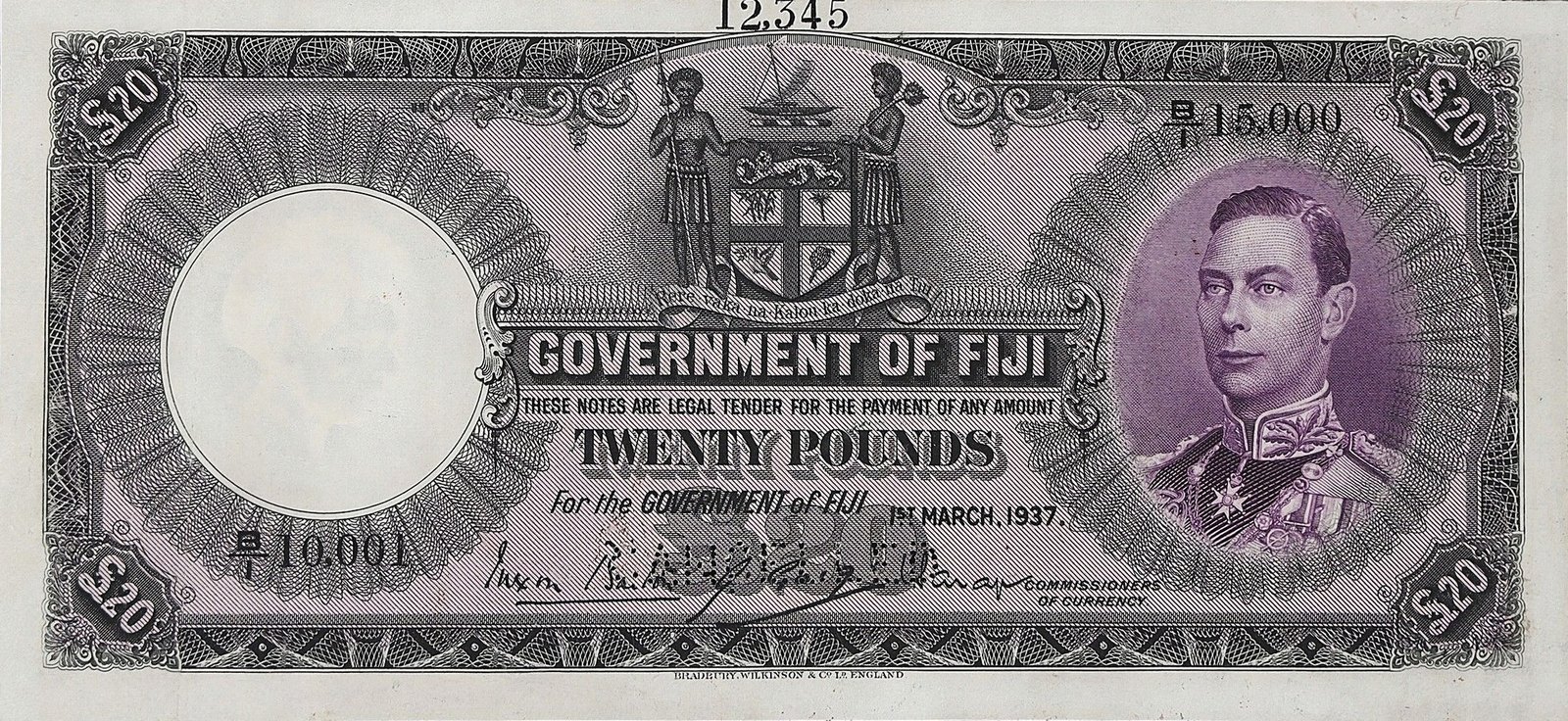
Heritage, describing a specimen of the same date with the same range (7 December 2024, lot 24168), wrote that the number range indicates 10,000 notes of the date. The range on the specimen is 5,000 numbers.
1943 to 1951: the full-face note
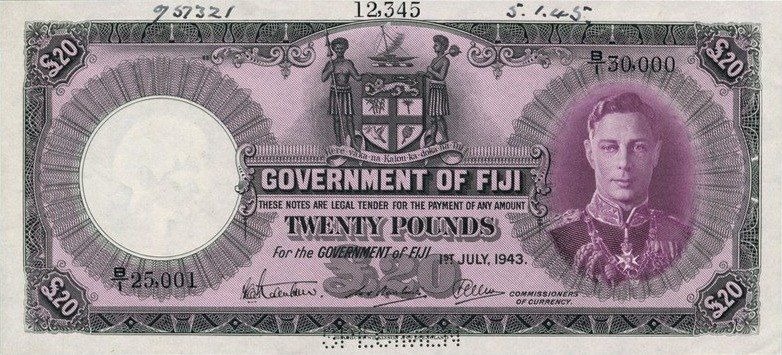
The dated specimens record four printings, and the study gives a count for each:
| Printed date | Range on the specimen | Notes, as the study counts |
|---|---|---|
| 1st July 1943 | B/1 15,001 to B/1 30,000 | 10,000 (B/1 15,001 to B/1 25,000) |
| 1st January 1946 | B/1 30,001 to B/1 35,000 | 5,000 |
| 1st September 1948 | B/1 35,001 to B/1 90,000 | 55,000 |
| 1st June 1951 | B/1 90,001 to B/1 96,250 | 6,250 |
For 1943 the study and the specimen differ: the study leaves out B/1 25,001 to B/1 30,000, a range found on a specimen of that date.
The date that was never printed
Sources mention a 20 pounds dated 1st March 1938, and the Pick page has a row for it. No note of that date has been seen. The numbers leave no room for one: B/1 00,001 to B/1 10,000 belong to 1934, B/1 10,001 to B/1 15,000 to the left-profile specimen of 1937, and B/1 15,001 onwards to 1st July 1943. The same study says that no note dated 1938 was issued.
September 1948: 1,000,000 pounds against speculation
The printing dated 1st September 1948 is more than twice the size of the three others together. Sources mention an urgent order of 8th September 1948 for 1,000,000 pounds in 20 pounds notes, held as a reserve against speculation on the Fiji pound and not meant for general circulation. At 20 pounds a note, that sum is 50,000 notes.
The 20 pounds also has a part in the story of the unissued overprinted 10 shillings. When 60,000 of those were sold back to the Currency Commissioners in May 1949, sources mention that they were exchanged for 20,000 new 10 shillings notes and 1,000 notes of 20 pounds.
Heritage, selling a note of 1st September 1948 numbered 42,937 (24 April 2020, lot 26108), says that issue of the value was limited and that the great majority of the notes were redeemed by 1969. The house adds that PMG had then graded three notes of the denomination, one of 1943 and two of 1948.
1953: the first note of the new reign
Sources mention an order by cable in March 1953 for 1,000,000 pounds in 20 pounds notes to rebuild the currency reserve. The printer kept the George VI design with the Queen's portrait, and the numbering carried on from the George VI notes. 50,000 notes, B/1 96,251 to B/1 146,250, were shipped on 10th June 1953. The note is dated 1st January 1953 and printed in black on purple. Sources mention that the portrait follows a 1952 photograph by Dorothy Wilding, engraved by Bradbury Wilkinson, and that not all of the 50,000 notes were issued.
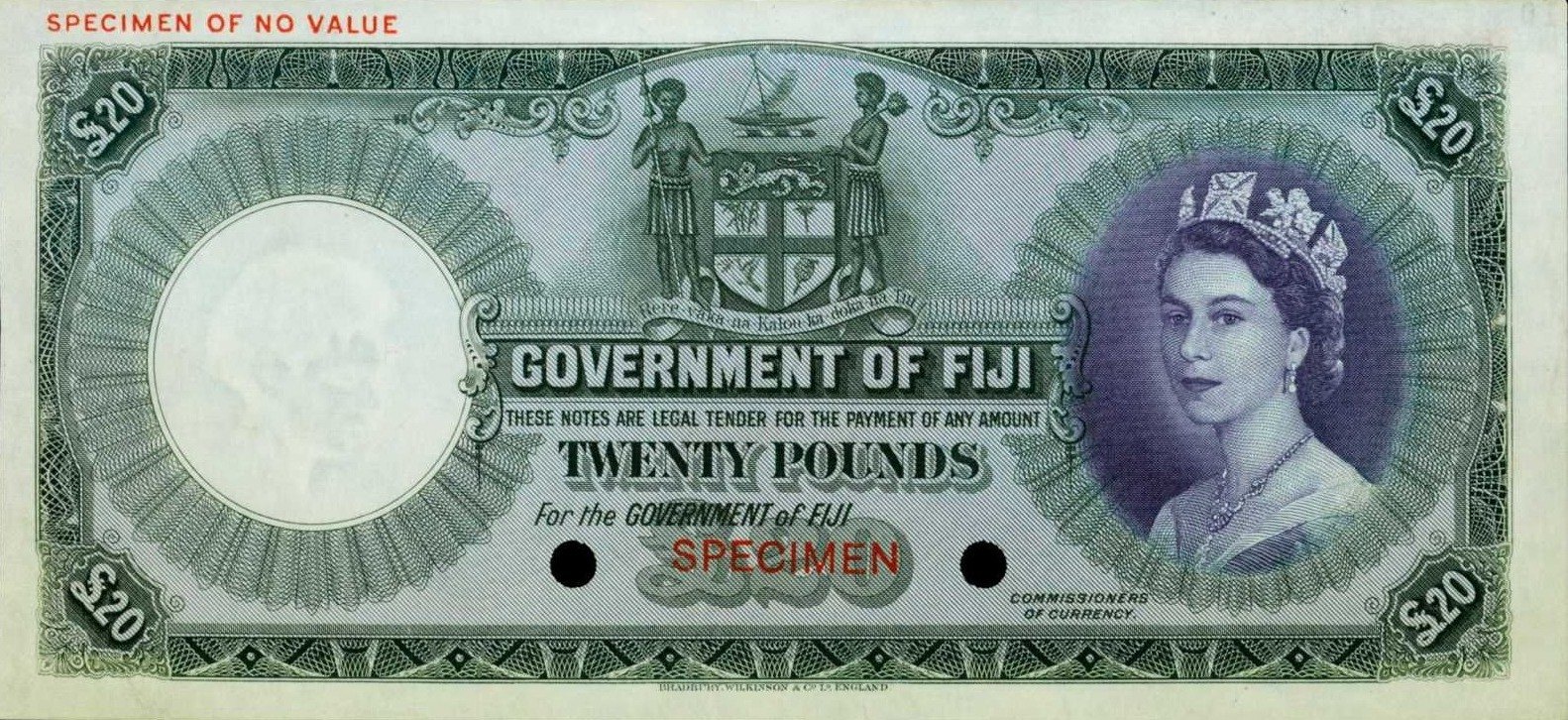
Punched specimens of this note exist in other colours, without numbers. Sources mention that the printer made them as samples to show to other customers, and that they are not trials of colour for this note. Stack's Bowers, selling one in green and blue from the Jerry and Diane Fishman Collection (17 January 2026, lot 31137), called it a colour trial in the house's own opinion, where PMG had called it a specimen, and remarked that with so few issued notes to compare, opinions on the status of such pieces differ.
1954 and 1958: the red note
The 20 pounds of the Queen's own series is printed in red over red and pale green, and has a different back. Sources mention 25,000 notes dated 1st July 1954 (C/1 00,001 to C/1 25,000) and 25,000 dated 1st November 1958 (C/1 25,001 to C/1 50,000), and that proofs in other colours went to Fiji early in 1955, after which the red was chosen. The printer's sample specimens in other colours are mentioned for this note as well; none is recorded in the catalogue.
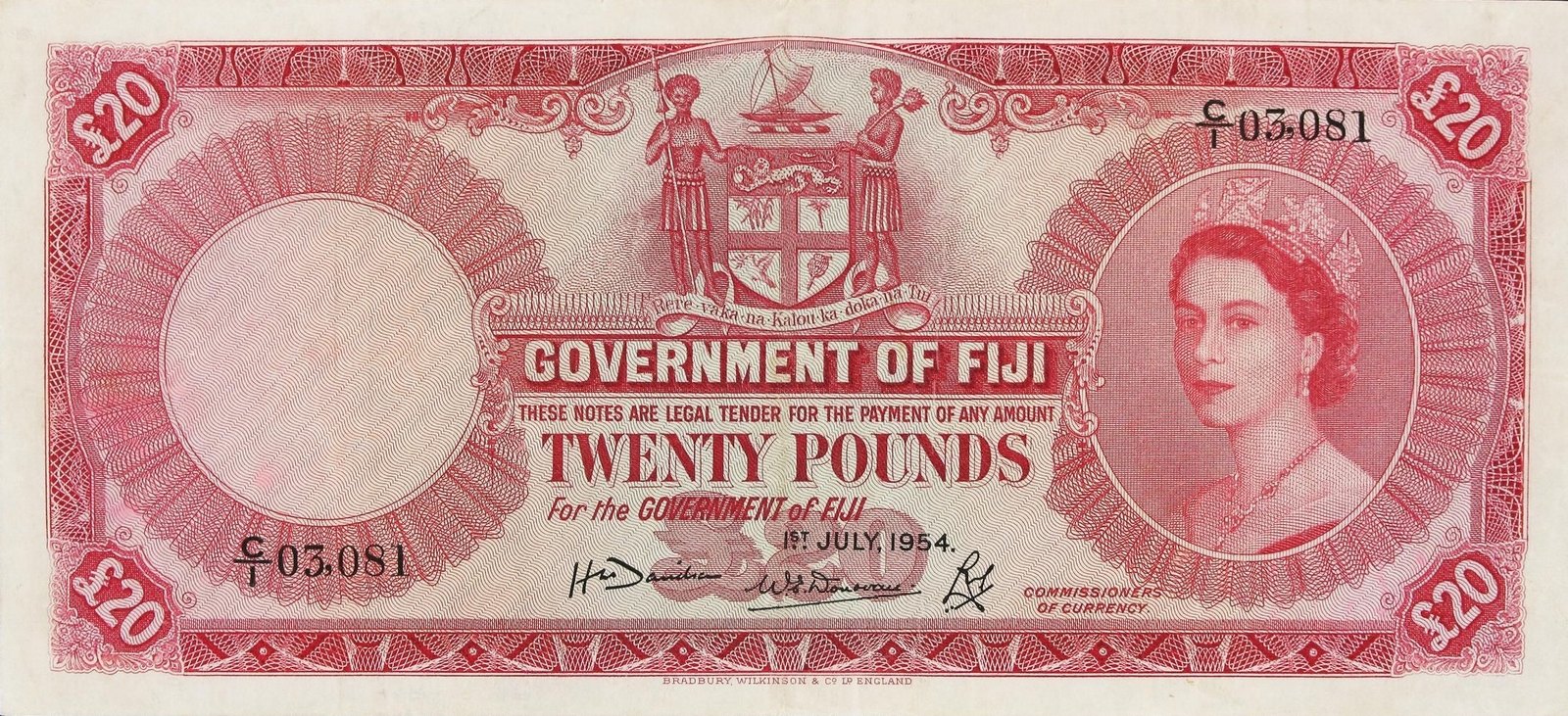
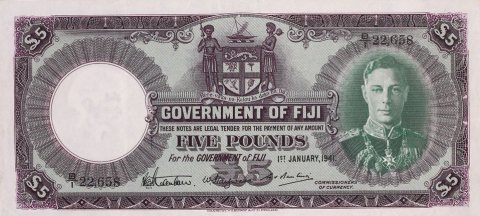
Two statements touch on the likeness to the 5 pounds. Sources mention that from November 1958 the old 20 pounds notes were called in and replaced, because the new 5 pounds looked similar: the 5 pounds of 1954 is printed in purple, and the 20 pounds of 1953 in black on purple. Stack's Bowers (17 January 2026, lot 31138) offers the same likeness to the 5 pounds as the probable reason for the change of colour.
The date 1st November 1958 is known so far only from specimens. Stack's Bowers, in the same description, says it is unclear whether the 1958 printing ever entered circulation. Old lists also give a date of 1st January 1953 for the red type; no such note has been confirmed.
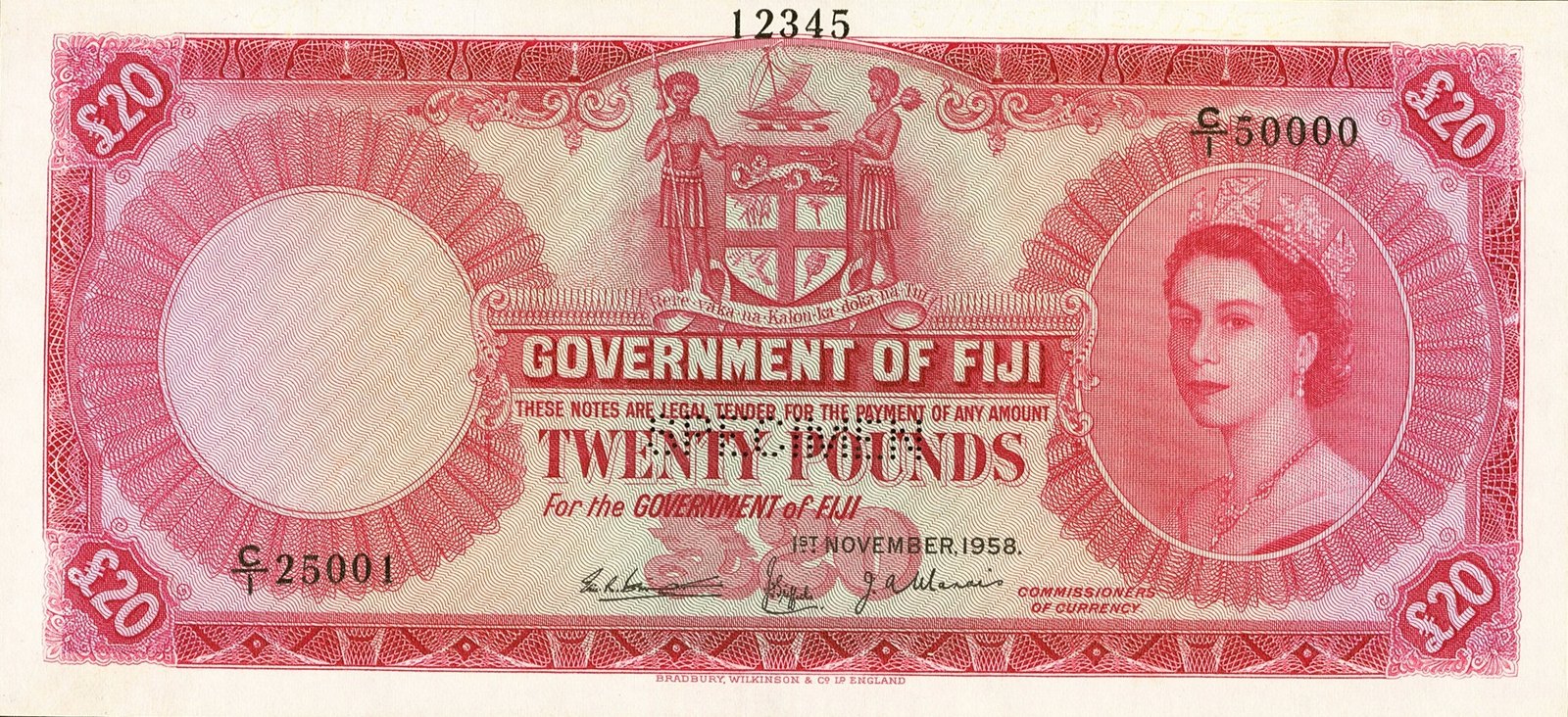
On the notes of 1954 the houses agree. Heritage (24 April 2020, lot 26115) recorded the prefix C/1 and the signatures of Davidson, Donovan and Davis on its note, and said that three examples were then registered in the PMG population report, none graded above Very Fine. Stack's Bowers, selling a note of the date from the Fishman Collection on 17 January 2026 (lot 31138), described it as one of three graded by PMG.
The end: November 1958 to July 1969
Three dates close the story. From November 1958, as sources mention, the old 20 pounds notes were called in. Sources mention that the remaining stock of the Queen's notes was burned at Suva on 15th January 1969, just after Fiji went decimal, and that the notes ceased to be legal tender on 1st July 1969.
What is not known
- How many uniface 20 pounds were printed, for any date.
- Whether the 5,000 left-profile notes of 1937 were printed and issued, as the study says, or stopped at the specimen.
- Whether B/1 25,001 to B/1 30,000 were printed with the date 1st July 1943.
- How many of the 50,000 notes of 1953 were issued.
- Whether any note dated 1st November 1958 went into circulation.
Sources
- The Pick pages of this catalogue for P-30, P-36, the unlisted 20 pounds of 1937, P-43, P-56 and P-57, with the printer's specimens they record.
- A study drawn from the colonial archives of the Reserve Bank of Fiji, as cited on the Pick pages for P-43 and the 20 pounds of 1937.
- Heritage: 17 August 2018, lot 28085; 24 April 2020, lots 26108 and 26115; 7 December 2024, lot 24168.
- Stack's Bowers: 13 January 2024, lot 60276; 2 October 2024, lot 20305; 17 January 2026, lots 31137 and 31138.
Member comments
Log in or register to post a comment.