Forged Palestine notes turn up in the newspapers from the third week of the new currency. Most reports are a few lines long and name no value. One is different: in December 1938 The Palestine Post printed a police notice on forged 1 pound notes that gives the first characters of their numbers and five ways to tell them. This article gathers what the papers reported from 1927 to 1938 and sets it beside the forged notes recorded in this catalogue.
The counts are those of 23 November 2026. The Palestine Post's reports are given here in our own words.
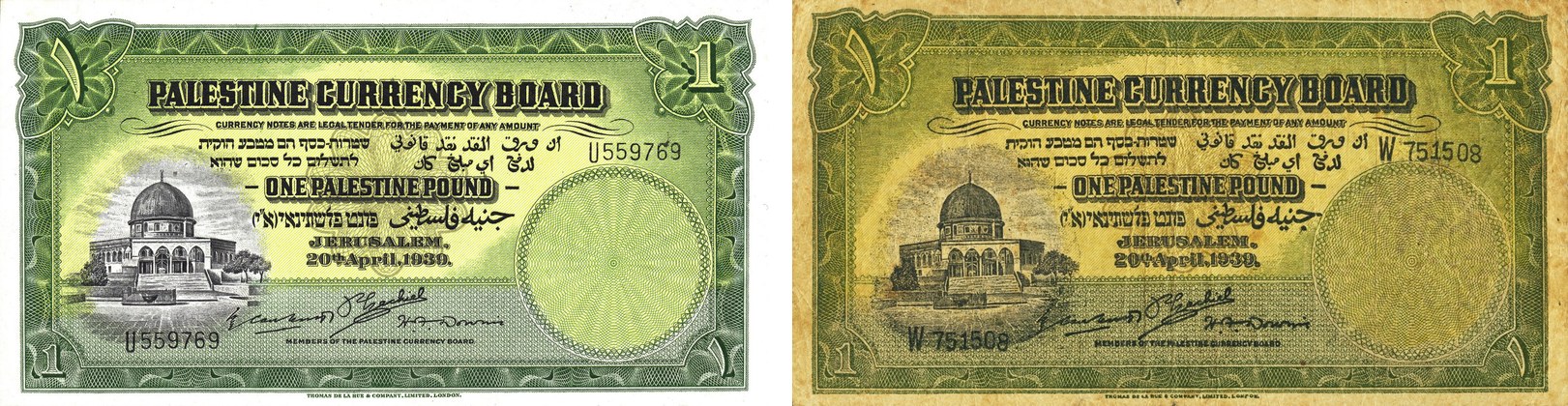
The law, from the start
The Currency Notes Ordinance was published in draft in the Official Gazette of 1 April 1927, seven months before the first note. The Palestine Bulletin of 5 April 1927 (p. 3) gave its penalties: up to ten years of penal servitude or imprisonment for forging a currency note; up to five years for issuing a note other than under the Ordinance; up to three months, or a fine, for mutilating one. A second Ordinance of the same year carried the rules on forgery over to bank notes (the quarterly report of the administration, in The Palestine Bulletin of 30 December 1927, p. 1).
What the papers reported
| Day of the paper | Paper | What it says |
|---|---|---|
| 21 November 1927 | The Palestine Bulletin, p. 3 | A man arrested on suspicion of passing forged 5 pound notes. Whether Palestine or Egyptian notes is not said; Egyptian notes were legal tender until March 1928 |
| 19 October 1928 | The Palestine Weekly, p. 368 | A man from Gaza arrested at the Central Post Office in Jerusalem while trying to pass a forged currency note. No value given |
| 21 October 1931 | The Palestine Bulletin, p. 4 | A man before the magistrate in Jerusalem for casting false 20 and 50 mils coins. In the room the police also found a liquid for treating notes, notes that looked chemically treated, and special paper to which notes had been transferred |
| 12 December 1932 | The Palestine Bulletin, p. 4 | From the Board's report: counterfeiting "does not seem to present a serious problem"; 612 false 100 mils and 538 false 50 mils coins in four years; three offenders given seven years each |
| 6 December 1938 | The Palestine Post, p. 2 | Forged 1 pound notes and the press that printed them seized in Jerusalem; a police notice describes them |
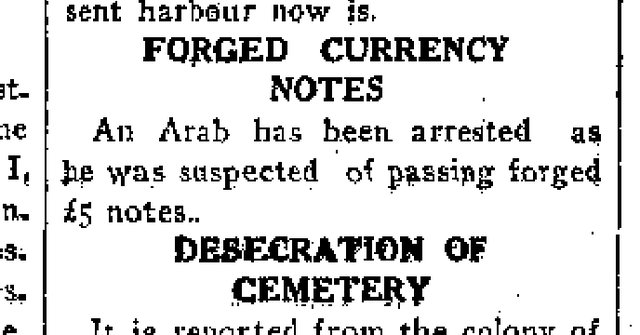
The item of 1931 is the only one that says anything of method. It appears to describe a transfer of the printed design from a genuine note to prepared paper with a chemical, not engraving or a press.
December 1938: the forged 1 pound
On 5 December 1938 the Jerusalem police arrested several people for passing forged money. One, a woman shopping in King George Avenue, had sixteen forged Palestine pound notes with her. The search that followed found a counterfeiters' press in the Jerusalem area and a considerable number of forged notes.
The notice the police gave the paper is the useful part. The forged notes were numbered E 320 followed by three more digits, and E 321 followed by three more digits. And they could be told from a genuine note in five ways:
| What to look at | Genuine note | The forgery of 1938 |
|---|---|---|
| The coloured printing, both sides | not shiny | smooth and shiny |
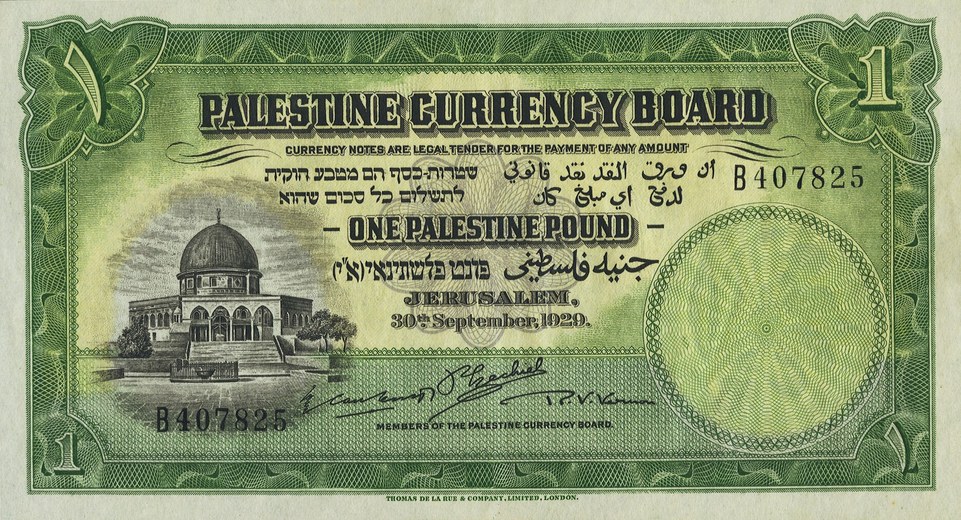
| The vignettes: the Dome of the Rock, the Citadel | finely drawn | less well drawn |
| The lace-work of fine lines | clear and sharp, even on an old note | blurred and indefinite |
| The printer's name at the foot | clearly readable | blurred, most of all on the back |
| The watermark | in the paper | printed on the surface |
The notice does not give the date printed on the forged notes. The prefix settles it as far as it can be settled: on the 1 pound the prefix E belongs to the notes dated 30th September 1929. This catalogue's register holds 34 genuine 1 pound notes with prefix E, and none of them falls between E 320000 and E 321999.
What the catalogue records
| Note | Forgery recorded | What tells it |
|---|---|---|
| 500 mils, 1929 and 1939 | none yet; a forged 500 mils was reported in November 1927 | not known |
| 1 pound, 30th September 1929 | none yet | the police notice of 1938: numbers E 320... and E 321..., and the five marks above |
| 1 pound, 20th April 1939 | two notes | an ordinary prefix and number |
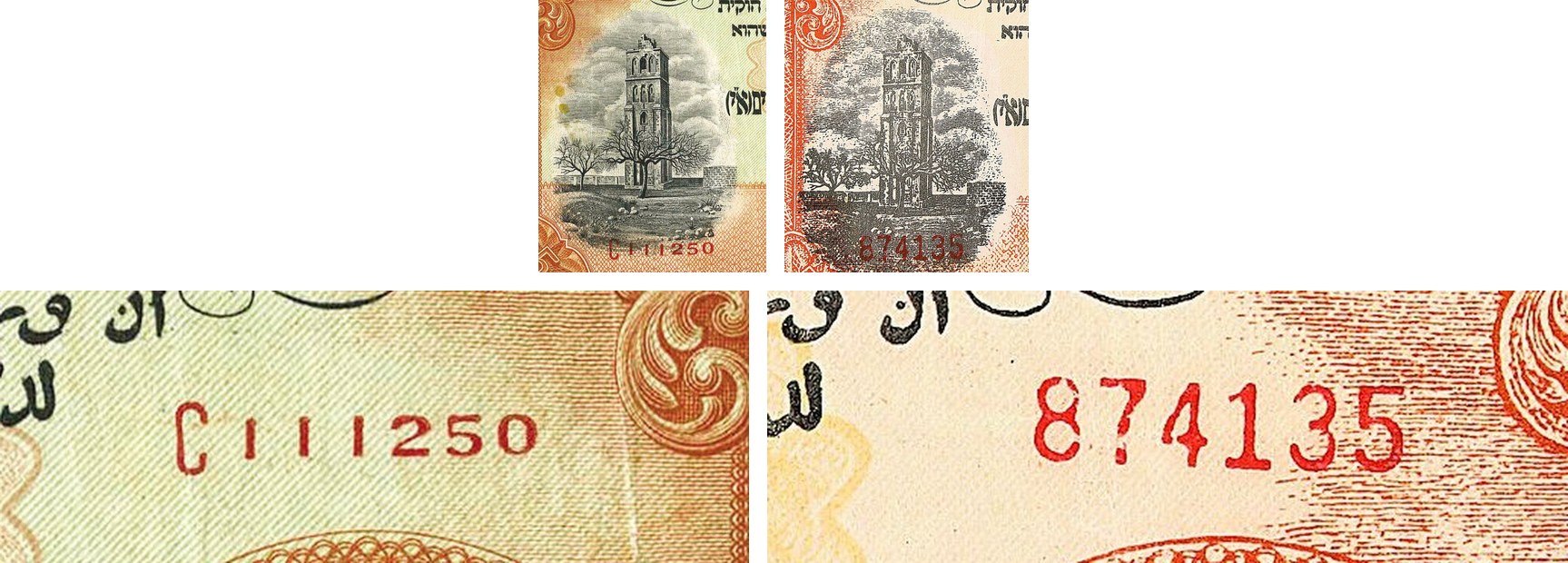
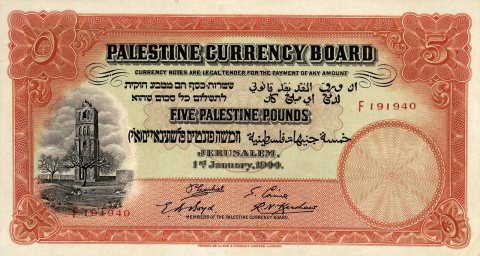
| 5 pounds, 20th April 1939 | ten notes | a bare six-digit number with no prefix letter; the tower a smudged mass |
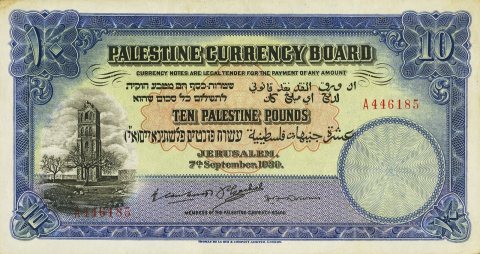
| 10 pounds, 1st January 1944 | three notes | an ordinary prefix and number |
How to use the notice
If you have a 1 pound dated 30th September 1929 whose number begins E 320 or E 321, go through the five marks before anything else. The watermark is the quickest: on a genuine note the olive sprig is in the paper and shows when the note is held to the light; on the forgery it was printed on the surface.
The marks are worth keeping in mind for any Palestine note. Blurred fine lines, a blurred printer's name and a flat watermark are what a forger working without engraved plates could not avoid.
Not Palestine notes
Three other reports in the same papers are about other money. On 8 December 1929 The Palestine Bulletin (p. 3) carried Scotland Yard's denial of a rumoured flood of forged pound notes in London. On 14 April 1946 The Palestine Post (p. 1) reported that Bank of England notes of 5 pounds and upwards had been collected in Palestine the year before and sent to London, and that many of those examined had proved forged; it was against the Defence (Finance) Regulations to bring such notes in or to deal in them. On 17 April 1949 the same paper (p. 1) reported forged United States notes seized in Cairo.
What is still wanted
No paper read so far prints the whole number of a forged Palestine note, or says what became of the forgers of 1938. The reports of their trial would be in The Palestine Post of December 1938 and the first months of 1939.
Member comments
Log in or register to post a comment.