This article sets out the notes of the Government of Gibraltar in order of time, from the emergency issue dated 6th August 1914 to the 5 pounds dated 21st August 2020. It is drawn from the Pick pages of this catalogue, the Gibraltar currency laws and House of Assembly papers, the Colonial Reports, and an article by D. C. Devenish of the Gibraltar Museum in the IBNS Journal of December 1969. Three other articles go further into the 1914 issue, the Rock design of 1927 to 1975 and the withdrawals and the circulation figures.
Before 1914
The sources read for this catalogue say little about paper money at Gibraltar before the war. Chalmers's book of 1893 on colonial currency (page 318) records no note issue at Gibraltar in 1892 and says that legal tender notes were under consideration. The annual report on Gibraltar for 1909 (Colonial Reports, Annual No. 647) has no chapter on currency or banks. It says only that the peseta, with which market supplies were bought, averaged 27.22 to the pound, and that Savings Bank deposits were kept in pounds and pesetas. Neither source says whose notes passed in the town.
1914: two emergency series with one date
Both series of 1914 are dated 6th August 1914 and were issued under Ordinance 10 of 1914, so that sterling and gold need not be paid out. Series A was typeset by Beanland, Malin and Company and signed by the Treasurer by hand: 2 shillings, 10 shillings, 1 pound, 5 pounds and 50 pounds. Series B, in the same five values, was engraved by Thomas de la Rue with the arms of Gibraltar and a stamped signature: 2 shillings, 10 shillings, 1 pound, 5 pounds and 50 pounds. Sources mention that Series B was put into circulation on 13th October 1914. Series A was demonetised on 1 January 1922 and Series B on 1 January 1929.
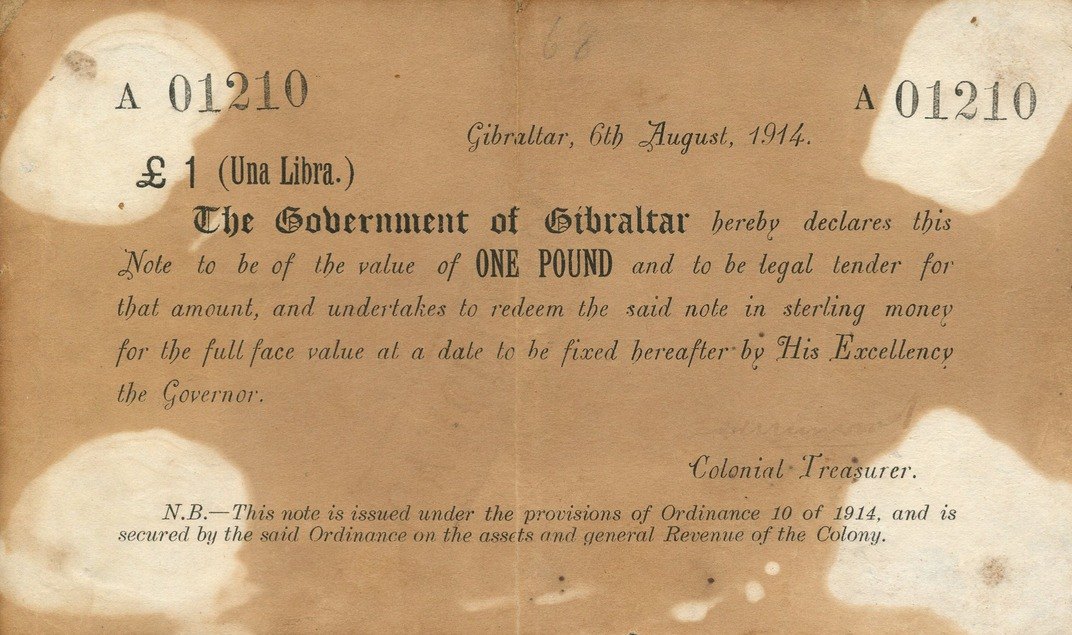
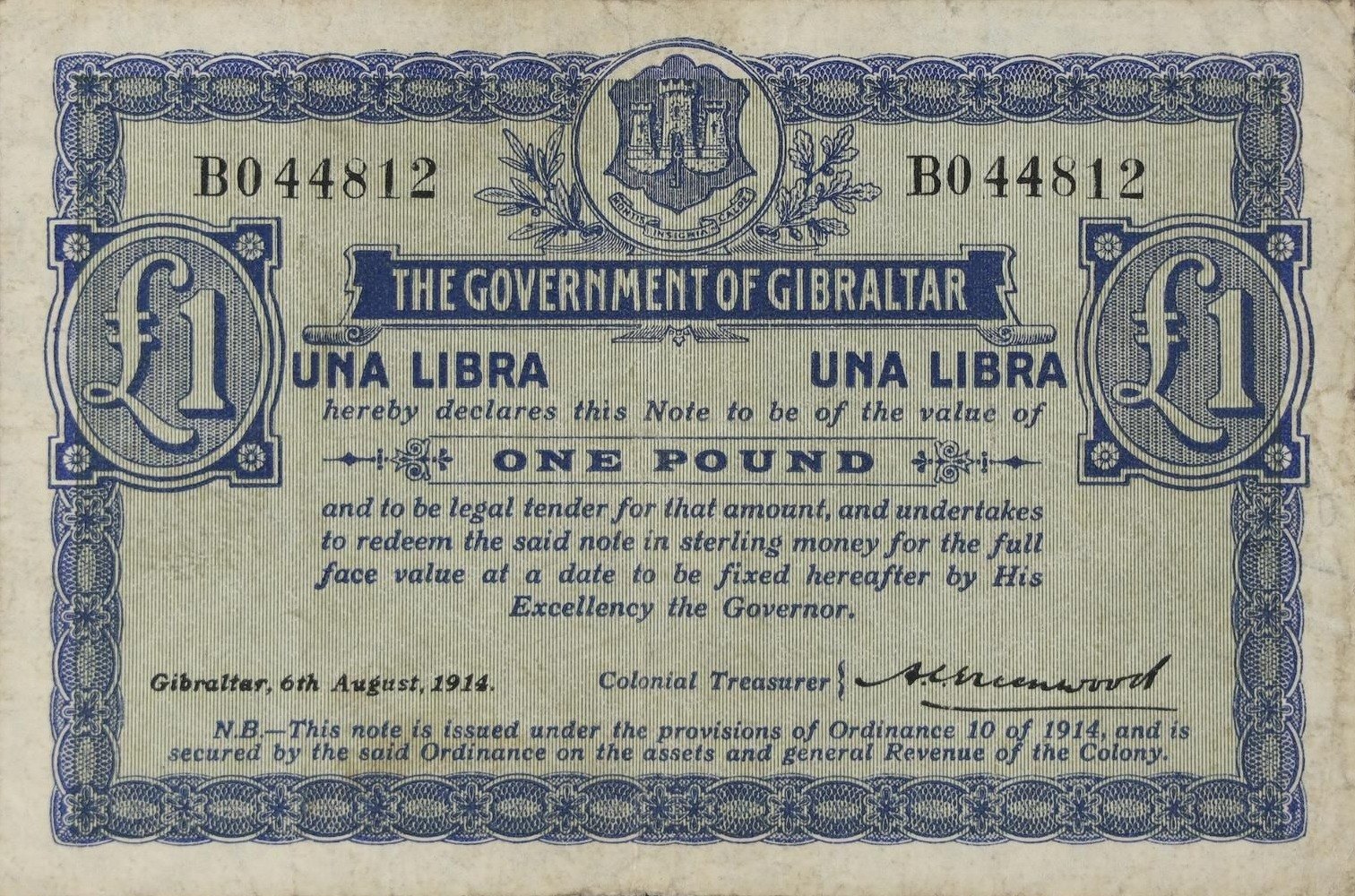
The annual report for 1922 gives 159,763 pounds of Government notes in circulation, in values of 50 pounds, 5 pounds, 1 pound, 10 shillings and 2 shillings. On where Series A was printed, and on whether any note of it bears a stamped signature, the Pick pages and the auction houses differ, and neither is settled. Both statements, with what the houses say of the notes that were never handed in, are in the article on the 1914 issue.
1927: the Currency Note Ordinance and the Rock design
The Pick pages of the 1927 notes say that the Secretary of State approved the 1914 note issue in Despatch No 108 of 21 October 1915, but that no law followed until the Currency Note Ordinance of 1927 (No. 1 of 1927, passed on 24th February 1927). The copy of that Ordinance in the Johns Hopkins currency board archive provides for notes in sterling values that are legal tender for any amount, and for a Note Security Fund held with the Crown Agents. Section 6 makes a certificate of the Treasurer, that a note lacks the secret features of a genuine note, conclusive in court. The Ordinance does not describe those features.
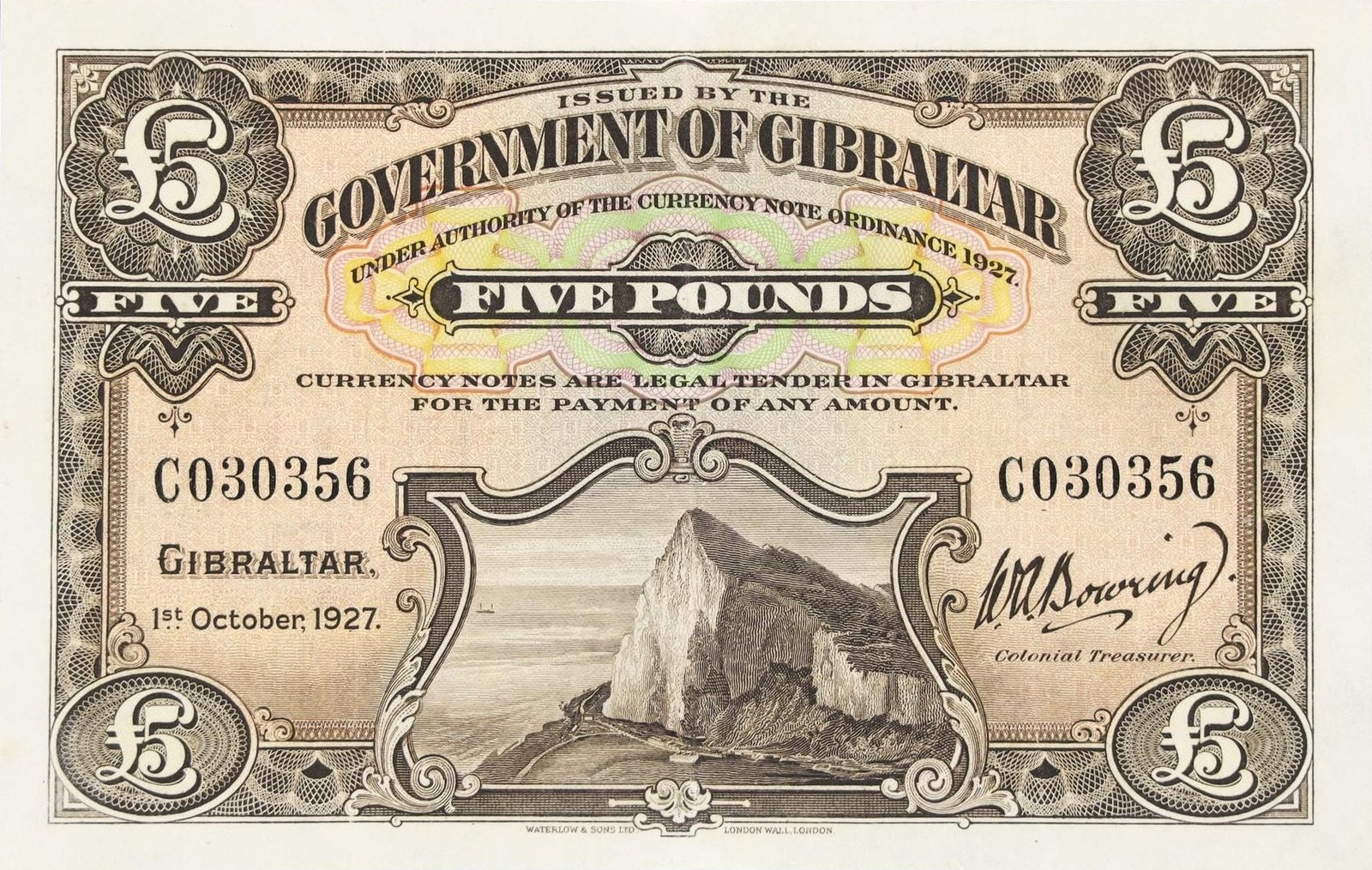
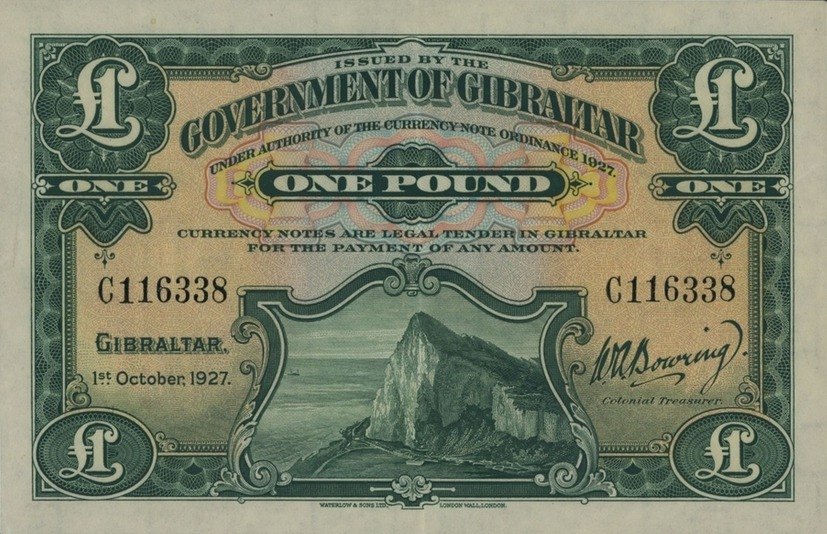
The notes are dated 1st October 1927, were printed by Waterlow and Sons and carry the words UNDER AUTHORITY OF THE CURRENCY NOTE ORDINANCE 1927. There are three values: 10 shillings, 1 pound and 5 pounds. Sources mention 100,000 notes of 10 shillings, 300,000 of 1 pound and 50,000 of 5 pounds printed with this date, all with prefix C. The annual report for 1928 gives 130,000 pounds of Government notes in circulation at the end of that year, the bulk of them of the new issue.

1934 to 1975: the same design under a new law
From 1937 the notes were issued under the Currency Notes Ordinance of 1934 (No. 6 of 1934). The Government's law site dates that law 11 May 1934. Devenish, who printed the matching sections of both laws side by side, points out that the form, design, plates and paper of the notes were to be approved by the Governor under the Ordinance of 1927 and by a Secretary of State under that of 1934. The Pick pages say that the law date on the notes was changed to 1934 when watermarked paper came into use in 1937. One house description gives a note of 1927 a watermark: both statements are in the article on the Rock design, linked below.
The design of 1927 continues on all the notes that followed until 1975. Waterlow and Sons printed the 10 shillings from 1937, the 1 pound from 1938 and the 5 pounds from 1942. During the date 3rd October 1958 the printing passed to Thomas de la Rue, whose notes are listed apart: 10 shillings of 1958 and 1965, 1 pound of 1958 to 1975 and 5 pounds of 1958 to 1975. The dates, the signers, the numbers printed and the ways of telling the two printers apart are in the article on the Rock design.
1938: two 2 shillings notes that were not issued
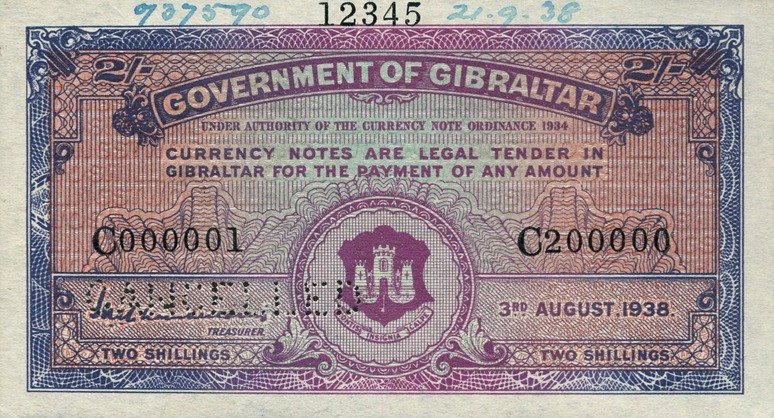
Two designs for a 2 shillings note were made in 1938 and neither was issued. One, dated 3rd August 1938, was printed by Bradbury Wilkinson and signed by the Treasurer. It is a uniface note, the background green at the centre shading to orange at the sides and the design mauve shading to blue. The piece recorded is a specimen with a horizontal CANCELLED perforation. Sources mention that nearly the whole printing was destroyed on 19th December 1968. Devenish treats this note as part of Series C and adds that it has no thread and no watermark.
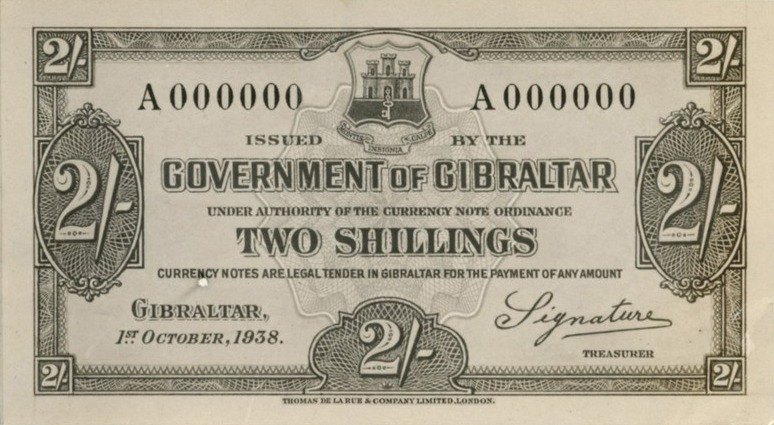
The other, dated 1st October 1938, was printed by De La Rue with the word Signature printed where a signature would go. The piece recorded is a proof with serial prefix A and an all-zero serial number, without overprint or perforation. Neither note has a Pick number. Sources mention a note without specimen markings for each of the two; none has been seen in a sale or photograph. None of the sources read here says why a 2 shillings note was prepared in 1938 or why it was held back. See also Values that were never issued.
1975 to 1988: the series with the Buckley portrait
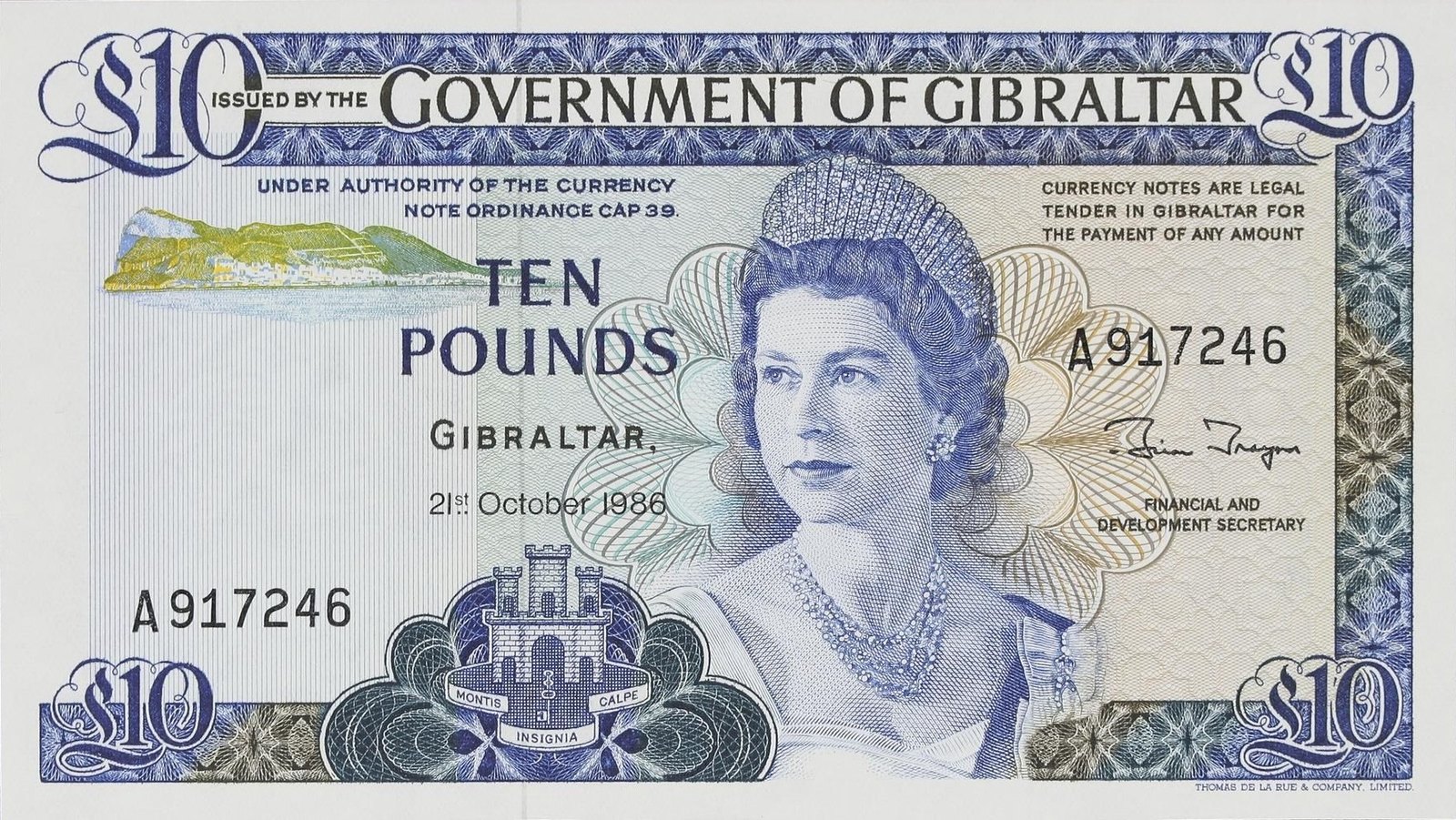
The next series is dated from 20th November 1975. The Financial and Development Secretary told the House of Assembly on 3rd April 1978 that the new series had gone into circulation between June and December 1977. Four values bear the first date: 1 pound, 5 pounds, 10 pounds and 20 pounds. A 50 pounds dated 27th November 1986 was added later. The 1 pound has five dates, signed by Collings (1975), Wallace (1979) and Traynor (1983, 1986 and 1988), all with the imprint THOMAS DE LA RUE & COMPANY, LIMITED and the title FINANCIAL AND DEVELOPMENT SECRETARY under the signature. The 1 pound and 5 pounds of the old Rock design also exist with the date 20th November 1975.
Sources mention that the series was designed at De La Rue by Ron Turrell, and that the portrait of the Queen follows a photograph by Anthony Buckley taken in October 1960 and was engraved by Stanley Doubtfire of De La Rue. Spink's descriptions of specimens from the De La Rue archive, sold on 17 April 2019 (lots 510 and 512), place the Rock of Gibraltar at upper left of the front and the arms at lower centre. Spink's description of a set of 1 pound specimens (27 September 2011, lot 813) names the Convent as the subject of the back of the 1 pound, and London Coins (1 March 2020, lot 191) describes the back of the 50 pounds as an aerial view of Gibraltar with the Rock.
The House of Assembly papers read for this catalogue give no number of notes ordered. Asked in the House of Assembly on 17th May 1977 (question 142) for the number of new notes of each value, the Financial and Development Secretary declined to give it, for security. The answer speaks of the new notes as ordered and moved from London to Gibraltar. Heritage (5 September 2019, lot 28417) says fewer than 300,000 notes of 20 pounds dated 20th November 1975 were printed and issued. In April 1978 the Financial and Development Secretary told the House of Assembly that the 20 pounds had been used considerably less than expected.
The four values dated 1975 were also sold as Franklin Mint Collector Series specimens, with a Maltese cross in place of the serial prefix: the sets P-20CS1 to P-23CS1 carry one number on all four notes.
Two pairs of hand-drawn essays for Gibraltar notes came to sale in 2026. Spink's descriptions of lots 272 and 274 in its sale of 30 September 2026 say that front and back essays for a 10 pounds and a 50 pounds, undated and placed by Spink in the 1970s or 1980s, are mounted in presentation folders of Harrison and Sons. According to Spink the 10 pounds essay keeps the Buckley portrait and shows the Ragged Staff Gates on the back, the 50 pounds essay shows the Southport Gates, and the 50 pounds essay bears a sample signature of Traynor in pen. Spink lists both as without a Pick number. Nothing read here says whether Harrison and Sons was asked for them or offered them.
1995 to 2006: the series with the O'Neill portrait
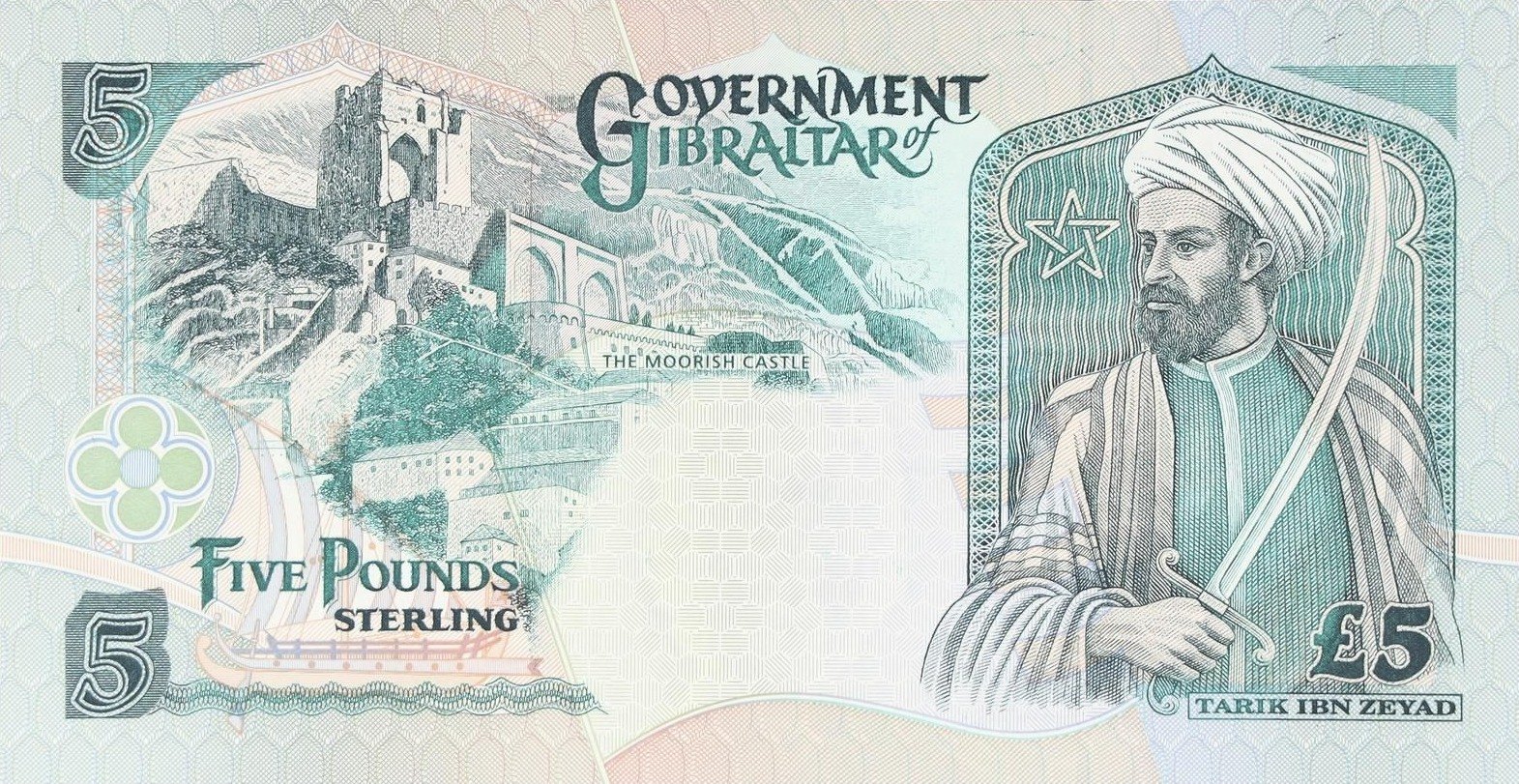
A new series is dated 1st July 1995. Sources mention that it was designed at De La Rue by Brian White and that the portrait follows a photograph by Terry O'Neill taken in April 1992, engraved by Alan Dow of De La Rue. The backs show:
| Note | Back |
|---|---|
| 5 pounds | Tarik ibn Zeyad, as the note spells the name, with the Moorish Castle |
| 10 pounds | General Eliott with the Great Siege of 1779-83 |
| 20 pounds | Admiral Nelson with HMS Victory returning to Gibraltar in 1805 |
| 50 pounds | Winston Churchill with Spitfires at the North Front in 1942 |
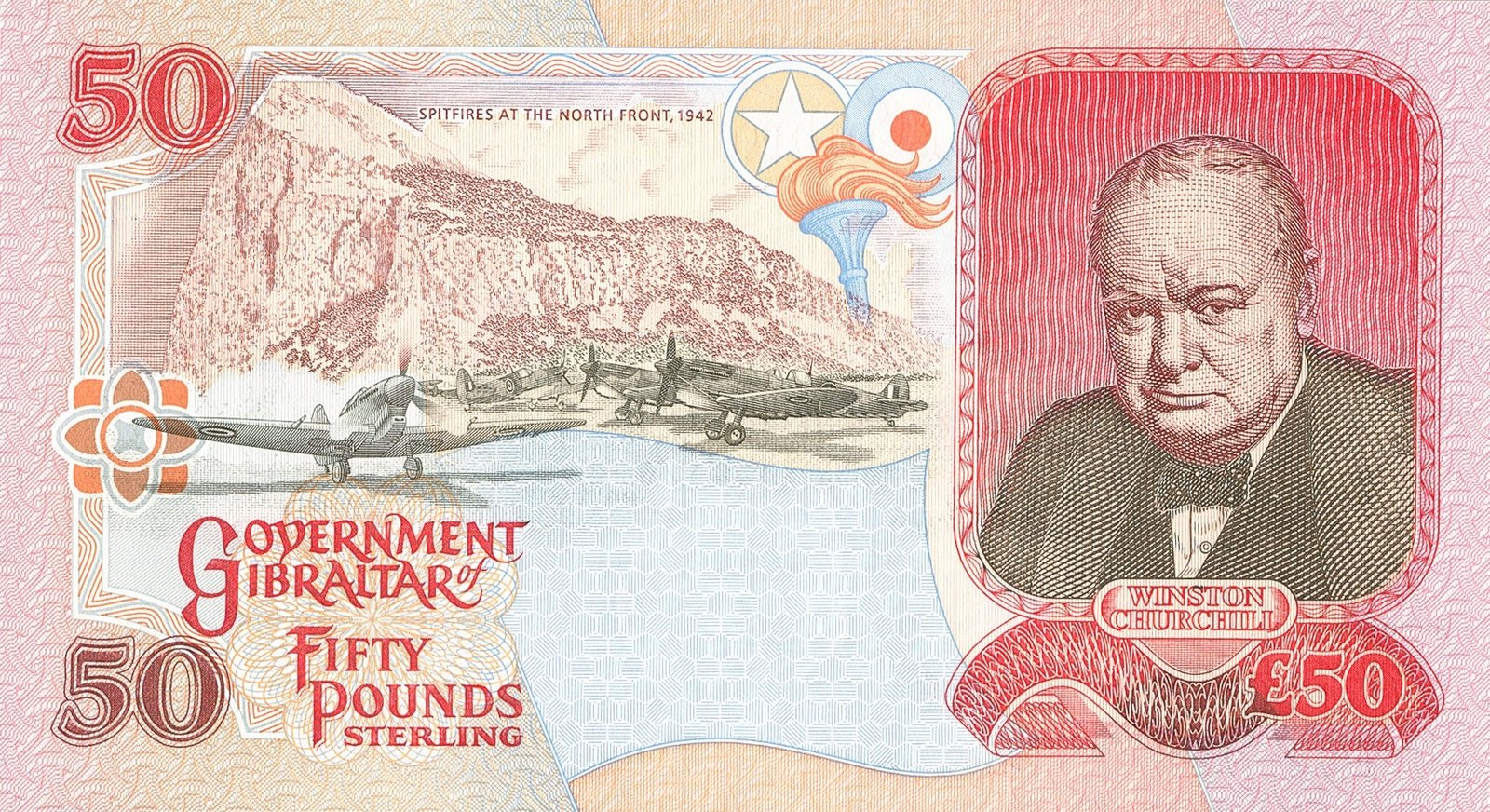
Later notes reuse these fronts. The millennium 5 pounds of 2000 has the front of the 1995 note with the cartouche Commemorating 2000 Millennium in place of the gateway, and a new back. The 10 pounds dated 10th September 2002 and the 20 pounds dated 4th August 2004, a commemorative for the tercentenary of 1704 to 2004, each have the 1995 front and a new back. Three notes are dated 1st December 2006: 10 pounds, 20 pounds and 50 pounds.
2010 to 2021: a new Act and new sizes
The next 10 pounds and 50 pounds are dated 1st January 2010. A chapter report in the IBNS Journal (volume 49, number 4, page 69) says the issue was announced on 8 July 2010, that the notes were released the next day, and that the other values up to 100 pounds were due in the following year. Those are the 5 pounds, 20 pounds and 100 pounds dated 1st January 2011.
The three notes of 2011 were issued under the Currency Notes Act 2011, in force from 10th February 2011. The Act moved the approval of the design from the Secretary of State to Gibraltar's Minister for finance, ended the Crown Agents' part in the issue, and requires the Queen's consent to the design of any note that bears the Queen's portrait. It makes the Financial Secretary the Commissioner of Currency. The Chief Minister, moving the Bill on 13 January 2011, said that it re-enacted the old law and that approval by the Secretary of State had in practice not taken place for a number of years. The consent clause was added in committee. The Government's law site shows the law of 1934 as repealed.
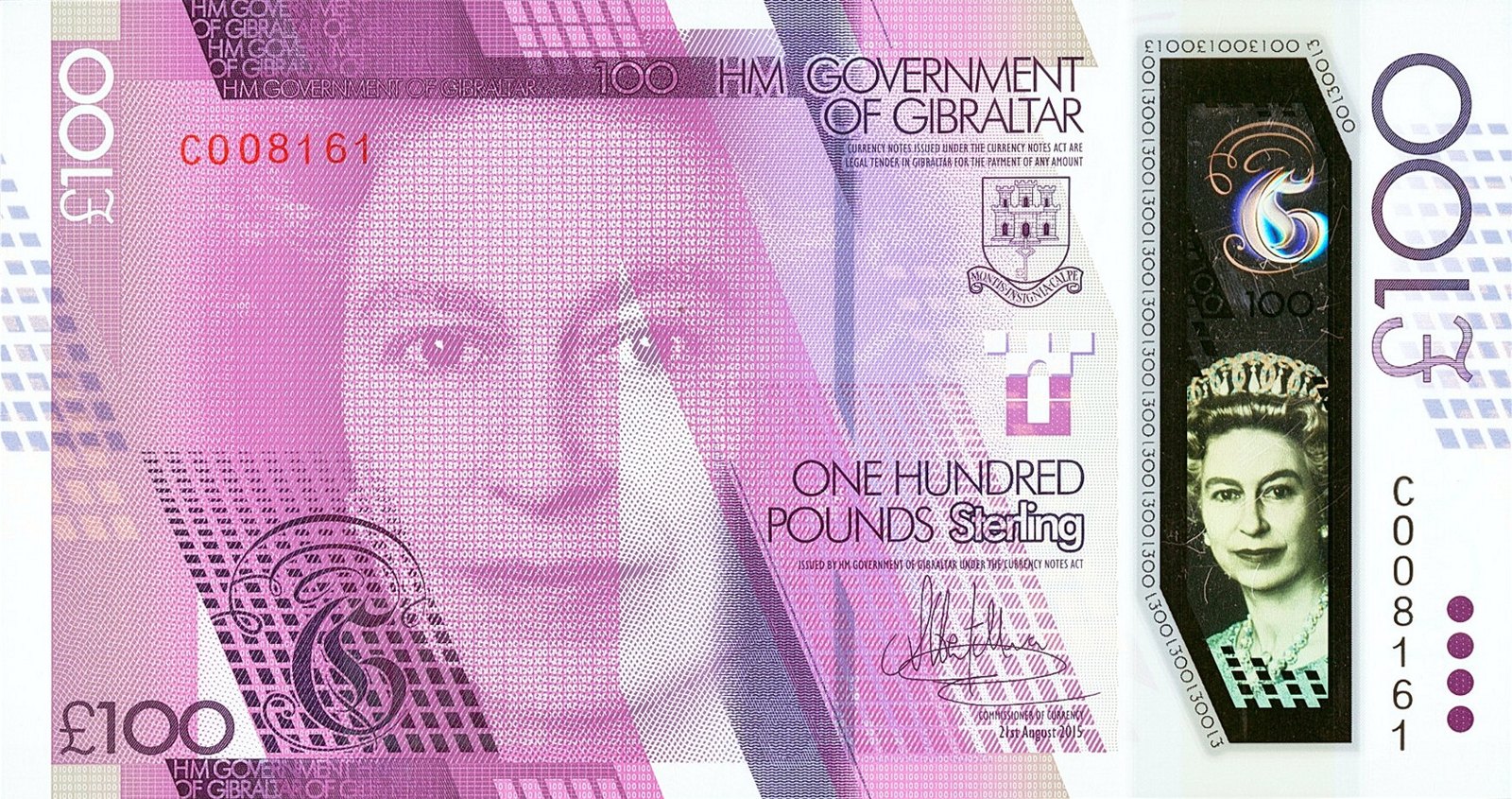
A later 10 pounds is dated 1st August 2016 and a later 50 pounds 30th May 2019. A 100 pounds dated 21st August 2015 marks the centenary of the birth of Sir Joshua Hassan on 21 August 1915. It was introduced on 23 January 2017 and is printed on De La Rue's Safeguard polymer substrate, with a holographic foil window showing Queen Elizabeth II.
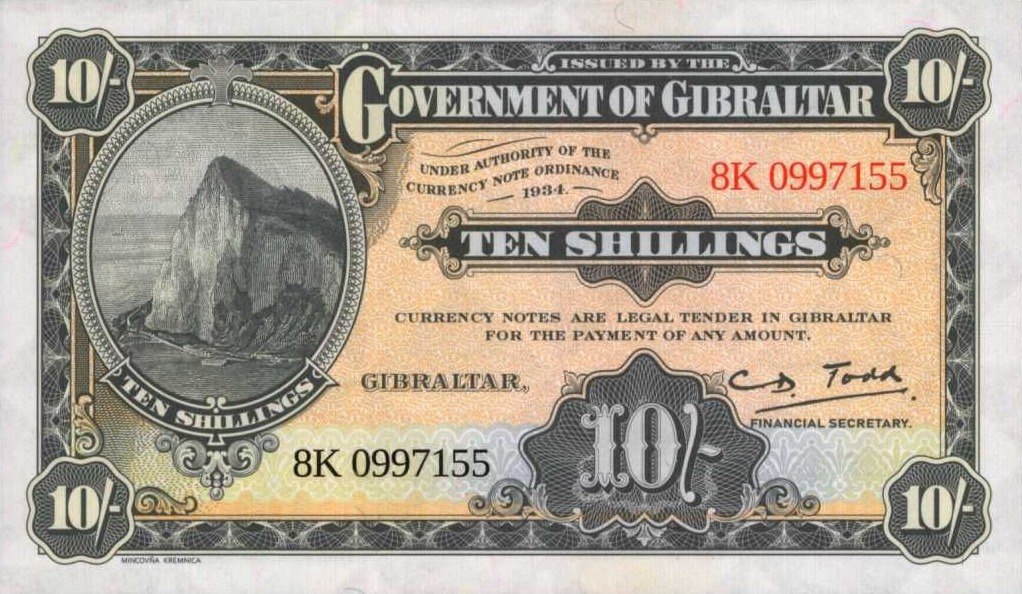
Two notes have no Pick number and carry this catalogue's own numbers. W41 is an official replica of the 10 shillings of the 1934 Ordinance with the facsimile signature of Todd, made for World Tourism in 2018, printed by Mincovňa Kremnica with prefix 8K, legal tender for 50 pence during 2018 only and sold by the Gibraltar Philatelic Bureau. W42 is the 5 pounds dated 21st August 2020, the first Gibraltar note in the reduced size of current Bank of England notes. The Government's press release 895/2021 says it was issued from 1st December 2021 with the prefix B/AA, was printed by De La Rue in a green and beige colour scheme with the Queen on the front and the Windsor Bridge on the back, and is slightly smaller than the 5 pounds it replaced.
What the sources leave out
- Whose notes circulated at Gibraltar before August 1914.
- An official number printed for any note dated after 1965. The only official statement read here is the refusal of 17th May 1977.
- The reason for the 2 shillings notes of 1938.
- The signers of the Rock design notes dated 1971 and 1975, which the Pick pages do not name.
Sources
- The Pick pages of this catalogue for Gibraltar, P-1 to P-40, W41, W42 and the two unissued 2 shillings notes.
- D. C. Devenish (Gibraltar Museum), "Currency Notes of Gibraltar", IBNS Journal, volume 9, number 2, December 1969, pages 73 to 75.
- Currency Note Ordinance, 1927 (No. 1 of 1927), copy in the Johns Hopkins currency board archive.
- Currency Notes Act 2011 and the Chief Minister's speech on the Bill, Gibraltar Hansard, 13 January 2011.
- House of Assembly, question 142 of 1977 (17th May 1977) and the budget speech of 3rd April 1978.
- Colonial Reports, Annual: No. 647 (Gibraltar 1909), No. 1173 (1922), No. 1437 (1928).
- Chalmers's book of 1893 on colonial currency, page 318.
- IBNS Journal, volume 49, number 4, page 69 (chapter report on the issue of July 2010).
- Laws of Gibraltar, entry for the Currency Notes Act 2011 (web).
- H.M. Government of Gibraltar, press release 895/2021 of 1 December 2021 (web).
- House descriptions: Spink, 27 September 2011, lot 813; Spink, 17 April 2019, lots 510 and 512; Heritage, 5 September 2019, lot 28417; London Coins, 1 March 2020, lot 191; Spink, 30 September 2026, lots 272 and 274.


Member comments
Log in or register to post a comment.