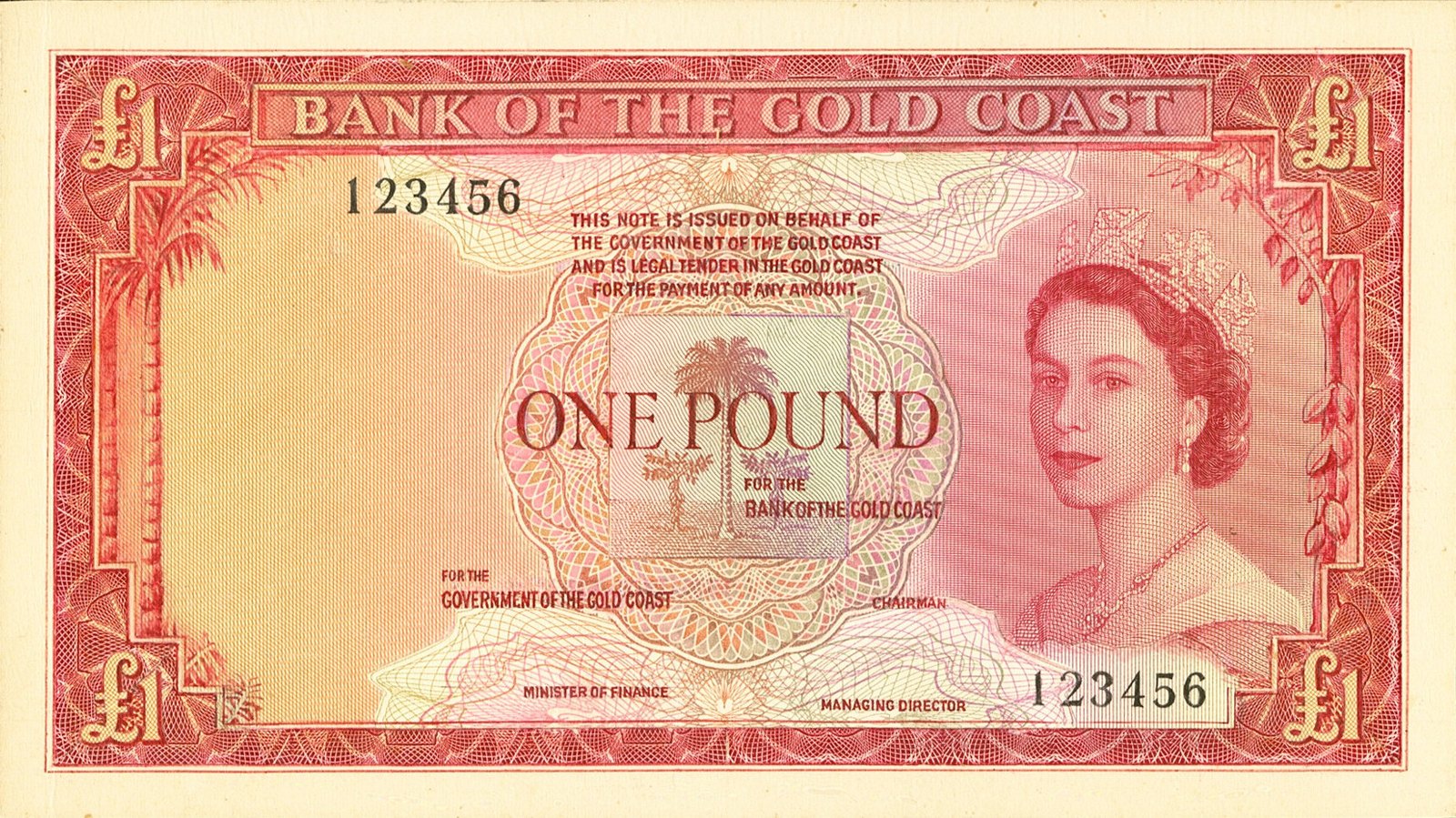
The catalogue's pages for the Gold Coast hold no issued note. They hold five designs prepared in 1953 for the Bank of the Gold Coast and never issued. This short article sets out what the designs show, what the official papers say and do not say, and what Spink and Heritage Auctions wrote when the pieces were sold, each as that house's own statement.
Five values, one serial number
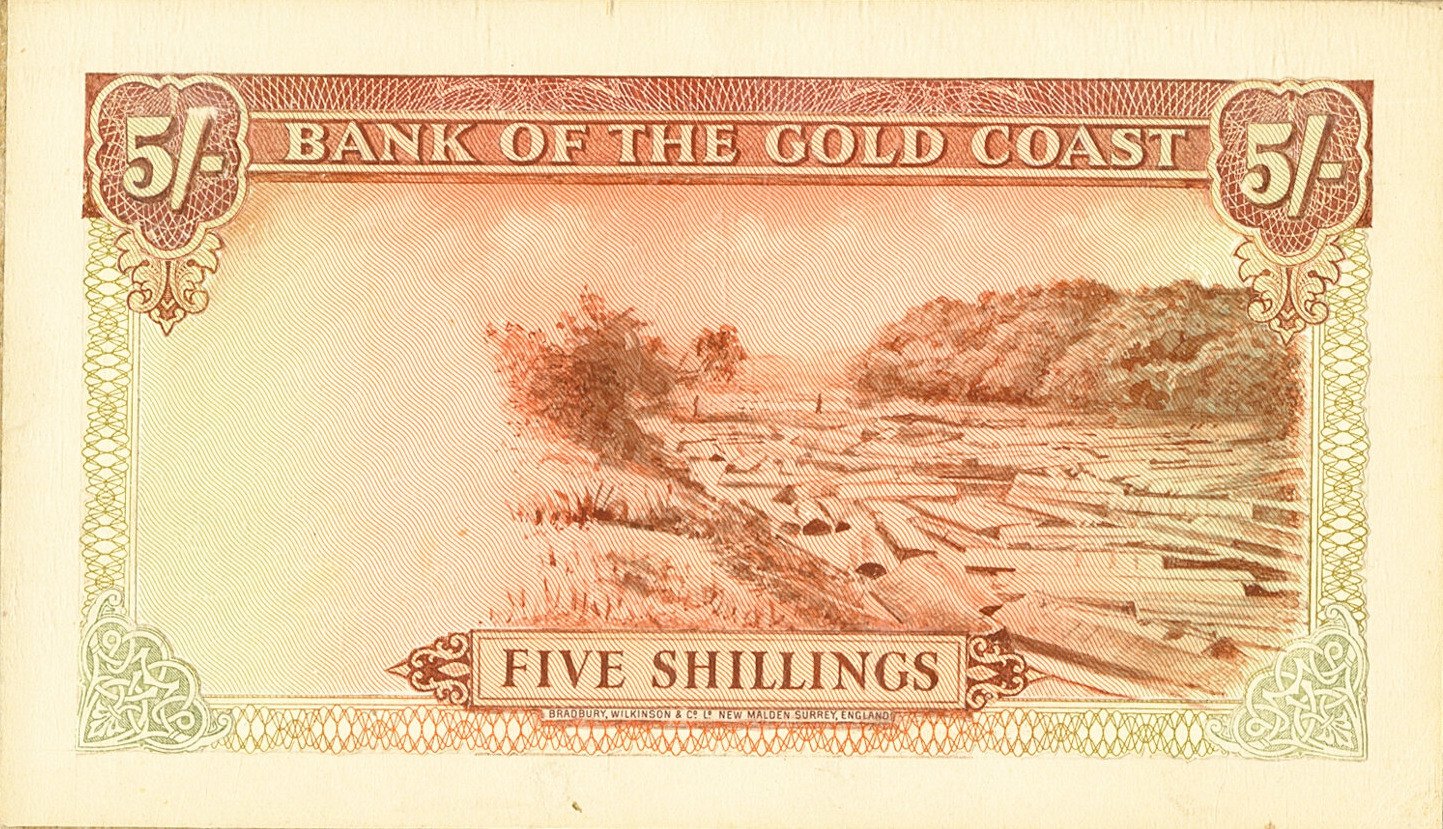
The designs are the work of Bradbury Wilkinson and Company. Each is known as a printer's model: a composite essay of the front and the back, mounted on card or board, with the serial number 123456. On the 5 pounds and the 100 pounds the front and the back are two pieces. Each has the Queen's portrait, and a palm tree at the centre of the front.
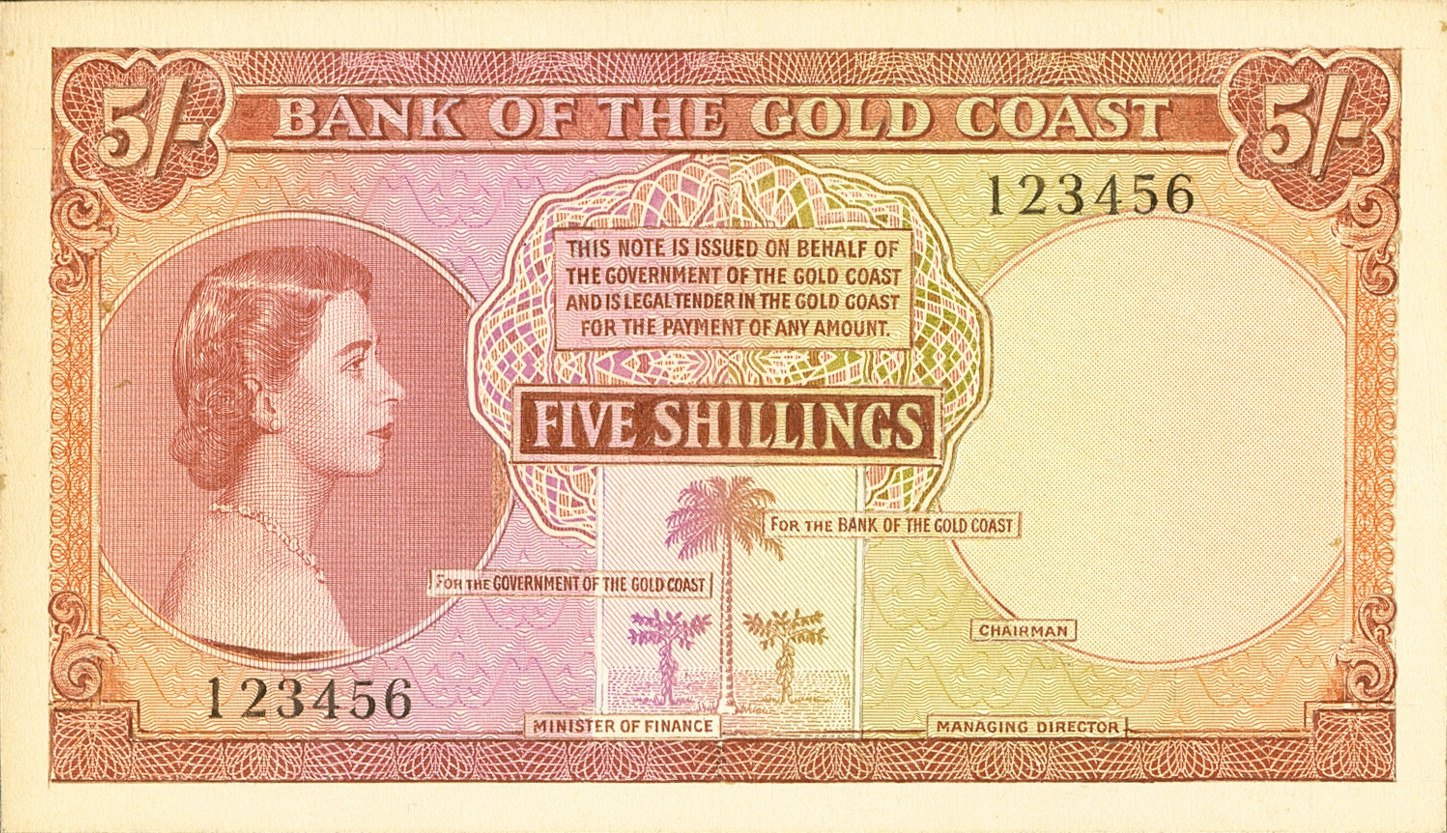
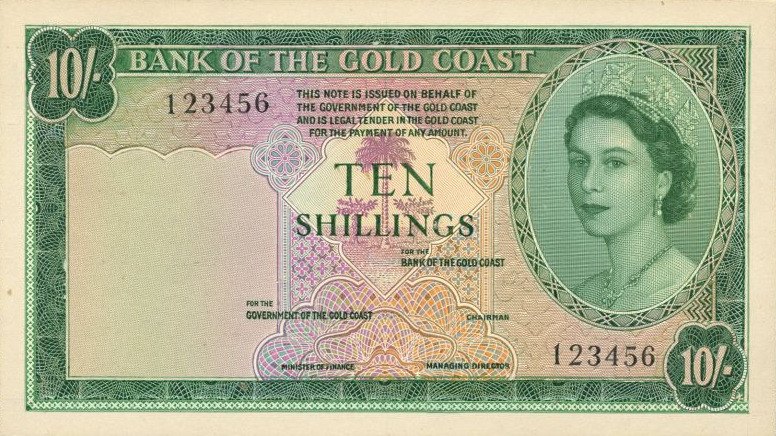
| Value | Colour | Portrait | Back |
|---|---|---|---|
| 5 shillings | red-brown and lilac | at left | a logging scene, logs floating on a river |
| 10 shillings | green | at right | a cocoa tree with pods in a plantation |
| 1 pound | red | at right | two men crouched by a heap of cocoa pods |
| 5 pounds | blue and green | at right | a mine with its headframe and buildings |
| 100 pounds | purple | at right | a river winding between wooded hills |
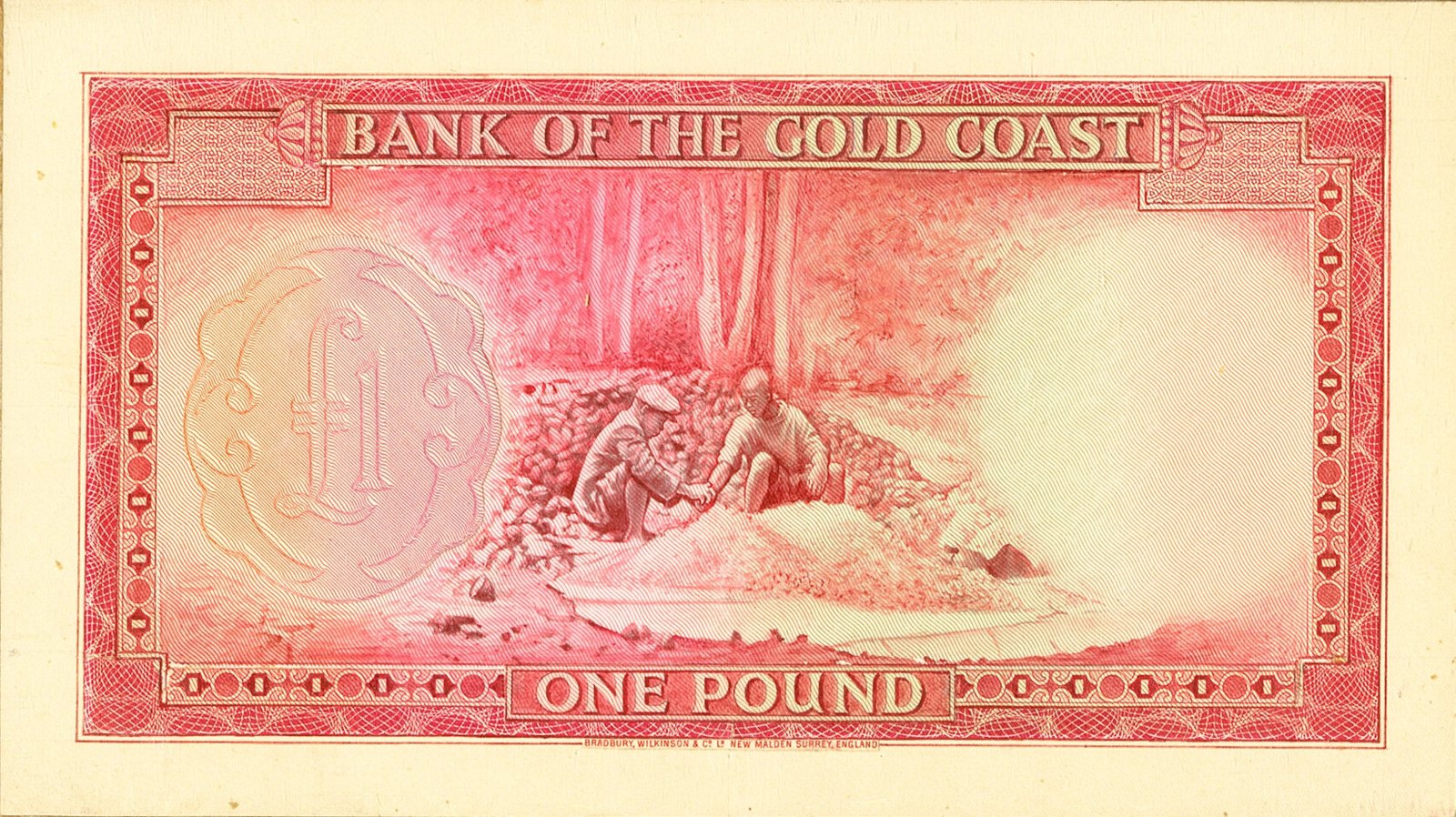
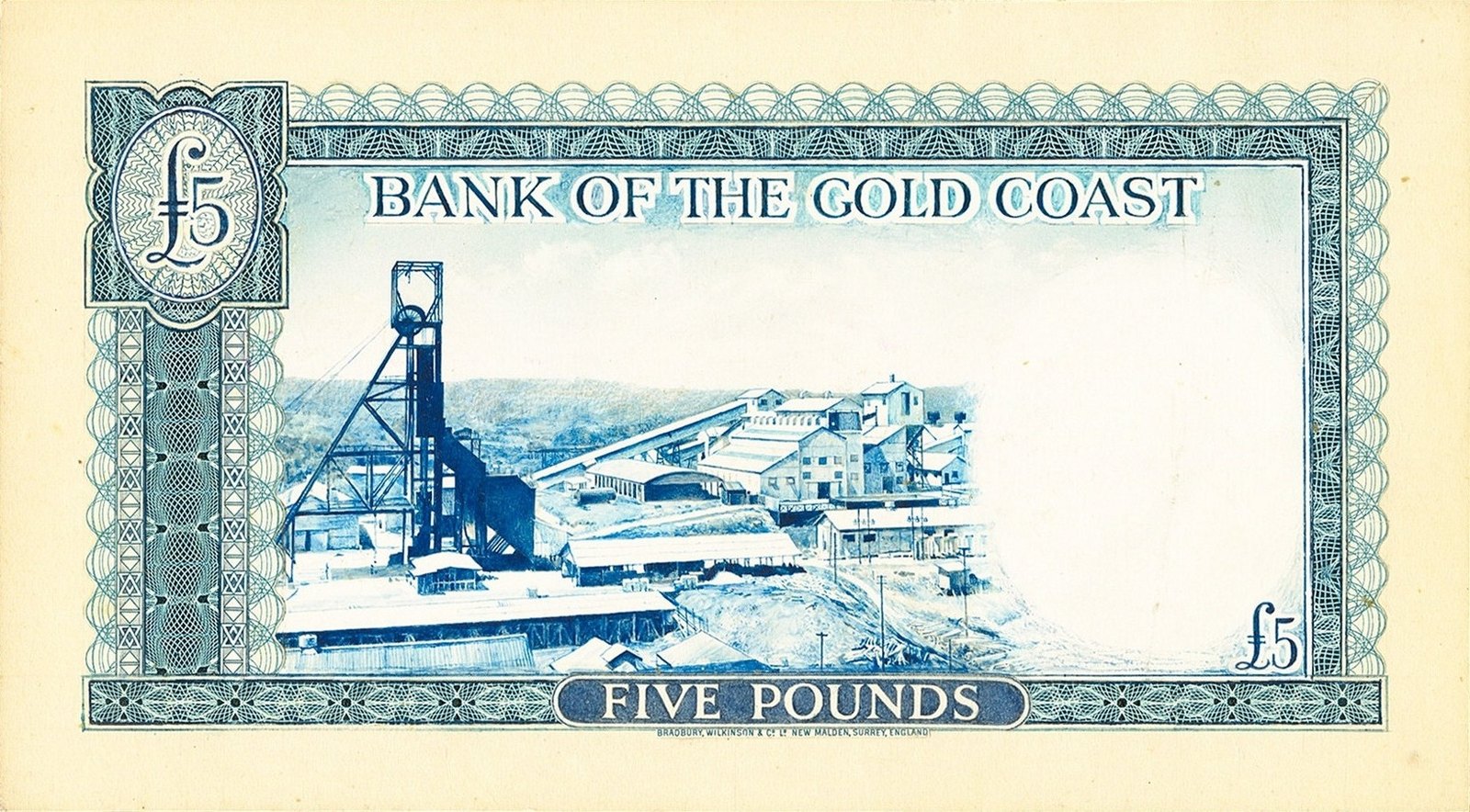
The models carry no signatures. The catalogue's rows record how the spaces are lettered: for the Government of the Gold Coast, the Minister of Finance, and for the Bank of the Gold Coast, the Chairman and the Managing Director. The 5 pounds is also known as a black and white photographic essay of the front, on which the spaces are lettered Minister of Finance at the left and Governor, Bank of the Gold Coast at the right, on pasted patches. The two pieces do not letter the Bank's space alike.
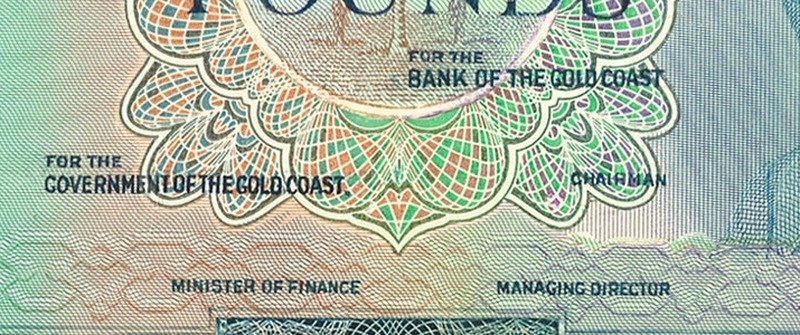
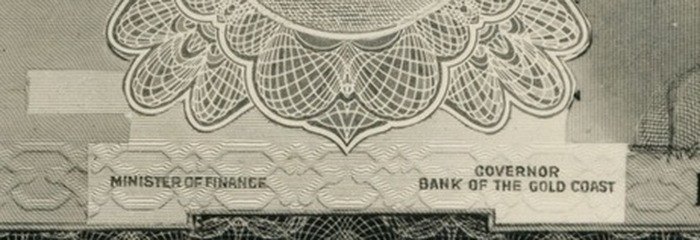
No catalogue lists the designs, and they have no Pick number. They are set beside other designs of the same years in Notes that never were: unissued designs with Queen Elizabeth II.
The Bank, and the notes that stayed in use
The Bank of the Gold Coast was established in 1953. The Gold Coast's annual reports read for the catalogue name the Bank, opened in Accra in May 1953, and say nothing of a plan for a currency of the colony's own. The Blue Books and Colonial Office Lists read for the catalogue do not mention the Bank or its designs at all.
The Gold Coast went on using the notes of the West African Currency Board until the Bank of Ghana issue of 1958. Those notes, and the figures of the Gold Coast's share of them, are told in The notes of the West African Currency Board, 1916 to 1962 and The West African Currency Board's notes in circulation, 1917 to 1961.
Where the models have been sold
- Spink, 2nd October 2012, lot 587: the 100 pounds, front and back on board.
- Spink, 12th April 2016, lot 1127: the 5 shillings.
- Spink, 2nd October 2019, lot 1, in the second part of the Ibrahim Salem Collection of British Commonwealth: the 5 pounds, front and back each in a holder of the grading company PMG.
- Heritage Auctions, 8th December 2023, lots 22251 to 22254, in its sale of the Queen Elizabeth II Collection: the 5 shillings, the 1 pound, the 5 pounds and the 100 pounds.
None of the descriptions read here is of the 10 shillings.
Spink calls each piece unique. Heritage says the models are partly printed and partly drawn or painted by hand, and that the sides are mounted on card.
Heritage also offers a reason for the designs: that they were made in case the Gold Coast became a separate colony, or stayed a colony apart from British West Africa. Heritage puts this forward as a possibility and names no source for it. One of its descriptions (lot 22253) calls the Bank of the Gold Coast fictitious. The catalogue's pages say the Bank was established in 1953, and the annual reports name it.
What is not known
- The date. Spink's description of the 5 shillings in 2016 dates it 30 April 1953. No date is printed on the models, and the catalogue treats the date as not settled.
- Why the designs were made and why they were dropped. No official paper read for the catalogue speaks of them.
- How many models exist. The houses call the pieces unique or possibly unique; no source counts them.
Sources
- The catalogue's pages and rows for the five designs.
- The annual reports on the Gold Coast, 1933 to 1954; the Gold Coast Blue Books and the Colonial Office Lists, in which the Bank is not found.
- Spink, 2nd October 2012, lot 587; 12th April 2016, lot 1127; 2nd October 2019, lot 1.
- Heritage Auctions, 8th December 2023, lots 22251, 22252, 22253 and 22254.
Member comments
Log in or register to post a comment.