From September 1926 to December 1928 Jerusalem's English daily, The Palestine Bulletin, followed the making of a new currency step by step: the Board, its rules, the plan, the first day, and at last the Board's own account of what it had done. Read in order, its pages give the story as people in Palestine met it, and several details that the later books leave out.
The issues quoted are in the newspaper collection of the National Library of Israel. Dates printed on notes are written here as "1st September 1927"; days of events as "1 November 1927".
1 September 1926: a Board is formed
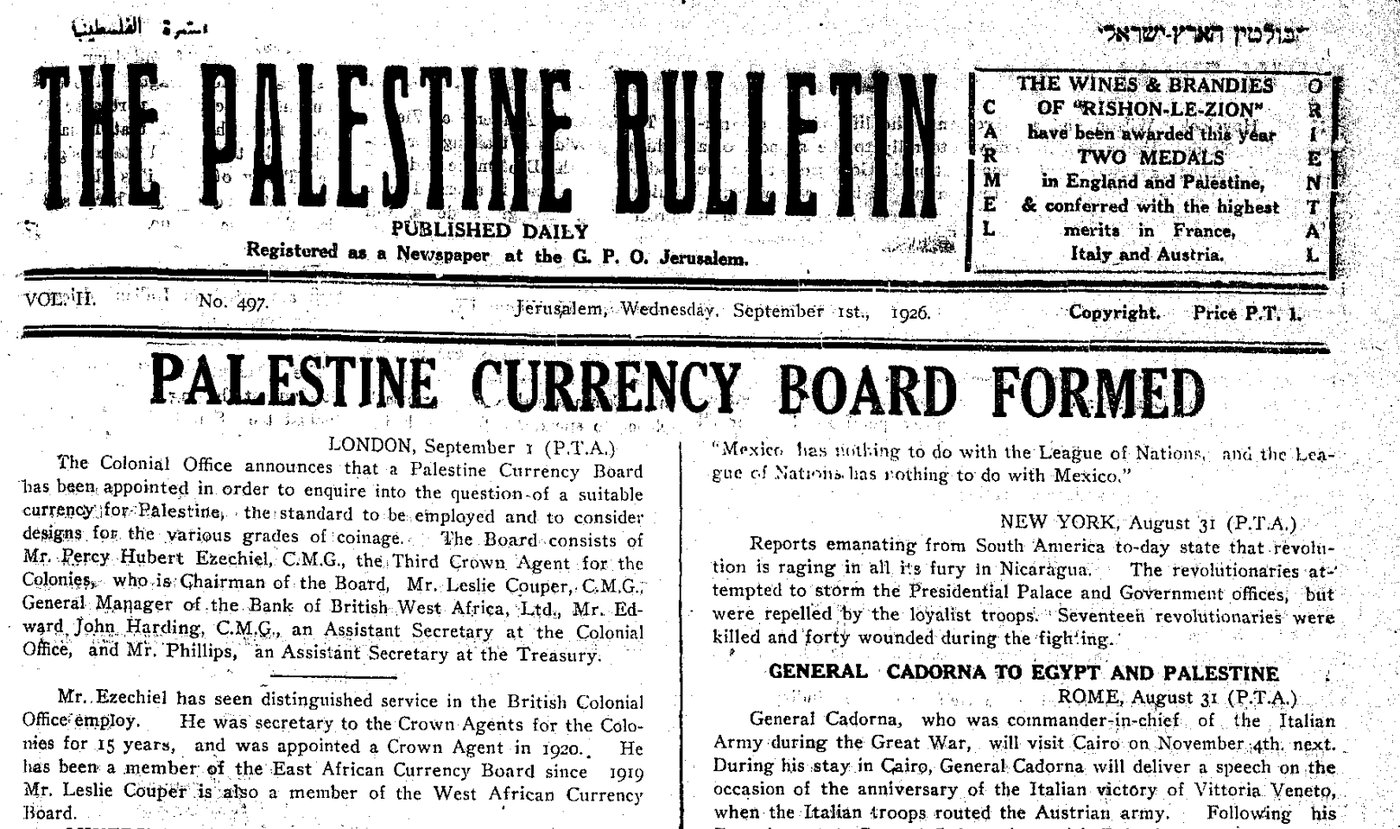
A London telegram announced that the Colonial Office had appointed a Palestine Currency Board: Percy Hubert Ezechiel, "the Third Crown Agent for the Colonies", as Chairman; Leslie Couper, General Manager of the Bank of British West Africa; an Assistant Secretary at the Colonial Office named Harding; and Mr. Phillips of the Treasury. The telegram adds that Ezechiel had been Secretary to the Crown Agents for fifteen years, a Crown Agent since 1920 and a member of the East African Currency Board since 1919, and that Couper sat on the West African Currency Board.
Two things in it are loose. It calls the third member "Edward John Harding"; the notes are signed A. J. Harding, and so is the Board's report. And it says the Board was to "enquire into the question of a suitable currency", when its work was to supply one.
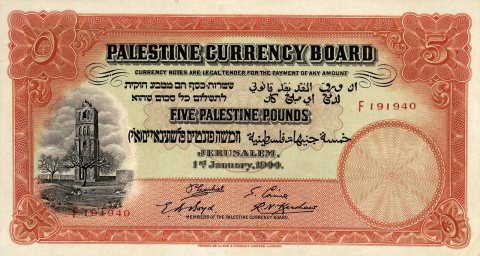
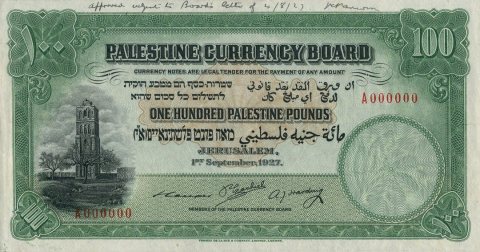
Two days later, on 3 September, the paper printed the Board's regulations of 2 August 1926 from the Official Gazette. One of them is the reason every Palestine note carries signatures: the notes "shall be authenticated by facsimiles of the signatures of the members of the Board".
14 October 1926: a forecast that was wrong
The Bulletin passed on a report of the London Financial News: the Palestine pound would be called the dinar, each dinar of ten shekels, each shekel of a hundred units. Those names had been proposed by a committee in Jerusalem and refused in London the year before. The notes say pounds and mils.
16 March 1927: the plan in full
On 16 March 1927 the paper gave three of its four pages to the Government's memorandum on the new currency. For the notes it laid down the six values and their sizes:
| Value | Size |
|---|---|
| 500 mils | 5 by 3 inches, 127 by 76 mm |
| 1 pound | 6½ by 3½ inches, 165 by 89 mm |
| 5, 10, 50 and 100 pounds | 7½ by 4 inches, 191 by 102 mm |
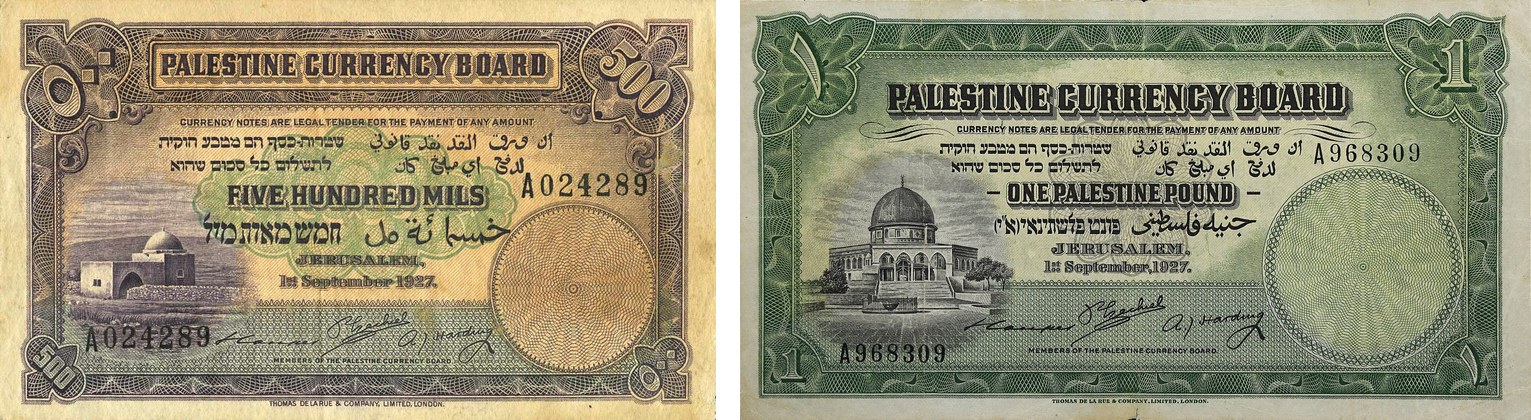
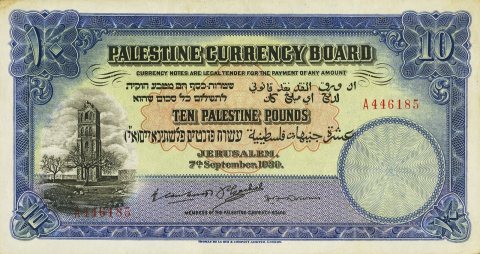
It also said what every front would carry: the name of the Board, the value in words, the line "Currency notes are legal tender for the payment of any amount", Jerusalem, the date, the members' signatures and the number in two places, all in English, Arabic and Hebrew. Egyptian money would be changed at one Palestine pound for 975 thousandths of an Egyptian pound, free of charge, but badly damaged notes would not be taken.
On 5 April the paper reported the draft Currency Notes Ordinance, published in the Official Gazette of 1 April: up to ten years for forging a note, and up to three months or a fine for mutilating one.
2 November 1927: the first day
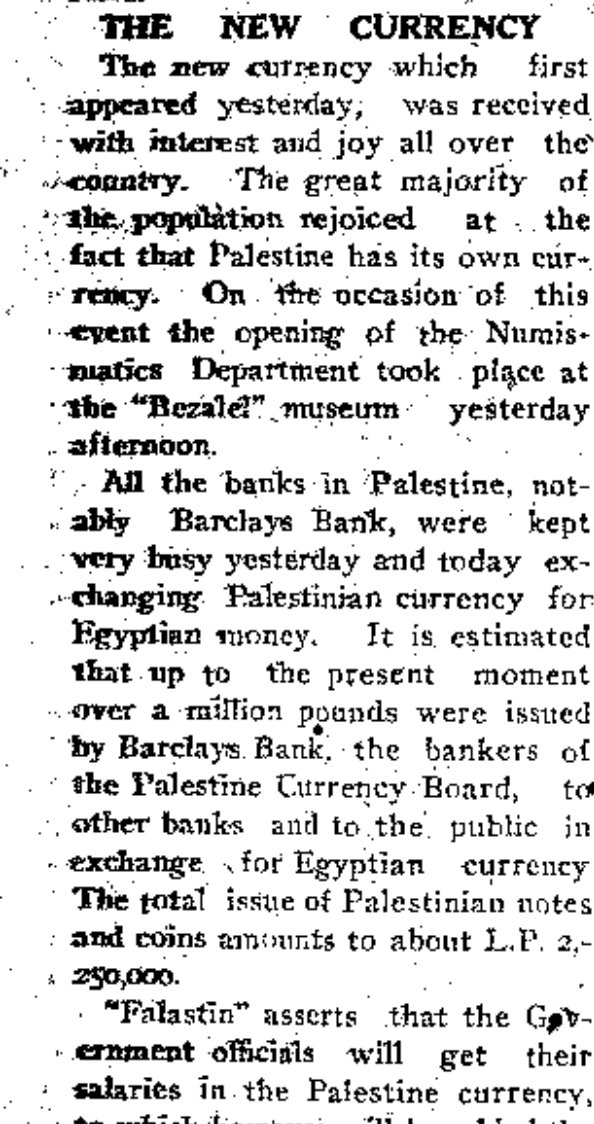
The notes and coins came out on Tuesday 1 November 1927. The next morning's paper said the new currency had been received "with interest and joy all over the country". All the banks, Barclays above all, had been kept very busy for two days changing Egyptian money, and over a million pounds was thought to have been paid out through Barclays already. The Bezalel museum opened a coin department to mark the day.
The small print of the same issue shows the change reaching daily life. The Bulletin itself now cost 10 mils. The Postmaster General announced that telephone charges would be the same figures in mils as they had been in milliemes. And the Arabic paper Falastin said that government officials would be paid in Palestine money with the difference between the Egyptian and the Palestine pound added, the Egyptian pound being worth a little more.
16 and 21 November 1927: where the notes went
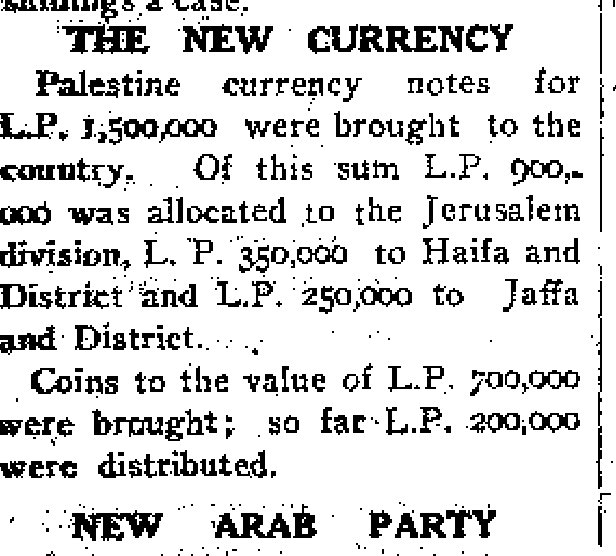
Two weeks on, the paper printed the only figures known for how the first notes were shared out:
| Division | Notes allotted |
|---|---|
| Jerusalem | 900,000 pounds |
| Haifa and district | 350,000 pounds |
| Jaffa and district | 250,000 pounds |
| Together | 1,500,000 pounds |
Coin worth 700,000 pounds had been brought as well, and 200,000 of it given out. In the same column the railwaymen at Haifa asked for their wages to be reckoned in Egyptian pounds, or the difference made up, as it was for the staff.
On 21 November the paper printed the Proclamation that made the small coins legal tender, and, a few lines below, a first sign of trouble: a man arrested on suspicion of passing forged 5 pound notes. It does not say whether they were the new notes or Egyptian ones.
10 December 1928: the Board's own account
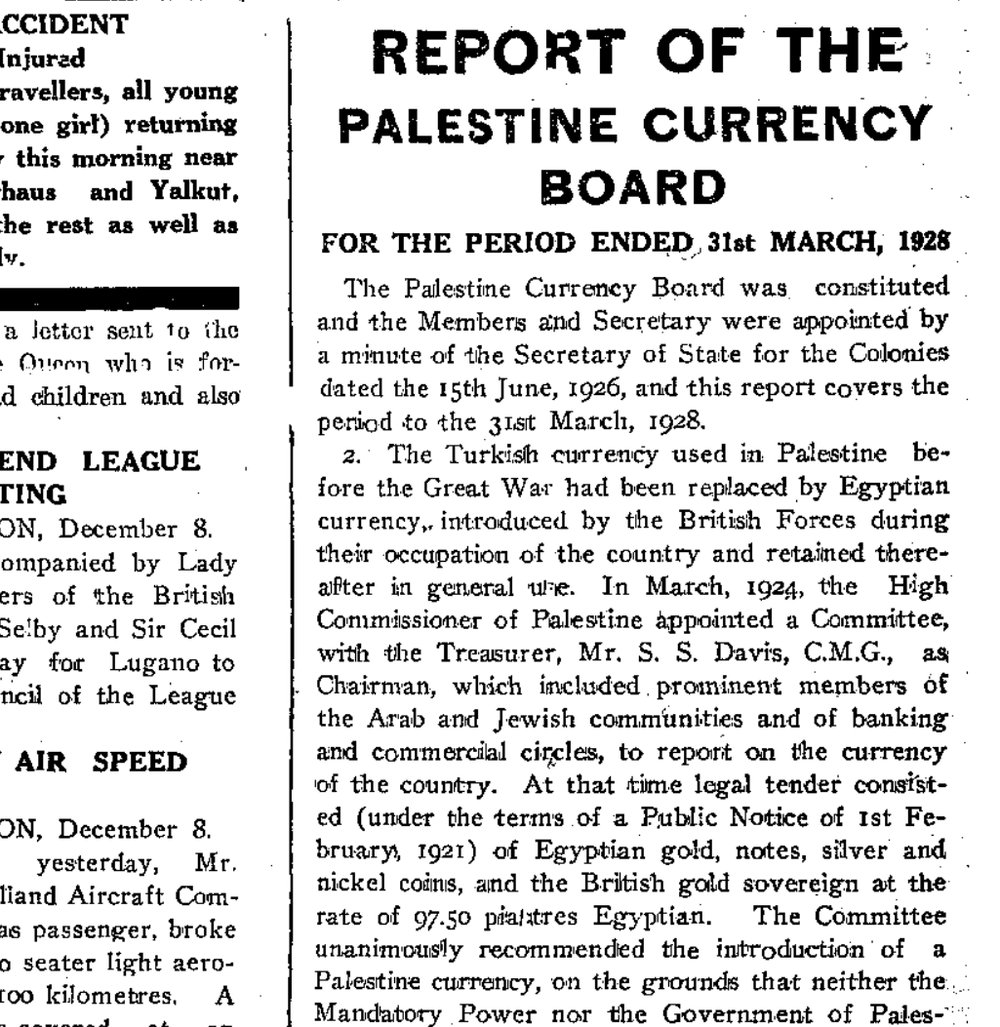
A year later the Bulletin printed the Board's first report in full, over three pages. It was signed on 24 September 1928 by Ezechiel, Couper and Harding, the three whose signatures are on the notes of 1st September 1927. It is the first-hand source for much that has been written since, and it settles several points.
- When the notes were ordered and sent. The contract for printing was placed in March 1927. Choosing the designs and approving the proofs took time. The first 1,500,000 pounds of notes left England in instalments between 27 August and 17 September 1927; more followed early in 1928 as the Egyptian money came in; 2,160,000 pounds in all had gone to Palestine by the time of the report, and a further reserve was kept in London.
- Why the first day was moved. The Board had aimed at 1 October 1927. The Government of Palestine put it back a month because of "the disturbance caused by the earthquake in Palestine", which was on 11 July 1927, and the financial adjustments still to be made.
- How the exchange was done. The new money was issued and the old redeemed at twenty centres. The Egyptian notes went back to Egypt under armed guard, against payment in London by the National Bank of Egypt. Egyptian notes and coin ceased to be legal tender after 31 March 1928 under a Proclamation of 9 February, and the British gold sovereign under one of 29 February.
- How much went out. Between 1 November 1927 and 31 March 1928, 2,192,348 pounds of notes and coin was issued and 305,000 pounds came back to stock.
- How the designs were received. The Board was told the notes were liked: the comments, "particularly of the notes, were generally favourable".
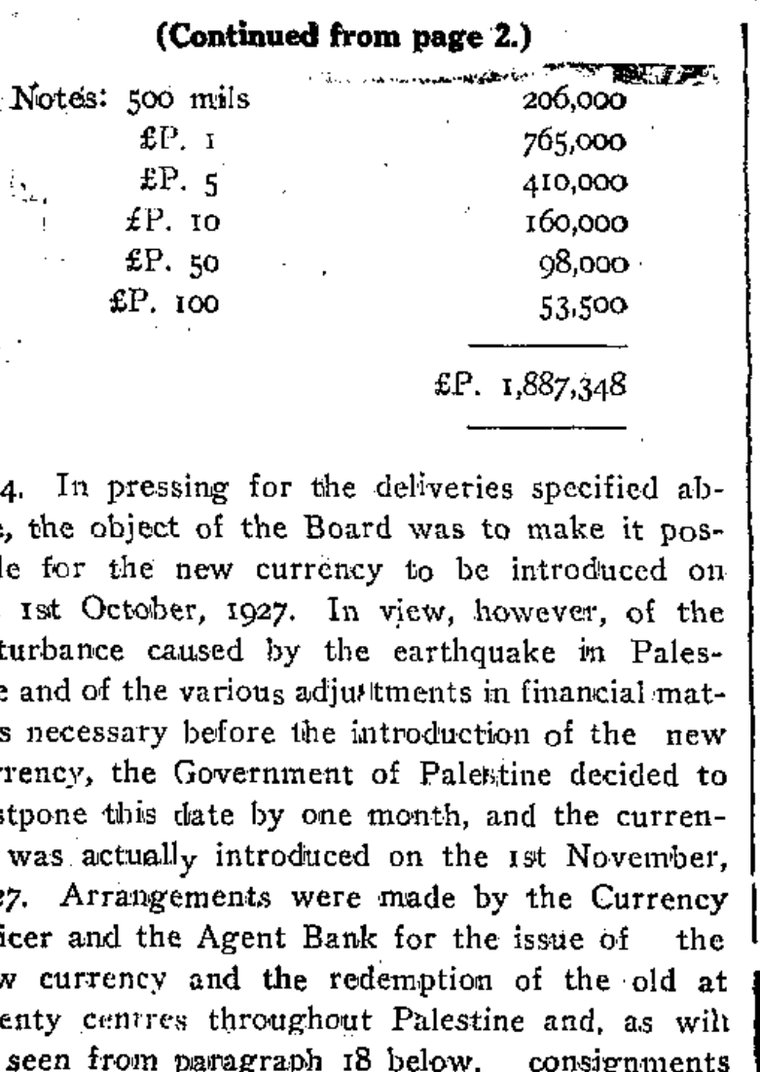
The report's table gives the notes in circulation on 31 March 1928 by value:
| Value | In pounds | Number of notes |
|---|---|---|
| 500 mils | 206,000 | 412,000 |
| 1 pound | 765,000 | 765,000 |
| 5 pounds | 410,000 | 82,000 |
| 10 pounds | 160,000 | 16,000 |
| 50 pounds | 98,000 | 1,960 |
| 100 pounds | 53,500 | 535 |
What this adds
- Every note of the first supply is dated 1st September 1927, but none left England before 27 August, and part of the supply was not sent until early 1928.
- The figures of 16 November 1927 are, so far, the only ones for where the notes first went: three fifths of them to the Jerusalem division.
- The reason for the month's delay comes from the Board itself. A later account gives a different one, that 1 October 1927 was a Saturday; the Board's report does not mention it.
What the Bulletin does not say: which values could be had at which place on the first day, and what people made of the look of the notes beyond a line or two.
Member comments
Log in or register to post a comment.