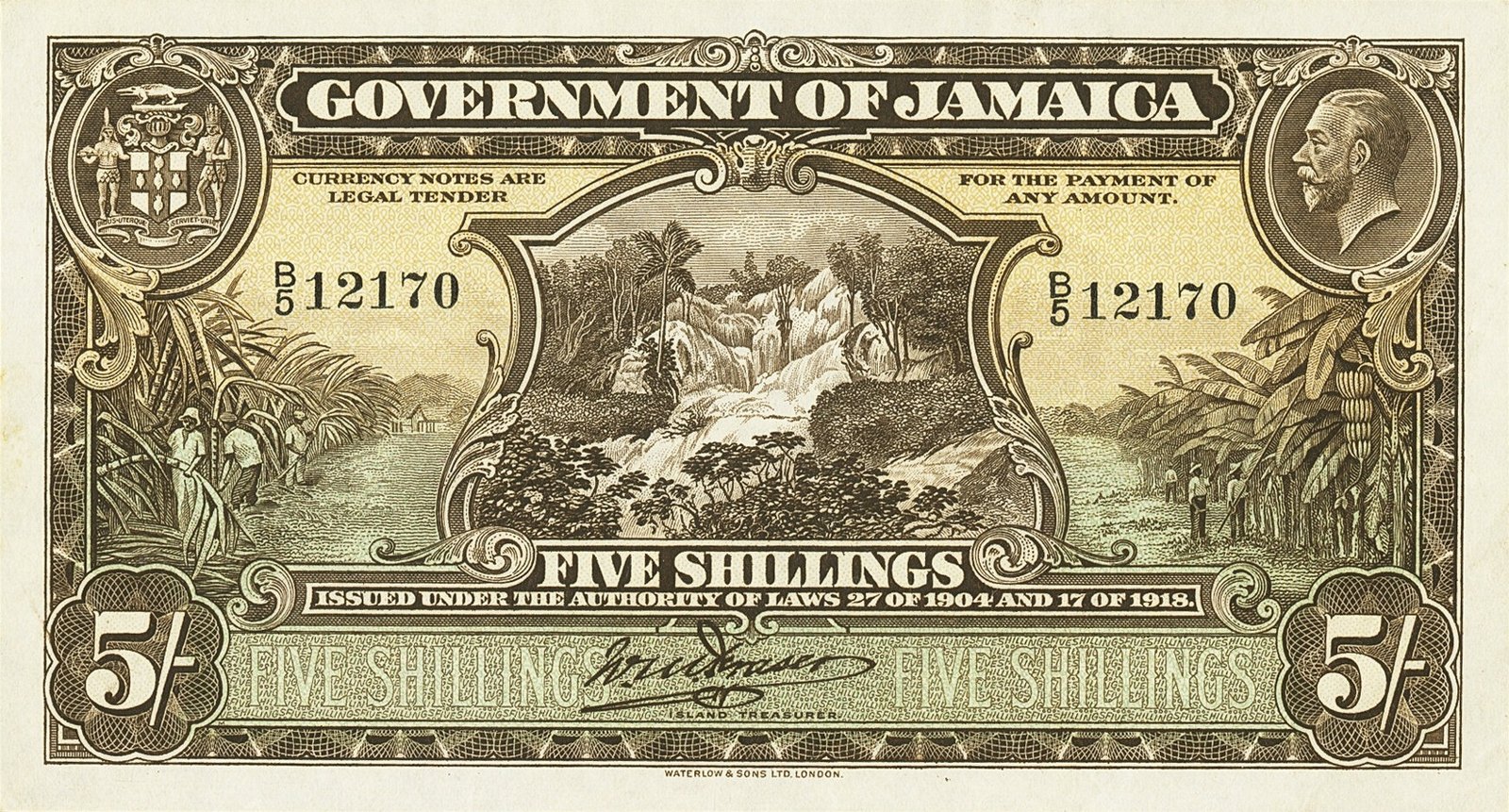
The catalogue's Pick pages for Jamaica begin with the Government notes of 1920 and hold no page for a bank's note. Yet for eighty years before 1920 the island's paper money was the banks', and the banks' pound notes went on circulating beside the Government's until the 1950s. This article gathers what the official books and the collectors' journals read for the catalogue say of them: the banks, the values, the amounts out, the laws that made them legal tender and the end of their issue. It does not describe the banks' notes one by one, which the sources read do not do.
The first banks, 1839 to 1865
Two banks of the years after emancipation are known from the IBNS Journal. Douglas A. Crawford's "A Couple of Early Jamaican Bank Notes" (IBNS Journal 11:1, September 1971, pp. 50-51) pictures a Colonial Bank note of 25 shillings sterling, or 6 dollars, dated 10th March 1840 and numbered 2016, which the author says is the only known example and is in the museum of Barclays Bank, and an unissued note of the Planters' Bank, founded in 1839, of which the author says a few copies exist. The Jamaica Journal 20:4 (1987), on its inside front cover, pictures the same Colonial Bank 25 shillings of 1840 with a Colonial Bank 5 pounds dated 1st January 1883, both in the Barclays Bank collection.
Crawford wrote again on a short-lived bank in "Jamaica: London and Colonial Bank Limited" (IBNS Journal 19:2, p. 13). The article pictures an unissued 10 shillings of the bank's Jamaica branch, number 805, in the McDonald Collection, and says the bank opened in Kingston on 4th January 1864 and merged about August 1864 into the International Bank.
The Handbook of Jamaica for 1883 adds a bank the island had lost: its table of note circulation from 1860 to 1882 covers the Colonial Bank and the old Bank of Jamaica, which closed in 1865 (text only).
The Colonial Bank alone, 1865 to 1900
After the old Bank of Jamaica closed, the Handbooks name the Colonial Bank alone. The Handbook for 1883 says "The only paper currency within the island consists of the notes of the Colonial Bank", which worked under the Imperial Act 19 and 20 Victoria, chapter 3; the Handbooks to 1896 repeat it. The Blue Books give the bank's average circulation for a few years, all read in the text only:
| Year | Colonial Bank notes, average circulation | Source |
|---|---|---|
| 1866 | £92,154 | Blue Book for 1866 |
| 1867 | £83,022 | Blue Book for 1867 |
| 1870 | £115,969 18s 5d | Blue Book for 1870 |
| 1871 | £127,355 6s 1d | Blue Book for 1871 |
| 1873 | £150,808 15s 4d | Blue Book for 1873 |
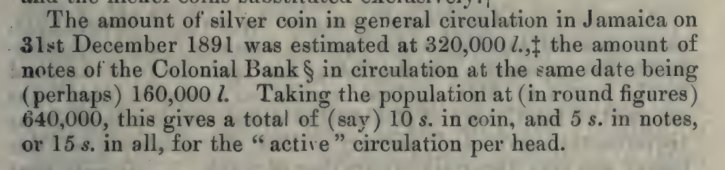
Chalmers, A History of Currency in the British Colonies (1893, p. 113, read in the text only), puts the Colonial Bank's notes in Jamaica on 31st December 1891 at about 160,000 pounds, against a total note circulation of 400,555 pounds 12 shillings 6 pence returned for the whole bank.
Four issuing banks, 1900 to 1922
The first article on Jamaica's notes quotes the Bank of Jamaica's currency timeline for the Bank of Nova Scotia issuing 1 and 5 pounds notes from 1900. The Handbook for 1904 names the Colonial Bank and the Bank of Nova Scotia, with notes "of £1, £5 and upwards"; from 1911 the Handbooks say "£1, £5 and £10". The Royal Bank of Canada is added from the Handbook for 1913, and the Canadian Bank of Commerce from that for 1922. From the Handbook for 1927 the Colonial Bank appears as Barclays Bank.
The Blue Books return the private banks' paper money as one figure:
| Year | Private banks' notes | Government notes | Source, how read |
|---|---|---|---|
| 1896-97 | £173,273 | None | Blue Book, text only |
| 1907-08 | £205,718 | None | Blue Book, text only |
| 1914-15 | £163,574 | None | Blue Book, text only |
| 1915-16 | £163,574 | None | Blue Book, page image |
| 1916-17 | £186,056 | None | Blue Book, page image |
| 1917-18 | £186,056 | None | Blue Book, text only |
A handbook titled "Jamaica in 1922", read on the page, names three banks issuing notes of a pound: the Colonial Bank, the Bank of Nova Scotia and the Royal Bank of Canada; the page breaks off before any word of the Government notes. The Voice of Saint Lucia of 3rd November 1923, summing up the report of the West Indian Currency Committee of June 1923, lists five kinds of paper money in Jamaica: Government notes and those of the Colonial Bank, the Royal Bank of Canada, the Canadian Bank of Commerce and the Bank of Nova Scotia.
Crawford's "Jamaica: other Bank Issues 1900-1942" (IBNS Journal 12:1, September 1972, pp. 40-42) pictures one note of each of the four banks: a Barclays Bank (Dominion, Colonial and Overseas) 10 pounds of 1st March 1940, a Bank of Nova Scotia 5 pounds of 2nd January 1920 of its second series, signed by Charles Archibald, a Royal Bank of Canada 5 pounds of 3rd January 1938, and a Canadian Bank of Commerce 5 pounds of 1st March 1921.
When the banks' notes were legal tender
Law 36 of 1914 let the Governor make the banks' notes legal tender, and a proclamation in an Extraordinary Gazette on 20th August 1914 did it for the notes of the Colonial Bank, the Bank of Nova Scotia and the Royal Bank of Canada. Gazette Notice No. 457 of 3rd July 1919 ended it; the Handbook for 1922 says the notes "are no longer legal tender". A proclamation of 13th October 1939, published in the Jamaica Gazette of 17th October 1939, made them legal tender again under the Bank Note Law, Chapter 276 (Handbook of Jamaica for 1947-48, text only). The report on Jamaica for 1953 still lists "currency notes of the Local Commercial Banks" among the legal tender; the report for 1954 no longer does. The laws themselves are listed in Jamaica's laws on paper money.
The banks' notes bank by bank, 1931 to 1957
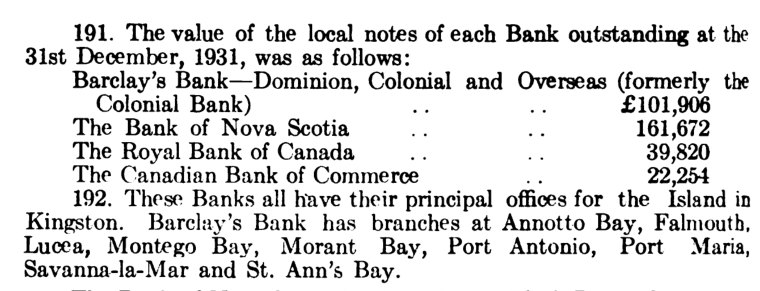
The annual report for 1931 (No. 1603, paragraph 191, printed p. 40, read on the page) gives the first figures bank by bank, at 31st December 1931. From 1946 the reports give them every year.
| 31st December | Barclays Bank (D.C. and O.) | Bank of Nova Scotia | Royal Bank of Canada | Canadian Bank of Commerce | How read |
|---|---|---|---|---|---|
| 1931 | £101,906 | £161,672 | £39,820 | £22,254 | page image |
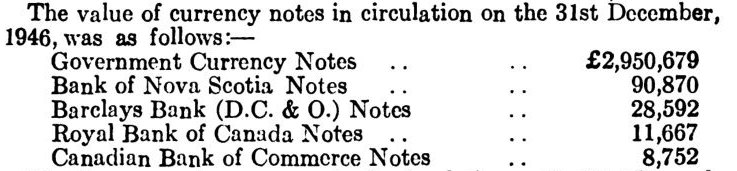
| 1946 | £28,592 | £90,870 | £11,667 | £8,752 | page image |
| 1947 | £22,628 | £37,932 | £8,450 | £6,276 | page image |
| 1948 | £27,385 | £23,903 | £6,492 | £4,267 | page image |
| 1949 | £28,245 | £18,816 | £5,469 | £3,722 | page image |
| 1950 | £45,926 | £16,425 | £4,922 | £3,285 | page image |
| 1951 | £59,917 | £14,748 | £4,450 | £2,668 | page image |
After 1951 the reports give one figure for the four commercial banks: 164,652 pounds at the end of 1952 (page image), 132,745 pounds in 1953 (text only), 109,160 pounds in 1954 (page image), 54,431 pounds in 1955 (text only) and 28,419 pounds 10 shillings in 1957 (text only). The Handbooks give 124,625 pounds on 31st March 1946 and 62,424 pounds on 31st March 1949.
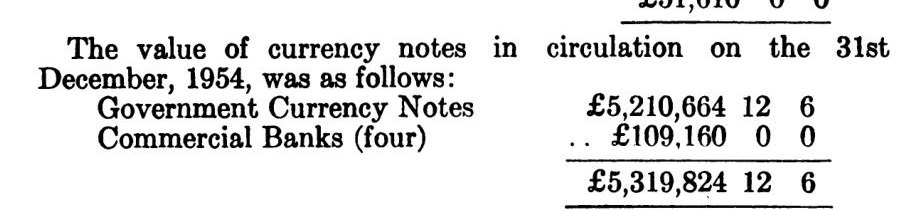
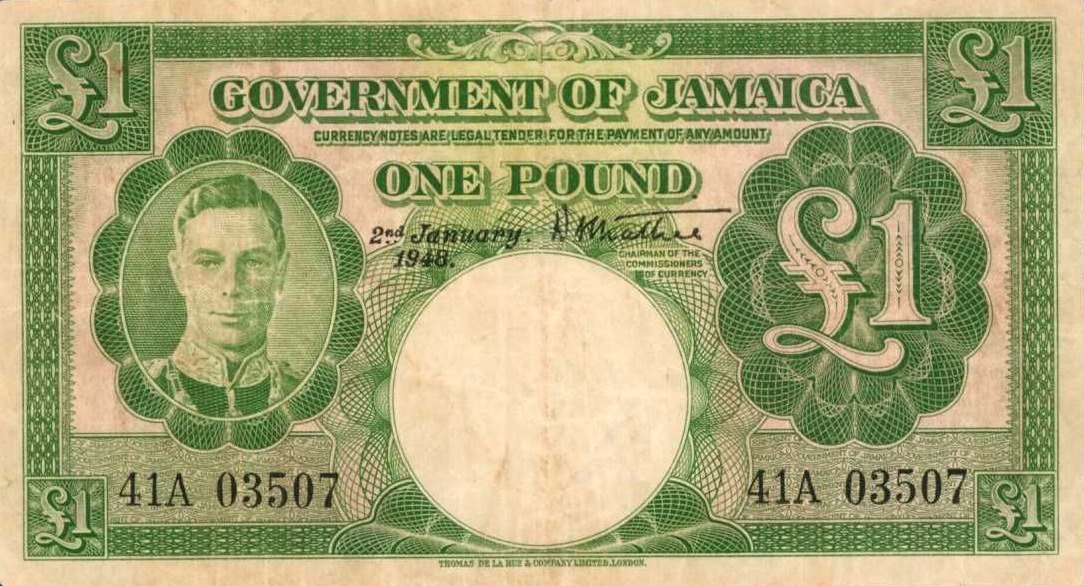
Set beside the Government's notes, the change is plain. At the end of 1931 Barclays and the Bank of Nova Scotia each had more notes out than the Government, whose notes the same report gives as 80,626 pounds 17 shillings 6 pence. At the end of 1946 the Government notes stood at 2,950,679 pounds and the largest bank figure was the Bank of Nova Scotia's 90,870 pounds. The Johns Hopkins working paper "Jamaica's Currency Board, 1920-1961, and a Comparison with its Central Bank" (Studies in Applied Economics, No. 136, pp. 4-5) says the Board's notes first exceeded the banks' notes in circulation at the end of 1941. An article on the Canadian banks in the West Indies (IBNS Journal 58:1, 2019, p. 34) says that in 1944 Barclays and the Canadian banks were made to cut their note circulation by 30 per cent to make room for the Government notes.
From 1948 Barclays had the largest figure of the four, and it rose each year from 1948 to 1951 while the other three fell.
The end, 1952 to 1958
The Barbados Advocate of 18th October 1952 (read in the text only) reported that the Jamaica Government had tabled a bill "providing for the termination of the right of note-issue to all banks operating in the island". The report on Jamaica for 1958 says that under the Bank Notes (Amendment) Law, 1954, the four commercial banks ceased to issue their own notes in the island, and that Law 10 of 1958 demonetised the notes they had issued before that Law and let their liability for notes still out pass to the Government, an arrangement that did not apply to Barclays Bank D.C.O. The working paper No. 136 says instead that the law of 1954 stopped all the banks but Barclays, and that the law of 1958 stopped Barclays. The Bank of Jamaica's timeline, as the first article quotes it, has the banks prohibited from issuing in 1954 and their notes demonetised in 1958.
An open question: 1942
Two collectors' sources put the end of the banks' issue much earlier. The Jamaica Journal 20:4 (1987) says that "Prior to 1942, commercial banks in Jamaica were empowered to issue their own bank notes". Crawford, in the IBNS Journal 12:1 (1972, p. 42), says the law of 1937 was amended in 1942, demonetising the chartered banks' notes, which were then withdrawn gradually; Crawford gives no number for the amending law.
Against this, the official books show the banks' notes made legal tender again in 1939, the banks' notes in circulation every year from 1946 to 1957, Barclays' figure rising from 1949 to 1951, the report for 1953 still counting them as legal tender, and the laws of 1954 and 1958 ending their issue and their legal tender. What happened in 1942 is not settled by the sources read. The law of 1942 itself, if there was one, would settle it; no Blue Book for 1939 to 1944 and no Handbook between that for 1939 and that for 1947-48 is among the volumes read, and the Handbook for 1939 has no currency chapter in the text that was read.
Sources
- The Handbook of Jamaica for 1883, 1896, 1904, 1911, 1913, 1918, 1922, 1927, 1947-48 and 1949-50, chapters on currency.
- The Blue Books of Jamaica for 1866, 1867, 1870, 1871, 1873, 1896-97, 1907-08 and 1914-15 to 1917-18.
- Colonial Reports, Annual, No. 1603, Jamaica, report for 1931, paragraph 191; the Colonial Office annual reports on Jamaica for 1946 to 1950 and the reports on Jamaica for 1951 to 1958.
- Robert Chalmers, A History of Currency in the British Colonies (London, 1893), p. 113.
- Jamaica in 1922 (handbook), p. 79; The Voice of Saint Lucia, 3rd November 1923; The Barbados Advocate, 18th October 1952, p. 2.
- Jamaica Journal 20:4 (1987), inside front cover.
- Douglas A. Crawford in the IBNS Journal 11:1 (September 1971), 12:1 (September 1972) and 19:2; IBNS Journal 58:1 (2019), p. 34.
- Studies in Applied Economics, working paper No. 136, "Jamaica's Currency Board, 1920-1961, and a Comparison with its Central Bank" (Johns Hopkins currency board archive).
Member comments
Log in or register to post a comment.