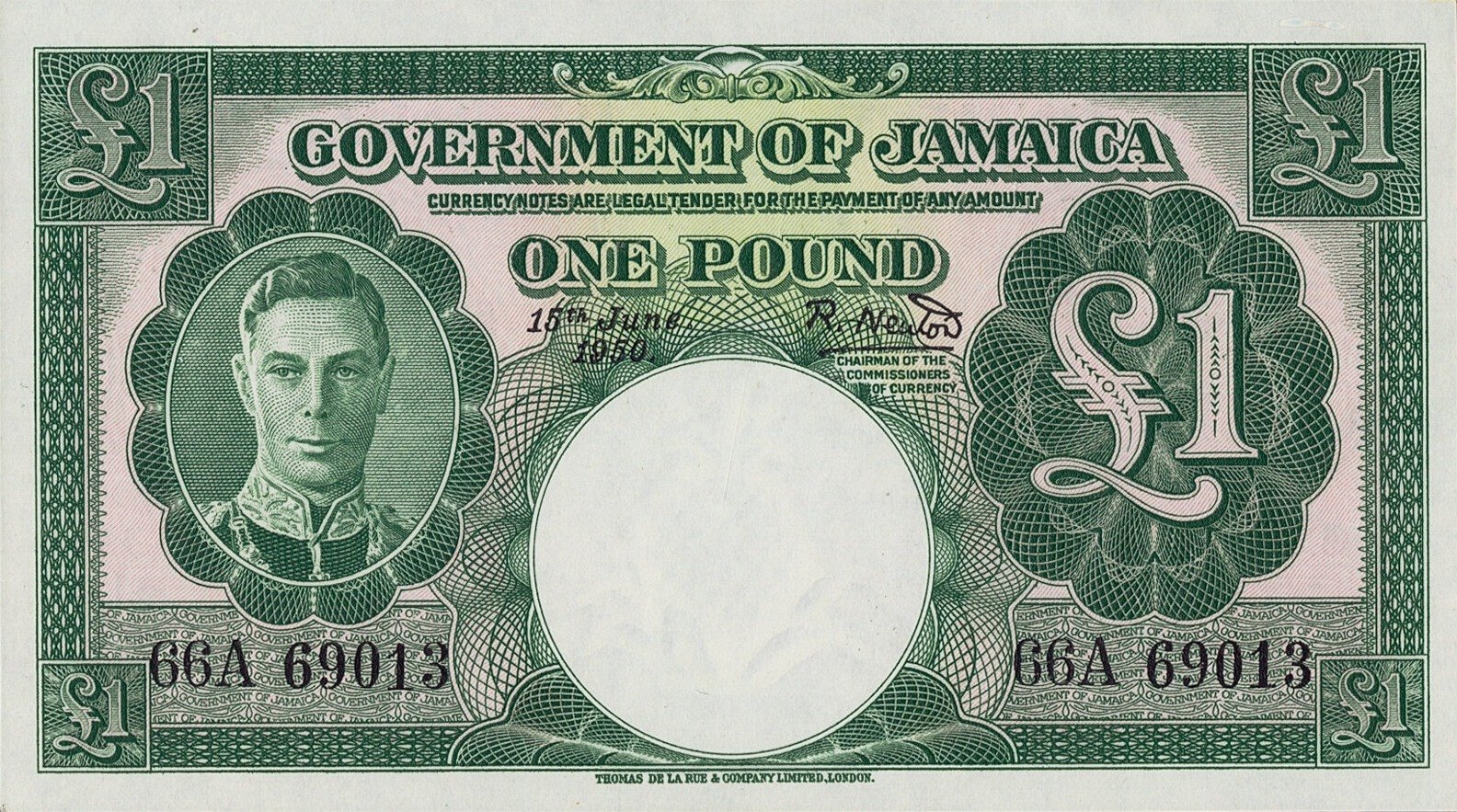
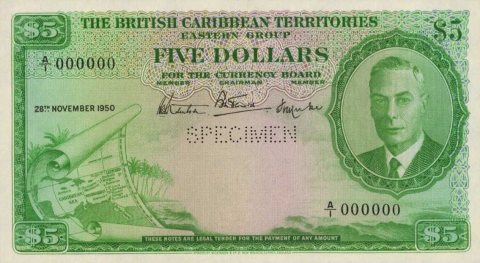
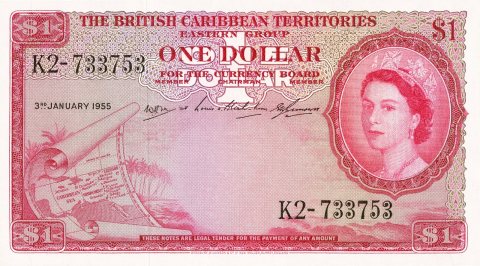
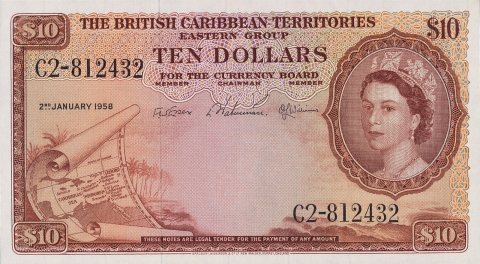
The Government notes of Jamaica did not stay in Jamaica. They were the paper money of the island's two Dependencies, the Cayman Islands and the Turks and Caicos Islands, and from 1955 they were legal tender in the colonies of the British Caribbean Currency Board. At the same time Jamaica declined, more than once, to join the Board's joint currency. This article follows these threads through the gazettes of the eastern Caribbean, the annual reports on Jamaica and its Dependencies, and the Board's own reports. The Board and its notes are told in The British Caribbean Currency Board and its notes, 1950 to 1968.
The Dependencies
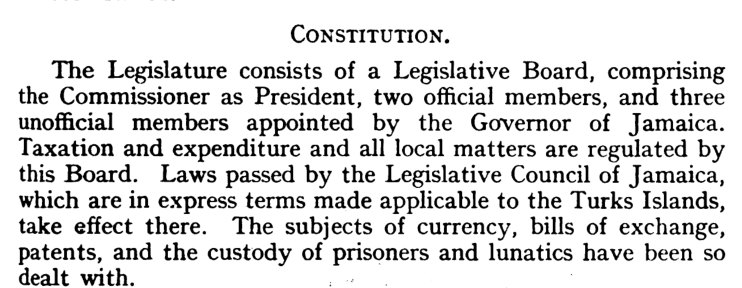
Law 2 of 1917, as the Blue Book for 1917-18 lists it, made British currency notes legal tender "in Jamaica and its Dependencies". The annual report on the Turks and Caicos Islands for 1921 (No. 1147), under Constitution, says that laws of the Legislative Council of Jamaica "which are in express terms made applicable to the Turks Islands, take effect there", and that "the subjects of currency, bills of exchange, patents, and the custody of prisoners and lunatics have been so dealt with."
The Turks and Caicos Islands
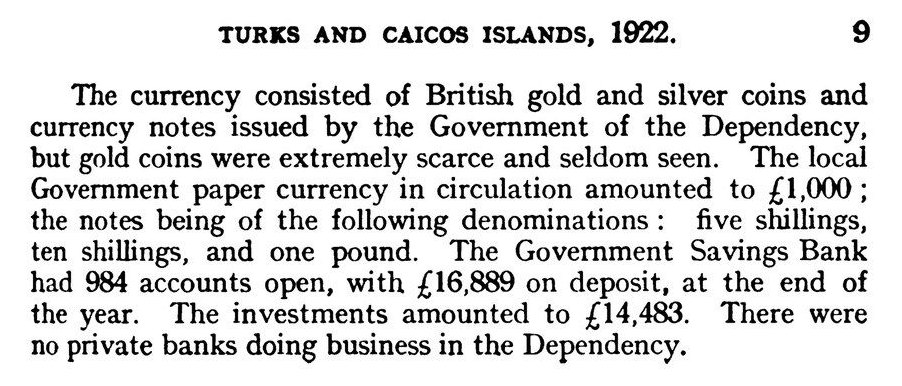
The Turks and Caicos Islands had notes of their own from 1903 to 1928, told in The Government notes of the Turks and Caicos Islands, 1903 to 1928. The Colonial Office reports on the islands from 1946 no longer mention them. The report for 1946 speaks of "British and foreign currency notes"; from 1948 the reports name Jamaica currency notes and British silver. They give these estimates, all read in the text only:
| Year | Jamaica notes in the islands | Source |
|---|---|---|
| 1953-54 | £40,000 | report on the Turks and Caicos Islands |
| 1955-56 | £40,500 | same |
| 1957-58 | £40,000 | same |
| 1959-60 | £50,000 | same |
| 1961-62 | £50,000 | same |
| 1963-64 | £50,000 | same |
| before decimalisation, 1969 | £206,000 | report covering 1967 to 1970 |
| 1969 | J$236,000 | same |
| 1970 | J$410,000 | same |
The report for 1961-62 says the islands used "Jamaican notes and British silver of all denominations, the Jamaica Government having agreed to the use of its currency after independence". The report covering 1967 to 1970 says that, on the advice of the Bank of England, the islands decided to go on using Jamaican currency and so followed Jamaica into decimal money in September 1969, under the Turks and Caicos Islands Currency Ordinance, 1968 (No. 3 of 1968).
The Cayman Islands
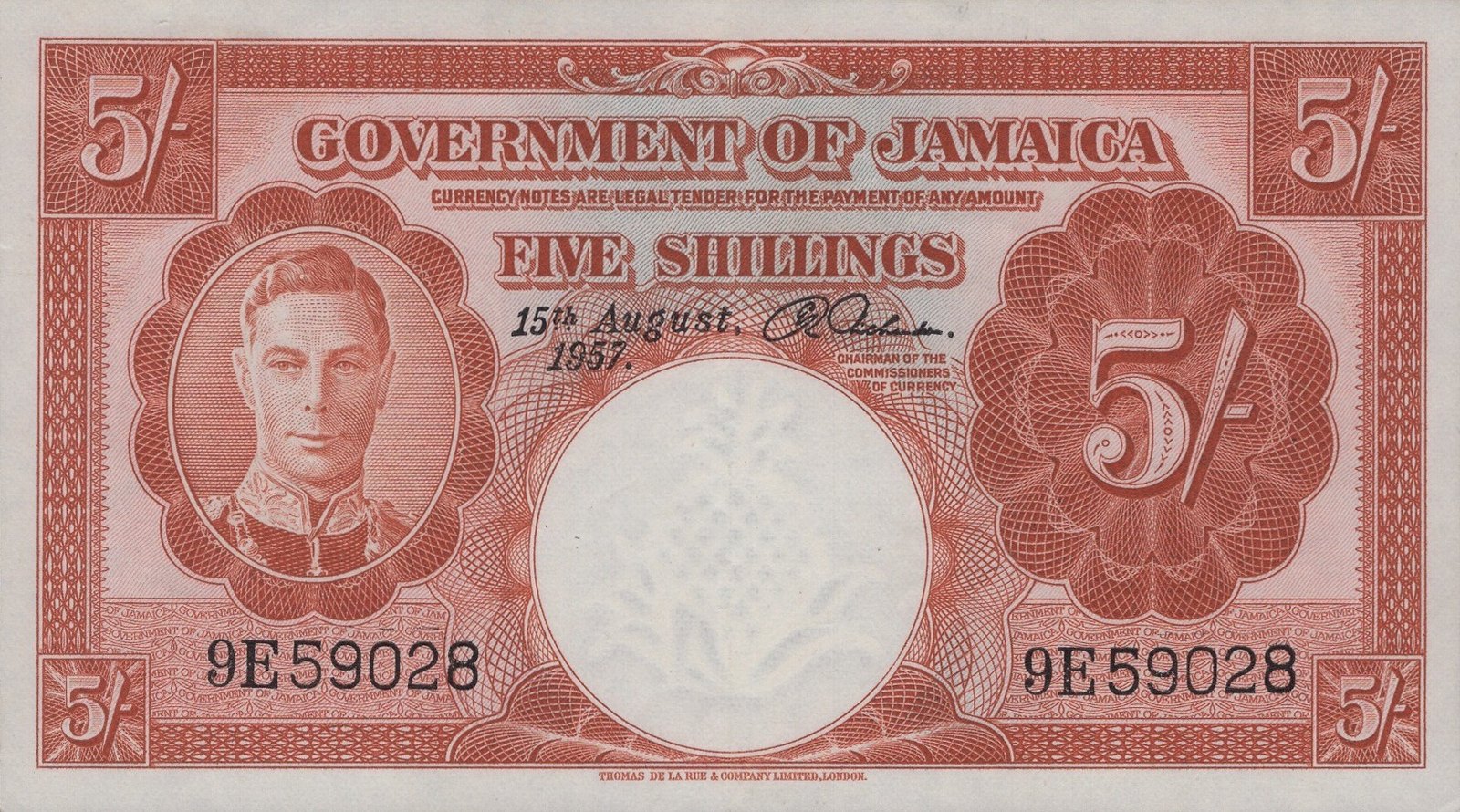
The Colonial Office report on the Cayman Islands for 1946 (text only) says that "Bank of England notes of the denominations of £1 and 10/- are normally in circulation together with Government of Jamaica notes of the denominations of £5, £1, 10/- and 5/-", with "a decreasing number of notes issued by private banks". From 1947 the Bank of England notes are no longer named. The reports estimate all the currency in circulation in the islands at 32,600 pounds at the end of 1952, 82,990 pounds in 1956, 92,030 pounds in 1958 and 139,486 pounds in 1960. Barclays opened the first bank in Grand Cayman in March 1953, the Royal Bank of Canada followed in 1963 and the Canadian Imperial Bank of Commerce in 1964. The reports for 1961 to 1965 still speak only of "Government of Jamaica notes" of 5 pounds, 1 pound, 10 shillings and 5 shillings, at par with sterling, and say nothing of the Bank of Jamaica's notes.
The Cayman Islands Currency Law, 1971 (Law No. 19 of 1971, in operation from 1st November 1971) let the Administrator declare Jamaican notes no longer legal tender by proclamation. The working paper on the Cayman Islands in the Johns Hopkins series (Studies in Applied Economics, No. 61, pp. 3-4) says the Currency Board began issuing on 1st May 1972 and that Jamaican currency stayed legal tender until 31st August 1972. A note in the IBNS Journal 49:1 (p. 59) gives 1st August 1972 for the end of legal tender and says about 711,000 Jamaican dollars had been surrendered by the end of June. The two dates are a month apart; the Cayman pages give 31st August 1972, and the story of the change is in The paper money of the Cayman Islands, 1972 to 2025.
Jamaica and the joint currency, 1944 to 1952
The Board's notes were meant for all the British colonies of the Caribbean. Jamaica stayed out, and the annual report on Jamaica for 1948 prints why, in an appendix: Message No. 88 from the Governor to the House of Representatives (pp. 136-137, read in the text only). It says Jamaica had refused a change in 1944, in a despatch of 9th December 1944; that it had declined to send an observer to the Barbados Currency Conference of May 1946, which fixed the British West Indian dollar at 4 shillings 2 pence and planned a Board for the Eastern Group from 1st January 1948; and that the Montego Bay Conference of 1947 recommended, as its Recommendation 24, that "in the case of the special note issued in Jamaica" values be printed "in terms of sterling and in terms of dollars; (i.e., £1-$4.80)", as a first step towards a joint currency. Jamaica's local committee, appointed again, advised that until political federation was "an accomplished fact" Jamaica should not join.
The question came back twice. When specimens of the Board's first notes were shown in Bridgetown on 27th April 1951, the Barbados Advocate of the next day reported that the words "Eastern Group" were to be dropped from future notes if Jamaica joined. On 18th October 1952 the same paper (read in the text only) reported a Jamaica Government proposal to replace the island's pound notes with notes "similar in design to those now in circulation in the Eastern Group", showing the sterling value on one side and the dollar value on the other. No such note appears among the Jamaica notes of the catalogue; the notes Jamaica issued to 1969 are in pounds only.
1st October 1955: one currency in two
Instead of a joint currency, Jamaica and the Board's colonies made each other's notes legal tender. A press release in the Saint Vincent Government Gazette of 29th September 1955 (No. 445, p. 314, read in the text only) says that legislation making Jamaica's Government notes legal tender in the Eastern Group, and the Board's notes legal tender in Jamaica, "has been enacted in all of the Colonies referred to" and would be brought into force by a proclamation in each colony on 1st October 1955. The Board's report for 1960 gives the rates: 4 dollars 80 cents to the pound for Jamaica's notes, 4 shillings 2 pence to the dollar for the Board's.
The laws were made colony by colony:
| Colony | Law | Dates | Source |
|---|---|---|---|
| Jamaica | the Currency, Coinage and Legal Tender (Amendment) Law, 1954 (No. 51 of 1954) | 1954 | Saint Vincent Government Gazette, 29th September 1955; report on Jamaica for 1954 |
| British Guiana | the Legal Tender (Jamaica Currency Notes) Ordinance, No. 45 of 1954 | Bill published 11th December 1954; passed 20th December; assented 23rd December 1954 | minutes of the Legislative Council of British Guiana, December 1954 |
| Grenada | Ordinance No. 55 of 1954, "to make Jamaica currency notes legal tender in Grenada" | published with the Gazette of 31st December 1954 | Grenada Government Gazette, 31st December 1954, p. 537 |
| Saint Vincent | Ordinance No. 3 of 1955 | assented 22nd March 1955 by L. Cools-Lartigue, Deputy to the Acting Governor | Saint Vincent Ordinances 1955, p. A-5 |
| Saint Vincent | Ordinance No. 16 of 1955, the Currency (Amendment No. 2) Ordinance | assented 24th October 1955 by Governor C. M. Deverell; in force from 1st October 1955; one pound to 4 dollars 80 cents | Saint Vincent Government Gazette, text only |
| Leeward Islands | Act No. 20 of 1955, the Currency (Amendment) Act, 1955 | passed 20th June, assented 23rd June 1955 by Governor K. W. Blackburne; in force on a day to be proclaimed | Leeward Islands Gazette, 30th June 1955 |
| Barbados | legislation of 1955 | annual report on Barbados for 1955 | |
| British Virgin Islands | the Currency, Coinage and Legal Tender Ordinance, 1956 (No. 11 of 1956) | assented 5th June 1956; in force 1st July 1956 by proclamation of the Acting Commissioner, E. A. Evelyn, of 7th June 1956 | Leeward Islands Gazette, 14th June 1956 |
The Leeward Islands Act deems "Currency Notes of the Government of Jamaica issued from time to time under the provisions of the Currency Notes Law of the Colony of Jamaica and being, at the time of tender, legal tender in Jamaica" to have been issued under the Act itself. Its objects and reasons say the same law was to be passed in every colony of the Eastern Group and brought in on the same day as Jamaica's. In Saint Vincent and the Leeward Islands the new clause took the place of the one that had made the Trinidad Government notes legal tender, those notes having been demonetised on 2nd January 1955.
Whether every colony did proclaim its law is less clear. The report of the Director of Audit of Trinidad and Tobago on the Board's accounts for 1955, signed by I. Mackay on 28th June 1956 and printed in the Grenada Government Gazette of 18th August 1956 (p. 324) and the Antigua, Montserrat and Virgin Islands Gazette of 27th December 1956 (p. 131), says the notes were made legal tender "by legislation proclaimed in Trinidad, British Guiana and Dominica", and that "Evidence of the proclamation of similar legislation in the other Territories of the Group has not been seen."
The Board's warning about the blue 10 shillings
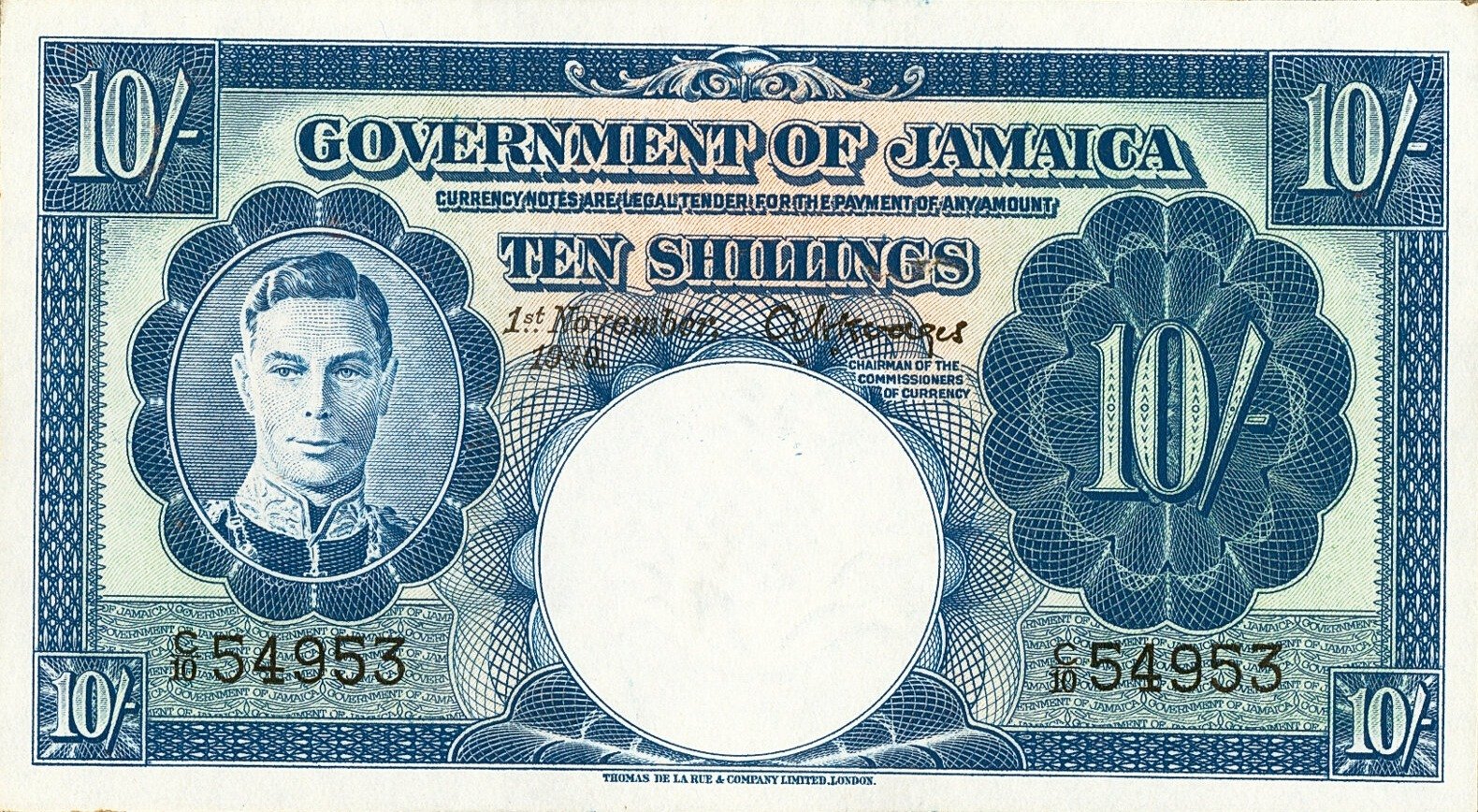
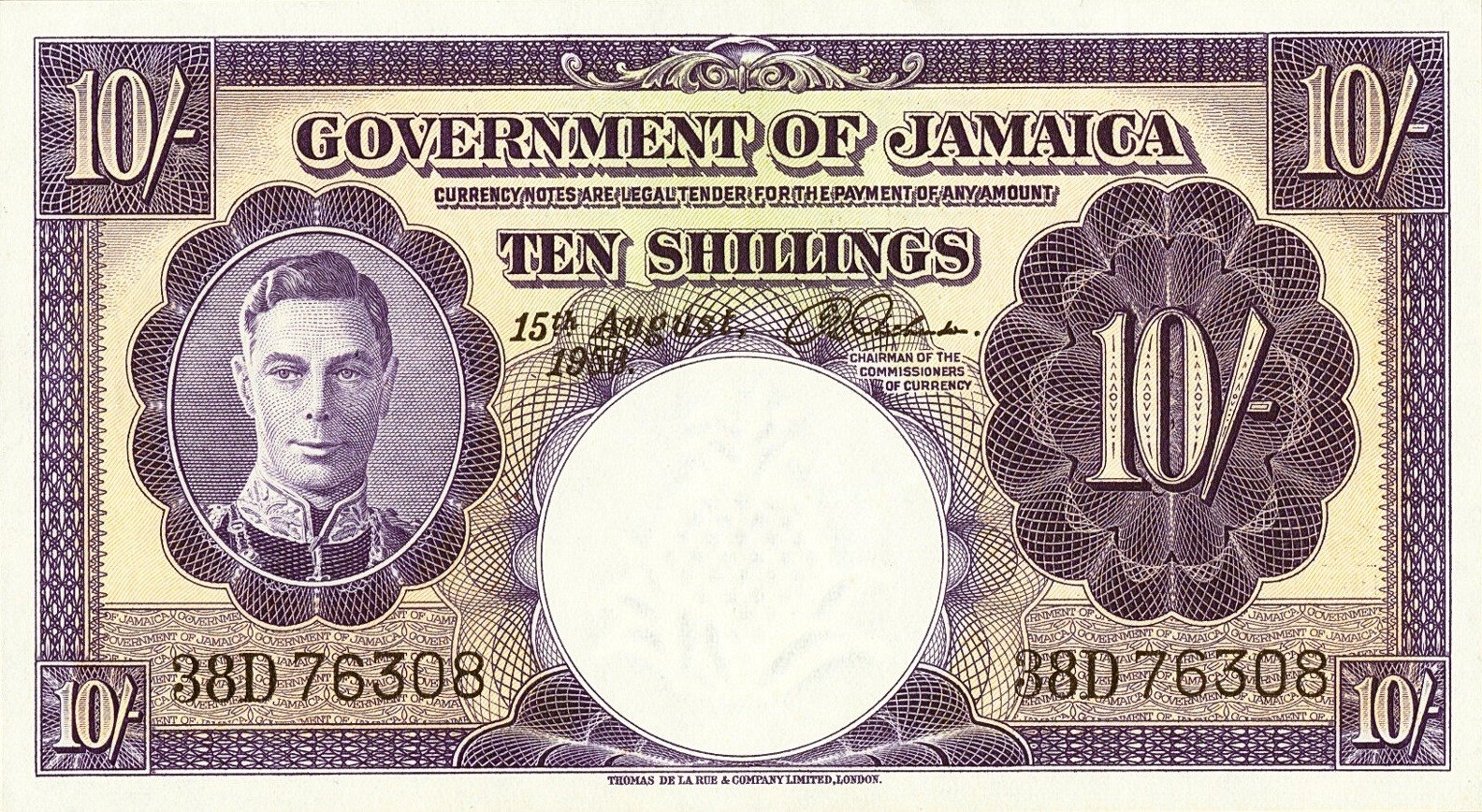
Within a month the Board had to warn the public. A notice signed by L. Spence, Executive Commissioner of the British Caribbean Currency Board, on 28th October 1955, and printed in the gazettes of Saint Vincent (28th October and 22nd November 1955, pp. 365 and 384), the Leeward Islands (17th and 24th November and 1st December 1955) and Grenada (12th November 1955, p. 439), all read on the page, said: "blue Jamaica ten shilling notes were demonetized by the Government of Jamaica on 1st July, 1951. Purple ten shilling notes only are therefore now legal tender in Jamaica and the Eastern Group of British Caribbean Colonies." The blue note is the 10 shillings of 1939 to 1948, 290,000 of whose notes were aboard the SS Politician when it ran aground in 1941; the purple one is the 10 shillings of 1950 to 1960.
After 1955
The Jamaica clause stayed in the Board's later laws. Antigua's Currency Ordinance, 1959 (No. 16 of 1959, passed 29th October 1959; Chapter 116 of the Revised Laws of Antigua, in force 1st April 1960), which gave force of law to the second Currency Agreement of 28th January 1958, kept Jamaica's notes legal tender at 4 dollars 80 cents to the pound. Saint Vincent's Currency Ordinance, 1959 (No. 5 of 1959, assented 29th August 1959 by the Acting Governor, H. Lindo) kept them too, and repealed Ordinances 3 and 16 of 1955. In the British Virgin Islands, the Legal Tender (Adoption of United States Currency) Ordinance, 1959, in force from 9th March 1959, valued 2 dollars 80 cents of United States money at "four dollars and eighty cents in British West Indian dollars or one pound in Jamaican pounds".
The report on Jamaica for 1954, read on the page, is the first to list the notes of the British Caribbean Territories (Eastern Group) among the legal tender of Jamaica. No source read gives a figure for the Board's notes in Jamaica, or for Jamaica's notes in the eastern Caribbean.
Sources
- The Blue Book of Jamaica for 1917-18; the annual report on Jamaica for 1948, appendix, Message No. 88 (pp. 136-137); the report on Jamaica for 1954.
- Colonial Reports, Annual, No. 1147 (Turks and Caicos Islands, 1921); the Colonial Office reports on the Turks and Caicos Islands, 1946 to 1970, and on the Cayman Islands, 1946 to 1965.
- The Cayman Islands Currency Law, 1971 (Law No. 19 of 1971), and Studies in Applied Economics, working paper No. 61, on the Cayman Islands (Johns Hopkins currency board archive); IBNS Journal 49:1, p. 59.
- The Barbados Advocate, 28th April 1951 (p. 5) and 18th October 1952 (p. 2).
- The Saint Vincent Government Gazette, 29th September 1955 (p. 314), 28th October 1955 (p. 365) and 22nd November 1955 (p. 384); Saint Vincent Ordinances 1955 and 1959.
- The Grenada Government Gazette, 31st December 1954 (p. 537), 12th November 1955 (p. 439) and 18th August 1956 (p. 324).
- The Leeward Islands Gazette, 30th June 1955, 17th November 1955 and 14th June 1956; the Antigua, Montserrat and Virgin Islands Gazette, 27th December 1956 (p. 131) and 1959; the Revised Laws of Antigua (1965), Chapter 116.
- The minutes and order papers of the Legislative Council of British Guiana, 16th, 17th and 20th December 1954; the Report of the Executive Commissioner of the British Caribbean Currency Board for 1960.
- The annual report on Barbados for 1955.
Member comments
Log in or register to post a comment.