Much of what collectors first knew of the paper money of Jamaica was printed in the Journal of the International Bank Note Society (IBNS) between 1966 and 1978, most of it by one writer, Douglas A. Crawford of Ontario. Later notes came in the IBNS Journal and in Bank Note Reporter. This article goes through what those issues say about Jamaica, in order of publication, and sets each point against the official books and the Pick pages. It is written from the issues read for the catalogue; the journals' tables of serial numbers are not reprinted here.
A call for data, 1966 and 1968
Jerome H. Remick's "Data Needed on Jamaican Currency" (IBNS Journal 6:1, Summer 1966) asked readers for what they knew. Two years later Remick's "Jamaican Banknotes" (Journal 8:2, Christmas 1968, p. 54) printed a list without pictures, marking with an asterisk the dates thought to exist but not seen. Among them are a King George VI 10 pounds dated 30 March 1953 and 5 pounds dated 30 November 1949 and 3 March 1953; of the 5 pounds dates, only 1 September 1957 is marked as seen. None of the three is on the Pick pages: they hold no 10 pounds, and the dates recorded on the 5 pounds of 1952 to 1957 are 1 August 1952, 7 April 1955, 15 August 1957 and 1 September 1957.
The same list puts the Bank of Jamaica notes signed by Hall as Acting Governor before those signed by Payton. That is the wrong way round. An article in the Journal 12:2 (1973, p. 26) gives Payton as Governor from 13th June 1960 and Hall as Acting Governor from 13th December 1964, and the prefixes on the Pick pages run the same way, Payton first.
Douglas A. Crawford, 1970 to 1972
The 2 shillings 6 pence, 1970
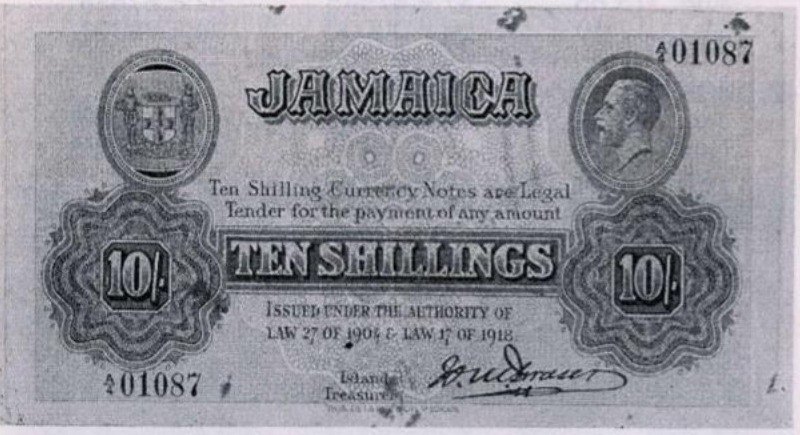
Crawford's first Jamaica piece (Journal 10:2, 1970, p. 71) is on the 2 shillings 6 pence. It says the first currency notes were issued on 15th March 1920 because silver was short, that De La Rue printed them, and that the 2 shillings 6 pence was green and black. It gives 31,250 pounds of the note out on 31st December 1920, 30,510 pounds 10 shillings redeemed in 1922 and 739 pounds 10 shillings left out, then 178 pounds 12 shillings 6 pence in 1925 and 108 pounds 17 shillings 6 pence in 1959. The Handbook of Jamaica for 1921 and 1923 gives the same figures for 1920 and 1922, and the Handbook for 1926 the same 178 pounds 12 shillings 6 pence for 31st March 1925. The annual reports carry 108 pounds 17 shillings 6 pence from 1948 to 1955, but from 1958 they no longer have a line for the 2 shillings 6 pence, so the article's figure for 1959 is not found in them. The article also gives 103,250 pounds of 5 shillings and 75,000 pounds of 10 shillings out at the end of 1920, the Handbook's figures. The whole run is in Jamaica's Government notes in circulation.
Two early bank notes, 1971
"A Couple of Early Jamaican Bank Notes" (Journal 11:1, September 1971, pp. 50-51) pictures a Colonial Bank note of 25 shillings sterling of 10th March 1840, which Crawford calls the only known example, in the museum of Barclays Bank, and an unissued note of the Planters' Bank, founded in 1839. These are told in The banks' notes in Jamaica.
The Politician notes, December 1971
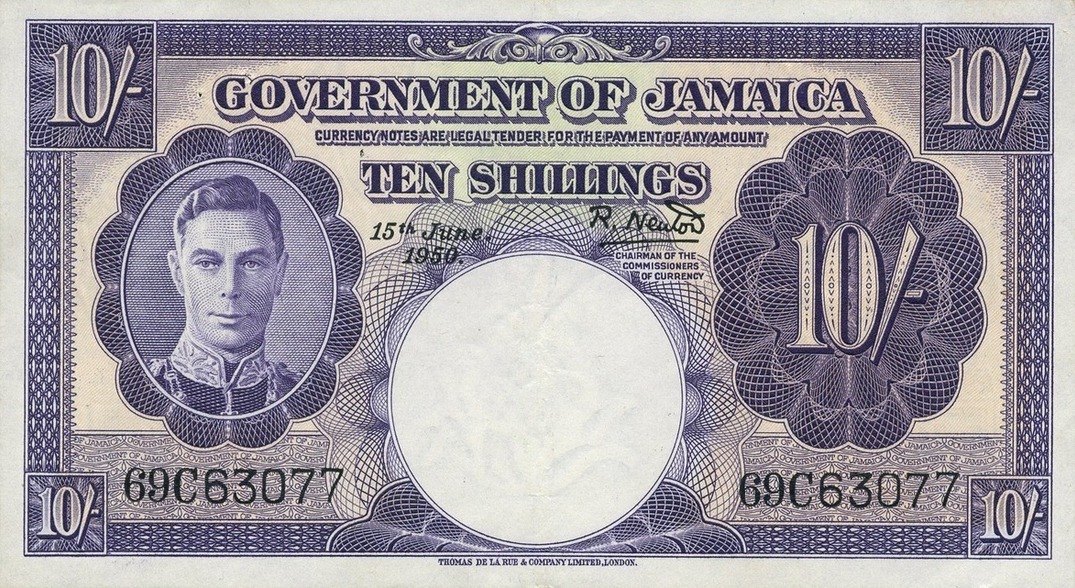
"The 'Politician' Notes of Jamaica" (Journal 11:2, December 1971, p. 106) is on the blue 10 shillings lost with the SS Politician. It prints the Bank of Jamaica's list of the numbers on board, on prefixes C/6 to C/11; the Pick page gives the same list and the same 290,000 notes. Crawford quotes the Commissioners of Currency's report for the year to 31st March 1952: the demonetisation was proclaimed on 29th January 1951 and published in a Supplement to the Jamaica Gazette on 8th February 1951, and the blue notes ceased to be legal tender on 1st July 1951. The replacement, the purple 10 shillings, is described as on a light orange ground.
One point has not held. Crawford writes that the Politician was torpedoed and that a submarine's crew took the notes. The Pick page and the first article on Jamaica's notes tell of the ship running onto a sandbank off Eriskay in February 1941, and of the islanders' salvage; the article's version is hearsay against that account.
The Government notes, 1972
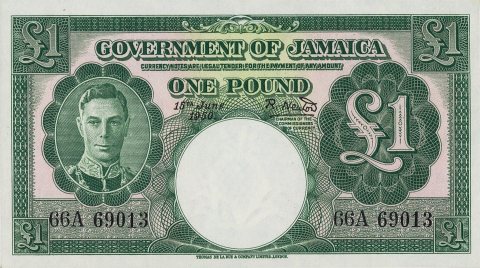
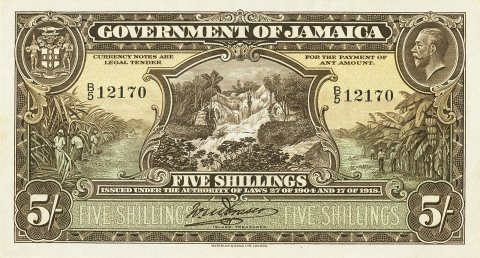
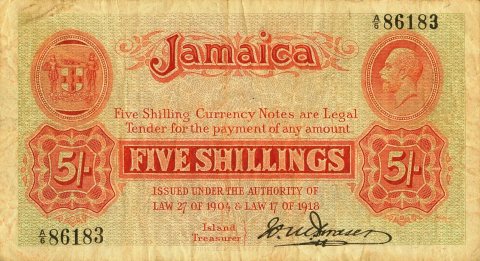
"Government of Jamaica 1920-1960" (Journal 11:3, 1972, pp. 180-184) is the longest of the series. It opens with the laws: Law 27 of 1904 set up the Commissioners for 10 shillings notes only, and Law 17 of 1918 allowed other values approved by the Secretary of State (p. 180). It quotes the Handbook of Jamaica for 1921 on the first issue. Then come lists of the lowest and highest serial numbers seen for each value and date.
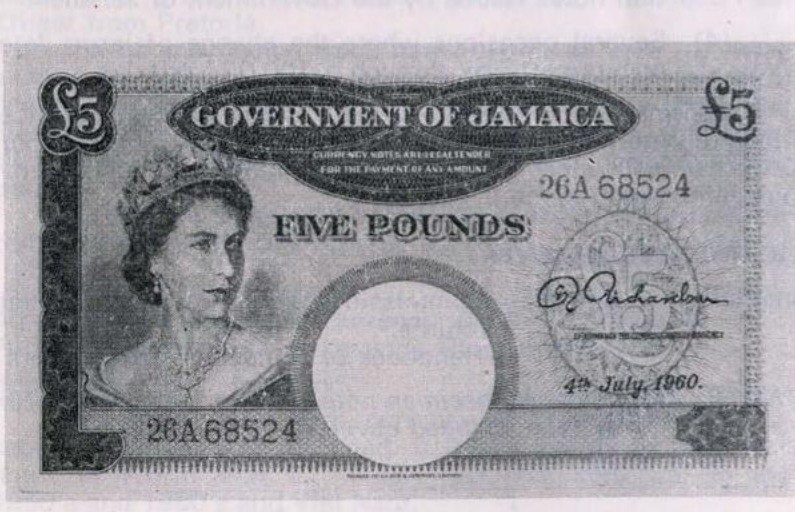
The lists widened what was known of several issues, and the catalogue took points from them: the date of 27th May 1957 on the 1 pound of 1942 to 1960 ends inside prefix 81B, where the 15th August 1957 notes begin, so the two dates share a prefix (p. 183); the specimen of the 10 shillings of 1960 dated 4th July 1960 is numbered on prefix 62D (p. 182); and the 5 pounds of 1960 of the July date runs from prefix 11A to at least 28A (p. 184).
The lists also have faults. One first number of the 1st March 1953 date is printed with a stray point, as 26.8 for 26D. The 10 shillings are listed under 1939, 1940 and 1948 only, without the 30th November 1942 date, which is known on the Pick page. And the first numbers printed under 1948 for the 1 pound and the 10 shillings fall within the prefix bands that the Pick pages give to earlier dates, so they cannot be placed on a row.
The Bank of Jamaica, June 1972
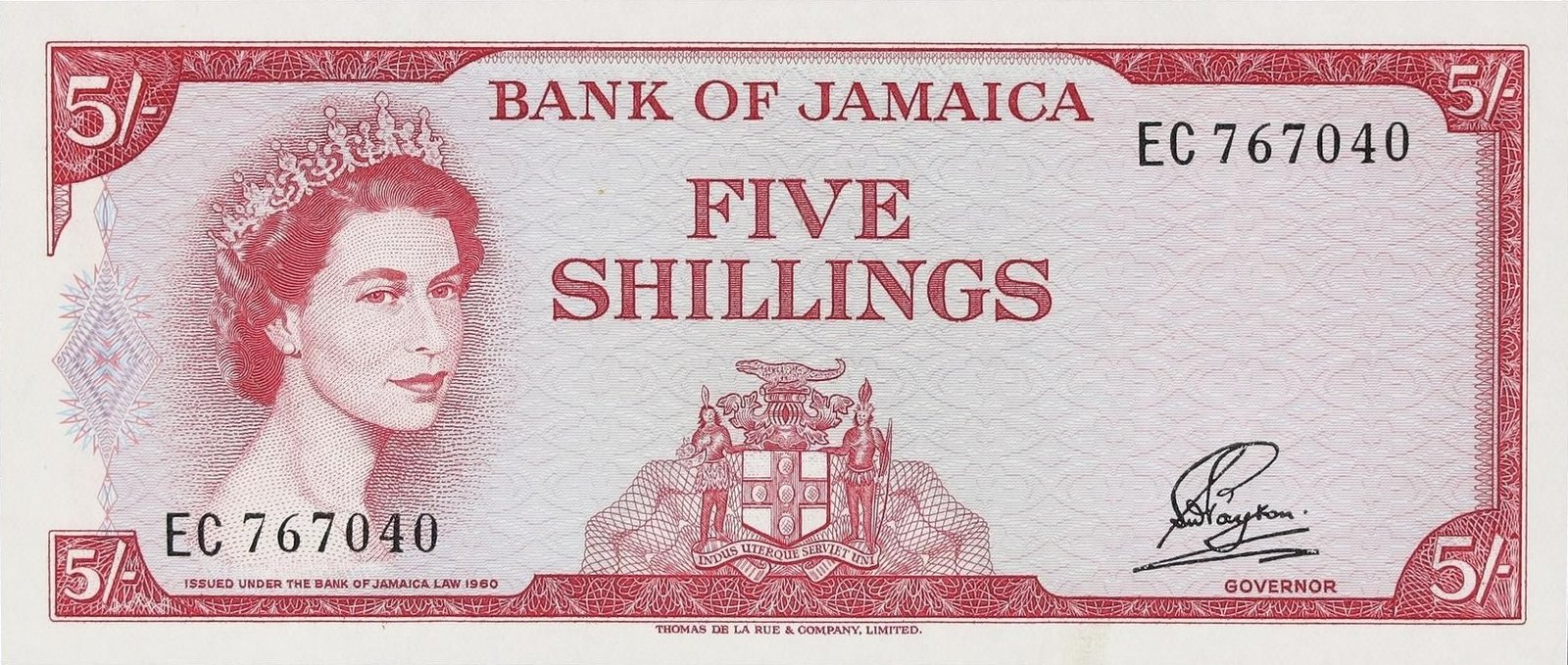
"Bank of Jamaica Issues 1961 to date" (Journal 11:4, June 1972, pp. 239-241) says the Bank was set up in October 1960 under the Bank of Jamaica Law 1960 and opened on 1st May 1961, and gives the first days of issue: 1 pound 1st May 1961, 5 shillings 20th December 1961, 10 shillings 9th March 1962, 5 pounds 1st February 1963. These are the days on the Pick pages of the 5 shillings, 10 shillings, 1 pound and 5 pounds. Its check list explains a gap in the signatures: no 5 pounds was issued with Hall as Acting Governor, and no 5 shillings with Hall as Governor, because enough notes were in stock at each change of Governor.
The other banks, September 1972
"Jamaica: other Bank Issues 1900-1942" (Journal 12:1, September 1972, pp. 40-42) pictures a note of each of Barclays, the Bank of Nova Scotia, the Royal Bank of Canada and the Canadian Bank of Commerce. On the Government notes it adds that the British Treasury's 10 shillings and 1 pound were made legal tender in Jamaica by Law 2 of 1917 (p. 41), and that the Currency Notes Law 1937 led to the 1 pound and 5 pounds from early 1940 (p. 42). It also says the law of 1937 was amended in 1942 to demonetise the chartered banks' notes. The annual reports, which show the banks' notes still in circulation every year from 1946 to 1957, do not bear this out; the point is set out in the article on the banks' notes.
Later articles, 1973 to 1978
The Journal 12:2 (1973) gives the dates of the Government notes of 1950 to 1960 (p. 25) and the Governors of the Bank of Jamaica (p. 26): Payton from 13th June 1960; Hall Acting Governor from 13th December 1964 and Governor from 1st April 1966; Brown from 1st July 1967. The Pick pages use these dates to date the undated Bank of Jamaica notes.
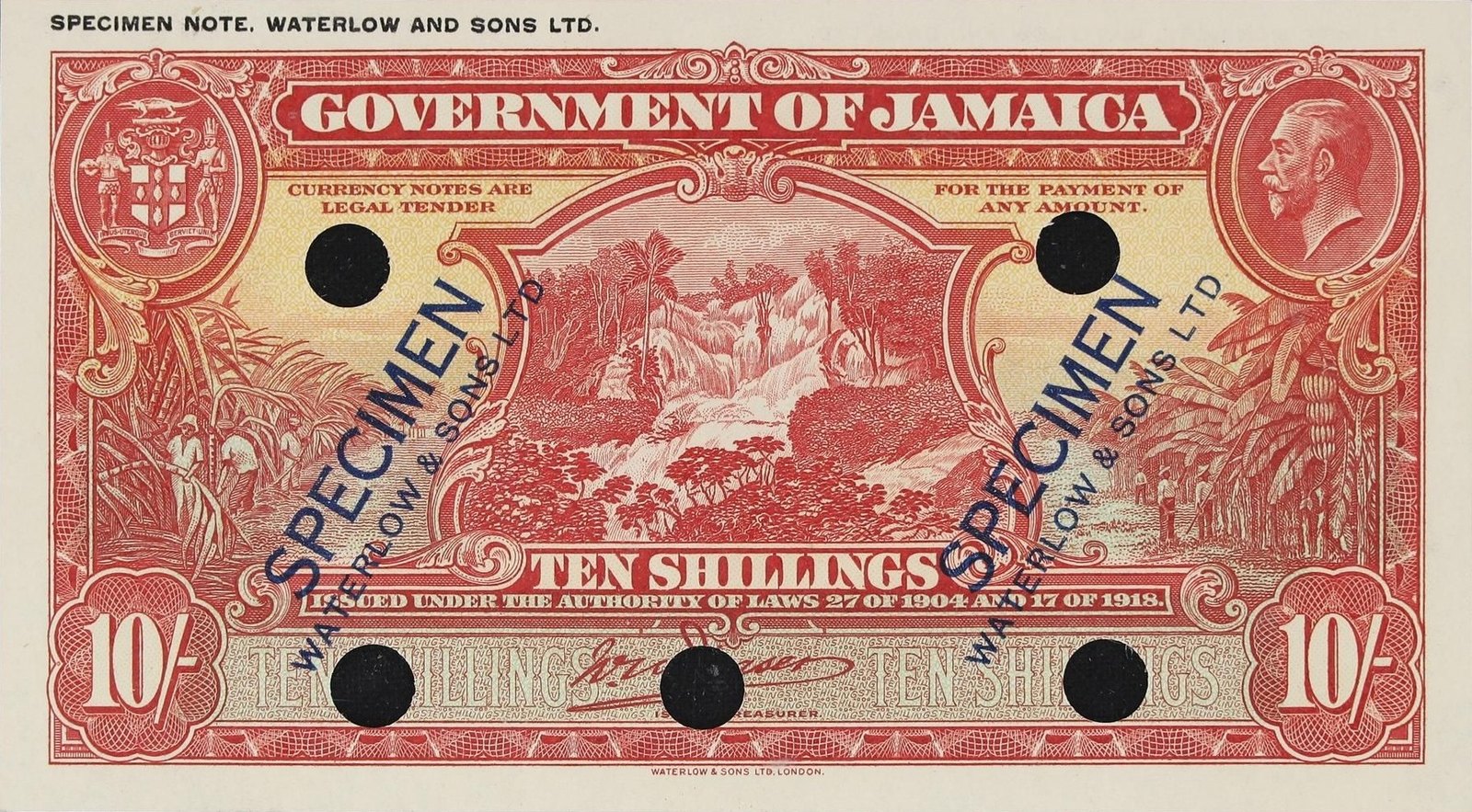
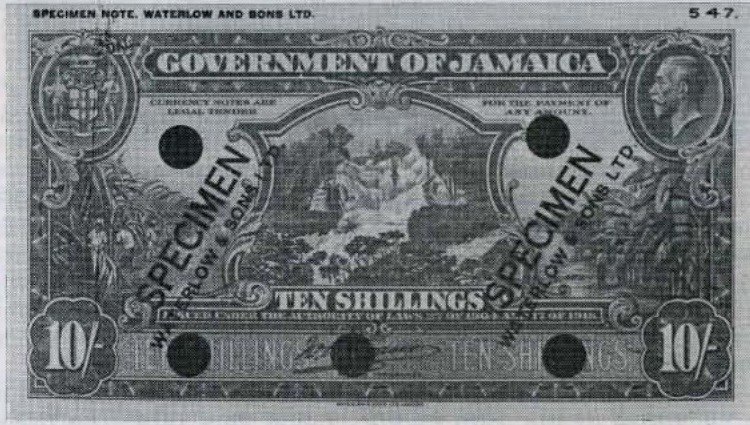
The Journal 15:1 (1976) pictures a red specimen of the Waterlow 10 shillings, numbered 547, a colour trial.
A survey of Commonwealth notes in the Journal 17:2 (1978, pp. 82-84) has a section on Jamaica. It gives the Government notes in circulation from the Blue Books, 17,500 pounds in 1920 and 2,914,504 pounds in 1945, and the banks' notes in 1945 bank by bank. It says the 1 pound began on 1st November 1940 and the 5 pounds on 30th November 1942, the dates of the first rows on the Pick pages, but adds that before then there were only 5 shillings and 10 shillings, which leaves out the 2 shillings 6 pence of 1920. It also says that until the change to dollars in 1969 a spoiled note was replaced by printing its number again, and that replacement notes with a Z prefix came only with the dollar. No pound note with a replacement prefix is recorded on the Pick pages.
Portraits, the Cayman change and the banks, 1999 to 2023
A survey of the Queen's portraits on banknotes in the Journal 44:2 (pp. 14-15) places the two Jamaica portraits. The Government's 5 pounds of 1960 shows the Dorothy Wilding photograph of 1954, facing left, with the State Diadem, shown with bare shoulders; the Bank of Jamaica's notes show the Wilding photograph of 1952, facing left, in De La Rue's engraving.
A note in the Journal 49:1 (p. 59) on the Cayman Islands says Jamaican currency ceased to be legal tender there on 1st August 1972; the Cayman Islands law and the Johns Hopkins working paper give 31st August 1972. See Jamaica's notes beyond the island.
An article on the Canadian banks in the West Indies (Journal 58:1, 2019, p. 34) says the Government notes in circulation rose from about 200,000 pounds in 1940 to almost 3 million by 1945, helped by the order of 1944 that made Barclays and the Canadian banks cut their note circulation by 30 per cent. It also speaks of a Government 5 pounds from 1940, which the Pick pages do not support: the first 5 pounds is dated 30th November 1942, and a proof of it in the World Banknote Auctions sale of 3 November 2023 (lot 8136) carries the approval date 10/3/43.
Advertisements in the Journal 62:2 and 62:3 (2023, p. 5) picture a 10 shillings headed THE CENTRAL BANK OF JAMAICA, with a young Queen Elizabeth II and the dummy numbers A 123456 and A 789012. The design and the bank that never took that name are told in Central banks that never opened.
Bank Note Reporter
Bank Note Reporter's columns added two things on the Bank of Jamaica's notes. Its "World Paper Money Update" of September 1986 pictured the 10 shillings with the English motto as the first of two serial-number types, and that of December 1986 the 5 shillings in both types: the first with figures of varying weight, the second with figures of even weight. The same Payton 5 shillings shown in December 1986 as the example of the second type was pictured whole by Charles R. Hosch in Bank Note Reporter in 1997 and in part by George S. Cuhaj in 2002. The two types are the two Payton printings that the auction houses later called variable-weight and monoweight, told in How many of Jamaica's notes were printed.
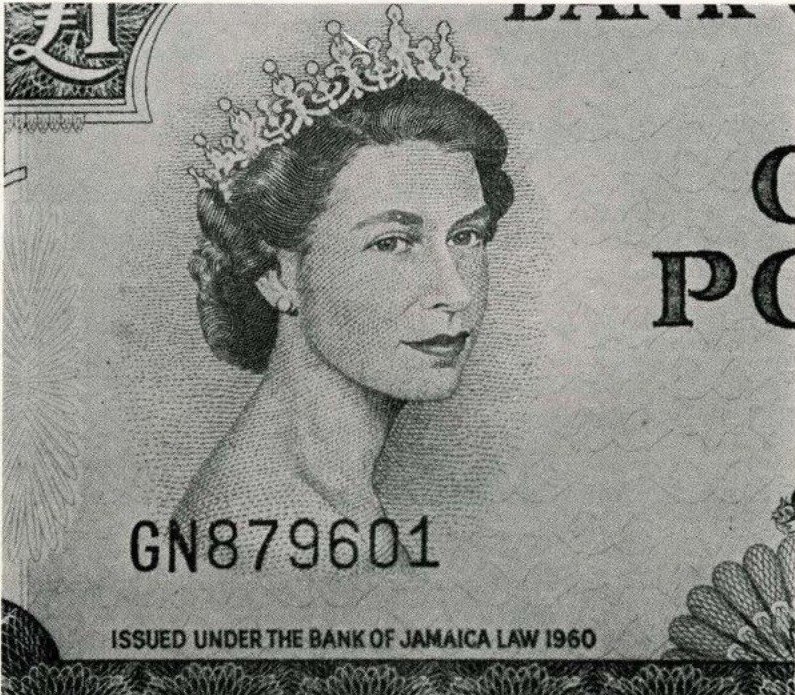
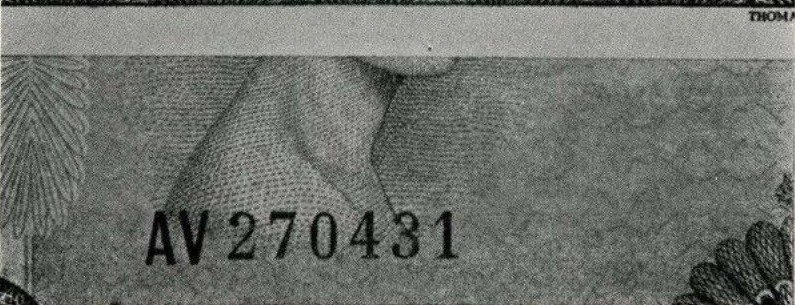
In April 2022 an advertisement of Archives International Auctions in Bank Note Reporter pictured a Government 5 pounds dated 17th March 1960 with Richardson's signature.
One colour trial through the journals and the sales
The red 10 shillings numbered 547 can be followed from 1976 to 1981. It is pictured in the IBNS Journal 15:1 (1976). A red 10 shillings numbered 547 was sold by NASCA on 7th December 1981 in its sale of the Stanley Gibbons collection, part II (lot 1372), which Bank Note Reporter's preview of that sale (December 1981) names as no. 547; a red 10 shillings was sold by Herbert I. Melnick on 20th December 1982 in the Stanley Gibbons collection, part V (lot 2745). Bank Note Reporter of December 1988 reports the sale at Pacific Coast Auction Galleries in Hong Kong on 1st to 2nd September 1988 of a specimen of the 10 shillings in red, a colour the report calls unlisted, without a number or a picture. Whether the Melnick and Hong Kong lots are the same piece as the one numbered 547 is not known: neither gives a number.
Sources
- IBNS Journal: 6:1 (Summer 1966); 8:2 (Christmas 1968), p. 54; 10:2 (1970), p. 71; 11:1 (September 1971), pp. 50-51; 11:2 (December 1971), p. 106; 11:3 (1972), pp. 180-184; 11:4 (June 1972), pp. 239-241; 12:1 (September 1972), pp. 40-42; 12:2 (1973), pp. 25-26; 15:1 (1976); 17:2 (1978), pp. 82-84; 44:2, pp. 14-15; 49:1, p. 59; 58:1 (2019), p. 34; 62:2 and 62:3 (2023), p. 5.
- Bank Note Reporter: December 1981 (NASCA preview); "World Paper Money Update", September and December 1986; December 1988; 1997 (Charles R. Hosch); 2002 (George S. Cuhaj); April 2022 (Archives International Auctions advertisement).
- NASCA, the Stanley Gibbons collection, part II, 7th December 1981, lot 1372; Herbert I. Melnick, the Stanley Gibbons collection, part V, 20th December 1982, lot 2745; World Banknote Auctions, 3 November 2023, lot 8136.
- The Handbook of Jamaica for 1921, 1923 and 1926; the annual reports on Jamaica, 1946 to 1957.
Member comments
Log in or register to post a comment.