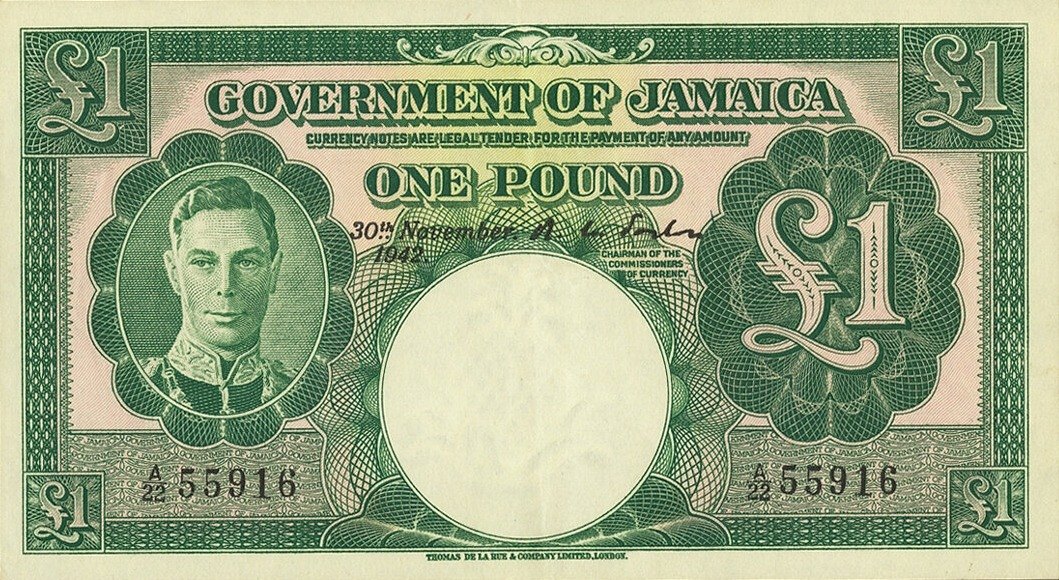
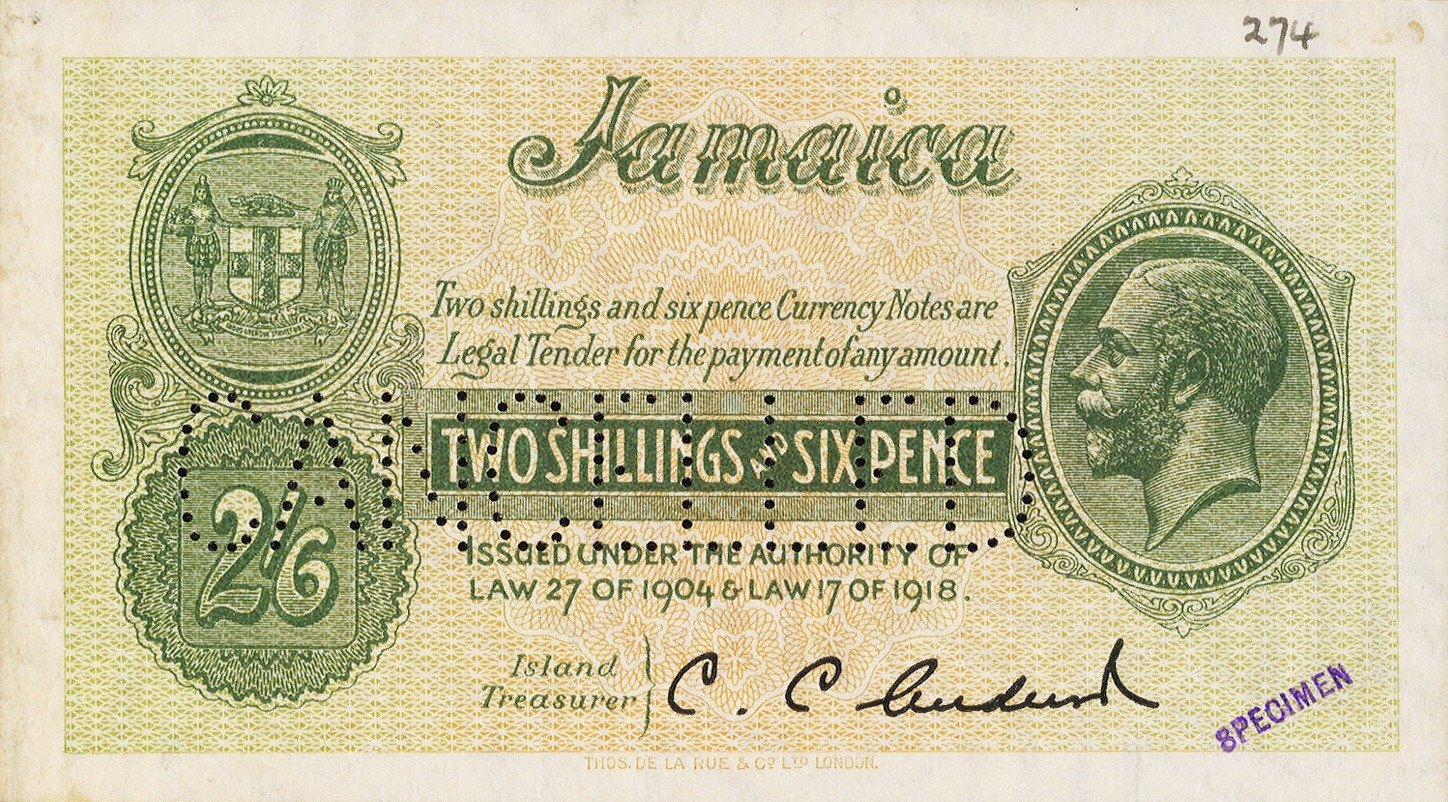
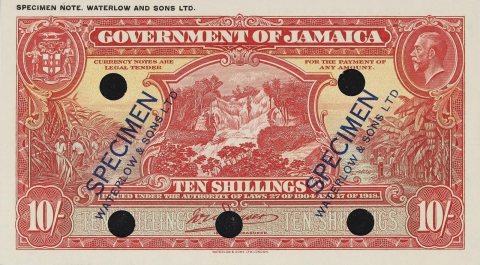
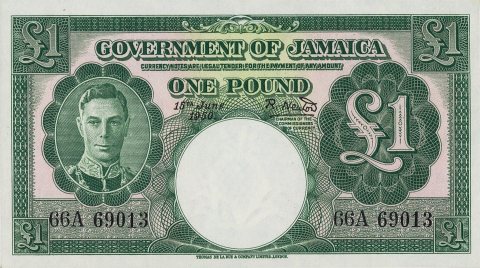
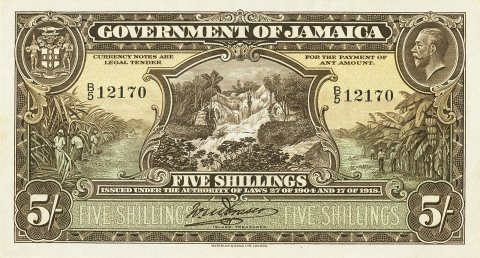
The Pick pages of Jamaica give a few figures of the Government notes in circulation, and the earlier articles give the run of the 2 shillings 6 pence and the counts of the first year. This article sets out the whole series as the official books printed it: the Handbook of Jamaica, which gave the notes out on 31st March (in its first years on 31st December), and the annual reports on Jamaica, which gave them on 31st December and, from 1946, the notes paid out and paid in during each financial year. Every figure is money, as the books print it. Where a figure was read on a scan of the page and where only in the text of a scan is said in the tables. The story of the issues is told in The notes of the Government of Jamaica and the Bank of Jamaica, 1920 to 1970, and the printing estimates in How many of Jamaica's notes were printed.
Before 1920: none
Every Blue Book of Jamaica from 1896-97 to 1917-18 returns the Government paper money in circulation as "None"; the returns for 1915-16 and 1916-17 were read on the page. The Handbooks of 1908 to 1918 say of the Currency Note Law of 1904 that no action had yet been taken under it. The Blue Book for 1867 still lists "Island Notes (called in)" with 344 pounds 14 shillings outstanding, read in the text only; from 1870 the line is gone.
The small notes, 1920 to 1938
The Handbook of Jamaica for 1921 says the Commissioners issued their first notes on 15th March 1920, 17,500 pounds' worth, and gives what they had "circulated" by 31st December 1920. The annual report for 1920 gives a slightly lower figure for the same year under the word "issued". The two sets of books then go on side by side, one at the end of March, the other at the end of December.
The Handbook of Jamaica
All Handbook figures were read in the text of the scans only.
| Date | 2s 6d | 5s | 10s | Total | Handbook |
|---|---|---|---|---|---|
| 31st December 1920 | £31,250 | £103,250 | £75,000 | £209,500 | 1921, p. 333 |
| 31st December 1922 | £739 10s | £43,899 10s | £32,826 10s | £77,465 10s | 1923, p. 350 |
| 31st March 1923 | £706 12s 6d | £47,635 | £28,091 10s | £76,433 2s 6d | 1924 |
| 31st March 1925 | £178 12s 6d | £38,053 5s | £50,570 10s | £88,802 7s 6d | 1926 |
| 31st March 1926 | £152 7s 6d | £30,100 5s | £46,115 10s | £76,367 7s 6d as printed | 1927 |
| 31st March 1929 | £128 15s | £31,295 5s | £49,620 | £81,044 | 1930 |
| 31st March 1930 | £125 7s 6d | £30,949 5s | £50,626 10s | not clear in the text | 1931 |
| 31st March 1931 | £123 15s | £33,251 | £42,918 | £76,292 15s | 1932 |
| 31st March 1932 | £121 17s 6d | £40,693 15s | £50,756 | £91,571 12s 6d | 1933-34 |
| 31st March 1935 | £113 7s 6d | £36,159 10s | £55,370 10s | £91,643 7s 6d | 1936 |
| 31st March 1936 | £112 12s 6d | £42,949 | £51,952 10s | £95,014 2s 6d | 1937-38 |
For the end of March 1926 the three values do not add up to the total the Handbook prints; the table keeps the printed total.
The annual reports
| Date | 2s 6d | 5s | 10s | Total | Report, how read |
|---|---|---|---|---|---|
| 1920 ("issued") | £29,787 15s | £101,950 | £74,475 | £206,212 15s | 1920, para. 44, page image |
| 1921 | £2,614 10s | £55,706 5s | £53,640 | £111,960 15s | 1921, para. 46, page image |
| 31st December 1924 | £192 15s | £31,565 10s | £46,816 | £78,574 5s | 1924, page image |
| 31st December 1926 | £144 5s | £33,555 5s | £39,307 10s | £73,007 | 1926, page image |
| 31st December 1929 | £125 15s | £29,288 15s | £46,147 10s | £75,562 | 1929, text only |
| 31st December 1930 | £124 | £32,518 5s | £48,778 | £81,420 5s | 1930, para. 12, page image |
| 31st December 1931 | £121 17s 6d | £34,288 10s | £46,216 10s | £80,626 17s 6d | 1931 (No. 1603), para. 200, page image |
| 31st December 1933 | £114 7s 6d | £38,429 | £41,200 10s | £79,743 17s 6d | 1933 (No. 1686), para. 258, page image |
| 31st December 1935 | £112 17s 6d | £38,552 | £49,614 | £88,278 17s 6d | 1935, page image |
| 31st December 1936 | £112 7s 6d | £42,862 15s | £54,959 | £97,934 2s 6d | 1936 (No. 1811), para. 229, page image |
| 31st December 1938 | £112 | £60,070 10s | £88,479 | £148,661 10s | 1938, page image |
The report for 1931 prints its table under the words "on the 31st December, 1930". The report for 1930 gives other figures for that day (124 pounds of 2 shillings 6 pence, 81,420 pounds 5 shillings in all), and the Handbook for 1933-34 gives the same 121 pounds 17 shillings 6 pence of 2 shillings 6 pence for 31st March 1932. The figures of the 1931 report therefore belong to the end of 1931, and the table puts them there. The same report prints "Law 27 of 1804" for the law of 1904.
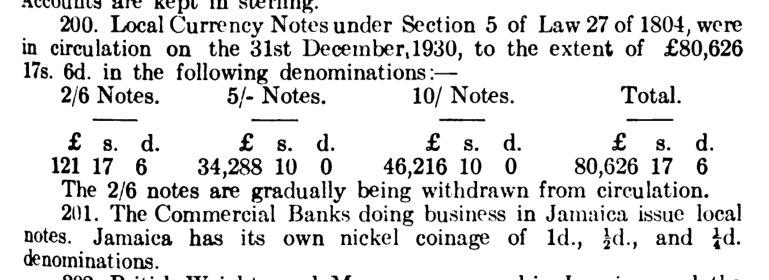
The reports for 1930, 1931 and 1933, read on the page image, say under their tables that the 2 shillings 6 pence notes were "gradually being withdrawn from circulation". The Handbook for 1923 says the Commissioners withdrew the issue during 1922 and that 30,510 pounds 10 shillings of it had been redeemed by 31st December 1922.
Two things stand out. The total out fell from about 209,500 pounds at the end of 1920 to below 80,000 pounds within two years, and stayed between about 73,000 and 98,000 pounds until 1936. And the 10 shillings and 5 shillings changed places more than once: in 1921 the 5 shillings was the larger part, in most later years the 10 shillings.
1939 to 1945: a gap
No Blue Book, Handbook or annual report for the years 1939 to 1944 is among the volumes read, so the first two years of the 1 pound and the 5 pounds have no official figure here. Two collectors' articles give round figures for these years. A survey in the IBNS Journal 17:2 (1978, p. 82) gives the Government notes in circulation from the Blue Books as 17,500 pounds in 1920 and 2,914,504 pounds in 1945. An article in the IBNS Journal 58:1 (2019, p. 34) says they rose from about 200,000 pounds in 1940 to almost 3 million by 1945. Neither is an official count read here.
The pound notes, 1945 to 1957
From 1946 the annual reports give the notes out by value on 31st December. The value "20/-" of the reports for 1946 and 1947 is the 1 pound.
| Date | 2s 6d | 5s | 10s | 1 pound | 5 pounds | Total | How read |
|---|---|---|---|---|---|---|---|
| 31st March 1946 | £109 | £214,760 | £318,441 | £1,851,564 | £529,630 | £2,914,504 | report 1946, p. 26, page image |
| 31st December 1946 | £109 | £217,125 | £287,300 | £1,897,075 | £549,070 | £2,950,679 | report 1946, page image |
| 31st December 1947 | £109 | £212,064 10s | £278,742 10s | £1,664,185 | £541,150 | £2,696,250 10s | report 1947; values in the text only |
| 31st December 1948 | £108 17s 6d | £148,976 5s | £322,720 10s | £1,766,637 | £537,045 | £2,775,487 12s 6d | report 1948, page image |
| 31st December 1949 | £108 17s 6d | £198,950 10s | £386,489 10s | £1,805,816 | £533,550 | £2,924,914 17s 6d | report 1949, page image |
| 31st December 1950 | £108 17s 6d | £241,889 10s | £370,287 | £2,031,576 | £525,455 | £3,169,316 7s 6d | report 1950, page image |
| 31st December 1951 | £108 17s 6d | £261,357 10s | £360,213 | £2,748,571 | £511,040 | £3,881,290 7s 6d | report 1951; three values in the text only |
| 31st December 1952 | £108 17s 6d | £312,302 | £396,266 | £2,910,987 | £493,290 | £4,112,953 17s 6d | report 1952, page image |
| 31st December 1953 | £108 17s 6d | £337,045 5s | £438,761 10s | £3,192,987 | £770,790 | £4,739,692 12s 6d | report 1953, text only |
| 31st December 1954 | £108 17s 6d | £360,030 15s | £454,748 | £3,564,987 | £830,790 | £5,210,664 12s 6d | report 1954, page image |
| 31st December 1955 | £108 17s 6d | £405,027 10s | £622,745 | £4,160,985 | £1,040,280 | £6,229,146 7s 6d | report 1955, text only |
| 31st December 1957 | £108 10s as read | £505,017 10s | £654,731 | £5,306,985 | £1,878,780 | £8,345,622 | report 1957, text only |
The Handbook of Jamaica for 1947-48 (pp. 246-247) gives the same day, 31st March 1946, with shillings that the report leaves off: 5 shillings 214,760 pounds 5 shillings, 10 shillings 318,441 pounds 10 shillings, total 2,914,504 pounds 15 shillings. The Handbook for 1949-50 gives 31st March 1949: 2 shillings 6 pence 108 pounds 17 shillings 6 pence, 5 shillings 152,874 pounds 15 shillings, 10 shillings 324,817 pounds, 1 pound 1,827,837 pounds, 5 pounds 536,525 pounds, total 2,842,162 pounds 12 shillings 6 pence. The report for 1946 prints the 10 shillings line of 31st December 1946 as "287,300 10/-".
The 1 pound carried most of the issue in every year given: about 1.9 million of the 2.95 million pounds out at the end of 1946, and more than 5.3 million of the 8.3 million at the end of 1957.
Paid out and paid in, 1945 to 1957
From 1946 the reports also give a table of "Government Currency Note transactions" for each financial year ending on 31st March: the notes in circulation at the start, issued, redeemed, and in circulation at the end. The amounts paid out during each year were these.
| Year ended 31st March | 5s issued | 10s issued | 1 pound issued | 5 pounds issued | All issued | All redeemed | How read |
|---|---|---|---|---|---|---|---|
| 1946 | £177,500 | £255,500 | £383,700 | £195,000 | £1,011,700 | £536,897 | page image |
| 1947 | £205,850 | £193,600 | £474,200 | £20,000 | £893,650 | £984,546 15s | the 5 pounds line on the page image; the rest not noted |
| 1948 | £255,900 | £353,400 | £858,600 | £34,500 | £1,502,400 | £1,517,908 12s 6d | page image |
| 1949 | £113,050 | £203,500 | £605,300 | £2,625 | £924,475 | £890,411 15s | not noted |
| 1950 | £228,650 | £286,400 | £710,900 | £2,900 | £1,228,850 | £938,555 15s | not noted |
| 1951 | £173,500 | £238,200 | £777,300 | none printed | £1,189,000 | £970,075 5s | not noted |
| 1952 | £276,500 | £372,000 | £1,250,000 | none printed | £1,898,500 | £1,298,609 | page image |
| 1953 | £314,850 | £357,650 | £1,211,000 | none printed | £1,883,500 | £1,607,071 10s | page image |
| 1954 | £339,900 | £330,750 | £1,419,000 | £390,000 | £2,479,650 | £1,942,664 10s | page image |
| 1955 | £321,750 | £374,500 | £1,550,000 | £50,000 | £2,296,250 | £1,850,273 5s | text only |
| 1957 | £511,750 | £672,000 | £2,177,000 | £445,000 | £3,805,750 | £2,965,259 15s | text only |
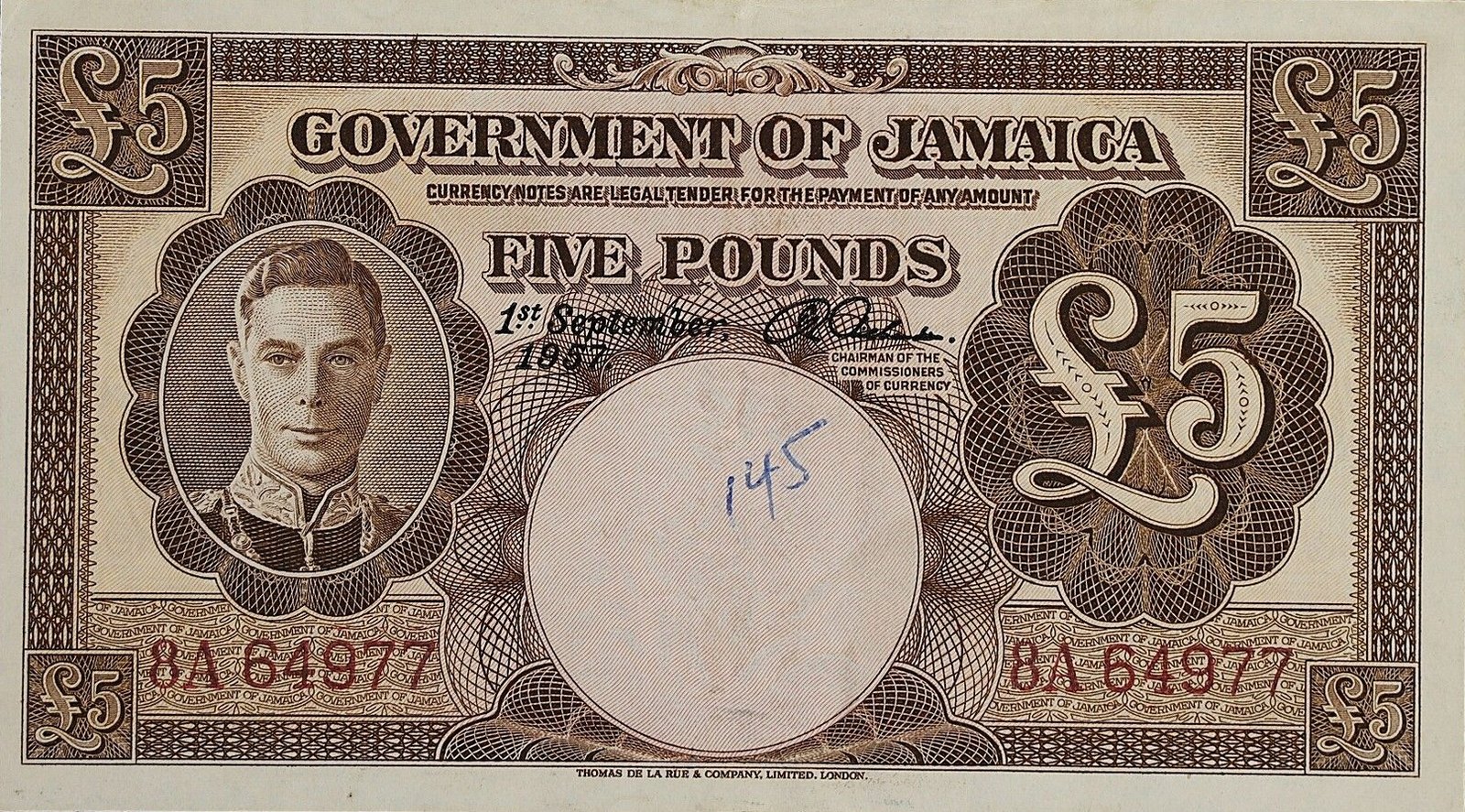
The report for 1954 (p. 35) shows, on the page image, that the 5 pounds stood at 490,790 pounds on 31st March 1953 and at 811,790 pounds a year later. The tables show no 5 pounds notes paid out in the three years to March 1953, and the notes dated 1 August 1952 on the 5 pounds of 1952 to 1957 most likely first went out in the year to March 1954; the report does not name the date on the notes it paid out.
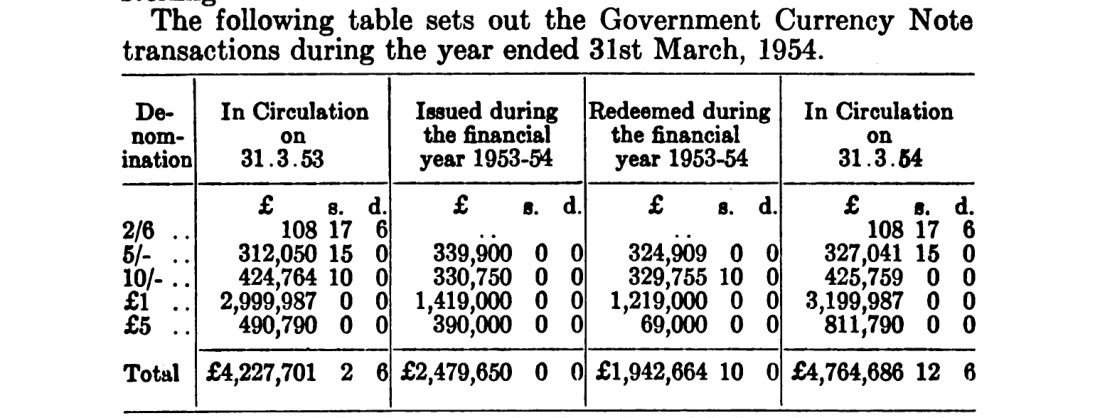
These tables also follow the last notes of the 2 shillings 6 pence. The figure stood at 109 pounds from April 1945 to March 1947. In the year to 31st March 1948 the report records 2 shillings 6 pence redeemed, a single note, which left 108 pounds 17 shillings 6 pence. That figure is carried unchanged in every report to the end of 1955.
1957 to 1961: the totals
The report for 1958 gives totals only, and says the notes were issued in 5 shillings, 10 shillings, 1 pound and 5 pounds: the 2 shillings 6 pence line has gone. It restates the total of 31st March 1957 as 7,126,534 pounds, where the report for 1957 had 7,126,634 pounds 2 shillings 6 pence. Neither report says that any note was written off.
| Date | Total out | Source |
|---|---|---|
| 31st March 1957 | £7,126,534 | report 1958, page image |
| 31st March 1958 | £8,408,622 | report 1958, page image |
| 31st December 1958 | £8,660,622 | report 1958, page image |
| 31st March 1959 | £8,435,620 5s | report 1959, text only |
| 31st December 1959 | £10,040,117 15s | report 1959, text only |
| 31st March 1960 | £9,750,367 | report 1960, text only |
| 31st December 1960 | £10,142,365 15s | report 1960, text only |
| 31st March 1961 | £9.89 million | report 1961, text only |
| 31st December 1961 | £10.56 million | report 1961, text only |
The report for 1961 speaks of "Currency Notes of the Island", which by the end of that year took in the first notes of the Bank of Jamaica.
What stood behind the notes
The Handbooks also give the Commissioners' investments. On 31st December 1920 they held 96,875 pounds in British securities. From the end of 1922 to 1930 the figure is 50,297 pounds 10 shillings. It is 58,361 pounds 9 shillings 10 pence on 31st March 1931, 60,153 pounds 3 pence in British and Colonial securities in 1932, 61,799 pounds 15 shillings 7 pence in 1935 and 62,023 pounds 18 shillings 9 pence in 1936. Proclamations of 3rd November 1922 and 27th September 1930, listed in the Blue Books for those years, fixed the coin part of the Note Guarantee Fund, but the lists do not give the proportion.
The issue also earned money. The Blue Book for 1937 shows a "profit" of 320 pounds 8 shillings 10 pence for 1937-38, and the Blue Book for 1945 a surplus of 27,687 pounds paid into revenue from the Government Currency Note Income Account. The import returns of the Blue Book for 1920 show "Currency Notes" from the United Kingdom valued at 2,357 pounds; the book does not say what they were, and it may be the cost of the first notes.
What the figures do not tell
- The Blue Books of 1920 to 1938 print their yearly currency table sideways, and the text of the scans could not be read; no Blue Book figure of those years is used here.
- No official figure for 1939 to 1944 is among the volumes read.
- The Handbook's word for 1920 is "circulated" and the report's is "issued"; neither says whether a note paid out, returned and paid out again is counted twice.
- None of these books gives the number of notes printed, burnt or held in stock, or any figure by date or signature. A figure in pounds says nothing about which printing the notes came from.
- The disappearance of the 108 pounds 17 shillings 6 pence of 2 shillings 6 pence in 1957 and 1958 is seen in the totals only; no source read gives a reason.
Sources
- The Handbook of Jamaica for 1921, 1923, 1924, 1926, 1927, 1930, 1931, 1932, 1933-34, 1936, 1937-38, 1947-48 and 1949-50, currency chapters.
- The Blue Books of Jamaica for 1867, 1896-97 to 1917-18, 1920, 1922, 1930, 1937 and 1945.
- The annual reports on Jamaica for 1920, 1921, 1924, 1926, 1929, 1930, 1935 and 1938; Colonial Reports, Annual, No. 1603 (Jamaica, report for 1931, paragraphs 191 and 200, printed pp. 40-41), No. 1686 (1933, paragraph 258, printed p. 45) and No. 1811 (1936, paragraph 229, printed p. 39).
- The Colonial Office annual reports on Jamaica for 1946 to 1950 and the reports on Jamaica for 1951 to 1961, chapters on currency and banking.
- IBNS Journal 17:2 (1978), p. 82, and 58:1 (2019), p. 34.
Member comments
Log in or register to post a comment.