This article sets out the paper money of Jamaica under the pound, from the first Government notes of 1920 to the withdrawal of the Bank of Jamaica's pound notes in 1970. It is drawn from the Pick pages of this catalogue, which name the Handbook of Jamaica, the Blue Books, the annual reports, the Colonial Office List and the Kingston Daily Gleaner, from the descriptions the auction houses wrote for their lots, and from the Bank of Jamaica's own history pages. Where two sources differ, both are given.
Before 1920: the island cheques and the two laws
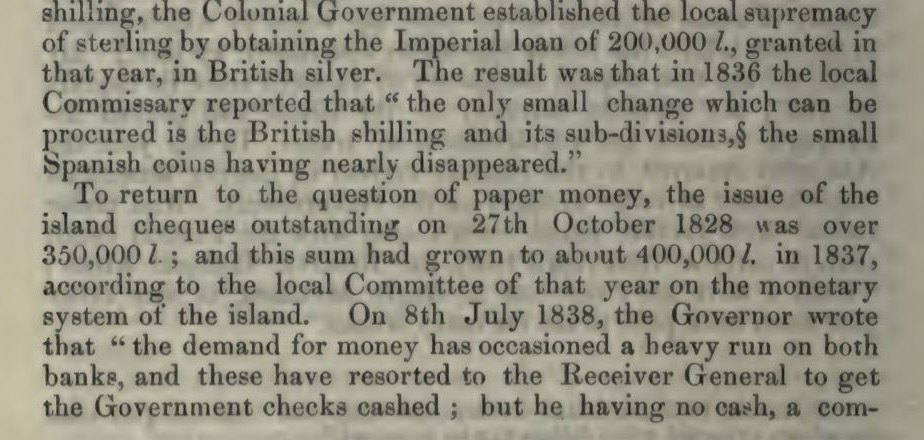
The notes of 1920 were not the island's first government paper. Chalmers' History of Currency in the British Colonies (1893) says the Assembly began issuing unsecured paper money, the "island cheques", in 1822, and that over 350,000 pounds of them were outstanding on 27th October 1828 and about 400,000 pounds in 1837.
The Bank of Jamaica's currency timeline records that the Bank of Nova Scotia issued notes of 1 pound and 5 pounds from 1900. Heritage, describing a 5 shillings in its sale of 23 March 2023 (lot 24337), puts the division this way: the Treasury issued the small notes and three values of coin, the private banks the higher notes, and English coin made up the rest.
The laws of 1904 and 1918
The first issue was made under two laws. Sources mention that Law 27 of 1904 provided for 10 shillings notes only, and that Law 17 of 1918 allowed other values approved by the Secretary of State. The Bank of Jamaica's history page describes the 1904 law in the same way, as constituting a Board of Commissioners to issue currency notes for the value of 10 shillings each, and the 1918 law as allowing such denominations as might be approved.
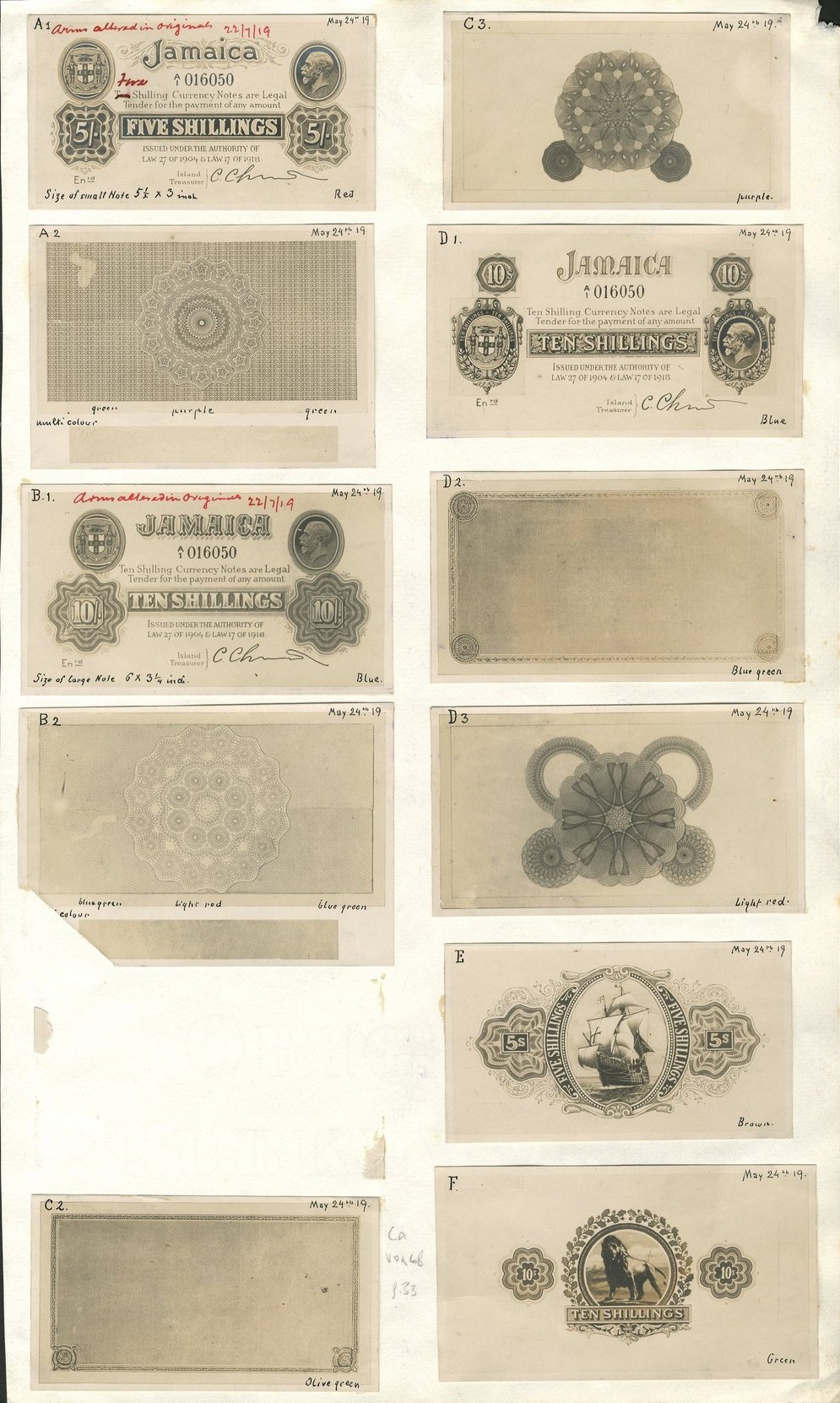
The Bank of Jamaica's history page says the Commissioners issued the first notes under these laws on 15 March 1920. The Handbook of Jamaica for 1919 still named only a 5 shillings and a 10 shillings as planned. Spink, in its sale of 30 September 2014 (lot 1042), offered a sheet of fourteen miniature archival photographs of 1919 showing layered designs for 5 and 10 shillings notes, annotated with colours and sizes; Spink's description says one of the 10 shillings designs is not at all like the note that was issued.
15th March 1920: the first issue
The Handbook of Jamaica for 1921 says the first notes, 17,500 pounds' worth, went out on 15th March 1920, at once because silver was scarce. The Bank of Jamaica's history page gives the same day and the same reason: a scarcity of silver coins of the lower denominations.
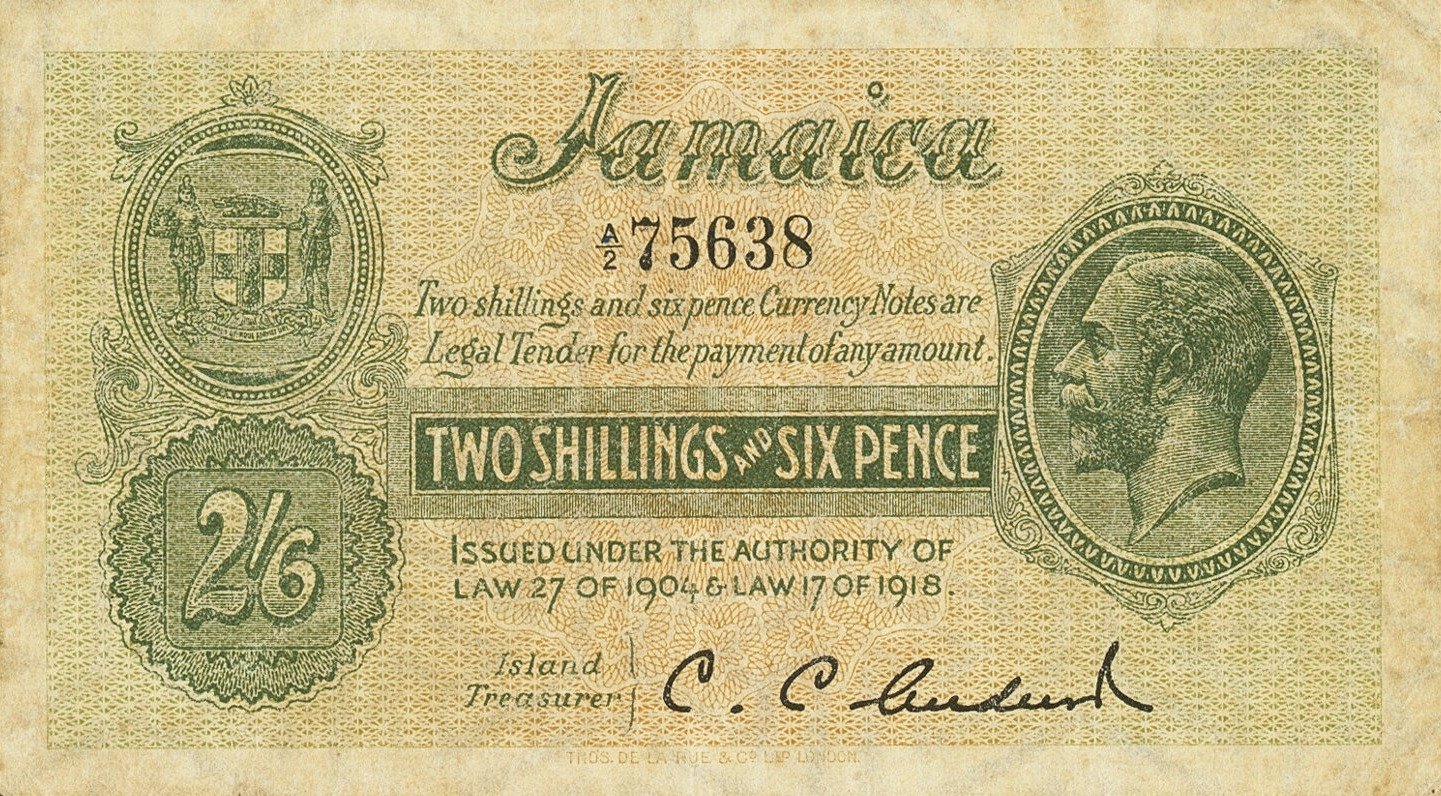
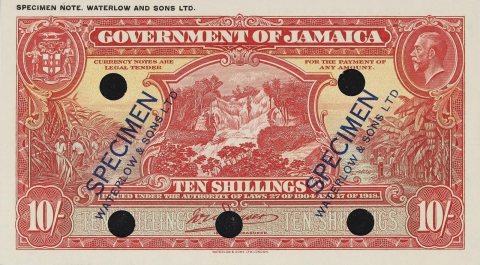
Three values were issued, all printed by Thomas de la Rue: the 2 shillings 6 pence, the 5 shillings and the 10 shillings. By 31st December 1920, the Handbook for 1921 says, the Commissioners had put out 209,500 pounds:
| Value | Put out by 31st December 1920 |
|---|---|
| 2 shillings 6 pence | 31,250 pounds |
| 5 shillings | 103,250 pounds |
| 10 shillings | 75,000 pounds |
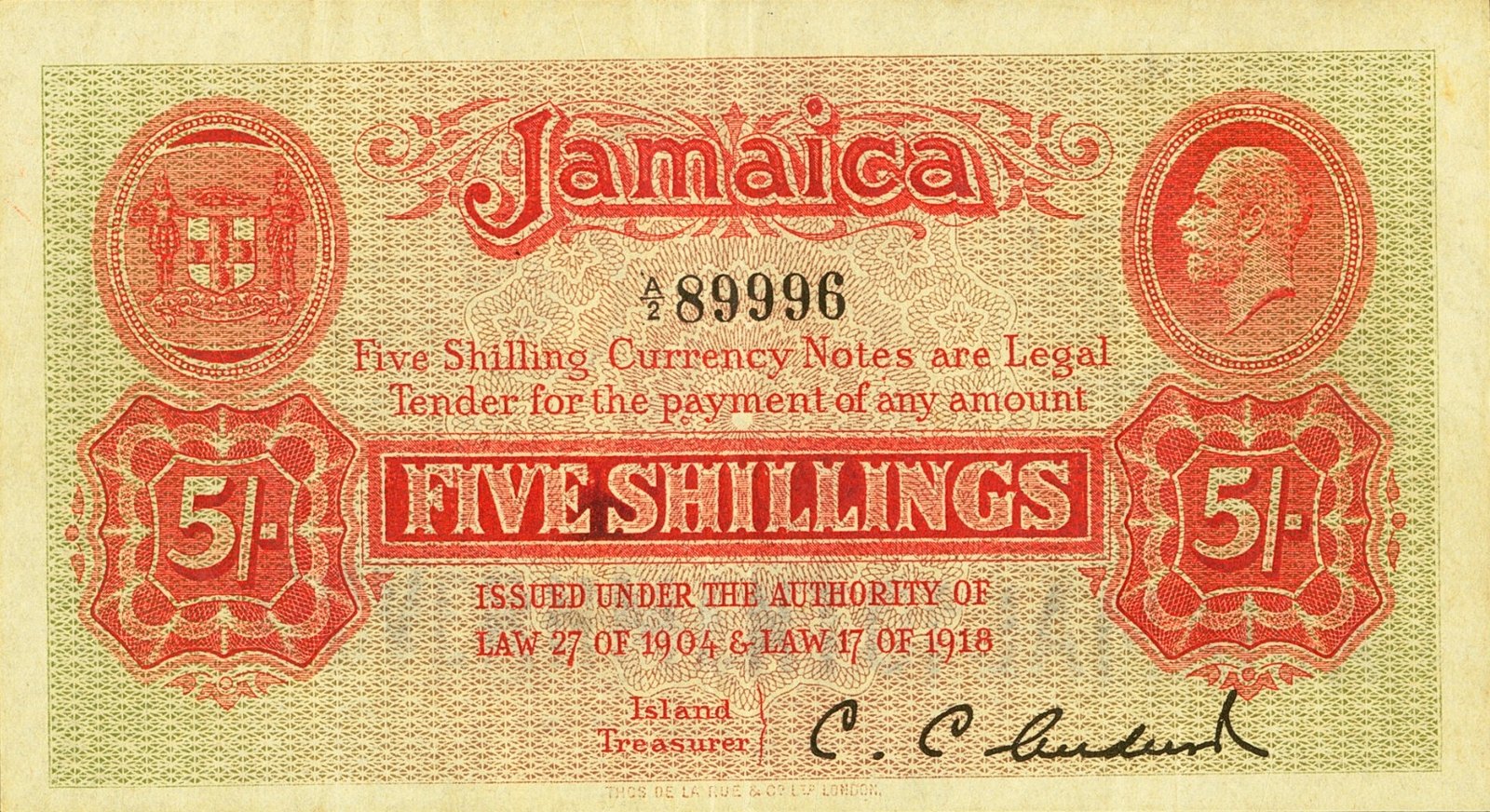
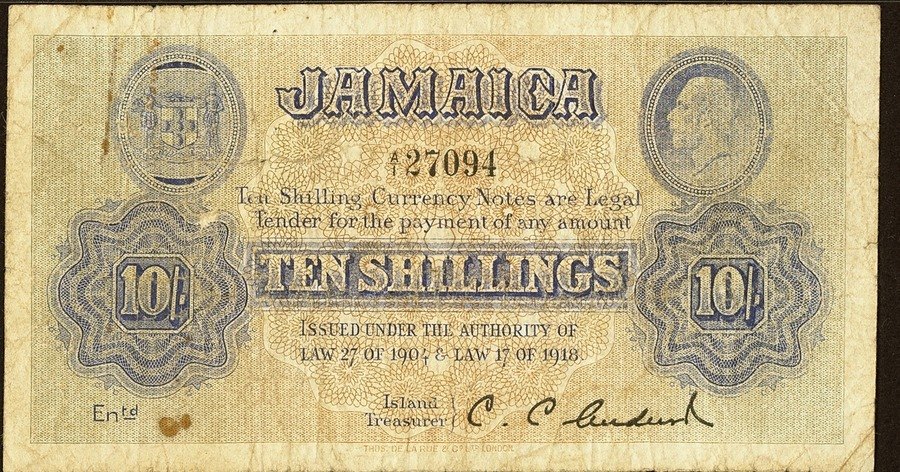
The annual reports give a slightly different figure for the 10 shillings: 74,475 pounds issued by the end of 1920, and 53,640 pounds still out in 1921. That is 148,950 and 107,280 notes.
World Banknote Auctions, in its sale of the Isabella Chang Fong and Ian Marshall Collection on 3 November 2023 (lots 8002 to 8004), says the De La Rue imprint stands in the bottom margin and is hard to read on many notes. The first notes carry one serial number at upper centre; later printings of the 5 and 10 shillings carry two, at upper right and lower left.
The 2 shillings 6 pence called in, 1922 to 1954
The Handbook of Jamaica for 1923 says the Commissioners withdrew the 2 shillings 6 pence during 1922: of the 31,250 pounds put out (250,000 notes), all but 739 pounds 10 shillings had come back by 31st December 1922. The Bank of Jamaica's timeline has the same year for the withdrawal.
The rest came in slowly. The annual reports say each year that the notes were "gradually being withdrawn", and give these sums still outstanding:
| At the end of | 2 shillings 6 pence notes outstanding |
|---|---|
| 1922 | 739 pounds 10 shillings |
| 1924 | 192 pounds 15 shillings |
| 1930 | 124 pounds |
| 1933 | 114 pounds 7 shillings 6 pence |
| 1938 | 112 pounds |
| 1948 and after | 108 pounds 17 shillings 6 pence |
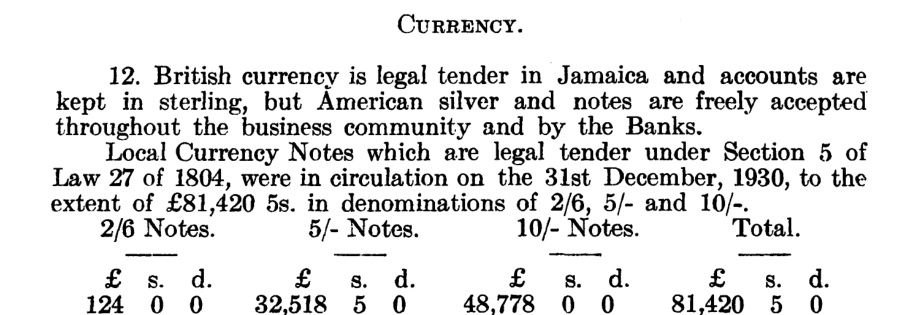
The last figure, 871 notes, was still carried in the figures for March 1954.
The Island Treasurers who signed, 1920 to 1938
The notes of the first two series were signed by the Island Treasurer. The Blue Books, which list the Treasury staff each year, give these terms:
- Charles Campbell Anderson, from 1st April 1912 until Anderson's death on 22nd October 1921.
- Richard Nosworthy, from 10th January 1922 to January 1924. No note with Nosworthy's signature is known.
- Walter Belinfante Isaacs, appointed from 10th January 1924, after acting from 1st January to 30th April 1923, until retirement on 31st March 1925.
- Walter Mortimer Fraser, from 1st April 1925, acting at first, until 1934.
- Arthur Harris Hodges, appointed from 27th November 1934.
The auction houses date some of these terms otherwise. World Banknote Auctions (3 November 2023, lots 8002 to 8004) gives Anderson as Island Treasurer from 1912 to 1921, which agrees, but Isaacs in 1925 only, adding that Isaacs was also Supervisor of the Revenue department and Manager of the Government Savings Bank. Stack's Bowers (2 October 2024, lot 20509) and Heritage (8 March 2024, lot 24341) say Fraser was Island Treasurer from 1926 to 1935. World Banknote Auctions (lot 8011) says Hodges was Island Treasurer from 1936 to 1938. The Blue Books list the Treasury staff each year, and the Pick pages give their dates beside those of the houses.
On the notes, Anderson signs the 2 shillings 6 pence and the single-number 5 and 10 shillings. Isaacs and Fraser sign the 5 shillings with two numbers, and prefix A/6 was printed with both signatures. On the 10 shillings with two numbers only Fraser's signature has been seen; Ian Marshall's commentary in the World Banknote Auctions sale (lot 8005) records no 10 shillings signed by Isaacs.
9 January 1931: the Waterlow notes
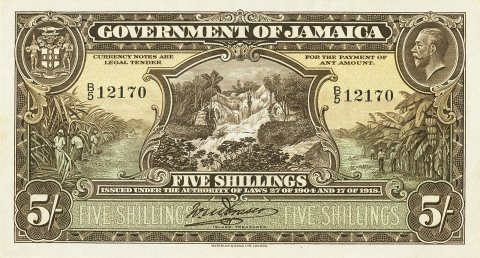
The second series was printed by Waterlow and Sons: a 5 shillings and a 10 shillings, still under Laws 27 of 1904 and 17 of 1918. World Banknote Auctions (3 November 2023, lots 8002 to 8004) says De La Rue tried and failed to win the contract for this series. The same sale (lots 8014 and 8015) included front and back artist's renditions of a 5 and a 10 shillings that De La Rue made in the early 1930s to win it. They are close to the issued design, but the arms and the King's portrait are set at a different angle, and the Treasurer's signature on them has not been identified. The 10 shillings rendition has the central vignettes of the issued note, but the two side vignettes on the back differ.
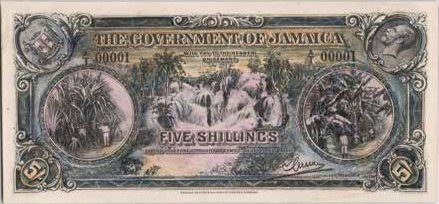
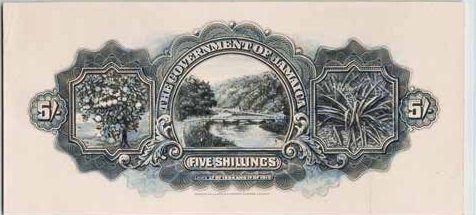
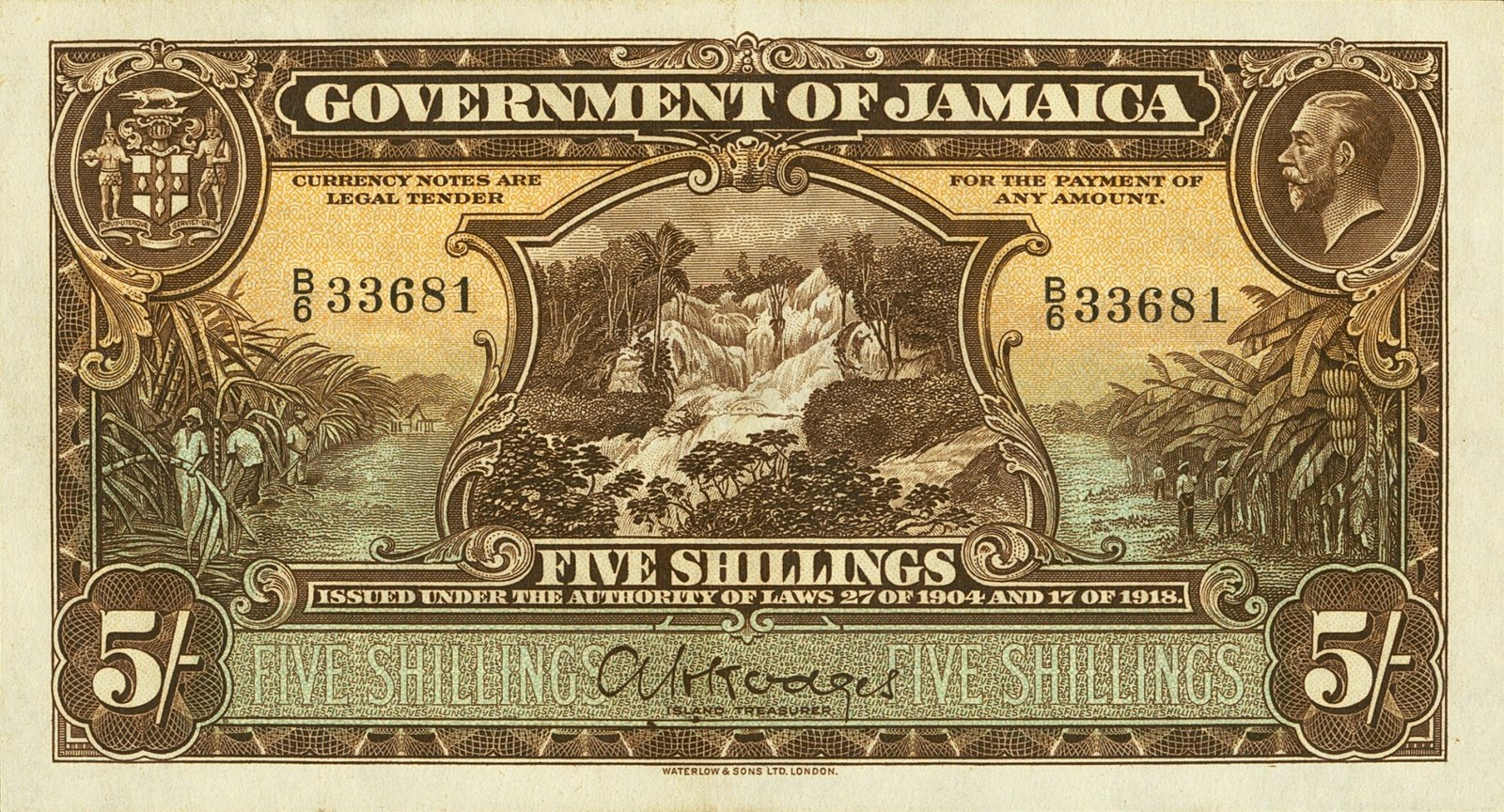
World Banknote Auctions (lot 8012) says, from the Kingston Daily Gleaner of the next day, that the Waterlow 5 and 10 shillings went into circulation on 9 January 1931. The Gleaner of 10 January 1931, shown in that sale (lot 8009), names the scene at the centre of the front as the Roaring River Falls and the back as the Flat Bridge over the Rio Cobre, and says the new notes take the place of the old ones. World Banknote Auctions (lot 8009) names the same views and says the first series was soon withdrawn. Heritage, describing a 5 shillings in the Eric P. Newman sale of 10 November 2018 (lot 20351), adds that harvesting scenes stand on either side of the falls, sugar cane at left and bananas at right.
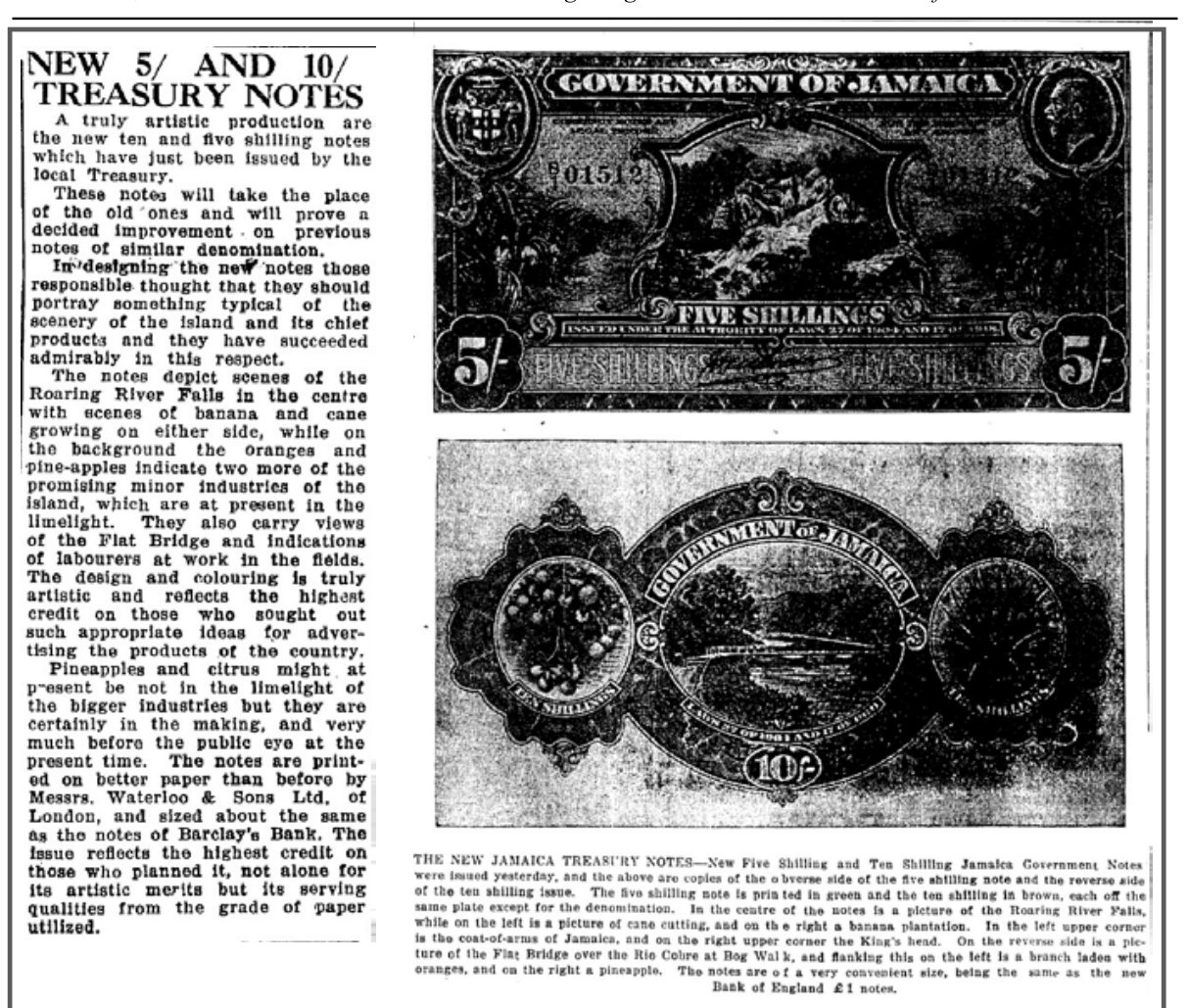
The 5 shillings is signed by Fraser and then by Hodges; the 10 shillings, World Banknote Auctions says (lot 8012), was issued with Fraser's signature only. Sources mention a 5 shillings with one serial number, which is not confirmed; World Banknote Auctions (lot 8011) says no such note exists.
Heritage, in its sale of 7 September 2017 (lot 28291), calls the Government's small notes of these years "coin notes", meant to pass from hand to hand as heavily as coin, while the commercial banks issued the higher values.
The Currency Notes Law 1937 and the notes of 1939
The third series came under a new law, the Currency Notes Law 1937 (Law 9 of 1937). The Blue Book for 1938 lists the Proclamation of 17th December 1938 that brought it into operation. The Bank of Jamaica's history page says the Law gave additional responsibilities to the Board of Commissioners, and its timeline enters "Currency Board established" under 1939.
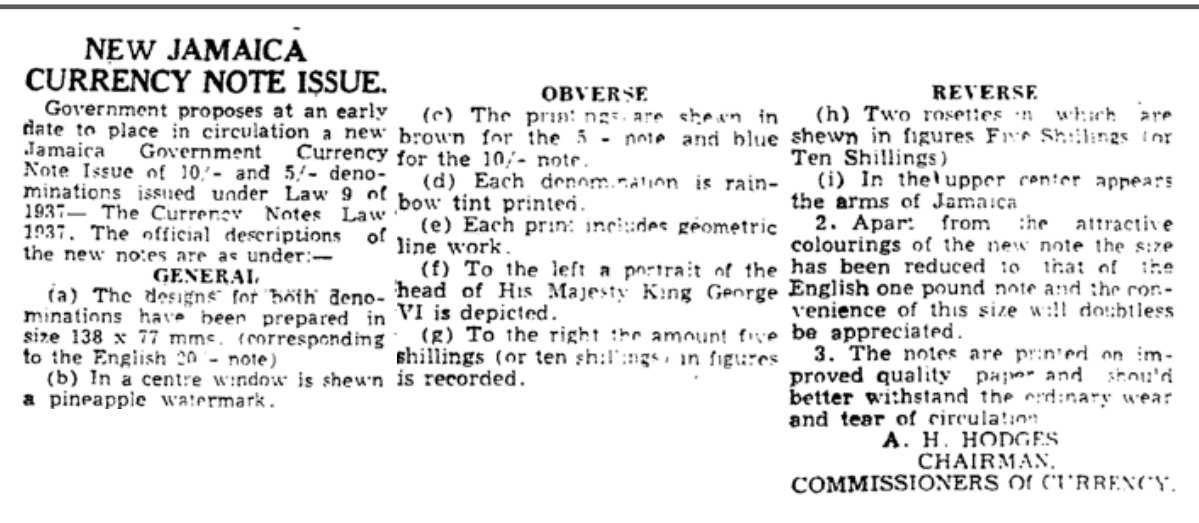
Four weeks after the Proclamation, the Kingston Daily Gleaner of 14 January 1939 printed the official description of the new 5 shillings and 10 shillings, signed by A. H. Hodges as Chairman of the Commissioners of Currency. The notice is shown in the World Banknote Auctions sale of 3 November 2023 (lot 8019). It gives both notes as 138 x 77 mm, with a pineapple watermark in a window at the centre and a rainbow tint, the 5 shillings in brown and the 10 shillings in blue, the portrait of King George VI at left and the arms of Jamaica at upper centre of the back. World Banknote Auctions (lot 8017) says the series went into circulation early in 1939, after the Currency Board was set up. The printer was again Thomas de la Rue. The lettered rows of the Pick pages begin with 2nd January 1939. World Banknote Auctions (lot 8016) says the specimens dated 1st May 1937 were probably printed late in 1938; that date was never used, but the design was.
Sources mention that the Law of 1937 allowed the 1 pound and 5 pounds, and that the pound notes began in 1940. The Bank of Jamaica's history page says the same: in 1940 the Commissioners began issuing 1 and 5 pound notes. The first 1 pound is dated 1st November 1940. The first 5 pounds is dated 30th November 1942, two years after the year the Bank gives for both values; the two do not agree for the 5 pounds.
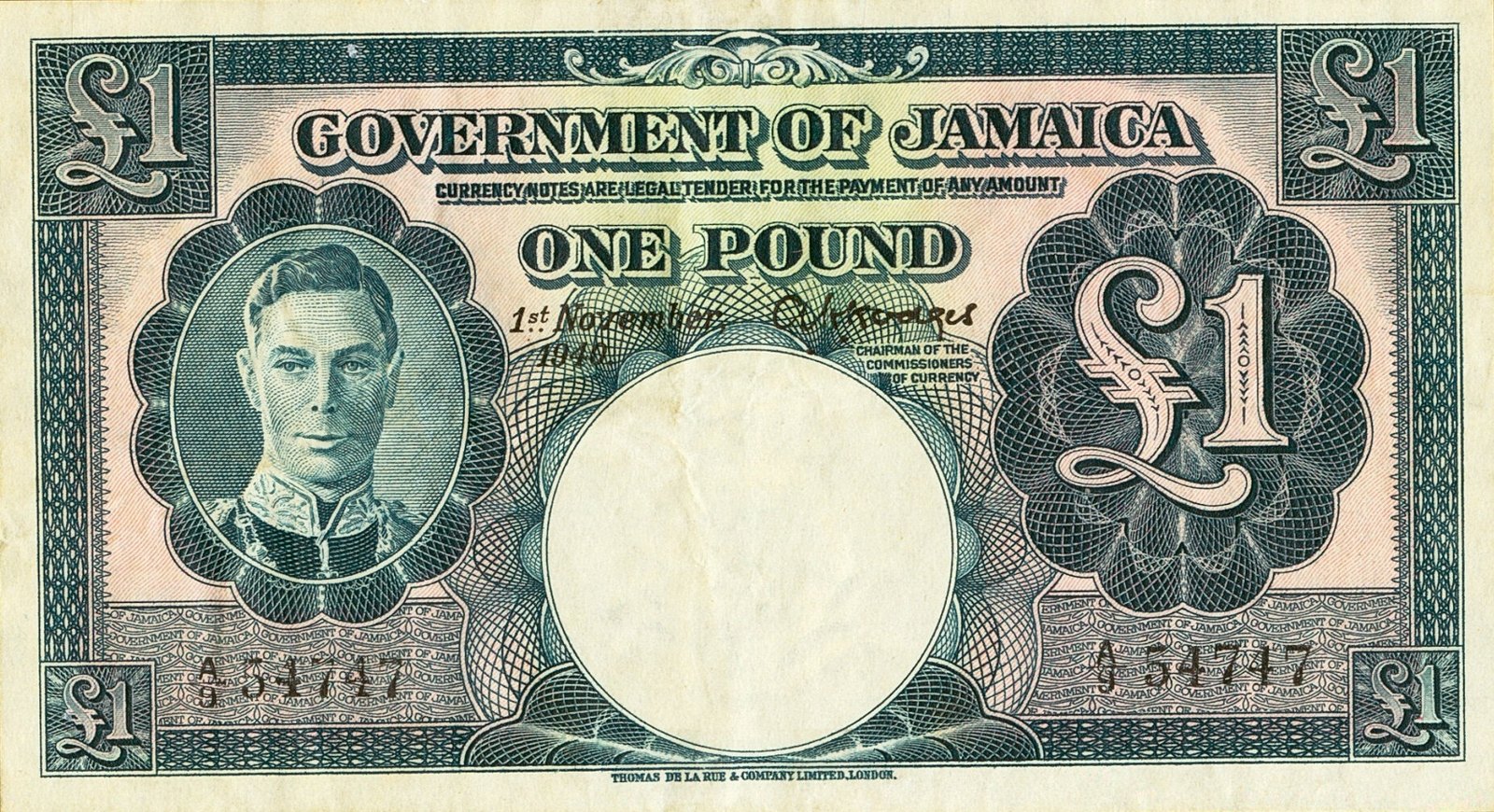
The Government's pound notes took the place of the banks' notes by stages. Sources mention that in 1944 the private banks were made to cut their note circulation in the British West Indies by 30% to make room for the government notes. The Bank of Jamaica's timeline records that private commercial banks were prohibited from issuing banknotes in 1954 and that commercial bank notes were demonetised in 1958.
The Chairmen of the Commissioners of Currency
From 1939 the signature is that of the Chairman of the Commissioners of Currency, who was the Treasurer and, from 1942, the Financial Secretary and Treasurer. The Blue Books and the Handbook of Jamaica give the first three, and the Colonial Office List the rest:
| Chairman | In office as Treasurer or Financial Secretary |
|---|---|
| Arthur Harris Hodges | from 27th November 1934 |
| Robert Walter Taylor | from 8th January 1942 |
| Sir Norman Strathie | from 19th November 1946 to 1949 |
| Robert Newton | 1949 to 1953 |
| Frank Denry Clement Williams | 1954 to 1956 |
| E. R. Richardson | from 1956 |
The Pick pages name Hodges as the signer of the 1 pound of 1st November 1940, Taylor of the 5 pounds of 30th November 1942, Newton of the 5 pounds of 1 August 1952, Williams of that of 7 April 1955, and Richardson of those of 15 August and 1 September 1957 and of the notes of 1960.
The SS Politician and the blue 10 shillings, 1941 to 1951
On 3 February 1941 the cargo ship SS Politician left Liverpool for Kingston carrying 28,000 cases of malt whisky and 290,000 of the blue 10 shillings notes dated 1st November 1940. Two days later the ship ran onto a sandbank in bad weather off Eriskay in the Outer Hebrides. The islanders who rescued the crew learned what the ship carried and salvaged much of the whisky, the episode behind Compton Mackenzie's Whisky Galore (1947) and the Ealing film of 1949. A good many of the notes went with it.
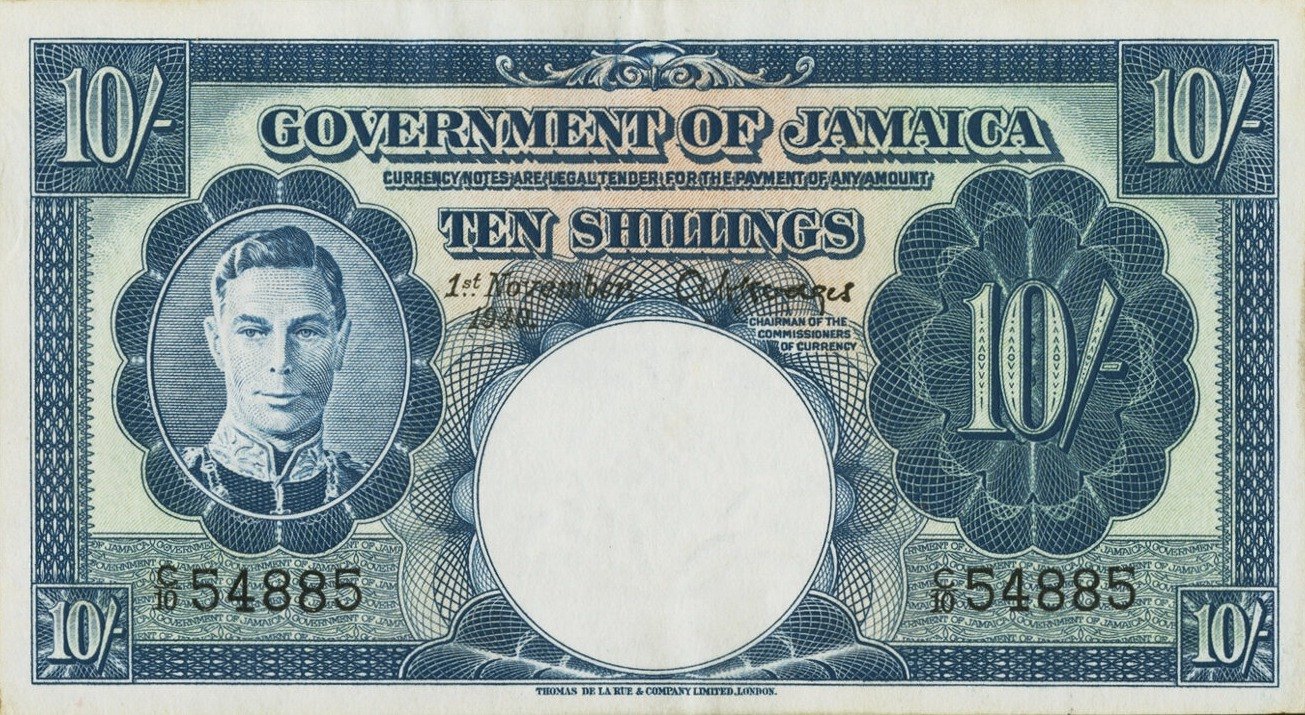
The notes began turning up at banks in Britain, Europe, the United States and Jamaica itself. Most were recovered or redeemed, but some 74,000 were never accounted for. That is why the blue 10 shillings was demonetised on 1 July 1951 and replaced by the same note in purple, the 10 shillings of 1950 to 1960. Sources mention that the demonetisation was proclaimed on 29th January 1951 and published in the Jamaica Gazette on 8th February 1951.
The serial numbers of the 290,000 notes are known, and the Pick page lists them. Ian Marshall's commentary in the World Banknote Auctions sale (lot 8059) says the Politician notes often show a small oil stain on the top border. National Museums Liverpool holds one: its object record DX/2515 describes a Jamaican 10 shillings note "from the consignment shipped on board Harrison Line ship Politician, 1941".
1960: the last Government notes
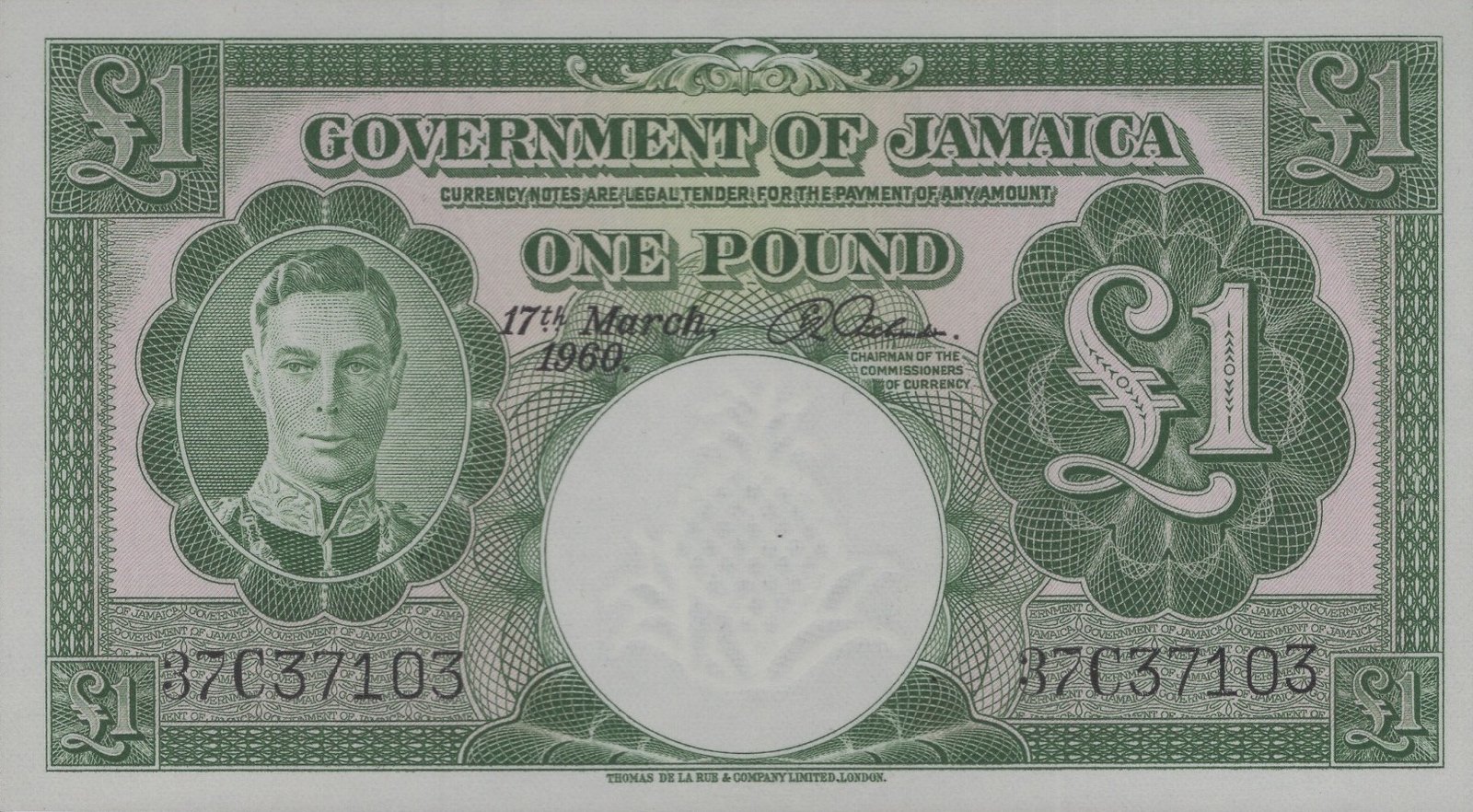
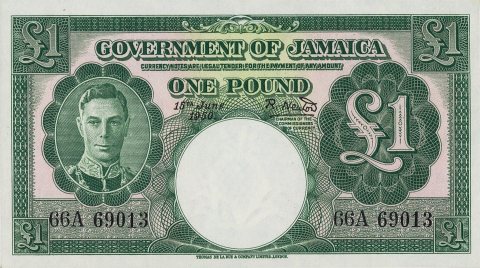
The portrait of King George VI stayed on the Government's 5 shillings, 10 shillings and 1 pound until the end. Stack's Bowers, describing a 1 pound of 27th May 1957 in its sale of 2 October 2025 (lot 50249), remarks that Jamaica kept the King's portrait for several years after the King's death, where elsewhere it was soon replaced by the Queen's.
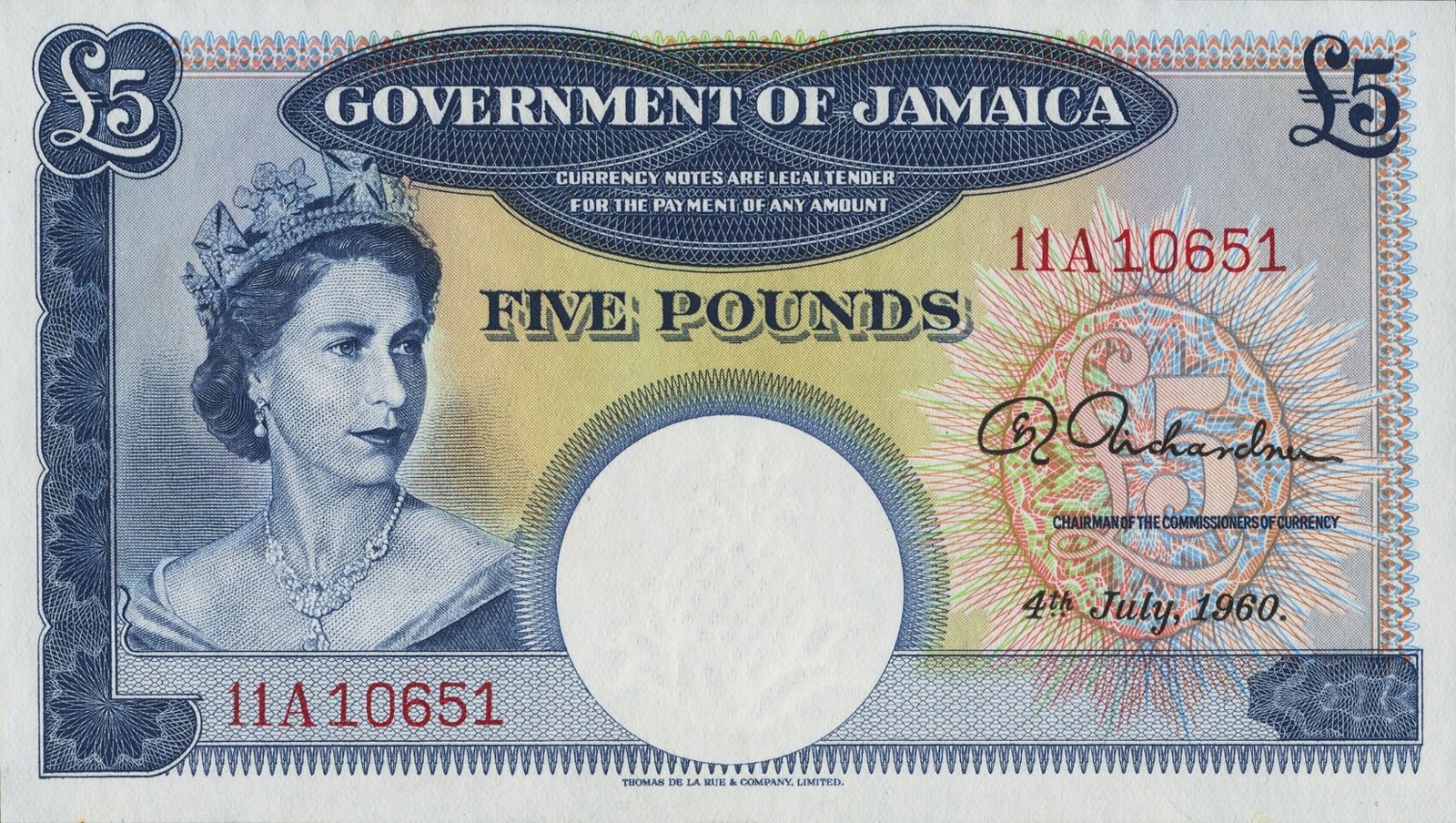
In 1960 the backs of the three lower values were redrawn, with the value in words in one line where it had stood in two: the 5 shillings of 17th March 1960, the 10 shillings of 4th July 1960 and the 1 pound of 19th May 1960. All three still show George VI.
The 5 pounds of 1960 was the one Government note with the Queen. The Bank of Jamaica's history page says the first note to bear the Queen's portrait was the 5 pounds issued on 17 March 1960. Sources mention that the portrait follows a 1954 photograph by Dorothy Wilding. Heritage (8 March 2024, lot 24352) says this portrait was used on no other banknote. World Banknote Auctions (3 November 2023, lot 8171) says the 4th July 1960 date was the last issue of the Government of Jamaica before the Bank of Jamaica took over the note issue.
The Bank of Jamaica, 1961 to 1970
The Bank of Jamaica issued its notes under the Bank of Jamaica Law 1960. The Bank's history page says the Act came into force in October 1960 and gave the Bank the sole right to issue notes and coins in the island; its timeline has the Bank established in 1960 and opened in 1961. Designs drawn in 1959 and 1960 for a "Central Bank of Jamaica", a name the bank never took, are described in Central banks that never opened.
The notes carry no date. The Pick pages give these days for the first issue, with the Latin motto INDUS UTERQUE SERVIET UNI below the arms:
| Note | First put out |
|---|---|
| 1 pound | 1 May 1961 |
| 5 shillings | 20 December 1961 |
| 10 shillings | 9 March 1962 |
The Bank of Jamaica's history page puts it differently: it says Bank of Jamaica notes first appeared on 1 May 1961 in the denominations of 5 shillings, 10 shillings, 1 pound and 5 pounds. The two accounts do not agree for three of the four values: the Pick pages give later days for the 5 shillings and the 10 shillings, and 1 February 1963 for the 5 pounds. Neither account is settled here; the newspaper notice below gives 9 March 1962 for the 10 shillings.
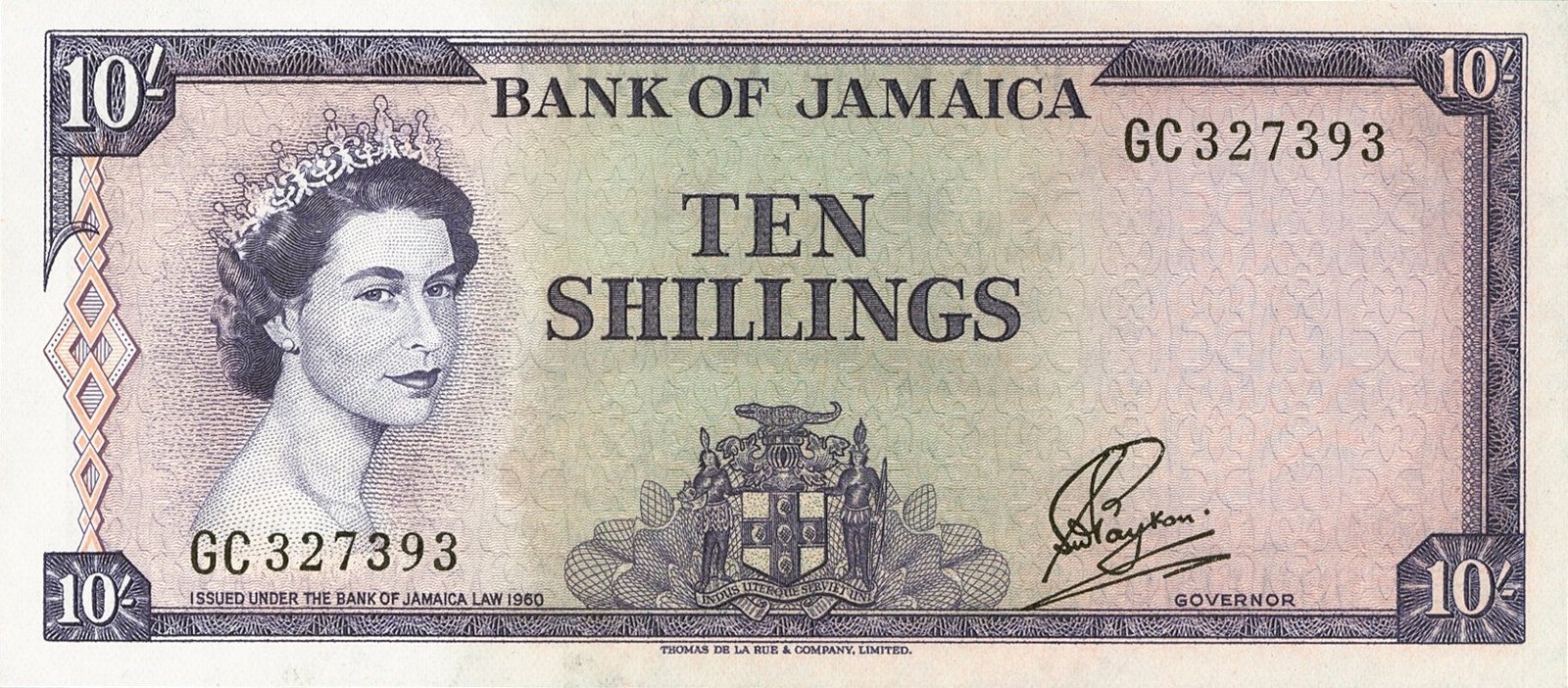
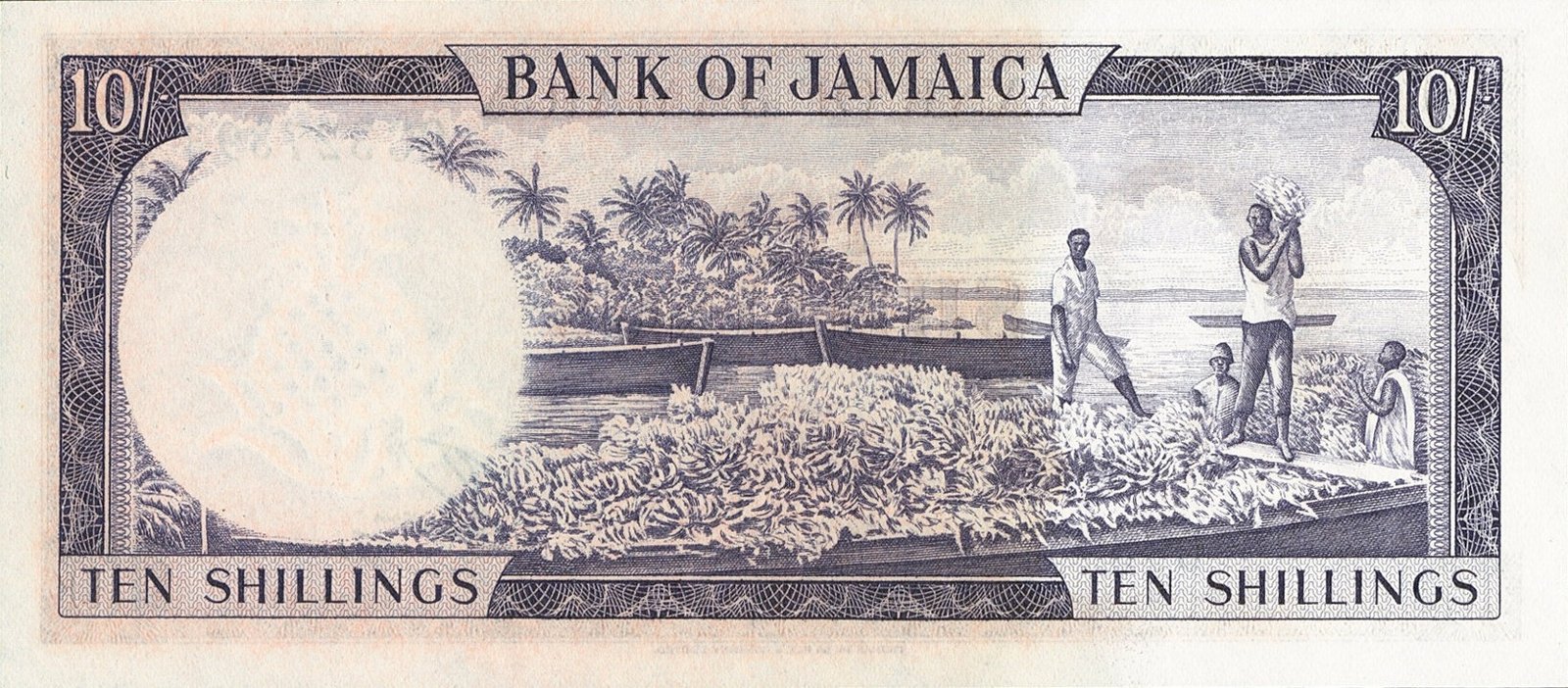
The Kingston Daily Gleaner of 9 March 1962, shown in the World Banknote Auctions sale (3 November 2023, lot 8197), says the new 10 shillings were issued to the Bank from that day and to the commercial banks soon after, and that the Government 10 shillings stayed legal tender while it was withdrawn. It gives the size as 144 x 64 mm and names the engravers: the Queen's portrait by L. Downey, from a photograph by Dorothy Wilding, and the back, all in purple and showing banana loading at Oracabessa Port, by J. C. Evans. Sources mention that the portrait, facing left, follows a 1952 photograph by Dorothy Wilding, in De La Rue's engraving.
The English motto
The second issue has the English motto OUT OF MANY, ONE PEOPLE below the arms. The 5 pounds, which its Pick page gives with the English motto, was first put out on 1 February 1963, before the lower values. Stack's Bowers, describing a set of four specimens each numbered 1 in its sale of 11 August 2015 (lot 32140), says the 5 and 10 shillings in the set have the English motto and the 1 pound and 5 pounds the Latin one; this catalogue has no row for a 5 pounds with the Latin motto. The Pick pages give 1964 for the 5 shillings, the 10 shillings and the 1 pound. For the 1 pound that year is not settled: World Banknote Auctions (lot 8207) shows a short Daily Gleaner notice, which it dates 19 March 1963, saying the Bank had started the day before to issue new 1 pound notes whose arms carry the motto "Out of many, one People", of the same size and design as before.
The Governors
Sources mention that Payton took office as Governor on 13th June 1960, that Hall became Acting Governor on 13th December 1964 and Governor on 1st April 1966, and that Brown became Governor on 1st July 1967. The Bank of Jamaica's history page names the first Governor as Stanley W. Payton and says the only changes to the notes came with a change of Governor. Heritage (8 December 2023, lot 22270) gives the third Governor's name in full as George Arthur Brown.
Hall's notes come with two titles. The 5 shillings is found with ACTING GOVERNOR only and the 5 pounds with GOVERNOR only; the 10 shillings and 1 pound are found with both. Sources mention that no 5 shillings was issued with Hall as Governor and no 5 pounds with Hall as Acting Governor, as enough notes were in stock at each change.
The counterfeit 5 pounds of 1966
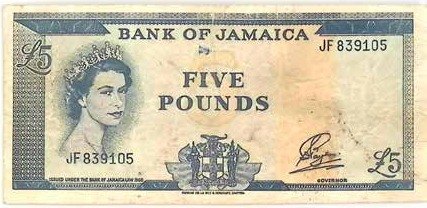
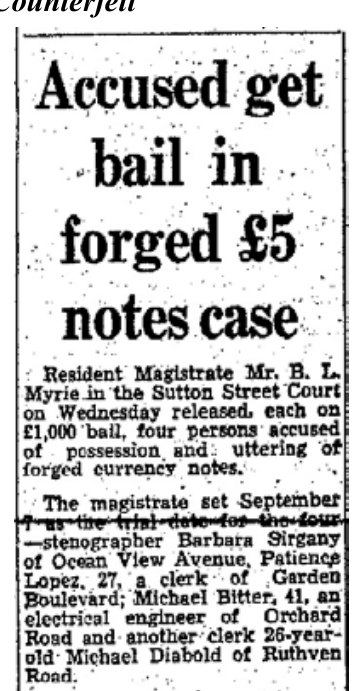
The World Banknote Auctions sale of 3 November 2023 (lot 8221) included a contemporary counterfeit copying a genuine Payton 5 pounds, JF 839105. World Banknote Auctions says the Kingston Daily Gleaner of 2 September 1966 listed that number as a counterfeit and reported the arrest of several people, that the Gleaner of 10 January 1967 reported two women convicted of conspiracy to defraud and sentenced to a fine of 50 pounds or two months' hard labour, and that more counterfeit 5 pounds with other numbers appeared in 1969.
The end of the pound notes
The Bank of Jamaica's history page says Jamaica changed to dollars and cents on 8 September 1969, and that the new notes went into circulation that day. The pages of this catalogue carry 15 April 1970 as the day the Bank's pound notes were withdrawn. For the Government notes they carry 1 July 1951 for the blue 10 shillings, 6 August 1963 for the 1 pound, 1 April 1964 for the 5 shillings, 1 July 1964 for the 10 shillings and 1 May 1965 for the 5 pounds.
What the sources do not say
- No source used here gives the text of Law 27 of 1904, Law 17 of 1918 or the Currency Notes Law 1937; the Pick pages have them only at second hand.
- Why no notes were issued under the 1904 law before 1920 is not stated.
- The Blue Books and the auction houses disagree on the terms of Isaacs, Fraser and Hodges, as set out above.
- The day the English-motto 5 shillings and 10 shillings first went out is not known; only the year 1964 is given, and for the 1 pound a newspaper notice points to March 1963.
- The Pick pages name the central scene of the Waterlow notes as Dunn's River Falls in their opening lines, while the Gleaner of 10 January 1931 and World Banknote Auctions (lot 8009) name it as the Roaring River Falls.
Sources
- Robert Chalmers, A History of Currency in the British Colonies (1893), as cited on the Pick page of the 2 shillings 6 pence.
- The Handbook of Jamaica for 1919, 1921 and 1923.
- The Blue Books of Jamaica, among them those for 1934, 1938 and 1945.
- The annual reports on Jamaica, 1920 to 1954.
- The Colonial Office List, for the Financial Secretaries from 1949.
- The Kingston Daily Gleaner of 10 January 1931, 14 January 1939, 9 March 1962, 19 March 1963 (as dated by World Banknote Auctions), 2 September 1966 and 10 January 1967, as shown or quoted in the World Banknote Auctions sale.
- World Banknote Auctions, the Isabella Chang Fong and Ian Marshall Collection of Jamaican Banknotes, 3 November 2023, lots 8002 to 8004, 8005, 8009, 8011, 8012, 8014 to 8017, 8019, 8059, 8171, 8197, 8207 and 8221, with Ian Marshall's commentary.
- Heritage Auctions: 7 September 2017, lot 28291; 10 November 2018, lot 20351; 23 March 2023, lot 24337; 8 December 2023, lot 22270; 8 March 2024, lots 24341 and 24352.
- Stack's Bowers: 11 August 2015, lot 32140; 2 October 2024, lot 20509; 2 October 2025, lot 50249.
- Spink, 30 September 2014, lot 1042.
- Bank of Jamaica, "History of our currency", https://boj.org.jm/core-functions/currency/history/ and the currency timeline, https://boj.org.jm/core-functions/currency/currency-timeline/
- National Museums Liverpool, object record DX/2515, https://www.liverpoolmuseums.org.uk/artifact/jamaican-ten-shilling-note
Member comments
Log in or register to post a comment.