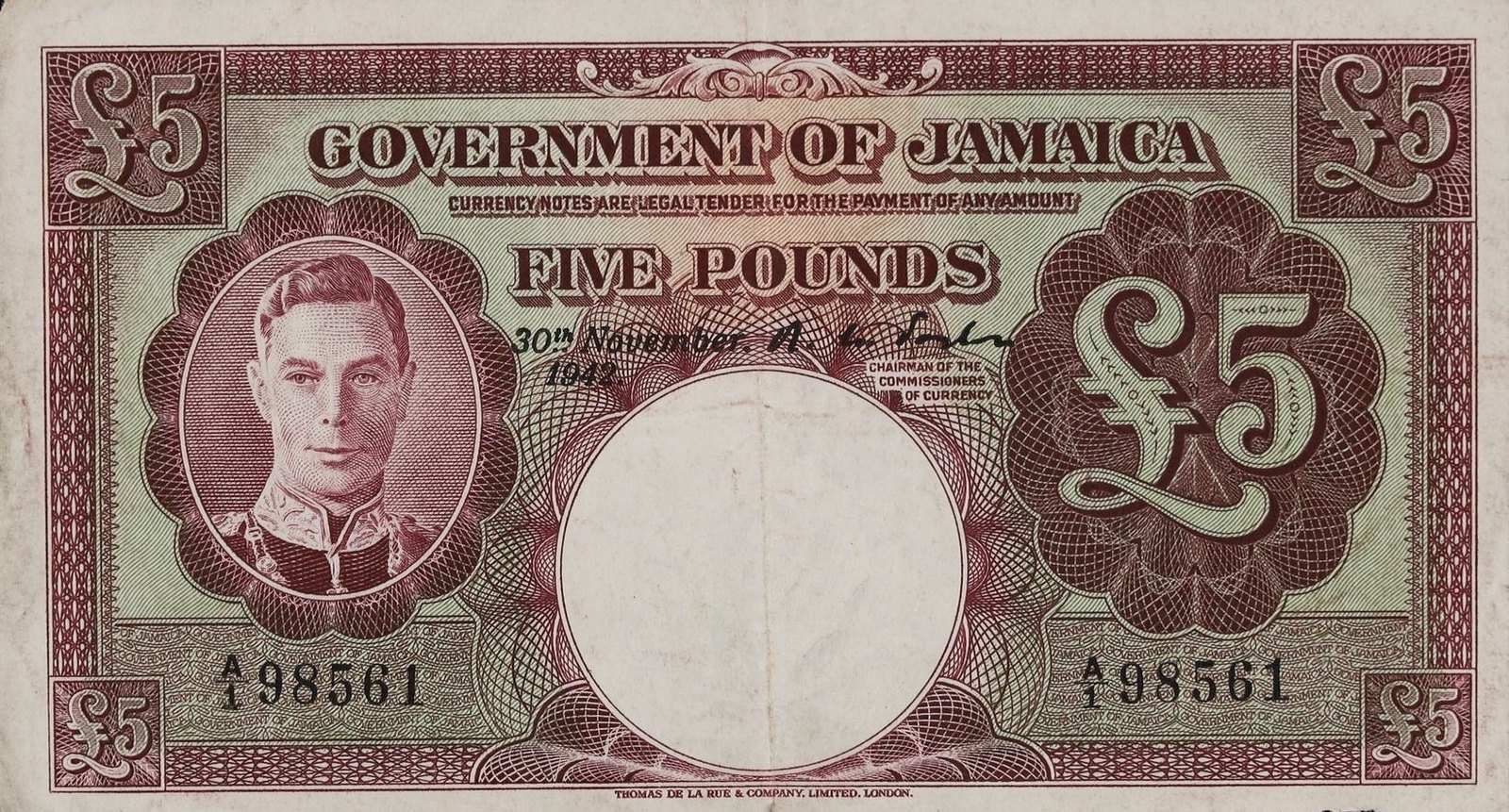
The Pick pages of this catalogue give no official printing figures for the pound notes of Jamaica. What they give is a set of estimates by the collector Ian Marshall, printed as commentary in the World Banknote Auctions sale of the Isabella Chang Fong and Ian Marshall Collection of Jamaican Banknotes on 3 November 2023. This article gathers those estimates from the Pick pages, value by value, with the lot that carries each one, and sets beside them the figures of the Handbook of Jamaica, the annual reports and other auction houses. It then lists what De La Rue's own notes on specimens and proofs in that sale show about when the notes were printed.
Every figure in the tables is an estimate, not a record. In the tables "Marshall" means Ian Marshall's commentary in the sale of 3 November 2023, and the lot number is that of the same sale.
The first issue, 1920
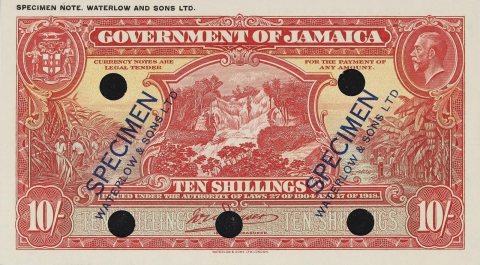
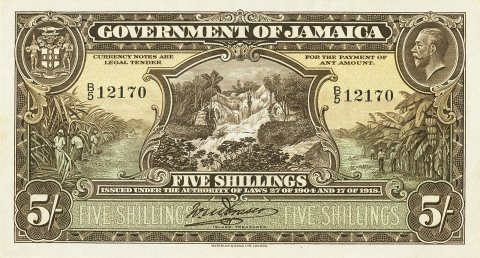
The notes of 1920 were printed by Thomas de la Rue under Law 27 of 1904 and Law 17 of 1918.
| Note | Marshall's estimate | Notes Marshall recorded | Lot |
|---|---|---|---|
| 2 shillings 6 pence | 360,000 to 400,000 | thirteen | 8001 |
| 5 shillings, Anderson, one serial number | 400,000 | not given | 8002 |
| 5 shillings, Isaacs | 110,000 to 180,000 | four | 8003 |
| 5 shillings, Fraser | 220,000 to 280,000 | seven issued, one specimen with a normal serial number | 8004 |
| 10 shillings, Anderson | perhaps 200,000 | two, both with prefix A/1 | 8005 |
| 10 shillings, Fraser | 410,000 or more | twenty issued, six of them in institutional collections, and one specimen with a normal serial number | 8006 |
Ian Marshall (lot 8007) knew of only two specimens of this first issue, both with normal serial numbers.
Other sources can be set against three of these lines.
For the 2 shillings 6 pence, the Handbook of Jamaica for 1923 says 31,250 pounds was put out in all, that is 250,000 notes, before the note was withdrawn in 1922. That is the number issued, and it is lower than the 360,000 to 400,000 that Ian Marshall estimates were printed.
For the 5 shillings with one serial number, Heritage (24 April 2020, lot 26143) also says 400,000 were printed. That fits the four prefixes of the row, A/1 to A/4, with five-digit numbers. For the Fraser 5 shillings, Heritage (8 March 2024, lot 24340) says about 300,000 or fewer were issued, judged from the prefixes, and notes that prefix A/6 is shared by the Isaacs and Fraser signatures.
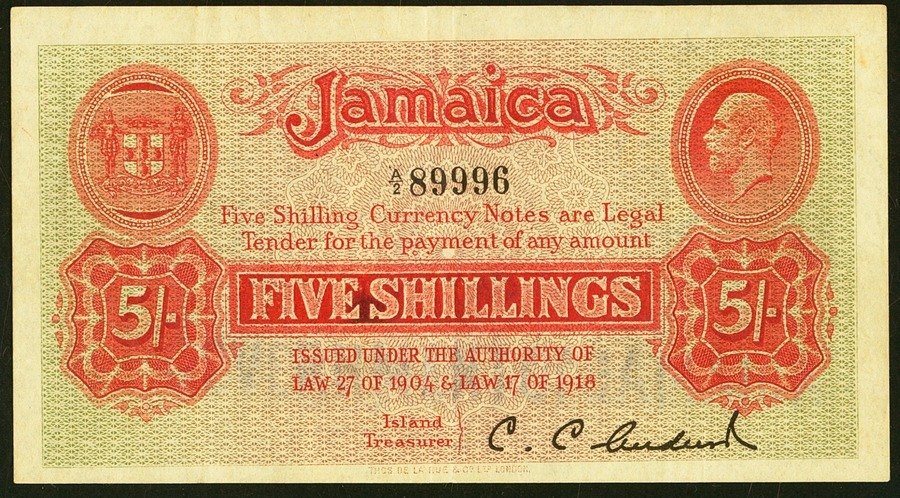
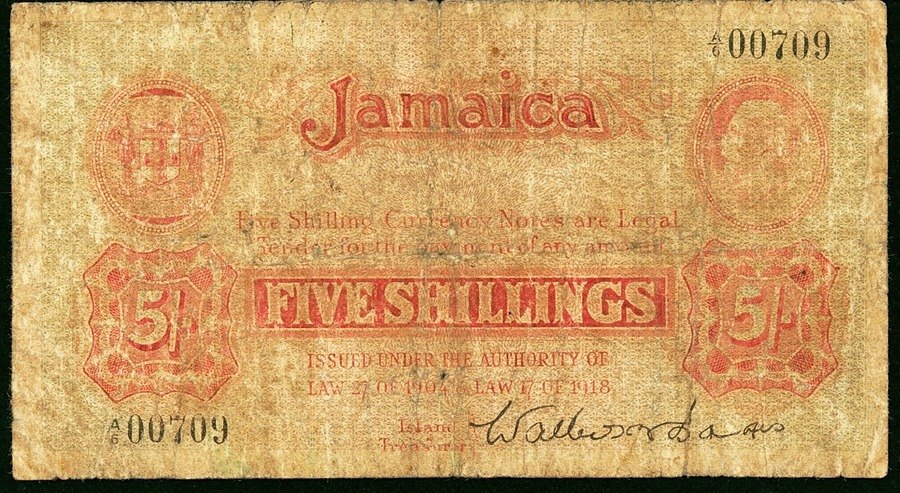
For the 10 shillings, the annual reports give 74,475 pounds issued by the end of 1920 and 53,640 pounds still out in 1921, that is 148,950 and 107,280 notes. Both are more than the 100,000 numbers of one prefix. Ian Marshall had seen no Anderson or Fraser note with A/2, and the Fraser notes begin at A/3, so notes with prefix A/2 were most likely paid out in 1920 or 1921 with Anderson's signature, though none has been seen. For the Fraser notes, Stack's Bowers (2 October 2024, lot 20509) says fewer than two dozen are thought to exist, at least a handful of them in institutional collections, which is close to Ian Marshall's count of twenty.
The Waterlow notes, 1931
| Note | Marshall's estimate | Notes Marshall recorded | Lot |
|---|---|---|---|
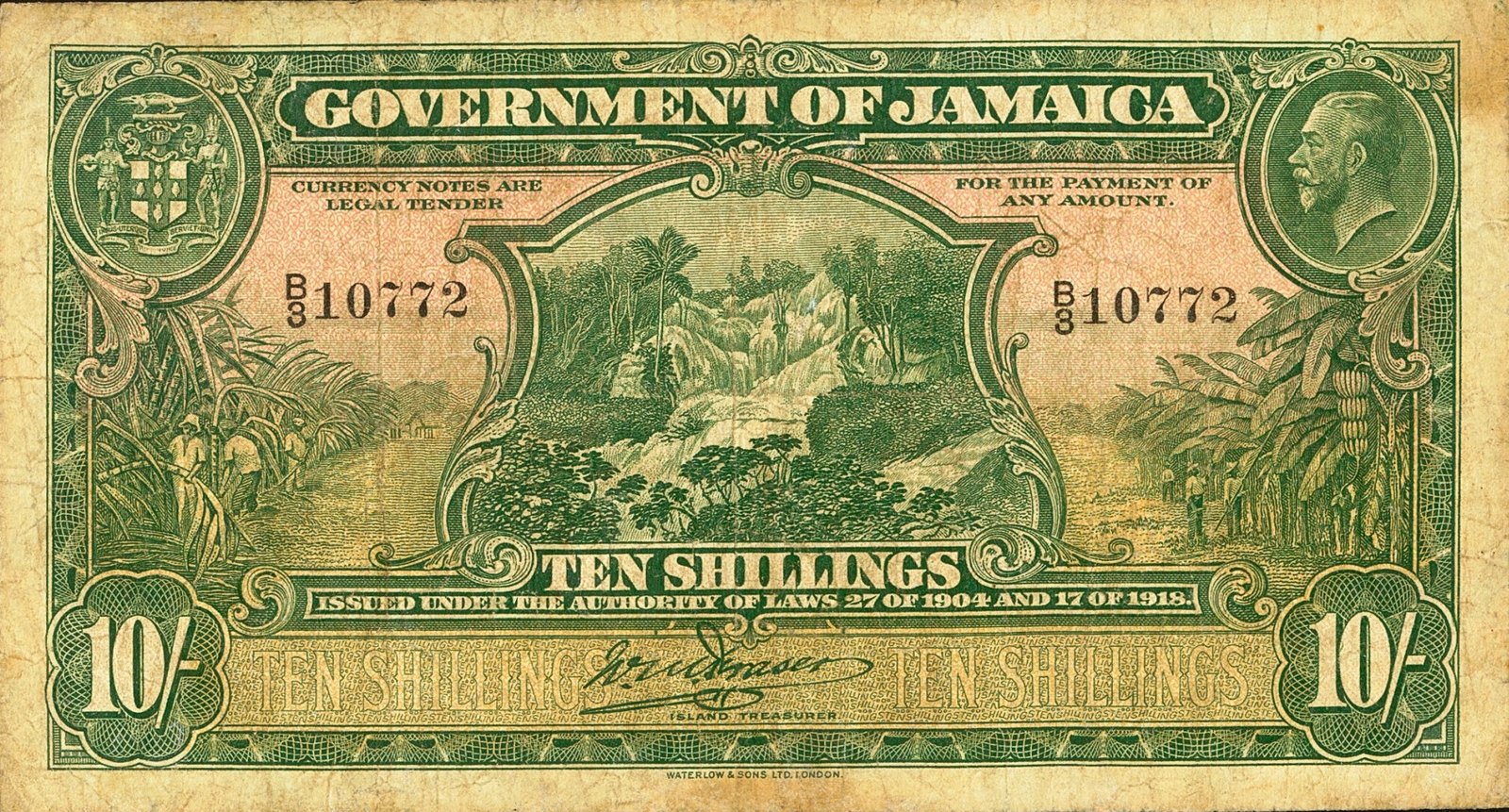
| 5 shillings, Fraser | 500,000 | eighteen | 8009 |
| 5 shillings, Hodges | 200,000 | not given | 8011 |
| 10 shillings, Fraser | 500,000 | seventeen | 8012 |
Heritage gives the same two figures for the 5 shillings, as notes issued: about 500,000 with Fraser's signature, on prefixes B/1 to B/5 (28 March 2025, lot 24335), and about 200,000 with that of Hodges (8 March 2024, lot 24342).
The George VI notes, 1939 to 1958
5 shillings
The 5 shillings of 1939 to 1958 has the longest run of dates.
| Date and form | Marshall's estimate | Lot |
|---|---|---|
| 2nd January 1939 | 1,100,000 | 8018 |
| 1st November 1940, large serial number | 500,000 | 8022 |
| 1st November 1940, small serial number | 3,900,000 | 8023 |
| 30th November 1942 | 500,000 | 8026 |
| 2nd January 1948, fractional prefix | 300,000 | 8029 |
| 2nd January 1948, number-letter prefix | 1,300,000 | 8031 |
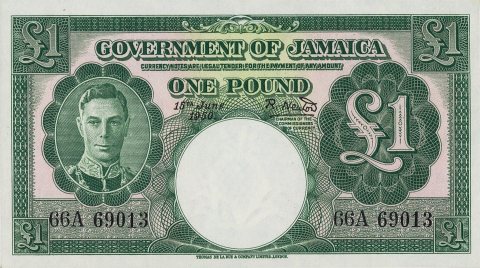
| 15th June 1950, first serial form | 3,300,000 | 8034 |
| 15th June 1950, second serial form | 200,000 | 8036 |
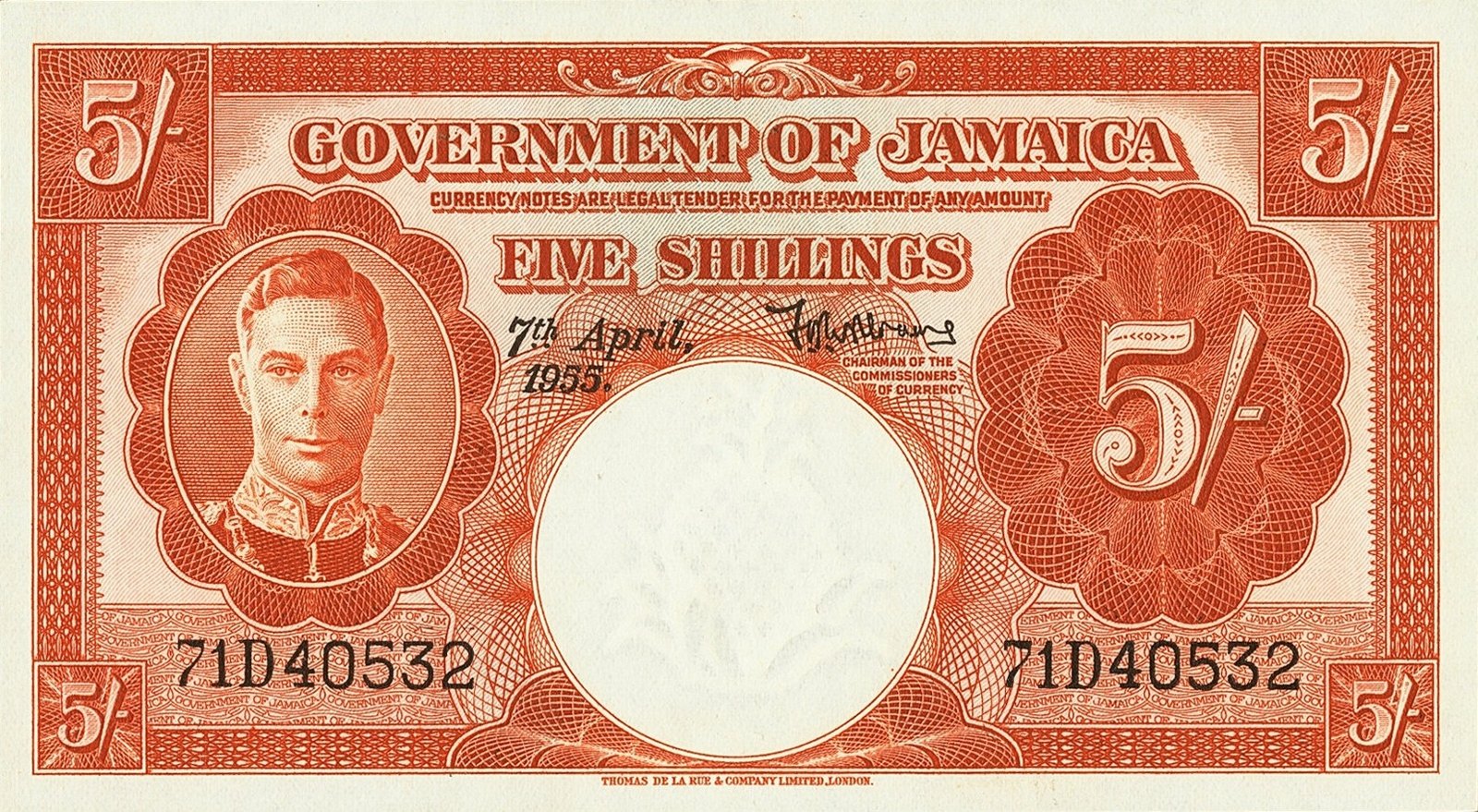
| 7th April 1955 | 3,700,000 | 8042 |
| 27th May 1957 | 2,700,000 | 8045 |
| 15th August 1957 | 2,450,000 | 8047 |
| 15th August 1958 | 2,150,000 | 8050 |
The Pick page carries no estimate for the date 1st March 1953. Ian Marshall recorded seven notes each of the 1942 date, the fractional 1948 notes and the second 1950 form, and saw no notes with prefixes C/17 to C/25. Ian Marshall links the large wartime printings to Allied service personnel on the island, and the later ones to tourism.
10 shillings, blue and purple
| Note and date | Marshall's estimate | Lot |
|---|---|---|
| Blue 10 shillings, 2nd January 1939 | 500,000 | 8056 |
| Blue, 30th November 1942 | 500,000 | 8063 |
| Blue, 2nd January 1948 | 800,000 | 8066 |
| Purple 10 shillings, 15th June 1950, narrow serial | 1,000,000 | 8072 |
| Purple, 15th June 1950, wide serial | 1,100,000 | 8073 |
| Purple, 1st March 1953 | 1,950,000 | 8075 |
| Purple, 7th April 1955 | 4,350,000 | 8078 |
| Purple, 15th August 1958 | 1,850,000 | 8082 |
| Purple, 17th March 1960 | 550,000 | 8086 |
The Pick page carries no estimate for the blue notes of 1st November 1940. What is known of that date is the lost consignment: 290,000 notes on prefixes C/6 to C/11 were on the SS Politician in February 1941. Ian Marshall saw no 1st November 1940 notes with prefixes C/12 to C/21, and thought that, if printed, they were probably never issued.
1 pound
| Note and date | Marshall's estimate | Lot |
|---|---|---|
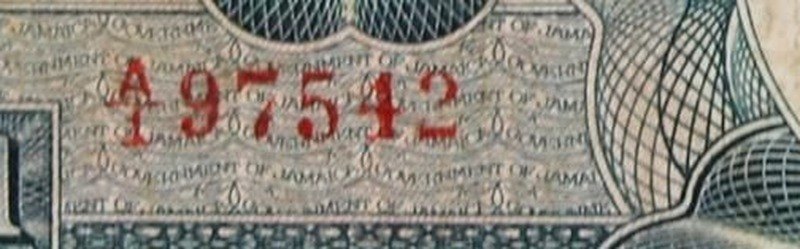
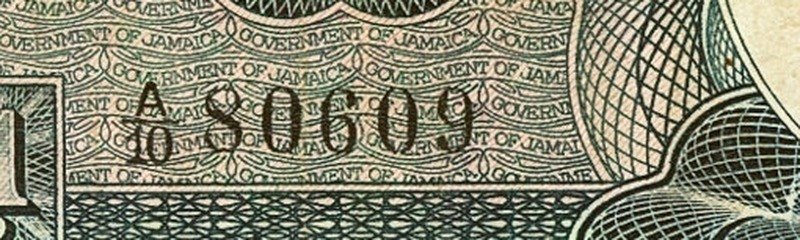
| 1 pound of 1940, red serial numbers | 1,300,000 | 8089 |
| 1 pound of 1940, black serial numbers | 150,000 to 200,000 | 8092 |
| 1 pound of 1942 to 1960, 30th November 1942 | 1,750,000 | 8094 |
| 2nd January 1948, fractional prefix | 750,000 | 8099 |
| 2nd January 1948, number-letter prefix | 1,100,000 | 8101 |
| 15th June 1950, first serial style | 1,700,000 | 8105 |
| 15th June 1950, second serial style | 1,700,000 | 8107 |
| 1st March 1953 | 3,100,000 | 8111 |
| 7th April 1955 | 4,100,000 | 8114 |
| 27th May 1957 | 2,350,000 | 8118 |
| 15th August 1957 | 2,830,000 | 8120 |
| 17th March 1960 | 1,080,000 | 8127 |
The Pick page carries no estimate for the date 15th August 1958. Ian Marshall (lot 8092) says it is not known why black was used for part of the 1940 run, and recorded black serial numbers only on prefixes A/9 and A/10. Heritage (8 March 2024, lot 24347) repeats the figure of 150,000 to 200,000 and the same two prefixes.

5 pounds
| Note and date | Marshall's estimate | Lot |
|---|---|---|
| 5 pounds of 1942, 30th November 1942 | 100,000 | 8133 |
| 5 pounds of 1952 to 1957, 1 August 1952 | about 90,000 | 8138 |
| 7 April 1955 | 210,000 | 8140 |
| 15 August 1957 | 30,000 to 40,000 | 8143 |
| 1 September 1957 | 260,000 | 8145 |
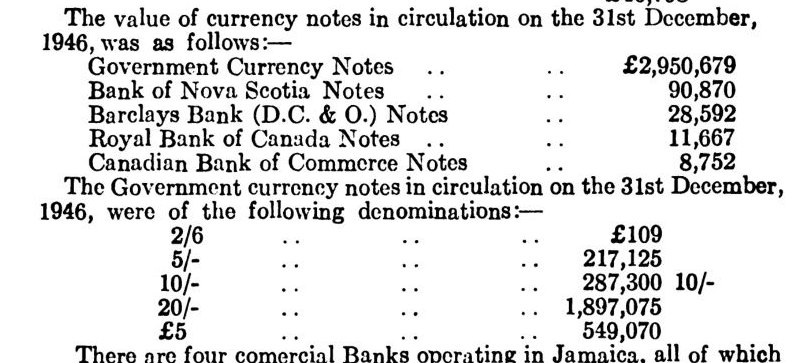
For the 1942 note Ian Marshall knew of about a dozen serial numbers, three of them in institutional collections. Heritage (8 March 2024, lot 24349) says specimens are known with prefixes A/1 and A/2 but issued notes only with A/1, so perhaps no more than 100,000 were issued, and Stack's Bowers (28 April 2022, lot 30200) also gives perhaps as few as 100,000. The annual reports point a little higher: they give 549,070 pounds in 5 pounds notes in circulation on 31 December 1946, that is 109,814 notes, when no other Government 5 pounds was current. That is more than the 100,000 numbers of prefix A/1, so notes with a second prefix were most likely paid out, though none has been seen.
The estimate for 1 August 1952 is judged from the serial numbers seen on the next date. Of the 15 August 1957 date Ian Marshall knew four issued notes. Heritage (24 April 2020, lot 26146) puts the whole type at 500,000 or fewer issued, judged from the known prefixes and dates; Ian Marshall's four figures add up to between 590,000 and 600,000.
The notes of 1960
| Note | Marshall's estimate | Lot |
|---|---|---|
| 5 shillings, 17 March 1960 | 4,000,000 | 8149 |
| 10 shillings, 4th July 1960 | 3,200,000 | 8157 |
| 1 pound, 19th May 1960 | 2,000,000 | 8162 |
| 5 pounds, 17th March 1960 | about 200,000 | 8169 |
| 5 pounds, 4th July 1960 | about 1,800,000 | 8171 |
For the 5 pounds, Heritage gives the same two figures (8 December 2023, lot 22262, and 8 March 2024, lot 24353), with the July notes beginning at prefix 11A. This fits the prefixes at 100,000 numbers each: two, 9A and 10A, for March and eighteen, 11A to 28A, for July.
The Bank of Jamaica, 1961 to 1967
| Note and variety | Marshall's estimate | Lot |
|---|---|---|
| 5 shillings, Latin motto | 800,000 | 8175 |
| 10 shillings, Latin motto | 500,000 | 8179 |
| 1 pound, Latin motto | 2,550,000 | 8182 |
| 5 shillings, English motto, Payton, variable-weight serial | about 1,000,000 | 8185 |
| 5 shillings, Payton, monoweight serial | about 1,000,000 | 8187 |
| 5 shillings, Hall, Acting Governor | about 1,000,000 | 8189 |
| 5 shillings, Brown | 1,700,000 | 8191 |
| 10 shillings, English motto, Payton, variable-weight serial | 600,000 | 8195 |
| 10 shillings, Payton, monoweight serial | 300,000 | 8196 |
| 10 shillings, Hall, Acting Governor | 1,050,000 | 8197 |
| 10 shillings, Brown | 900,000 | 8201 |
| 1 pound, English motto, Payton, variable-weight serial | 2,250,000 | 8204 |
| 1 pound, Payton, monoweight serial | 3,000,000 | 8207 |
| 1 pound, Hall, Acting Governor | 2,100,000 | 8208 |
| 1 pound, Hall, Governor | 2,100,000 | 8210 |
| 1 pound, Brown | 3,700,000 | 8212 |
| 5 pounds, Payton, variable-weight serial | 400,000 | 8216 |
| 5 pounds, Payton, monoweight serial | 400,000 | 8218 |
| 5 pounds, Hall, Governor | 200,000 | 8222 |
| 5 pounds, Brown | 500,000 | 8224 |
The Pick page carries no estimate for the 10 shillings signed by Hall as Governor. Heritage repeats the figure of about 400,000 for the first Payton 5 pounds, on prefixes JA to JD (17 October 2024, lot 24286), and gives perhaps as few as 200,000 for the Hall 5 pounds (8 March 2024, lot 24360).
Printed after the date
De La Rue wrote notes on its specimens, and the specimens in the sale of 3 November 2023 show that a date on a Government note is not the day it was printed. A date stayed in use long after the day it bears.
| Note and date on it | What the printer's notes show | Lot |
|---|---|---|
| 5 shillings, 2nd January 1939 | still being printed in June 1940 | 8021 |
| 5 shillings, 1st November 1940 | printed in October and December 1941 | 8024, 8025 |
| 5 shillings, 2nd January 1948 | printed in June 1949 | 8033 |
| 5 shillings, 15th June 1950 | printed in February 1952 | 8037 |
| 10 shillings, 15th June 1950, wide serial | printing date 26 February 1952 | 8074 |
| 1 pound, 2nd January 1948 | printed in June 1949 | 8104 |
| 1 pound, 15th June 1950 | printed in February 1952 | 8110 |
| 5 pounds, 30th November 1942, prefix A/2 | a printing date in 1948 | 8135 |
| 5 shillings, 17 March 1960 | printing dates from 24 June to 12 September 1960 | 8150 to 8155 |
| 10 shillings, 4th July 1960, prefix 87D | 6 December 1960 | 8161 |
| 1 pound, 19th May 1960 | printing dates from 24 June to 12 September 1960 | 8163 to 8167 |
A new date often began on the last prefix of the one before, as at 19D, 22D, 9E and 34E on the 5 shillings.
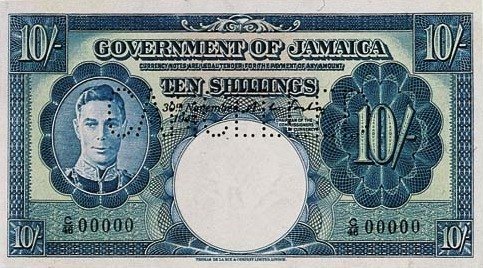
Three further marks of the printer bear on the order of the work. The 1st March 1953 specimens of the 1 pound and of the 10 shillings carry the same requisition and order numbers (lots 8112 and 8076), so both values were ordered together. One 10 shillings specimen of 4th July 1960 is marked NEW DATE by the printer (lot 8159); the specimens of that date in the sale carry prefixes 62D, 67D and 87D. And World Banknote Auctions (lot 8168) says the printer marked the later prefixes of the 1 pound of 1960 as reprints, so they came from a second printing order.
The undated Bank of Jamaica notes can be dated the same way. A 1 pound specimen on prefix BS, inside the band of the first Payton printing with the English motto, carries a printing date of 16 August 1963 (lot 8206), which fits a 1963 start, the year of the newspaper notice that World Banknote Auctions (lot 8207) dates 19 March 1963. The printer's notes on Brown specimens of the 1 pound (prefix FL, lot 8213) and of the 5 pounds (prefix JN, lot 8226) both give 21 June 1967. Sources mention that Brown became Governor on 1st July 1967, ten days later.
Proofs, approval dates and a set-up sheet
Proofs in the same sale carry the dates on which the designs were approved.
- A proof of the 1 pound of 1940 carries the approval date 15/1/40 on its top border (lot 8093). The notes are dated 1st November 1940.
- A proof of the 1 pound of 1942 carries the approval date 2/2/42 and a File stamp (lot 8131).
- A 1 pound proof printed in maroon is marked as approved for the colour of the 5 pounds, dated 7/1/43 (lot 8132), which shows how the colour of the 5 pounds was chosen.
- A uniface front proof of the 5 pounds carries the approval date 10/3/43 and a File stamp (lot 8136). The note itself is dated 30th November 1942, so the date on the 5 pounds is earlier than the approval of its proof.
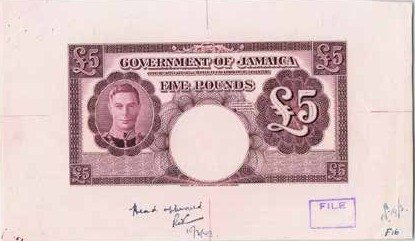
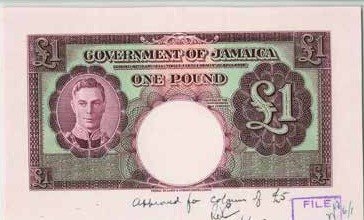
World Banknote Auctions (lot 8138) says the 5 pounds of 1952 changed the colours of the 1942 note but kept its design.
A De La Rue set-up sheet in the sale (lot 8071) carries the front of the blue 10 shillings on one side and the front of the East Africa 1 shilling of 1943 on the other, so both were on the presses at the same time.
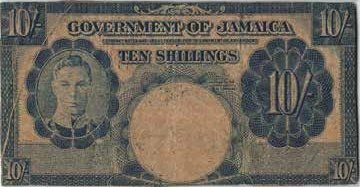
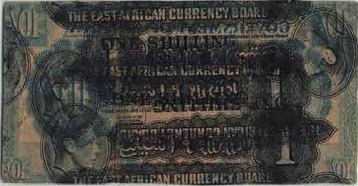
The 30th November 1942 specimens of the 10 shillings all carry prefix C/46, a prefix not seen on issued notes: the piece Christie's sold on 3 May 2001 (lot 407) and the two in the World Banknote Auctions sale (lots 8064 and 8065). World Banknote Auctions (lot 8016) says the specimens of the 5 and 10 shillings dated 1st May 1937 were probably printed late in 1938; that date was never used, but the design was.
One 5 shillings specimen of 1960 on prefix 64E (lot 8154) is marked "New Design on Back - Plasto-Processed Paper". Ian Marshall takes this for a trial of a more durable treated paper. Whether issued notes were printed on it is not known.
Numbering heads, a duplicate number and replacements
Two dates of the George VI notes come in two serial styles. World Banknote Auctions (lot 8034) calls the two forms of the 15th June 1950 5 shillings narrow and wide serial numbers, from different numbering wheels, and says of the 10 shillings of the same date (lot 8073) that the numbering heads were changed part-way through the printing. The Payton notes of the Bank of Jamaica are likewise divided into a first printing with a variable-weight serial number and a second with a monoweight one. Heritage (10 November 2023, lot 24399, and 28 March 2025, lot 24336) points out that the Standard Catalog letters the two Payton 5 pounds the wrong way round, the variable-weight notes on JA to JD being the earlier.
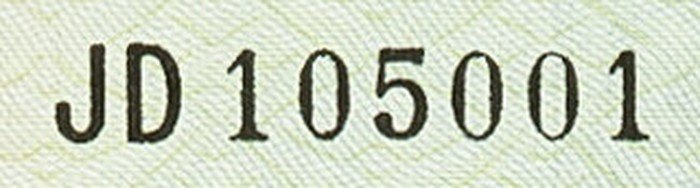
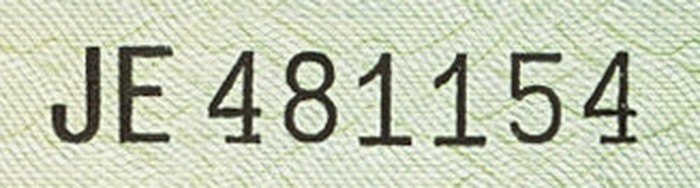
World Banknote Auctions (lot 8211) offered two different 1 pound notes signed by Hall as Governor with the same serial number, EP 017555. It quotes Peter Huntoon's suggestion that the numbering was restarted one number too soon after spoiled sheets were replaced, so that such a pack holds more than 100 notes. No replacement prefix is recorded on the notes of the pound currency; sources mention that until the dollar notes of 1969 a spoiled note was made good by printing its serial number again.
Two questions about prefixes stay open. Ian Marshall (lot 8078) notes that prefix 49D is known on issued purple 10 shillings dated 15th August 1958, and asks whether the 7th April 1955 specimens on 49D were given a wrong prefix in error. And Ian Marshall (lot 8086) recorded issued 17th March 1960 10 shillings only from 57D to 61D, while the specimens of that date are on 56D.
Sources
- World Banknote Auctions, the Isabella Chang Fong and Ian Marshall Collection of Jamaican Banknotes, 3 November 2023, lots 8001 to 8226 as cited, with Ian Marshall's commentary and the printer's notes on the specimens and proofs.
- The Handbook of Jamaica for 1923, for the 2 shillings 6 pence put out.
- The annual reports on Jamaica, for the 10 shillings of 1920 and 1921 and the 5 pounds in circulation on 31 December 1946.
- Heritage Auctions: 24 April 2020, lots 26143 and 26146; 10 November 2023, lot 24399; 8 December 2023, lot 22262; 8 March 2024, lots 24340, 24342, 24347, 24349, 24353 and 24360; 17 October 2024, lot 24286; 28 March 2025, lots 24335 and 24336.
- Stack's Bowers: 28 April 2022, lot 30200; 2 October 2024, lot 20509.
- Christie's, 3 May 2001, lot 407.
Member comments
Log in or register to post a comment.