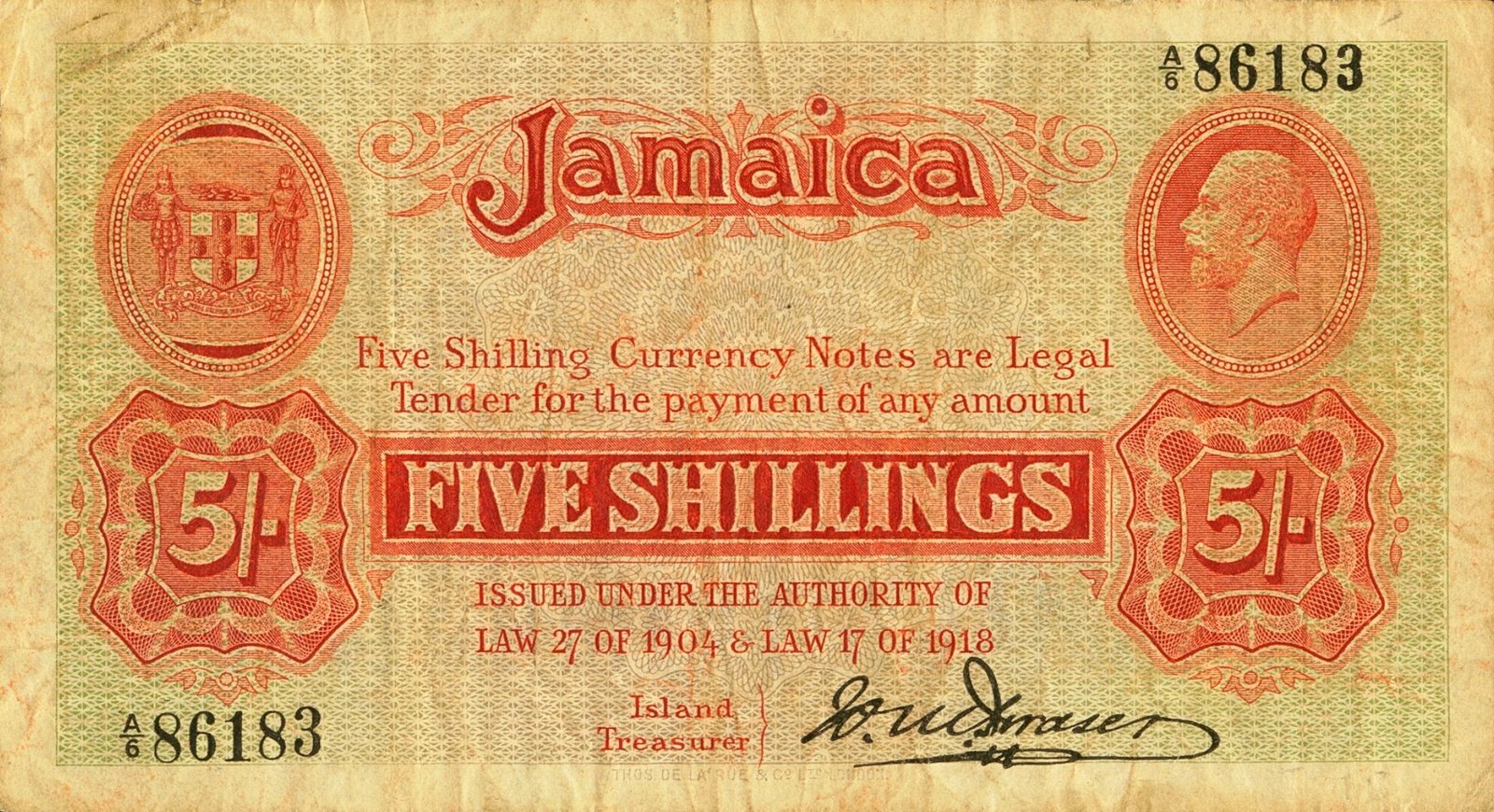
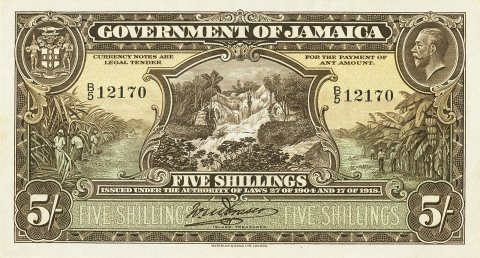
Paper money in Jamaica was governed by many more laws than the two that the first Government notes name. This article lists, in order of time, every law, proclamation and gazette notice on paper money that the official books read for the catalogue mention: the Blue Books and Handbooks of Jamaica, the annual reports, the copies of the currency laws in the Johns Hopkins currency board archive, and the gazettes of the eastern Caribbean. It covers the Government's notes, the banks' notes and the British and Eastern Caribbean notes that were legal tender in the island. The text of most of these laws has not been read; what each did is given as the source describes it. Dates read in the text of a scan only, and not on the page, are marked so.
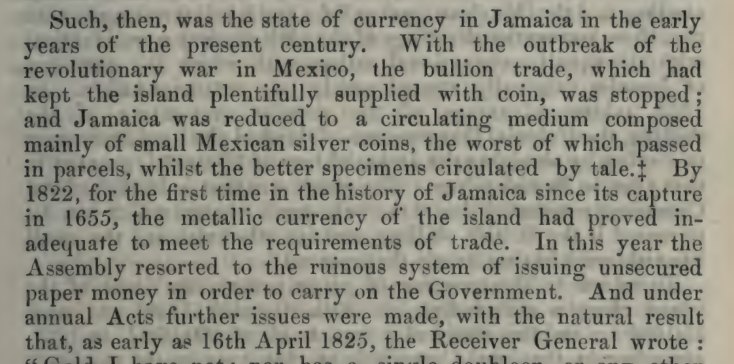
Before the Government notes
| Date | Law or notice | What it did, as the source puts it | Source |
|---|---|---|---|
| 1822 and after | annual Acts of the Assembly | unsecured paper money, the "island cheques", over 350,000 pounds out in 1828 | Chalmers, A History of Currency in the British Colonies (1893), pp. 109-110; the 1828 figure read on the page image |
| 1866 and 1867 | (no law named) | the old "Island Notes" called in; 344 pounds 14 shillings still outstanding in 1867, no longer listed from 1870 | Blue Book for 1867, text only |
| 1880s, under Governor Norman | report of a Select Committee of the Legislative Council | proposed Government notes of 4, 8, 12, 16 and 20 shillings to pay commuted salaries; the plan was dropped | Handbook of Jamaica for 1890-91, text only |
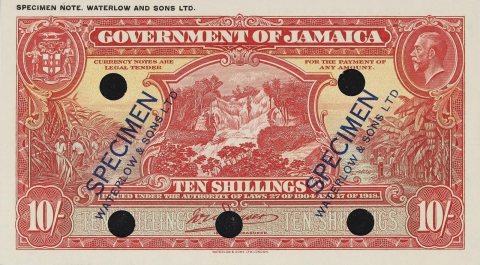
| 22nd September 1904 | Law 27 of 1904, the Currency Note Law, 1904 | a Board of Commissioners of Currency; notes of 10 shillings only; in force after a proclamation of non-disallowance | the Law, Johns Hopkins archive copy, text only |
The island cheques are told in the first article on Jamaica's notes. No note was issued under Law 27 of 1904 for sixteen years. The Handbook of Jamaica for 1908 says "No action has yet been taken under this law", and the Handbooks to 1918 repeat it; every Blue Book from 1896-97 to 1917-18 returns the Government paper money as "None".
War, the banks and the British notes, 1914 to 1920
| Date | Law or notice | What it did, as the source puts it | Source |
|---|---|---|---|
| 1914 | Law 36 of 1914 | let the Governor make certain bank notes legal tender | Blue Book for 1914-15, text only |
| 20th August 1914 | Proclamation, Extraordinary Gazette, under Law 36 of 1914 | the notes of the Colonial Bank, the Bank of Nova Scotia and the Royal Bank of Canada, of 1, 5 and 10 pounds, made legal tender | Handbook of Jamaica for 1918 and Blue Book for 1914-15, both text only |
| 1917 | Law 2 of 1917 | British currency notes (the Treasury's 1 pound and 10 shillings) made legal tender in Jamaica and its Dependencies | Blue Book for 1917-18 and Handbook of Jamaica for 1927, both text only |
| 1917 | Law 3 of 1917 | amended Law 36 of 1914 | Blue Book for 1917-18, text only |
| 19th September 1918 | Law 17 of 1918 | a new Board of three appointed by the Governor; notes of any value the Secretary of State approves | the Law, Johns Hopkins archive copy, text only |
| 3rd July 1919 | Gazette Notice No. 457 | ended the legal tender of the banks' notes under the proclamation of 1914 | Handbook of Jamaica for 1922 and 1926, text only |
| January 1920 | Law 2 of 1920, the Currency Note Amendment Law | British Treasury notes count as current coin for the Currency Note Laws of 1904 and 1918: Jamaica notes could be issued against them and paid in them | Handbook of Jamaica for 1921 and the Law, Johns Hopkins archive copy, both text only |
The Blue Book for 1917-18 prints the two dates 1st May and 19th May against Law 2 of 1917; the text that was read does not show which is the date of the Law. For Law 2 of 1920 the sources give two days. The copy in the Johns Hopkins archive is dated 9th January 1920. The list of laws in the Blue Book for 1920 has 31st January 1920, read in the text only, in a column whose heading was lost; it may be the day the Law was sent to London. Both are before the first notes went out on 15th March 1920.
The Handbook of Jamaica for 1921 says the Commissioners had to put the Law of 1904 into force at once in 1920 because silver was short. The Handbook for 1919 had planned notes of 5 and 10 shillings only; the 2 shillings 6 pence was added later.
The Note Guarantee Fund and the new law, 1922 to 1939
| Date | Law or notice | What it did, as the source puts it | Source |
|---|---|---|---|
| 3rd November 1922 | Proclamation | fixed the coin part of the Note Guarantee Fund | Blue Book for 1922, text only |
| 27th September 1930 | Proclamation | fixed the coin part of the Note Guarantee Fund | Blue Book for 1930, text only |
| 1933 | Law 13 of 1933 | further amended the Currency Note Law, 1904 (the list gives 18th July 1933, perhaps the day sent to London) | Blue Book for 1933, text only |
| 1st August 1933 | (no law named) | British Treasury notes ceased to be legal tender in Jamaica | An Economic Survey of the Colonial Empire (1932), Colonial No. 95, p. 291: page image, the date read in the text |
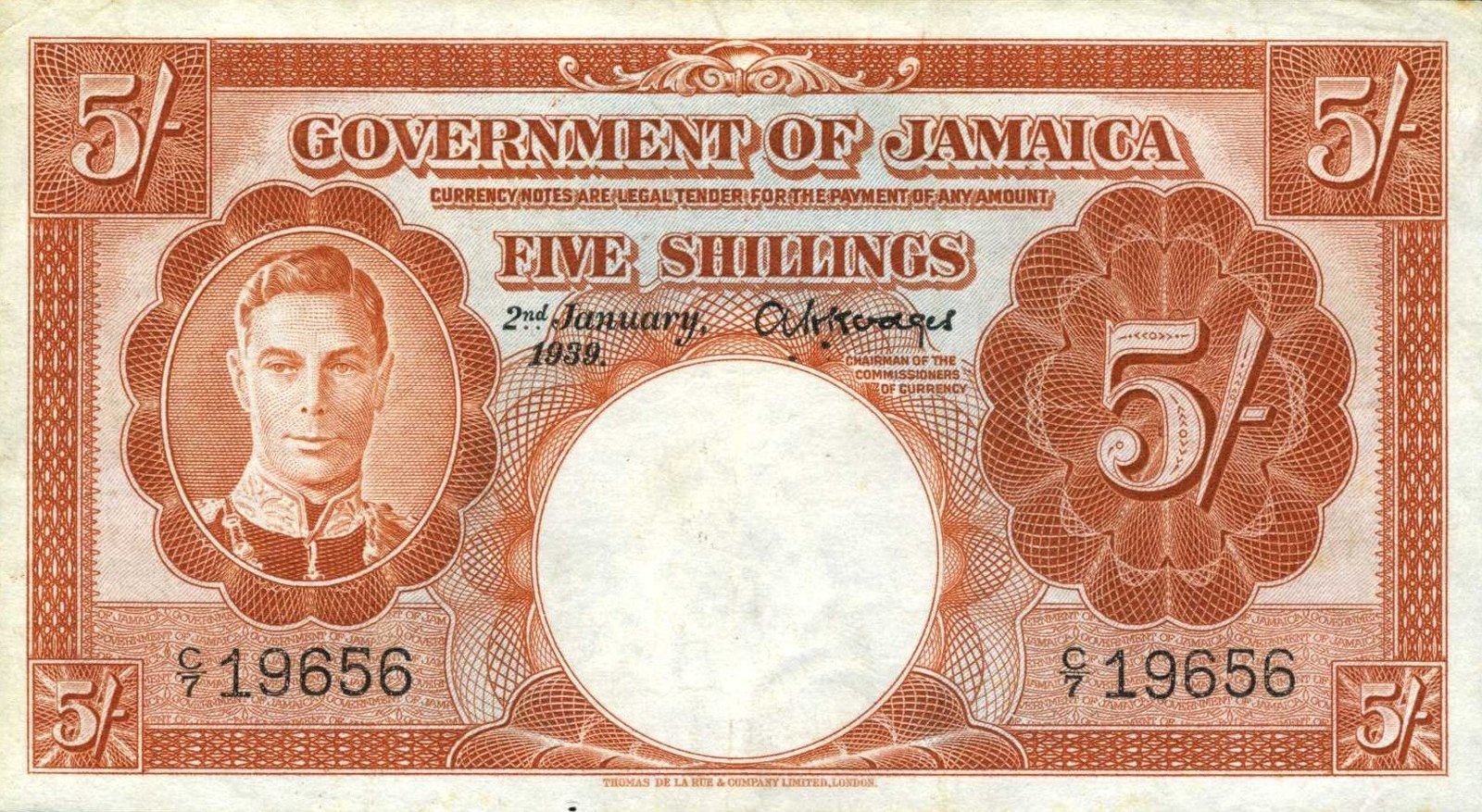
| 1937 | Law 9 of 1937, the Currency Notes Law 1937 | "A Law to make Provision for Currency Notes of Jamaica and to place the Issue of such Currency Notes upon a Permanent Basis" | Blue Book for 1937, list of Laws, text only |
| 17th December 1938 | Proclamation | brought Law 9 of 1937 into operation | Blue Book for 1938, list of Proclamations, text only |
| 1939 | Bank Notes (Bank of England) Legal Tender Law 1939 | made Bank of England notes legal tender, as a wartime measure | report on Jamaica for 1958, text only |
| 13th October 1939 | Proclamation, Jamaica Gazette of 17th October 1939 | made the banks' notes legal tender again, under the Bank Note Law, Chapter 276 | Handbook of Jamaica for 1947-48, text only |
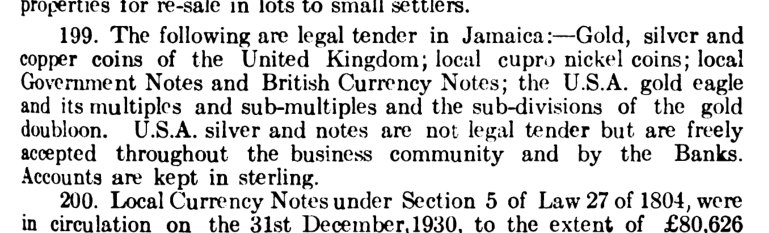
The reports for 1933 and 1936 say the Government notes were legal tender "under Section 5 of Law 27 of 1904"; the reports for 1930 and 1931, read on the page, print "Law 27 of 1804". The Johns Hopkins working paper "Jamaica's Currency Board, 1920-1961, and a Comparison with its Central Bank" (Studies in Applied Economics, No. 136, pp. 3-4) names the law of 1937 as Nos. 9 and 27 of 1937, says it let the Commissioners issue 1 pound and 5 pounds notes, and says that redemption changed from coin to sterling drafts on London, with a commission of 1.75 per cent. The Blue Books name Law 9 alone. The notes issued under this law begin with the 5 shillings and 10 shillings of 1939 and the 1 pound of 1940.
War and after, 1942 to 1951
| Date | Law or notice | What it did, as the source puts it | Source |
|---|---|---|---|
| 2nd June 1942 | Gazette Notice No. 49 | suspended the legal tender of Bank of England notes, by Order under the Emergency Regulations | Handbook of Jamaica for 1947-48 and report on Jamaica for 1958, both text only |
| 1943 | Law 3 of 1943, the Currency, Coinage and Legal Tender Law | the currency of the island to be the currency of Great Britain, currency notes, Jamaican coins and any bank notes the Governor declares; the currency notes legal tender to any amount | Handbook of Jamaica for 1947-48, text only |
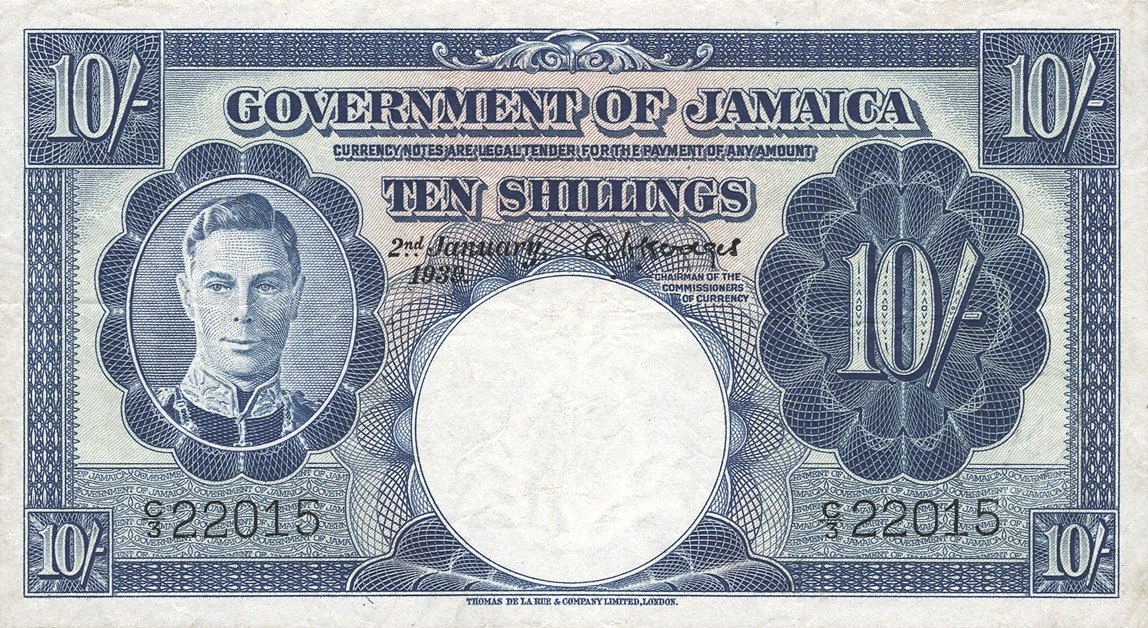
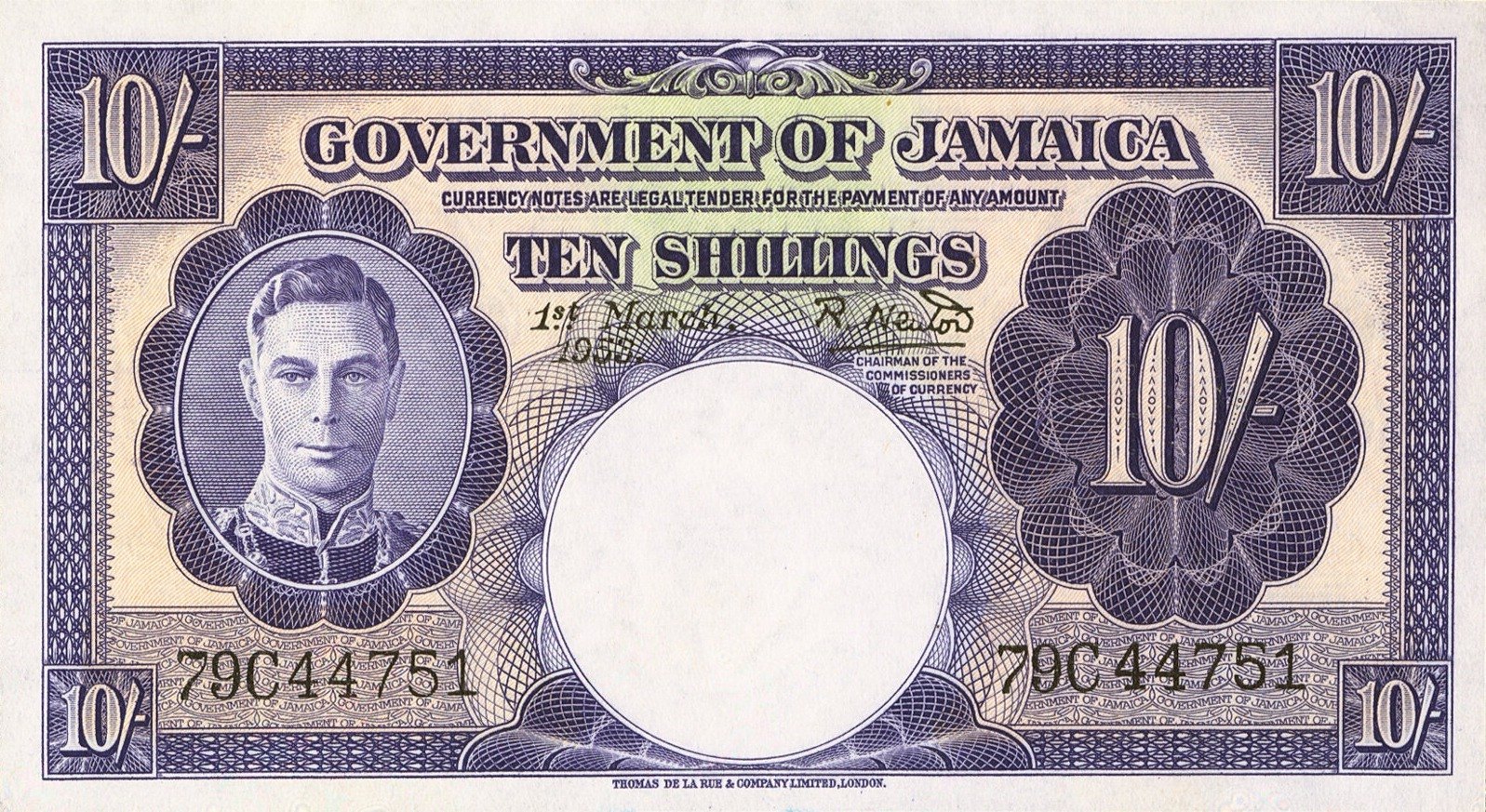
| 29th January 1951 | Proclamation, Jamaica Gazette Supplement of 8th February 1951 | the blue 10 shillings not legal tender from 1st July 1951 | report of the Commissioners of Currency to 31st March 1952, as quoted in the IBNS Journal 11:2 (December 1971), p. 106; the report itself not read |
The Handbook for 1947-48 names the law of the notes as the Currency Notes Law, Chapter 205; the Handbook for 1949-50 gives Chapter 270, and the amending Law of 1956 speaks of Cap. 88. The sources do not say why the numbers differ; they may belong to different revised editions of the Laws. The demonetisation of 1951 ended the blue 10 shillings, many of whose notes had been lost with the SS Politician in 1941; it was replaced by the same note in purple.
The end of the banks' notes, and the Eastern Group, 1954 to 1960
| Date | Law or notice | What it did, as the source puts it | Source |
|---|---|---|---|
| 1954 | Bank Notes (Amendment) Law, 1954 | under it the four commercial banks ceased to issue their own notes in the island | report on Jamaica for 1958, text only |
| 1954 | Law 51 of 1954, the Currency, Coinage and Legal Tender (Amendment) Law, 1954 | the Jamaica law for the exchange of legal tender with the British Caribbean Currency Board; the Board's notes appear among the legal tender of Jamaica in the report for 1954 | report on Jamaica for 1954, list of laws text only; Saint Vincent Government Gazette, 29th September 1955, text only |
| 1954 | Law 63 of 1954, the Currency Notes (Amendment) Law, 1954 | not described | report on Jamaica for 1954, text only |
| 1st October 1955 | a proclamation announced for each colony | Jamaica Government notes legal tender in the Eastern Group at 4 dollars 80 cents to the pound, and the Board's notes in Jamaica at 4 shillings 2 pence to the dollar | Saint Vincent Government Gazette, 29th September 1955, text only; the Board's report for 1960, how read not noted |
| 25th January 1956 | Law 1 of 1956, the Currency Notes (Amendment) Law, 1956 | struck out the word "Government" throughout section 5 of the Currency Notes Law, Cap. 88, and let up to one million pounds of the Note Security Fund go into Jamaica Government securities | the Law, Johns Hopkins archive copy, text only |
| 1958 | Law 10 of 1958, the Bank Notes (Demonetization and Redemption) Law, 1958 | demonetised the banks' notes issued before the Law of 1954, and allowed the banks' liability for notes still out to pass to the Government, except for Barclays Bank D.C.O. | report on Jamaica for 1958, text only |
| 1958 | Bank Notes (Bank of England) Legal Tender (Repeal) Law, 1958 | formally repealed the wartime law of 1939 | report on Jamaica for 1958, text only |
The working paper No. 136 (pp. 4-5) puts the law of 1954 another way: it calls it the Currency Notes Law No. 9 of 1954 and says it barred all banks but Barclays from issuing new notes, and that the law of 1958 stopped Barclays too. The report for 1958 says all four banks had ceased to issue under the Law of 1954. The two accounts are given here as they stand. How Jamaica's notes passed into the eastern Caribbean is told in Jamaica's notes beyond the island, and the banks' own notes in The banks' notes in Jamaica.
What Law 1 of 1956 meant for the notes cannot be read from the copy held: the section it changes is not in the file. The Bank of Jamaica Law, 1960, under which the Bank took over the issue, is set out in the first article on Jamaica's notes.
What is not known
- The text of Law 27 of 1904, Law 17 of 1918 and Law 2 of 1920 is known only from the archive copies as they were read in the text of the scans; the dates were not checked on the page.
- No source read gives the date of Law 9 of 1937 with certainty; the Blue Book for 1937 lists the laws with dates, but the date against Law 9 could only be matched by counting down a column.
- No source read gives a law, proclamation or notice that ended the legal tender of the 2 shillings 6 pence. The Handbook for 1923 says only that the Commissioners withdrew it from circulation in 1922.
- The proclamations that brought the exchange of legal tender into force on 1st October 1955 have not been read for Jamaica itself, and the Director of Audit of Trinidad and Tobago, reporting on the Board's accounts for 1955, had seen them only for Trinidad, British Guiana and Dominica.
Sources
- Robert Chalmers, A History of Currency in the British Colonies (London, 1893).
- The Blue Books of Jamaica for 1867, 1896-97 to 1917-18, 1920, 1922, 1930, 1933, 1937 and 1938.
- The Handbook of Jamaica for 1890-91, 1908 to 1923, 1926, 1927, 1947-48 and 1949-50.
- The annual reports on Jamaica for 1930 to 1938 (No. 1603 for 1931), and the reports on Jamaica for 1954 and 1958.
- The Economic Survey of the Colonial Empire for 1932.
- The Johns Hopkins currency board archive: the Jamaica Currency Board Constitution (1904) and its Amendments of 1918, 1920 and 1956; Studies in Applied Economics working paper No. 136, "Jamaica's Currency Board, 1920-1961, and a Comparison with its Central Bank".
- The Saint Vincent Government Gazette of 29th September 1955 (No. 445, p. 314); the Report of the Executive Commissioner of the British Caribbean Currency Board for 1960; the report of the Director of Audit of Trinidad and Tobago on the Board's accounts for 1955 (Grenada Government Gazette, 18th August 1956, p. 324).
- IBNS Journal 11:2 (December 1971), p. 106.
Member comments
Log in or register to post a comment.