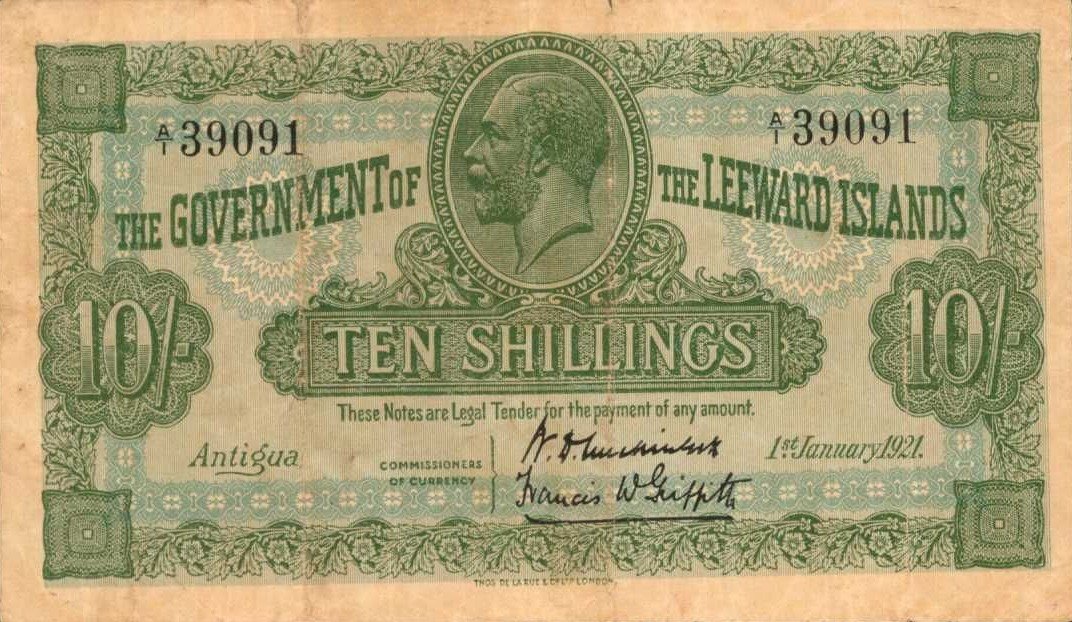
The Government of the Leeward Islands issued paper money once: notes in shillings dated 1st January 1921. This article sets out the laws behind them, the two officers who signed, how much each of the four Presidencies had in circulation and how fast the notes went. It is drawn from the catalogue's three note pages, from the Leeward Islands Gazette of 1914 to 1925, from the Colonial Office Lists and from what the auction houses wrote when the few surviving pieces were sold. The silence of the Colonial Report for 1921-22 on these notes is told in Half a crown withdrawn: the small islands' notes of 1920 and what became of them and is not repeated here.
The Acts of 1914, 1920 and 1921
The Leeward Islands Gazette shows three laws. A first Act, No. 10 of 1914, assented to on 23rd November 1914, allowed notes of 10 shillings and 5 shillings. Nothing in the Gazette shows that it was used.
In May 1920 each Presidency handed the matter of a note issue to the General Legislature of the colony. The Gazette names Antigua's Ordinance as No. 5 of 1920 and Dominica's as No. 11 of 1920. Act No. 15 of 1920, assented to on 4th August 1920, then provided for notes of ten shillings, five shillings and two shillings and sixpence. It named the Auditor General and the Treasurer of the Colony as the Commissioners of Currency. It also said:
The Act of 1920 was replaced by the Government Currency Notes Act, 1921. A Proclamation of 21st June 1921 brought that Act into operation on 1st July 1921. The Gazette shows that the 1921 Act was laid before the General Legislative Council in March 1921, which is after the date printed on the notes. The text of the 1921 Act is not among the Gazette pages read, so it is not known whether it kept the rule about the name of the Presidency.
The notes
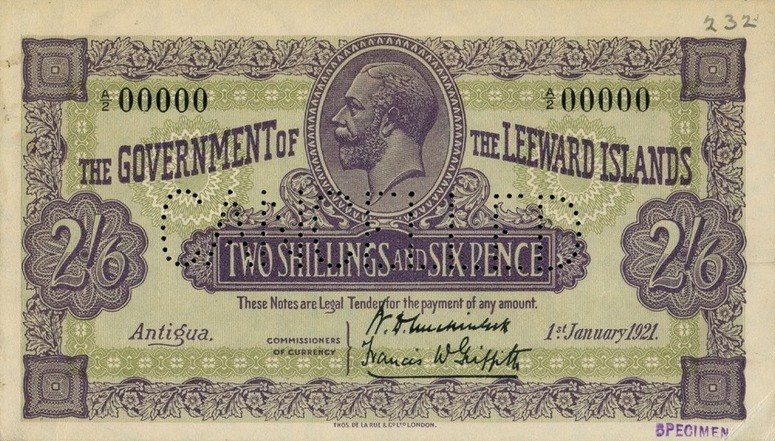
Three values were made: the 2 shillings 6 pence, the 5 shillings and the 10 shillings. All are dated Antigua, 1st January 1921. All show King George V on the front and the arms of the Leeward Islands on the back. They were printed by Thomas de la Rue, whose imprint is in the bottom margin of the 10 shillings. The Saint Lucia notes of 1920 come from the same printer with the same portrait in a different layout.
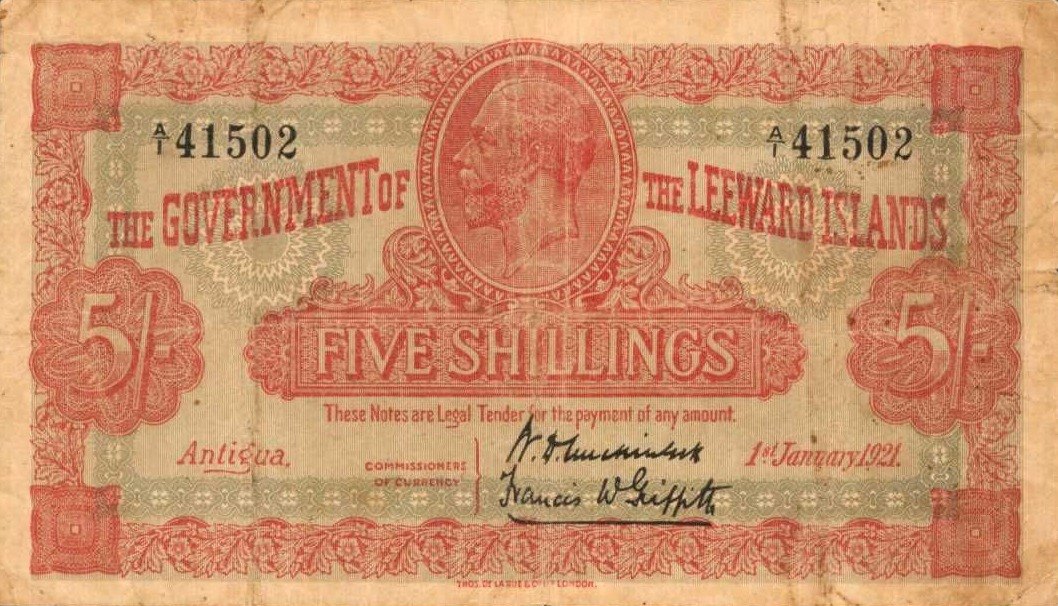
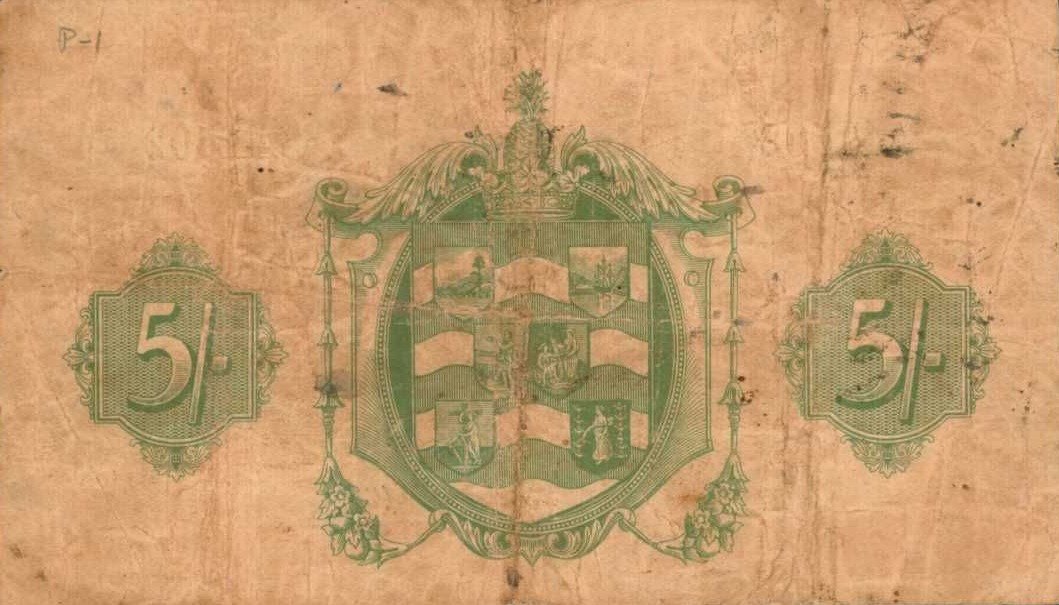
The colours are given here as the auction houses describe them. Spink (12 April 2016, lot 1411) describes the 5 shillings as red on a grey-green underprint with a green back. Stack's Bowers (5 August 2020, lot 30216) describes the 10 shillings as dark green and light blue with a light brown back. Spink (2 October 2019, lot 5) describes the 2 shillings 6 pence as purple on an olive green underprint with a blue back.
The note pages give the 5 shillings and the 10 shillings as introduced on 6 July 1921, after the Act came into operation on the 1st. The first 10 shillings, A/1 00001, was sold by Lockdales on 14 July 2012. The catalogue's line for that Lockdales sale, which gives no lot number, says that the note has "Issued 6 - 7 - 21" in pencil on the back and that it was sold by descendants of one of the two signers. Stack's Bowers (29 August 2025, lot 30305) says only that the notes entered circulation in the late summer.
The 5 and 10 shillings are recorded with the prefix A/1. For the 2 shillings 6 pence the note page says that sources give the issued note with prefix A/1 and, as the specimen shows, with prefix A/2, and that no issued note is recorded. Stack's Bowers, in the same lot description, says that only the 5 and 10 shillings are known as issued notes and thinks it likely that the lowest value was issued as well. Heritage Auctions (13 January 2022, lot 28297) calls the 2 shillings 6 pence unconfirmed as issued. The Gazette accounts give amounts in pounds only and do not divide them by value.
The two Commissioners of Currency
The notes are signed Auchinleck and Griffith. They held the two offices that the Act of 1920 made Commissioners of Currency.
The Colonial Office List for 1922 gives the record of William Douglas Auchinleck, I.S.O.: third clerk of the Treasury of Antigua on 10th June 1867, Treasurer of Nevis in 1879, of St Kitts-Nevis in 1883, of Antigua in 1893, and Auditor General of the Leeward Islands from 1st April 1907. The Colonial Office List for 1921 names F. W. Griffith as Federal Treasurer and Treasurer of Antigua. The year of that appointment is not clear in the scan of the List for 1928 that was read, so it is left out. The Gazette prints the name in full, Francis W. Griffith, under the Antigua accounts.
Notes out in four Presidencies
The quarterly accounts of the Presidencies, printed in the Leeward Islands Gazette, carry a line for the currency notes. They show notes out in Antigua, Dominica, Montserrat and St Kitts-Nevis. The figures below are the liability line of each account. Those marked with a star were read on the image of the Gazette page. The others come from the machine text of the scan and are less sure.
| Presidency | Date of the account | Currency notes outstanding |
|---|---|---|
| Antigua | 30th September 1921 | 2,000 pounds * |
| Dominica | 30th September 1921 | 3,500 pounds * |
| Montserrat | 30th September 1921 | 2,000 pounds * |
| Montserrat | 31st March 1922 | 2,750 pounds |
| St Kitts-Nevis | 30th June 1922 | 6,000 pounds * |
| Dominica | 30th September 1922 | 3,820 pounds * |
| St Kitts-Nevis | 31st March 1923 | 1,135 pounds |
| St Kitts-Nevis | 30th June 1923 | 80 pounds 5 shillings * |
| Montserrat | 30th June 1923 | 2,719 pounds 10 shillings |
| Montserrat | 31st December 1923 | 2,173 pounds 10 shillings |
| Dominica | 30th June 1924 | 745 pounds |
| Antigua | 30th September 1924 | 927 pounds 5 shillings |
| Antigua | 31st December 1924 | 927 pounds 5 shillings * |
| Montserrat | 31st December 1924 | 1,477 pounds * |
| Dominica | 31st December 1924 | 243 pounds 15 shillings |
| Dominica | 31st March 1925 | 384 pounds 5 shillings * |
| Antigua | 31st March 1925 | 557 pounds 10 shillings |
| Dominica | 30th June 1925 | 18 pounds 5 shillings |
| Antigua | 30th June 1925 | 482 pounds |
Against the notes each Presidency showed cover. Dominica's account of 30th September 1921 sets 3,500 pounds of "Remittances in transit to Crown Agents" against its 3,500 pounds of notes. Antigua's of the same date shows 2,000 pounds with the Crown Agents on account of currency notes. Montserrat's later accounts show an investment on account of currency notes, and the St Kitts-Nevis account of 30th June 1922 a security account of 4,000 pounds against 6,000 pounds of notes.
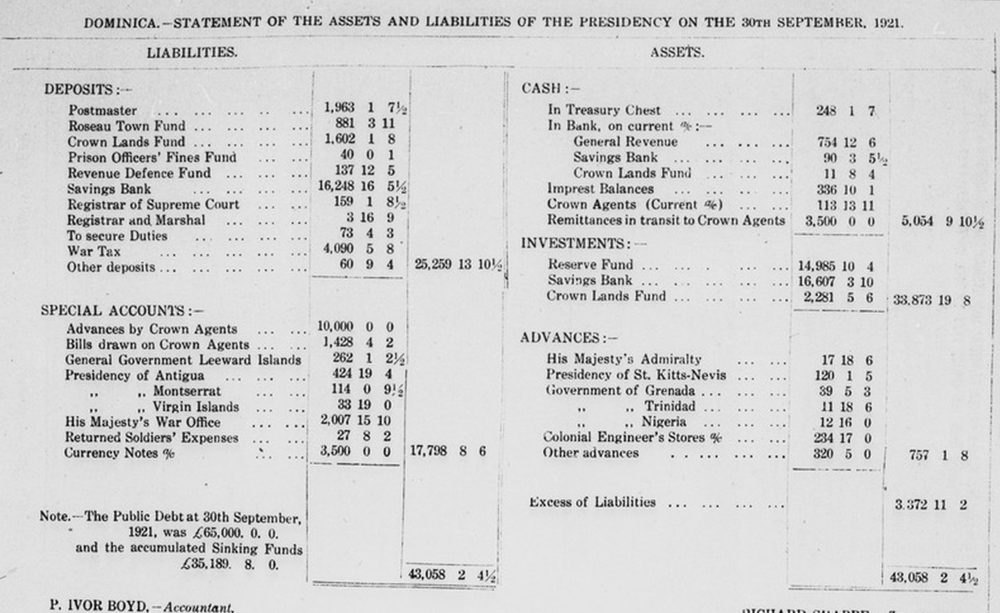
The accounts do not say how many notes of each value were sent to each Presidency, and no Gazette page read gives the number printed.
Bought in, 1923 to 1925
Regulations of 12th September 1922, signed by Auchinleck and Griffith as Commissioners of Currency and printed in the Gazette, let the Treasurer of each Presidency withdraw notes and send them to the Federal Treasurer, who was to register them by number, cancel them and destroy them.
The table shows what followed. St Kitts-Nevis, with the largest amount, had 80 pounds 5 shillings left on 30th June 1923. By the middle of 1925 only 482 pounds remained out in Antigua and 18 pounds 5 shillings in Dominica. No notice calling the notes in, and no day on which they ceased to be legal tender, was found in the Gazette. The withdrawal field of the three note pages is empty for that reason.
The banks' notes beside them
The Gazette also shows whose paper the Government notes joined. The Royal Bank of Canada was authorised in 1915 to issue notes in the Leeward Islands, with 150,000 dollars named, and was allowed a temporary increase of 25,000 dollars in St Kitts in 1920. Its issue in Dominica was raised to 100,000 dollars in February 1920. The catalogue has no pages for the banks' notes.
Stack's Bowers (29 August 2025, lot 30305) adds, as its own account, that the Colonial Bank supplied most of the paper in circulation in the islands before 1921 and that coin remained the main means of payment.
The Colonial Office annual report on the Leeward Islands for 1949 and 1950 names the colony's law for the British Caribbean Currency Board, whose notes came next: the Currency Act, No. 4 of 1950, enacted by the General Legislative Council on 20th July 1950. That story is told in The British Caribbean Currency Board and its notes, 1950 to 1968.
Every note seen is an Antigua note
Three of the four Presidencies with notes in their accounts were not Antigua, and the Act of 1920 required the name of the issuing Presidency on each note. Yet every note and specimen recorded so far reads Antigua. No note headed for Dominica, Montserrat or St Kitts-Nevis has been seen, and the catalogue has no row for one. Whether such notes were printed, or whether Antigua notes were used in all four Presidencies, is not known.
The essay of 1920 with Grenada signatures
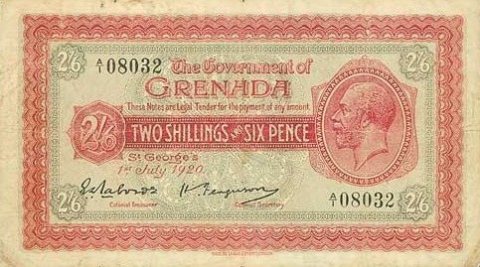
The 5 shillings page holds a hand-tinted essay of the front, dated Antigua, 1st October 1920, a date that was not used for the issue. It is annotated 4th Aug. 20, the day the Act of 1920 received assent. Its signature panels are headed Colonial Treasurer and Colonial Secretary and carry the signatures of Laborde and Ferguson. The Colonial Office List for 1921 gives Edward Daniel Laborde as Treasurer and Herbert Ferguson as Colonial Secretary of Grenada. Neither served in the Leeward Islands. The same two sign the Grenada notes of 1st July 1920, so the printer appears to have worked the Leeward essay up from a Grenada model. That story is in The Government of Grenada notes of 1920.
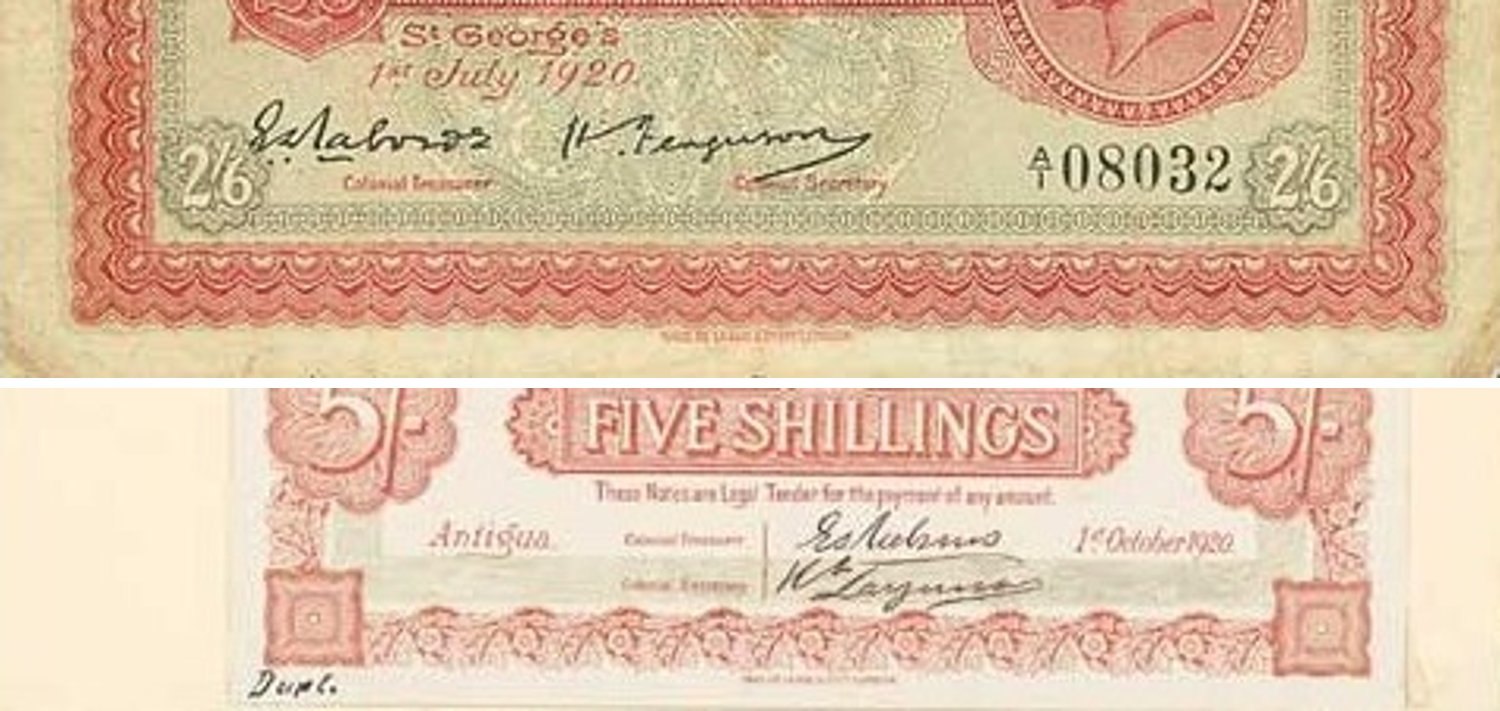
The essay carries the number A/1 09670. The catalogue records the same number on seven trial pieces that De La Rue made between 1919 and 1920 for six colonies, and reads it as a number the printer put on its own trial work, not as a serial of any note.
What survives, as each source puts it
Stack's Bowers (29 August 2025, lot 30305) says that three values were prepared, that the print totals were not recorded, and that fewer than a dozen notes are known in any form. It calls its 10 shillings specimen the plate note of the Banknote Book and says it may be the only specimen of that value to survive. Spink (29 September 2015, lot 546, and 2 October 2019, lot 5) calls the 2 shillings 6 pence specimen one of only a few in existence, if not the only one. The counts the catalogue itself keeps are on the 10 shillings page.
The issued notes have long pedigrees. Stack's Bowers sold a 5 shillings and a 10 shillings on 5 August 2020 (lots 30215 and 30216) from the Dauer Collection, and gives both as formerly in the Amon Carter and Christensen collections and as last offered by Spink in September 2009. The catalogue traces that 5 shillings back to the Albert I. Donn Collection, sold by Harmer-Rooke in New York on 5 December 1974 (lot 220). A second issued 10 shillings was sold by Henry Christensen in New York on 6 December 1975 (lot 1046) and has been in the British Museum since 1984.
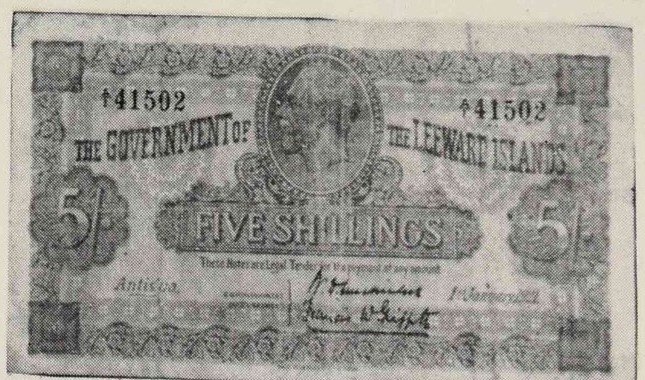
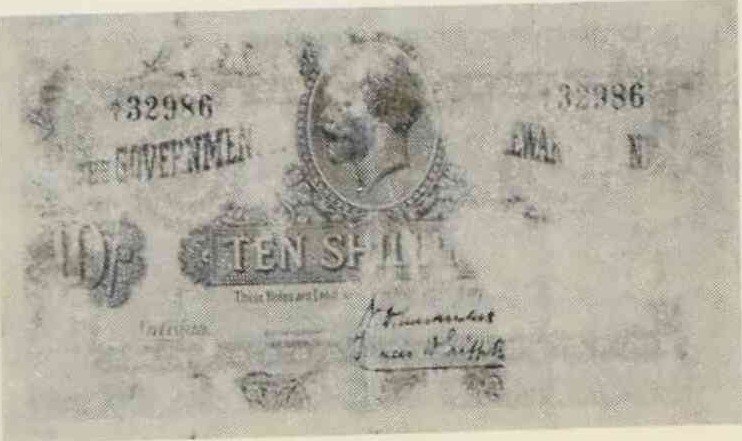
No genuine 1 pound exists. A 1 pound in this style is a fantasy made in 2007 by Fan-T-C Graphix.
What the sources do not say
- The text of the Government Currency Notes Act, 1921, and with it the values, the printer and the rule on the name of the Presidency as finally passed.
- The number of notes printed, by value or in all.
- The day of first issue in any official notice. The 6 July 1921 of the note pages is not contradicted: the Act was in force from the 1st.
- Any notice calling the notes in. Only the falling balances of 1923 to 1925 are there.
- The Currency return of the Leeward Islands Blue Books for 1921 and 1922, which should give the paper money in circulation: it is printed sideways and could not be read in the copies held.
Sources
- The catalogue's note pages for the Leeward Islands 2 shillings 6 pence, 5 shillings and 10 shillings, with their rows and sale records.
- Leeward Islands Gazette, 1914 to 1925: Act No. 10 of 1914; Act No. 15 of 1920; the Proclamation of 21st June 1921; the Regulations of 12th September 1922; the quarterly accounts of Antigua, Dominica, Montserrat and St Kitts-Nevis; the notices on the Royal Bank of Canada.
- Colonial Office List, 1921, 1922 and 1928.
- Colonial Office annual report on the Leeward Islands for 1949 and 1950.
- Stack's Bowers, 5 August 2020, lots 30215 and 30216; 29 August 2025, lot 30305.
- Spink, 29 September 2015, lot 546; 12 April 2016, lot 1411; 2 October 2019, lot 5.
- Heritage Auctions, 13 January 2022, lot 28297.
- Harmer-Rooke, New York, 5 December 1974, lot 220; Henry Christensen, New York, 6 December 1975, lot 1046; Lockdales, 14 July 2012.
Member comments
Log in or register to post a comment.