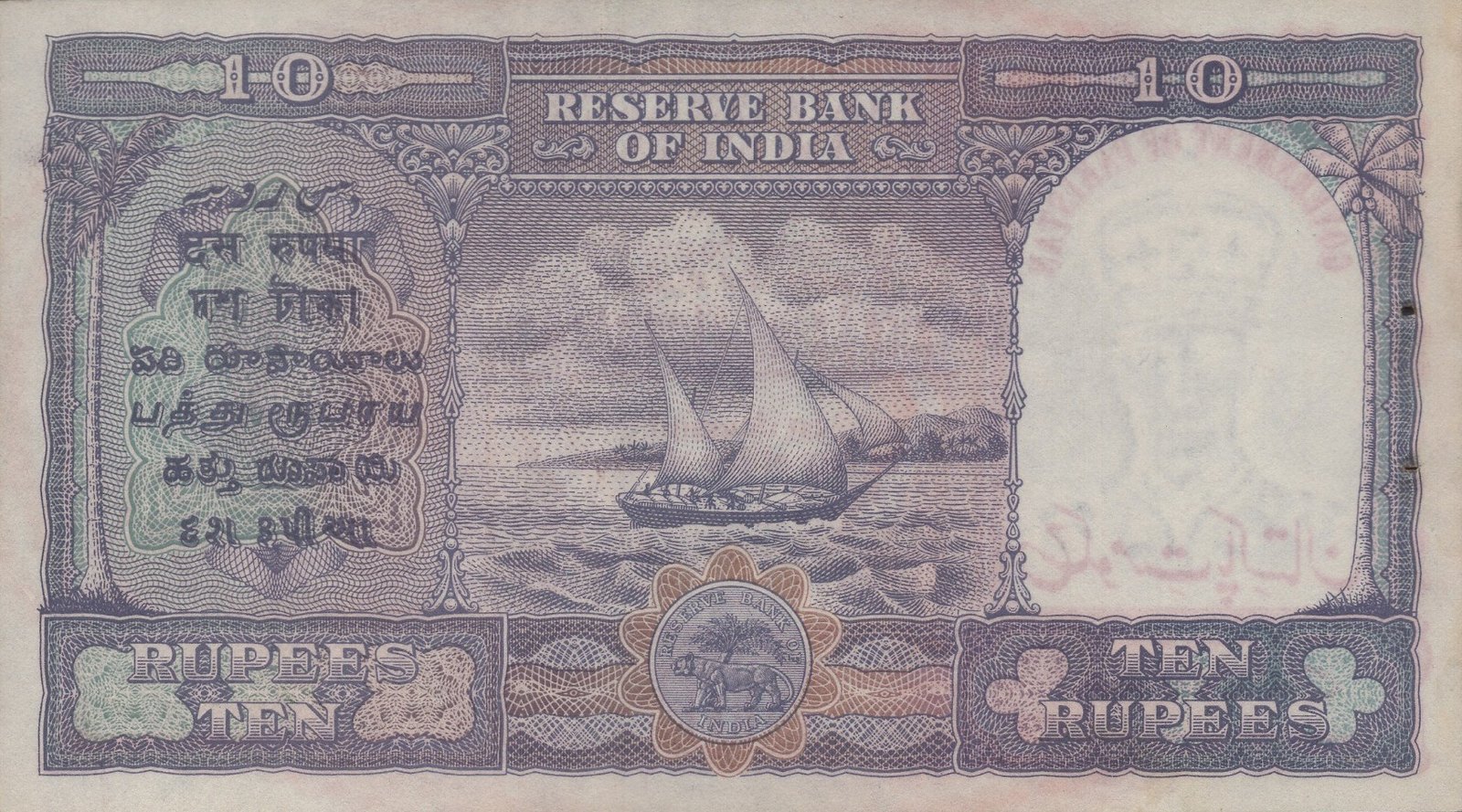
This article lists what was printed about the five notes inscribed GOVERNMENT OF PAKISTAN in the auction catalogues, journals and papers read for this catalogue: four sales of 1974 to 1993, the IBNS Journal from 1999 to 2018 and the Bank Note Reporter of August 2011. It says who wrote what, in which issue, and how each statement stands against the Reserve Bank of India's own reports. The facts of the issue are told in The Reserve Bank of India notes inscribed GOVERNMENT OF PAKISTAN, 1948 to 1952 and the altered and stamped notes in PAYMENT REFUSED: the Pakistan notes of 1948 with the inscription removed; this article does not tell them again. All the catalogues and journals were read in text copies of the scans, not on the printed page.
The writings in order
| Year | Where | Writer | What it covers |
|---|---|---|---|
| 1974 | Harmer-Rooke, the Albert I. Donn Collection, New York, 5th December 1974, lot 268 | the house | a mixed lot with a 10 rupees "overprinted on India" |
| 1981 | NASCA, the Stanley Gibbons Collection, Part II, New York, 7th December 1981, lots 1766 to 1768 | the house | a 100 rupees, a stamped India 100 rupees, and a 5 and a 10 rupees in a group |
| 1982 | Herbert I. Melnick, the Stanley Gibbons Collection, Part V, Bellmore, New York, 20th December 1982, lots 3056, 3057 and 4099 | the house | groups with the 1 and 2 rupees |
| 1993 | R. M. Smythe, sale 119, Memphis, 15th July 1993, lot 7227 | the house | a 1 rupee |
| 1999 | IBNS Journal, volume 38, number 4 | Peter Symes | "The Bank Notes of Pakistan, 1947 to 1972" |
| 2009 | IBNS Journal, volume 48, number 4 | Anil R. Bohora | "The Indian Rupee: Used Around the World" |
| 2011 | IBNS Journal, volume 50, number 3 | Jamal Bokhari and Anil R. Bohora | "Banknotes of Early Pakistan: Payment Refused in India" |
| 2011 | Bank Note Reporter, August 2011 | Kerry Rodgers | a news article on British India's notes, p. 110 |
| 2011 | IBNS Journal, volume 50, number 4 | Dr. Malik Aftab Maqbool Joiya | letter, "More on Payment Refused Pakistan Notes" |
| 2012 | IBNS Journal, volume 51, number 2 | Jamal Bokhari and Anil R. Bohora | letter, "More Information on Pakistan Payment Refused Notes" |
| 2012 | IBNS Journal, volume 51, number 3 | Dr. Malik Aftab Maqbool Joiya | "The Special Notes of Pakistan Since 1947: Overprints Both Official and Private" |
| 2012 | IBNS Journal, volume 51, number 4 | Rezwan Razack | "Varieties of Portrait Notes in India's King George VI 100 Rupee Series" |
| 2013 | IBNS Journal, volume 52, number 1 | Anil Bohora | letter, "The First Issue of Pakistan Banknotes Were Not Overprinted" |
| 2013 | IBNS Journal, volume 52, number 3 | Mustehsin Shahab Khan | letter, "More Study Called for on Early Pakistan and Bangladesh Specimens" |
| 2013 | IBNS Journal, volume 52, number 3 | Dr. Shailendra Bhandare | review of Kishore Jhunjhunwalla and Rezwan Razack, The Revised Standard Reference Guide to Indian Paper Money |
| 2015 | IBNS Journal, volume 54, number 1 | Anil R. Bohora | "Indian Banknotes Used In Gulf Countries: 'Payment Refused' in India" |
| 2018 | IBNS Journal, volume 57, number 1 | a chapter report | the launch of the book One Rupee, One Hundred Years, 1917 to 2017 |
The pieces of 2011 to 2013 by Bokhari and Bohora, Joiya, Razack and Bohora are the main sources of the two articles linked above, and are given there point by point.
The sale catalogues, 1974 to 1993
The four old catalogues are the earliest descriptions of these notes in the records, and they show how the notes were seen before anyone wrote about them at length.
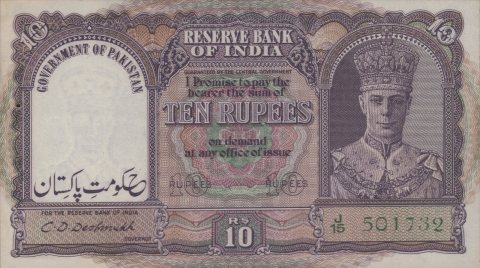
Harmer-Rooke's lot 268 of 5th December 1974, from the Albert I. Donn collection, was seven notes: a green 1 rupee of what the house calls the "1st series", two blue 1 rupee notes of the "2nd series", a 5 and a 10 rupees described as the "same", a 10 rupees "overprinted on India", and a 1 tughrik of Outer Mongolia of 1925. The catalogue places the 10 rupees on the inscribed 10 rupees. The import of the sale took the 1 rupee notes and the rest of the lot as Pakistan's later notes, outside the catalogue; the words "green, 1st series" do not say whether the first 1 rupee was the inscribed 1 rupee.
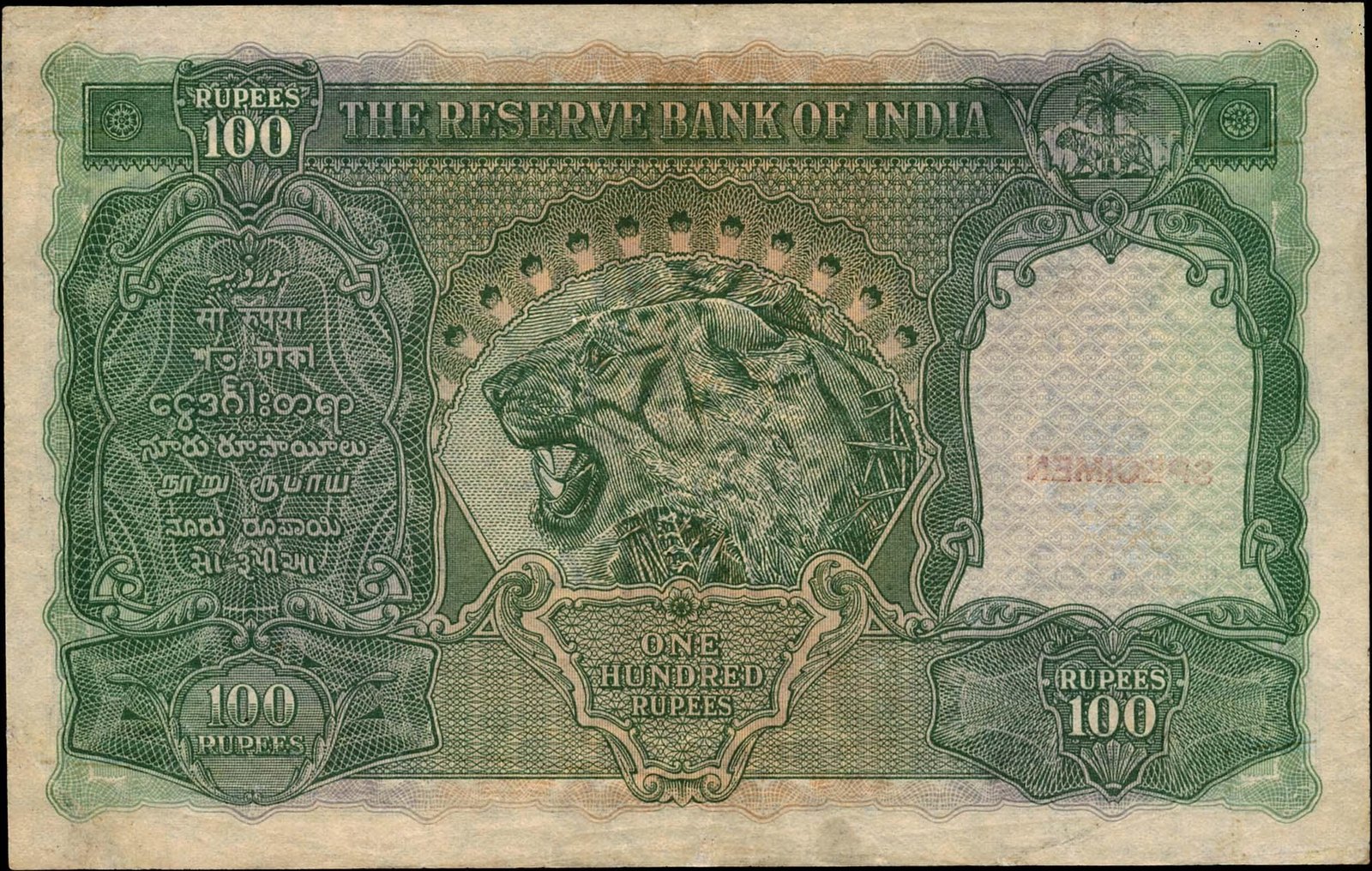
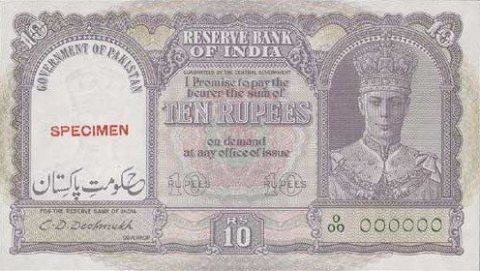
NASCA's sale of the Stanley Gibbons Collection, Part II, on 7th December 1981 had three lots. Lot 1766 was a 100 rupees, described as "P-3A", dated 1948, GOVERNMENT OF PAKISTAN / RESERVE BANK OF INDIA, printed in green and lilac, with "GOVERNMENT OF PAKISTAN" printed above the watermark. Lot 1768, a "starter collection of early Pakistani bank notes", held a 5 rupees and a 10 rupees, both dated 1948, with a 10 and a 100 rupees of 1949 from Pakistan's own issues, and the house noted staple holes at the left margins. Lot 1767 is told below.
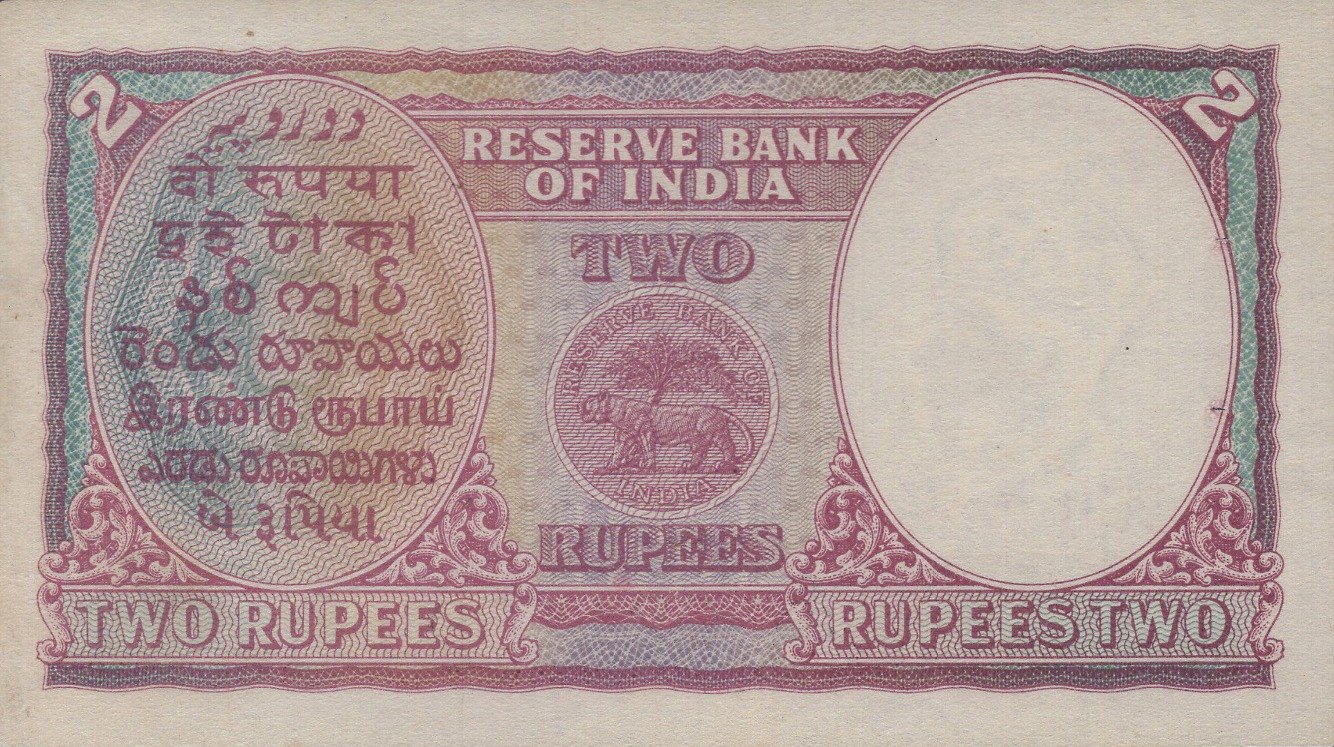
Melnick's sale of 20th December 1982, Part V of the same collection, had two Pakistan groups, one listing "Pick #'s 1, 1A" among fifteen notes and one listing "Pick #'s 1" among seven, with pinholes on several. Lot 4099 was a mixed lot of Asian notes and rubber coupons with a Pakistan 1 rupee "(p-1)". The catalogue's import took the Pick 1A of the first group as the 2 rupees. R. M. Smythe's lot 7227 of 15th July 1993 was a Government of Pakistan 1 rupee, "P-1", with "two staple holes at the left".
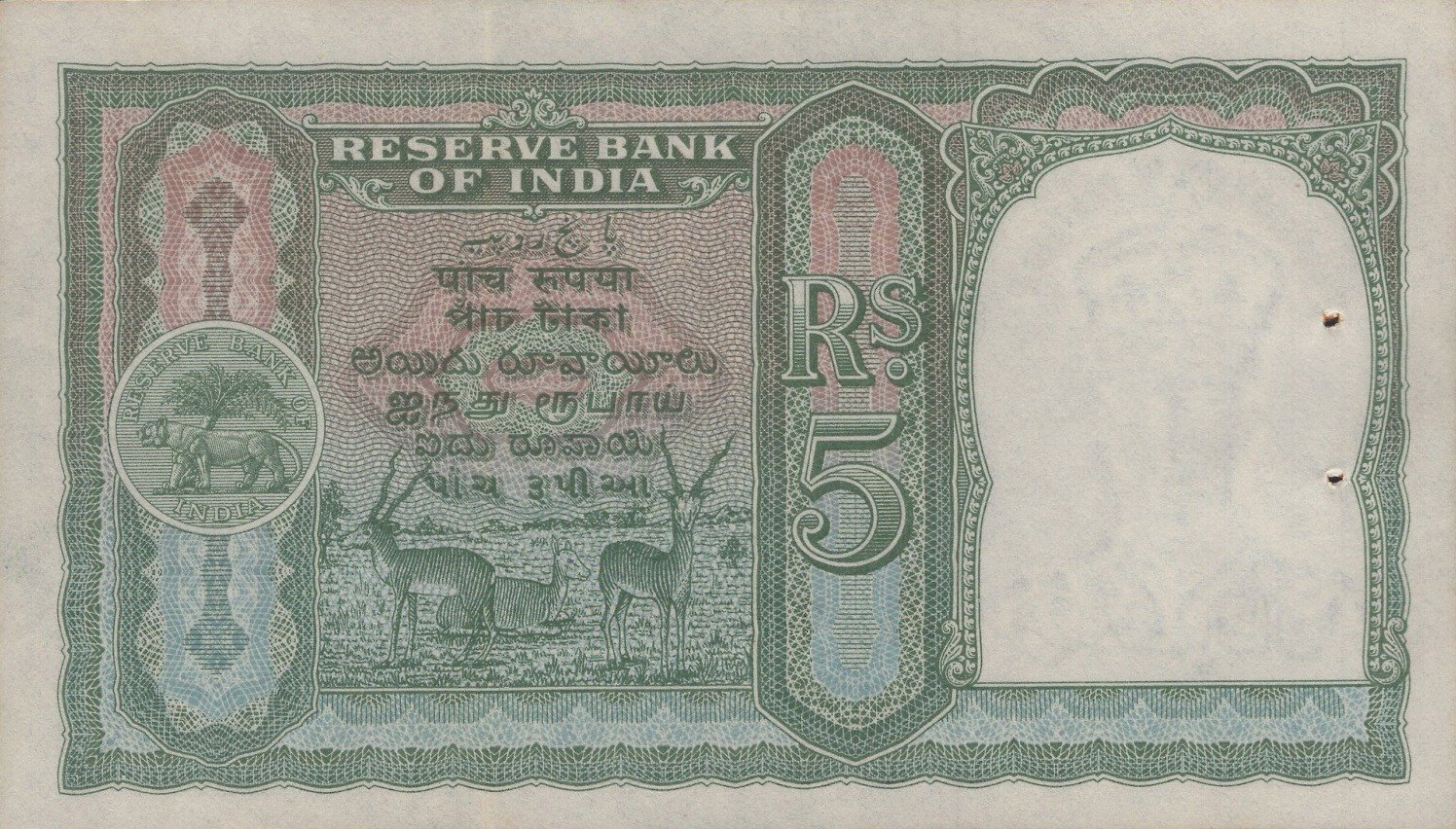
The staple holes recur. The 1981 and 1993 descriptions note them, and Heritage, describing lot 28426 in its sale of 21 January 2021, calls them customary for the issue. None of these descriptions says why the notes were stapled.
Peter Symes, 1999
Symes's study is the first full account in the records, and it set down most of what later writers repeat: the Order of 14 August 1947, the inscriptions made on the plates and not overprinted, the shortened term to 30 June 1948, and the State Bank Order of 12 May 1948. Two parts of it are not used in the earlier articles.
The first is a list of signers. Symes gives "C. E. Jones (Secretary, Finance Department, Govt. of India)" with the period of office "(Unknown)", and "C. D. Deshmukh (Governor, Reserve Bank of India)" with "15 August 1947 to 30 June 1949". The next entries are Ghulam Mohammed, Minister of the Treasury of Pakistan, 1948 to 1951, and the first Governor of the State Bank of Pakistan, Zahid Hussain, June 1948 to 19 July 1953. The Reserve Bank's Report on Currency and Finance for 1943-44 (paragraph 73) gives 29th February 1944 for the first notes signed by Deshmukh, a 10 rupees issued at Calcutta. Symes does not say what the period of office stands for.
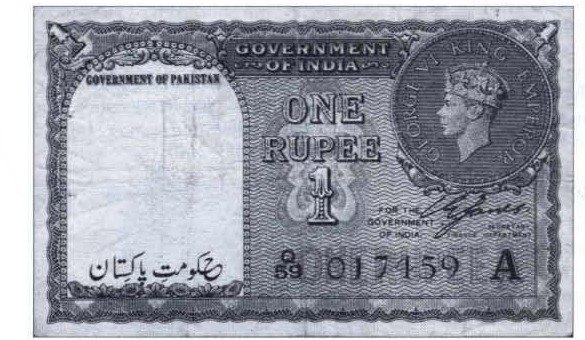
The second is Symes's account of the plain India notes. They were due to be withdrawn from circulation from 30 September 1948, and Symes writes that the agreement seems to have been honoured despite the end of the Reserve Bank's authority on 1 July 1948, so that the India notes went on circulating between 1 July and 30 September. The Reserve Bank's table in its Report for 1949-50 (paragraph 100) bears this out: India notes without the inscription ceased to be legal tender in Pakistan on 1st October 1948. Symes's list of the first issue gives "All notes issued on 1 April 1948".
Anil R. Bohora, 2009 and 2015
Bohora's article of 2009 is a survey of the rupee outside India, with Pakistan as one section beside Burma, Bhutan and the Persian Gulf. It gives the Reserve Bank as sole note-issuing authority in Pakistan "until 31 September 1948", the arrangement ended on 30 June 1948 with the founding of the State Bank of Pakistan on 1 July 1948, the plates changed to carry GOVERNMENT OF PAKISTAN in English and Hukumat-e-Pakistan in Urdu in the watermark area, the notes to be issued after 31 March 1948 without the Government of India being required to redeem them, and the five values released between 1 April 1948 and 30 June 1948. The day "31 September" comes back in Bokhari and Bohora's article of 2011 as "September 31, 1948". September has thirty days; Symes and Joiya give 30 September 1948.
In 2015 Bohora wrote of an India 10 rupees of the Gulf issue with a boxed stamp, SPECIAL GULF NOTE / Payment Refused, in dark blue, and three rust holes in the watermark area. Bohora takes the holes as the mark of an iron clip that once held a paper to the note, and says the same is seen on many notes impounded by banks in India. Bohora adds that notes of India used in Pakistan and in Burma are often found with payment refused stamps, while this Gulf note was the first of its kind the writer had seen.
The Bank Note Reporter, 2011, and the letters of 2013
Kerry Rodgers, in a news article in the Bank Note Reporter of August 2011 (p. 110, its title under Sources), says that in Pakistan the King George VI notes of the Reserve Bank went on in use "over-stamped GOVERNMENT OF PAKISTAN" as an interim issue until the country could release its own notes in 1948. Symes in 1999 and Bohora in 2013 write that the words were printed from altered plates and not added afterwards.
Mustehsin Shahab Khan's letter in the IBNS Journal, volume 52, number 3 (2013), praises the work on the payment refused notes of Pakistan and on the overprinted notes of Bangladesh, says there is still doubt about counterfeits among some of the pieces ("specimens" in the letter, meaning examples, not SPECIMEN notes), and asks for a group study of these notes by collectors in Pakistan to sort the real notes from the false. The letter gives the article on the early payment refused notes in IBNS Journal 50:3 to Joiya; that article is by Bokhari and Bohora, and Joiya's pieces are the letter in 50:4 and the article in 51:3. The letter names no particular note.
Dr. Shailendra Bhandare's review in the same issue lists the chapters of the revised Standard Reference Guide to Indian Paper Money by Kishore Jhunjhunwalla and Rezwan Razack, one of them "Indian Notes used in Burma and Pakistan", and says that the book lists the prefixes of every note while the authors call their lists provisional. The book itself has not been read for this catalogue. The report in volume 57, number 1 (2018), of the launch of Razack's book on the 1 rupee from 1917 to 2017 says that the talk showed notes used in Pakistan and Burma, and notes from Pakistan and Burma with political messages and Payment Refused stamps.
Joiya's lists in the text copy
Joiya's article of 2012 lists the prefixes of the five inscribed notes with their signers. Two readings in the text copy differ from the other sources: the signer of the 1 rupee is printed "C.E. Johns", where Symes and the houses have C. E. Jones; and the last 1 rupee block ends at "S/33", where Bokhari and Bohora's table has S/55. A third, the 1 rupee block "R/06", is printed the same way in the copy of Bokhari and Bohora's table; the Pick page has R/0 to R/6. The 1 rupee page gives S/0 to S/55 from the sources and records notes to S/54. Whether "S/33" is Joiya's figure or a fault of the scan needs the printed page.
What has held and what has not
- An inscription on the plate. Symes (1999), Bohora (2009 and 2013) and Joiya (2012) say the words were printed from altered plates. NASCA in 1981 said "printed above watermark". Harmer-Rooke in 1974 said "overprinted on India", Rodgers in 2011 "over-stamped", and Razack in 2012 "overprinted". The first article gives the evidence of the notes.
- The end of the Reserve Bank's authority. First set for 30 September 1948 (Symes, Joiya; "31 September" in Bohora 2009 and in Bokhari and Bohora 2011), brought forward to 30 June 1948. All the writers agree on 30 June.
- The plain India notes. Symes's statement that they circulated to 30 September 1948 agrees with the Reserve Bank's date of 1st October 1948 for the end of their legal tender in Pakistan.
- The end of the inscribed notes. None of the writers read gives the Reserve Bank's day, 1st November 1949. Joiya gives 15 January 1952; Razack has the notes discontinued in 1950 and finally withdrawn in January 1952, and in another place demonetised in 1949. The question is set out in the first article.
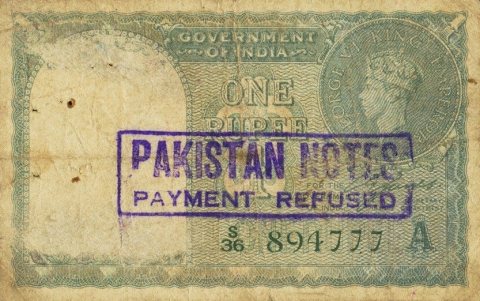
- Stamped notes before 2011. Bokhari and Bohora wrote in 2011 (IBNS Journal 50:3) that the altered notes with payment refused stamps had come in a slow, sporadic trickle over the twenty years of their collecting. NASCA offered lot 1767 on 7th December 1981. It was a Reserve Bank 100 rupees, described as "India P-32", with a large purple stamp on the face, read in the text copy as "PAKISTAN NOTE" and "PAYMENT RECEIVED" joined by a dash, and staple holes at the left. No picture of the lot was taken into the catalogue, and the catalogue has not placed it on a row: it is not known whether it was an inscribed note with the words removed, a plain India note stamped in Pakistan like Joiya's type 4, or whether "RECEIVED" is a misreading of "REFUSED". The plate of the catalogue, if it was pictured there, would settle the words.
- The red-number 2 rupees. Symes doubted it in 1999, and the Pick page dates the red numbers of the India note to May 1949. No later writer read here reports one.
Sources
- Harmer-Rooke, The Albert I. Donn Collection of World-Wide Paper Currency, New York, 5th December 1974, lot 268 (text copy).
- NASCA, The Stanley Gibbons Collection, Part II, New York, 7th December 1981, lots 1766, 1767 and 1768 (text copy).
- Herbert I. Melnick, The Stanley Gibbons Collection, Part V, Bellmore, New York, 20th December 1982, lots 3056, 3057 and 4099 (text copy).
- R. M. Smythe, 1993 Memphis International Mail Bid Auction, sale 119, 15th July 1993, lot 7227 (text copy).
- Heritage, FUN World Paper Money Signature Auction, Dallas, 21 January 2021, lot 28426 (the house's description).
- Peter Symes, "The Bank Notes of Pakistan, 1947 to 1972", IBNS Journal, volume 38, number 4, 1999.
- Anil R. Bohora, "The Indian Rupee: Used Around the World", IBNS Journal, volume 48, number 4, 2009, p. 44.
- Jamal Bokhari and Anil R. Bohora, "Banknotes of Early Pakistan: Payment Refused in India", IBNS Journal, volume 50, number 3, 2011, and their letter in volume 51, number 2, 2012.
- Kerry Rodgers, "Hoard of Indian rarities surfaces", Bank Note Reporter, August 2011, p. 110.
- Dr. Malik Aftab Maqbool Joiya, letter in IBNS Journal, volume 50, number 4, 2011, and "The Special Notes of Pakistan Since 1947: Overprints Both Official and Private", IBNS Journal, volume 51, number 3, 2012.
- Rezwan Razack, "Varieties of Portrait Notes in India's King George VI 100 Rupee Series", IBNS Journal, volume 51, number 4, 2012.
- Anil Bohora, letter, "The First Issue of Pakistan Banknotes Were Not Overprinted", IBNS Journal, volume 52, number 1, 2013.
- Mustehsin Shahab Khan, letter, "More Study Called for on Early Pakistan and Bangladesh Specimens", IBNS Journal, volume 52, number 3, 2013.
- Dr. Shailendra Bhandare, review of The Revised Standard Reference Guide to Indian Paper Money, IBNS Journal, volume 52, number 3, 2013.
- Anil R. Bohora, "Indian Banknotes Used In Gulf Countries: 'Payment Refused' in India", IBNS Journal, volume 54, number 1, 2015, pp. 20 to 21.
- Report of the launch of One Rupee, One Hundred Years, 1917 to 2017, IBNS Journal, volume 57, number 1, 2018, p. 72.
- Reserve Bank of India, Report on Currency and Finance for 1943-44, paragraph 73, and for 1949-50, paragraph 100.
Member comments
Log in or register to post a comment.