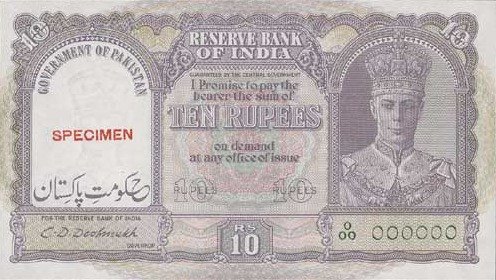
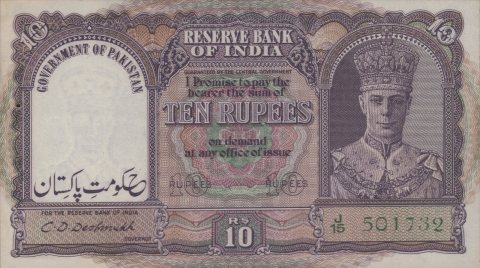
From 1 April 1948 the Reserve Bank of India put the notes inscribed GOVERNMENT OF PAKISTAN into circulation in Pakistan, and the India notes there began to be withdrawn. This article follows that withdrawal and what came after it, from the Reserve Bank of India's Reports on Currency and Finance for 1949-50, 1950-51 and 1951-52 and from the account of Dr. Malik Aftab Maqbool Joiya in the IBNS Journal, volume 51, number 3 (2012). The inscribed notes themselves, the Order of 1947 and the three dates given for their end are told in The Reserve Bank of India notes inscribed GOVERNMENT OF PAKISTAN, 1948 to 1952; the figures of India notes returned that it gives are not repeated here.
The reports were read for this catalogue in a scanned copy. Where a passage below was read only in the text layer of the scan, and not on the page image, the article says so: a figure read that way can be a digit out. Joiya's article was read in a text copy of the journal only.
What the Order required
Joiya sets out the legal frame. The right of Pakistan to the assets behind the India notes in its territory was guaranteed by clause 4 of Part IV of the Pakistan (Monetary System and Reserve Bank) Order, 1947, as amended in 1948. Under clauses 4(2) and 9(1) of Part IV, the India notes held in the currency chests in Pakistan on 30 June 1948, and those cashed between 1 July 1948 and 30 June 1949, had to be returned to the Reserve Bank before the State Bank of Pakistan could claim the same value in assets.
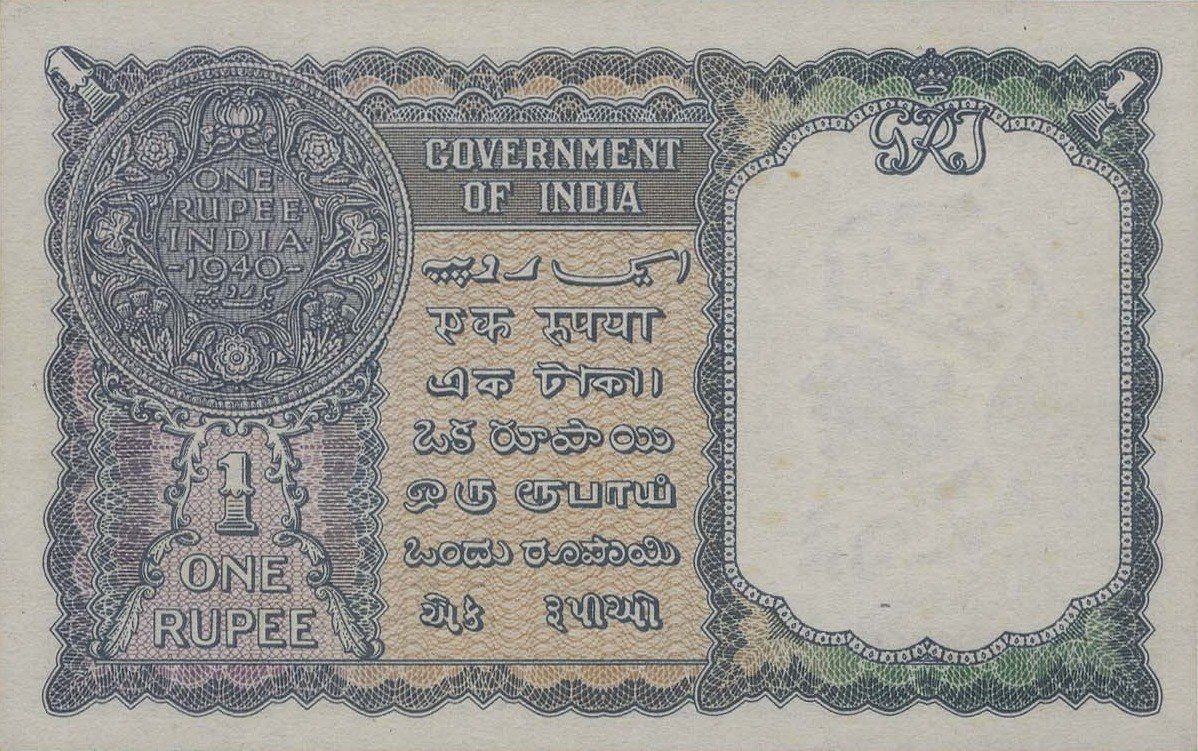
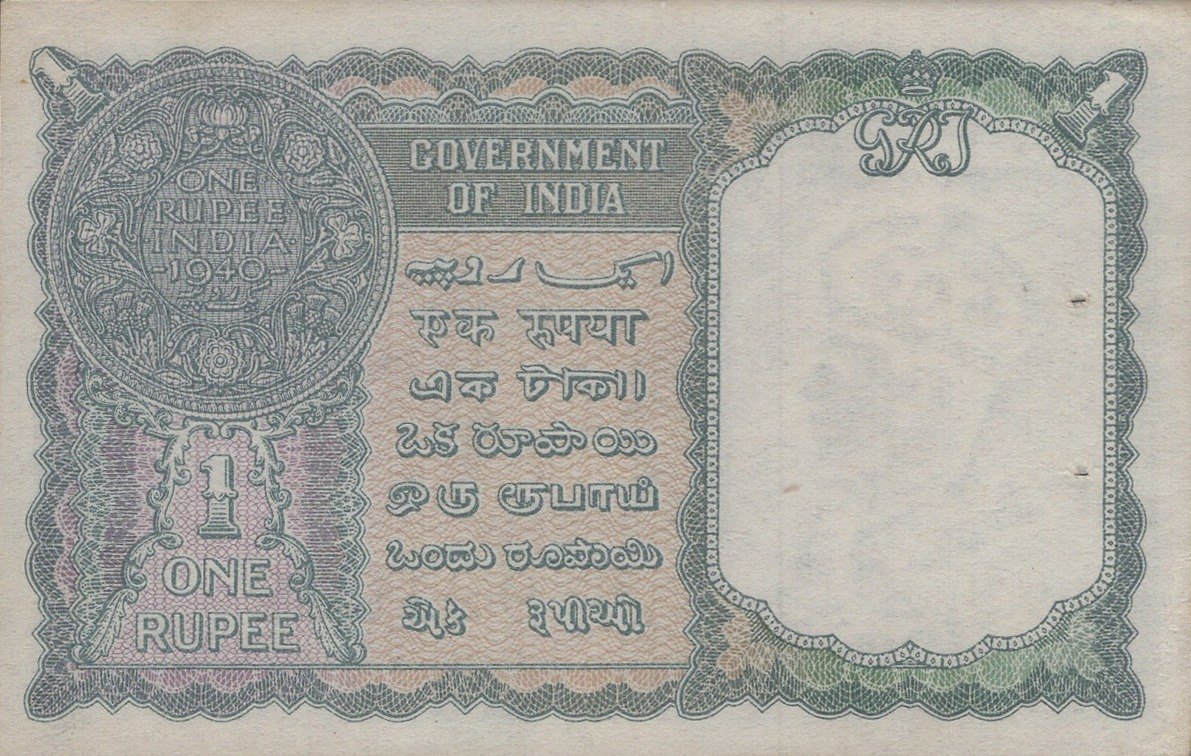
The Reserve Bank's Report for 1950-51 (paragraph 27, read in the text layer) names a second section of the same Part. Under Section 3 of Part IV, the India coins, with the Government of India 1 rupee notes, were being withdrawn by the State Bank of Pakistan, and certain categories of them, as the Order specified, were returned to the Reserve Bank in instalments. The 1 rupee notes went with the coin because, as the Report for 1951-52 (paragraph 26, text layer) explains, the Government of India's Currency Ordinance of 24th July 1940 (No. IV of 1940) made them count as "rupee coin" for all purposes of the Reserve Bank of India Act, 1934.
Joiya describes the work as difficult. The banking system had broken down since partition, the staff left at the treasuries and sub-treasuries were too few and untrained to serve the public, and the area was large, many people could not read, and communications were slow, above all in East Pakistan. There were too few offices offering exchange. After the date of exchange had passed, Joiya writes, the India notes were destroyed, though some survived.
How the Reserve Bank kept its books
The reports show the split in the footnotes to their statements of the Issue Department's liabilities and assets (all read in the text layer). In the Report for 1949-50 the liabilities for April to June 1948 are shown net of India notes withdrawn from circulation in Pakistan, and the figures for the inscribed Pakistan notes and for Pakistan rupee coin are shown in brackets below those for India notes and rupee coin. From July 1948 the monthly figures are net of adjustments for two things: the inscribed Pakistan notes issued between April and June 1948, and the India notes returned from circulation in Pakistan under Section 4(2) of Part IV of the Order. The Reports for 1950-51 and 1951-52 call the first of these the transfer of liabilities to the State Bank of Pakistan in respect of inscribed Pakistan notes issued between April and June 1948. A footnote to another statement of the Report for 1950-51 adds that its figures include the balance of India notes retired from Pakistan and awaiting cancellation.
The footnotes thus treat the inscribed notes issued from April to June 1948 as a liability transferred to the State Bank of Pakistan. The bracketed figures for them are, by the footnote of the Report for 1949-50, averages of the weekly figures for April to June 1948; the text layer of those tables is too broken to give them safely.
The footnotes also show that the count of India notes was never closed in these years. The Report for 1950-51 (paragraph 25, text layer) says that the total of India notes in circulation in Pakistan on 31 March 1948 had not been finally determined. The Report for 1951-52, in a footnote to its circulation statement (text layer), repeats the two adjustments for Pakistan and adds a third, for about 6 crores of rupees of India notes returned from circulation in Aden from October 1951 to March 1952.
The 1 rupee notes and the coin sent back
The Report for 1951-52 (paragraph 26) gives a table of the rupee coin returned by the State Bank of Pakistan and adjusted to the end of March 1952, in lakhs of rupees. It is read here in the text layer only.
| Year | Quaternary rupees | Nickel rupees | Government of India 1 rupee notes | Total |
|---|---|---|---|---|
| 1948-49 | none | none | none | none |
| 1949-50 | 43 | 8 | 3,41 | 3,92 |
| 1950-51 | none | 30 | none | 30 |
| 1951-52 | none | 4 | none | 4 |
| Total | 43 | 42 | 3,41 (read as 8*41 in the copy) | 4,26 |
The paragraph above the table gives the total adjusted to the end of March 1952 as 4.20 crores; the table's own total row reads 4,26 lakhs. Only the page image would show which of the two the report printed. The Report for 1950-51 (paragraph 27) gives 30 lakhs returned in 1950-51 and 4.22 crores to the end of March 1951, and its own table, in which the 1 rupee note column is not clearly legible, has 3,41 under the 1 rupee notes in its total row. Both tables show the Government of India 1 rupee notes under 1949-50 only. The tables do not say whether those notes were the plain India 1 rupee (India P-25) or whether any inscribed 1 rupee notes (Pakistan P-1) were among them. The Report for 1950-51 adds that until the State Bank had finished returning the coin, exact figures of the rupee coin in circulation in the Indian Union would not be available.
When each kind of money ceased in Pakistan
The Report for 1949-50 (paragraph 100) prints a table of the days on which India money ceased to be legal tender in Pakistan. The two lines for notes were read on the page image; the three lines for coin in the text layer.
| Money | Ceased to be legal tender in Pakistan |
|---|---|
| Indian currency and bank notes of all current values, with the Government of India 1 rupee notes | 1st October 1948 |
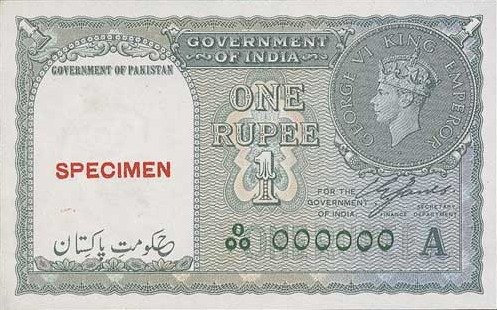
| Inscribed Pakistan notes of all values issued by the Reserve Bank of India, with the Government of India 1 rupee notes inscribed GOVERNMENT OF PAKISTAN | 1st November 1949 |
| Two-anna nickel-brass coins | 1st July 1949 |
| Nickel rupee coins | 1st October 1949 |
| Half and quarter rupee coins | 1st December 1949 |
The announcement of 30th May 1950 in the same paragraph, told in the first article, names the coins that ceased from 1st September 1950 (the list read in the text layer): the India quaternary silver rupee and the India two-anna (cupro-nickel), one-anna, half-anna and single pice. The later dates of exchange that Joiya gives, to 15 April 1952 and again in 1956 and 1957, are discussed there too.
On the Indian side, the Report for 1949-50 (paragraph 99, read on the page image) records the demonetisation in India, from 12th September 1949, of the 100 rupee India notes of the KARACHI and LAHORE offices, told in The Reserve Bank of India's King George VI notes, 1938 to 1950. The paragraph speaks of India notes only and does not name the inscribed 100 rupees, which carries KARACHI and was not redeemable in India.
The stamps on the India notes retired in Pakistan
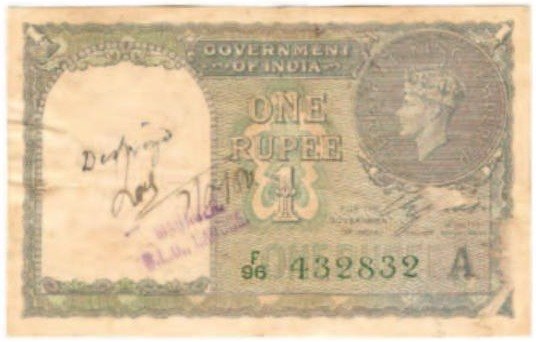
Joiya's article of 2012 describes India notes of 1, 2, 5, 10 and 100 rupees that carry handstamps, signatures with or without a date, and written words about their cancellation and destruction. Joiya's table of them, "Some types and varieties of Indian stamps", reads in the text copy as follows; the last column gives the values on which each was seen.
| Type | Handstamp | Written words | Signature or date | Values |
|---|---|---|---|---|
| 1a | GOVERNMENT OF WEST PAKISTAN, one line, black | none | initials only | 1, 2 and 5 rupees |
| 1b | GOVERNMENT OF WEST PAKISTAN | none | initial with date | 10 rupees |
| 2a | MANAGER / D.L.O. LAHORE, black in Joiya's text (the stamp in Joiya's picture on page 37 looks violet) | Destroyed | initial with date | 1 rupee |
| 2b | MANAGER / D.L.O. LAHORE | Destroyed | signature | 1 rupee |
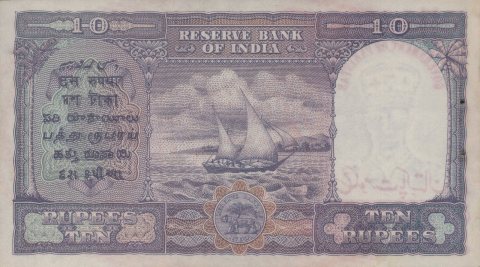
| 3 | PAID, black | Wapis kia gia (Urdu, "returned back") and cancelled (English, blue ink) | one initial and one signature with date | 10 rupees |
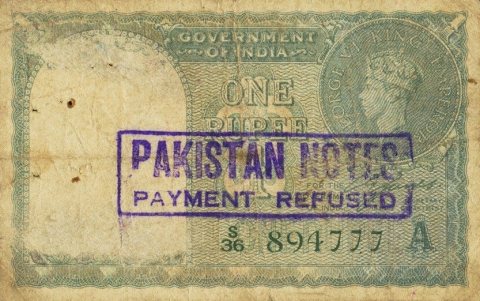
| 4 | PAKISTAN NOTE / PAYMENT REFUSED, pink, in a box | none | none | 100 rupees |
The values in the table are as the text copy places them; the scan of the table is broken, so they need the printed page before they are relied on.
Joiya reads the marks as showing that these notes were withdrawn after their cancellation and the end of the exchange period announced by the Government, and were then either sent back to the Reserve Bank or ordered to be destroyed by the Manager of the Dead Letter Office, Lahore. The notes were found mostly in the northern cities of what was West Pakistan. Joiya allows that the same may exist from East Pakistan, since Dacca was one of the three currency chests of the Reserve Bank, with Karachi and Lahore. Joiya takes the dull print of the stamps, after more than sixty years, as a sign that they are genuine.
Joiya also shows that stamping India notes was older than partition. A 1,000 rupees (India P-21) issued in June 1938 and demonetised on 12th January 1946 carries a stamp in two lines, PAYMENT REFUSED UNDER ORDERS / OF THE CENTRAL GOVERNMENT. That note was never legal tender in Pakistan.
Type 4 matters for the Pakistan pages. A stamp of the same words, PAKISTAN NOTE / PAYMENT REFUSED, is also found on inscribed notes, some of them with the words scraped off, as told in PAYMENT REFUSED: the Pakistan notes of 1948 with the inscription removed. Joiya lists the 100 rupees of type 4 as an India note, and the text copy does not say whether it was looked at for a removed inscription. A 100 rupees of the India design with a purple PAKISTAN NOTE stamp was offered at auction in 1981, as told in What collectors and the old sale catalogues wrote about the Pakistan notes of 1948.
Pakistan's own notes bought and sold in India
Once Pakistan had notes of its own, the Reserve Bank of India bought and sold them. The reports give this in three paragraphs.
| Date | What the Reserve Bank did | Report |
|---|---|---|
| 20th July 1948 | Began to buy (encash) Pakistan notes | 1949-50, paragraph 102, footnote |
| 25th September 1948 | Began to sell Pakistan notes | 1949-50, paragraph 102, footnote |
| 20th September 1949 | Buying and selling suspended, after the devaluation of the Indian rupee and Pakistan's decision not to devalue its rupee | 1949-50, paragraph 102 |
| Middle of March 1950 | Pakistan notes and coin exchanged on Government account into Indian money at par, Re. 1 Indian to Re. 1 Pakistan, for evacuees arriving from East Bengal | 1949-50, paragraph 102 |
| 1 September 1950 | The exchange for evacuees discontinued | 1950-51, paragraph 98 |
| To 27 February 1951 | Pakistan notes sold on a limited scale to refugees returning to East Bengal | 1950-51, paragraph 98 |
| From 27 February 1951 | Ready buying and selling of Pakistan currency with authorised dealers resumed, at Pakistan Rs. 69-8-3 (buying) and Rs. 69-6-6 (selling) for Indian Rs. 100 | 1950-51, paragraph 98; 1951-52, paragraph 106 |
| From 16 April 1951 | Buying and selling for six months' forward delivery, at Pakistan Rs. 69-9-0 and Rs. 69-5-9 for Indian Rs. 100 | 1951-52, paragraph 106 |
The rows from the Report for 1949-50 and the first two rows from 1950-51 were read on the page image. The reasons for the suspension of 1949, the par rate in figures (Re. 1 to Re. 1), the rates and the forward dealing were read in the text layer; the two reports give the same rates for February 1951.
From the start to 20th September 1949 the Bank bought Pakistan notes to the amount of Rs. 1,03,00,916 and sold Rs. 71,15,708 (page image). For 1st April to 20th September 1949 alone the text layer reads Rs. 12,87,612 bought and Rs. 13,26,694 sold, at the Bank's offices at Bombay, Calcutta, Madras, Delhi and Kanpur. The exchange for evacuees of March 1950 was offered at the Calcutta office, at treasuries and Imperial Bank branches in West Bengal, Assam and Tripura State, and at some in Bihar and Orissa, with no limit on the amount and a commission of 4 annas per cent, at least 4 annas a tender (text layer). Notes and coin exchanged to 31st March 1950 came to Rs. 11,00,979 (page image).
The reports say "Pakistan notes" and do not say which notes were meant. The buying began on 20th July 1948. By Peter Symes's account in the IBNS Journal, volume 38, number 4 (1999), the State Bank of Pakistan released its first notes of its own on 1 October 1948, so in July, August and September 1948 the only notes of Pakistan were the inscribed notes, which were not payable in India. Whether the Reserve Bank bought inscribed notes in those weeks, and on what terms, the reports read do not tell; the Report for 1948-49, which described the facilities first, may. From 1st October 1948 Pakistan had notes of its own, which lie outside this catalogue.
What the sources do not give
The reports read give no count of the inscribed notes by value, and no figure for them at all that can be read safely in the copy used. They do not say when the last India notes from Pakistan were cancelled, or how many came back after February 1949, when the Reserve Bank stopped adjusting its figures. The Report for 1948-49, which the Report for 1949-50 cites for the first year of the buying and selling of Pakistan notes, has not been read for this catalogue, and neither has any report of the State Bank of Pakistan. Joiya's figures and table were read in a text copy, and the stamps in the table have not been compared with notes in this catalogue.
Sources
- Reserve Bank of India, Report on Currency and Finance for 1949-50: paragraphs 99, 100 and 102 (page image, except where said), and the footnotes to the statement of the Issue Department (text layer).
- Reserve Bank of India, Report on Currency and Finance for 1950-51: paragraphs 25 and 27 (text layer), paragraph 98 (page image, the rates in the text layer), and the footnotes to its statements (text layer).
- Reserve Bank of India, Report on Currency and Finance for 1951-52: paragraphs 26 and 106 and the footnote to its circulation statement (text layer).
- Peter Symes, "The Bank Notes of Pakistan, 1947 to 1972", IBNS Journal, volume 38, number 4, 1999 (text copy), for the release of the State Bank's first notes.
- Dr. Malik Aftab Maqbool Joiya, "The Special Notes of Pakistan Since 1947: Overprints Both Official and Private", IBNS Journal, volume 51, number 3, 2012, pp. 36 to 38 (text copy).
Member comments
Log in or register to post a comment.