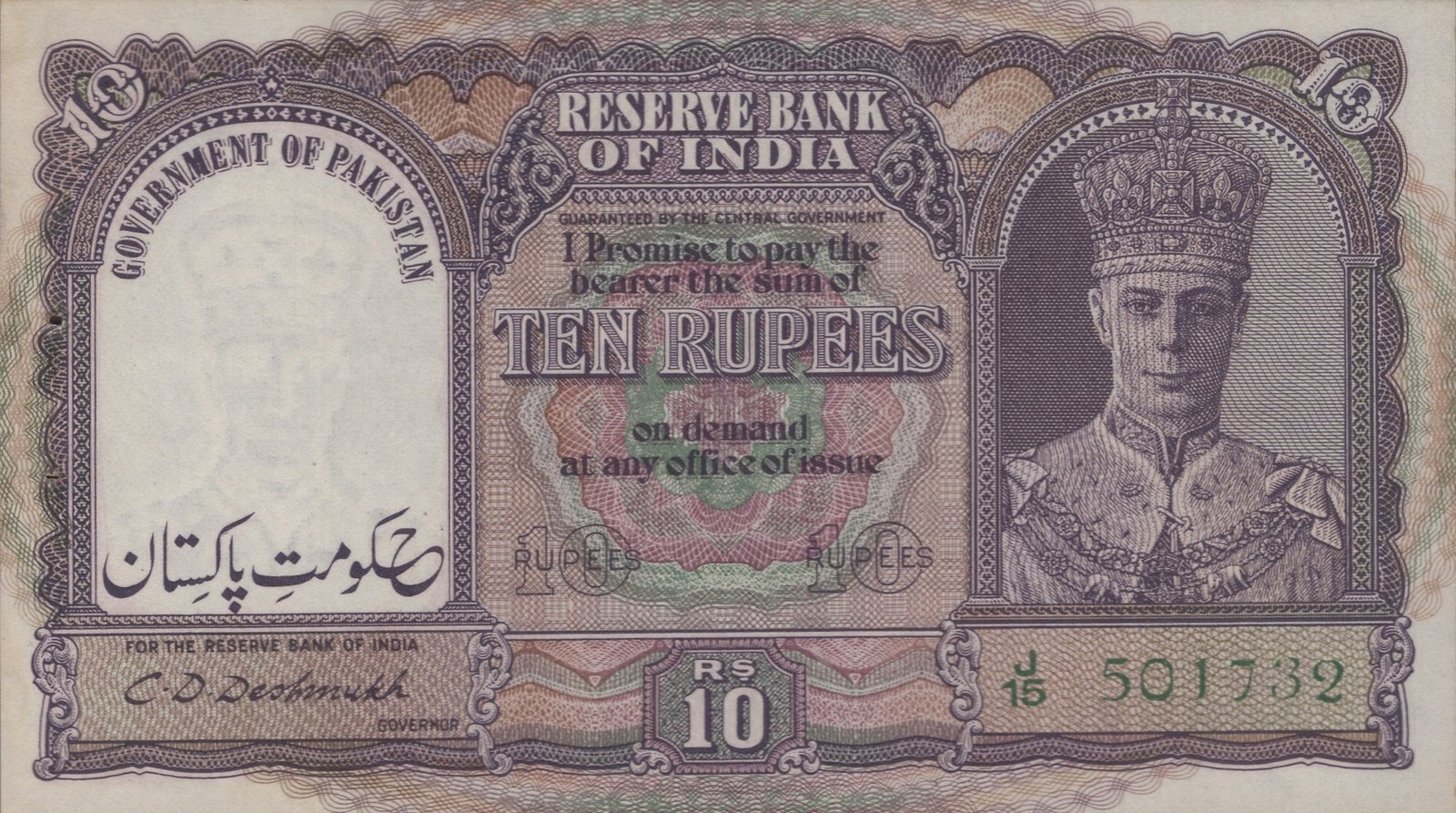
In this catalogue Pakistan is five notes: the Indian 1, 2, 5, 10 and 100 rupees printed with the words GOVERNMENT OF PAKISTAN and issued from 1 April 1948. This article tells how they came about, what they are, how they were numbered and when they ended. It draws on the Pick pages, the Reserve Bank of India's Reports on Currency and Finance for 1949-50 and 1950-51, articles and letters in the IBNS Journal, the State Bank Museum's caption and the descriptions of the auction houses. The notes with the inscription scraped off have an article of their own.
The Order of 14 August 1947
Peter Symes, in "The Bank Notes of Pakistan, 1947 to 1972" (IBNS Journal, volume 38, number 4, 1999), writes that the plan for partition was announced on 3 June 1947 and took effect on 15 August 1947, which left just over two months to arrange a currency. On the advice of an expert committee the Governor General of undivided India issued the Pakistan (Monetary System and Reserve Bank) Order, 1947 on 14 August 1947. Under it the Reserve Bank of India was to be the common currency authority for India and Pakistan until 30 September 1948, and the notes of the Reserve Bank and of the Government of India were to stay legal tender in Pakistan until the same date. The Order also allowed those notes to be inscribed with "Government of Pakistan" in English and Urdu and put into circulation from 1 April 1948 under the responsibility of the Government of Pakistan. The caption of the State Bank Museum and Art Gallery in Karachi to its British India notes gives the same dates.
Dr. Malik Aftab Maqbool Joiya, in "The Special Notes of Pakistan Since 1947" (IBNS Journal, volume 51, number 3, 2012), names the committee: Ghulam Muhammad, Zahid Hussain and I. H. Qureshi for Pakistan, and K. G. Ambegaokar, Sanjiva Row and M. V. Rangachari for India. Joiya adds that the Government of India was not liable to pay the value of any inscribed note after 30 September 1948. Jamal Bokhari and Anil R. Bohora, in "Banknotes of Early Pakistan: Payment Refused in India" (IBNS Journal, volume 50, number 3, 2011), put it as the Government of India not being held liable to redeem notes issued after 31 March 1948.
Until then, Bokhari and Bohora write, Pakistan used the ordinary notes of India. Joiya gives the time as seven months and 15 days. The inscribed notes were meant to replace them. Joiya gives the reason: the Indian notes had to be retired and replaced so that the assets due to Pakistan could be worked out.
The arrangement ends three months early
The Pick pages say that the Reserve Bank of India managed these notes until 30 June 1948 and that the State Bank of Pakistan took charge of them from 1 July 1948. The Reserve Bank's term as Pakistan's currency authority, first set to end on 30 September 1948, was brought forward to 30 June 1948. India stopped supplying the notes from that date, so fewer reached Pakistan than planned, and the Government of Pakistan put out its own emergency notes on 1 October 1948.
Symes tells it at more length. Riots after partition strained relations between the two governments. After consultation early in 1948 the Order was amended so that the Reserve Bank's responsibility ended on 30 June 1948, and it was agreed that the Bank's undertaking to supply inscribed notes would be suspended from the same date. Joiya writes that there were first talks between the Governor of the Reserve Bank and the High Commissioner for Pakistan in India, then talks of the two governments and the Bank together, that 31 March 1948 had been proposed, and that the Amendment Order was issued on 31 March 1948.
The State Bank of Pakistan Order, 1948 was issued on 12 May 1948, according to Symes, because there was no time for an Act. The Reserve Bank of India's own chronology has the entry "RBI ceased to function as the Central Bank of Pakistan" under 30 June 1948. The same entry prints the start of the State Bank of Pakistan as July 1, 1949. The Pick pages and the articles of Symes, of Bokhari and Bohora and of Joiya give 1 July 1948.
The State Bank, Symes writes, opened short of inscribed notes to replace the Indian notes still in circulation. Officials had begun an emergency issue of 5, 10 and 100 rupees, printed by Thomas De La Rue and Company, and the State Bank released it on 1 October 1948. Those notes, and the 1 and 2 rupees by Bradbury Wilkinson and Company that followed on 1 March 1949, are Pakistan's own and lie outside this catalogue. Heritage's description of lot 26162 in its sale of 24 April 2020 says the same of the inscribed notes: issued in haste and phased out once De La Rue could deliver.
The five notes
Each is an Indian note of the day with two added inscriptions. The Pick pages give the Indian note each one matches.
| Value | The same note as | Serial numbers | Signed by |
|---|---|---|---|
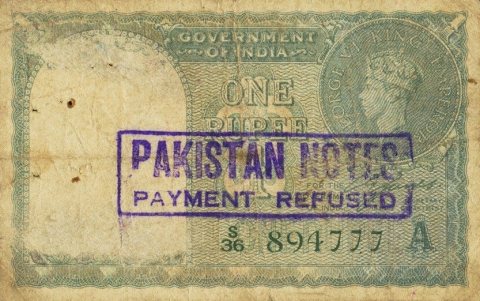
| 1 rupee | India P-25d, dated 1940, plate letter A | green | the Finance Secretary of the Government of India |
| 2 rupees | India P-17b | black | the Governor of the Reserve Bank of India |
| 5 rupees | India P-23a | black | the Governor of the Reserve Bank of India |
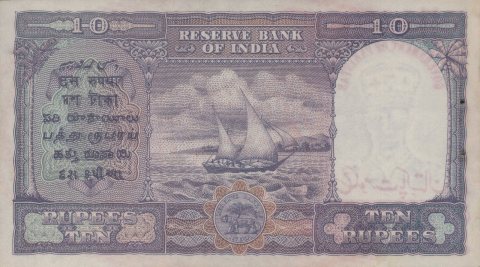
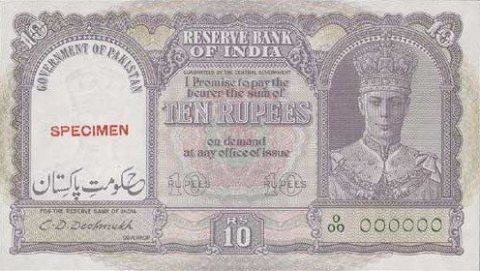
| 10 rupees | India P-24a | green | the Governor of the Reserve Bank of India |
| 100 rupees | India P-20b, KARACHI office | black | the Governor of the Reserve Bank of India |
The pages are the 1 rupee, the 2 rupees, the 5 rupees, the 10 rupees and the 100 rupees. Each note is signed by one Indian official. Symes and the house descriptions name the two signers as C. E. Jones on the 1 rupee and C. D. Deshmukh on the others. The notes were for use in Pakistan only and were not redeemable in India.
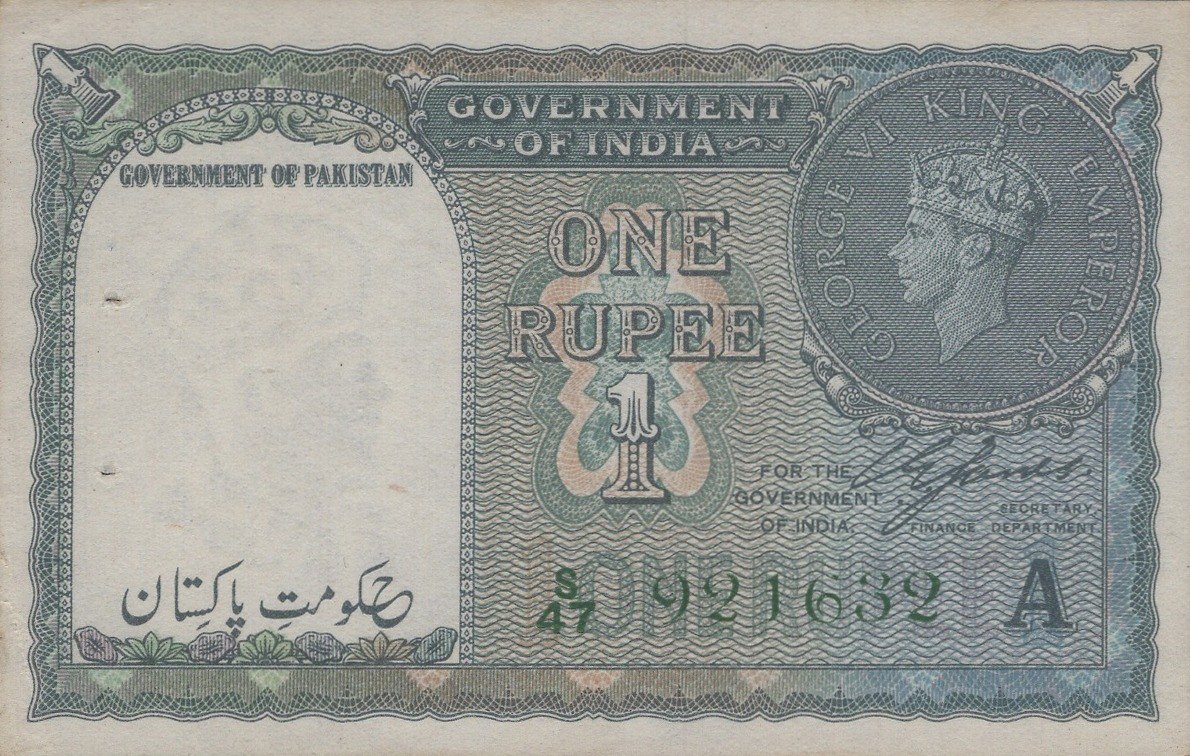
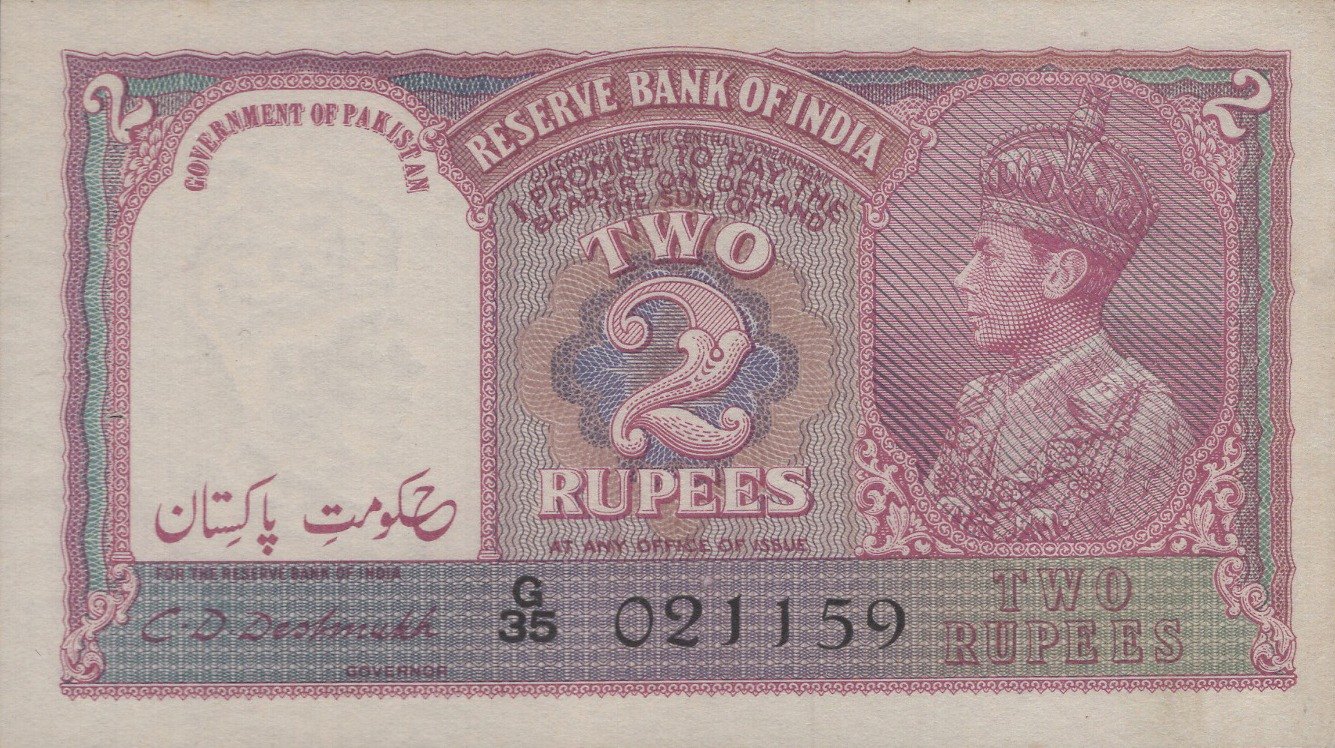
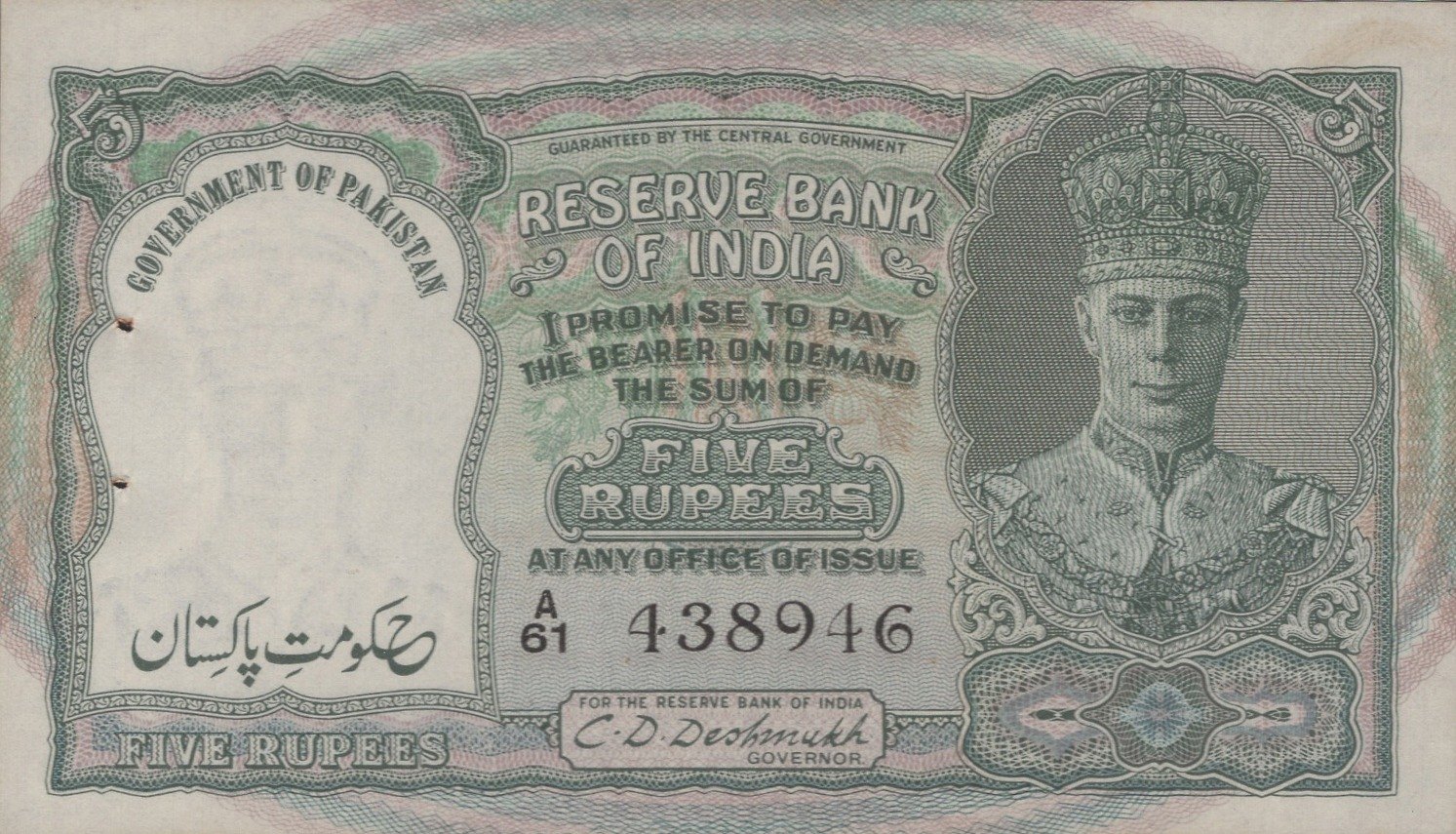
The Pick pages name the printer as the India Security Press. Symes writes that the inscribed notes were produced at the Government of India's Security Printing Press at Nasik. Joiya writes that on the 100 rupees the inscription was only on notes of the Karachi issue office. Rezwan Razack, in "Varieties of Portrait Notes in India's King George VI 100 Rupee Series" (IBNS Journal, volume 51, number 4, 2012), lists the inscribed 100 rupees under the Karachi circle.
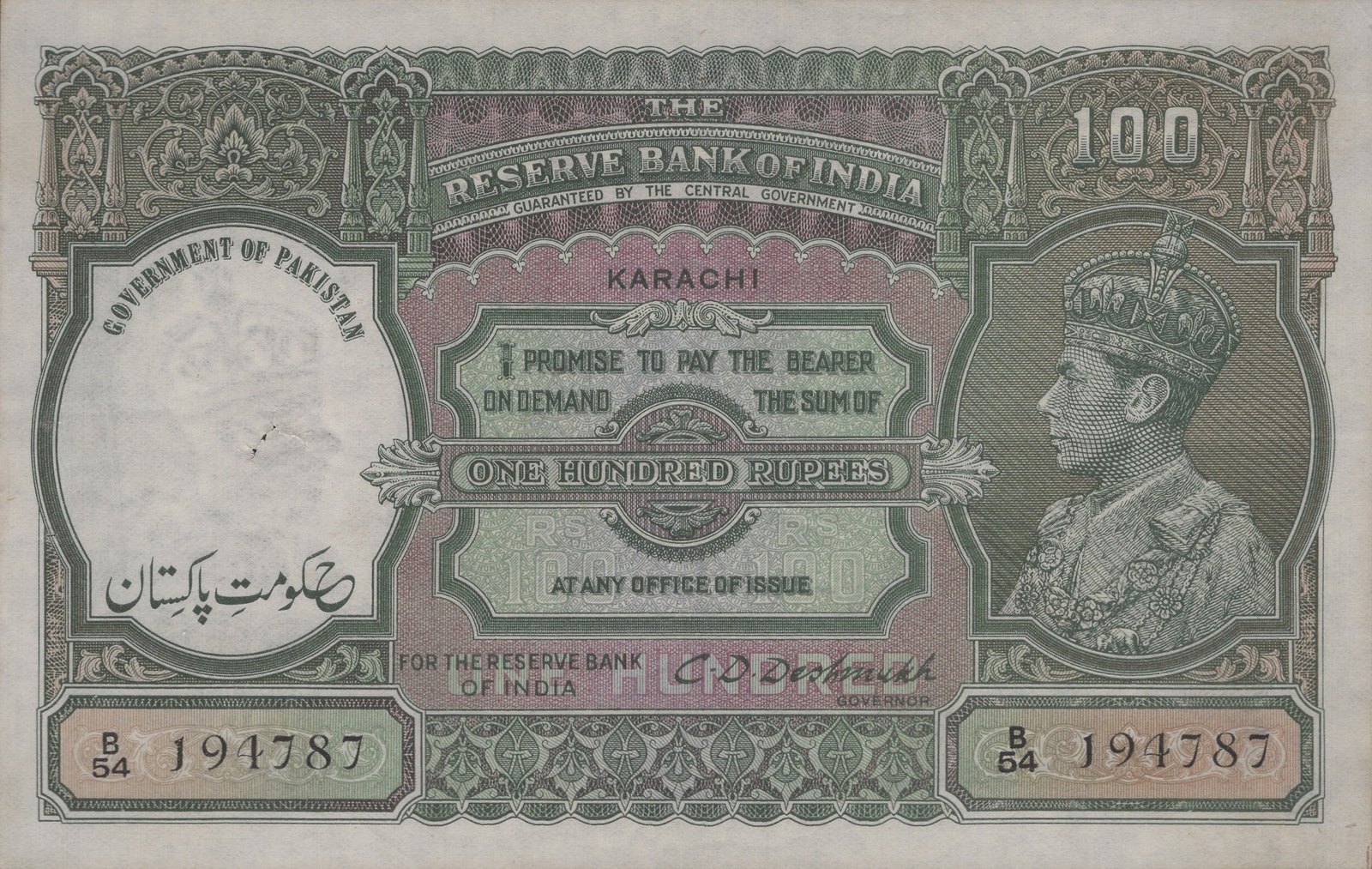
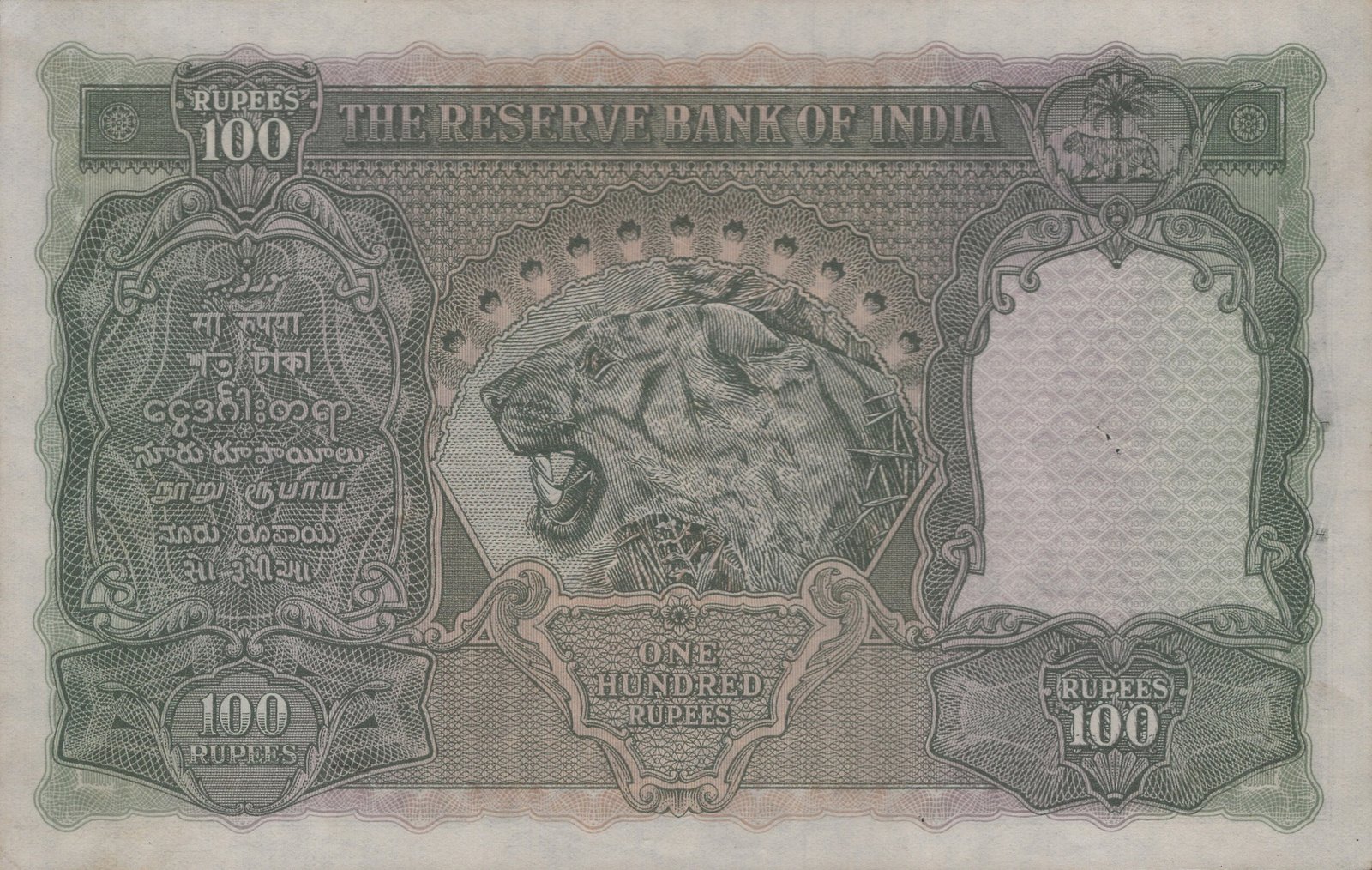
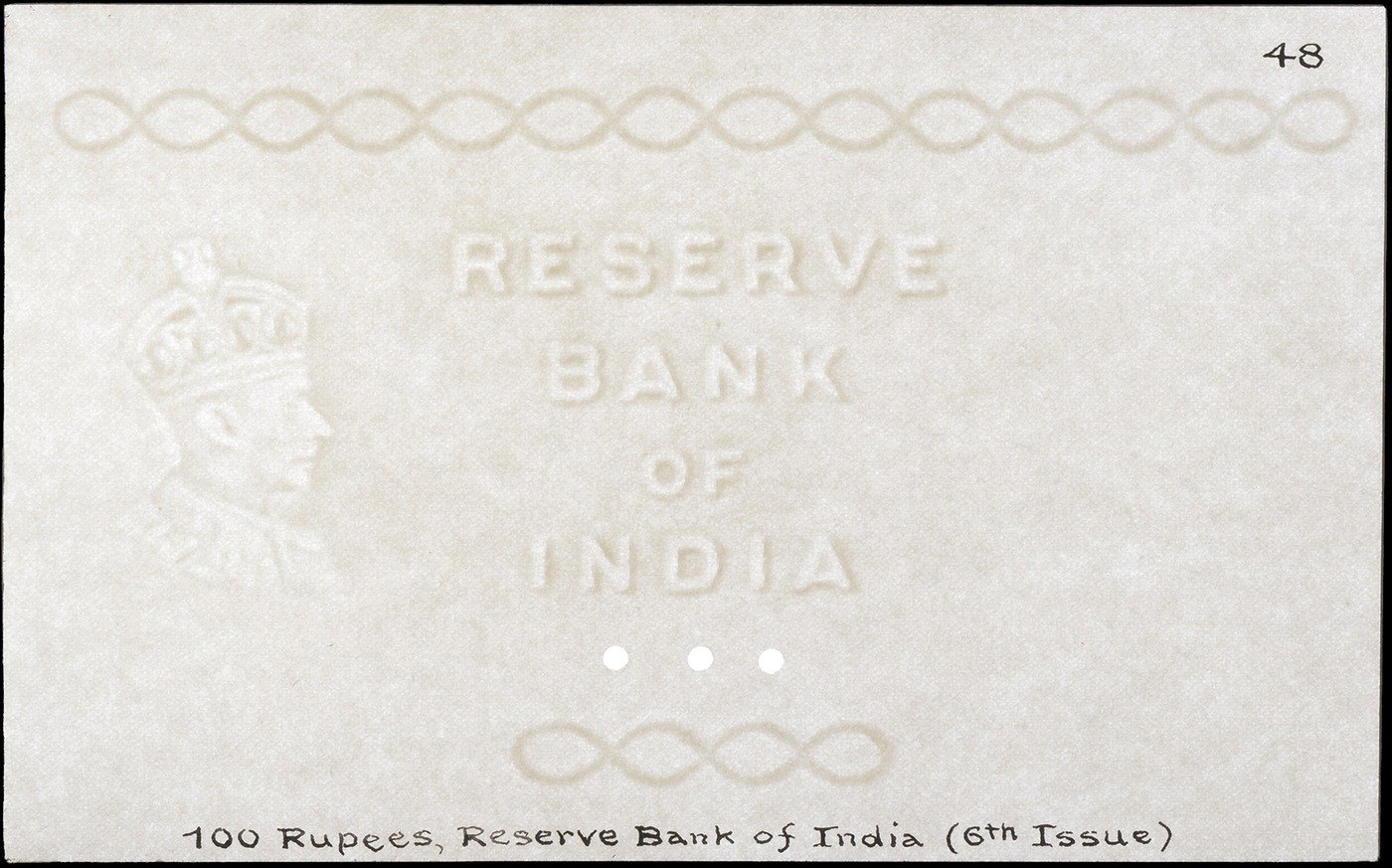
The Indian 100 rupees comes with two watermarks, the King in profile and the King facing forward. The Pick page of the Pakistan 100 rupees reasons that every prefix recorded with the inscription is earlier than the change, so these notes should show King George VI in profile. The Indian notes themselves are told in The Reserve Bank of India's King George VI notes, 1938 to 1950.
An inscription on the plate, not an overprint
GOVERNMENT OF PAKISTAN stands in English at the top of the watermark area on the front, and Hukumat-e-Pakistan in Urdu at its foot. The Pick pages call the words lithographed, not overprinted, from the Indian plates. Symes makes the same point in 1999: the inscriptions come from changes to the printing plates, and the difference matters because people have tried to deceive collectors by overprinting ordinary Reserve Bank notes.
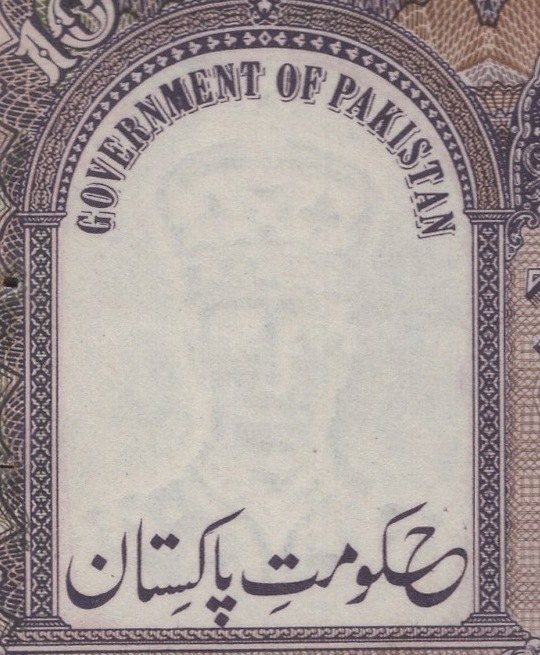
The point had to be made again. Razack's article of 2012 speaks of Indian notes "overprinted" for Pakistan. Anil Bohora answered in a letter in the IBNS Journal, volume 52, number 1 (2013): the plates were modified, the words were printed with the rest of the note, and a close look at a note confirms it.
The auction houses are divided in the same way. Heritage's description of lot 28194 in its sale of 25 April 2019 says the type was not overprinted on old stock but printed fresh for Pakistan. Heritage's description of lot 27746 in its sale of 5 January 2017, a note of Pick 1A, the 2 rupees, says that on it the inscription is in the same colour as the main design, and takes that as proof that it was part of the plate. Heritage's descriptions of lot 24434 on 8 March 2024 and of lot 24388 on 26 March 2026 say that unused stock of Reserve Bank notes was overprinted, and Classical Numismatic Gallery's description of lot 480 on 28 January 2012 has "over printed only".
A 2 rupees with red serial numbers has been listed. Symes notes that the Standard Catalog of World Paper Money gives such a variety, doubts that it exists, and suspects that red-number Indian notes were overprinted by someone making false inscribed notes. The Pick page adds the dates: red serial numbers came to the Indian 2 rupees only in May 1949, from prefix H/37, so a red-number 2 rupees with the inscription is likely an India note with a forged inscription. None is recorded in the catalogue.
The prefixes the journals list
The inscribed notes took blocks of prefixes out of the running Indian series. Bokhari and Bohora printed this table in 2011, with what they call the possible quantity of notes.
| Value | Prefixes, as Bokhari and Bohora list them | Possible quantity of notes | Possible amount in rupees |
|---|---|---|---|
| 1 rupee | Q/37 to Q/99; an R entry printed as R/06 in the copy read (the Pick page has R/0 to R/6); R/76 to R/99; S/0 to S/55 | 144,000,000 | 144,000,000 |
| 2 rupees | G/27 to G/36; G/53 to G/67 | 25,000,000 | 50,000,000 |
| 5 rupees | A/41 to A/80; B/65 to B/88 | 64,000,000 | 320,000,000 |
| 10 rupees | H/48 to H/72; H/83 to H/99; J/0 to J/42; J/51 to J/58 | 93,000,000 | 930,000,000 |
| 100 rupees | B/54 to B/59; B/60 from 000001 to 700000 | 6,700,000 | 670,000,000 |
| Total | 332,700,000 | 2,114,000,000 |
The quantities are the two authors' own, and their table heads them as possible. None of the sources read for this article gives a printing figure from the Reserve Bank or the press.
Razack's table of the 100 rupees gives B/54 to B/59 in full and B/60 from 000001 to 700000, and adds that B/60 from 700001 to 1000000 was never issued to the public. Razack also writes that the B/54 to B/60 Karachi notes were printed in April 1948.
The Pick pages set these lists beside the prefixes actually recorded on notes, and they stay there. Other sources give wider ranges for the 1 rupee, and the pages show why the narrower ones fit: Indian 1 rupee notes without the inscription are recorded between the two Pakistan R blocks. The gaps in the 10 rupees are blocks that went to the Burma overprint, and the Burma 100 rupees ends at B/53, just before the Pakistan block begins. The Burma notes are in Legal tender in Burma only, 1937 to 1952.
What the reports counted
Joiya writes that the quantity of Pakistan notes in circulation on 30 June 1948 was certified by the Reserve Bank at 515.7 million rupees, and that the Bank had to transfer assets of that amount to Pakistan. Joiya also cites the first weekly statement of the State Bank's Issue Department, for the week ended 2 July 1948.
The Reserve Bank's own reports count the other side, the Indian notes that came back.
- The Report on Currency and Finance for 1949-50 (paragraph 90, footnote) gives 44.98 crores of rupees of India notes withdrawn from circulation in Pakistan from April to June 1948, and 82.20 crores returned from Pakistan from July 1948 to February 1949 under the Order of 1947: 127.18 crores in all. No further adjustment had been made since March 1949.
- Joiya gives the India notes retired between 1 July 1948 and 30 June 1949 and sent to the Reserve Bank as 1,231.8 million rupees, of which 1,230 million had been returned by 30 June 1949. The notes had to be brought to the State Bank's offices at Karachi, Dacca and Lahore, counted, examined, packed and sent to India.
- The Report for 1950-51 (paragraph 25) says that the total of India notes in circulation in Pakistan on 31 March 1948 had still not been finally determined.
- The same Report (paragraph 27) says that the State Bank of Pakistan was withdrawing India coin, with the 1 rupee notes counted as coin, and returning it in instalments: 30 lakhs of rupees in 1950-51 and 4.22 crores in all to the end of March 1951.
None of the passages read says how many inscribed notes of each value were issued.
The end of legal tender: three dates
The sources do not agree on when the inscribed notes ended.
1st November 1949. The Reserve Bank's Report on Currency and Finance for 1949-50 (paragraph 100) has a table of the days on which Indian money ceased to be legal tender in Pakistan. Indian notes without the inscription ceased on 1st October 1948. The inscribed Pakistan notes of all values, with the inscribed 1 rupee, ceased on 1st November 1949. The paragraph opens by saying that the Pakistan Government decided to withdraw from 1st July 1948 both the India notes and coin and the inscribed notes issued from 1st April 1948, and to replace them with notes and coin of its own designs. The Pick pages take this date.
1st September 1950. The same paragraph reports an announcement by the Government of Pakistan on 30th May 1950 about India silver coin. It says that by 1st September 1950 the demonetisation of India notes and coin of all values in Pakistan, inscribed notes included, would be complete.
15 January 1952. Joiya writes that the inscribed notes were demonetised from 15 January 1952. Exchange was allowed until 15 April 1952 for members of the public who could give sound reasons for not handing the notes in by the day, at the offices of the State Bank, the Government treasuries and sub-treasuries and the branches of the Imperial Bank of India in Pakistan. After public demand the exchange was opened again from 1 October 1956 to 30 September 1957. Razack has the notes discontinued in 1950 and finally withdrawn in January 1952, and in another place demonetised in 1949.
The house descriptions vary as widely. Heritage's descriptions of lot 24309 on 20 June 2023 and lot 24435 on 8 March 2024 have the notes withdrawn in 1952. Spink's description of lot 2125 on 12 January 2025 says the issue was used in Pakistan for six months only.
The Report for 1950-51, as read for this catalogue, has no later word on legal tender in Pakistan. No notice of the Government or the State Bank of Pakistan has been read for this article, and such a notice would settle which date is the end of legal tender and which the end of exchange.
Specimens, and what the grading counts say
The catalogue has a specimen row for each value: 1 rupee, 2 rupees, 5 rupees, 10 rupees and 100 rupees. Spink's description of lot 1302 in its sale of 27 September 2011, the 1, 2 and 5 rupees together, gives all-zero serial numbers and a red SPECIMEN overprint. Lyn Knight's description of lot 1499 in its sale of 8 June 2012 says that one expert knows of only four specimen sets. That 5 rupees was sold again by Corne Akkermans on 9 April 2014 as lot 1043.
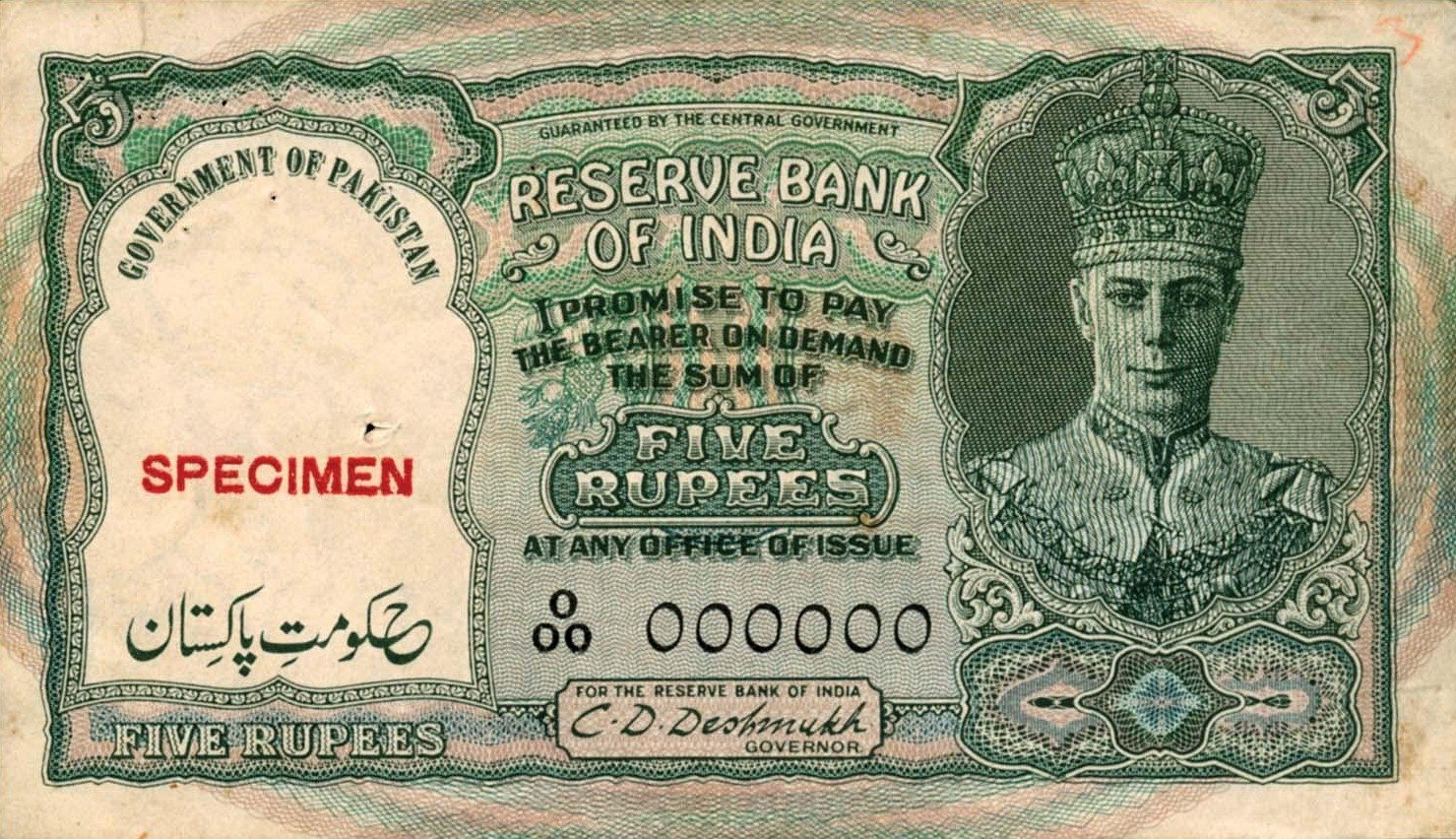
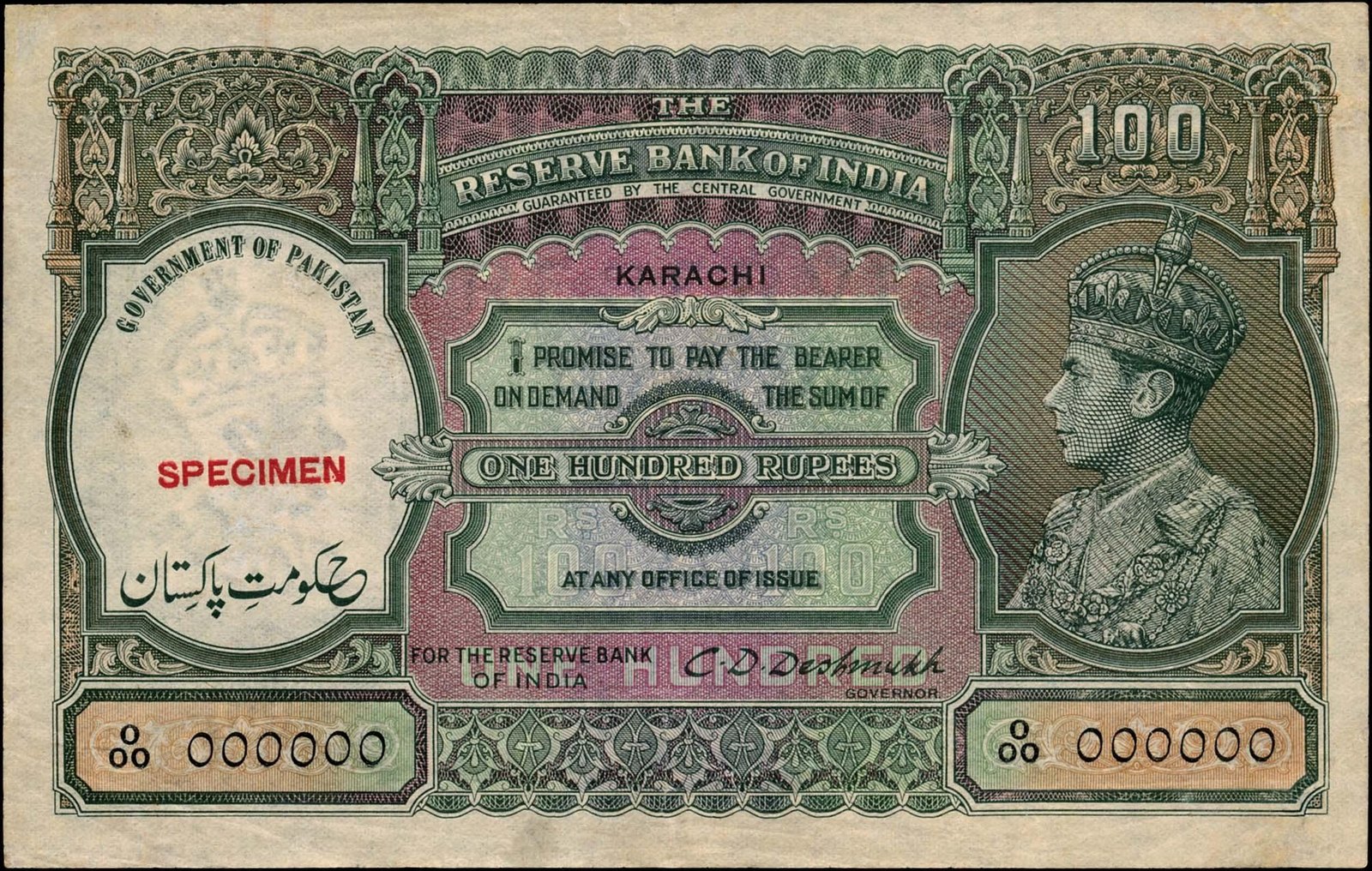
For the issued notes the houses give counts from the grading service PMG, each as it stood on the day. Stack's Bowers' description of lot 30249 in its sale of 5 August 2020 says PMG had graded 35 notes of the 100 rupees. Heritage's description of lot 24434 on 8 March 2024 speaks of over 140 notes of the 10 rupees submitted to PMG. Stack's Bowers' description of a 5 rupees, lot 30247 on 5 August 2020, says that PMG had graded none above the Choice Uncirculated level, and its description of lot 70363 on 8 July 2025 says that PMG had graded no Gem.
Many of the descriptions mention staple holes, and Heritage's description of lot 28426 on 21 January 2021 calls them customary for the issue. Stack's Bowers' lot 50312 on 6 August 2018 was a run of five consecutive 10 rupees.
Sources
- The Pick pages of Pakistan P-1, P-1A, P-2, P-3 and P-3A in this catalogue.
- Reserve Bank of India, Report on Currency and Finance for 1949-50, paragraphs 90 and 100; Report on Currency and Finance for 1950-51, paragraphs 25 and 27.
- Peter Symes, "The Bank Notes of Pakistan, 1947 to 1972", IBNS Journal, volume 38, number 4, 1999.
- Jamal Bokhari and Anil R. Bohora, "Banknotes of Early Pakistan: Payment Refused in India", IBNS Journal, volume 50, number 3, 2011.
- Dr. Malik Aftab Maqbool Joiya, "The Special Notes of Pakistan Since 1947: Overprints Both Official and Private", IBNS Journal, volume 51, number 3, 2012.
- Rezwan Razack, "Varieties of Portrait Notes in India's King George VI 100 Rupee Series", IBNS Journal, volume 51, number 4, 2012.
- Anil Bohora, letter to the editor, IBNS Journal, volume 52, number 1, 2013.
- State Bank Museum and Art Gallery, Karachi, caption to "British India Banknotes" (Google Arts and Culture).
- Reserve Bank of India, "Chronology of Events", entry for 30 June 1948.
- Auction descriptions: Classical Numismatic Gallery, 28 January 2012, lot 480; Spink, 27 September 2011, lot 1302, and 12 January 2025, lot 2125; Lyn Knight, 8 June 2012, lot 1499; Corne Akkermans, 9 April 2014, lot 1043; Heritage, 5 January 2017, lot 27746; 25 April 2019, lot 28194; 24 April 2020, lot 26162; 21 January 2021, lot 28426; 20 June 2023, lot 24309; 8 March 2024, lots 24434 and 24435; 26 March 2026, lot 24388; Stack's Bowers, 6 August 2018, lot 50312; 5 August 2020, lots 30247 and 30249; 8 July 2025, lot 70363.
Member comments
Log in or register to post a comment.