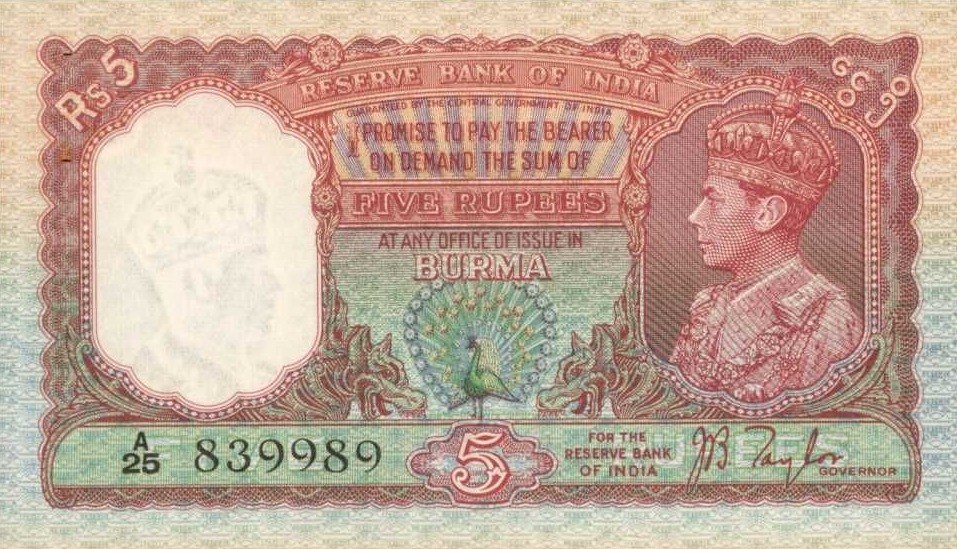
From 1937 to 1952 Burma had notes that were legal tender there and nowhere else. Three of the four issues were India notes with an overprint. This article sets out the four issues in order of time, with the laws and dates that the Pick pages give from the Reserve Bank of India's Reports on Currency and Finance and the reports of the Burma Currency Board, and with what Fred Schwan wrote in Bank Note Reporter in August 1982. The earlier Rangoon notes are in The Rangoon circle, 1862 to 1937.
1937: the Reserve Bank of India keeps Burma's currency
Burma was separated from India in 1937. Sources mention that the Burma Monetary Arrangements Order of 1937 made the Reserve Bank of India responsible for Burma's notes and barred the Government of Burma from issuing its own. Spink's description of lot 58 in its sale of 12 January 2024 gives the Order its full name, the India and Burma (Burma Monetary Arrangements) Order, 1937, and puts the separation in April 1937. The Reserve Bank of India's own page on the Burma notes names the same Order but gives 1938 as the year of separation; the Pick pages and Spink say 1937.
The provisional overprints of 1937
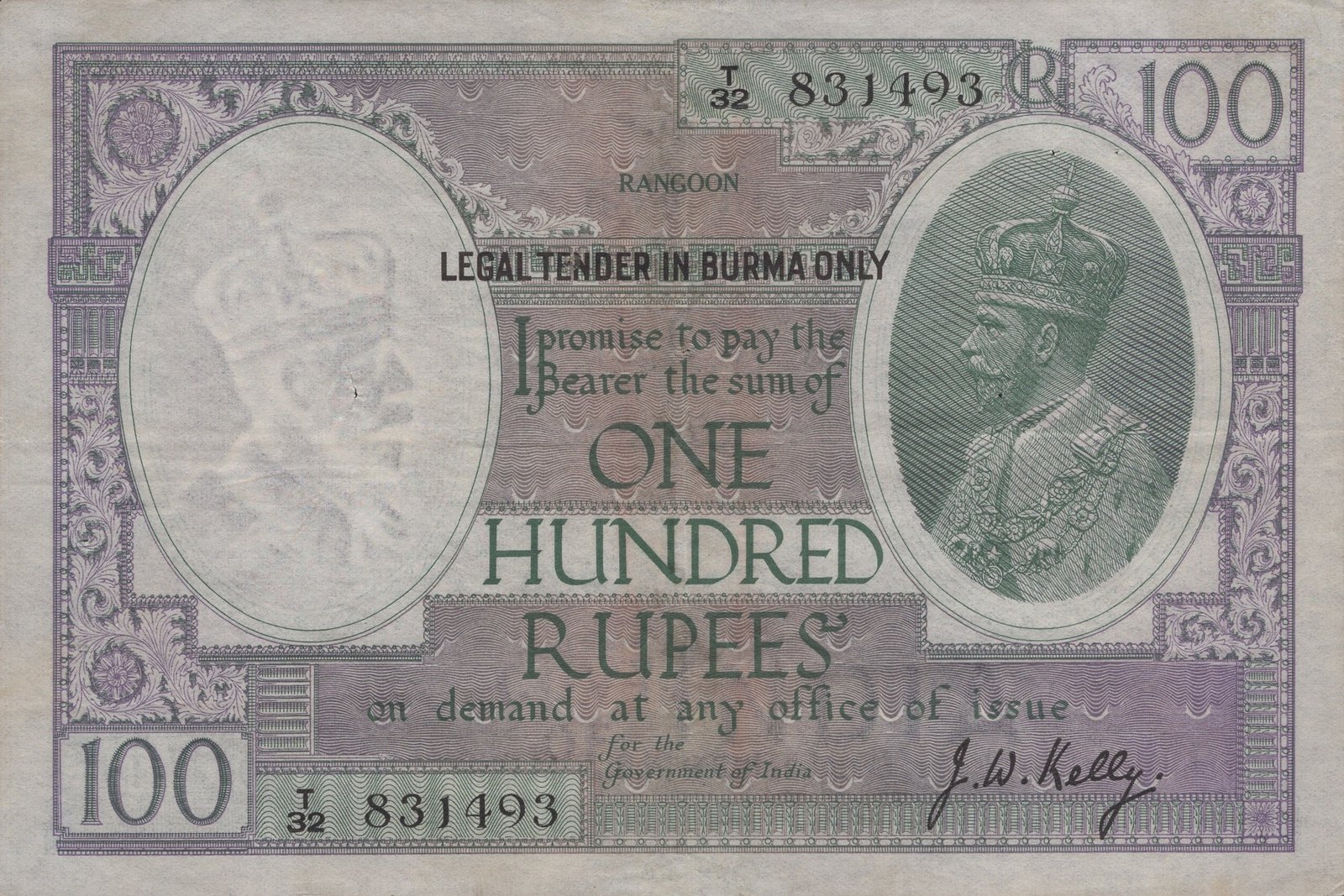
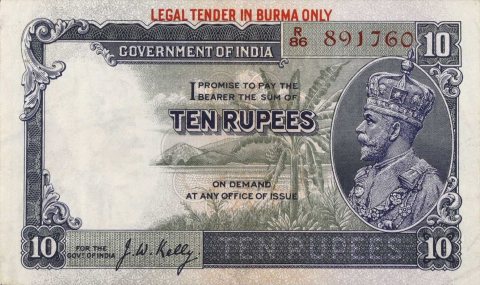
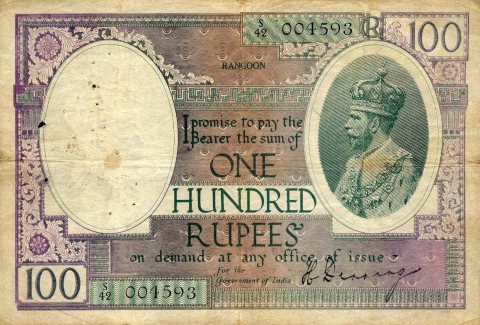
The first Burma-only notes were India notes overprinted LEGAL TENDER IN BURMA ONLY: the 5 rupees, the 10 rupees and the 100 rupees. Sources mention that the official overprints were lithographed at the Nasik security press, the same in type and place on all the notes of one overprint.
The black overprint came first, in April 1937. It was hard to read against the design, so in the second half of 1937 it was changed to red in the upper margins. Sources mention that the black-overprint notes were then called in and exchanged for red ones. The numbers agree with that order.
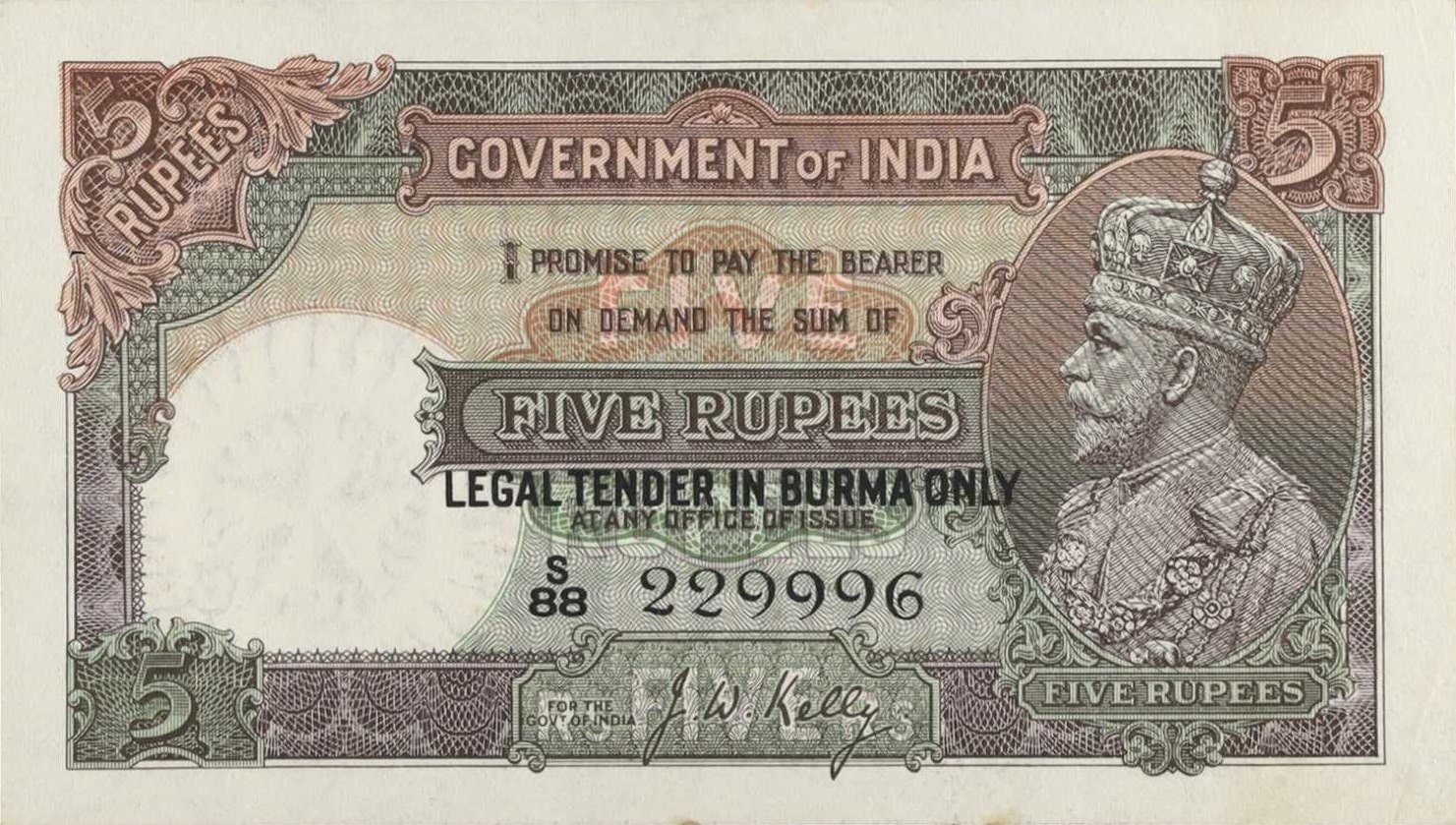
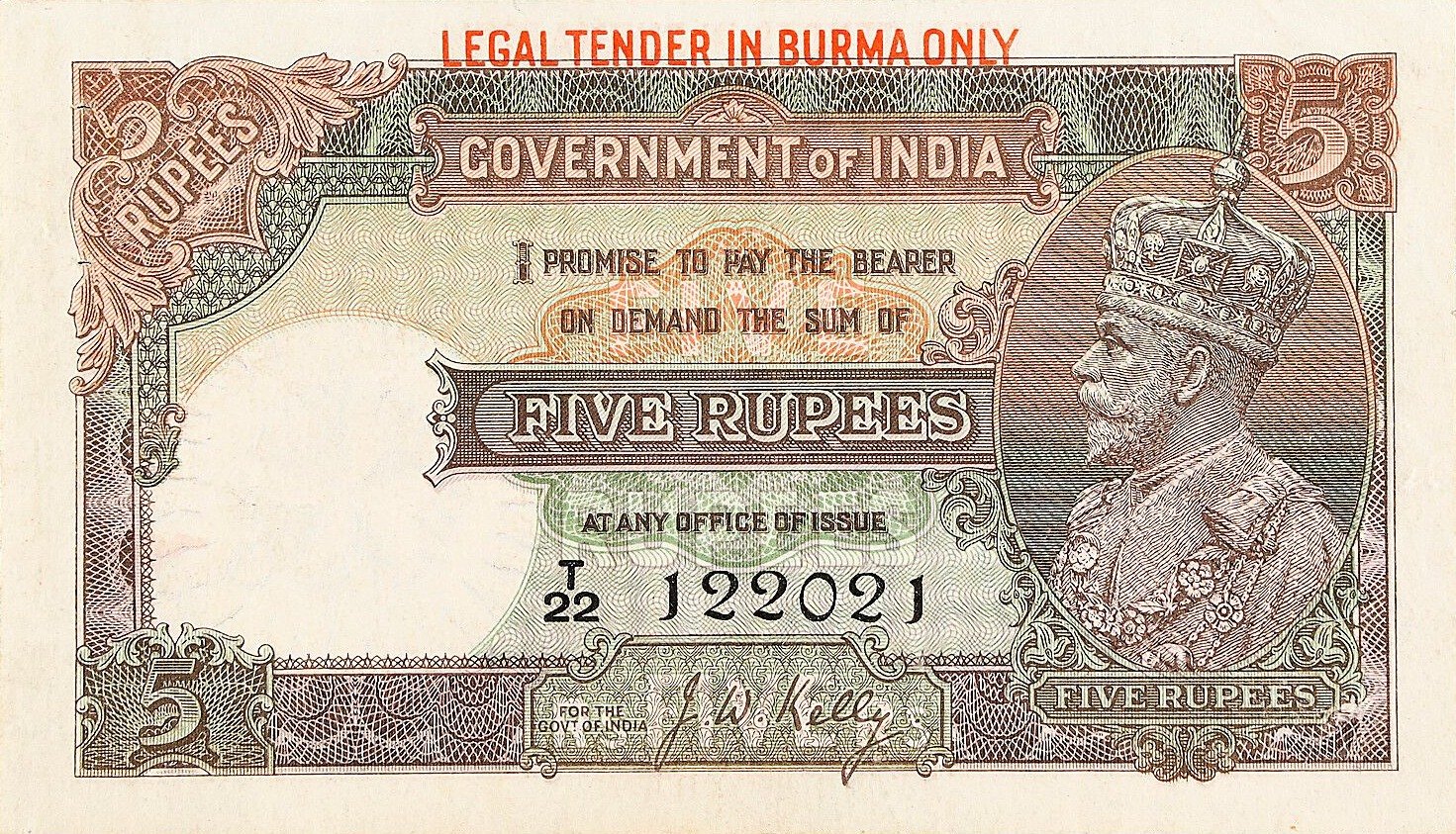
| Value | Black overprint | Red overprint |
|---|---|---|
| 5 rupees | S/88 (from 200001), S/89, S/90 | T/18 to T/22 |
| 10 rupees | R/42 to R/49 | R/82 to R/89 |
| 100 rupees | T/32 (from 700001) and the first 100,000 notes of T/41 | the rest of T/41, and T/47 (to 606000) |
Genuine overprints are found on notes signed by Kelly only. The 100 rupees was overprinted on the Rangoon notes of the 100 rupees of 1927 to 1937. Heritage's description of lot 26114 in its sale of 8 September 2016 gives a reason for the overprint on the 5 rupees: the earlier notes for Burma named Rangoon as place of issue, the George V design had no place for a city, and so the clause was added. Stack's Bowers names the host notes as India P-15b for the 5 rupees (8 July 2025, lot 70033) and India P-16b for the 10 rupees (4 October 2022, lot 41094).
Jhunjhunwalla, quoted by Lyn Knight (10 November 2011, lot 63), says the black overprint on the 100 rupees had not been seen and that its details came from the Reserve Bank of India archives. Black-overprint notes of T/32 have been recorded since. One of them, T/32 831493, was in Spink's sale of 27 September 2017 (lot 1195) and in Noonans' sale of 24 February 2022 (lot 543).
Whether a 1,000 rupees was also overprinted in 1937 is not settled. That question, and the quarter-cut 100 rupees, are in Cut quarters, posted claims and a 1,000 rupees overprint.
The Burma notes of 1938 to 1939
The Reserve Bank of India then prepared a George VI issue for Burma. Sources mention that the notes were designed and printed at the Nasik security press. The promise is payable at any office of issue in Burma, and sources mention that the notes were not legal tender in India.
| Note | Design | Introduced |
|---|---|---|
| 5 rupees | peacock on the front, elephant on the back | May 1938 |
| 10 rupees | ox cart on the front, sailing dhow on the back | June 1938 |
| 100 rupees | peacock on the front, elephants on the back | May 1939 |
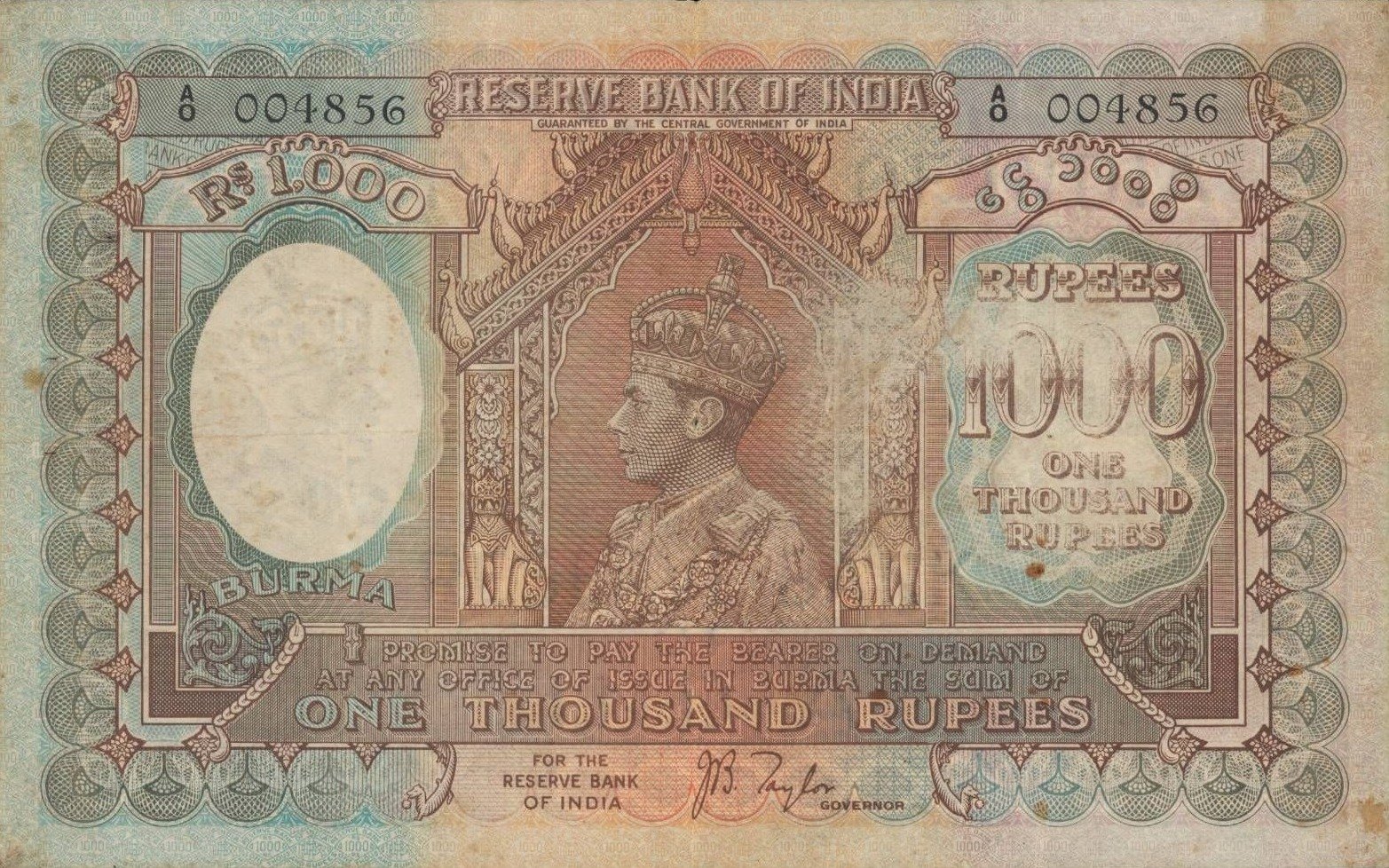
| 1,000 rupees | tiger on the back | July 1939 |
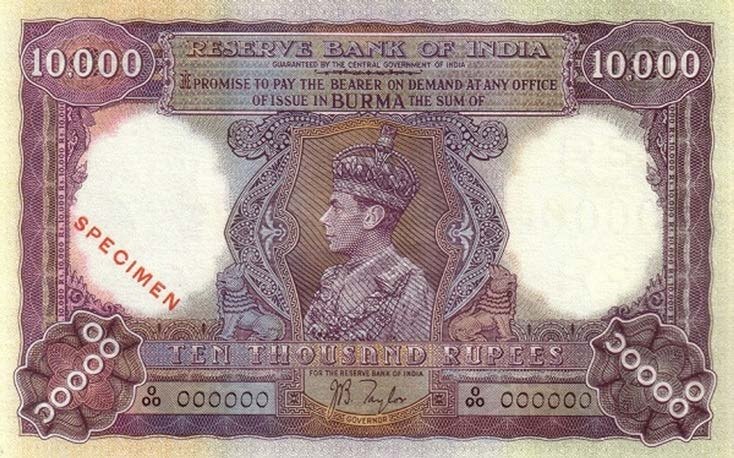
| 10,000 rupees | not described on the page | May 1939 |
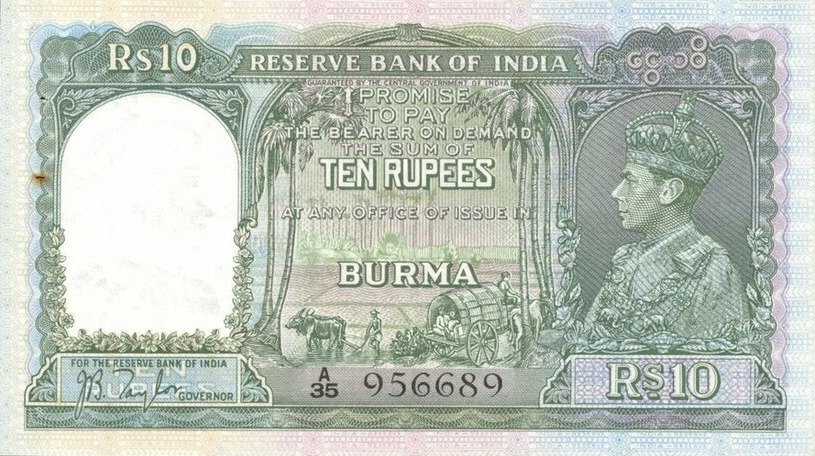
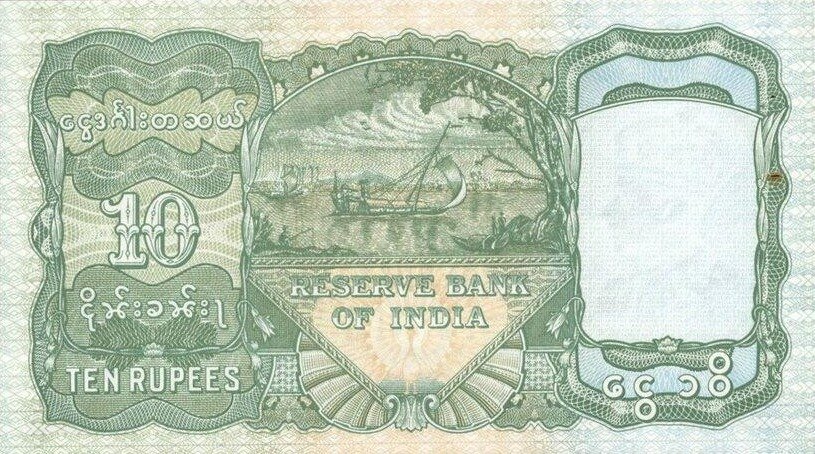
The Reserve Bank of India's page on the Burma notes also dates the first distinctive Burma notes to May 1938 and says they were not legal tender in India. Spink's description of its lot 58 of 12 January 2024 says the notes have English text on the front and Burmese, English and Shan on the back. An album sold by Spink on 27 April 2006 (lot 78), with letters, photographs and trials from the security press at Nasik Road, held original pen and watercolour essays for the 5 and 10 rupees of this type.
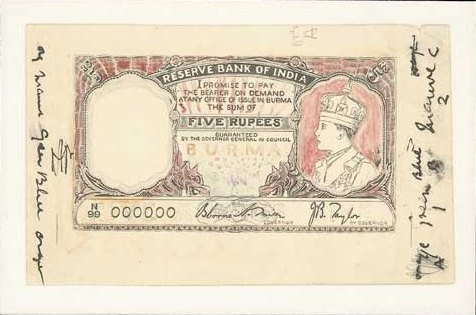
No issued 10,000 rupees has been recorded; the note is known in specimen form. Nearly every 1,000 rupees recorded is numbered between A/0 004821 and A/0 004890. Stack's Bowers' description of A/0 004856 (7 August 2012, lot 20070) says it is ten numbers from the note pictured in Jhunjhunwalla's book. Heritage's description of a 100 rupees (11 July 2020, lot 28004) says that only three prefixes are known for it.
The war, 1942 to 1945
In India the Reserve Bank cashed Burma notes from 5th January 1942, at first only under strict limits, and from 1st May 1945 at par at Calcutta and a few eastern treasuries on a Civil Affairs certificate. This ended on 1st May 1950 (the Reserve Bank of India's Reports on Currency and Finance).
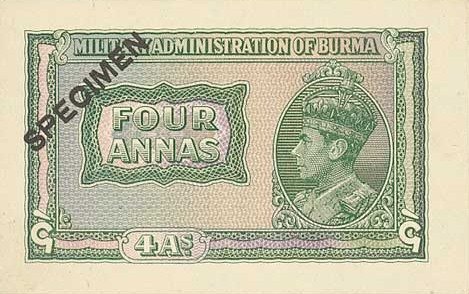
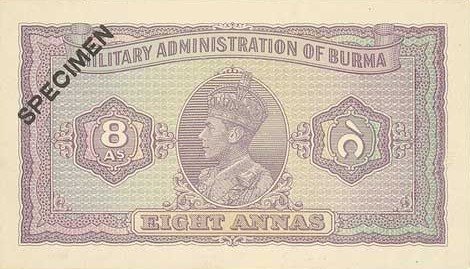
Two small notes were made ready for the return to Burma: the 4 annas and the 8 annas, prepared in booklets with perforated left edges. Fred Schwan, writing in Bank Note Reporter in August 1982 from M. Robinson and L. A. Shaw's book The Coins and Banknotes of Burma (1980), says that the two values were planned in 1943, that proofs went to London in May of that year for the King's approval, given in June, and that the notes were then held in reserve against a shortage of coin rather than issued. Six million pieces of the two values are reported printed. Only specimens are known.
Sources mention that the 1,000 and 10,000 rupees ceased to be legal tender in Burma under a British Military Administration proclamation of May 1945 and were left out of the Currency Notes Act 1946, which kept the lower values in force.
The Military Administration overprints of 1945
After the reoccupation the British Military Administration issued India notes overprinted MILITARY ADMINISTRATION OF BURMA and LEGAL TENDER IN BURMA ONLY.
| Note | Host note and signature | Prefixes |
|---|---|---|
| 1 rupee | Government of India 1 rupee dated 1940, Jones | black serial: T/99, U/0, U/1; green serial with plate letter A: C/86 to C/99, D/0 to D/71, E/42 to E/99, F/0 to F/61 |
| 5 rupees | India 5 rupees, Taylor and Deshmukh | Taylor: J/62 to J/65; Deshmukh: N/20 to N/31, N/75 to N/80, P/11 to P/48 |
| 10 rupees, King in profile | India 10 rupees | specimens only |
| 10 rupees, facing portrait | India 10 rupees, Deshmukh | C/1 to C/10, C/79 to C/90, D/56 to D/75 |
| 100 rupees | India 100 rupees of Calcutta, Taylor and Deshmukh | Taylor: A/62 from 900001, A/73 to 200000; Deshmukh: A/89 from 700001, A/98 to 100000, B/7 from 600001, B/16 to 700000, B/23 from 700001, B/47 to 100000 |
The overprint is red on the 1, 10 and 100 rupees and dark blue on the 5 rupees. On the issued 10 rupees the value is also overprinted in Burmese; sources mention that this is because the language panel on the back of that note has no Burmese. The 1 rupee of 1940 with red serial numbers carries no overprint.
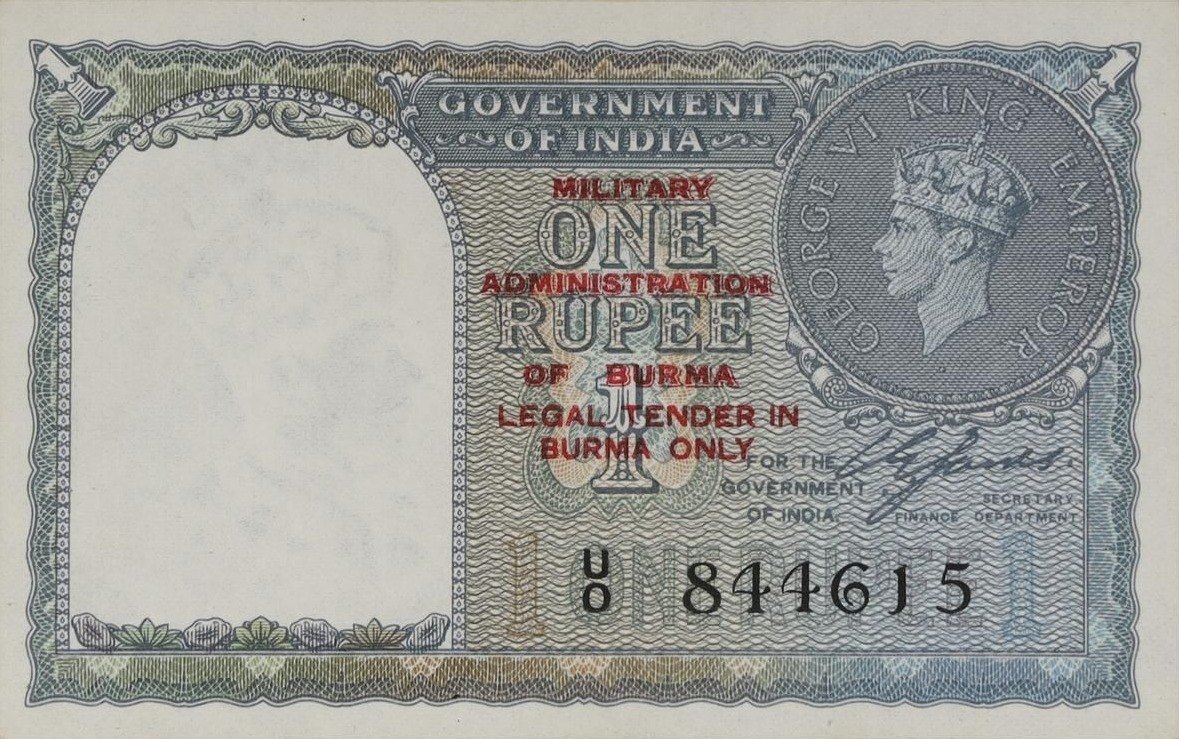
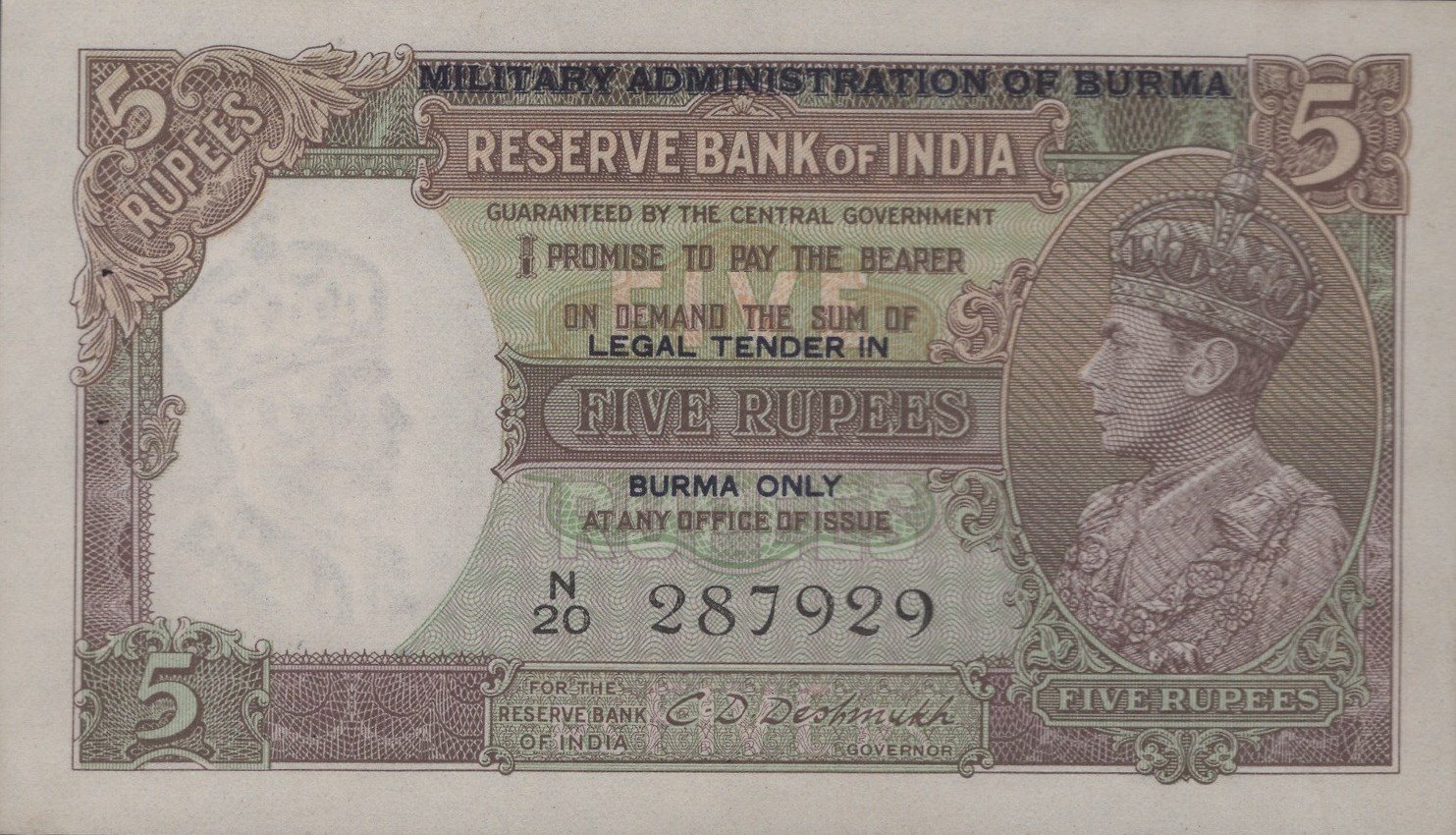
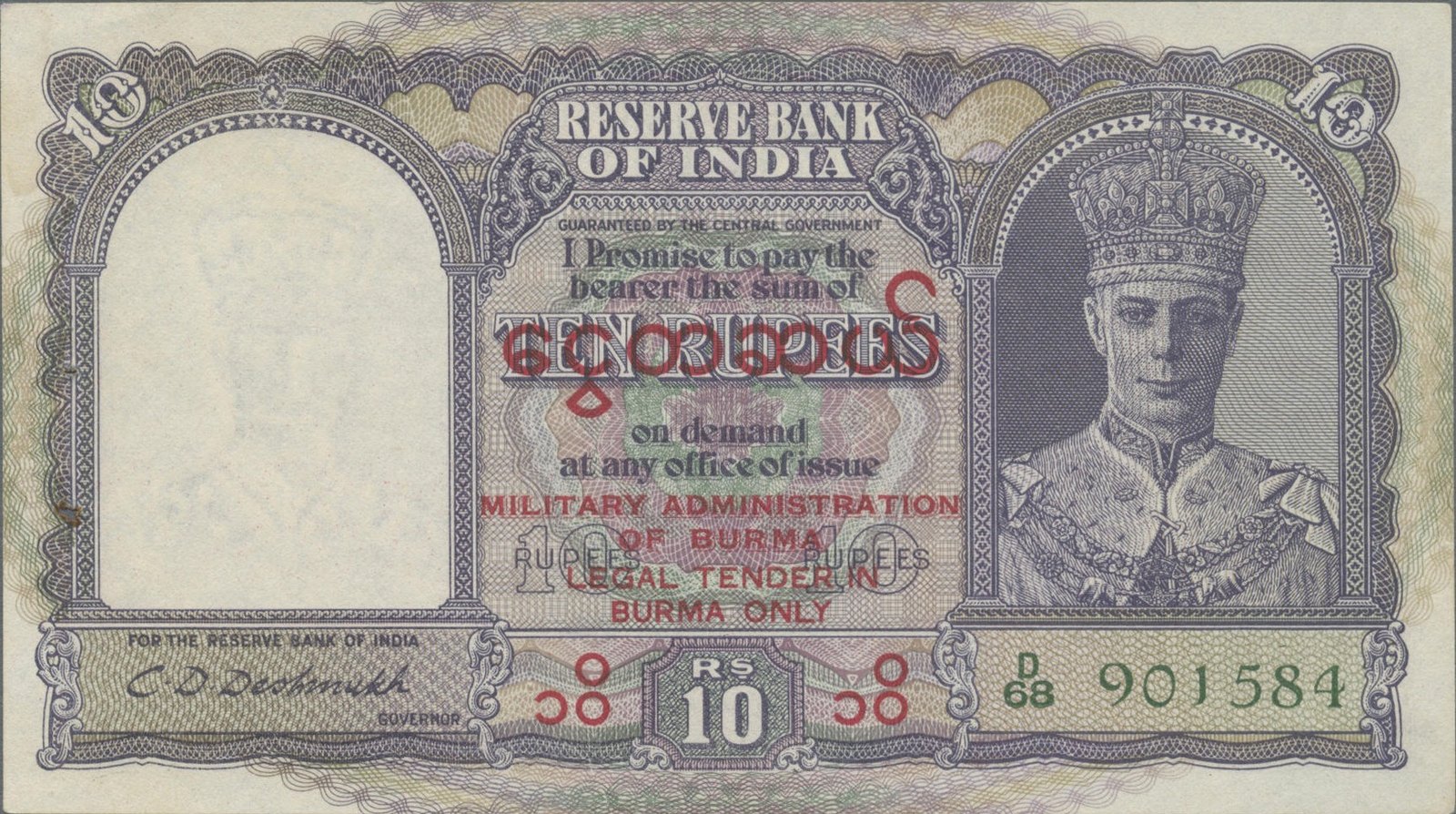
Fred Schwan, in the same article of August 1982, says the whole issue was shipped in bundles sewn together, so most of these notes have two small holes about 1 cm apart at the left.
The Government of Burma and the Currency Board, 1946 to 1947
Sources mention that the Government of Burma took over currency from the Military Administration on 1 February 1946, and that the Currency Notes Act of 6 July 1946, in force from 16 October 1945, let the Governor of Burma issue the overprinted India notes. Under that Act (Burma Act XXV of 1946) the surviving notes of 1938 to 1939 circulated beside the Military Administration issues.
The Burma Currency Board was set up under the Currency and Coinage Act 1946 (Burma Act XLV of 1946) and took over the note issue on 1st April 1947. The Reserve Bank of India's page says the Bank had reopened its Rangoon office in 1945 and acted as banker to the Government of Burma until that same day, 1st April 1947. From 1st April to 30th June 1947 the Board itself paid out the Military Administration notes as its own, until its own overprinted notes were ready. The Board's report for 1947-48 and the Currency and Coinage (Amendment) Act 1947 (Burma Act XVII of 1947) give the mechanism: the Military Administration overprints counted as the Board's notes until Notification No. 226 of 27th June 1947 ended this on 1st July 1947.
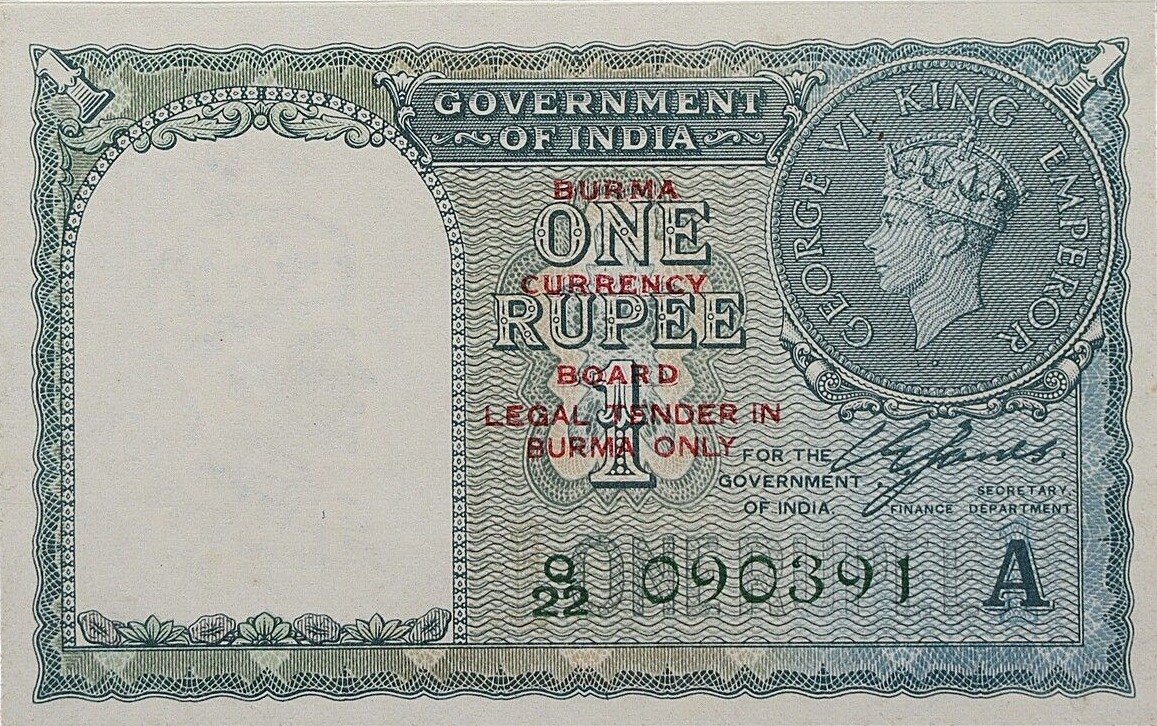
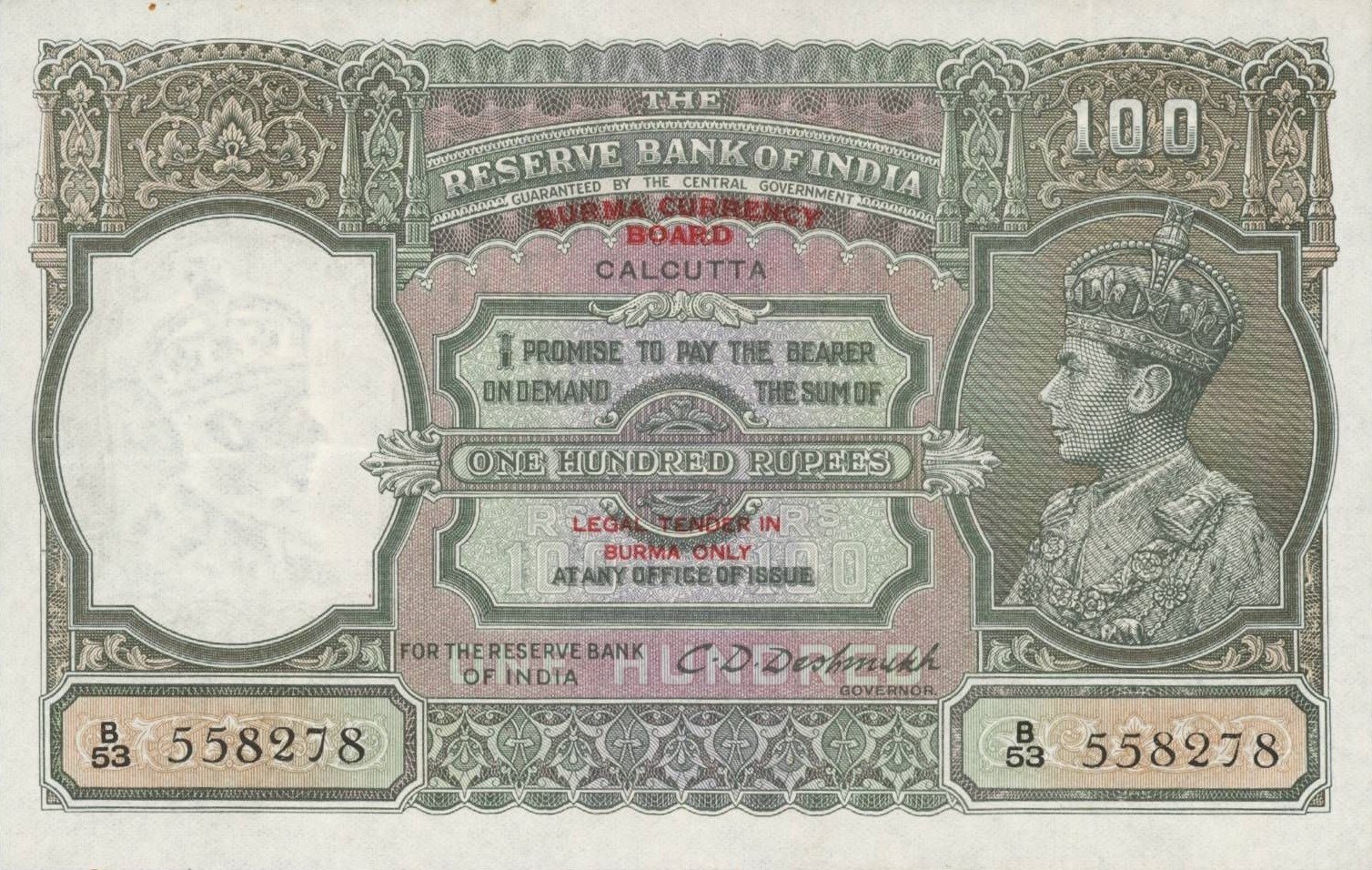
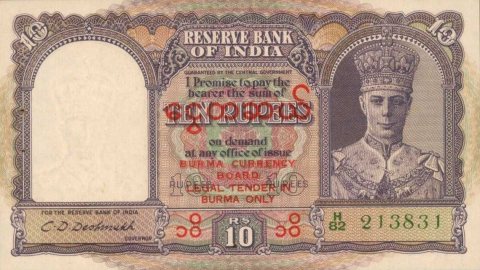
The Board's overprint, BURMA CURRENCY BOARD and LEGAL TENDER IN BURMA ONLY, was issued from 1 July 1947.
| Note | Host note and signature | Prefixes |
|---|---|---|
| 1 rupee | Government of India 1 rupee dated 1940, green serial and plate letter A, Jones | K/27 to K/66, Q/17 to Q/36 |
| 5 rupees | India 5 rupees, Deshmukh | R/24 to R/41 |
| 10 rupees | India 10 rupees with the facing portrait, Deshmukh | G/31 to G/42, H/73 to H/82, J/43 to J/50 |
| 100 rupees | India 100 rupees of Calcutta, Deshmukh | B/47 600001 to 1000000, B/52 000001 to 1000000, B/53 000001 to 800000 |
These overprinted notes, 67 crores of rupees in all, were made at the Government of India's currency note press as a stop-gap until the Board's own notes arrived in 1948. The Board's report for the period from 1st April 1947 to 30th September 1948 (paragraph 10) splits the figure: 19.5 crores ordered first and 47.5 crores more later. It says the overprints were to stop as the notes printed by De La Rue arrived, the 1 rupee in February 1948 and the 5 rupees in August 1948. Those later notes are not among the Burma Pick pages.
Prefix B/47 of the 100 rupees is shared by two issues: numbers to B/47 100000 carry the 1945 overprint, numbers from B/47 600001 the 1947 overprint. The Pakistan 1 rupee of 1948 is recorded from Q/38, two prefixes after the last Burma one.
How the notes ended, 1948 to 1952
- India notes without a Burma overprint ceased to be legal tender in Burma after 30th June 1948, under Notification No. 124 of 8th April 1948; Notification No. 140 of 27th April 1948 said the same of the Government of India 1 rupee (the Burma Currency Board's file on its constitution, Appendix V).
- The 1937 overprints, the 5, 10 and 100 rupees of 1938 to 1939 and the Military Administration notes ceased to be legal tender in Burma on 1 June 1950.
- After that date the notes could still be exchanged at government treasuries and the Currency Board's Rangoon office, until 31st March 1951 as announced on 2nd May 1950 (the Reserve Bank of India's Report on Currency and Finance for 1950-51), and later until 15th January 1952. Later claims needed a specific government order. The Board's report for the year to 30th September 1951 adds an earlier first limit, 31st December 1950.
- Sources mention that the Currency Board overprints of 1947 ceased to be legal tender in Burma on 29 December 1952.
- Sources also mention 20 December 1952 as the date all Burma notes issued by the Reserve Bank of India were withdrawn and demonetised.
The last two dates stand side by side on the Pick pages and no source there explains the nine days between them.
On 30th September 1948 the Board's report still counted Military Administration notes outstanding to the value of 6,866,970 rupees in 1 rupee notes, 4,375,600 in 5 rupee notes, 49,272,290 in 10 rupee notes and 28,289,500 in 100 rupee notes.
Forged and removed overprints
Sources mention that notes with a Burma overprint outside the official prefix and number ranges are likely forgeries, and that some forged Military Administration overprints have every line in a plain type. On the official overprint MILITARY ADMINISTRATION OF BURMA is in a serif type with a drop shadow and LEGAL TENDER IN BURMA ONLY in plain letters without it. An overprinted 1937 note signed by Taylor is a forgery, and so is a Currency Board 100 rupees on a note of an office other than Calcutta.
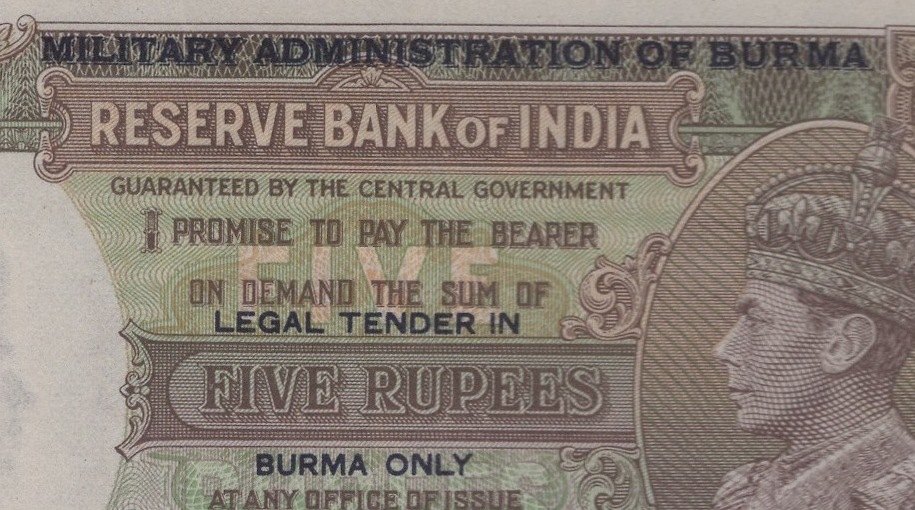
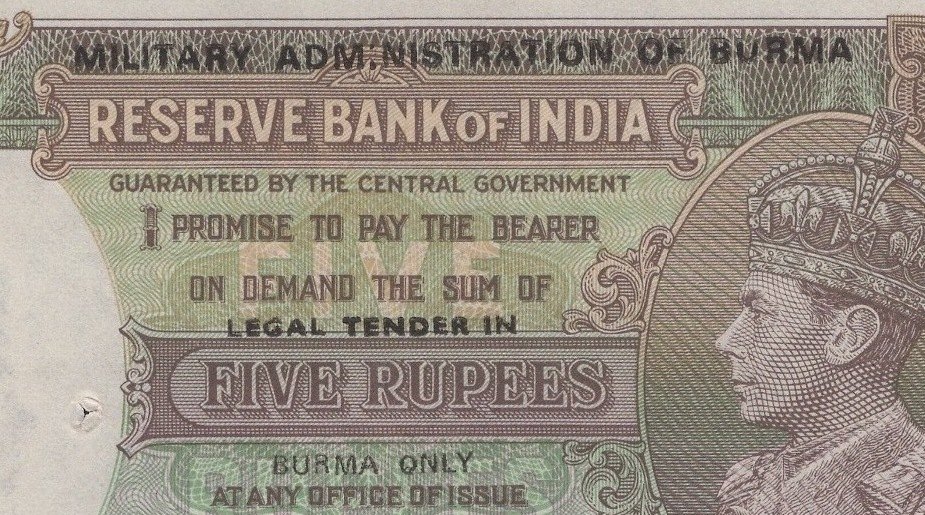
Whole notes were counterfeited too. Sources mention well-made counterfeits of the 5 rupees of 1937, with a back tint shading from green to lilac and back to green, and a watermark laminated between two layers of paper instead of formed in it. Contemporary counterfeits of the 10 rupees of 1938 are recorded with the prefix A/25 and numbers between 098475 and 099487, and a second with the prefix A/30.
The opposite fraud is recorded in an official paper. A Government of India press communique of 16th September 1950 warned that overprinted Burma notes, chiefly the 100 rupees, were being brought into India with the overprint skilfully removed and passed as India notes. It listed the series and numbers of the overprinted 100 rupee notes so that they could be refused (the Reserve Bank of India's Report on Currency and Finance for 1950-51). The page of the 5 rupees of 1945 notes that a note of its prefixes without the overprint may have had it removed, and the page of the 100 rupees of 1945 records a forged overprint without the word OF on a note of the A/73 block.
What is not known
- The Pick pages say the 1,000 and 10,000 rupees lost legal tender by a proclamation of May 1945. A Johns Hopkins working paper on the Board, citing Tun Wai (1953), instead names the Burma Notes Act 1947 and exchange rules of 1946. The texts of these laws were not read.
- Whether the black overprints of 1937 were all called in that year. Heritage (7 January 2016, lot 26055) describes the issue as in circulation from 1937 to 1950.
Sources
- The Reserve Bank of India's Reports on Currency and Finance, among them the report for 1950-51.
- Burma Currency Board, report for 1st April 1947 to 30th September 1948 and report for the year to 30th September 1951; the Board's file on its constitution with the Currency and Coinage Act 1946 (Burma Act XLV of 1946), the Currency and Coinage (Amendment) Act 1947 (Burma Act XVII of 1947) and the notifications of 1946 to 1948.
- Currency Notes Act 1946 (Burma Act XXV of 1946), as the Pick pages name it.
- Fred Schwan, Bank Note Reporter, August 1982, drawing on M. Robinson and L. A. Shaw, The Coins and Banknotes of Burma (1980).
- Reserve Bank of India, "Burma" page of its history of paper money, https://rbi.org.in/scripts/pm_burma.aspx.
- Johns Hopkins working paper on the Burma Currency Board (SAE0072), citing Tun Wai (1953).
- Lyn Knight, 10 November 2011, lot 63; Spink, 27 April 2006, lot 78, 27 September 2017, lot 1195 and 12 January 2024, lot 58; Noonans, 24 February 2022, lot 543; Heritage Auctions, 7 January 2016, lot 26055, 8 September 2016, lot 26114 and 11 July 2020, lot 28004; Stack's Bowers, 7 August 2012, lot 20070, 4 October 2022, lot 41094 and 8 July 2025, lot 70033.
- The Pick pages of Burma P-1 to P-8 and P-23 to P-33.
Member comments
Log in or register to post a comment.