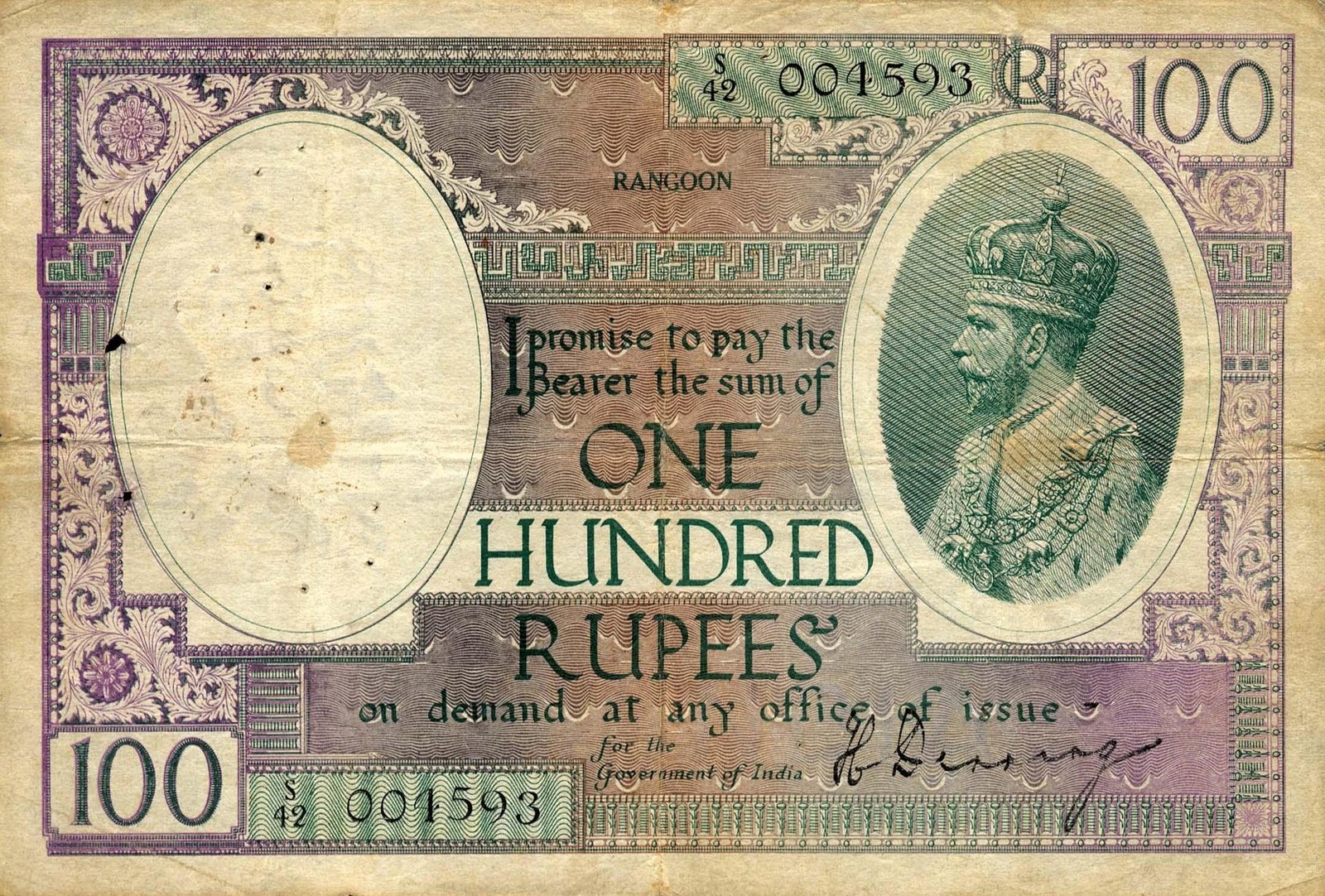
The yearly reports of the Government of India's Currency Department, and from 1914 of the Controller of the Currency, cover every office of issue, and the office at Rangoon has a column of its own in most of their tables. This article takes out what they say of Burma: the Currency Department's reports for 1909-10 to 1913-14 and the Controller's reports for 1923-24 and 1926-27 to 1928-29. Every figure below was read on the page images of those reports. The Burma government's own count of the same notes is in The Paper Currency paragraph of the Report on the Administration of Burma. The circulation of every circle by value on 31st March 1910, and the notes of each value for every 10,000 people in 1913-14, are set out in How many notes of each value and are not repeated here.
A lakh is 100,000 rupees and a crore is 100 lakhs. The reports print rupees the Indian way (1,16,87,800); the tables below write whole rupees in the ordinary way (11,687,800).
The circle that grew fastest
Statement XIV of the report for 1910-11 gives the average value of the notes of each circle in circulation, five years at a time and then year by year. Rangoon has no figure before 1882-83, and its first figure is an average of four years. The report for 1911-12 adds the year 1911-12, and that for 1913-14 the last two years.
| Period | Rangoon circle, average circulation in rupees |
|---|---|
| 1882-83 to 1886-87 (four years) | 2,345,849 |
| 1887-88 to 1891-92 | 4,596,834 |
| 1892-93 to 1896-97 | 6,373,527 |
| 1897-98 to 1901-02 | 8,513,134 |
| 1902-03 to 1906-07 | 16,507,822 |
| 1907-08 | 28,021,317 |
| 1908-09 | 32,272,433 |
| 1909-10 | 29,735,585 |
| 1910-11 | 31,806,085 |
| 1911-12 | 41,039,541 |
| 1907-08 to 1911-12 | 32,574,992 |
| 1912-13 | 52,779,991 |
| 1913-14 | 51,882,638 |
The report for 1913-14 reprints the earlier averages, and its print reads the first one as 28,45,849 and the fourth as 85,18,134. The report for 1910-11 prints them as 23,45,849 and 85,13,134, as does Statement IV of the report for 1909-10, and those are used above.
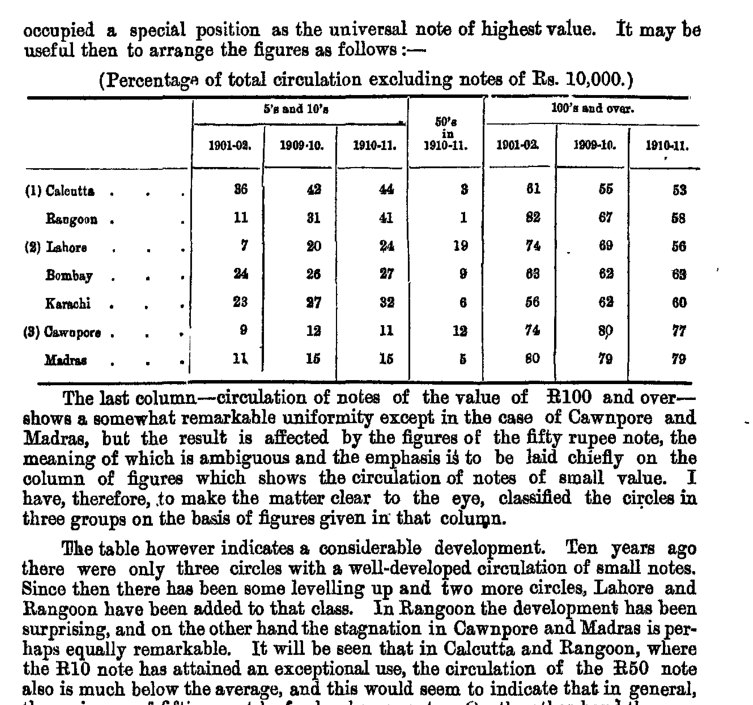
The report for 1910-11 (para 36) looks at the net circulation since 1901-02 circle by circle: "By circles Burma easily comes first, the proportionate increase in the same period being well over 200 per cent." In para 40 it sorts each circle's notes into three groups, as a share of all notes but the 10,000 rupees.

| Rangoon circle | 1901-02 | 1909-10 | 1910-11 |
|---|---|---|---|
| 5 and 10 rupees | 11 | 31 | 41 |
| 50 rupees | not given | not given | 1 |
| 100 rupees and over | 82 | 67 | 58 |
The report says, "In Rangoon the development has been surprising", and adds that in Calcutta and Rangoon, where the 10 rupees "has attained an exceptional use", the 50 rupees was much below the average.
Paying for the rice crop
The reports return to one theme year after year: in Burma the rice crop was paid for in notes. The report for 1913-14 sets out each circle's seasons. For Rangoon, in lakhs of rupees, with a minus for money that came back from circulation:
| Rangoon, 1913-14 | Rupees | Notes | Sovereigns | Total |
|---|---|---|---|---|
| Slack season, April to November | minus 300 | minus 217 | 77 | minus 440 |
| Busy season, December to March | 275 | 237 | 46 | 558 |
| The year | minus 25 | 20 | 123 | 118 |
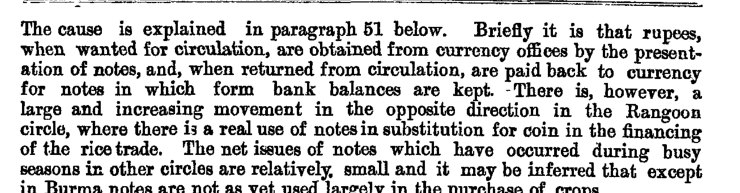
(The report prints these the Indian way: 2,37 is 237 lakhs.) Elsewhere, the report explains, the note circulation moved the opposite way to the rupee, because rupees for the busy season were drawn from the currency offices against notes: "There is, however, a large and increasing movement in the opposite direction in the Rangoon circle, where there is a real use of notes in substitution for coin in the financing of the rice trade." It adds that in 1913-14 a large return followed the heavy issues of the busy season before, so that the year's net absorption was much smaller in spite of an excellent rice crop. The money came from India: the rice trade of that year needed a remittance of 10 3/4 crores, 6 1/2 crores from Calcutta and 4 1/4 from Bombay, and Rangoon sent back only about 3/4 of a crore in its slack season, a quarter each to Calcutta, Bombay and Madras.
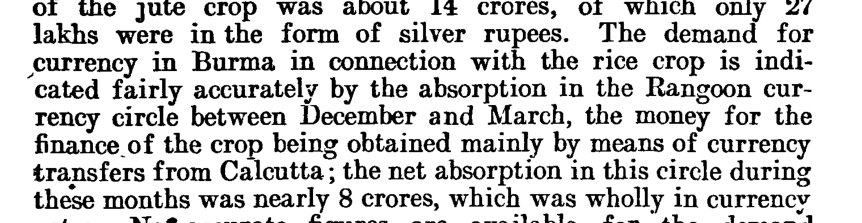
Ten years later the Controller of the Currency's report for 1923-24 says (para 34) that the demand for currency in Burma for the rice crop "is indicated fairly accurately by the absorption in the Rangoon currency circle between December and March"; the money came mainly by currency transfers from Calcutta, and the net absorption in those months "was nearly 8 crores, which was wholly in currency notes". The same report (para 33) says the rice crop was reported to have been financed entirely by notes in several districts, and there was a return of rupees from circulation in the Burma circle in place of the usual absorption.
An appendix to that report describes the trade. Rice was grown all over Burma, but only Lower Burma had a large surplus to export: 1,950,000 tons in 1923-24, worth 2,361 lakhs of rupees (printed 23,61), against 2,450,000 tons worth 2,847 lakhs (printed 28,47) in 1922-23, by the figures of the Commissioner of Settlement and Land Records, Burma. The funds came from the large banking houses of Rangoon, but were handed out mostly by money-lenders of the Chettyar community from Madras, more than 300 of them in Rangoon, with head offices in Rangoon and Mandalay and agents all over Burma. The smaller firms sent money to their branches by their own agents and messengers, which was easy because of "the readiness with which currency notes are accepted in all business transactions in Lower Burma". Coin played only a small part, and in 1923-24 there was a net return of whole rupees of about 73 lakhs, put down to the floods of the monsoon in Lower Burma: people made homeless changed their hoarded silver for notes, which were easier to hold than coin.
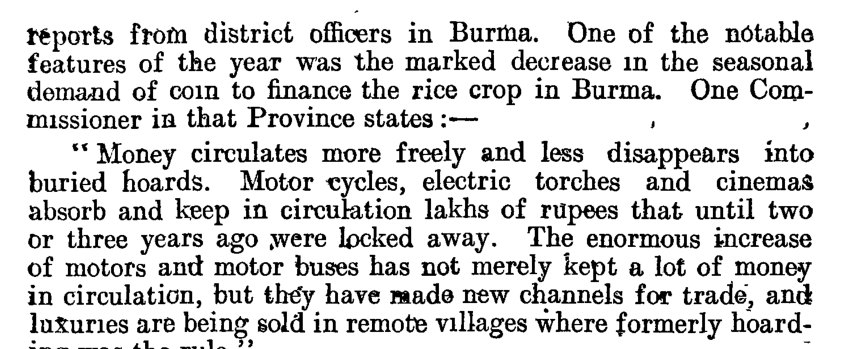
The report for 1926-27 quotes a Commissioner in Burma on the fall in the demand for coin: "Money circulates more freely and less disappears into buried hoards. Motor cycles, electric torches and cinemas absorb and keep in circulation lakhs of rupees that until two or three years ago were locked away." The report for 1927-28 (para 37) found the return from circulation in the Rangoon circle that year "interesting", after a steady absorption of rupees in 1924-25 to 1926-27, and put it down mainly to the increasing popularity of notes.
Rangoon notes cashed far from home
A note bore the name or letter of its office, and each report counts the notes of every circle cashed at the other offices. The first column below is the value of Rangoon notes cashed at offices in India; the second is the value of notes of other circles cashed at Rangoon.
| Year | Rangoon notes cashed elsewhere, rupees | Other circles' notes cashed at Rangoon, rupees | Report |
|---|---|---|---|
| 1906-07 | 872,525 | 36,085 | 1909-10 |
| 1907-08 | 1,064,050 | 509,945 | 1909-10 |
| 1908-09 | 1,564,585 | 577,100 | 1909-10 |
| 1909-10 | 1,856,925 | 408,320 | 1909-10 |
| 1910-11 | 1,541,345 | 541,970 | 1913-14 |
| 1911-12 | 4,772,055 | 1,150,215 | 1913-14 |
| 1912-13 | 6,896,915 | 1,858,850 | 1913-14 |
| 1913-14 | 9,339,715 | 1,719,780 | 1913-14 |
| 1920-21 | 42,216,970 | 5,749,650 | 1923-24 |
| 1921-22 | 19,265,870 | 12,974,120 | 1923-24 |
| 1922-23 | 11,876,450 | 24,148,650 | 1923-24 |
| 1923-24 | 11,955,600 | 6,392,200 | 1923-24 |
| 1924-25 | 13,381,100 | 12,690,000 | 1926-27 |
| 1925-26 | 12,291,820 | 2,320,020 | 1926-27 |
| 1926-27 | 11,687,800 | 11,830,170 | 1926-27 and 1928-29 |
| 1927-28 | 11,609,920 | 9,528,300 | 1928-29 |
| 1928-29 | 14,225,900 | 2,765,400 | 1928-29 |
The years 1914-15 to 1919-20 are missing because the reports of those years were not found. The largest sums were cashed at the three Presidency towns. In 1909-10 Calcutta cashed 1,136,595 rupees of them, Bombay 369,640 and Madras 241,015. In 1913-14 Calcutta cashed 4,008,180 rupees and Bombay 1,476,215; the Madras figure is not clear in the print. In 1923-24 Calcutta cashed 4,569,550, Bombay 3,511,700 and Madras 3,005,600, and in 1928-29 Madras 4,911,800, Calcutta 4,378,450 and Bombay 3,397,300. The report for 1910-11 (para 41) says that the cashing of other circles' notes at the currency offices "has fallen greatly in consequence of the legislation of February 1910", the Act that made the 10 and 50 rupees payable at every office. The report for 1909-10 (para 24) heads its table "Foreign Circle Notes received over the Counter" of the currency offices.
The work of the office
Statement XVII of the report for 1926-27 gives the work of each office in that year. Rangoon issued 277 lakhs of notes, worth 6,876 lakhs of rupees, and cancelled 195 lakhs of notes worth 4,999 lakhs (the report prints these 2,77, 68,76, 1,95 and 49,99). It registered 60 claims on defective, lost or wholly destroyed notes, against 10,996 at Calcutta and 15,310 at all the offices. The claims on lost and cut notes are told for India as a whole in Lost in the post, cut in half, written off.
How much of the forgery came in at Rangoon
The forged series the reports name are listed in The Rangoon circle, 1862 to 1937 and, for all India, in The forged series of British India, 1909 to 1929. The Controller's reports also say how many forged notes each circle took in, and from 1926 Rangoon led.
- 1923-24 (para 40). Most of the forged 5 rupee notes came in at Rangoon. Notes of the series GC/18 had spread fairly widely over Upper Burma, and the report hoped that large seizures of forged notes and forging tools in the Myingyan and Sagaing districts would stop their making. (This sentence was read in the text of the scan.)
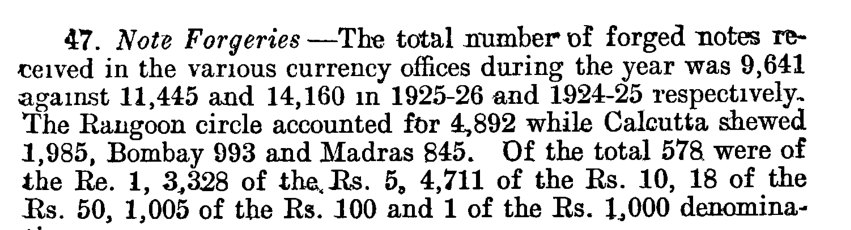
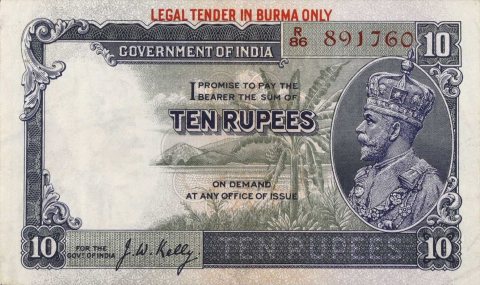
- 1926-27 (para 47). Of 9,641 forged notes received, the Rangoon circle accounted for 4,892, against 1,985 at Calcutta, 993 at Bombay and 845 at Madras. Three-fourths of the forged 10 rupee notes appeared in Rangoon, and by far the largest number of forged 100 rupee notes, as in the year before.
- 1927-28 (para 44). Of 6,956 forged notes, nearly half appeared in the Rangoon circle; Calcutta had 1,563, Bombay 982 and Madras 685. More than half the forged 10 rupee notes appeared in Rangoon. Only two new forgeries of the 100 rupees came in at Rangoon, against 309 the year before.
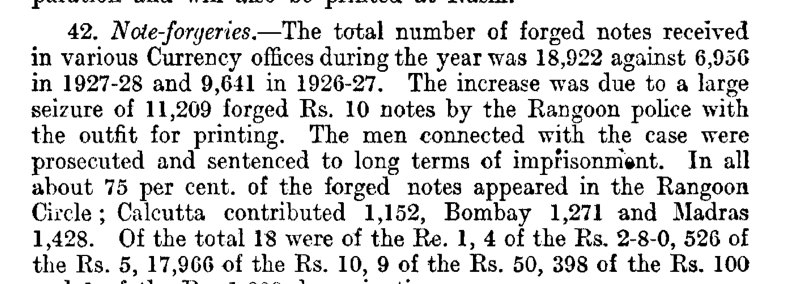
- 1928-29 (para 42). The total rose to 18,922, "due to a large seizure of 11,209 forged Rs. 10 notes by the Rangoon police with the outfit for printing". The men were sentenced to long terms of imprisonment. In all about 75 per cent of the forged notes of the year appeared in the Rangoon circle; Calcutta had 1,152, Bombay 1,271 and Madras 1,428.
The reports count the forged notes by the circle where they came in, not by the office named on them, and they do not say how many of the forged notes at Rangoon carried the letter R.
What these reports do not give
- The reports for 1914-15 to 1919-20, 1921-22, 1922-23, 1924-25 and 1925-26 were not found, so the years of the war and of the small notes are seen only through later tables and the Burma report.
- They give the work of the Rangoon office, but never the name of the officer who signed its notes.
- From 1922-23 they stop giving the circulation of each circle by value.
Sources
- Annual reports of the Currency Department, India, for 1909-10 to 1913-14, bound together (Gokhale Institute of Politics and Economics, GIPE-015725): 1909-10 para 24; 1910-11 paras 36, 40 and Statement XIV; 1911-12 Statement XIV; 1913-14 paras 29 to 31, the remittances of the year, Statements XII and XVIII.
- Reports of the Controller of the Currency for 1923-24 (paras 33, 34 and 40, the appendix on the financing of the crops, Statement XV), 1926-27 (paras 37 and 47, Statements XIV and XVII), 1927-28 (paras 37 and 44) and 1928-29 (para 42, Statement XXXVIII).
- The Pick pages of Burma P-A1 to P-A8 for the notes named.
Member comments
Log in or register to post a comment.