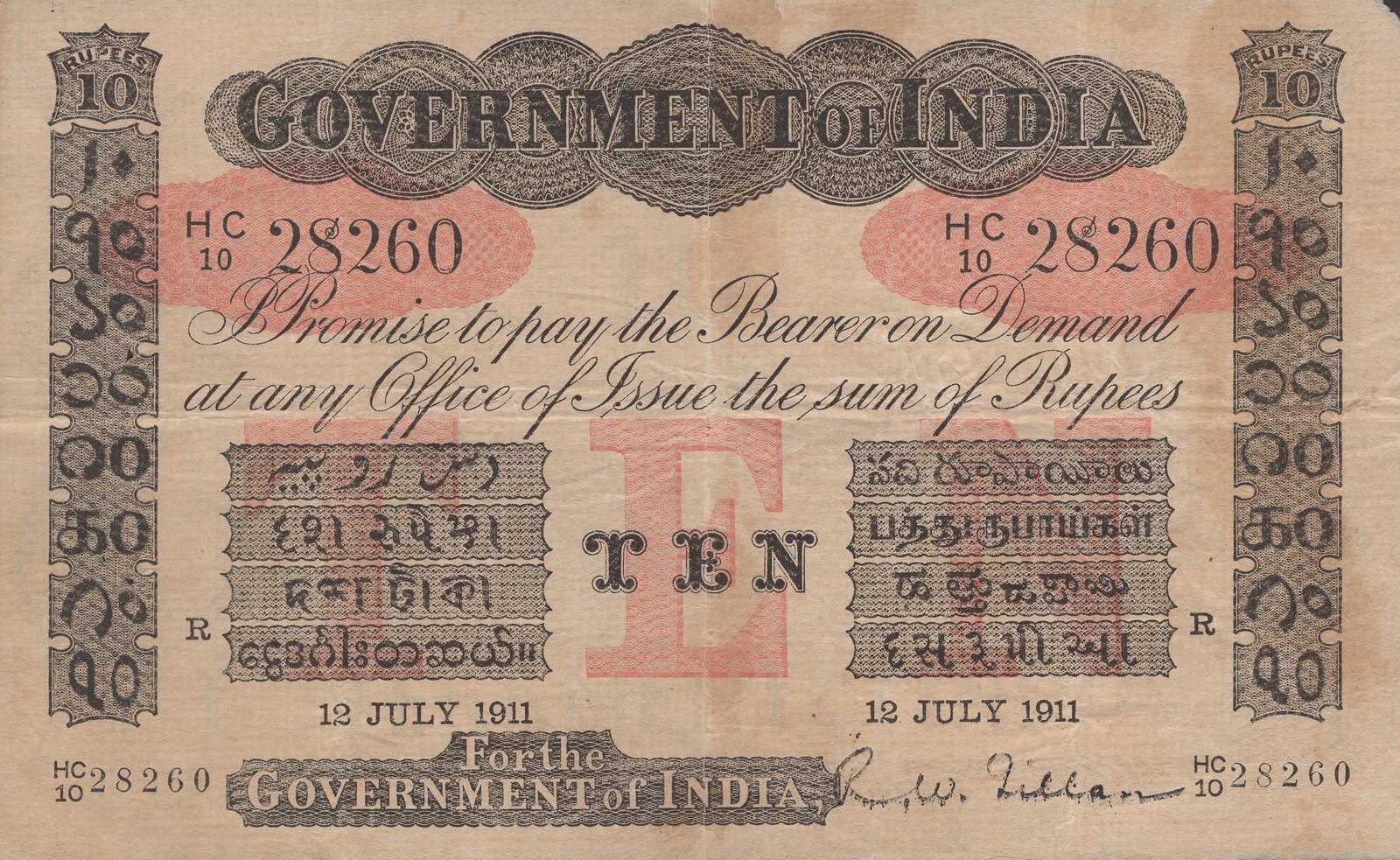
Every year the Government of Burma printed a Report on the Administration of Burma, and every year it gave one paragraph, headed Paper Currency, to the Government of India notes of the Rangoon circle. The volumes from 1896-97 to 1935-36 were read for the catalogue in November 2026, and the figures below were taken from the page images. This article sets out what those paragraphs give, year by year and table by table. A selection of the same figures, with the notes themselves, is in The Rangoon circle, 1862 to 1937; what the Government of India's own currency reports said of Rangoon is in The Rangoon Currency Office in the currency reports.
The reports print large sums the Indian way, with the comma two places from the end: 20,90,495 rupees is 2,090,495 rupees, and a lakh is 100,000 rupees. The tables below write whole rupees in the ordinary way and leave lakhs and crores (100 lakhs) as the reports give them.
The net circulation from the first year, 1884 to 1905
The report for 1896-97 opens its paragraph with a list: "The net circulation of notes on the 31st March of each year since the office was first opened in August 1883 has been as follows". The later reports carry the series on.
| 31st March | Net circulation, rupees | Report |
|---|---|---|
| 1884 | 2,090,495 | 1896-97 |
| 1885 | 1,336,705 | 1896-97 |
| 1886 | 1,586,780 | 1896-97 |
| 1887 | 3,201,200 | 1896-97 |
| 1888 | 3,742,850 | 1896-97 |
| 1889 | 2,844,310 | 1896-97 |
| 1890 | 2,890,800 | 1896-97 |
| 1891 | 5,311,715 | 1896-97 |
| 1892 | 3,946,175 | 1896-97 |
| 1893 | 6,677,090 | 1896-97 |
| 1894 | 3,975,125 | 1896-97 |
| 1895 | 5,650,720 | 1896-97 |
| 1896 | 4,928,225 | 1896-97 |
| 1897 | 5,357,155 | 1896-97 |
| 1898 | 5,946,620 | 1897-98 |
| 1899 | 5,885,090 | 1898-99 |
| 1900 | 7,589,640 | 1899-1900 |
| 1901 | 10,151,090 | 1900-01 |
| 1902 | 10,401,775 | 1901-02 |
| 1903 | 15,031,740 | 1902-03 |
| 1905 | 17,483,405 | 1904-05 |
The report for 1903-04 has no paper currency paragraph, so 1904 is missing. The figure for 1906 is given only in words, "a crore and 84.67 lakhs", and those for 1907 to 1910 in lakhs: 271 lakhs on 31st March 1907, 260 lakhs in 1908 (259.93 in the report for 1908-09), 296.81 lakhs in 1909 and 359.44 lakhs in 1910. The report for 1910-11 gives 404 lakhs on 31st March 1911.
The report does not explain the years in which the figure fell, such as 1885, 1889, 1892 and 1894. It does tell of one blow: a forgery of the 5 rupee notes discovered in April 1891, after which, the report for 1902-03 says, "the panic of 1891 appears to have shaken public confidence to such an extent that not a single note of Rupees 5 has been issued from the Mandalay Currency Agency since September 1893".
Every value, 1896 to 1910
Until 1910 the paragraph counted the notes of each value in circulation in the circle on 31st March. The table gives the number of notes, not their value. Every value from 5 to 10,000 rupees was already in use in the first year read.
| 31st March | All notes | 5 | 10 | 20 | 50 | 100 | 500 | 1,000 | 10,000 |
|---|---|---|---|---|---|---|---|---|---|
| 1896 | 97,291 | 9,351 | 48,326 | 13,503 | 6,517 | 17,928 | 717 | 871 | 78 |
| 1897 | 105,871 | 9,689 | 52,064 | 13,831 | 7,759 | 20,790 | 755 | 907 | 76 |
| 1898 | 114,926 | 8,740 | 60,360 | 12,966 | 6,998 | 24,196 | 699 | 861 | 106 |
| 1899 | 131,327 | 8,748 | 73,335 | 14,595 | 7,790 | 25,346 | 448 | 998 | 67 |
| 1900 | 148,720 | 7,916 | 83,304 | 11,911 | 8,050 | 36,033 | 352 | 1,027 | 127 |
| 1901 | 166,113 | 8,114 | 91,170 | 9,891 | 7,710 | 47,280 | 297 | 1,419 | 232 |
| 1902 | 186,596 | 7,731 | 96,803 | 12,517 | 7,961 | 59,812 | 317 | 1,327 | 128 |
| 1903 | 270,605 | 8,598 | 133,807 | 14,964 | 8,586 | 102,971 | 232 | 1,329 | 118 |
| 1907 | not given | 15,004 | 352,780 | not given | not given | 201,025 | not given | not given | not given |
| 1909 | 909,497 | 22,871 | 676,998 | not given | not given | 183,448 | not given | not given | not given |
| 1910 | 1,319,698 | 41,328 | 1,044,368 | not given | not given | 212,436 | not given | not given | not given |
The figures for 1896 come from the report for 1896-97, which prints the year before beside its own. The 1909 counts are taken from the report for 1909-10. The reports between add remarks in place of a full table:
- 1904-05: no table by value; the 10 and 100 rupees grew most.
- 1905-06: 468,207 notes in all, the 10 rupees over 63 per cent of them and the 100 rupees 20 per cent; the 5 rupees rose but was "still unpopular".
- 1906-07: the circulation rose by over 87 lakhs, of which only 14 1/2 lakhs were in notes of 1,000 and 10,000 rupees.
- 1907-08: 652,056 notes in all (from the report for 1909-10); a large increase in the 10 rupees; the 100 rupees fell because 25,785 of them were transferred in March 1908 from the Government account at the Bank of Bengal to the Currency Office; the 50 rupees was "gradually decreasing".
- 1909-10: the 20 rupees and the 50 rupees declined. "The twenty-rupee note was abolished in February 1910."
- 1910-11: about 1,702 thousand notes in all; the 100 rupees down from 212 thousand to 197 thousand.
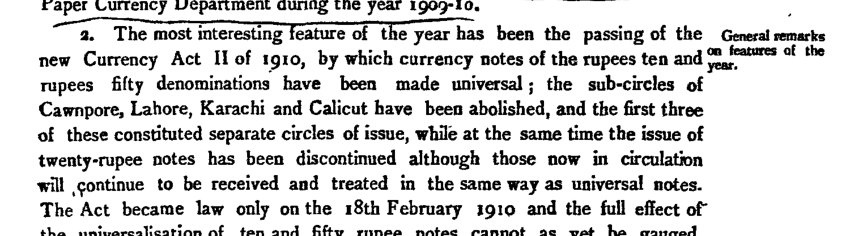
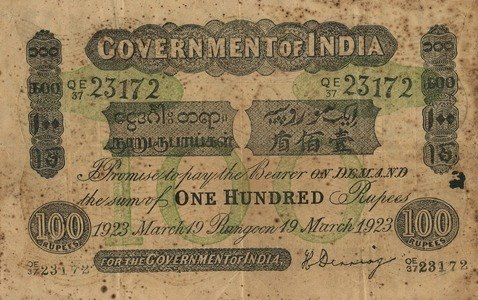
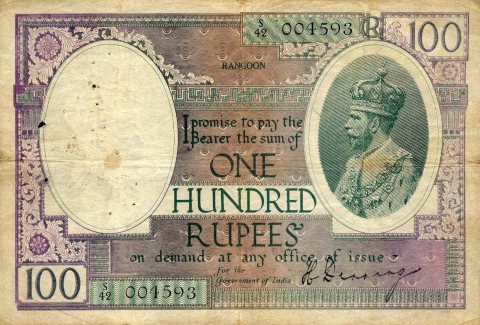
Each value had its own use, as the paragraphs tell it. The 100 rupees became "the favourite medium" for paying for paddy. The notes of 500 rupees and above were used almost only by the banks, against telegraphic transfers from Calcutta. The 10 rupees was the note in widest use from the first year read. The 10 and 50 rupees were made payable at every currency office in 1910, and the report for 1910-11 says this swelled their circulation in Burma. That report's summary names the "10 and 5" rupees; its text names the 10 and 50, which is what the Act of 1910 did.
The months of the paddy trade
The report for 1897-98 gives the notes issued by the Rangoon office in each month of two years. Here are the 10 and 100 rupees.
| Month | 10 rupees, 1896-97 | 10 rupees, 1897-98 | 100 rupees, 1896-97 | 100 rupees, 1897-98 |
|---|---|---|---|---|
| April | 17,484 | 20,501 | 6,275 | 6,972 |
| May | 19,851 | 17,736 | 7,689 | 9,657 |
| June | 21,718 | 21,218 | 9,796 | 12,970 |
| July | 18,222 | 18,047 | 6,798 | 11,323 |
| August | 19,131 | 19,770 | 9,972 | 14,335 |
| September | 18,376 | 21,762 | 9,319 | 11,573 |
| October | 19,074 | 17,859 | 5,817 | 7,001 |
| November | 19,285 | 23,201 | 7,991 | 12,451 |
| December | 18,915 | 23,200 | 8,657 | 16,790 |
| January | 20,202 | 23,005 | 8,040 | 11,166 |
| February | 21,044 | 24,386 | 17,299 | 18,548 |
| March | 19,655 | 24,308 | 11,994 | 16,839 |
The 10 rupees went out at much the same pace all year. The 100 rupees went out in the largest numbers in February in both years; the report does not say why.
The report for 1898-99 gives the circulation on the last day of each month, split between notes of 100 rupees and less and notes of 500 rupees and more.
| Last day of | 100 rupees and less | 500 rupees and more | Total |
|---|---|---|---|
| April 1898 | 3,546,880 | 1,896,000 | 5,442,880 |
| May | 3,360,935 | 3,693,500 | 7,054,435 |
| June | 3,551,325 | 5,327,500 | 8,878,825 |
| July | 4,030,530 | 2,904,000 | 6,934,530 |
| August | 4,303,770 | 1,812,500 | 6,116,270 |
| September | 4,276,650 | 3,058,500 | 7,335,150 |
| October | 4,033,200 | 4,719,000 | 8,752,200 |
| November | 4,062,345 | 5,190,500 | 9,252,845 |
| December | 4,493,110 | 3,888,500 | 8,381,610 |
| January 1899 | 4,351,045 | 1,971,000 | 6,322,045 |
| February | 4,672,060 | 4,637,000 | 9,309,060 |
| March 1899 | 3,993,090 | 1,892,000 | 5,885,090 |
The small notes changed little from month to month. The high notes, held by the banks, came and went by millions of rupees. The same report gives the average circulation of the year in round numbers: about 7,472,000 rupees in 1898-99, against 7,596,000 in 1897-98 and 5,527,000 in 1896-97.
Notes issued and paid in, 1895 to 1905
The office paid out and took in far more notes in a year than were out at any one time. The reports give the value of the notes issued and received each year.
| Year | Issued, rupees | Received, rupees |
|---|---|---|
| 1895-96 | 81,925,075 | 82,647,570 |
| 1896-97 | 101,966,285 | 101,537,355 |
| 1897-98 | 123,137,265 | 122,547,800 |
| 1898-99 | 129,904,390 | 129,965,920 |
| 1899-1900 | 152,753,020 | 151,048,470 |
| 1900-01 | 159,474,265 | 156,912,815 |
| 1901-02 | 148,647,015 | 148,396,330 |
| 1902-03 | 191,755,415 | 187,125,450 |
| 1903-04 | 204,297,600 | 203,754,335 |
| 1904-05 | 223,480,680 | 221,572,280 |
The figures for 1903-04 and 1904-05 are in the report for 1904-05. The report for 1897-98 prints its table of notes by value one line out of place, and the report for 1898-99 repeats the year correctly; the totals above are not affected.
The highest and lowest of each year, 1911 to 1920
From 1911-12 the paragraph stops counting notes by value. It gives instead the average circulation of the year with its highest and lowest points, in lakhs of rupees.
| Year | Average gross circulation | Highest | Lowest |
|---|---|---|---|
| 1911-12 | 413.40 | 580, January 1912 | 329, November 1911 |
| 1912-13 | 532.90 | 684.97, end of February 1913 | 434.09, November 1912 |
| 1913-14 | 527.01 | 789.14, 5th March 1914 | 407.06, 2nd December 1913 |
| 1914-15 | 494 | 607, 11th March 1915 | 421, 27th August 1914 |
| 1915-16 | 537 | 713, 24th February 1916 | 445, 16th December 1915 |
| 1916-17 | 602.3 | 848.9, 24th February 1917 | 506.63, 15th August 1916 |
| 1917-18 | 624.57 | 769.13, 11th March 1918 | 551.80, 5th November 1917 |
| 1918-19 | 952.44 | 1,643.70, 7th February 1919 | 647.62, 29th June 1918 |
| 1919-20 | 1,726.10 | 2,816.15, 17th February 1920 | 1,292.27, 29th September 1919 |
In every year but 1911-12 the highest point falls in February or March. For 1911-12 the summary of the same report gives a maximum of 684 lakhs on 1st March 1912, against 483 and 433 lakhs in the two years before, and the paragraph a highest net circulation of 592.99 lakhs on 22nd February 1912. The report for 1914-15 dates the fall of that year from August 1914, the outbreak of the war.
The share of each value, 1913 to 1933
After 1910 the paragraph gives each value's share of the circulation, in per cent. The base is not the same every year: the share of the net circulation, of the value of all notes, of the notes of 1 to 1,000 rupees, or of the average circulation, as each report chose.
| Year | 1 rupee | 5 rupees | 10 rupees | 100 rupees | 1,000 rupees |
|---|---|---|---|---|---|
| 1912-13 | none | not given | 51.61 | 44.31 | not given |
| 1913-14 | none | not given | 56.50 | 38.70 | not given |
| 1914-15 | none | not in much use | 55.58 | 37.73 | 4.67 |
| 1916-17 | none | 1.47 | 59.53 | 35.04 | 2.83 |
| 1917-18 | see below | 1.95 | 57.04 | 37.19 | 2.85 |
| 1918-19 | 142.91 lakhs | 3.31 | 53.71 | 29.28 | 1.42 |
| 1919-20 | 239.29 lakhs | 6.55 | 43.24 | 33.81 | 0.95 |
| 1920-21 | 10.23 | 11.97 | 48.5 | 27.55 | 1.32 |
| 1921-22 | 10.6 | 13.5 | 56.1 | 18.3 | not given |
| 1924-25 | issue stopped | not given | 57.60 | not given | not given |
| 1925-26 | 6.19, with the 2 rupees 8 annas | not given | 59.56 | 20.12 | not given |
| 1926-27 | not given | not given | 61.69 | 17.19 | not given |
| 1928-29 | 5.00 | 15.58 | 61.56 | 17.65 | not given |
| 1929-30 | 4.74 | 15.81 | 63.75 | 15.59 | not given |
| 1931-32 | not given | not given | 67.34 | not given | not given |
| 1932-33 | not given | not given | 68.17 | not given | not given |
For 1918-19 and 1919-20 the report gives the 1 rupee as a sum, not a share, and the 2 rupees 8 annas stood at 8.88 lakhs and 9.69 lakhs. At the end of March 1918 the two small notes together came to 1.02 lakhs: their issue had begun only in the latter part of that month. The 2 rupees 8 annas was 0.31 per cent in 1920-21, 0.22 in 1921-22 and 0.17 in 1922-23. The report for 1912-13 marks the turn: in that year the 10 rupees overtook the 100 rupees in value for the first time. The figure for 1931-32 is given in the report for 1932-33. In 1930-31, 1931-32 and 1932-33 the reports give the notes of 5 to 100 rupees together as 94.8, 95.31 and 95.26 per cent (the report for 1930-31 prints "5 to 10"), and the high values as 0.41, 0.40 and 0.47 per cent.
The small notes of 1917 and 1918 are told in The Rangoon circle, 1862 to 1937. The paragraphs add a few things: in 1918-19 the 1 and 2 1/2 rupee notes together made up more than 11 per cent of the currency of the circle, and forged 1 rupee notes, believed made in the Straits or the Dutch East Indies, had appeared in Rangoon in 1918; in 1922-23 notes were at a discount in only one township, while in the hill tracts money was still hoarded by burial; in 1923-24 notes were not customarily at a discount; and in 1928-29 the 1 and 2 1/2 rupee notes coming back to the treasuries and currency offices were being cancelled.
The average circulation, 1920 to 1936
From 1919-20 the paragraph gives the average active circulation of the year.
| Year | Average active circulation |
|---|---|
| 1919-20 | 1,617.23 lakhs |
| 1920-21 | 1,696.65 lakhs |
| 1921-22 | 2,047.71 lakhs |
| 1922-23 | 2,279.23 lakhs |
| 1923-24 | 2,572.72 lakhs |
| 1924-25 | 3,022.73 lakhs |
| 1925-26 | 35.12 crores |
| 1926-27 | 38.25 crores |
| 1927-28 | 42.05 crores |
| 1928-29 | 45.09 crores |
| 1929-30 | 48.41 crores |
| 1930-31 | 50.60 crores |
| 1931-32 | 54.66 crores |
| 1932-33 | 57.11 crores |
| 1933-34 | 60.41 crores |
| 1934-35 | 63.70 crores |
| 1935-36 | 66.18 crores |
Three cautions go with this table. The report for 1921-22 gives the year before as 1,696.95 lakhs, against 1,696.65 in the report for 1920-21. The report for 1925-26 prints a column it calls the average circulation, but its figures (7.4 crores for 1919-20, 4.89 for 1925-26) are the increases of each year; the 35.12 crores for 1925-26 is from the report for 1926-27. The report for 1927-28 was not found, and its figure is from the report for 1928-29, a volume that was read by machine because its scan has no text. From 1932-33 the reports count only the notes issued by the Rangoon Currency Office, and remark that Rangoon notes circulated in India and Indian notes in Burma.
What the paragraphs leave out
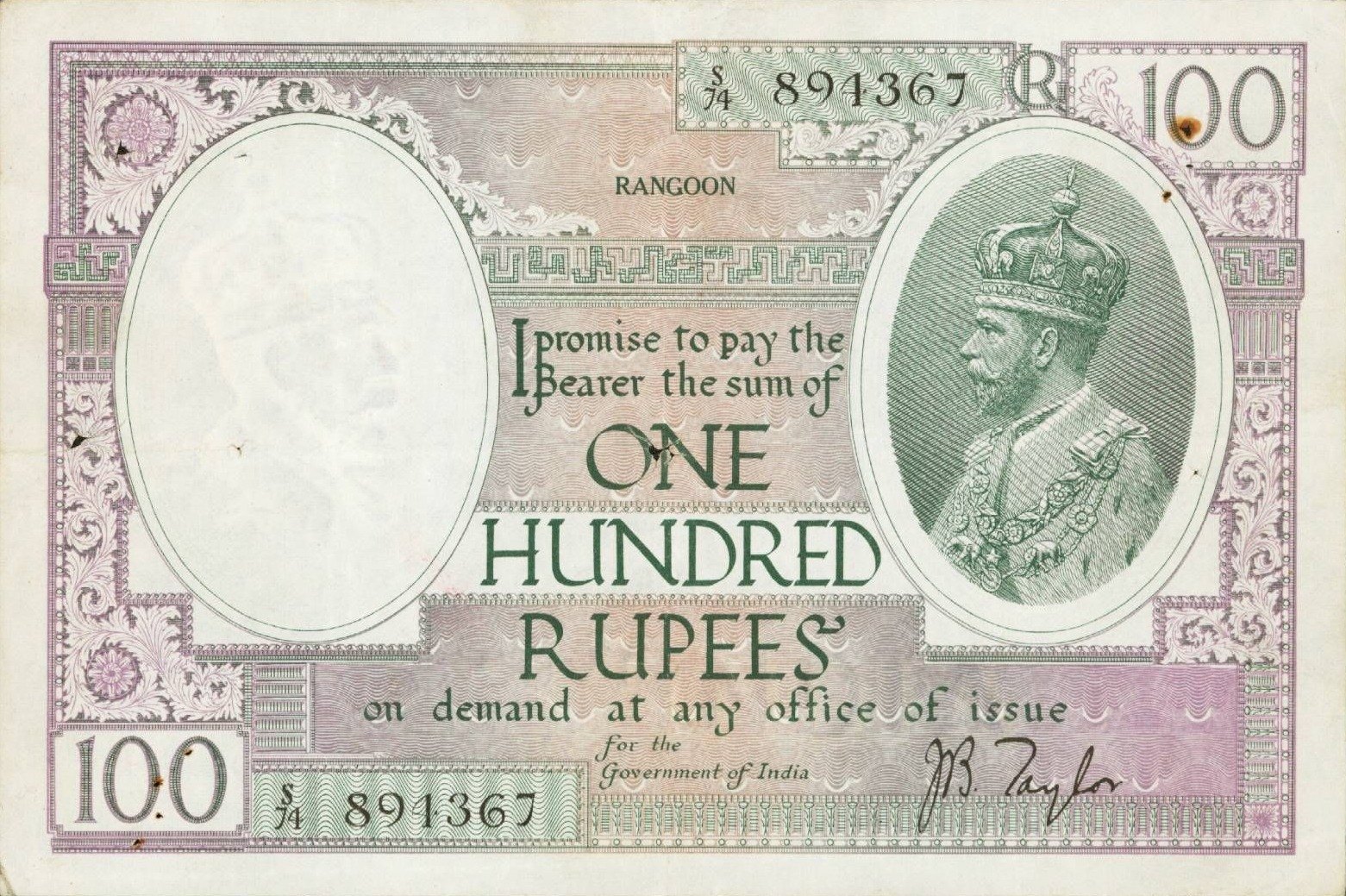
- They never name the officer who signed the notes. In forty years the Commissioner of Paper Currency at Rangoon appears only as an office, in 1907-08 at the Currency Buildings with the Accountant-General, Burma (a passage of the public works chapter, read in the text of the scan only). The names come from the Indian Civil Lists, through a collector: see What collectors wrote about the notes of Burma.
- They give no date on which the 50 or 100 rupees first came into use at Rangoon. Both were already in circulation in the first year read.
- After 1910 they give no count of notes, only shares, and the base of the share changes.
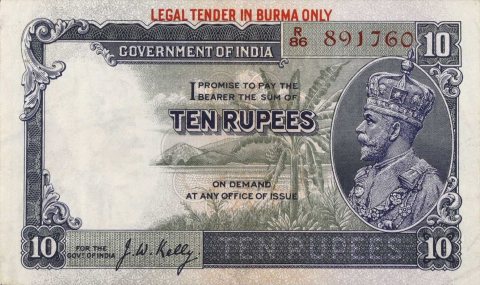
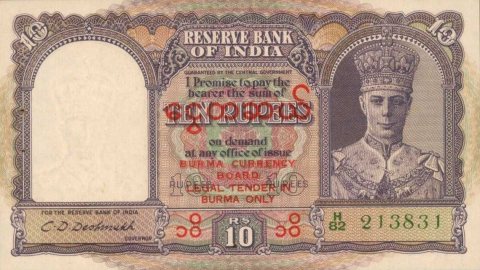
- The reports to 1935-36 say nothing of the Reserve Bank of India, of the overprints of 1937 or of notes made for Burma alone. Those are told in Legal tender in Burma only.
Sources
- Report on the Administration of Burma, the Paper Currency paragraph of each year from 1896-97 to 1935-36 (the report for 1903-04 has none; the report for 1927-28 was not found). The volumes were read on their page images in November 2026 and are not on this computer now.
- The Pick pages of Burma P-A1 to P-A6 for the notes named.
Member comments
Log in or register to post a comment.