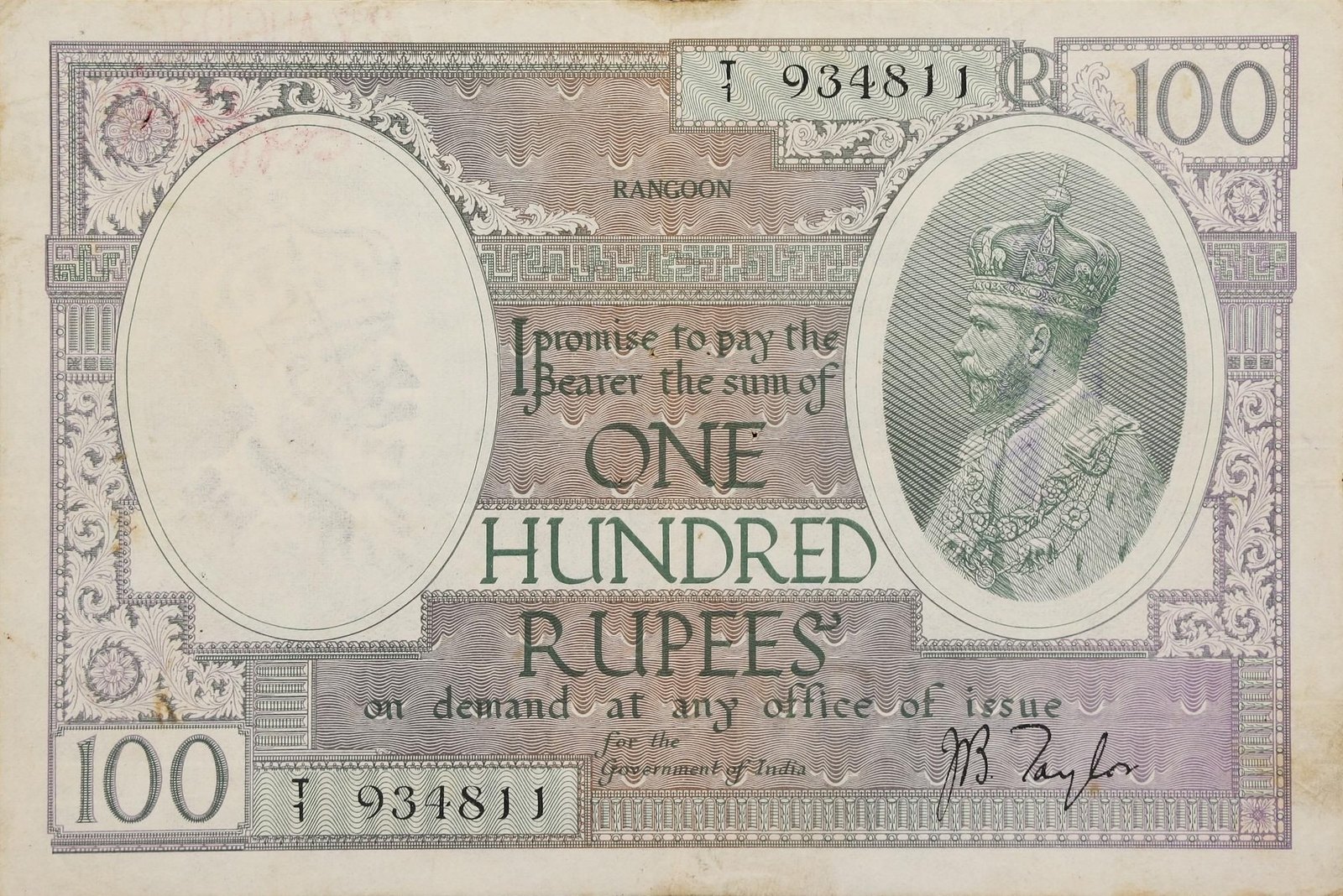
Before 1937 Burma had no notes of its own. It used the notes of the Government of India, issued from a currency office at Rangoon and marked with the name RANGOON or the code letter R. This article puts in order of time what the Pick pages and the official reports behind them say: the Report on the Administration of Burma, the reports of the Currency Department and of the Controller of the Currency, and the papers of the Commission on Act XIX of 1861. The notes made for Burma alone after 1937 are in Legal tender in Burma only.
Calcutta notes at Rangoon, 1862 to 1883
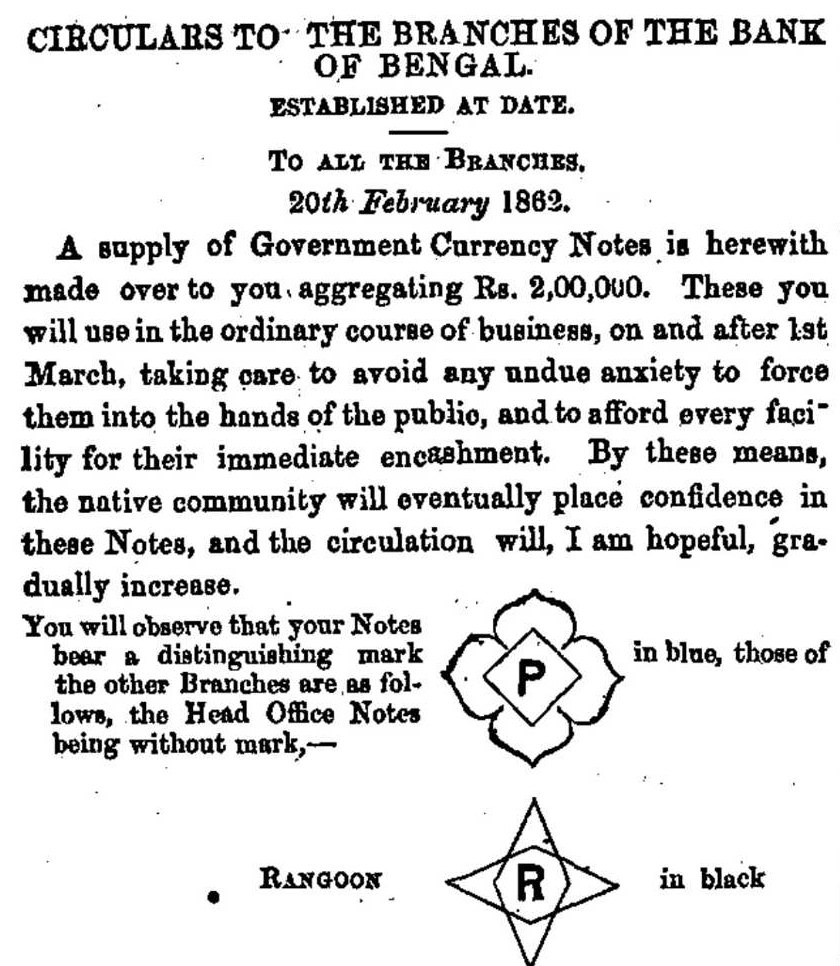
Government of India notes were in Burma long before it had a circle. The Bank of Bengal sent 200,000 rupees of Calcutta notes to its Rangoon branch for use from 1st March 1862. They were stamped with the branch's mark, an R in a four-pointed star in black. Rangoon lay outside every circle of issue and the notes were not legal tender there. Until March 1866 they could be cashed only at Rangoon. The source is the papers printed by the Commission on Act XIX of 1861, Appendix XXVI, and the Chief Commissioner's letter of 9th June 1866. The marks of all the bank's branches are described in A letter in a frame, which says that none is recorded on a note yet.
The office opens, 1882 to 1884
Sources mention that the Rangoon circle of issue was established in 1882, and that the first Rangoon notes left England about October 1883 and reached Rangoon at the end of January 1884. The Report on the Administration of Burma for 1896-97 says the Rangoon office was first opened in August 1883 and gives 2,090,495 rupees of notes in circulation on 31st March 1884, the first year-end.
A third date exists. Das Gupta's book of 1927 (page 92) says Burma was brought under the Paper Currency Act by Act XX of 1882 but that a Circle Office at Rangoon was established only on 24th February 1893, by a notification of the Government of India. Neither source says how the office opened in 1883 and the Circle Office of 1893 go together, and the Pick pages do not use the 1893 date.
The same paragraph of the Burma report gives the net circulation of the circle at each 31st March: 1,336,705 rupees in 1885, 3,201,200 in 1887, 5,311,715 in 1891, 6,677,090 in 1893 and 5,357,155 in 1897. Later reports carry it on to 7,589,640 rupees in 1900, 15,031,740 in 1903 and 17,483,405 in 1905.
Besides Rangoon there was a currency agency at Mandalay. The Currency Department's report for 1909-10 lists it among the agencies where the public could exchange notes.
The notes
The Pick pages hold eight Rangoon types.
- The 5 rupees green of 1904 to 1907 has two language panels, each with two languages: Burmese over Tamil, and Urdu over Chinese. The India note of the same design has six panels.
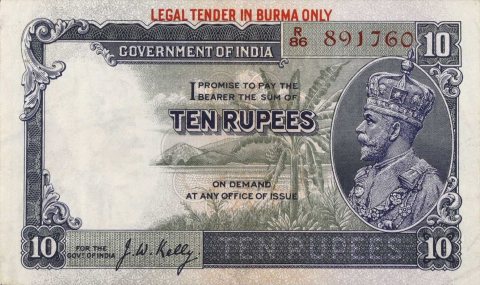
- The 10 rupees green of 1897 to 1907 comes on two plates, with two and with four serial numbers.
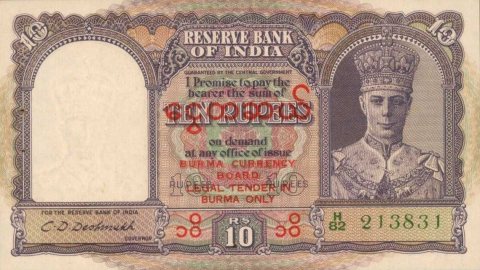
- The 5 rupees red of 1907 to 1920 and the 10 rupees red of 1910 to 1920 are the Rangoon office (code letter R) of the India red plates.
- The 100 rupees green of 1914 to 1925 has four serial numbers.
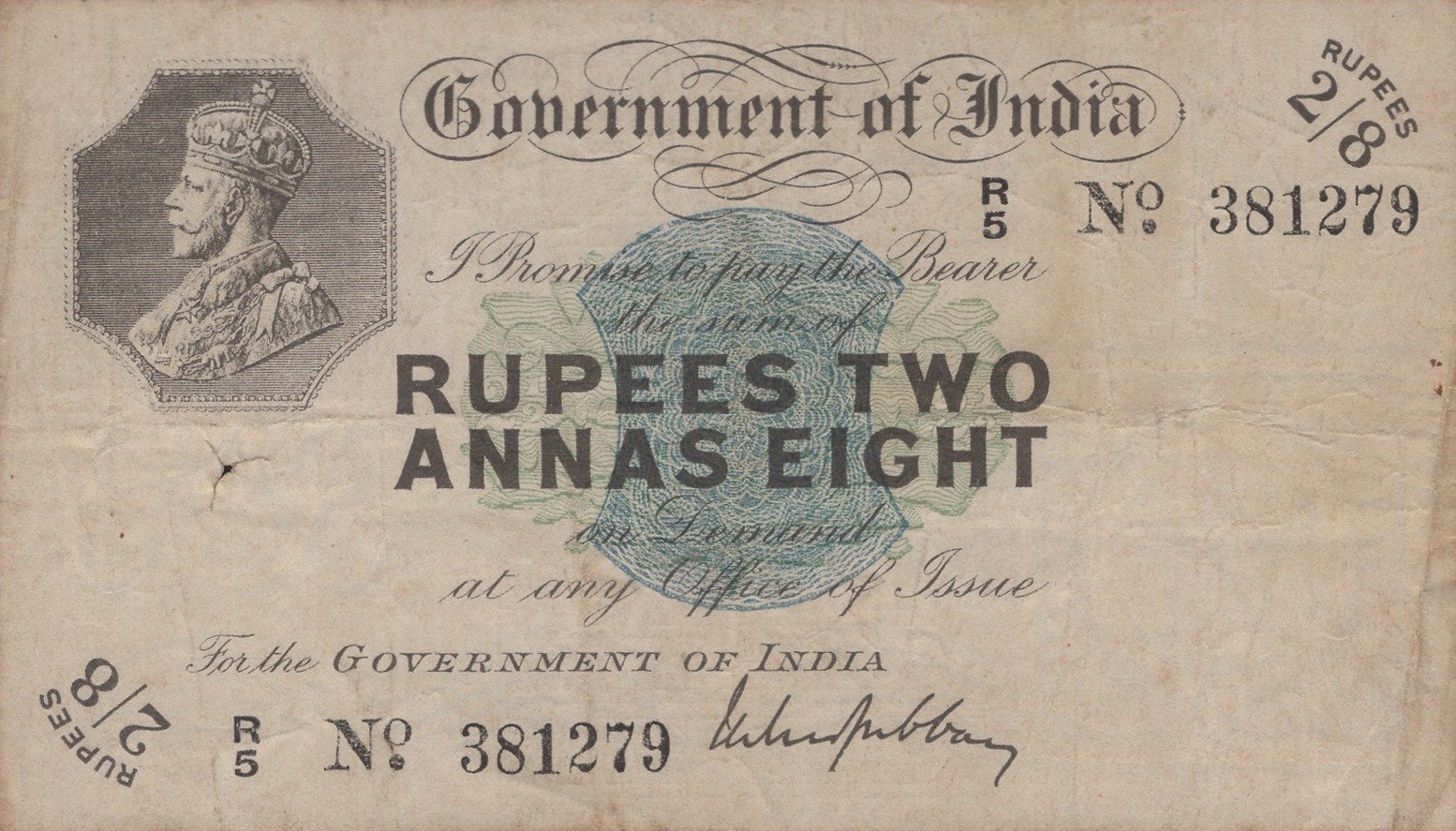
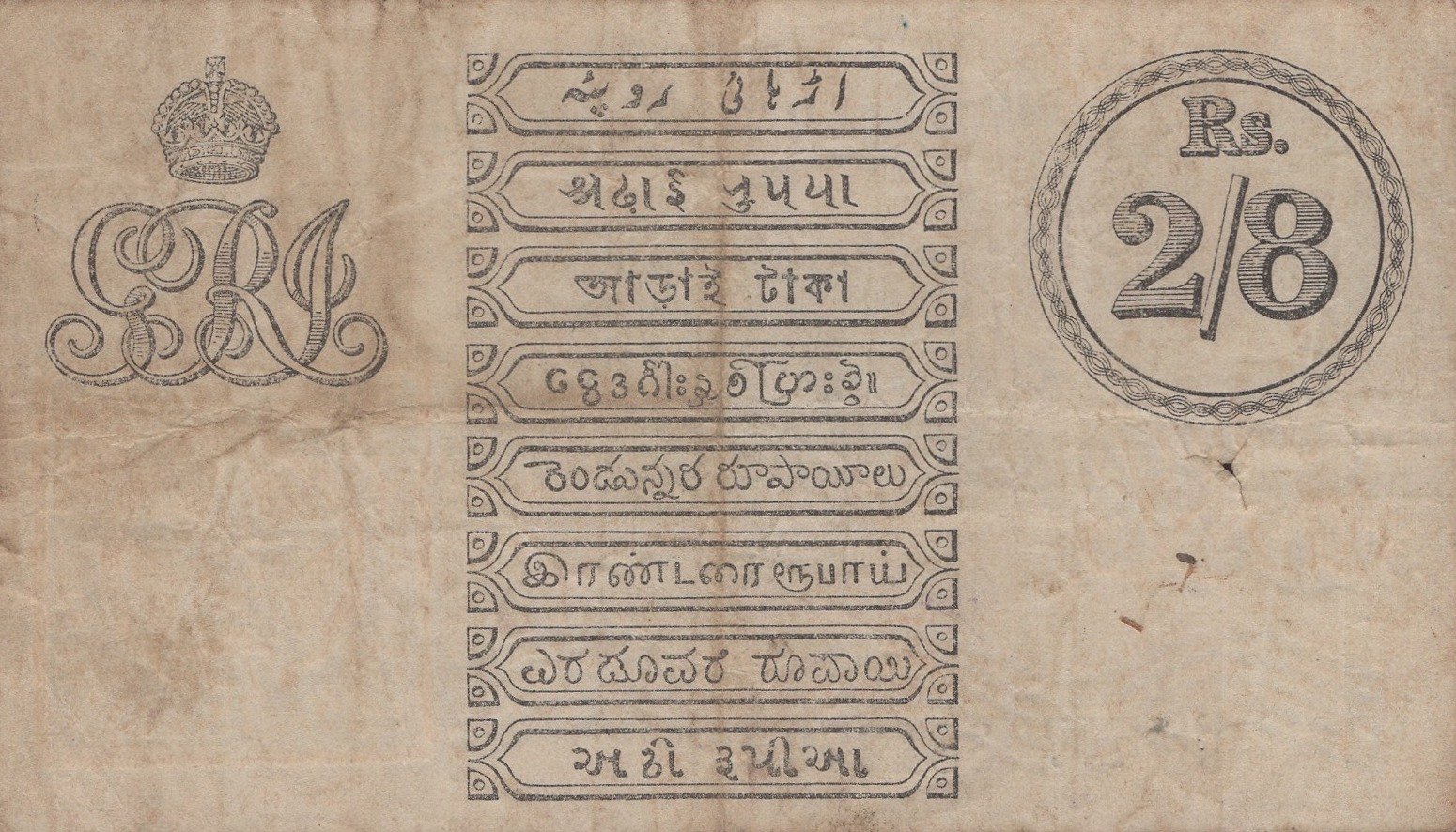
- The 2 rupees 8 annas of 1917 is known for Rangoon by the letter R of its prefix: R/2, R/4 and R/5 are recorded.
- The 50 rupees of 1930 has the prefix V/3. No Rangoon note of it is recorded yet.
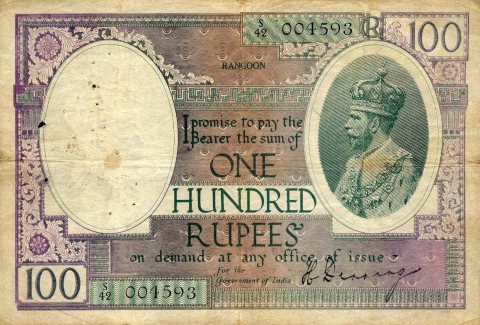
- The 100 rupees of 1927 to 1937 has RANGOON printed on it in black or green.
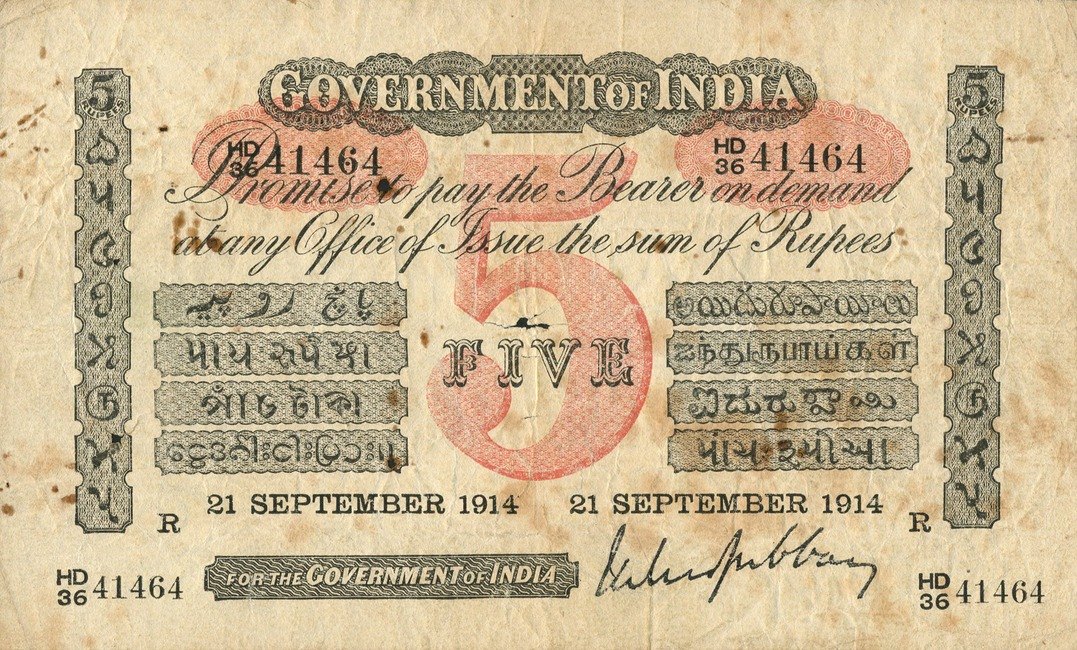
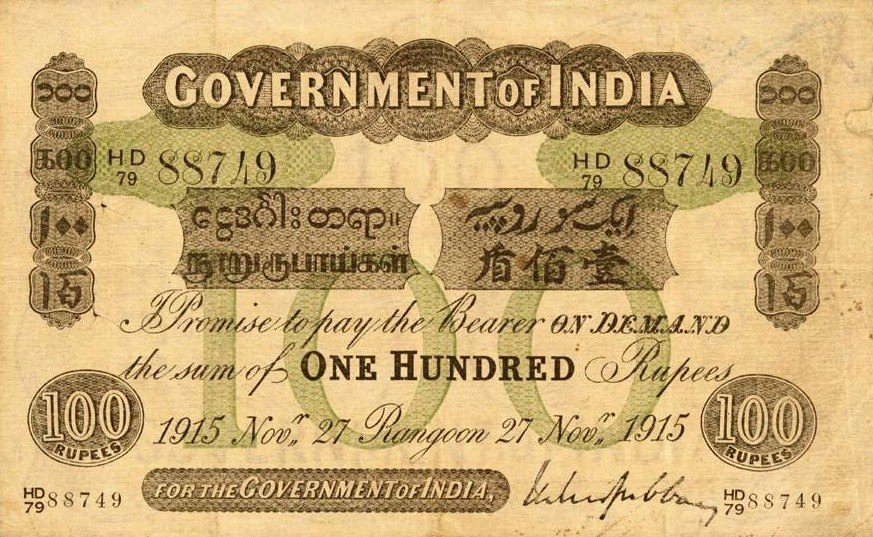
The pages give the Bank of England as printer of the five dated types of 1897 to 1925, and Thomas de la Rue and Company for the 2 rupees 8 annas. Sources mention that the paper of these notes carries a watermark date: a mould letter followed by the week and the year the paper was made, so that A 41 06 is week 41 of 1906. The printed date goes with the serial prefix and can be up to about three years before the paper was made. The Brereton 5 rupees QB/34 is dated 19 May 1905 on paper of 1906, the Gauntlett 10 rupees QB/78 is dated 6 September 1907 on paper of 1909, and the Gubbay 5 rupees HD/36 is dated 21 September 1914 on paper of 1917. A note could therefore be signed and issued years after its printed date.
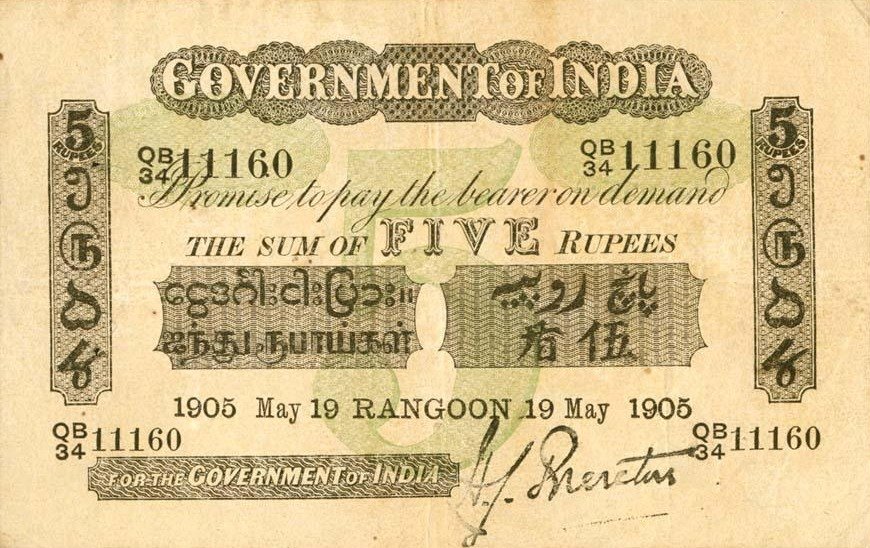
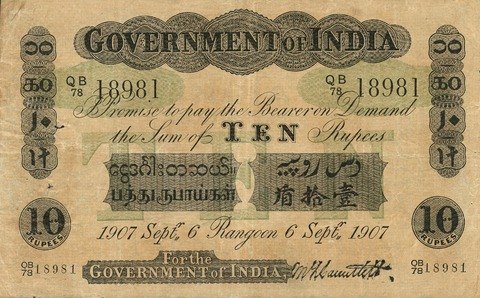
Sources list the commissioners at Rangoon who signed the early notes as Atkinson from March 1904 to May 1906, Gauntlett from May 1906 to November 1907 and again from November 1908 to November 1909, and Brereton from November 1907 to November 1908. The 10 rupees of 1897 recorded is signed by Hamilton. Later notes are signed by Gillan, Howard, Gubbay, McWatters and Denning, and the 100 rupees of 1927 by Denning, Taylor and Kelly. Heritage's description of lot 23003 in its sale of 6 December 2022 says the Gillan signature is found on the red 10 rupees only from July 1911 to November 1912.
Which values Burma used, 1897 to 1914
The Report on the Administration of Burma counted the notes of the Rangoon circle by value each 31st March up to 1910. The Currency Department's own reports give counts for 1910 and for 1912 to 1914. The two disagree a little for 1910, and both figures are shown.
| 31st March | All notes | 5 rupees | 10 rupees | 100 rupees | Source |
|---|---|---|---|---|---|
| 1897 | 105,871 | 9,689 | 52,064 | 20,790 | Report on the Administration of Burma |
| 1900 | 148,720 | 7,916 | 83,304 | 36,033 | Report on the Administration of Burma |
| 1903 | 270,605 | 8,598 | 133,807 | 102,971 | Report on the Administration of Burma |
| 1907 | not given | 15,004 | 352,780 | 201,025 | Report on the Administration of Burma |
| 1909 | 909,497 | 22,871 | 676,998 | 183,448 | Report on the Administration of Burma |
| 1910 | 1,319,698 | 41,328 | 1,044,368 | 212,436 | Report on the Administration of Burma |
| 1910 | not given | 41,012 | 1,040,381 | 212,097 | Currency Department, report for 1909-10 |
| 1912 | not given | 67,626 | 2,133,022 | 246,286 | Currency Department |
| 1913 | not given | 99,853 | 3,001,730 | 260,291 | Currency Department |
| 1914 | not given | 140,318 | 3,206,478 | 225,009 | Currency Department |
On 31st March 1897 the circle also had 13,831 notes of 20 rupees, 7,759 of 50 rupees, 755 of 500 rupees, 907 of 1,000 rupees and 76 of 10,000 rupees. Every value from 5 to 10,000 rupees was thus in use at Rangoon by 1896-97, the first year of the report that was read. The catalogue has no Burma page for the 20, 50, 500, 1,000 or 10,000 rupees of those years.
The 10 rupees
The 10 rupees was about half of all the circle's notes in 1897 and nearly four in every five in 1910. It was made payable at every office of issue by the Paper Currency Act of 1910, and the Report on the Administration of Burma says this swelled its circulation in Burma in 1910-11. By 1914, the Currency Department reported, Burma had more 10 and 100 rupee notes for its people than any other circle: 1,450 tens and 139 hundreds for every 10,000.
The 5 rupees
The Report on the Administration of Burma says the 5 rupees never recovered in Burma from a forgery of the Rangoon notes discovered in April 1891. The Mandalay agency issued none after September 1893, and only 15,004 were in circulation on 31st March 1907. Sources mention that the 5 rupees became payable at every office in Burma in 1909. The count then rose each year to 1914.
The 100 rupees
The Report on the Administration of Burma calls the 100 rupees the favourite note for paying for paddy. The 100 rupees was made payable at every office of issue from 1st April 1911. The same report says the notes of 500 rupees and above were used almost only by the banks.
The 1 rupee and the 2 rupees 8 annas
The page of the 2 rupees 8 annas gives 2 January 1918 as the day the note was introduced. In Burma the issue of the 1 rupee and the 2 rupees 8 annas began only in the latter part of March 1918 and was stopped from the middle of September 1924 (Report on the Administration of Burma). The report for 1918-19 says the small notes at first passed at a discount of up to 10 per cent in Burma, until small coin from Calcutta met the demand by June 1919; at the end of March 1919 the 1 rupee notes of the circle stood at 142.91 lakhs of rupees and the 2 rupees 8 annas at 8.88 lakhs. The report for 1921-22 says the 2 rupees 8 annas was disliked because it was easily taken for the 1 rupee. The Currency Department's report for 1920-21 says it had a very limited circulation and had never been popular. R/1 is a Rangoon prefix of the 1 rupee, not of the 2 rupees 8 annas.
The red 10 rupees: prefixes, dates and a sunken ship
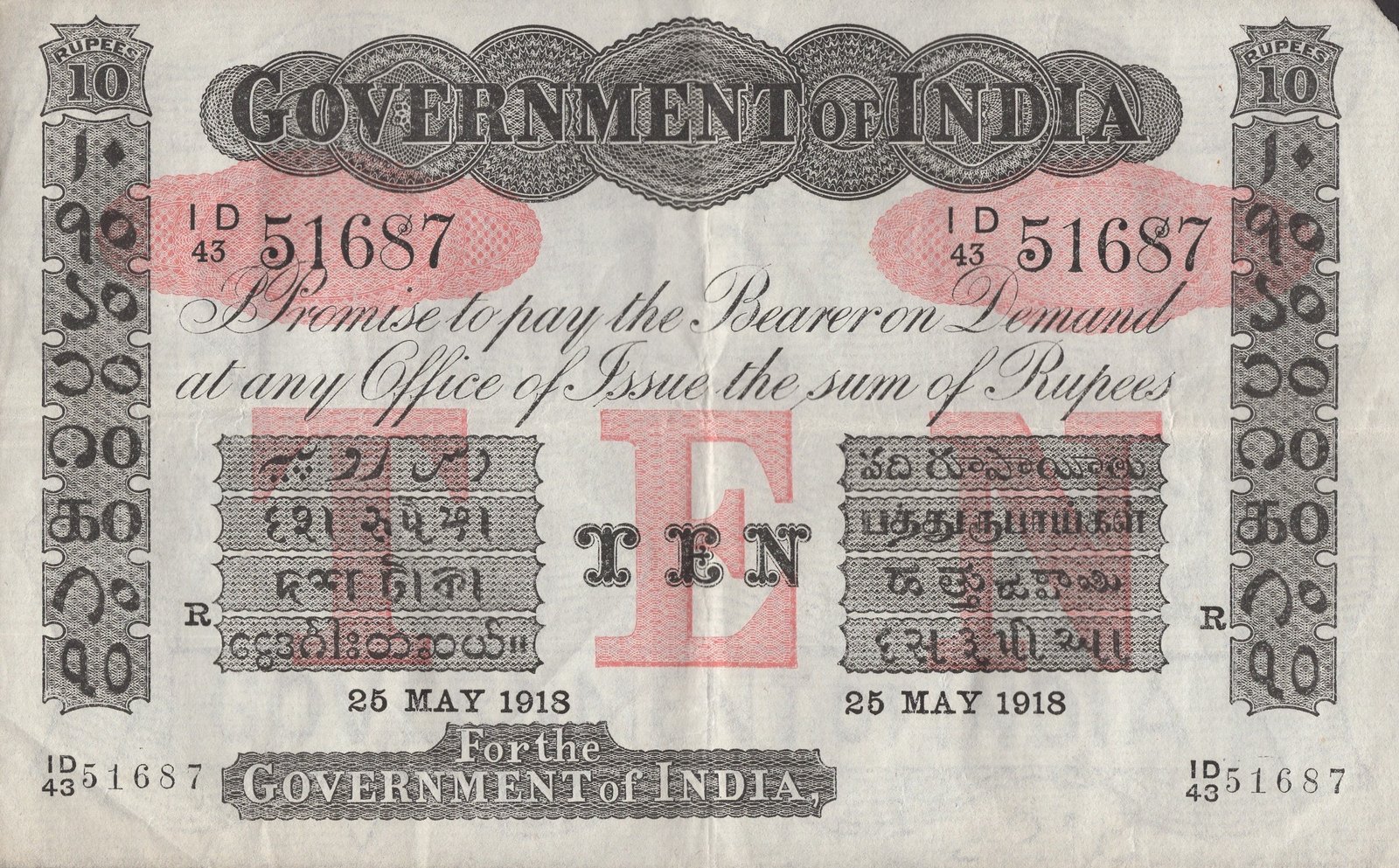
At Rangoon the prefix letters of the red 10 rupees do not run in alphabetical order. Q opens each new second letter, so NC (1914 and January 1915) is followed by QD (1915 and 1916), HD (1917) and then by ID, KD and ND (1918). Within a run of dates the prefix number goes up by one each working day, Monday to Saturday: ID/43 is 25 May 1918 and ID/89 is 18 July 1918.
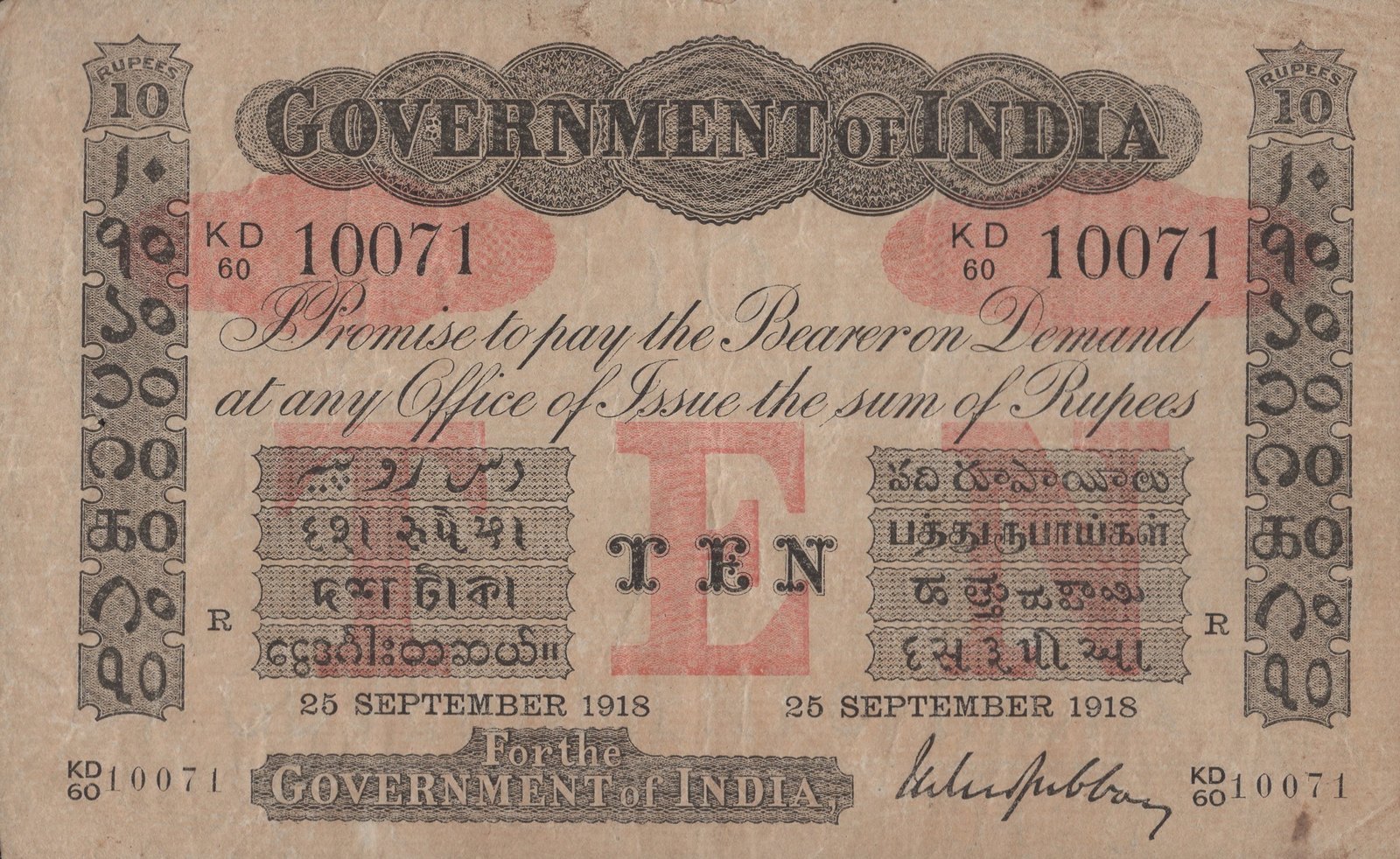
One row of the page holds unsigned notes of ID/43 (25 May 1918) and ID/54 (7 June 1918), recovered from a ship sunk a few weeks later. Which ship is not settled. The page names the SS Shirala, sunk 2 July 1918, on the word of Jhunjhunwalla as quoted by Lyn Knight (30 July 2018, lot 24516) for an India 1 rupee. Spink (10 April 2013, lot 572) says the unsigned ID/54 01309 was salvaged from the S.S. Chantala. Noonans (29 May 2024, lots 474 and 475) names no ship for the ID/43 notes.
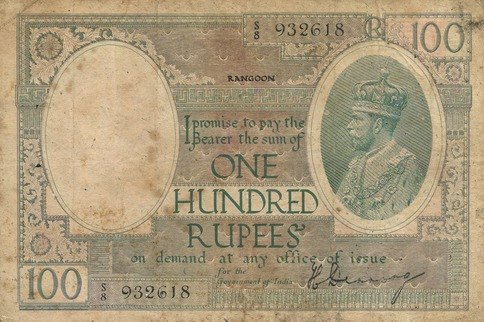
The new 100 rupees of 1927
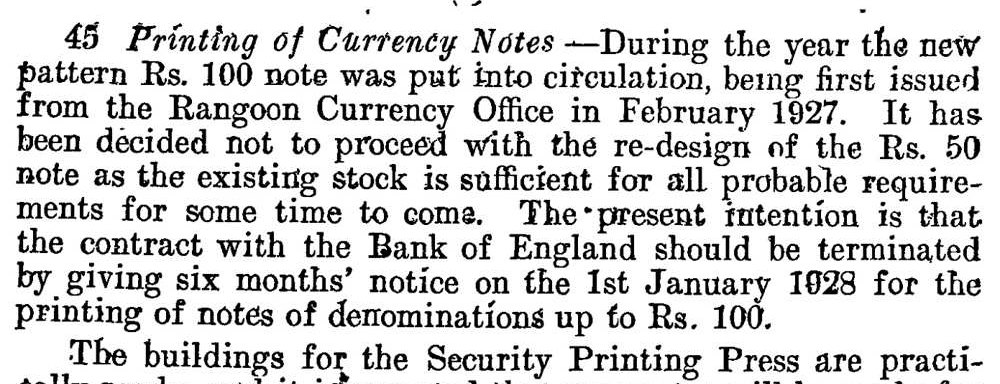
The new 100 rupees was first issued from the Rangoon Currency Office, in February 1927, before any office in India (the Controller of the Currency's report for 1926-27). The prefixes recorded are S/4, S/8, S/42 and S/49 for Denning, S/65, S/74, T/1 and T/16 for Taylor, and T/16, T/25 and T/32 for Kelly. T/16 carries both signatures. From T/32 700001 the notes carry the 1937 overprint and belong to the 100 rupees of 1937.
The forged Rangoon series
The reports named forged notes by their series. The India-wide lists are in The forged series of British India, 1909 to 1929. These are the Rangoon ones.
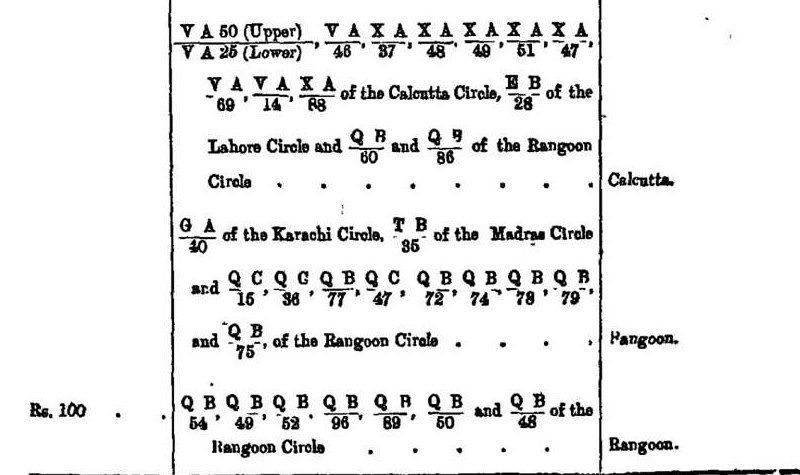
10 rupees green. The Currency Department's report for 1909-10 names QB/44 and QB/61, made by the anastatic process on thicker paper with an imitation watermark, the green word for ten hardly showing, and QB/57, traced in pen and ink from a genuine note. The report for 1911-12 adds QB/60, QB/72, QB/74, QB/75, QB/77, QB/78, QB/79 and QB/86. QB/78 is also the prefix of a genuine note on the page. Rangoon 10 rupee notes were altered by hand to read 50 and 100 rupees year after year (reports for 1909-10 to 1913-14).
10 rupees red. The reports name QC/15, QC/36 and QC/47 (1911-12) and QC/91 (1912-13). QC/15 and QC/36 belong to a family of photo-lithographed forgeries, with the numbers and the Head Commissioner's signature printed separately, whose makers were arrested at Batavia. The report for 1920-21 describes a forgery of the series QD/90 received in the Rangoon circle: lithographed on thin paper with an imitation watermark, its serial letters and numbers uneven and thicker than on a genuine note, and dated differently from the genuine QD/90 notes.
100 rupees. The reports name forged notes "of the Rangoon Circle" of the series QB/48, QB/49, QB/50, QB/52, QB/54, QB/89 and QB/96 in 1911-12, QB/11, QC/63, QC/69 and QC/71 in 1912-13 and QC/61, QC/62, QC/64 and QC/66 in 1913-14. QB/96 was fairly printed on good paper with a very good imitation watermark, and a man named Po Chan was given seven years for it by the Chief Court of Lower Burma. QB/11 was a photograph on bromide paper coloured green by hand. Forgers copied real notes, so Rangoon 100 rupee notes of the QB and QC series came before the HD notes of 1915 that are recorded. None has been seen. In the 1920s most forged 100 rupee notes again came in at Rangoon: the Controller of the Currency's reports name ND/85, ND/60 and QE/7 (1925-26 to 1927-28) and 308 pieces in 1926-27 of a new forgery of the series QE/37, "a very fair imitation of the genuine note". ND/60 and QE/37 are also the series of two of the three genuine notes recorded.
What is not known
- No whole Rangoon note earlier than 1897 is on the Pick pages, although the Burma report counts notes in circulation from 31st March 1884.
- No Rangoon 100 rupees of the QB and QC series, and no Rangoon 50 rupees of 1930, has been seen.
- The ship from which the unsigned 10 rupees came is named differently by two sources.
- The Controller of the Currency's reports stopped giving the circulation by circle after 1922-23, and the Burma report for 1927-28 was not read.
Sources
- Report on the Administration of Burma, yearly volumes from 1896-97 on, without the volume for 1927-28 (Paper Currency paragraph).
- Reports of the Currency Department for 1909-10, 1911-12, 1912-13, 1913-14 and 1920-21.
- Reports of the Controller of the Currency for 1925-26 to 1927-28.
- Papers printed by the Commission on Act XIX of 1861, Appendix XXVI, and the Chief Commissioner's letter of 9th June 1866.
- Das Gupta (1927), page 92, on Act XX of 1882 and the notification of 24th February 1893.
- Heritage Auctions, 6 December 2022, lot 23003.
- Spink, 10 April 2013, lot 572; Lyn Knight, 30 July 2018, lot 24516; Noonans, 29 May 2024, lots 474 and 475.
- The Pick pages of Burma P-A1 to P-A8.
Member comments
Log in or register to post a comment.