Burma 100 Rupees ND (1937) P-3
P-3 ND (1937) 2 varieties

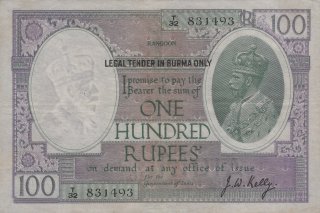
P-3b, 100 Rupees, T/32 831493 - obverse
Source: © Noonans
Notes
ND (1937) provisional issue
India notes overprinted "LEGAL TENDER IN BURMA ONLY" when the Reserve Bank of India took over Burma's currency after the 1937 separation from India. Legal tender in Burma ended on 1 June 1950. Sources also mention 20 December 1952 as the date all Burma notes issued by the Reserve Bank of India were withdrawn and demonetised. Sources mention that the official overprints were lithographed at the Nasik security press, the same in type and place on all the notes of one overprint.
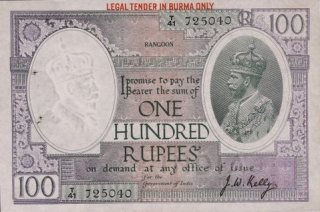
The black overprint came first (April 1937), on the 100 rupees at the upper front and the lower back; it was hard to read against the design, so in the second half of 1937 the overprint was changed to red in the upper margins. The numbers agree: the black overprint is on T/32 (from 700001) and the first 100,000 notes of T/41, the red on the rest of T/41 and on T/47 (to 606000). The rows keep the usual letters, a for the red overprint and b for the black; some sources list the black first. Overprints on prefixes outside the listed ranges are likely forgeries. The 100 rupees was overprinted on the Rangoon-office India P-10 notes signed by Kelly (Burma P-A8f). Jhunjhunwalla, quoted by Lyn Knight (10 November 2011, lot 63), says the black overprint had not been seen and its details came from the Reserve Bank of India archives; the register here now holds eight black-overprint notes, all T/32.
Genuine LEGAL TENDER IN BURMA ONLY overprints are found on notes signed by Kelly only; an overprinted note signed by Taylor is a forgery (the Taylor notes of the Rangoon 100 rupees are Burma P-A8d and P-A8e).
Quarter-cut pieces of the 100 rupees are known
the lower-left quarter, kept as a treasury accounting record rather than currency, some with treasury date stamps or Japanese chop marks. Sources mention that the quarter was cut when a black-overprint note was exchanged for a red one, that a handstamp on its back gives a letter and the exchange date (from 7 September to November 1937 on the T/32 pieces recorded), and that the other three quarters were destroyed. Other sources say the corner was kept when the notes were exchanged for the 1938-1939 Reserve Bank notes for Burma (Burma P-A8). A quarter from a black-overprint note shows the end of the overprint on its back. A quarter from a red-overprint note shows no overprint, so only its serial number can place it: T/41 100001 and above, or T/47 000001 - T/47 606000, is P-3a.
Signatures
- James William Kelly On 2 undated varieties
Pick varieties list (2)
One row per variety. Press a variety’s button for its own page, with its sales history and its serial register.
| # | Variety | Signatures | Comment | On record |
|---|---|---|---|---|
| Issued notes 2 Released into circulation | ||||
| 1 | P-3a | Kelly | Serial number range T/41 100001 - T/41 1000000, T/47 000001 - T/47 606000 red LEGAL TENDER IN BURMA ONLY overprint in the upper margin, front and back | 22 photographs1010 serial numbers recorded1111 sales recorded |
| 2 | P-3b | Kelly | Serial number range T/32 700001 - T/32 1000000, T/41 000001 - T/41 100000 black LEGAL TENDER IN BURMA ONLY overprint at upper front and lower back | 22 photographs88 serial numbers recorded66 sales recorded22 museum, published, archive or collection records |
Pick numbers follow the standard numismatic literature — see the references used on this site.
Research
7 articles on the notes of Burma, with their sources.
- Cut quarters, posted claims and a 1,000 rupees overprint Three open questions on the Burma notes, 1937 to 1960
- Legal tender in Burma only The notes of 1937 to 1952, from the Reserve Bank of India to the Burma Currency Board
- What collectors wrote about the notes of Burma Bank Note Reporter and the IBNS Journal, 1974 to 2026
- Burma notes in the reports of the Reserve Bank of India and the Burma Currency Board, 1938 to 1952 Circulation, cashing in India and the Board's accounts
- The Rangoon Currency Office in the Government of India's currency reports, 1909 to 1929 The rice crop, notes cashed far from home, and the forgeries
Is your 100 Rupees on record?
Type its serial number to see which variety it belongs to and whether the note is on the register. Looking a number up needs a free account.
Sales history Pro
What each variety of this pick has sold for, on its own page. 17 sales and 2 published records on record. Pro shows where these records are held or published, with their photographs and sources.
Serial register Pro
The serial numbers logged for each variety, on its own page. 18 serial numbers on record.
See Pro plans Already have Pro? Log in