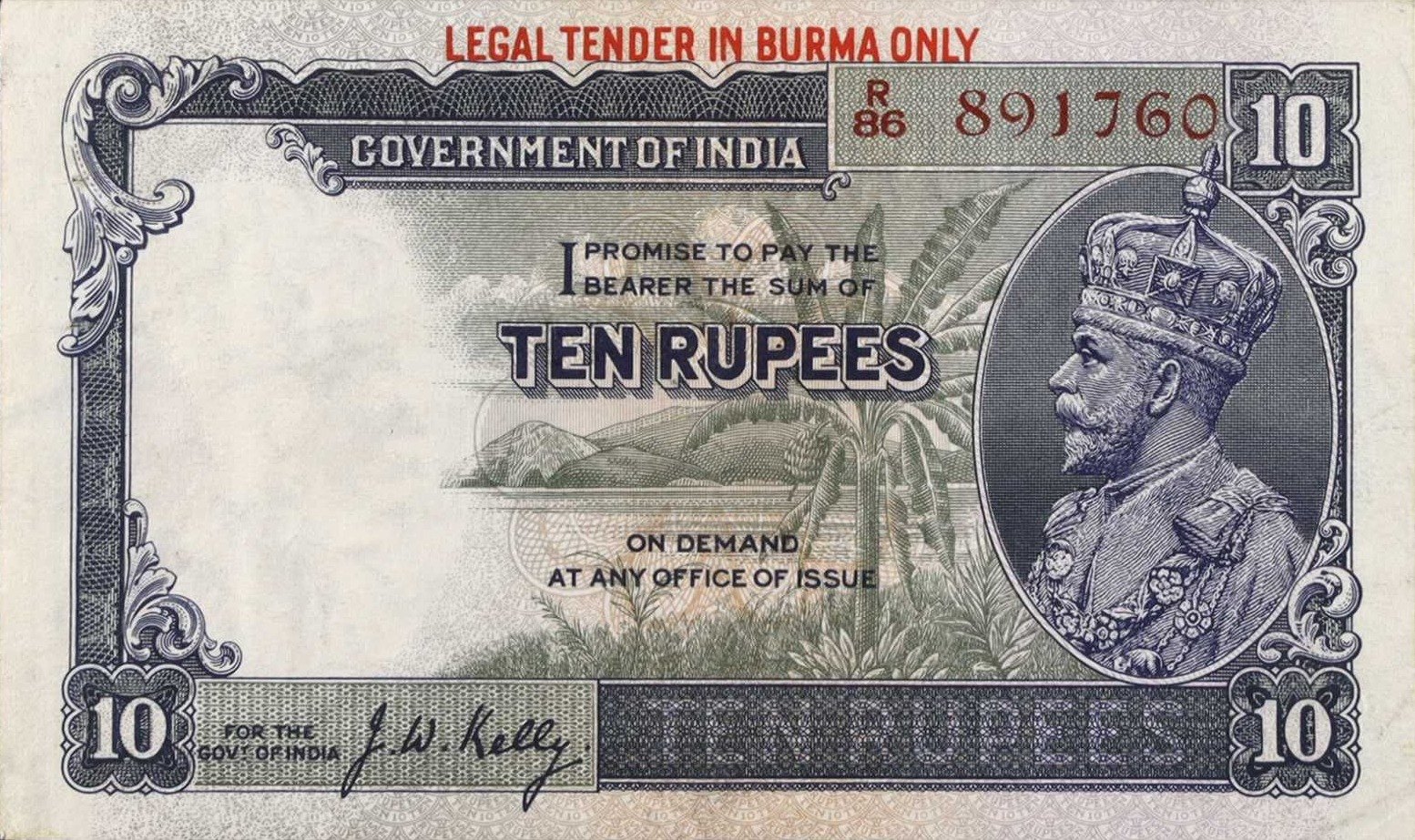
Some of what the Pick pages of Burma say under "sources mention" was first written by collectors, in the collectors' newspaper Bank Note Reporter and in the Journal of the International Bank Note Society (IBNS). This article names them: the writer, the issue and the page, what was said, and how it stands against the official papers read for the catalogue, the reports of the Government of India's Currency Department, the Report on the Administration of Burma, the Reserve Bank of India's reports and the Burma Currency Board's own reports. The writings on British India as a whole are in What collectors wrote about the notes of British India.
The writings
| Year | Where | Writer | Subject |
|---|---|---|---|
| 1974 | Bank Note Reporter, June, pp. 14 and 15 | R. Leader | "Bank Notes Of India Since 1862" |
| 1977 and 1978 | Bank Note Reporter, April 1977 and September and October 1978 | Fred Schwan | advertisements picturing Military Administration notes |
| 1979 | Bank Note Reporter, October, p. 19 | the newspaper's wrap-up of new finds | the back overprints of 1937 |
| 1981 | IBNS Journal 20:3-4, p. 87 | Michael Robinson | "Commercial Overprints on Burmese Banknotes" |
| 1982 | Bank Note Reporter, August, p. 14 | Fred Schwan | the Burma notes, after Robinson and Shaw's book of 1980 |
| 1985 | Bank Note Reporter, July, p. 12 | the newspaper | "Rangoon issues 100-rupee note" |
| 1991 | IBNS Journal 30:4, pp. 22 to 24 | Michael Robinson | printed and watermark dates, with the Rangoon commissioners |
| 1993 | Bank Note Reporter, March | the World Update column | a Kelly 100 rupees of Rangoon |
| 2009 | IBNS Journal 48:4, p. 43 | Anil R. Bohora | "The Indian Rupee: Used Around the World" |
| 2012 | IBNS Journal 51:4, pp. 25 to 31 | Rezwan Razack | the King George VI 100 rupees, with the Burma blocks |
| 2014 | IBNS Journal 53:4, pp. 9 to 14 | Rezwan Razack | "The Banknotes of India for Burma Before and After Separation" |
| 2015 | IBNS Journal 54:3, pp. 16 to 18 | Anil R. Bohora | "The Facts on High Denomination British India Banknotes with Burma Overstamps" |
| 2015 | IBNS Journal 54:4, pp. 8 to 11 | Rezwan Razack and Joseph E. Boling | two letters in reply |
| 2018 | Bank Note Reporter, July, p. 20, and August, p. 20 | the newspaper; Kerry Rodgers in August | two sale reports |
| 2023 | IBNS Journal 62:1, pp. 36 and 37 | Anil R. Bohora | "British Burma: Submitting Withdrawn & Demonetized Banknotes by Post" |
| 2023 | IBNS Journal 62:2, p. 8 | Tim Whitney | a letter in follow-up |
| 2024 | IBNS Journal 63:3, p. 37 | Fabrizio Raponi | counterfeits made by governments, with a Burma 5 rupees |
| 2024 | Bank Note Reporter, July | the newspaper | report of Noonans' sale of 29th May 2024 |
| 2025 | IBNS Journal 64:2, pp. 32 and 33 | Anil R. Bohora | "Solved: Mystery of Quarter Portion of British Burma 100 Rupee Banknotes" |
| 2026 | IBNS Journal 65:1, pp. 32 to 38 | Anil R. Bohora | the red-numbered 1 rupee |
Robinson also wrote "The Government of India Banknotes Issued for Burma" in Spink's Numismatic Circular for April and May 1983, which the article of 1991 cites. It was not among the papers read.
Michael Robinson, 1981 and 1991
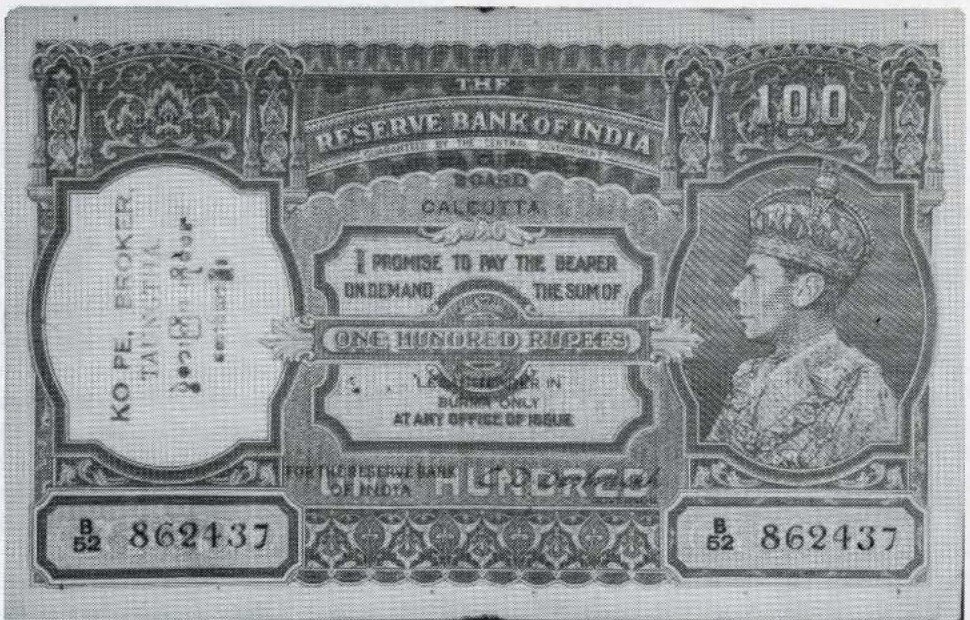
Robinson was a collector of Burmese notes, as the article of 1991 says. The short piece of 1981 (IBNS Journal 20:3-4, p. 87) is about private stamps. It pictures a 100 rupees of the Burma Currency Board with a purple stamp reading in English "Ko Pe, Broker, Taungtha", and two Japanese occupation notes with purple stamps that John Okell of the School of Oriental and African Studies translated: one for a "King of the Peacocks Brand" of fast colours, the other for a pagoda's electric lighting association. Robinson concluded that the Burmese may have stamped notes "quite frequently for advertising reasons". The piece also asks after a Military Administration 1 rupee that an earlier writer, Toy, had reported with a stamp "for use in the government stores"; Robinson had never seen one. The P-33 page now says that the trader stamps are private advertisements, not official overprints.
The article of 1991 (IBNS Journal 30:4, pp. 22 to 24) is the source of a rule now on the pages of the Rangoon notes: the paper made by Portals for the Bank of England carries a mould letter, the week and the year (A 41 06 is week 41 of 1906), and the printed date belongs to the series, so a note could be signed years after its date. Robinson's own example was a Rangoon 5 rupees dated 19th May 1905 and signed by H. J. Brereton, who held office only from November 1907. The Pick page of the 10 rupees of 1897 to 1907 shows the same thing: Hamilton signs a note dated 3rd April 1897, more than a year before the term Robinson gives.
Robinson listed the Commissioners of Paper Currency at Rangoon from the Indian Civil Lists. The post appears there first in October 1887, but, Robinson writes, a commissioner existed from 1883: the office was part of the finance department and the notes were issued by the Comptroller of British Burma. The list below was read in the text of the scan, which was read by machine; a letter or a figure may be wrong.
| From | To | Commissioner |
|---|---|---|
| 1st August 1883 | 24th March 1885 | William Wells, Commissioner of the Financial Department |
| 25th March 1885 | 24th June 1885 | William Dougald Flower Cowley, Comptroller of British Burma |
| 25th June 1885 | 26th February 1887 | W. Wells |
| 27th February 1887 | 4th March 1887 | W. D. F. Cowley |
| 5th March 1887 | 27th June 1890 | Thomas Hesketh Biggs |
| 28th June 1890 | 25th September 1890 | Frederick James Atkinson |
| 26th September 1890 | 23rd March 1892 | T. H. Biggs |
| 24th March 1892 | 15th December 1892 | C. E. Crawley |
| 16th December 1892 | 5th November 1895 | T. H. Biggs |
| 6th November 1895 | 14th November 1898 | C. Rivett-Camac (as the text reads) |
| 15th November 1898 | 22nd December 1902 | Richard Erris Hamilton |
| 23rd December 1902 | 11th March 1904 | Henry George Harris Keene |
| 12th March 1904 | 10th May 1906 | F. J. Atkinson |
| 11th May 1906 | 12th November 1907 | Mager Frederic Gauntlett |
| 13th November 1907 | 21st November 1908 | Herbert James Brereton |
| 22nd November 1908 | 9th November 1909 | M. F. Gauntlett |
| 10th November 1909 | 27th May 1912 | Walter Sibbold Adie |
Robinson adds that a Mr. Rule is also named as Commissioner, so the very first notes may be signed by Rule or by Wells; that P. L. Gupta found in the National Archives at New Delhi that the first shipment of Rangoon notes left England about October 1883 and reached Rangoon at the end of January 1884; that A. Newmarch came next; and that after 1912 a Rangoon signature could appear only on notes of 500 rupees and above, the lower values being universal notes signed at Calcutta, and none had been reported.
The Report on the Administration of Burma for 1896-97 says the Rangoon office "was first opened in August 1883", the month Robinson gives for Wells's first day, and gives its first circulation figure for 31st March 1884. The same reports never name the commissioner (see The Paper Currency paragraph of the Report on the Administration of Burma). The one other list read for the catalogue is a collectors' table, "Signatures on Indian Uniface Notes 1858-1931" on the web site Banknote Index, and its years are not always Robinson's: it gives Wells 1881 to 1887, Rivett-Carnac 1896 to 1898, Keene 1902 to 1904 and Brereton 1906 to 1909.
Bank Note Reporter
- R. Leader, June 1974, p. 15. Rangoon 10 rupee notes overprinted MADRAS, dated about 1896, were issued for a short time in the year to March 1897 to cover a shortage at Madras. No such note is recorded, and no report read mentions it.
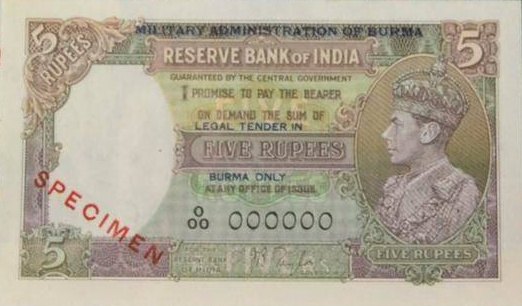
- Fred Schwan, 1977 to 1982. Schwan's advertisements of April 1977 and September and October 1978 picture Military Administration notes of 1, 5 and 10 rupees, and say the 4 and 8 annas were prepared but not issued. The review of August 1982, after M. Robinson and L. A. Shaw's book The Coins and Banknotes of Burma (1980), is told in Legal tender in Burma only.
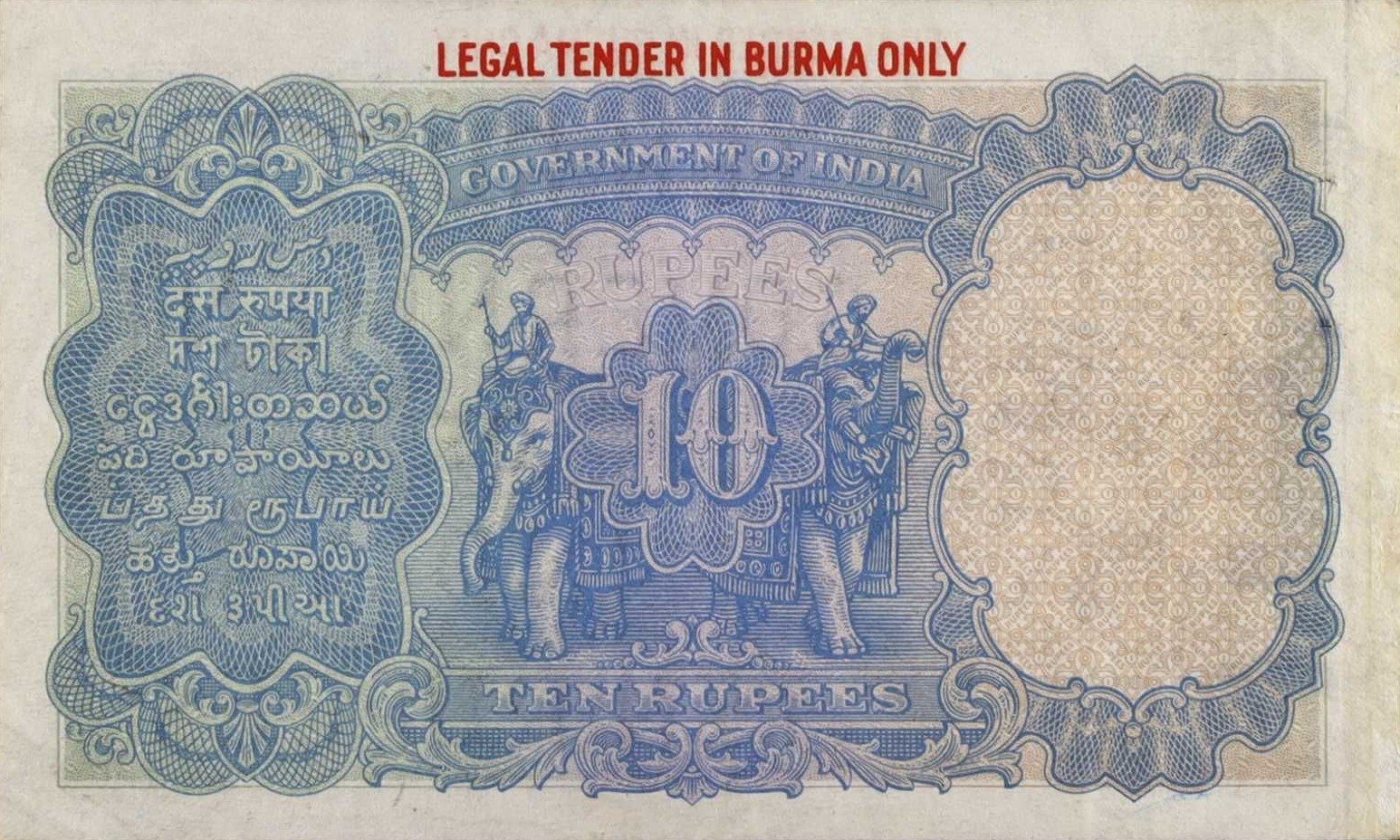
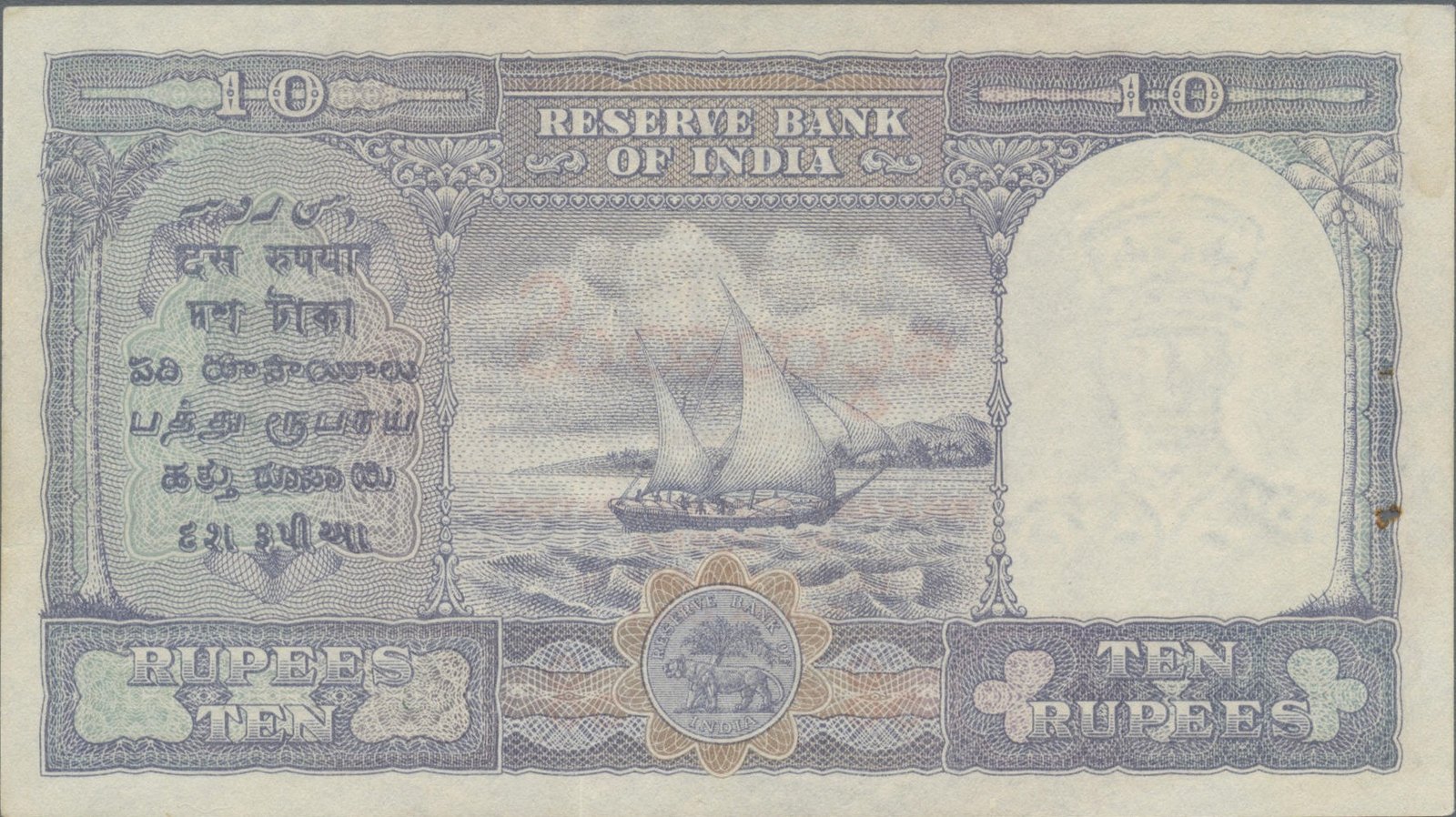
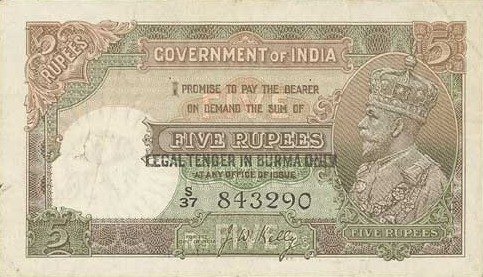
- October 1979, p. 19. The newspaper confirmed that the 5 and 10 rupees of 1937 also carry LEGAL TENDER IN BURMA ONLY on the back, as the pages of the 5 rupees and 10 rupees of 1937 say.
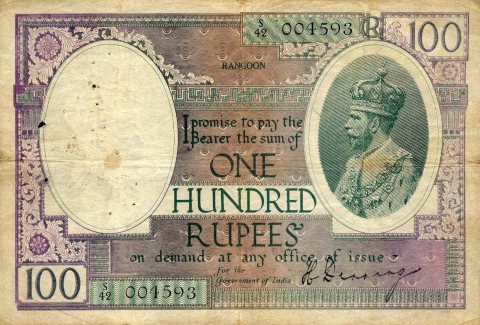
- July 1985, p. 12. "Rangoon issues 100-rupee note": a Government of India 100 rupees of Rangoon dated 12th October 1918 and signed by McWatters, which "had not been reported" before, pictured by courtesy of D. D. Bhathena of Fort, Bombay. The catalogue records it as ND/60 66106; the figure under ND reads 60 or 80 in the newsprint. The Controller of the Currency's reports for 1926-27 and 1927-28 name ND/60 among the forged series of 100 rupee notes received in those years, when most forged 100 rupee notes came in at Rangoon. No paper read says whether the note pictured in 1985 is a genuine note or one of those forgeries.
- March 1993. The World Update pictures a Rangoon 100 rupees of 1927 to 1937 signed by J. W. Kelly and reports a Kelly note with RANGOON in small green letters. The catalogue's Kelly row has large green letters; the picture shows no number, and the small letters are not recorded on a note.
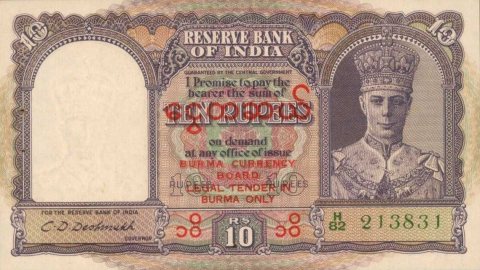
- July and August 2018. A report of a sale by Tennants of North Yorkshire in May 2018 pictures in colour the six Military Administration specimens, 4 annas to 100 rupees, in one lot, with SPECIMEN in red; the catalogue's row of the 10 rupees with the King in profile says black. A report of Lyn Knight's sale of 7th June 2018 calls the 1,000 rupees of 1939 numbered 004881 the Standard Catalog's plate note.
- July 2024. The report of Noonans' sale of 29th May 2024 calls the two unsigned red 10 rupees of 1918 in lots 474 and 475 SS Shirala notes, and names a signed Shirala 1 rupee in the same sale. The page of the red 10 rupees records that the house's own lots name no ship.
The IBNS Journal, 2009 to 2026
- Bohora, 48:4 (2009), p. 43. All the Reserve Bank's Burma issues were demonetised from 20th December 1952; the Bank's own Burma series began in May 1938.
- Razack, 51:4 (2012), pp. 25 to 31. The Military Administration notes were withdrawn on 1st June 1950 (elsewhere in the article, May 1950); the Currency Board overprints were issued on 1st July 1947 and demonetised on 28th December 1952. The article lists by number the Calcutta blocks of the 100 rupees overprinted for Burma in 1945 and 1947, and notes that the signature changes within prefix A/73.
- Razack, 53:4 (2014), pp. 9 to 14. The fullest account. Indian notes of the Presidency Banks were used in Burma until 1862; the Rangoon circle was established in 1882; the black-overprint 5 and 10 rupees of 1937 were hard to read and were withdrawn in the second half of 1937 and exchanged for red; the corner of a 100, 1,000 or 10,000 rupees was kept for the accounts when the notes were exchanged for the Reserve Bank's Burma notes; the notes of 1938 to 1939 were designed and printed at Nasik and were not legal tender in India; on the 10 rupees of 1945 the value is overprinted in Burmese because the back has no Burmese; the Military Administration 1 rupee was used by the armed forces only and the Currency Board 1 rupee by Burmese civilians only; India notes without the Burma overprint ceased to be legal tender in Burma from 1st July 1948; and the Currency Board overprints were withdrawn in June 1952 and ceased to be legal tender on 29th December 1952.
- Bohora, 54:3 (2015), pp. 16 to 18, and the letters in 54:4 (2015), pp. 8 to 11. The argument over the 1,000 rupees with the 1937 overprint, set out in Cut quarters, posted claims and a 1,000 rupees overprint. Bohora also quotes the Reserve Bank's official history: an Amendment Order of 1946 moved the liability for Burma notes issued before 1st May 1945, except those of 1,000 and 10,000 rupees, which a Military Administration proclamation of May 1945 had ended. Both letters quote the House of Commons on 17th May 1946: the 1,000 and 10,000 rupee notes were not legal tender in Burma, and holders had to show they had come by them lawfully. Razack points to the Reserve Bank's book Mint Road Milestones (2010), which pictures a stamped 1,000 rupees, X/6 097172, on p. 53.
- Bohora, 62:1 (2023), pp. 36 and 37, and Tim Whitney, 62:2 (2023), p. 8. The notes stamped CLAIMS BY POST. Bohora deduced from a 10 rupees of 1945 with glue and pin marks that notes were posted to the bank for exchange, after writing that no information on how the demonetised notes were redeemed is available. Bohora's article also says that in March 1952 the Parliament of Burma passed an Act moving the Board's work to the Union Bank of Burma, that the Board ended on 31st December 1952, and that roughly 365 million rupees of Military Administration and old Burma notes were replaced, which Bohora reckons at about 50 million pieces. Whitney's letter is about a 100 rupees of 1939 stamped TAUNGGYI and CLAIMS BY POST, with "Case no 1/1960" written by hand, bought at Noble Numismatics, whose catalogue had read the stamp as "Poss". Whitney writes that before reading Bohora's article the notes had seemed to be bookmarks in a legal case, No. 1 of 1960, in the court at Taunggyi; after it, and after talking with Bohora, Whitney takes the number for the note's own claim number and Taunggyi for the place where the claim was dealt with. Whitney also gives 20 December 1952 for the demonetisation of all the Reserve Bank's Burma notes.
- Raponi, 63:3 (2024), p. 37. A counterfeit 5 rupees of 1937 with a back tint shading from green to lilac and back, and a watermark laminated between two sheets of paper. The article sets it among counterfeits made by governments and argues that it is no amateur work; it does not say who made it.
- Bohora, 64:2 (2025), pp. 32 and 33. The quarter-cut 100 rupees, from letters of 1946: told in Cut quarters, posted claims and a 1,000 rupees overprint.
- Bohora, 65:1 (2026), pp. 32 to 38. Besides the red numbers of 1942 on the 1 rupee meant for Burma, a letter of 1st April 1946 on the stocks of old Burma notes held at Cawnpore, Calcutta and Nasik, proposed for destruction, which judges the overprinting of so many 1 rupee notes impractical.
How it stands
Each line gives a collector's statement and, beside it, what the other papers read for the catalogue say, each named. Where none of them speaks to the point, the line says so. Nothing here is settled by this article.
| Statement | Writer | What the other papers read say |
|---|---|---|
| The Rangoon circle was established in 1882 | Razack, 2014 | Das Gupta (1927, p. 92): Act XX of 1882 brought Burma under the Paper Currency Act, and a Circle Office at Rangoon came by a notification of 24th February 1893; Report on the Administration of Burma for 1896-97: the office was first opened in August 1883 |
| The first Rangoon notes reached Rangoon at the end of January 1884 | Robinson, 1991, from P. L. Gupta | Report on the Administration of Burma for 1896-97: its series of figures begins on 31st March 1884 |
| A Rangoon signature after 1912 only on notes of 500 rupees and above | Robinson, 1991 | Currency Department's reports for 1911-12 (para 47) and 1913-14 (para 61): forgeries of the new universal 10 rupees, among them Rangoon series, had "the signatures of the Head Commissioner" printed apart from the rest of the note |
| India notes without the overprint ceased to be legal tender in Burma from 1st July 1948 | Razack, 2014 | Notification No. 124 of 8th April 1948: "after 30th June 1948"; Reserve Bank's report for 1950-51 (para 96): "effective from 1 July 1948" |
| The 1,000 and 10,000 rupees ended by a proclamation of May 1945 | Bohora, 2015, from the Reserve Bank's history | Currency and Coinage Act, 1946: "Burma notes" are the Reserve Bank's notes of 100 rupees or less; Johns Hopkins working paper SAE0072, citing Tun Wai (1953): the Burma Notes Act 1947 and exchange rules of 1946 |
| The Currency Board ended on 31st December 1952 | Bohora, 2023 | Johns Hopkins working paper SAE0072: 31st December 1952; no Act on the point was read |
| All the Reserve Bank's Burma notes demonetised on 20th December 1952 | Bohora, 2009 and 2023; Whitney, 2023 | no official paper read gives this date; the Board's report for the year to 30th September 1951: free exchange to 15th January 1952 |
| The Currency Board overprints demonetised on 28th December 1952 (2012) or ceased to be legal tender on 29th December 1952 (2014) | Razack, 2012 and 2014 | no official paper read gives either date |
| Claims were posted to the bank | Bohora, 2023 | the Board's report for the year to 30th September 1951: after 15th January 1952 exchange only by a specific order of the Government; no paper read speaks of the case of 1960 |
| The two 1 rupee overprints, one for the forces and one for civilians | Razack, 2014 | no official paper read speaks to the point |
| Rangoon 10 rupees overprinted MADRAS in 1896-97 | Leader, 1974 | no report read mentions it, and the catalogue records no such note |
Sources
- Bank Note Reporter: June 1974 (R. Leader, pp. 14 and 15); April 1977; September and October 1978; October 1979, p. 19; August 1982, p. 14 (Fred Schwan); July 1985, p. 12; March 1993; July and August 2018; July 2024.
- IBNS Journal: 20:3-4 (1981), p. 87 (Michael Robinson); 30:4 (1991), pp. 22 to 24 (Michael Robinson); 48:4 (2009), p. 43 (Anil R. Bohora); 51:4 (2012), pp. 25 to 31 (Rezwan Razack); 53:4 (2014), pp. 9 to 14 (Rezwan Razack); 54:3 (2015), pp. 16 to 18 (Anil R. Bohora); 54:4 (2015), pp. 8 to 11 (Rezwan Razack, Joseph E. Boling); 62:1 (2023), pp. 36 and 37 (Anil R. Bohora); 62:2 (2023), p. 8 (Tim Whitney); 63:3 (2024), p. 37 (Fabrizio Raponi); 64:2 (2025), pp. 32 and 33 (Anil R. Bohora); 65:1 (2026), pp. 32 to 38 (Anil R. Bohora).
- Report on the Administration of Burma for 1896-97; reports of the Currency Department for 1911-12 and 1913-14; reports of the Controller of the Currency for 1926-27 and 1927-28; "Signatures on Indian Uniface Notes 1858-1931", the India Series A table of the web site Banknote Index, as read for the catalogue in November 2026; B. B. Das Gupta, Paper Currency in India (1927), p. 92; G. Findlay Shirras, Indian Finance and Banking (1920).
- Reserve Bank of India, Report on Currency and Finance for 1950-51; Burma Currency Board, report for the year to 30th September 1951 and the file of its constitution, with the Currency and Coinage Act, 1946 and Notification No. 124 of 8th April 1948; Johns Hopkins University, working paper SAE0072 on the Burma Currency Board.
- The Pick pages of Burma named above.
Member comments
Log in or register to post a comment.