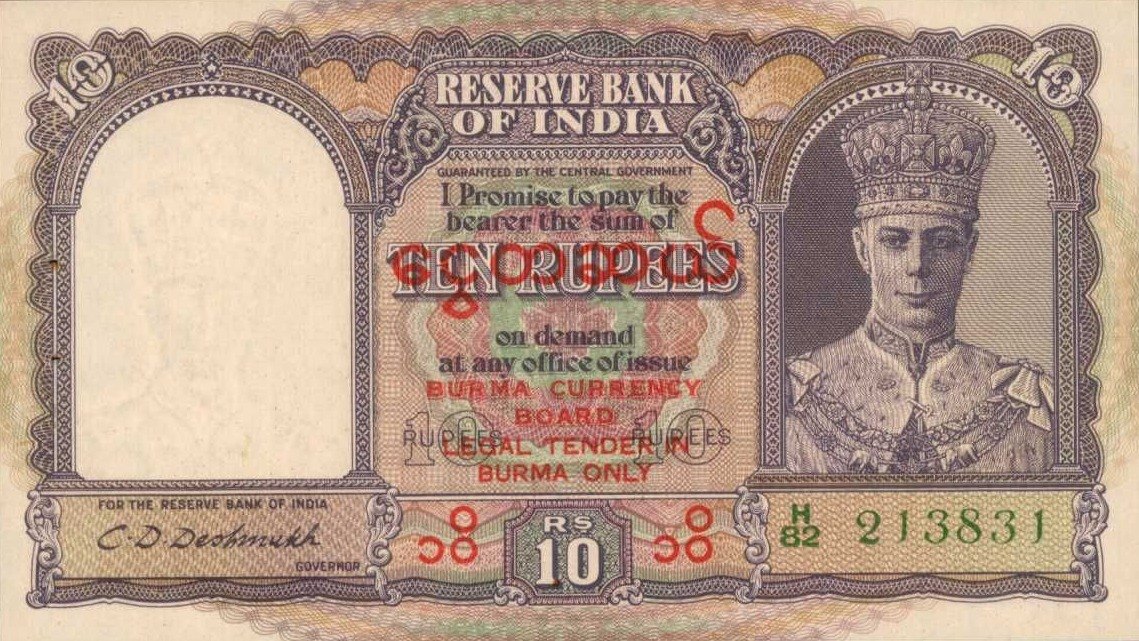
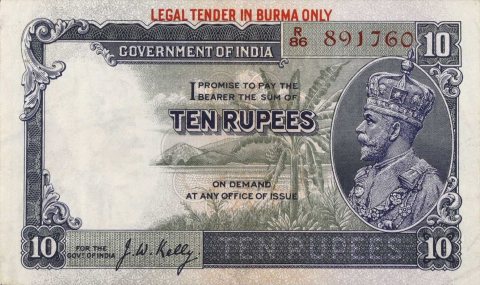
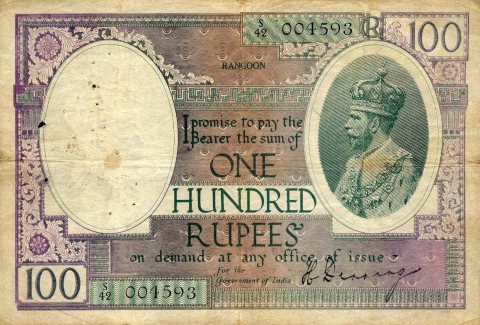
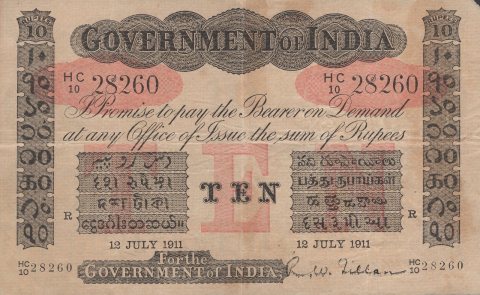
The issues of Burma from 1937 to 1952 are told note by note in Legal tender in Burma only. This article gives the figures and the rules that two official series of reports set down beside them. The first is the Reserve Bank of India's yearly Report on Currency and Finance, of which the volumes for 1943-44 (bound with 1944-45 and 1945-46), 1949-50, 1950-51 and 1951-52 were read; those for 1946-47 to 1948-49 are not held. The second is the reports of the Burma Currency Board for 1947-48 to 1952, with the Board's file of laws and notifications, from the archive of currency boards kept by the Johns Hopkins University. None of these volumes is on this computer now. Every figure and passage below is taken from the notes made when they were read for the catalogue (the Reserve Bank's reports on 11th November 2026, the Currency Board's papers on 7th November 2026), and could not be read again on the page for this article. Unless a sentence says otherwise, those notes record the figure as read on the page image.
A lakh is 100,000 rupees and a crore is 100 lakhs. The reports print rupees the Indian way (29,55,34,934); the figures below are written the ordinary way (295,534,934).
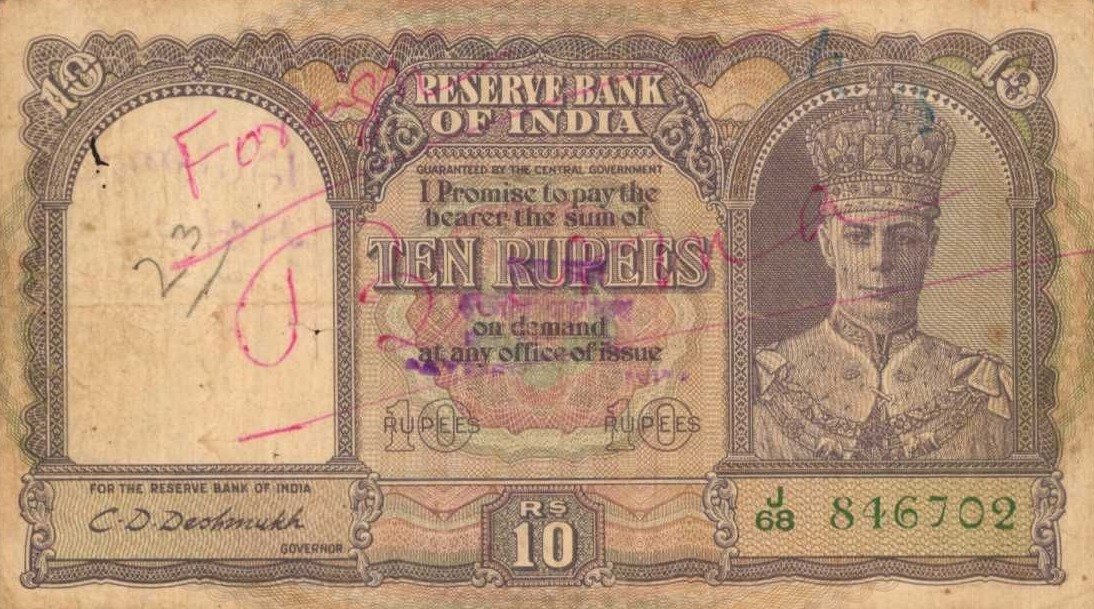
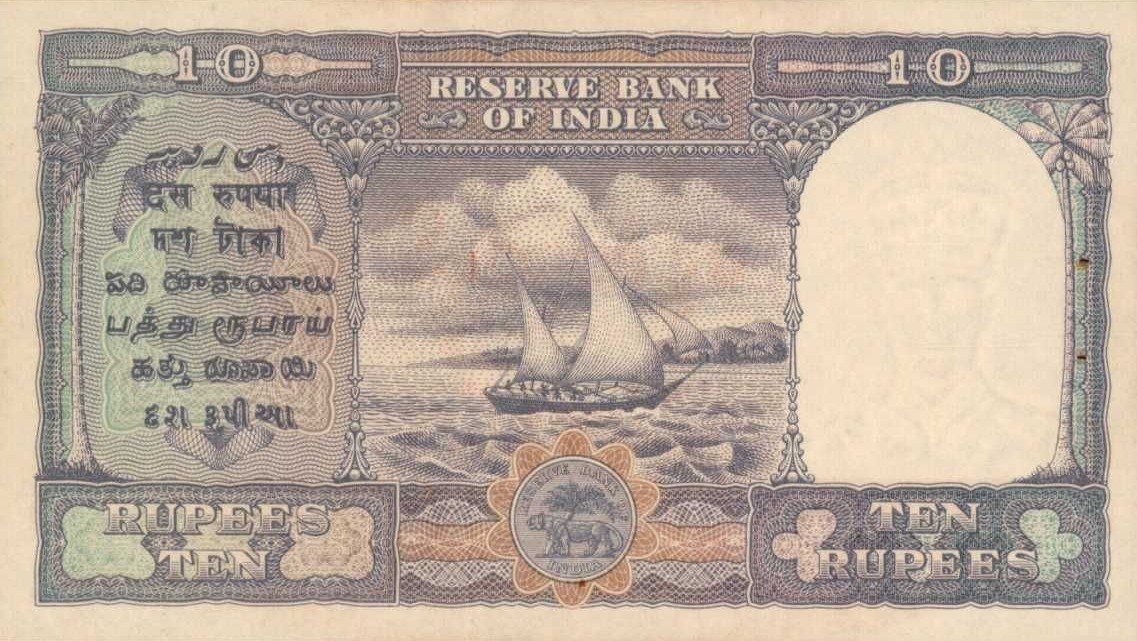
The Reserve Bank's Burma notes, 1938 to 1942
Statement XXXIII of the report for 1943-44 shows the Burma notes apart from the India notes for the five years from 1937-38 to 1941-42. In lakhs of rupees:
| Year to 31st March | Burma notes issued, year end | Burma notes in circulation, year end | Average in circulation | Absorption in the year |
|---|---|---|---|---|
| 1938 | 7,83 | 7,83 | 3,96 | not given |
| 1939 | 10,76 | 10,74 | 7,97 | 2,91 |
| 1940 | 13,78 | 13,45 | 11,09 | 2,71 |
| 1941 | 17,44 | 17,11 | 13,38 | 3,66 |
| 1942 | 28,35 | 28,33 | 20,20 | 11,22 |
(7,83 lakhs is 783 lakhs, or 7.83 crores.) The statement gives the absorption as a share too: 37 per cent in 1938-39, 25 in 1939-40, 27 in 1940-41 and 66 in 1941-42. It does not say whether the figure for 1937-38 counts the India notes overprinted for Burma in 1937 as well as the Reserve Bank's own Burma notes, the first of which came out in May 1938.
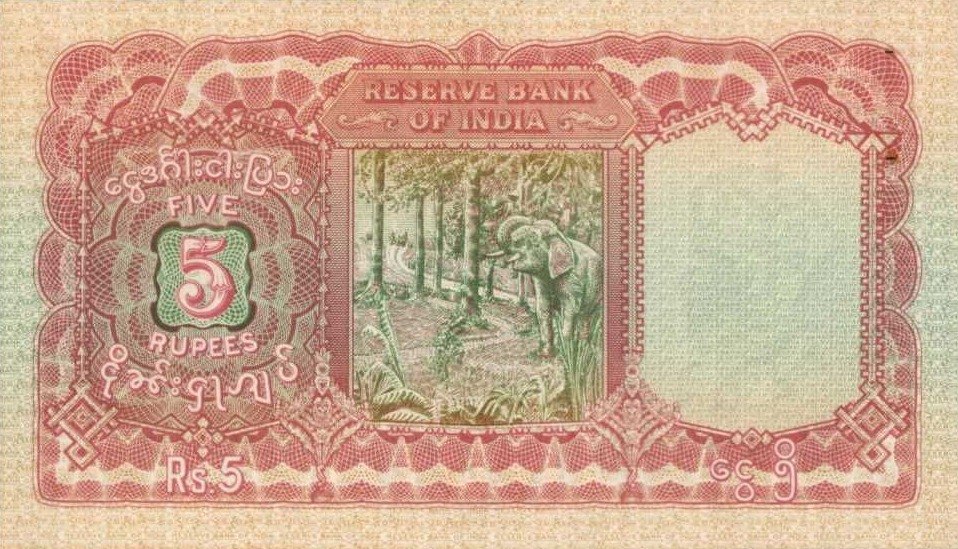
After 1941-42 the Burma column stops. The report for 1945-46 (para 78) explains why: the Bank's liability for the Burma notes was passed to the Government of India in the week that ended on 12th June 1942, when the Burma notes outstanding stood at 28.69 crores of rupees. The report for 1949-50 (para 90) repeats that the Bank was relieved of its liabilities for Burma notes from June 1942, and the report for 1943-44 already gives the notes in circulation in India "excluding Burma notes" (a passage read in the text of the scan).
Burma notes cashed in India, 1942 to 1950
The report for 1944-45 (para 69) gives 5th January 1942 as the day the Reserve Bank was first authorised to cash Burma notes in India. Each report counts what the Bank cashed.
| Year | Burma notes cashed in India, rupees | Report |
|---|---|---|
| 1941-42 (from 5th January 1942) | 10,539,780 | 1943-44, para 74 |
| 1942-43 | 52,920,095 | 1943-44, para 74 |
| 1943-44 | 3,864,535 | 1943-44, para 74 |
| 1944-45 | 933,305 | 1944-45, para 69 |
| 1945-46 | 99,545,870 | 1945-46, para 78 |
| 1946-47 and 1947-48 | not known (reports not found) | |
| 1948-49 | 4,850,310 | 1949-50, para 101 |
| 1949-50 | 24,397,198 | 1949-50, para 101 |
| 1950-51 | 4,116,411 | 1950-51, para 97 |
The reports also give the running total since 5th January 1942: 68,257,715 rupees at March 1945, 167,803,585 at March 1946, 291,418,523 at March 1950, and 295,534,934 in all when the cashing ended. The last figure reads 29,56,34,934 in the machine-read text of the 1950-51 report and 29,55,34,934 on the page image.
The rules changed three times.
- Restrictions, 1942 to 1945. The report for 1945-46 speaks of the "stringent restrictions" on bringing Burma notes into India and on cashing them "detailed in previous years' reports"; the first of them were set out in paragraph 75 of the report for 1942-43, which is not held. In January 1944 the Government of India went further: a notification barred the import across any customs frontier east of India or north of Assam of notes that were legal tender in British India. The report explains that this stopped both the Government of India 1 rupee notes, which were also legal tender in Burma, and the Reserve Bank's India notes, "of which there were still a number circulating in Burma, although no longer legal tender there". Licences for Burma notes carried by evacuees were given by Refugee Officers at the frontier posts. (These sentences were read in the text of the scan.)
- At par, from 1st May 1945. After the reoccupation the restrictions were cancelled. Burma notes could be exchanged at par at the Reserve Bank's Issue Department in Calcutta, the Imperial Bank of India at Chittagong, the treasuries at Imphal and Aijal and the sub-treasuries at Margherita and Cox's Bazar. The holder needed a certificate of the Civil Affairs Service (Burma), and sums over 500 rupees a senior officer's certificate (report for 1945-46, para 78). The jump in 1945-46 followed.
- A ration, 1949 to 1950. By 1949-50 the old Burma notes, the Military Administration notes and the Currency Board notes were cashed at the Reserve Bank's offices at Bombay, Calcutta and Madras, at offices of the Imperial Bank, at treasuries in Assam and at Port Blair, up to 100 rupees for each adult and 50 rupees for each child. In April 1949 authorised dealers were told to limit their purchases of Burma currency to 100 rupees a traveller, and from 10th September 1949 no one could bring more than 100 rupees of India or Burma notes from Burma into India (report for 1949-50; the exchange control passage was read in the text of the scan). The facility ended on 1st May 1950, "when the Government of Burma terminated the arrangements" (report for 1950-51, para 97).
The return to Rangoon, 1945
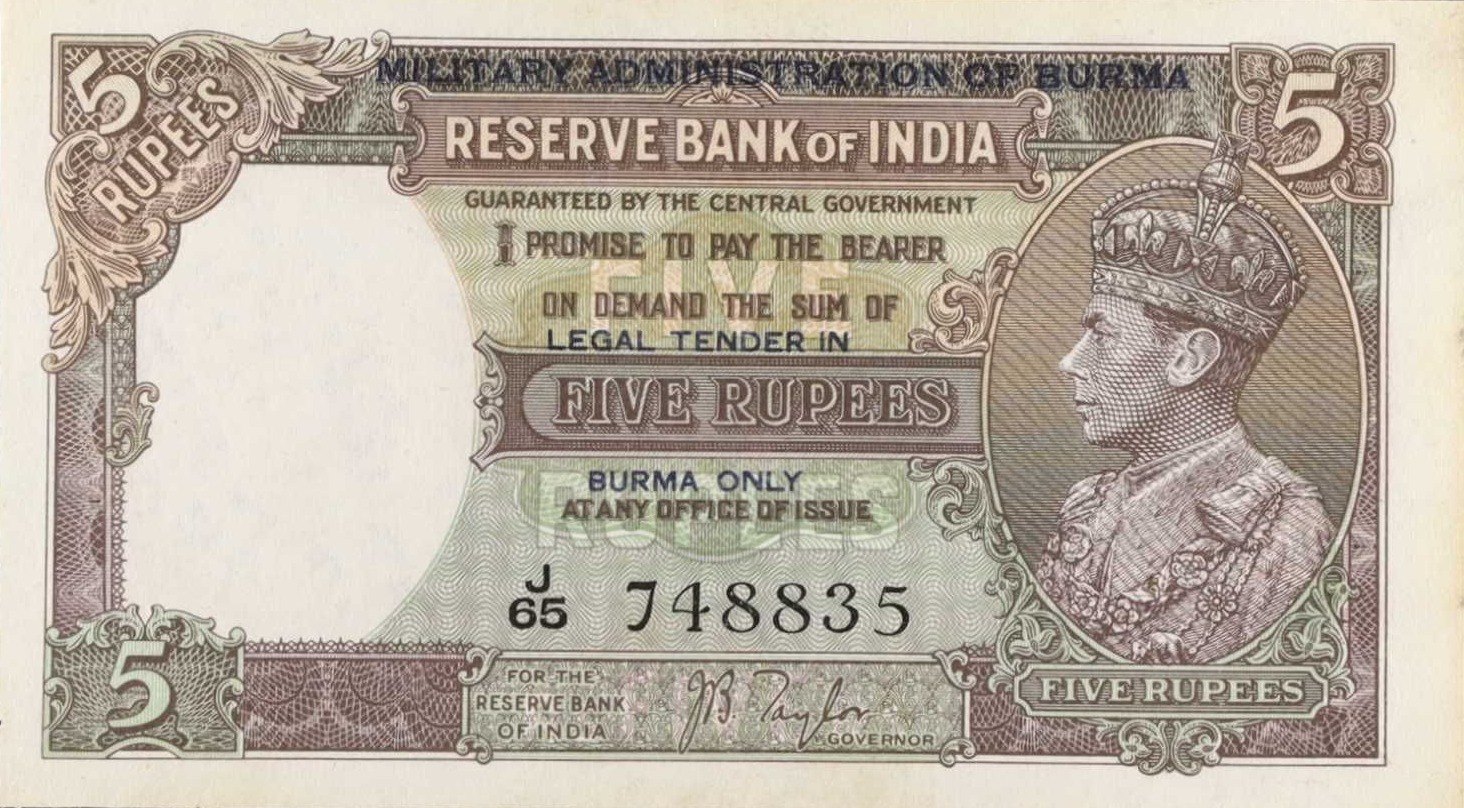
The banking section of the report for 1945-46 says that the Reserve Bank's office in Rangoon, closed during the occupation, reopened for business on 20th August 1945 and took over the functions of the British Military Administration Treasury set up after the liberation of Burma. (This passage was read in the text of the scan.)
The same report (para 83) counts a record 23,792 forged notes in 1945-46. The forged 10 rupee notes received at Calcutta numbered 5,367 and at Rangoon 2,947, and forged notes of all values came to 2,970 at Rangoon. The report does not say which design of 10 rupees was forged, or whether the Rangoon pieces carried a Burma overprint.
The Burma Currency Board: the law and the members
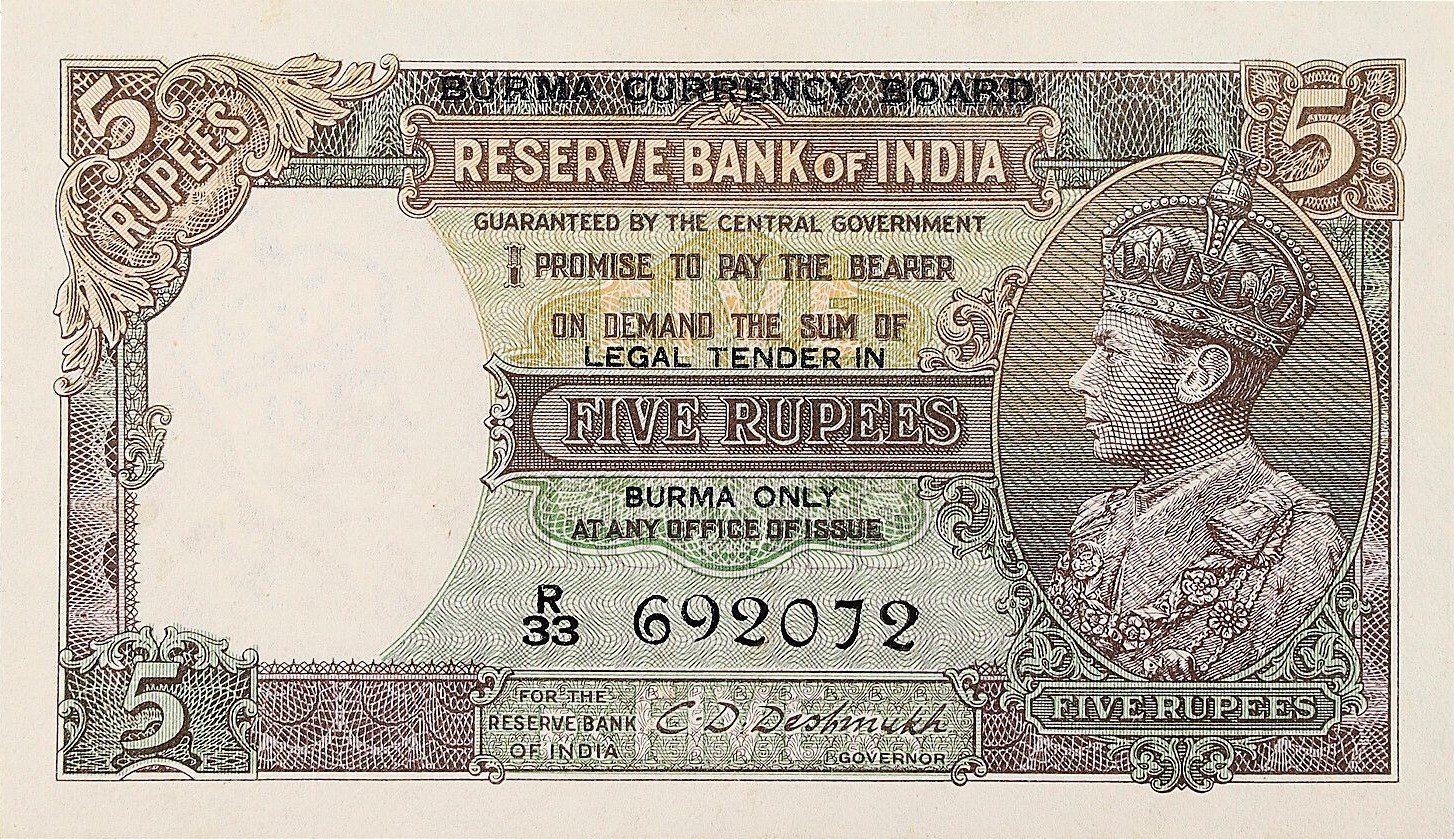
The Board was made by the Currency and Coinage Act, 1946 (Burma Act XLV of 1946), printed in its file of laws.
- The Board. Five members: a Chairman named by the Governor of Burma, two members of Burmese birth named by the Governor, one named by the Secretary of State for Burma and one by the Governor of the Bank of England.
- The money. A Burma rupee of 16 annas, and notes of 1, 5, 10 and 100 rupees, with other values by notification. The Board set the form, design, plates and paper of its notes with the Governor's approval, and could declare any series to have ceased to be legal tender except at its own offices. Notes were issued against sterling at 1 shilling 6 pence a rupee.
- The old notes. "Burma notes" in the Act are three things: the Reserve Bank's notes of 100 rupees or less under the Order of 1937, the Military Administration notes under Currency Proclamation No. 6 of 1945, and notes under the Currency Notes Act, 1946. All stayed legal tender.
The notifications printed in the file give the steps in order.
| Notification | What it did |
|---|---|
| No. 246 of 12th December 1946 | brought sections 1 to 4, 6, 7, 9 and 27 of the Act into force |
| No. 265 of 19th December 1946 | appointed the Board |
| No. 104 of 26th February 1947 | put the Board's main office in London and a branch in Rangoon |
| Nos. 103, 132 and 144, February and March 1947 | brought the note-issue sections into force on 1st April 1947 |
| Nos. 133 and 134 of 24th March 1947 | kept Burma notes and India notes legal tender until a date to be notified |
| No. 226 of 27th June 1947 | under the Currency and Coinage (Amendment) Act, 1947 (Burma Act XVII of 1947), ended on 1st July 1947 the use of the Military Administration notes as the Board's own |
| No. 124 of 8th April 1948 | India notes cease to be legal tender in Burma after 30th June 1948 |
| No. 140 of 27th April 1948 | the same for the Government of India 1 rupee notes |
The file does not name the members. A working paper on the Board in the Johns Hopkins series (SAE0072, p. 8) does: Sir Richard Hopkins as chairman, with U Kaung, Saw Htin Lin Mya, W. Johnston and Raymond Kershaw, and U San Lin as Currency Officer in Rangoon.
What the Board's accounts counted
The Board's report for 1st April 1947 to 30th September 1948 gives the Military Administration notes outstanding on 1st April 1947, the day the Board began, as 591,821,266 rupees (this figure was read in the text and checked on the image). It gives the notes outstanding on 30th September 1948:
| Notes outstanding, 30th September 1948 | Rupees |
|---|---|
| Military Administration 1 rupee | 6,866,970 |
| Military Administration 5 rupees | 4,375,600 |
| Military Administration 10 rupees | 49,272,290 |
| Military Administration 100 rupees | 28,289,500 |
| Military Administration notes, total as the report gives it | 88,804,360 |
| Burma Currency Board notes, the overprints and the new notes together | 237,633,698 |
| Old Burma notes (the Reserve Bank's), estimated | 9,128,786 |
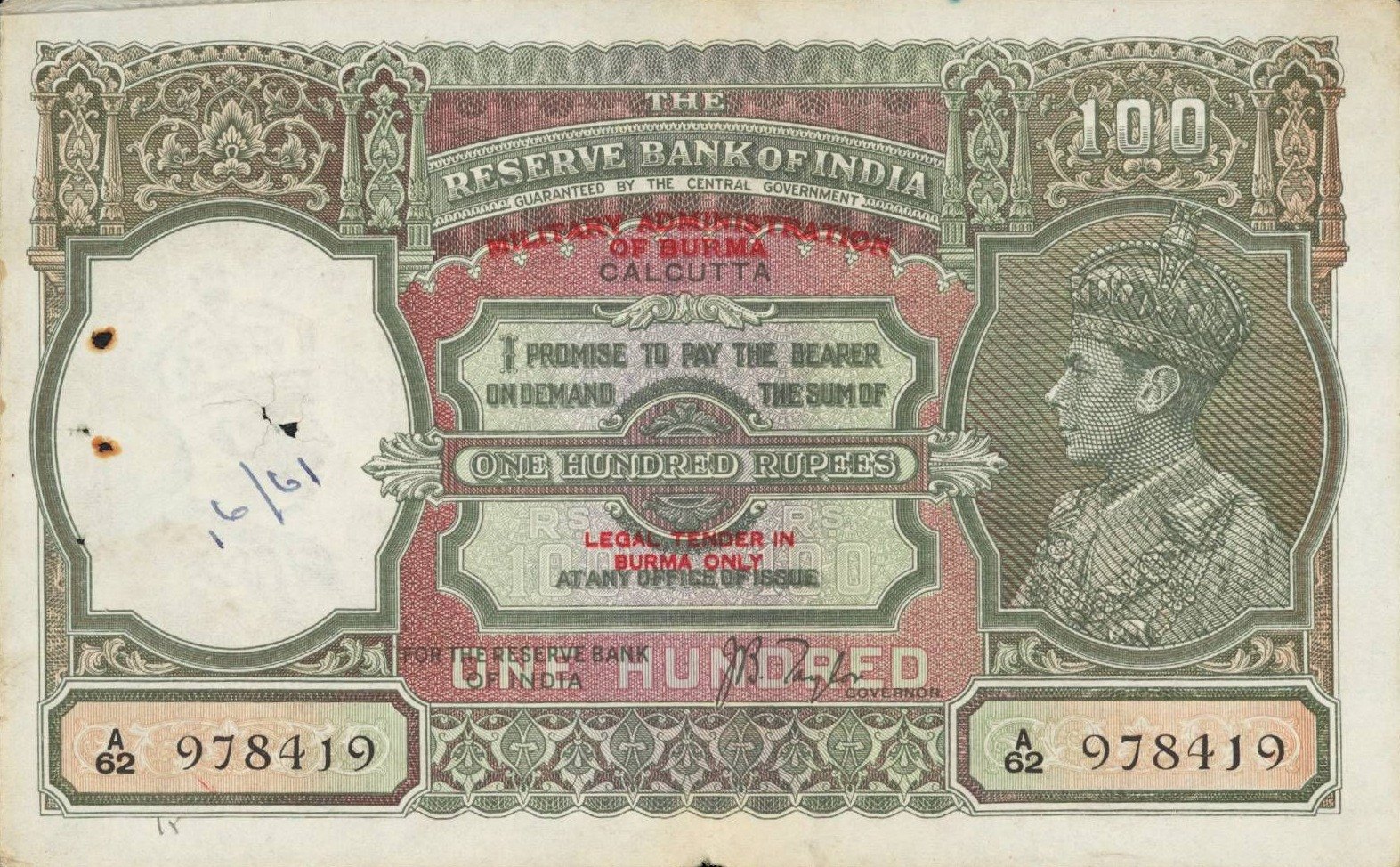
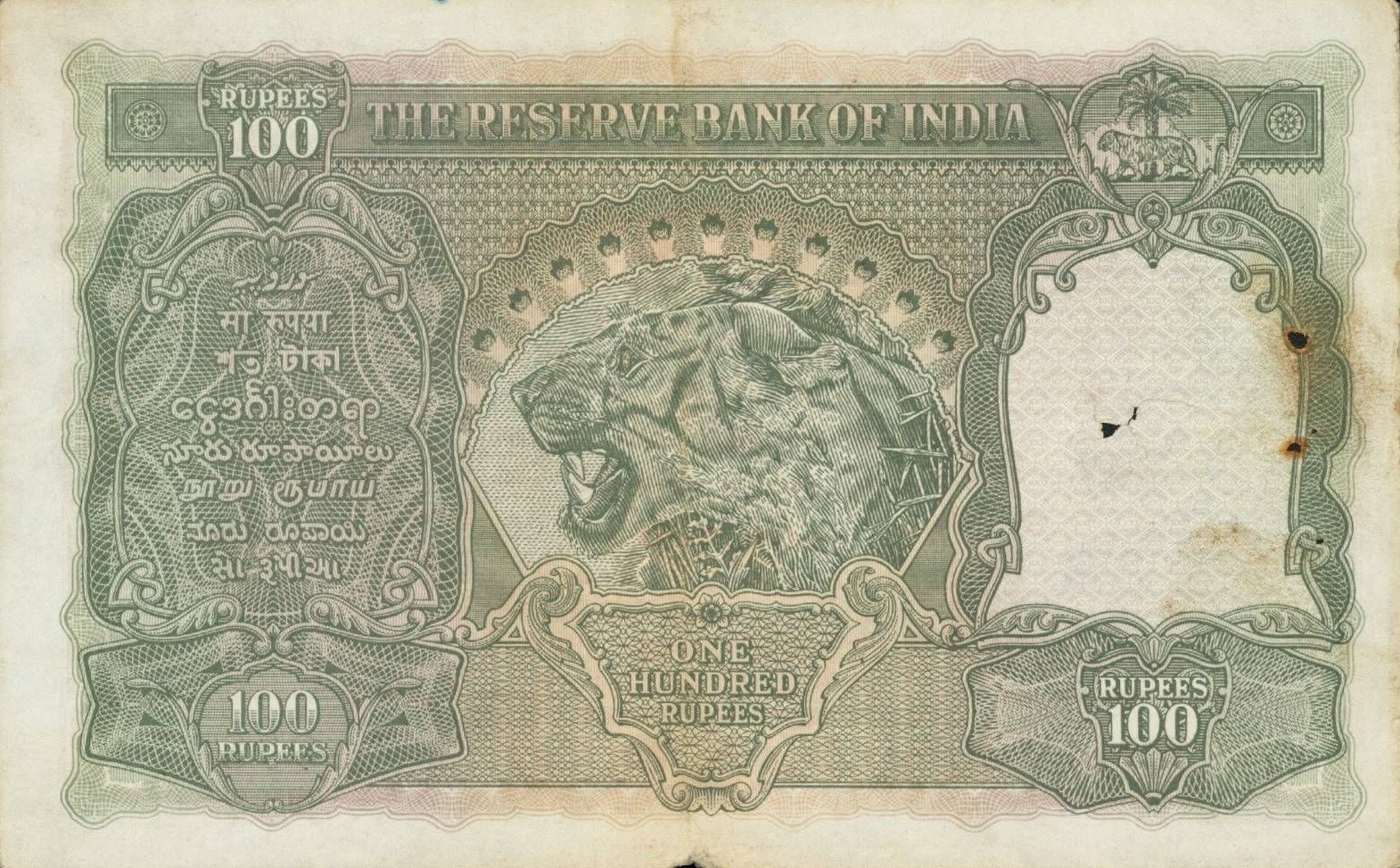
What the same report (para 10) says of the overprints the Board had made in India, 67 crores of rupees in all, is told in Legal tender in Burma only.
The later reports, for 1949 to 1952, give the notes outstanding by value each year, but their tables were not copied when the reports were read, and they are not given here. The Johns Hopkins working paper (p. 9) gives two figures from them: the Board's notes at 237,633,844 rupees in 1948, against 237,633,698 in the report itself, and 38,345,750 rupees of old Burma notes redeemed by 1952, more than four times the estimate of 1948. The paper adds that in 1950 the Government threatened to demonetise all the notes still out, and that the Board ended on 31st December 1952, its work passing to the Union Bank of Burma. Those statements are the working paper's.
The end of the old notes
How the old notes ceased to be legal tender in Burma on 1st June 1950, and how long they could still be exchanged there, is told in Legal tender in Burma only, from the Reserve Bank's report for 1950-51 (para 96) and the Board's report for the year to 30th September 1951 (para 7). The Board's report adds that after 15th January 1952 notes were exchanged only by a specific order of the Government, on presenting them at Rangoon or at a District Headquarters Treasury. The notes stamped CLAIMS BY POST, among them one group with a case number of 1960, are in Cut quarters, posted claims and a 1,000 rupees overprint.
In India the forged 100 rupee notes detected rose sharply in 1950-51, to 182 from 35 the year before (report for 1950-51, para 101), in the year of the press communique of 16th September 1950 on Burma 100 rupee notes passed with the overprint erased. The report does not say whether the 182 include such notes.
What the reports leave open
- The report for 1942-43, with the first rules on cashing Burma notes, and those for 1946-47 to 1948-49 were not found.
- The Board's tables by value for 1949 to 1952 were not copied, so how fast each kind of note came in is not known here.
- No official text read gives a day in December 1952 for any of these notes. The Pick pages say that "sources mention" 29 December 1952 for the end of the Board's overprints and 20 December 1952 for the withdrawal of all the Reserve Bank's Burma notes; the working paper gives 31st December 1952 for the end of the Board. What each collector wrote of these dates is set out in What collectors wrote about the notes of Burma. None of the dates is settled here.
Sources
- Reserve Bank of India, Report on Currency and Finance for 1943-44 (paras 64 and 65, para 74, Statement XXXIII), 1944-45 (para 69), 1945-46 (paras 78 and 83 and the Banking Department section), 1949-50 (paras 90 and 101 and the exchange control section), 1950-51 (paras 96, 97 and 101).
- Burma Currency Board, report for 1st April 1947 to 30th September 1948 (paras 5, 10 and 14 and the list of notifications) and report for the year to 30th September 1951 (para 7, with para 6 of the report for 1950).
- Burma Currency Board, file of its constitution: the Currency and Coinage Act, 1946 (Burma Act XLV of 1946), the Currency and Coinage (Amendment) Act, 1947 (Burma Act XVII of 1947) and the notifications of 1946 to 1948 (Appendix V).
- Johns Hopkins University, working paper SAE0072 on the Burma Currency Board, pp. 8 and 9.
- The Pick pages of Burma P-1 to P-8 and P-25 to P-33.
Member comments
Log in or register to post a comment.