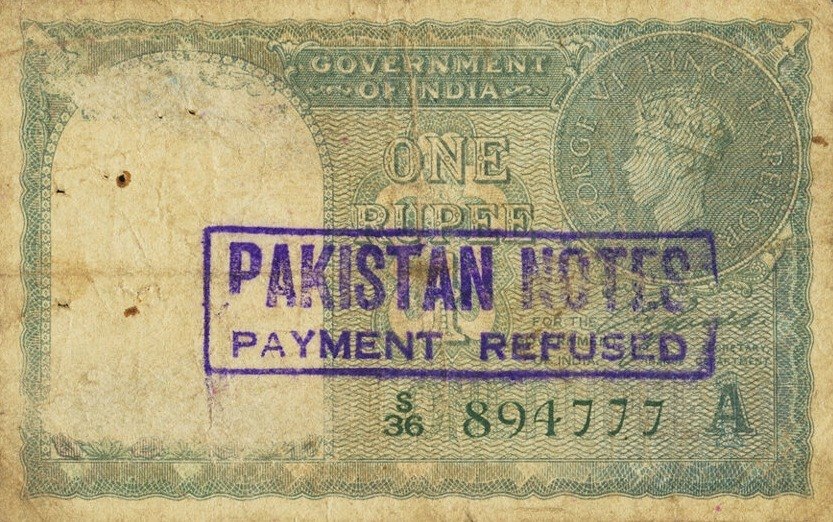
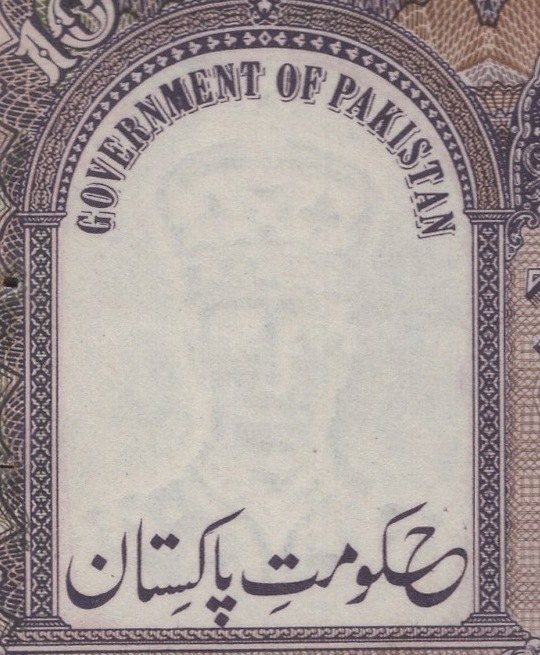
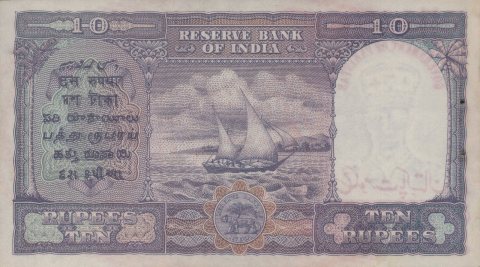
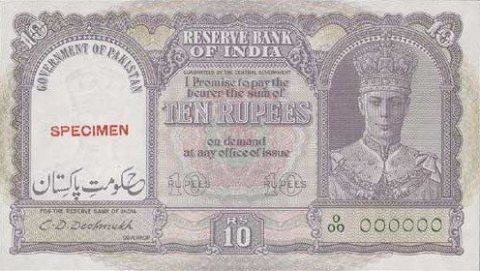
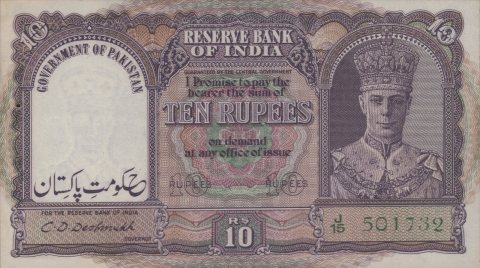
The Indian notes issued for Pakistan from 1 April 1948 differed from the notes of India only by two inscriptions in the watermark area, and they were not redeemable in India. Some had the inscriptions removed so that they would pass as India notes, and banks that caught them stamped them PAYMENT REFUSED. This article sets out what was written about these notes in the IBNS Journal, mostly in 2011 and 2012, what the auction houses have said of single notes, and how the Pick pages place them. The issue itself is told in The Reserve Bank of India notes inscribed GOVERNMENT OF PAKISTAN, 1948 to 1952.
Why the words were scraped off
Jamal Bokhari and Anil R. Bohora wrote a study of them, "Banknotes of Early Pakistan: Payment Refused in India" (IBNS Journal, volume 50, number 3, 2011). Their account is this. The migration between the two countries went on long after independence. Refugees leaving Pakistan for India received the inscribed notes in everyday dealings, and in India the notes were not accepted. How such notes could be exchanged, if at all, the authors could not find out. Some holders scratched off the words that marked the notes as Pakistan's.
Dr. Malik Aftab Maqbool Joiya, in "The Special Notes of Pakistan Since 1947" (IBNS Journal, volume 51, number 3, 2012), gives a second reason beside the first. People in country districts did not follow the changing dates for exchanging the inscribed notes, thought the currency of India the stronger, and removed the inscription.
How the notes were altered
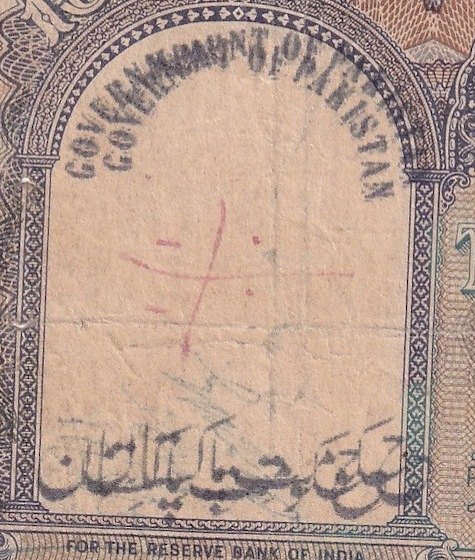
Bokhari and Bohora describe alterations of two kinds: crude ones that damaged the design beside the words, and careful ones that took off the words alone. On some notes only the Urdu line at the foot was scratched off and GOVERNMENT OF PAKISTAN in English was left, perhaps, the authors suggest, because the person did not read English.
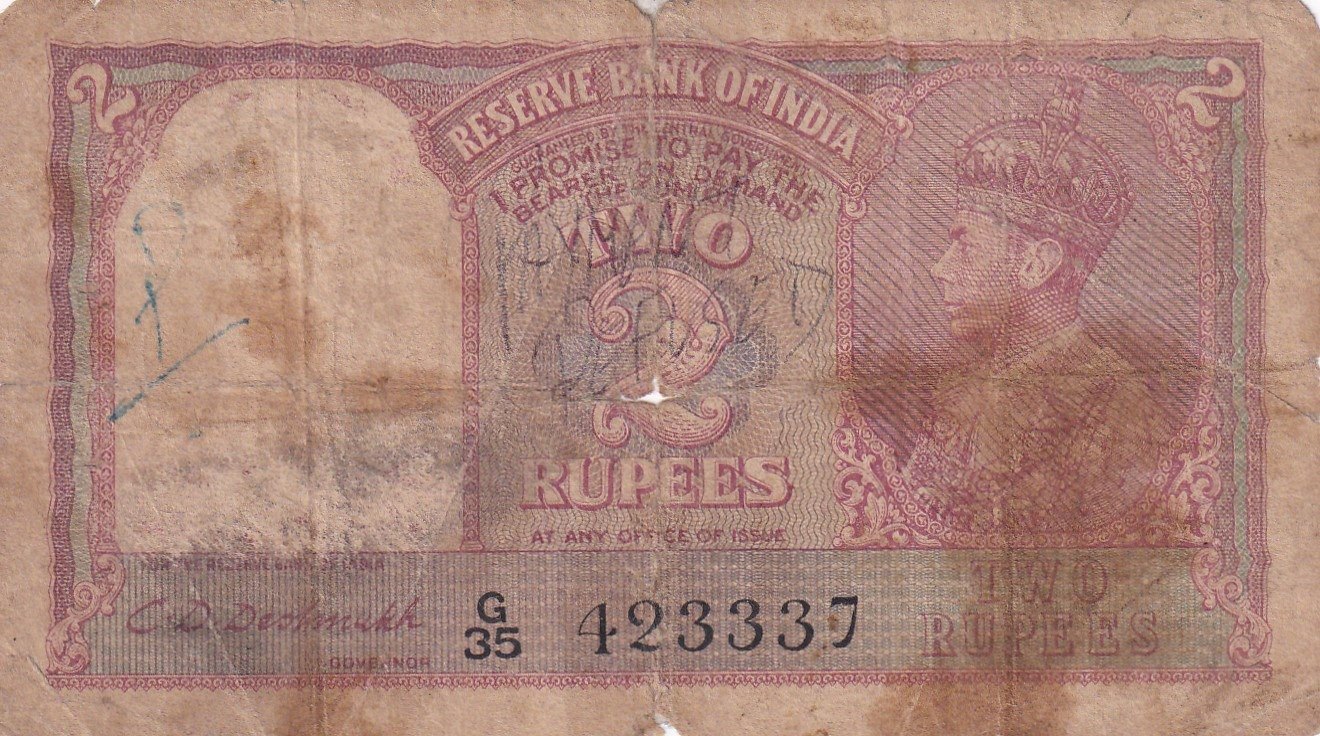
Some notes went further. The inscribed notes took their own blocks of prefixes, and a note outside the India blocks could be caught by its prefix alone. Bokhari and Bohora picture a 5 rupees on which the inscription was neatly removed and the prefix B/75 changed to E/75. Joiya's article lists a 5 rupees of prefix E/75 without either inscription, among notes that may be printing errors or may have had the inscription removed on purpose. The two descriptions name the same prefix.
Not every altered note was caught. Bokhari and Bohora show one with no stamp at all, and take it to have stayed in circulation.
The handstamps on altered notes
By Bokhari and Bohora's account, when a bank found an altered note it refused it and stamped it, so that it could not be offered again. The two authors write that the stamping looks officially ordered, but that no official authority for it has come to light. They list these legends, each in two lines:
- PAKISTAN NOTE / PAYMENT REFUSED, in mauve to dark blue ink, in a rectangular box
- PAKISTAN NOTES / PAYMENT REFUSED, in mauve to dark blue ink, in a rectangular box
- PAKISTAN NOTE / PAYMENT REFUSED, in mauve to dark blue ink, without a box
- ALTERED NOTE / PAYMENT REFUSED, in mauve to dark blue ink, without a box
- ALTERED PAKISTAN NOTE / PAYMENT REFUSED, in dark blue ink, without a box
Their second table breaks these into types by size and gives the values on which each was seen. The PAKISTAN NOTE and PAKISTAN NOTES stamps are each recorded on the 1, 2, 5 and 10 rupees. ALTERED NOTE is recorded on the 2 and the 10 rupees, and ALTERED PAKISTAN NOTE on the 5 rupees.
The stamps are usually on the front, and often more than once, on front and back. Some notes also carry pen or pencil notes by the people or firms that received them.
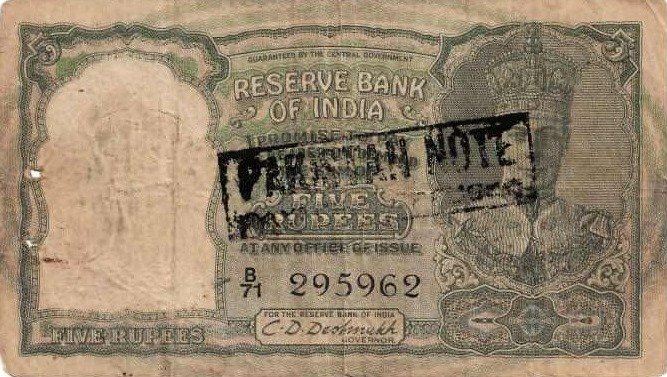
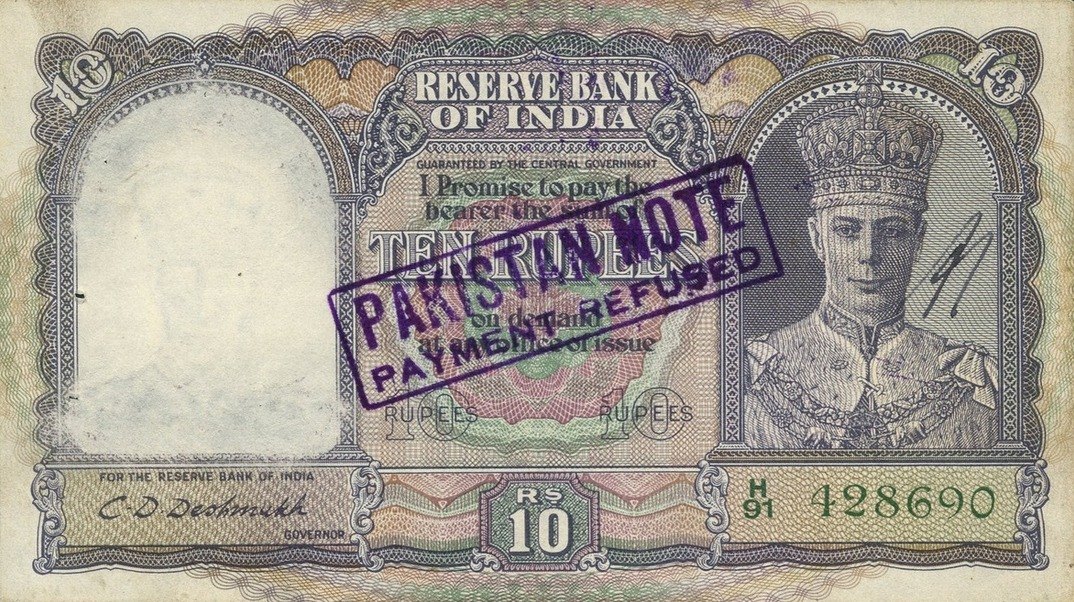
In a reply printed in the IBNS Journal, volume 51, number 2 (2012), the two authors added a 10 rupees with a stamp of another kind, PAK CURRENCY.
The handstamps Joiya recorded in 2012
Joiya's article of 2012 lists the stamps found on inscribed notes by type. Of the CANCELLED notes it says that the inscribed text was not altered or removed. Of the other types it does not say. It records these.
- Two CANCELLED stamps in dark blue ink on the front, on notes of 2, 5 and 10 rupees. Joiya thinks they were probably applied when the notes were demonetised and withdrawn.
- PAKISTAN NOTE / PAYMENT REFUSED, on the 1, 2 and 10 rupees, in mauve to dark blue, pink and dark blue ink.
- PAKISTAN NOTES / PAYMENT REFUSED, on all five values. The 100 rupees, of prefix B/57, is given as the only high value of the type found.
- A 2 rupees with PAKISTAN NOTES / PAYMENT REFUSED in blue ink and five marks like the letter X on the upper border, and a 10 rupees with two boxed PAKISTAN NOTE / PAYMENT REFUSED stamps in pink ink and further cancellation marks.
- ALTERED NOTE / PAYMENT REFUSED in dark blue ink on a 10 rupees.
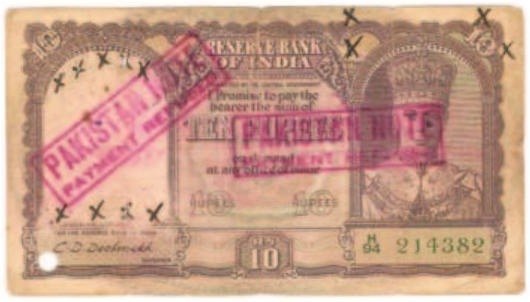
The Pick pages count the two CANCELLED stamps (2, 5 and 10 rupees) and PAKISTAN NOTE or PAKISTAN NOTES / PAYMENT REFUSED in blue, mauve or pink as handstamps on notes that still show the inscription.
Joiya had described the X marks a year earlier, in a letter in the IBNS Journal, volume 50, number 4 (2011): handstamped notes that also carry rows of the letter X in blue, pink or black ink, across the inscription or along the top and bottom borders.
Bokhari and Bohora write of banks in India, in the areas nearer the refugee camps, where staff may have had the list of prefixes. Joiya agrees that bank staff knew the prefixes, and adds that within Pakistan's border area such stamping was probably done by the Imperial Bank of India, which acted in Pakistan for the Reserve Bank.
The 100 rupees
In 2011 Bokhari and Bohora had 1, 2, 5 and 10 rupees with the stamps and had not met a 100 rupees. Joiya's letter of the same year answered that stamped 100 rupees exist, and that one seen with the name of an office other than Karachi was perhaps a case of a false stamp. The authors replied in 2012 that they too had met a 100 rupees of another office with the stamp, and that it was an altered note.
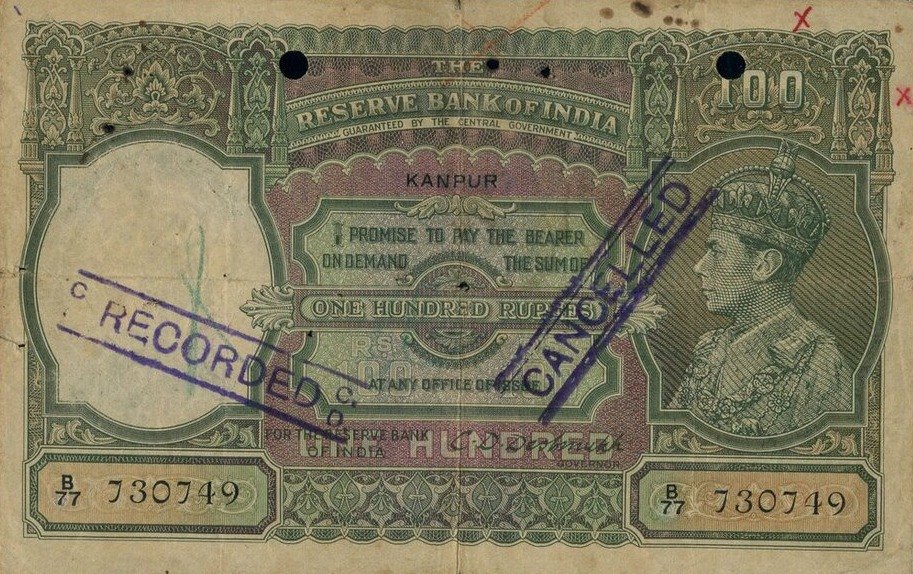
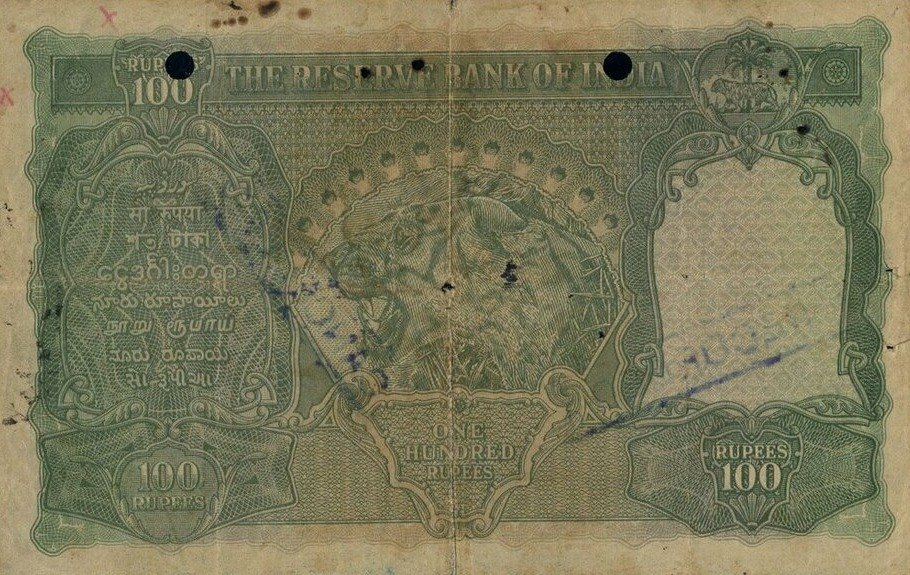
A note of that kind has been sold. Spink's description of lot 73 in its sale of 4 November 2020 is of a 100 rupees that reads Kanpur and B/77. Spink says it was a Karachi note with the Pakistan inscription erased, the office changed from Karachi to Kanpur and the prefix B/57 changed to B/77, and that it carries RECORDED and CANCELLED handstamps. The Pick page of the 100 rupees has it on the row for altered notes.
Noonans' description of lot 454 in its sale of 25 February 2026 is of a 100 rupees of prefix B/58 on which both inscriptions were only partly removed. Under the rule of the Pick pages a note that still shows the inscription stays on the issued row.
Forged inscriptions
The opposite fraud exists too: an India note given a false Pakistan inscription. Peter Symes, in "The Bank Notes of Pakistan, 1947 to 1972" (IBNS Journal, volume 38, number 4, 1999), warns that ordinary Reserve Bank notes have been overprinted to deceive collectors, and suspects it of any 2 rupees with red serial numbers. The Pick page of the 10 rupees has a row for such notes: genuine 10 rupees of the India design on C prefixes with a counterfeit GOVERNMENT OF PAKISTAN overprint.
Where each kind sits in the catalogue
The Pick pages sort these notes by what was done to the inscription, not by the stamp.
- A note with the inscription removed from the watermark area goes on the Counterfeit row of its value: P-1ax, P-1Aax, P-2ax, P-3ax and P-3Aax. Most carry a handstamp. One of the 5 rupees has its prefix altered as well.
- A handstamped note that still shows the inscription stays on the issued row. So does a note with only the Urdu line scratched off and the English one left.
- A genuine India 10 rupees with a forged inscription goes on P-3x.
The pages of the 1 rupee, the 2 rupees and the 5 rupees follow the same rule.
The house descriptions do not always name the alteration. London Coins' description of lot 1521 in its sale of 2 December 2019 offers two 10 rupees as India Pick 24, one of them of prefix J/20, which lies inside a Pakistan block. The catalogue has that lot on row P-3ax. Stack's Bowers' description of lot 31311 in its sale of 6 September 2026, a 2 rupees stamped as an altered note, says the house could not tell what the alteration was. Spink's description of lot 2429 in its sale of 27 September 2017 includes a 10 rupees with the Pakistan text removed and a purple PAKISTAN NOTE PAYMENT REFUSED stamp across the front.
India notes that were handstamped in Pakistan when they were withdrawn there are a different matter, and are touched on in The Reserve Bank of India's King George VI notes, 1938 to 1950.
What is not known
Bokhari and Bohora say plainly what they could not find. The number and value of the altered notes are unknown. It is not known whether a bank kept a note after stamping it or handed it back. No record of the stamps the banks used is public, so a stamp cannot be checked against one. The authors allow that some stamped notes may be modern work for collectors, and in their correction of 2012 add that there is no evidence of this having happened. In their article of 2011 (IBNS Journal 50:3) they set against it, among other points, that the notes have come to light slowly and singly over twenty years, where forgeries come in groups, and that altered notes exist with no stamp at all.
On the Pick page of the 100 rupees one question is open. A KARACHI 100 rupees of prefix B/58 shows no inscription and no handstamp, on a prefix otherwise recorded only on Pakistan notes, and its photograph is too small to show whether an inscription was removed.
Sources
- The Pick pages of Pakistan P-1, P-1A, P-2, P-3 and P-3A in this catalogue.
- Jamal Bokhari and Anil R. Bohora, "Banknotes of Early Pakistan: Payment Refused in India", IBNS Journal, volume 50, number 3, 2011.
- Dr. Malik Aftab Maqbool Joiya, letter "More on Payment Refused Pakistan Notes", IBNS Journal, volume 50, number 4, 2011.
- Jamal Bokhari and Anil R. Bohora, letter "More Information on Pakistan Payment Refused Notes", IBNS Journal, volume 51, number 2, 2012.
- Dr. Malik Aftab Maqbool Joiya, "The Special Notes of Pakistan Since 1947: Overprints Both Official and Private", IBNS Journal, volume 51, number 3, 2012.
- Peter Symes, "The Bank Notes of Pakistan, 1947 to 1972", IBNS Journal, volume 38, number 4, 1999.
- Auction descriptions: Spink, 27 September 2017, lot 2429, and 4 November 2020, lot 73; London Coins, 2 December 2019, lot 1521; Noonans, 25 February 2026, lot 454; Stack's Bowers, 6 September 2026, lot 31311.
Member comments
Log in or register to post a comment.