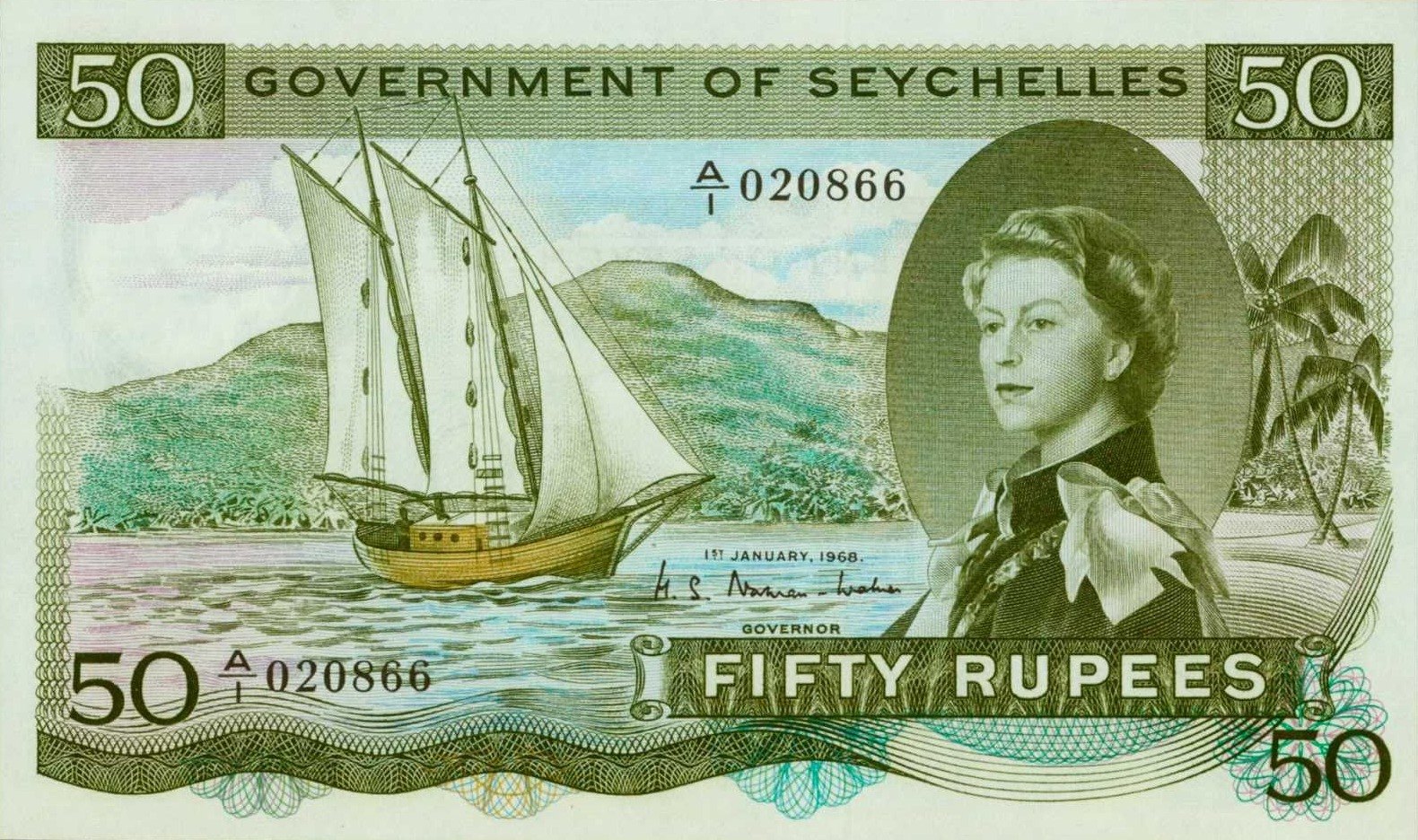
This article goes through what collectors wrote about the notes of 1914 to 1975 in Coins magazine, in Bank Note Reporter between 1974 and 2013, and in the Journal of the International Bank Note Society (IBNS) between 1995 and 2017, and in a book of 2025, in order of time. For each writer it says what was claimed and how the claim stands against the Ordinances and the notes as the Pick pages give them. The notes themselves are told in The paper money of the Seychelles, 1914 to 1975.
Leslie Harris, Coins, February 1969
Leslie W. Harris, "Paper Money of Seychelles", in Coins: The Magazine of Coin Collecting, volume 16 number 2, February 1969, pages 40 to 44, is still the fullest account. The first-wave articles give its quantities, its story of August 1914 and its list of Governors. Four of its points have not been told there.
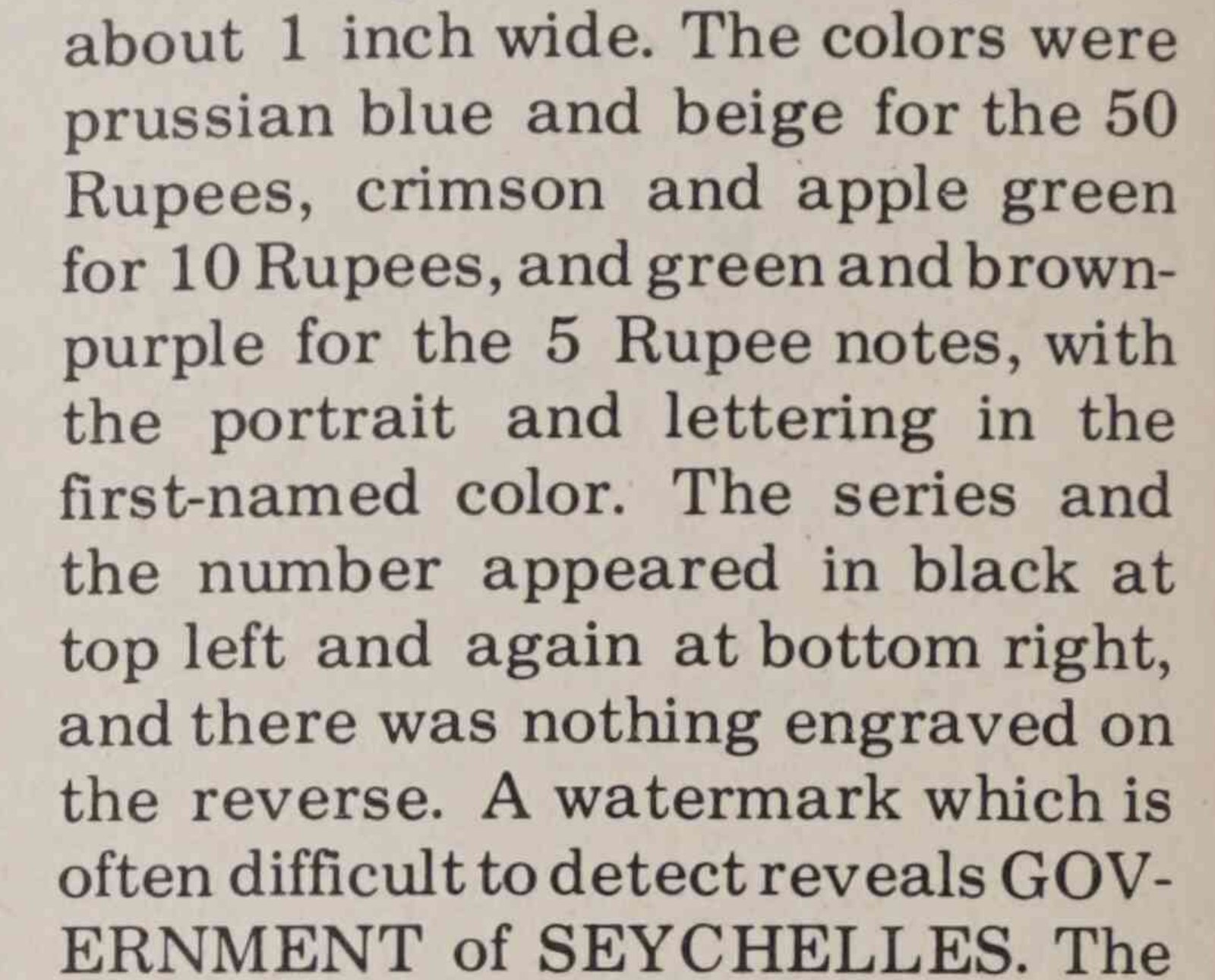
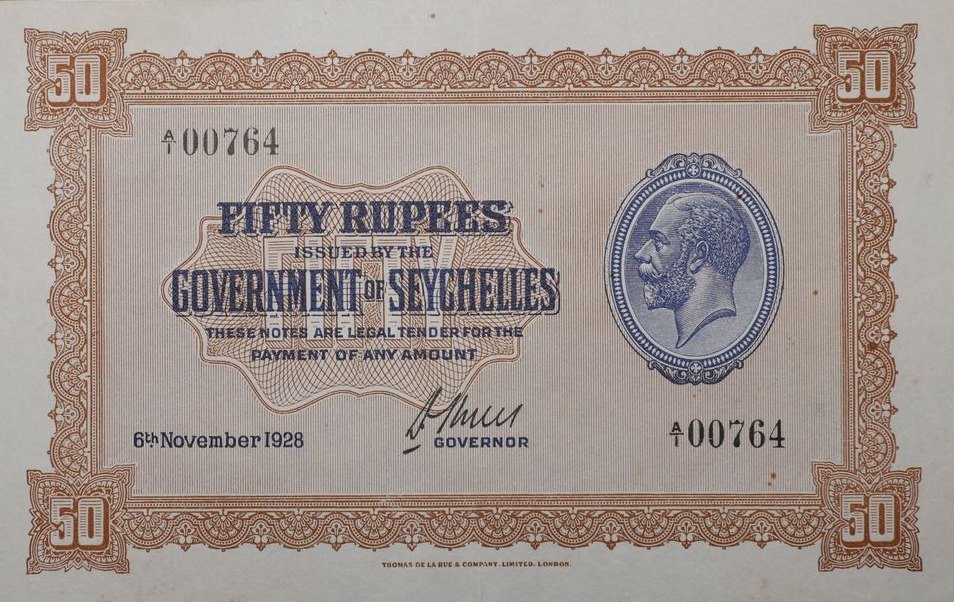
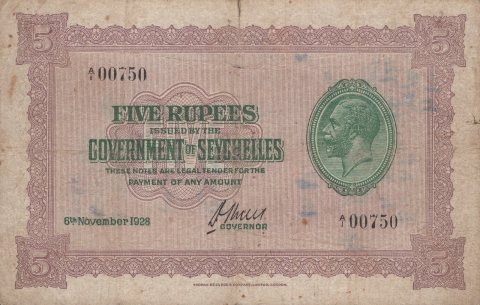
- Harris says the George V notes of 5, 10 and 50 rupees carry a watermark reading GOVERNMENT of SEYCHELLES, often hard to see. The catalogue's pages for the 5 rupees, 10 rupees and 50 rupees list no watermark.
- Harris calls the George V 50 rupees prussian blue and beige. The catalogue's page calls the issued notes orange and blue.
- Harris gives the issue of 1914 as notes of 5 and 10 rupees only. The text of the Ordinance of 1914 bears this out: it allowed those two values and no other.
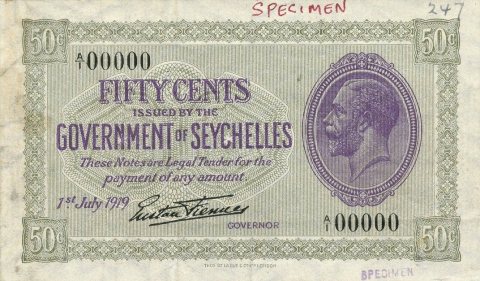
- Harris does not know the De La Rue notes dated 1st July 1919 and calls the numbers below the 1924 and 1928 printings gaps. The Pick pages record notes of 1919 in those numbers.
Bank Note Reporter, 1974 to 1990
July 1974, page 15. The report of the Stanley Gibbons sale of banknotes in London on 24th June 1974 names a Seychelles 50 cents dated 10th November 1919, signed by hand by a Governor whose name the report gives as E. Hines. The catalogue has no signer of that name. Harris read the signature on these notes as "Eustace Fiennes, Bart", and the catalogue places the note on the 50 cents of 10th November 1919.
July 1978. Jerry Remick, "Commonwealth Banknotes: Portraits of Queen Elizabeth", sorts the portraits on the Queen's notes into types. Remick's second type, the young bareheaded Queen facing left, was first issued, Remick says, by the Falkland Islands in 1960 and by the Seychelles in 1954, the year of the 5 rupees, 10 rupees and 50 rupees signed by Addis. Remick adds that after independence the Queen's portrait gave way to that of James R. Mancham, deposed in June 1977. The front page of the same issue pictures a 5 rupees of 1st August 1960 signed by Thorp, whose prefix figure cannot be read with certainty in the print.
June 1983, page 28. Fred Schwan wrote on Mauritius and the Seychelles in the Second World War. Schwan had judged the Seychelles notes of 1942 and 1943 a continuation of the pre-war issue, and so left the Colony out of Schwan's own book, World War II Military Currency. The emergency 5 rupees in the third edition of Pick changed that. Schwan gives Pick's date, "June 2, 1942", the only number then seen, 745, and thought the Governor's signature probably stamped. The catalogue's page for the 5 rupees of 20th June 1942 dates it 20th June and describes a signature written by hand, in red ink on some notes and black on others. Schwan gives the population of the Colony in 1947 as 34,632.
December 1990, pages 30 to 32. A feature by Lance K. Campbell, "Seychelles note series short and interesting", ran from 1914 to the notes of 1989. Several of its statements do not stand:
- It gives four values for 1914, 50 cents, 1, 5 and 10 rupees. The Ordinance of 1914 allowed 5 and 10 rupees only.
- It says the first regular issue was a run of 1 rupee notes printed by De La Rue in 1918. The catalogue's 1 rupee page says plainly that no such date exists: the notes dated 1st July 1919 began at A/1 00001, and the 1918 date listed in Pick and The Banknote Book does not exist.
- It gives two dates for the George VI 1 rupee, 3rd May 1943 and 7th July 1943. No note is pictured, and the catalogue's 1 rupee page has 7th July 1943 alone.
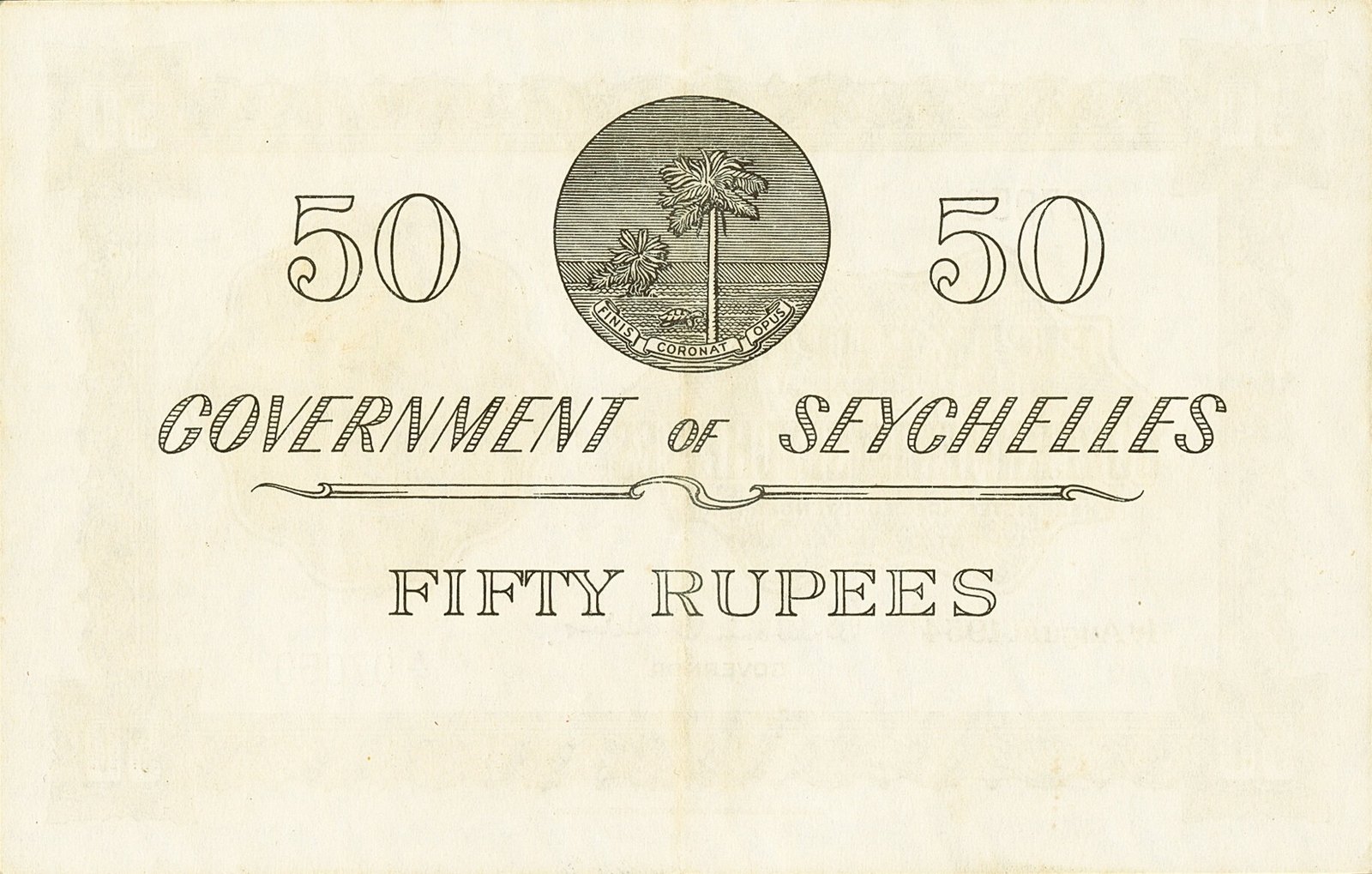
- It describes the back of the 1954 notes as a plain inscription, "Government of the Seychelles". The catalogue's pages describe palm trees and a tortoise.
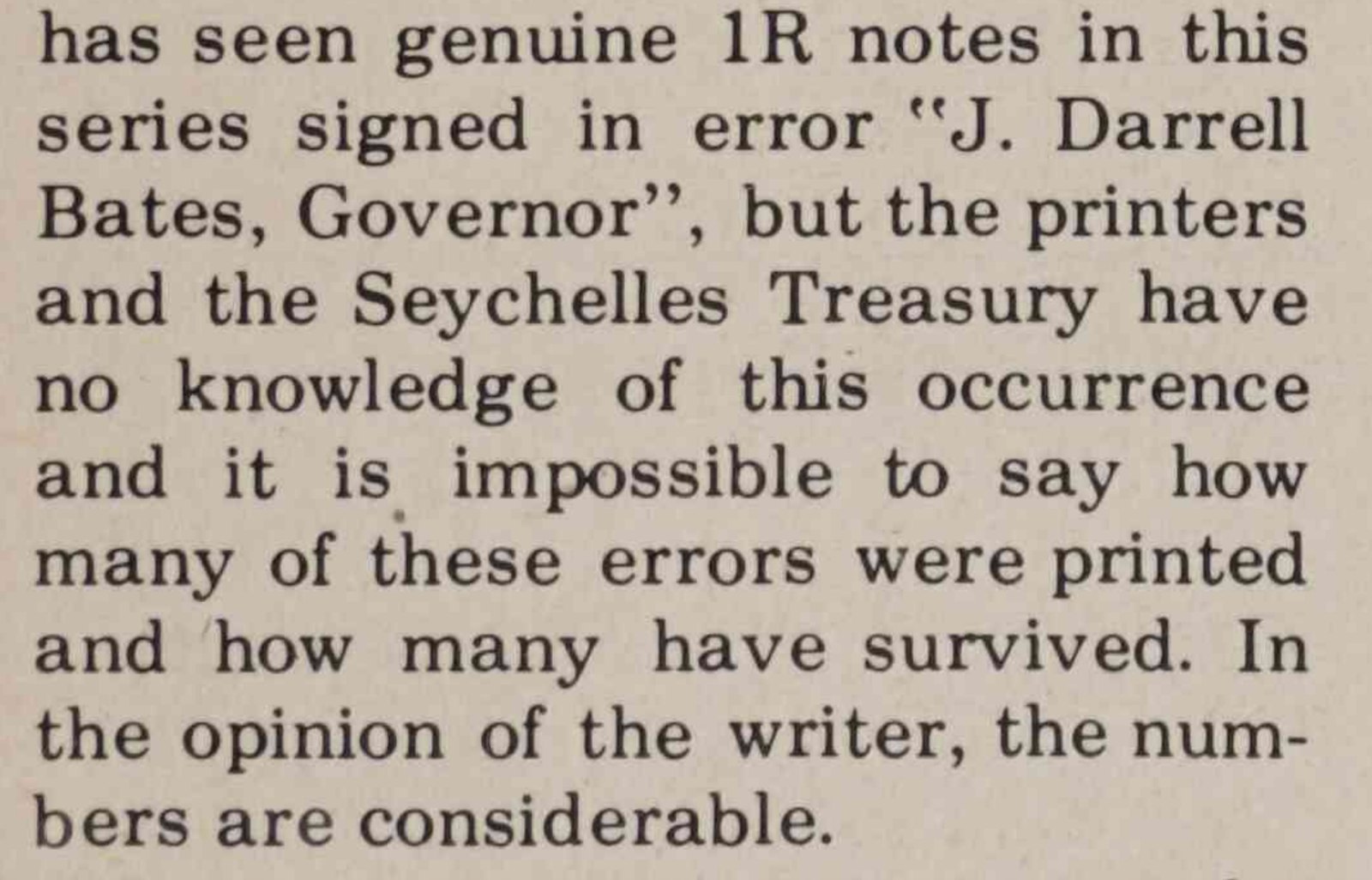
- It explains the two titles under the signature of Bates on the notes of 6th January 1951 by the politics of the time, the vote given in 1948 to some 2,000 male property owners. Harris had called the notes with GOVERNOR an error of which the printers and the Seychelles Treasury knew nothing.
Bank Note Reporter, 1996 to 2013
October 1996. Alan Herbert's Bank Note Clinic answered a reader's question on the "sex" note and pictured a 50 rupees of 1st August 1973; the same note was pictured again by Herbert in January 2002.
March 2001. Joe Shead's market report, "World paper money market sizzles", pictured a 50 rupees of 1st August 1954 signed by Addis as an example.
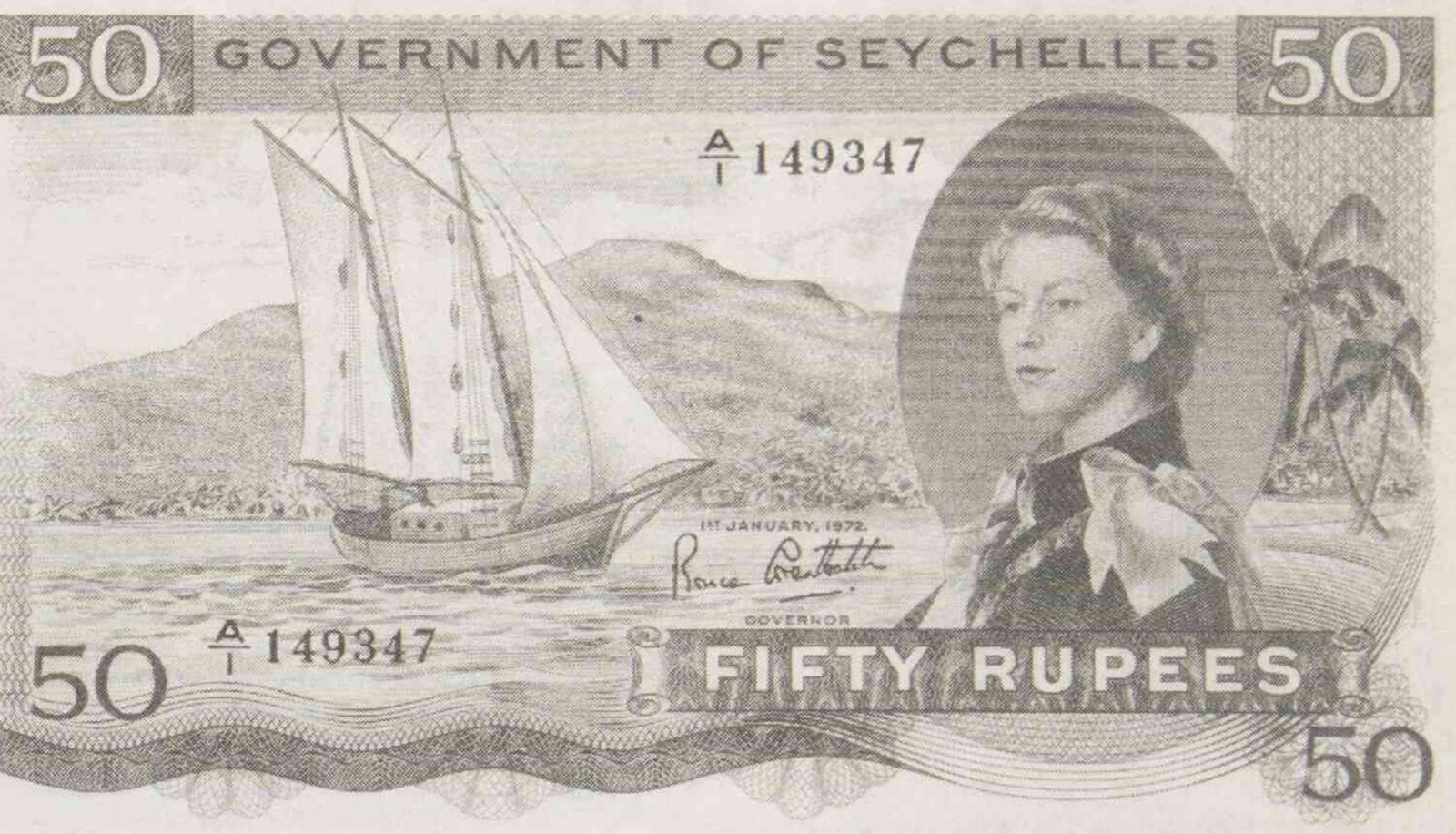
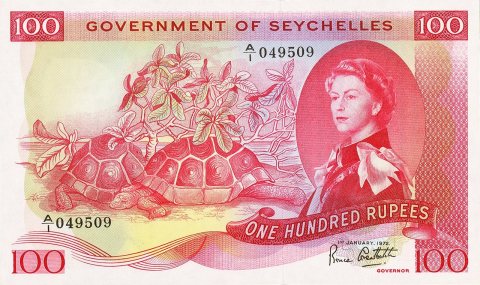
October 2002, page 62. Peter Symes, "'Dribbling King' among many world errors", pictured a 50 rupees of 1st January 1972 and wrote that the note was never issued with a modified design.
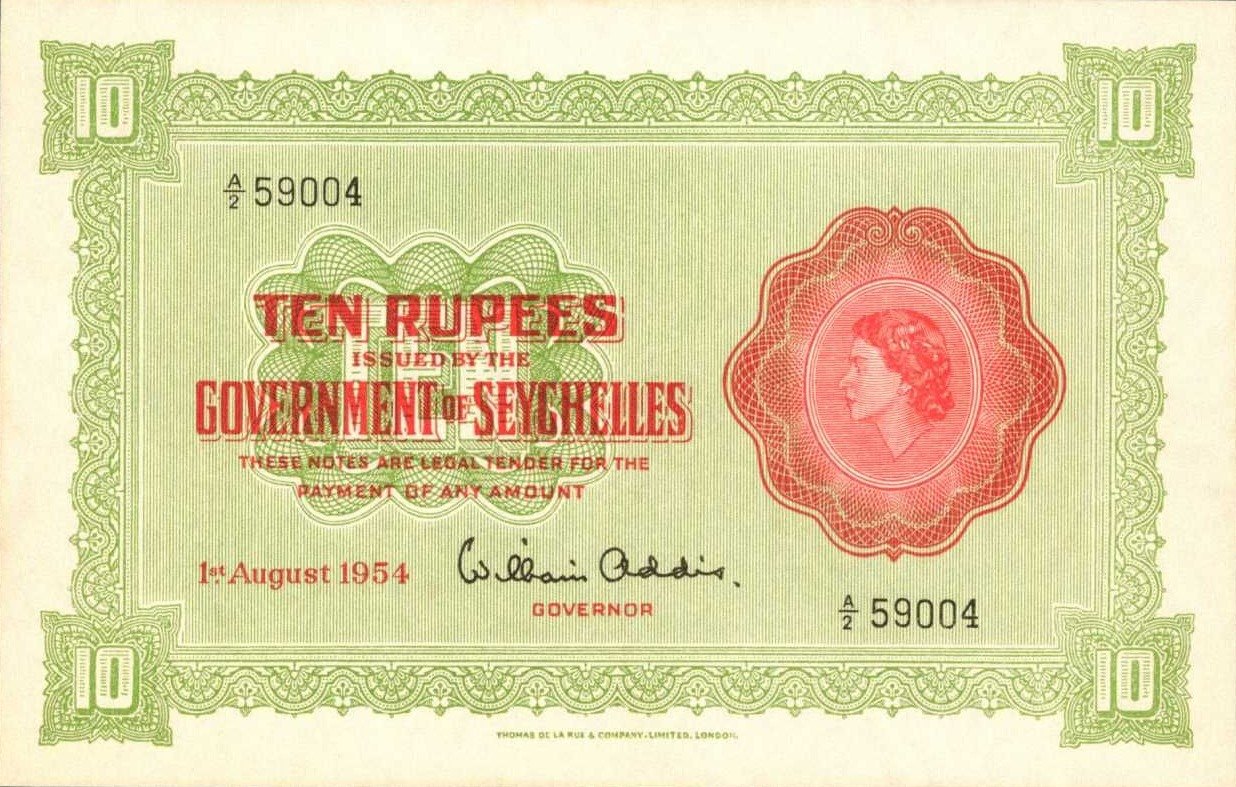
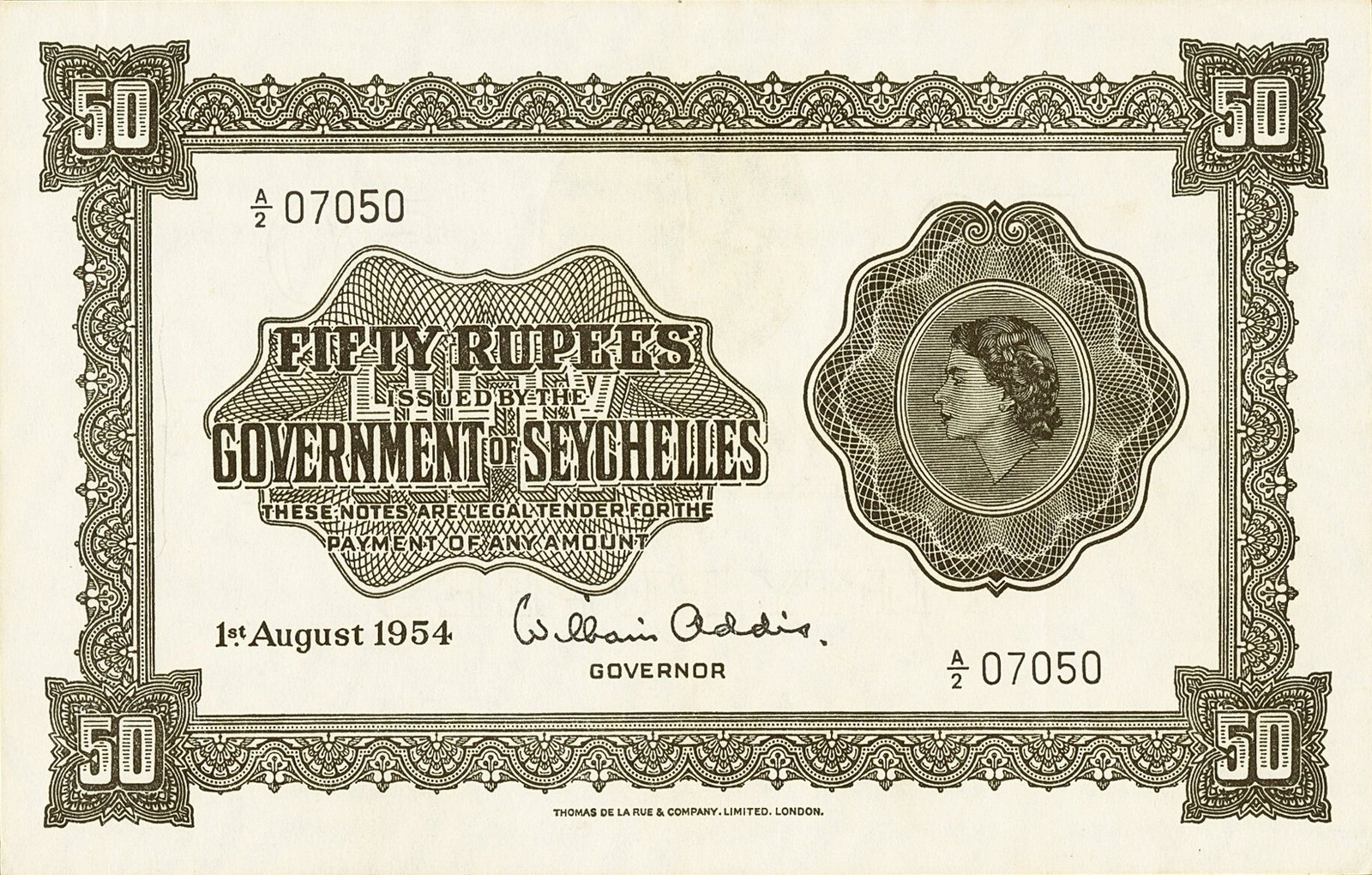
March 2013, page 106. Kerry Rodgers, "Spink UK April sale taking shape", previewed Spink's sale of 10th to 11th April 2013. Two notes of 1st August 1954, a 10 rupees and a 50 rupees, each numbered A/2 00001 and signed by Sir William Addis, had been put up for sale by the signer's family, and neither had been on the market before. Spink sold them as lots 1268 and 1269 on 10th April 2013.
June 2013. The report "Sleepers come to fore in AIA sale" says that Archives International Auctions sold, on 16th April 2013, the 10 rupees of 1st January 1967 that is pictured in the Standard Catalog of World Paper Money. The report gives no number, so the note cannot yet be tied to one on the catalogue's 10 rupees page.
The IBNS Journal, 1995 to 2017
Volume 34 number 1, 1995. Colin Narbeth sent the editor an artist's drawing of the 50 rupees, obtained, the letter says, from an engraver at the printers, in which the palm trees spell nothing. The letter, which names the artist as "Mary Ha wood" and the Bradbury Wilkinson designer as "Brain Fox", says: "It was not the lady artist's fault!" A note captioned as a specimen version of the issued design was pictured beside it.
Volume 44 number 2, 2005. Peter Symes's survey of the Queen's portraits on banknotes says the notes of 1954 to 1967 use a 1952 profile photograph by Dorothy Wilding, chosen to keep the De La Rue design that had carried the profiles of George V and George VI, and that the Seychelles and Fiji were the last to take up the Bradbury Wilkinson version of Pietro Annigoni's portrait, in 1968.
Volume 52 number 4, 2013. A letter from Simon Biddlestone asks how many signers appear on the notes of two countries, and gives Hugh Selby Norman-Walker as one: on a Southern Rhodesia note of 1955 and on the Seychelles notes of 1968. The letter gives Norman-Walker's career: the Colonial Office from 1949, Nyasaland, then Bechuanaland until it became Botswana, Governor and Commander-in-Chief of the Seychelles from 1967, later Colonial Secretary in Hong Kong. Norman-Walker died in 1985, aged 68. It pictures a 10 rupees of 1968.
Volume 55 number 4, 2016. Richard Scott Morel, curator of the British Library's philatelic collections, described the paper money in the Crown Agents' Philatelic and Security Printing Archive. The archive holds five photocopies of the original sketches for the 5, 10, 20, 50 and 100 rupees of 1968; Scott Morel pictured Mary Hayward's sketch of the 50 rupees and wrote that it was well known that the engraver Brian Fox had altered the design.
Volume 56 number 4, 2017, pages 38 to 41. Jaime Sanz, writing on "Sex" and "Hate" in the Seychelles notes of 1968, cites the Central Bank of Seychelles book on the history of paper currency in the islands for the two artists, Wendy Day Veevers-Carter and Mary Hayward. Sanz found no evidence that Fox made the change, and used Bradbury Wilkinson photographic proofs of 7th September 1966 and 25th February 1967 to show the 10 rupees coral and the 100 rupees branches changing between the two. Those readings are told in The Seychelles notes of 1968 to 1975.
Anil R. Bohora, Banknote Stories, 2025
Anil R. Bohora's book Banknote Stories, published by the author at Nashik in 2025, gives the notes of 1968 pages 13 and 14 of a chapter on hidden messages. Bohora reads SCUM in the coral at the lower left of the 10 rupees, under the turtle's flipper, POOP in the branches in front of the bird's tail on the 20 rupees, and SEX in the palm leaves behind the Queen's head on the 50 rupees. The book pictures one note of each value from Bohora's own collection, all three with the same low number.
Three of its statements can be set against what was already in print.
- Bohora writes that the 5 and 100 rupees may also hold words, not yet found. Sanz had written on "Sex" and "Hate" in these notes in 2017 and shown the branches of the 100 rupees changing between two proofs.
- Bohora calls how, why and when the words came to be there a mystery for which nobody has taken responsibility, and gives as a commonly accepted possibility that an opponent of British rule who supported the independence movement added them as an insult to the Crown. No source is given. Narbeth in 1995 and Scott Morel in 2016 had placed the change at the printers, and the catalogue's page for the 50 rupees says the artists' design was altered at Bradbury Wilkinson about January 1967.
- The book names Bradbury Wilkinson as designer and printer, and neither of the two artists.
What has held and what has not
| Statement | Who, and where | How it stands |
|---|---|---|
| The issue of 1914 was of 5 and 10 rupees only | Harris, 1969 | Agrees with Ordinance No. 14 of 1914 |
| There were four values in 1914 | Campbell, Bank Note Reporter, December 1990 | The Ordinance allowed two |
| The first De La Rue 1 rupee was of 1924 | Harris, 1969 | The Pick pages record notes of 1st July 1919 |
| A 1 rupee was printed in 1918 | Campbell, 1990 | The catalogue's page says the date does not exist |
| A George VI 1 rupee is dated 3rd May 1943 | Campbell, 1990 | No such note pictured; the catalogue has 7th July 1943 |
| The local 5 rupees is dated 2nd June 1942 | Pick, third edition, as Schwan gives it, 1983 | The catalogue has 20th June 1942 |
| Its signature is probably stamped | Schwan, 1983 | The catalogue describes an ink signature, red or black |
| The 1954 backs carry only an inscription | Campbell, 1990 | The catalogue describes palm trees and a tortoise |
| The George V high values have a watermark | Harris, 1969 | The catalogue lists none; not settled |
| Brian Fox put the word in the palms | Narbeth, 1995; Scott Morel, 2016 | Sanz, 2017, found no evidence; the catalogue's page says some sources name Fox |
| The words were put in by a supporter of independence | Bohora, Banknote Stories, 2025, as a possibility | No source given; Narbeth, 1995, Scott Morel, 2016, and the catalogue's page place the change at the printers |
Sources
- Leslie W. Harris, "Paper Money of Seychelles", Coins: The Magazine of Coin Collecting, volume 16 number 2, February 1969, pages 40 to 44.
- Bank Note Reporter: July 1974, page 15 (the Stanley Gibbons sale of 24th June 1974); July 1978 (Jerry Remick, "Commonwealth Banknotes: Portraits of Queen Elizabeth", and the front page); June 1983, page 28 (Fred Schwan); December 1990, pages 30 to 32 (Lance K. Campbell, "Seychelles note series short and interesting"); October 1996 and January 2002 (Alan Herbert, Bank Note Clinic); March 2001 (Joe Shead, "World paper money market sizzles"); October 2002, page 62 (Peter Symes, "'Dribbling King' among many world errors"); March 2013, page 106 (Kerry Rodgers, "Spink UK April sale taking shape"); June 2013 ("Sleepers come to fore in AIA sale").
- International Bank Note Society Journal: volume 34 number 1, 1995 (letter of Colin Narbeth); volume 44 number 2, 2005 (Peter Symes on the Queen's portraits); volume 52 number 4, 2013 (letter of Simon Biddlestone); volume 55 number 4, 2016 (Richard Scott Morel, "World Paper Money Resources at the British Library"); volume 56 number 4, 2017, pages 38 to 41 (Jaime Sanz).
- Anil R. Bohora, Banknote Stories, published by the author, Nashik, 2025, pages 13 and 14.
- Seychelles Ordinance No. 14 of 1914, in the Johns Hopkins archive of currency boards.
- Spink, 10th April 2013, lots 1268 and 1269.
- The Pick pages of the Seychelles in this catalogue.
Member comments
Log in or register to post a comment.