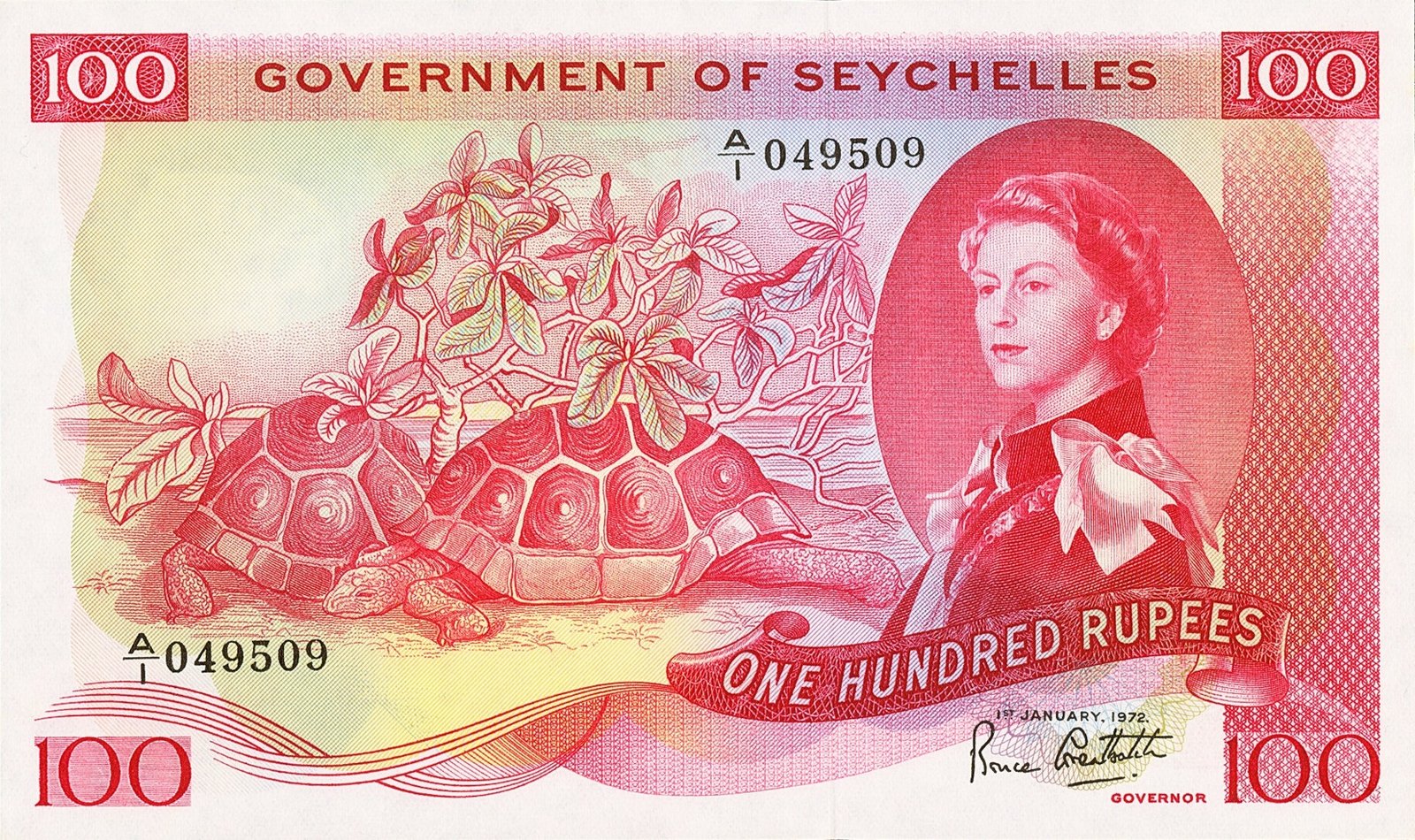
On 22 July 1968 the Government of Seychelles issued five new notes, printed by Bradbury Wilkinson, with the plants and animals of the islands beside Pietro Annigoni's 1956 portrait of Queen Elizabeth II. This article puts together what the five Pick pages say, what Leslie Harris wrote of the coming notes in Coins magazine in February 1969, and what the auction houses have written about the notes and the printer's archive pieces. A house's statement is given as that house's statement.
The five notes
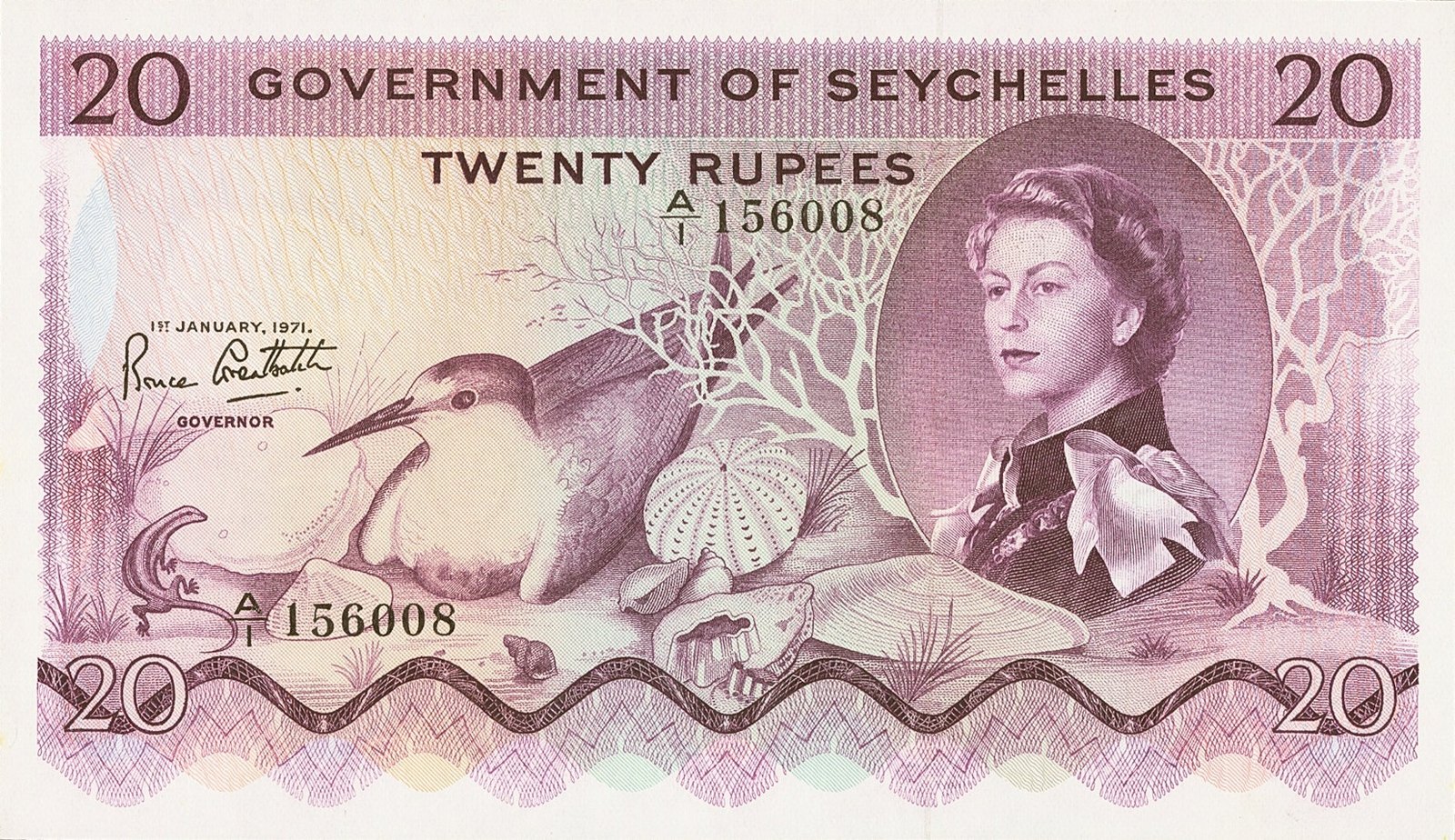
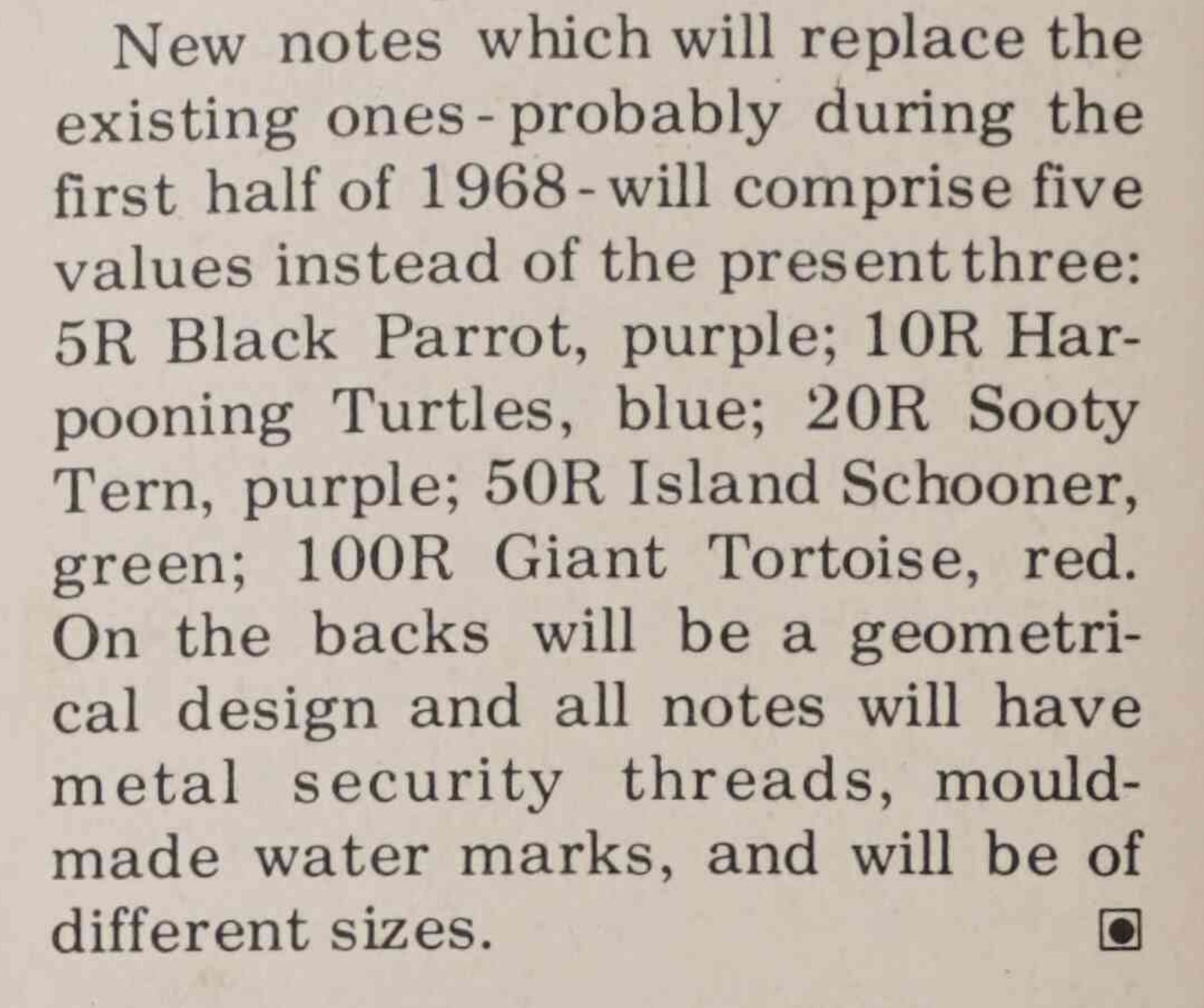
The designs were drawn by two residents of the islands, Wendy Day Veevers-Carter and Mary Hayward. Harris, writing before the issue, expected the new notes in the first half of 1968 and listed five values in place of the three then in use, each with its subject and colour:
| Value | Subject and colour (Harris) | Size on the Pick page |
|---|---|---|
| 5 rupees | Black parrot, purple | 134 x 70 mm |
| 10 rupees | Harpooning turtles, blue | 147 x 83 mm |
| 20 rupees | Sooty tern, purple | 154 x 89 mm |
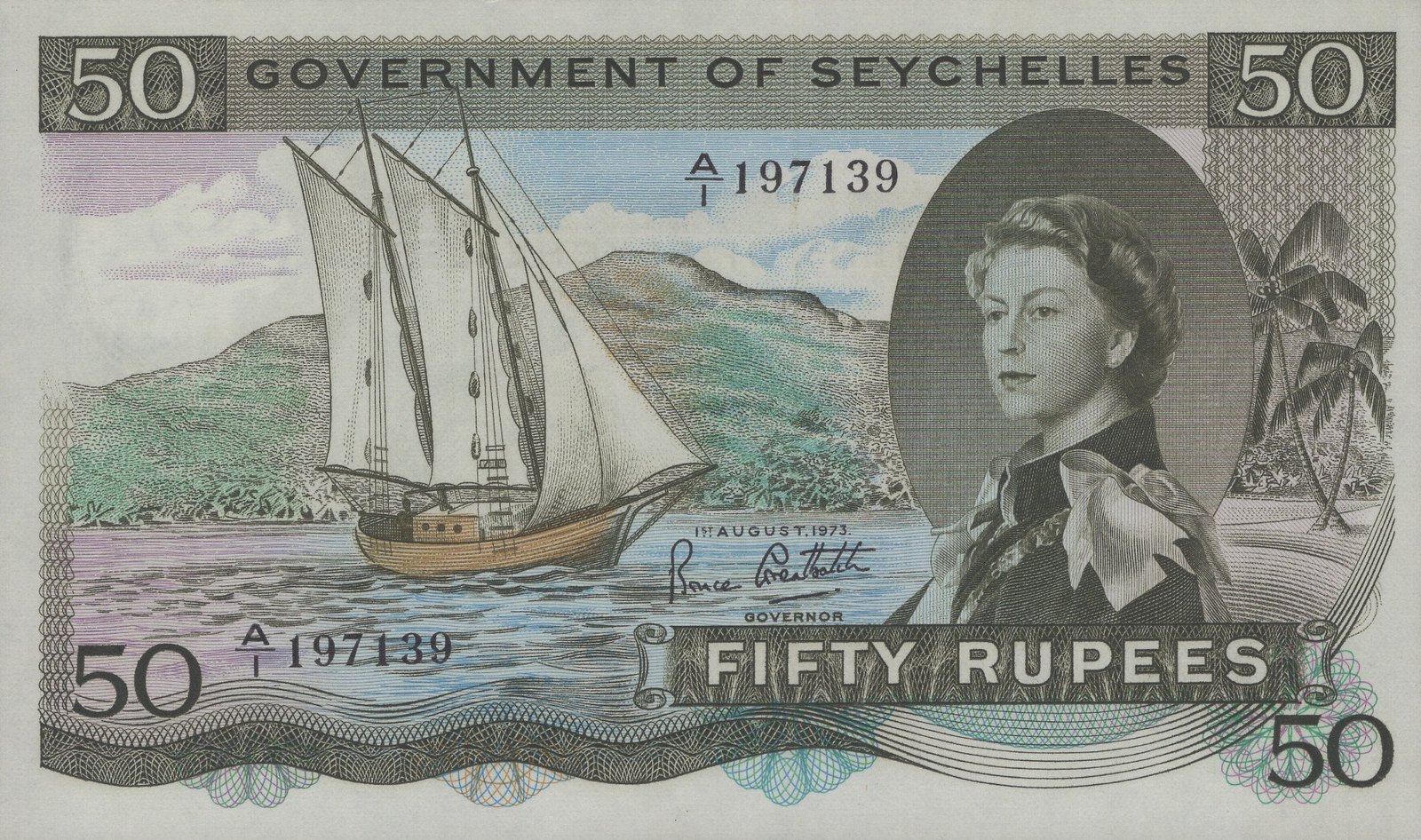
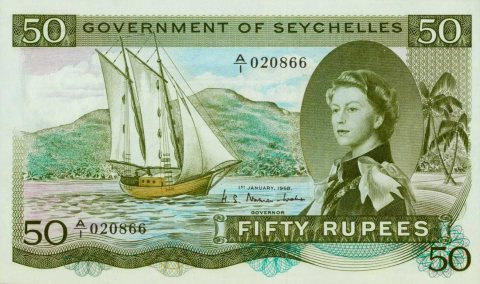
| 50 rupees | Island schooner, green | 156 x 92 mm |
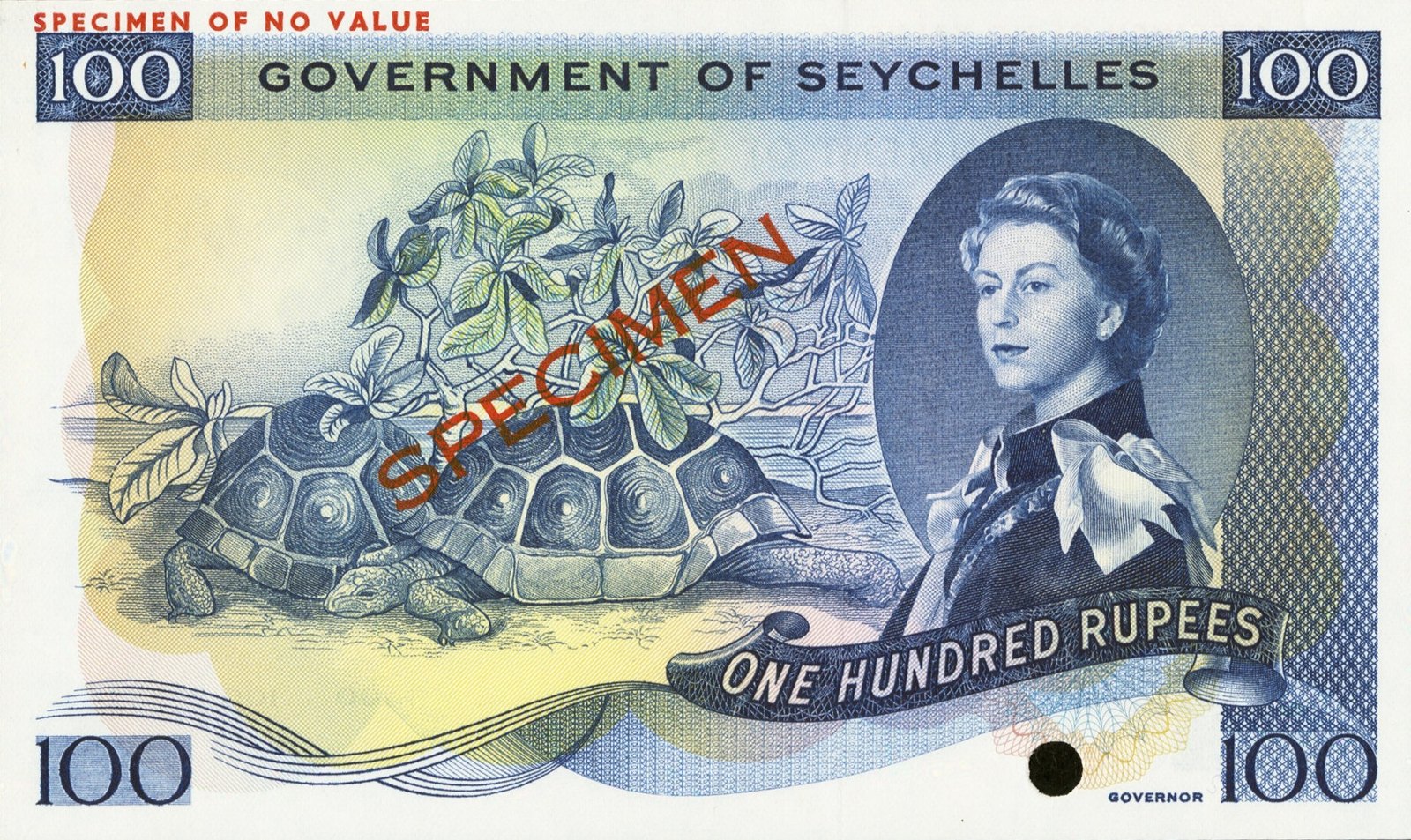
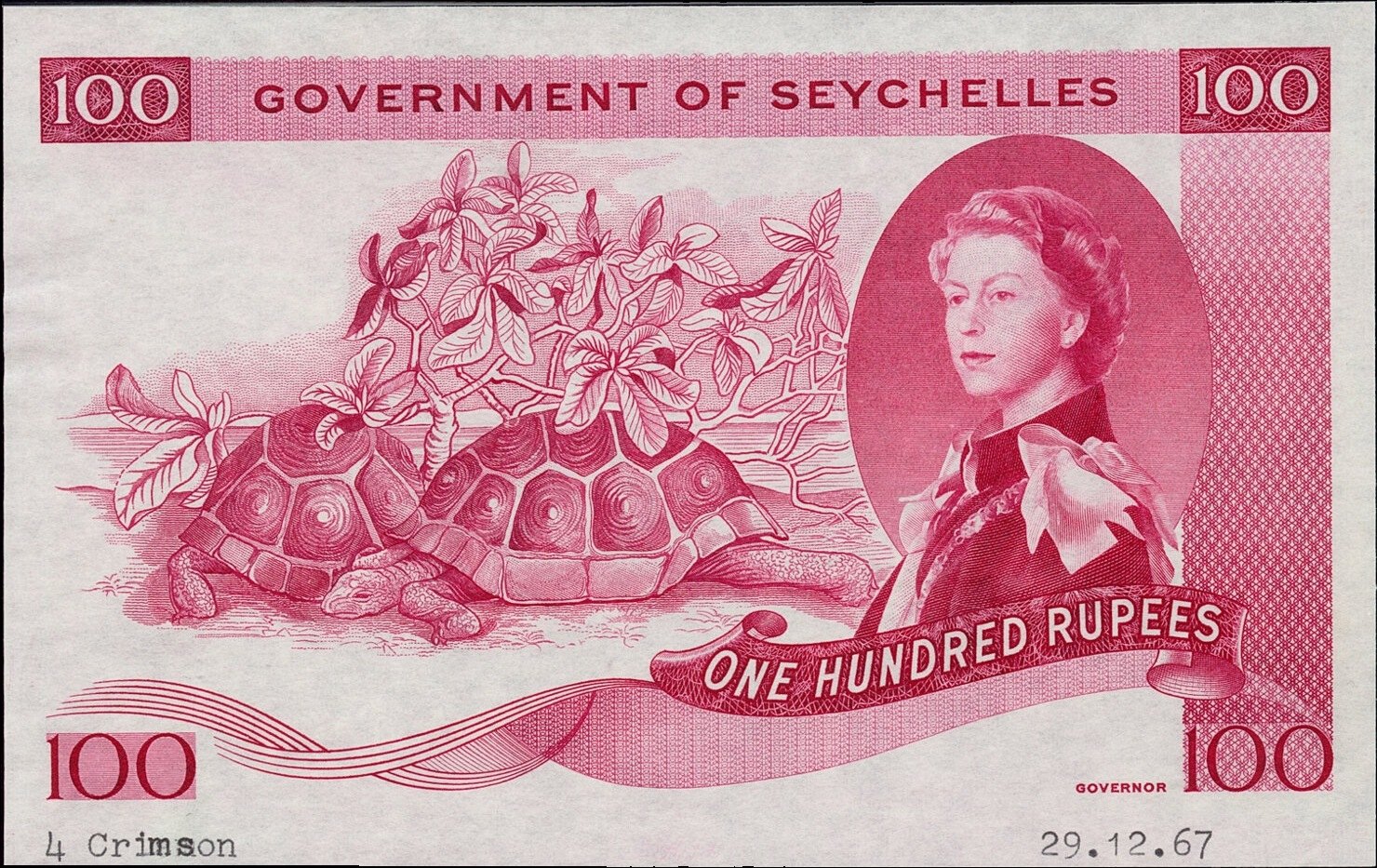
| 100 rupees | Giant tortoise, red | 160 x 95 mm |
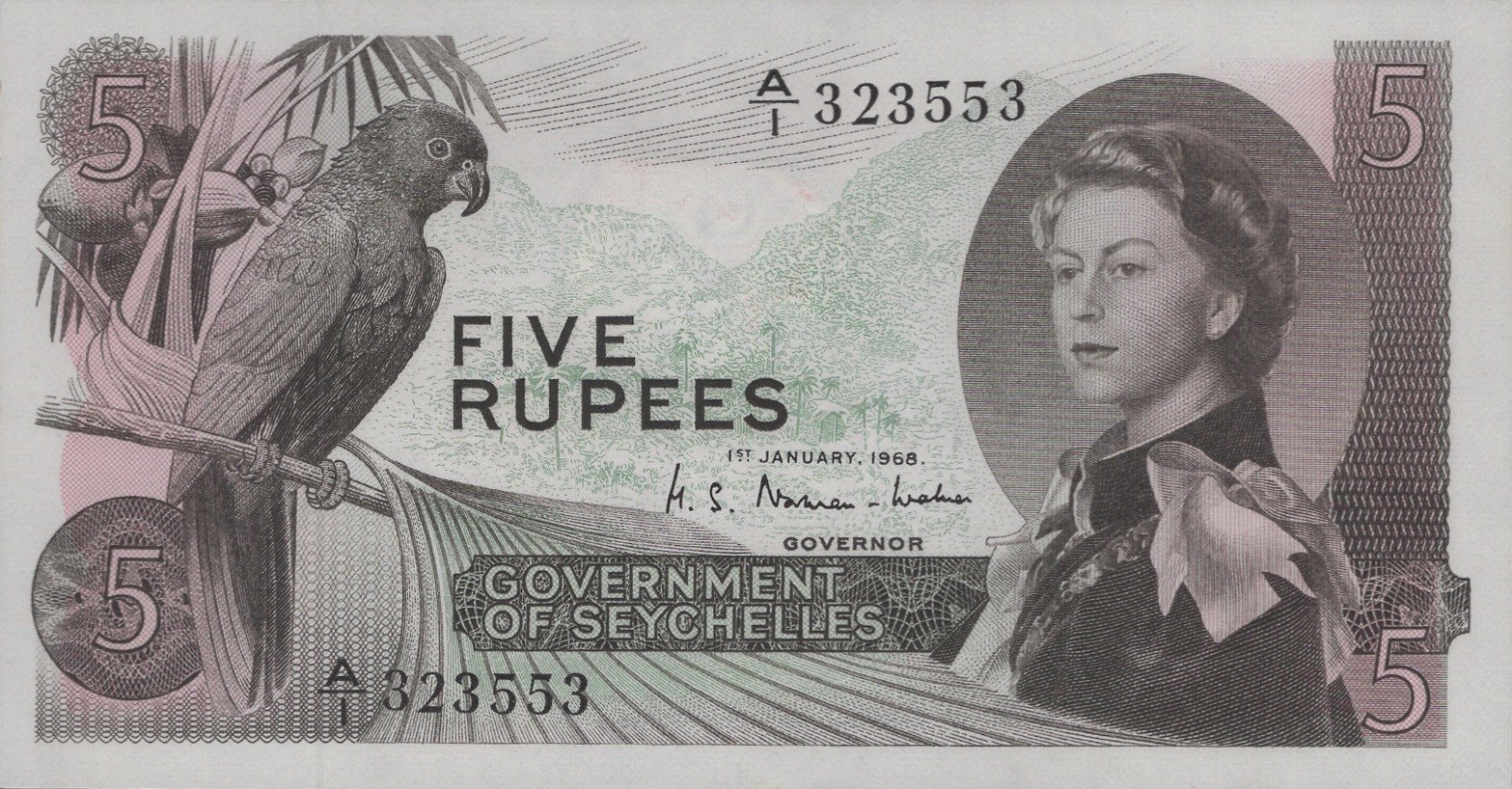
Harris added that the backs would carry a geometrical design and that all the notes would have metal security threads and mould-made watermarks and be of different sizes. Heritage Auctions (10 January 2019, lot 28852) describes the 100 rupees as showing two giant tortoises and a veloutye shrub, with a black parrot's head as the watermark.
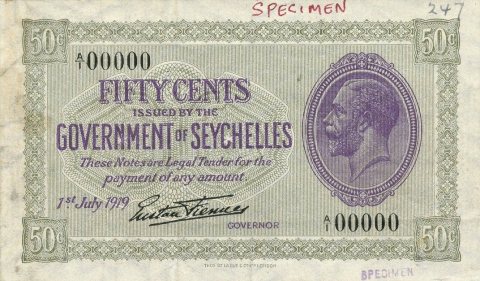
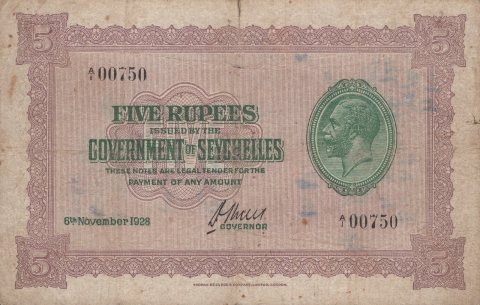
The 20 rupees and the 100 rupees were new values. The notes they replaced, the Queen Elizabeth II issue of 1954 to 1967, are covered in The paper money of the Seychelles, 1914 to 1975. Stack's Bowers (2 October 2024, lot 20767) says the last of them, the 50 rupees dated 1st January 1967, was in circulation for less than a year.
The printings and their blocks of numbers
Every note of the issue has the serial prefix A/1. Each printing has its own date, its own Governor's signature and its own block of numbers, and the blocks follow one another without a break. The Pick pages give them:
| Value | Printings | Numbers |
|---|---|---|
| 5 rupees | 1st January 1968, Norman-Walker | A/1 000001 to A/1 388782 |
| 10 rupees | 1st January 1968, Norman-Walker; 1st January 1974, Allan | A/1 000001 to A/1 350000; A/1 350001 to A/1 450000 |
| 20 rupees | 1st January 1968, Norman-Walker; 1st January 1971, Greatbatch; 1st January 1974, Allan | A/1 000001 to A/1 150000; A/1 150001 to A/1 250000; A/1 250001 to A/1 350000 |
| 50 rupees | 1968 and 1969, Norman-Walker; 1970, 1972 and 1973, Greatbatch | five blocks, A/1 000001 to A/1 210000 in all |
| 100 rupees | 1968 and 1969, Norman-Walker; 1972 and 1973, Greatbatch; 1975, Allan | five blocks, A/1 000001 to A/1 100000 in all |
The blocks are known from printer's specimens that show the first and last numbers of a printing. Such a specimen exists for the 20 rupees of 1971, for the 50 rupees of 1969, 1970 and 1973, and for every printing of the 100 rupees. None is recorded for the 50 rupees of 1968 or 1972, whose blocks follow from the ones on either side. One 5 rupees sold by Stack's Bowers in January 2025 has a number above the block given for that value; the Pick page records it and does not explain it.
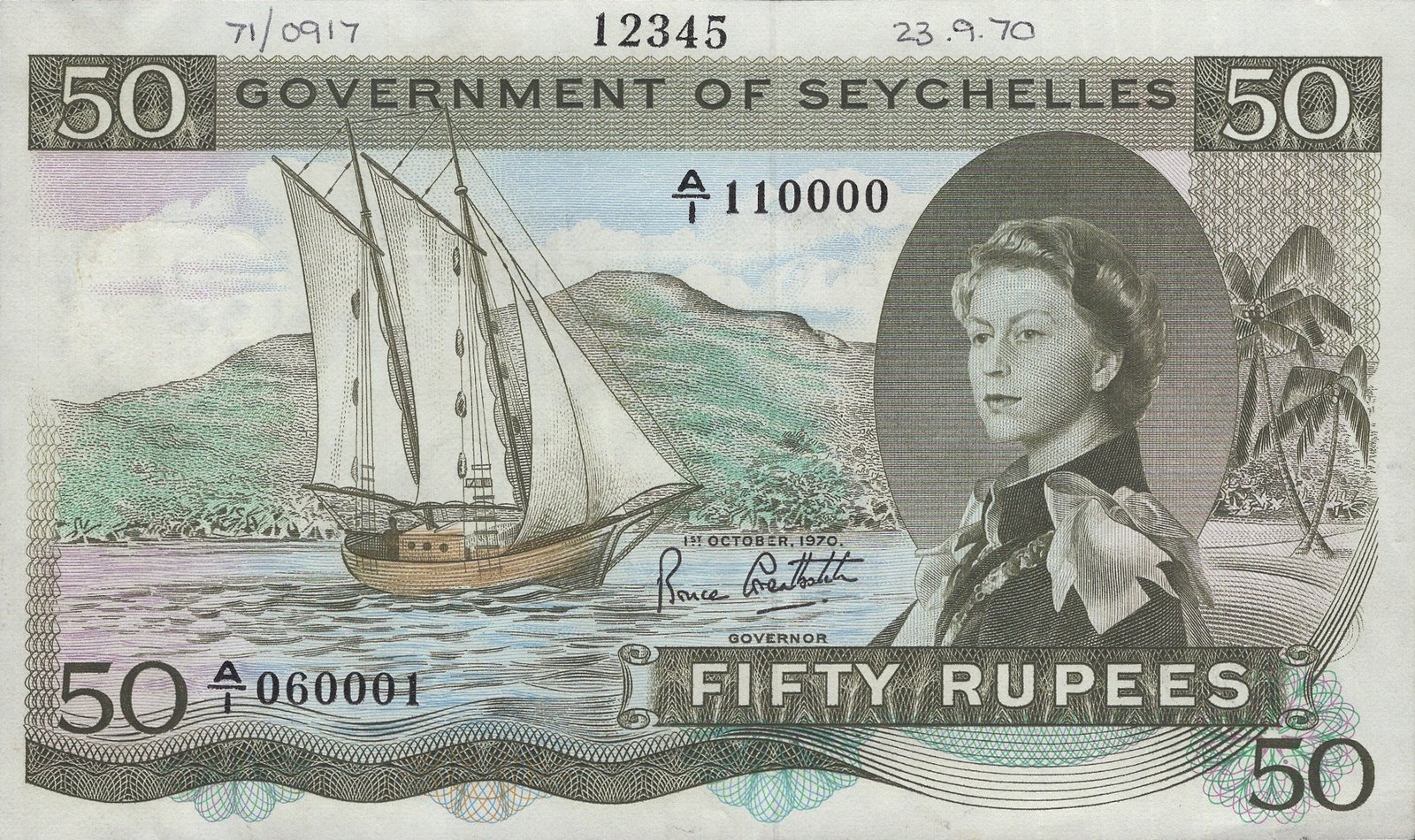
Noonans (16 April 2019, lot 1482) and Spink (27 August 2021, lot 878) say that only one range specimen was made for the 50 rupees of 1970. Both sold the same piece, which has 71/0917 and 23.9.70 written in the top margin.
The houses draw the same conclusion from the 100 rupees. Heritage (13 January 2022, lot 28391, and 10 November 2023, lots 24603 and 24604) and Stack's Bowers (2 October 2025, lot 50392) say that only 100,000 notes were made over the five dates, Stack's adding that the figure rests on the numbers seen on the last date. Heritage (21 January 2021, lot 28479), describing a specimen of the 1968 printing with a handwritten date earlier than the issue, says it appears that only 15,000 notes were to be issued with the 1968 date.
A signature that was replaced
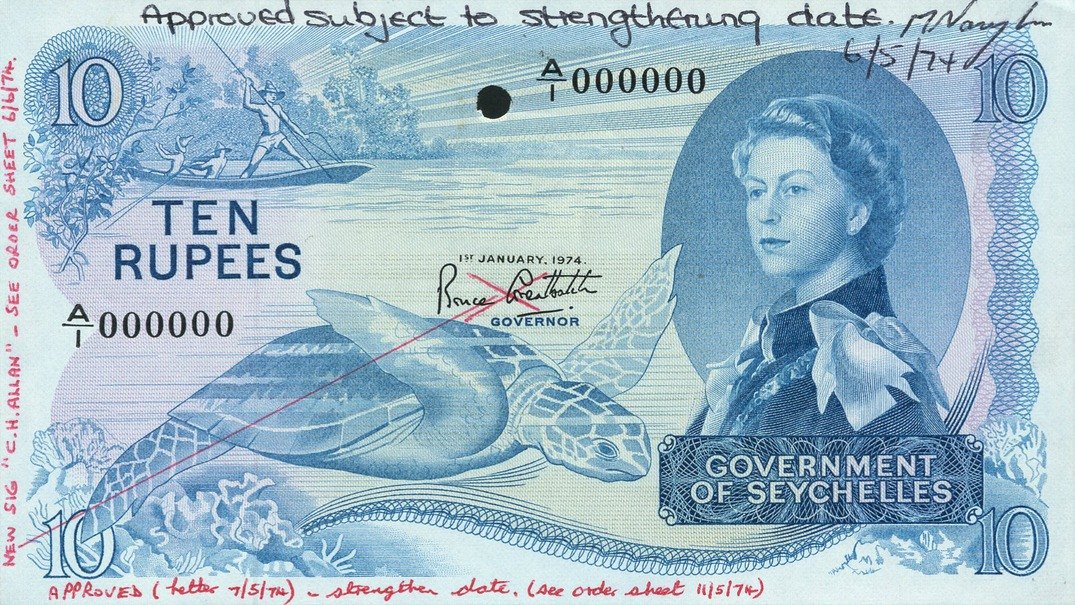
No issued 10 rupees with Greatbatch's signature is recorded. The Pick page explains why Greatbatch is nevertheless among the signers of that value: a specimen of the 1974 printing carries the printed signature of Greatbatch struck out in red and marked for the new signature of Allan.
Spink (12 April 2016, lot 1877) offered a like piece of the 20 rupees: a specimen proof dated 1 January 1974 with the signature of Greatbatch, which Spink calls incorrect, and with the changes to the date and the signature written in the margins. The same lot held a 20 rupees proof without numbers or signatures and with the ink date 31.3.71.
The words
Four of the five notes have a nickname among collectors, each from a word that some read in the drawing.
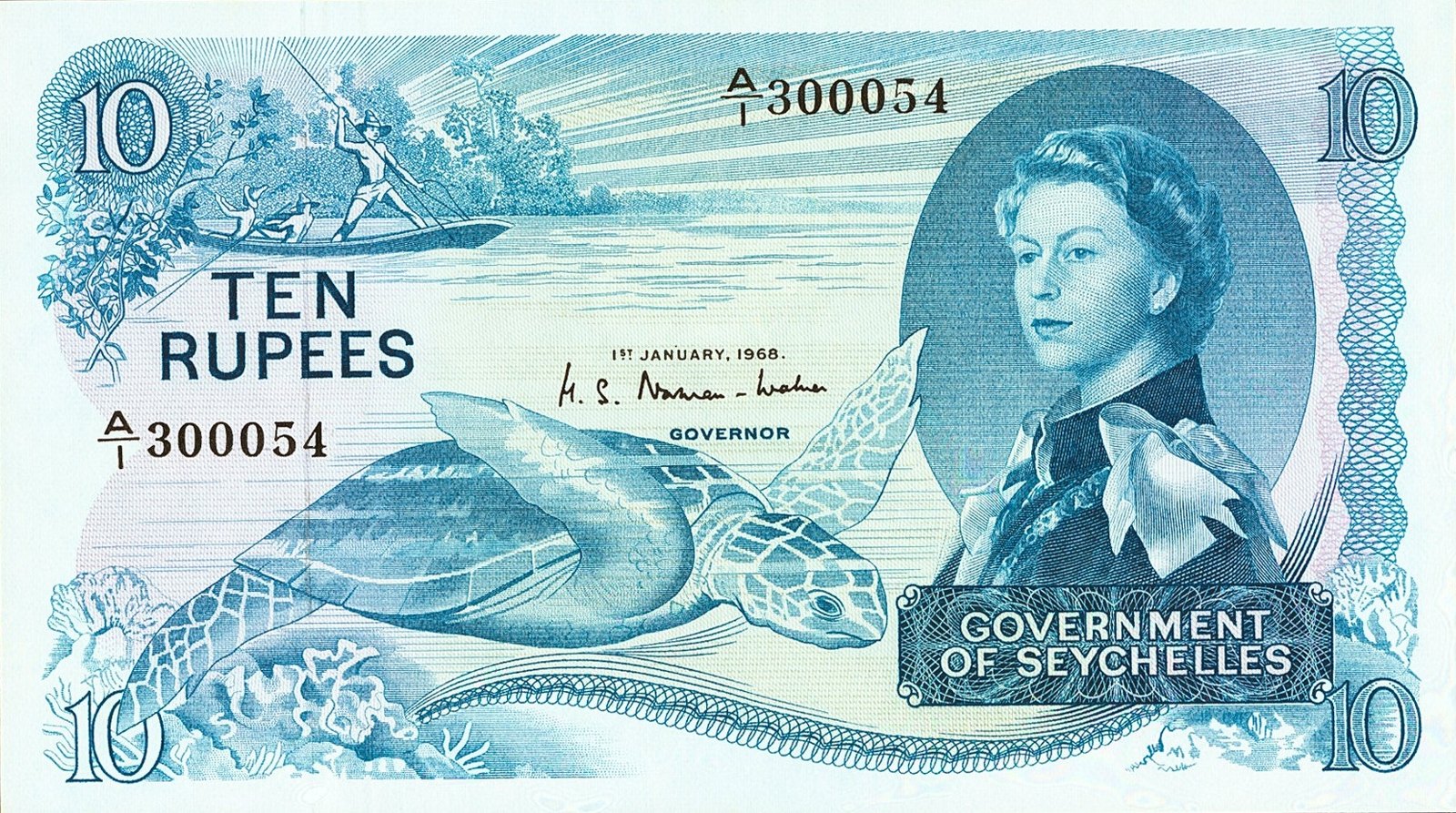
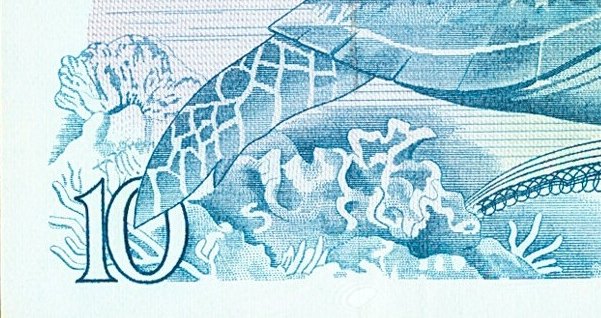
10 rupees. The coral at the lower left of the front appears to spell SCUM.
20 rupees. The coral above the tail at the centre of the front appears to spell POOP. Heritage (10 November 2023, lot 24597) calls this a recent discovery and places the letters in the coral branches to the left of the portrait, under the A/1 prefix.
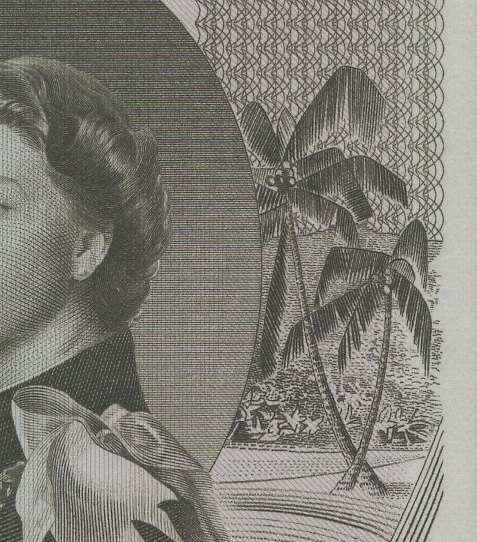
50 rupees. The fronds of the palm tree at the right of the front appear to spell SEX when the note is turned a quarter turn to the left. The Pick page says the original design by the two artists was altered at Bradbury Wilkinson about January 1967, and that some sources name the designer Brian Fox. Heritage (14 January 2019, lot 29468) is one that names Fox.
100 rupees. Sources mention that the branches above the larger tortoise were changed between the designs of 7th September 1966 and 25th February 1967: a branch was added above the tortoise, and the one near the portrait was lengthened and crossed. Some read the changed branches as the word HATE. Stack's Bowers reads another word. In its sale of 13 January 2024 (lot 60447) the house said it had found LOVE in the branches just to the left of the Queen, and in later sales it places the word above what it calls the turtles (2 October 2024, lot 20774; 2 October 2025, lot 50392). Spink (8 October 2024, lot 415) also uses the name.
5 rupees. No word has been reported. Stack's Bowers said so in the same description of 13 January 2024.
No source read here says that any of the words was meant, apart from the statement about the 50 rupees given above, and none quotes the printer, the artists or the government on the matter.
Proofs, colour trial specimens and photographs
The Pick pages list progressive proofs of all five values, dated to 1967, and archival photographs of the designs. The auction descriptions add these details:
- 5 rupees. Spink (12 April 2016, lot 1873) offered four pieces together: a progressive proof with only the mountains and the underprint on the front, a finished proof without signatures, a specimen dated 1 January 1968, and a colour trial specimen in blue-green and pink. The first three have the ink date 29.6.67 in the top margin.
- 20 rupees. Spink (12 April 2016, lot 1877) describes the colour trial specimen as red and the two proofs in the same lot as purple.
- 50 rupees. Stack's Bowers (2 October 2024, lot 20768) describes the colour trial specimen as a much lighter green than the issued note.
- 100 rupees. Heritage (25 April 2019, lot 28407, and 8 December 2023, lot 22387) describes the colour trial specimen as printed in blue where the issued note is red. Heritage also offered a pair of front and back progressive proofs (8 December 2023, lot 22388).
- Photographs. Special Auction Services (24 October 2023, lot 286) offered Bradbury Wilkinson photographs of the front designs of the 10, 20, 50 and 100 rupees. The house says the lighter prints show earlier hand-drawn versions, cut from larger sheets with notes still around them, and the darker prints show later essays.
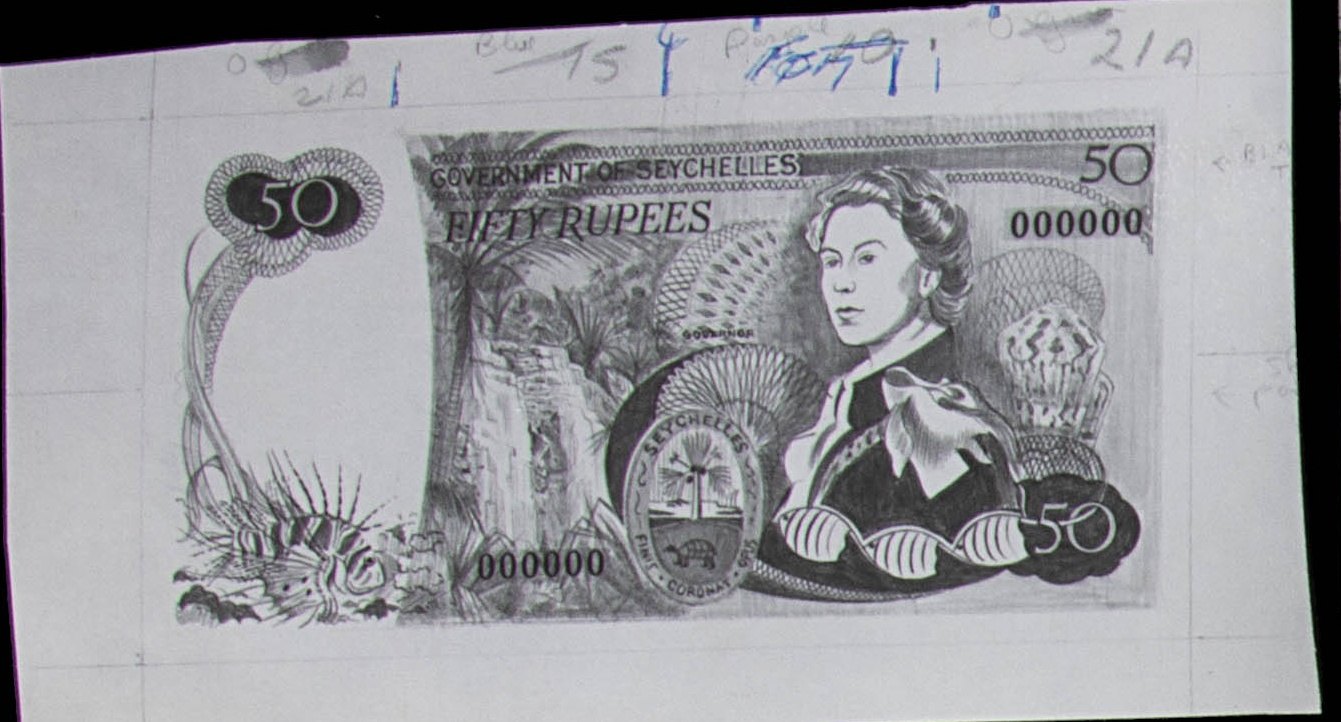
The Seychelles designs of 1965 in the archive are described in Animals that never made it: tigers, toucans and a flying fish in the design archive.
Withdrawal
The 5 rupees was withdrawn in 1972. The Pick pages give 1st October 1980 as the day of withdrawal for the 10, 20, 50 and 100 rupees. They name no source for either date.
Sources
- The Pick pages of the five notes in this catalogue.
- Leslie Harris, "Paper Money of Seychelles", Coins: The Magazine of Coin Collecting, volume 16 number 2, February 1969, page 44.
- Heritage Auctions: 10 January 2019, lot 28852; 14 January 2019, lot 29468; 25 April 2019, lot 28407; 21 January 2021, lot 28479; 13 January 2022, lot 28391; 10 November 2023, lots 24597, 24603 and 24604; 8 December 2023, lots 22387 and 22388.
- Stack's Bowers: 13 January 2024, lot 60447; 2 October 2024, lots 20767, 20768 and 20774; 2 October 2025, lot 50392.
- Spink: 12 April 2016, lots 1873 and 1877; 27 August 2021, lot 878; 8 October 2024, lot 415.
- Noonans, 16 April 2019, lot 1482.
- Special Auction Services, 24 October 2023, lot 286.
Member comments
Log in or register to post a comment.