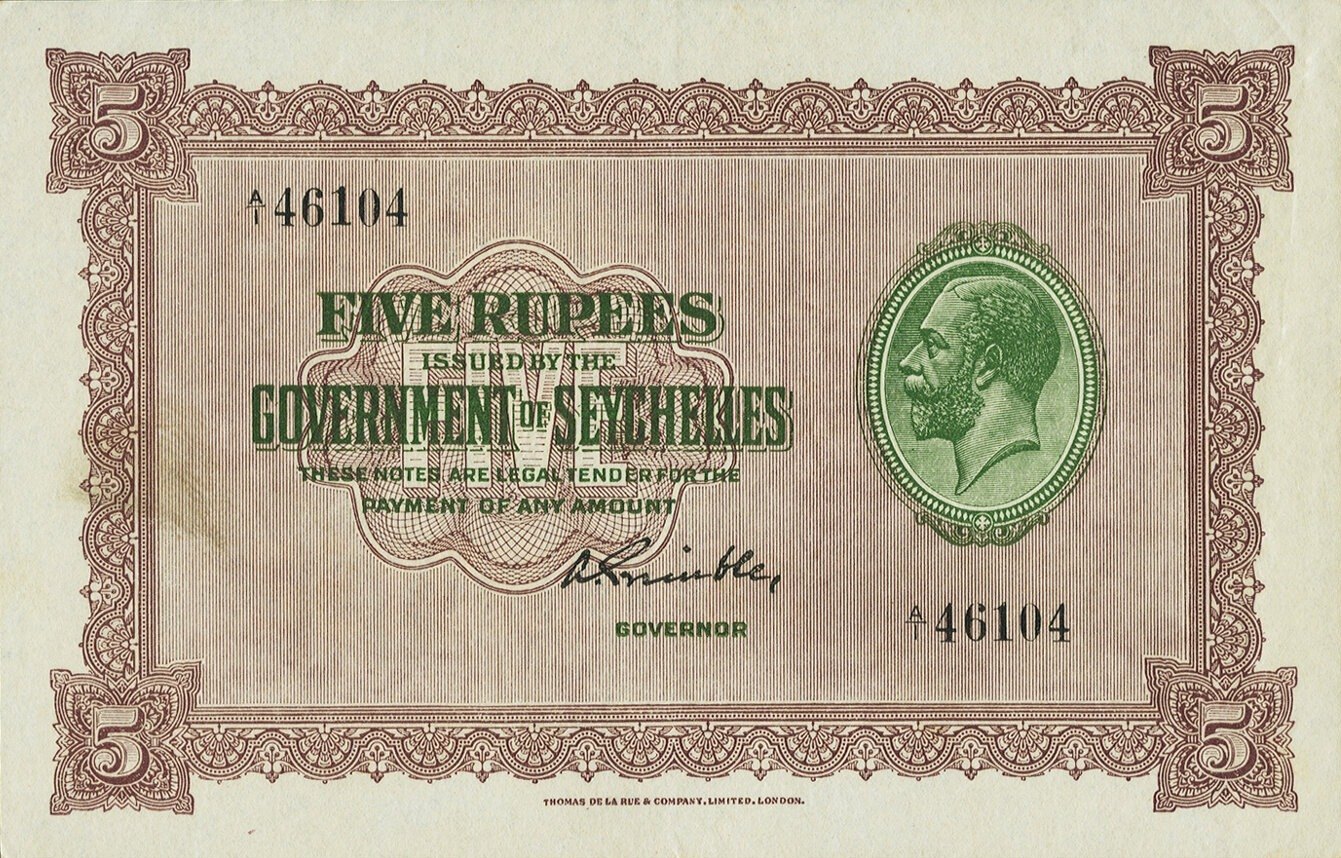
Every note in the Seychelles catalogue from 1914 to 1975 was issued by the Government of Seychelles and signed by the Governor, in 1951 by the officer administering the government, or, in 1914, by the Auditor and the Treasurer. This article sets the issues out in order of time. It draws on the Pick pages of this catalogue, on the Ordinances kept in the Johns Hopkins archive of currency boards, on the annual reports on the Colony, and on Leslie Harris, "Paper Money of Seychelles", in Coins magazine for February 1969 (pages 40 to 44). Harris lived in the islands and gives quantities and delivery dates that no other source here gives.
Before 1919: other people's notes, and notes printed in the Colony
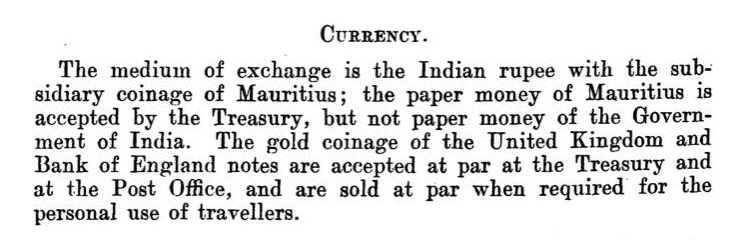
The annual report on the Seychelles for 1909 says the medium of exchange was the Indian rupee with the small coin of Mauritius. The paper money of Mauritius was accepted by the Treasury and that of the Government of India was not. Bank of England notes were taken at par at the Treasury and the Post Office, and there was no bank.
Harris writes that proposals for a Seychelles paper currency were made in 1901 and again in 1904 and were turned down after correspondence between the Governor and the Colonial Office, and that in 1903 Indian merchants in the islands asked for Bombay Government notes to be allowed, which the Colonial Office also refused, on "insufficient grounds". Harris adds that by August 1914 the only bank was a branch of the Bank of Mauritius, and that the Mauritius notes in circulation in the Seychelles then came to only 75,000 rupees.
What other colonies did in the same years is told in Whose paper passed? Other people's notes in the colonies, 1909 to 1929.
1914 and 1919: notes printed in the Colony
The first notes were an emergency issue. The Paper Currency Ordinance of 1914, No. 14 of that year, was assented to on 10 August 1914 and set up a Board of Commissioners of Currency, and notes of 5 rupees and 10 rupees dated 11th August 1914 were printed by the Government Printer. The Ordinance was repealed in 1916 and nearly all the notes were burned.
In November 1919 a second local issue followed, of 50 cents and 1 rupee, signed by hand by the Governor. Both issues, and the local 5 rupees of 1942, have their own article: The emergency notes of the Seychelles: 1914, 1919 and 1942.
1919 to 1936: the King George V notes
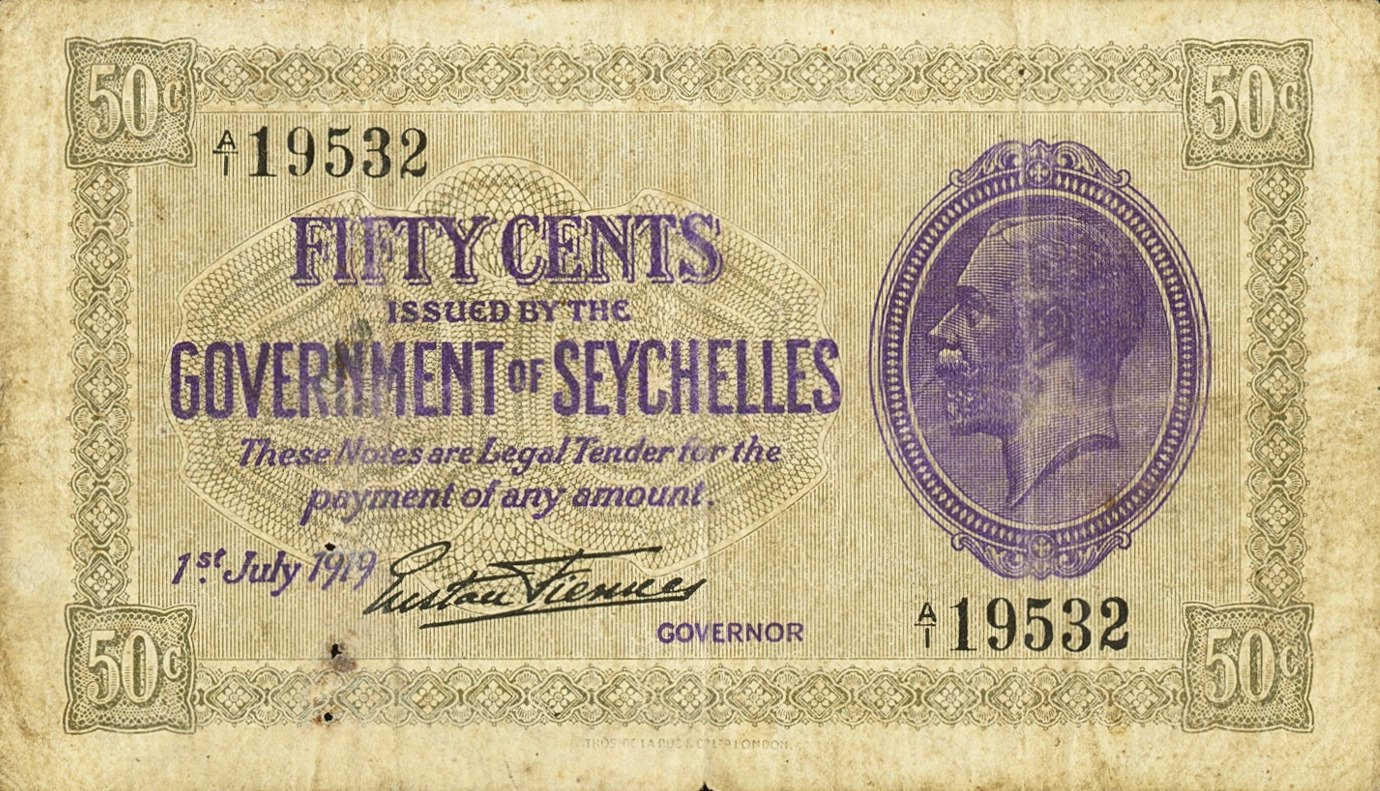
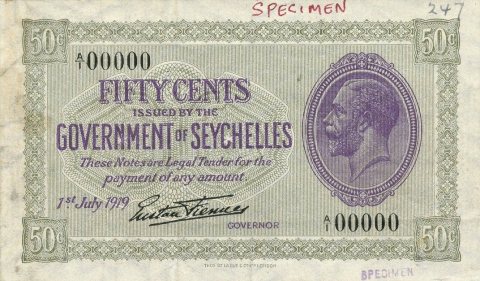
The 50 cents of 1919 to 1936 and the 1 rupee of 1919 to 1936 were the first Seychelles notes printed by Thomas de la Rue. They are uniface and show King George V facing left.
The law. The Paper Currency Ordinance of 1919 (No. 13 of 1919, assented to on 6th November 1919) allowed 10,000 notes of 50 cents and 10,000 of 1 rupee, each with the Governor's signature or a facsimile of it. An ordinance of July 1924 raised the issue to 45,000 notes of 1 rupee and 10,000 of 50 cents. The annual report for 1924 gives it as No. 2 of 1924; the text in the Johns Hopkins archive shows the assent on 17th July 1924 and its printing in Gazette No. 29 of 19th July 1924.
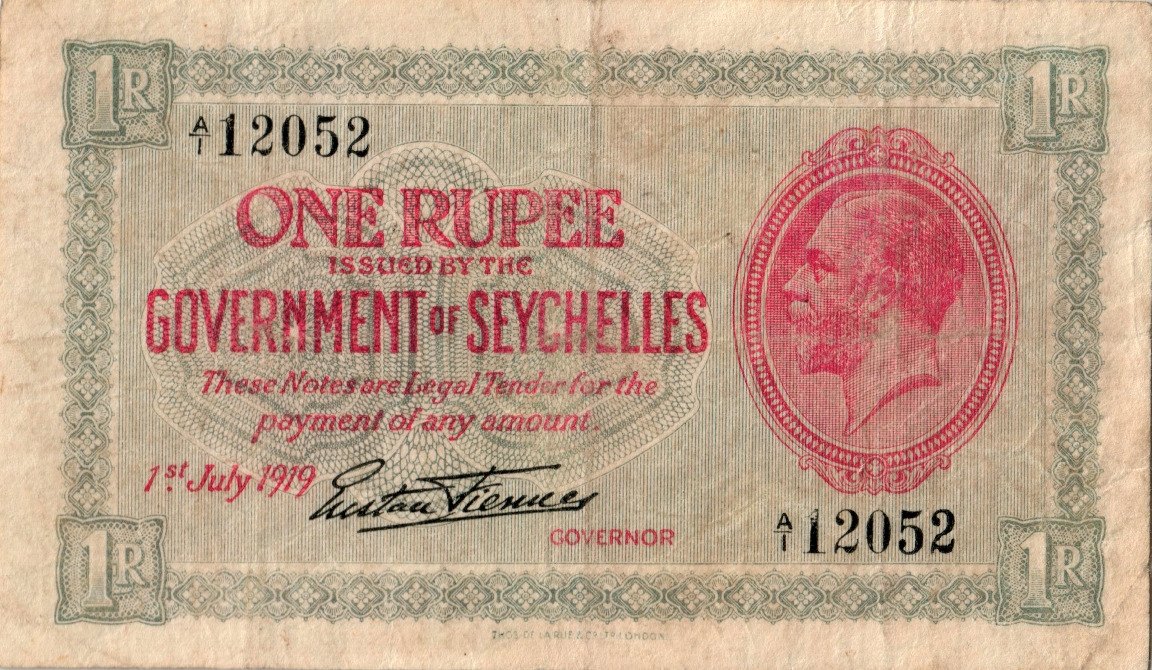
The dates and the signers. Each printing carries one printed signature, the Governor's, and a date: 1st July 1919 (Twisleton-Wykeham-Fiennes), 1st July 1924 (Byrne), 6th November 1928 (Honey) and 5th October 1934 (Lethem). A last printing has no date and the signature of Grimble. The Pick pages give the rows and the numbers recorded for each.
A date that does not exist. Pick and The Banknote Book both list a 1 rupee dated 1918. The Pick page says the date does not exist and that the notes of 1st July 1919 began at A/1 00001; the row is kept only so that the letters of the later rows stay as the catalogues and the grading holders have them.
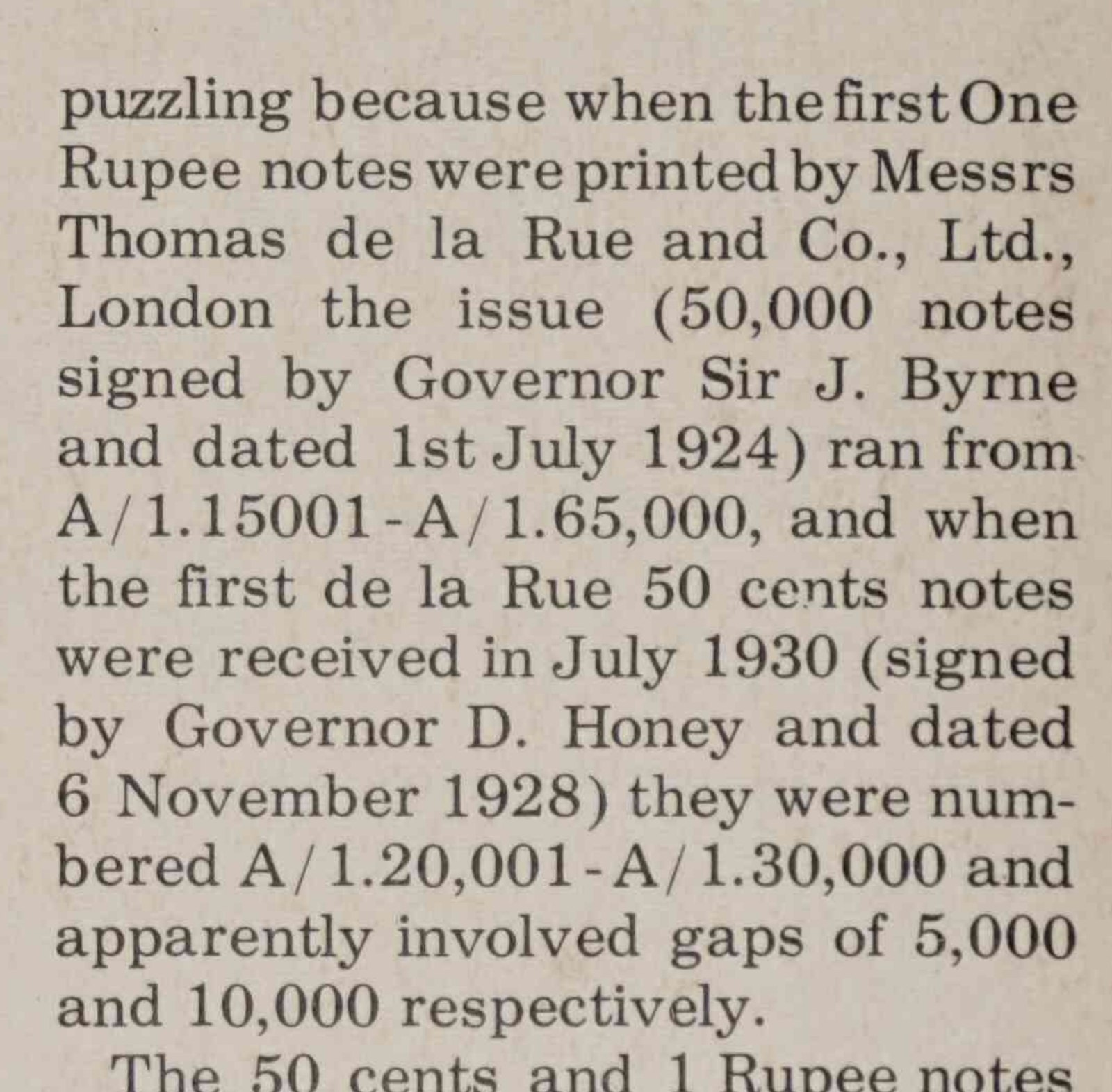
What Harris knew, and did not. Harris does not mention the notes dated 1st July 1919 at all. For Harris the first De La Rue 1 rupee was the printing of 1st July 1924, 50,000 notes numbered A/1 15001 to A/1 65000, and the first De La Rue 50 cents was the printing dated 6th November 1928, received in July 1930 and numbered A/1 20001 to A/1 30000. Harris calls the unused numbers below them gaps. The Pick pages record notes of 1st July 1919 of both values inside those gaps. Two things stay open. The notes are dated four months before the Ordinance of 6th November 1919 was assented to, and no source read here says when they reached the Colony. And Harris's 50,000 notes of 1924 is more than the 45,000 the Ordinance of July 1924 allowed; neither source explains the difference.
Harris describes the two small notes as about 4 1/2 by 2 3/4 inches, the 50 cents olive green with the portrait, medallion and lettering in violet, the 1 rupee grey and crimson, each with the value in figures in every corner and a blank back. Harris read on the 50 cents that the notes were legal tender for any amount not exceeding thirty rupees.
1928: notes of 5, 10 and 50 rupees
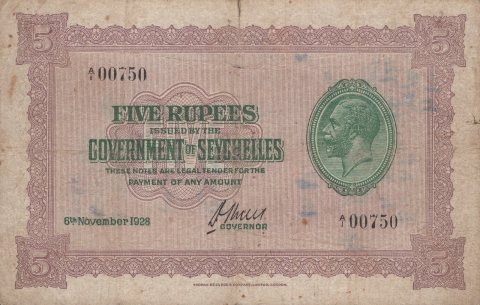
An ordinance of 30th May 1928 (the Paper Currency Ordinance, 1928, No. 3 of 1928 in the text of the Johns Hopkins archive) first allowed notes of 5, 10 and 50 rupees beside the 50 cents and 1 rupee: 20,000 of 5 rupees, 5,000 of 10 rupees and 1,000 of 50 rupees. The Paper Currency Revised Ordinance (No. 7 of 1928 in the archive text and in the annual report for 1930; the annual report for 1928 gives only its title) was assented to on 5th November 1928, the day before the date on the first notes, and authorised 250,000 rupees in notes. Harris reads that figure as a limit on circulation and not on printing, and says 65,000 rupees' worth of the small notes already existed, in the Treasury vaults or outside.
The three values are the 5 rupees of 1928 to 1936, the 10 rupees of 1928 to 1936 and the 50 rupees of 1928 to 1936.
The order of 1927. The notes were ordered from De La Rue in October 1927, dated 1927 and to carry the signature of Governor Sir Malcolm Stevenson. Stevenson died on 27 November 1927 before the plates were finished, so the date was changed to 1928 and the signature of the next Governor, Honey, put in its place. Harris gives the order as 20,000 notes of 5 rupees, 10,000 of 10 rupees and 1,000 of 50 rupees, each value to be numbered from A/1 00001. The Ordinance of 30th May 1928 has 5,000 for the 10 rupees, where Harris has 10,000.
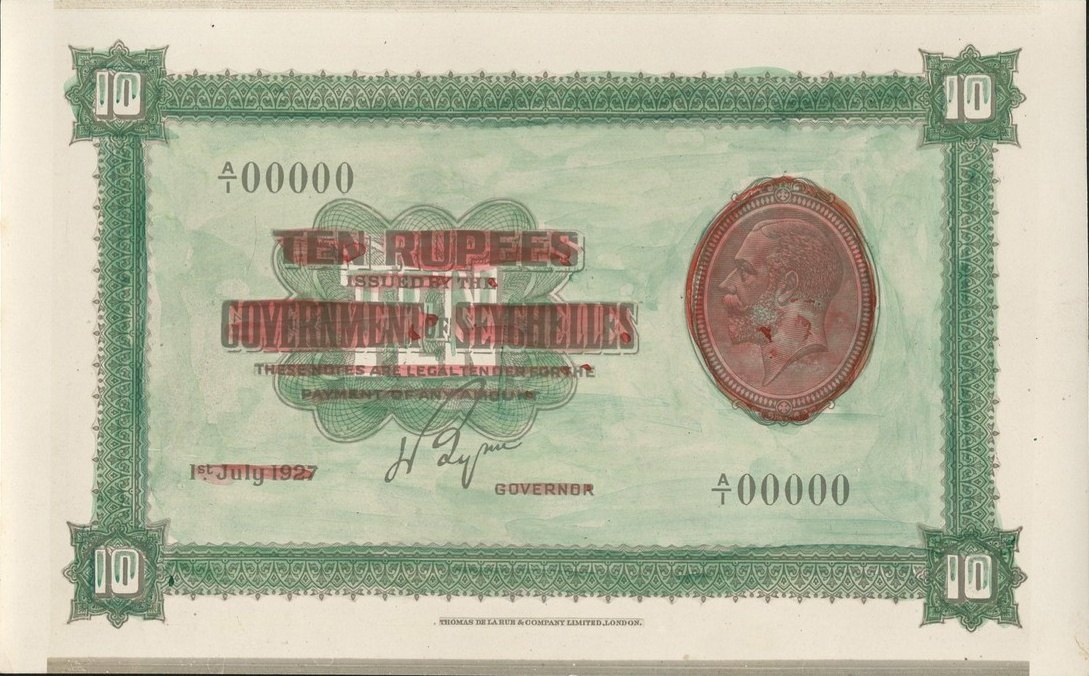
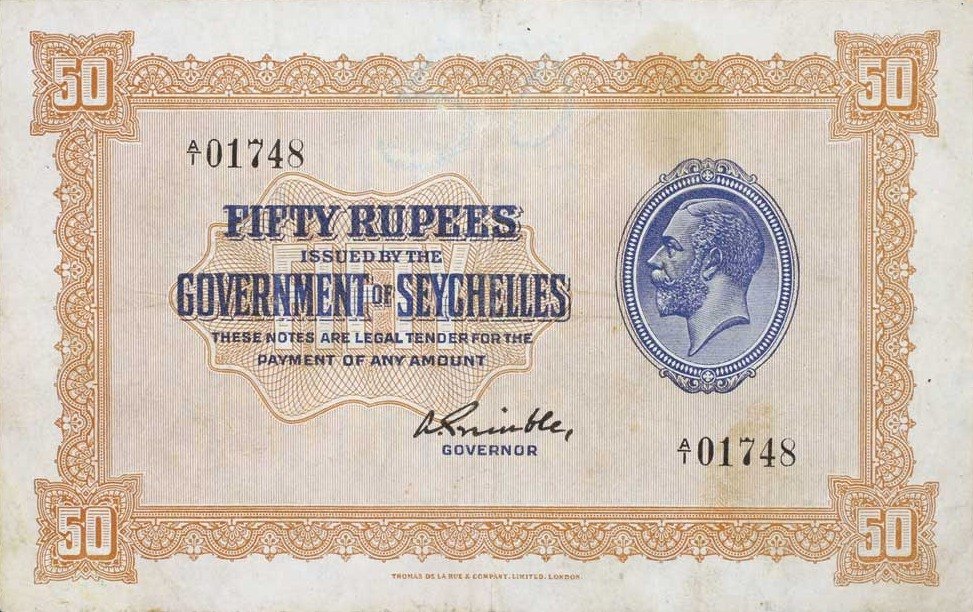
Colours. Harris gives green and brown-purple for the 5 rupees, crimson and apple green for the 10 rupees, and prussian blue and beige for the 50 rupees, with the portrait and lettering in the first colour, and the notes as about 6 1/4 by 4 inches. By night light the 50 rupees was easily taken for the 5 rupees, so people wrote a large 50 on the notes. Harris says nearly every surviving note is marked this way.
Later printings. Harris records a further 3,000 notes of 5 rupees dated 5th October 1934 and signed by Lethem, numbered A/1 20001 to A/1 23000 and received in the Seychelles in January 1936. New ink was mixed somewhere between numbers 20781 and 22097, and the later notes are a bluer green and a redder purple. Of the three high values only the 5 rupees is listed with the 1934 date.
1936: a new law, sterling, and notes without a date
In January 1936 the Colony's currency was put on a sterling basis, at 13.33 rupees to the pound. The Seychelles Currency Notes Ordinance of 1936 (No. 2 of 1936, assented to on 30th January 1936) replaced the earlier laws and gave the issue of notes to the Treasurer, with notes legal tender for any amount.
The last King George V printings carry Grimble's signature and no date. Harris says that in mid-1937 the Colony received 35,000 notes of 5 rupees, 8,500 of 10 rupees and 800 of 50 rupees with no date at all. The King had died in 1936, and Harris supposes that the plates had been made ready towards the end of the reign and that the date was taken off so that the notes could still be used. Harris does not say whether further deliveries followed.
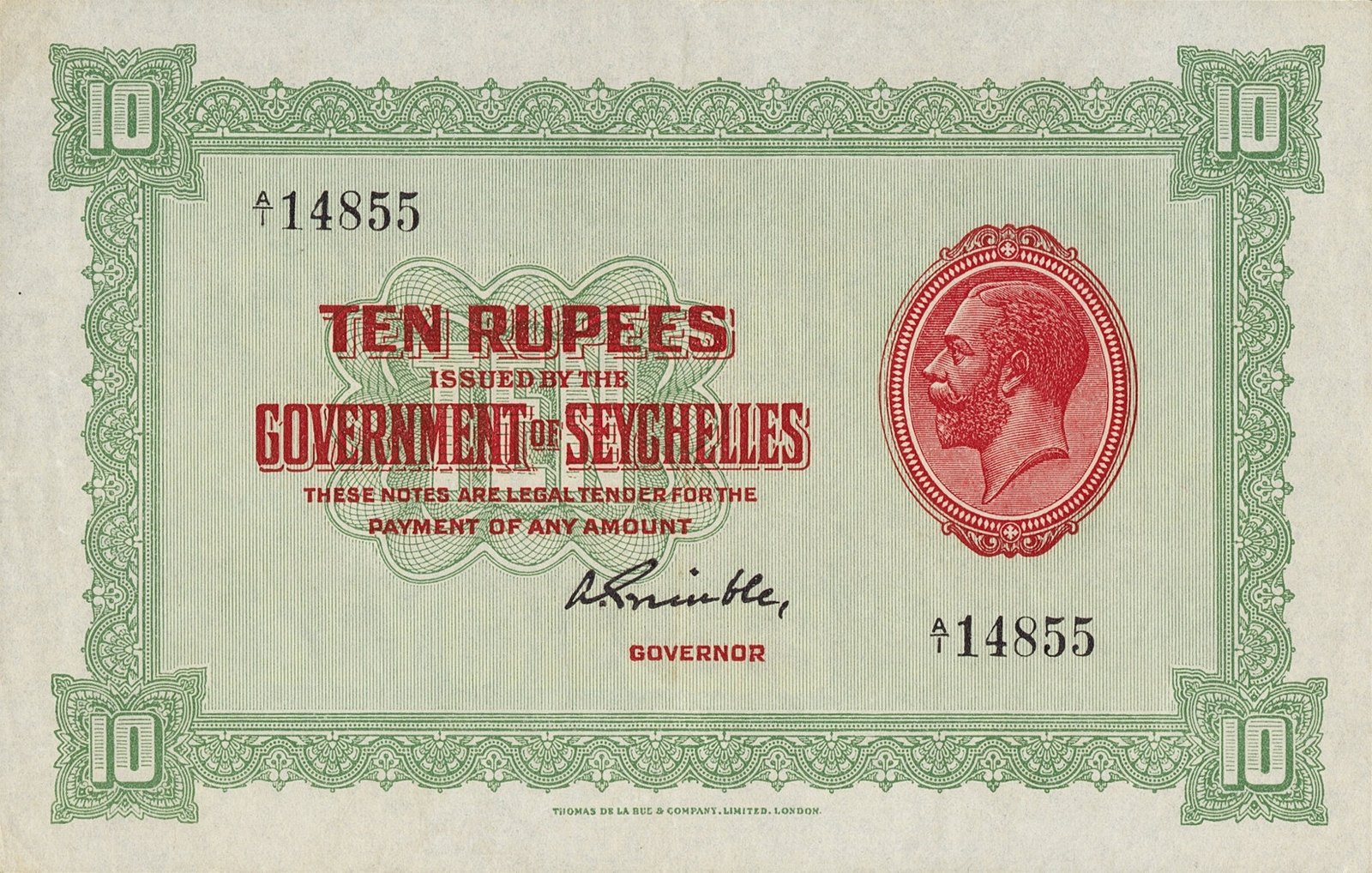
Three auction descriptions add the houses' own reckonings. Stack's Bowers (8 May 2025, lot 50545) believes fewer than 60,000 notes of the 50 cents were printed between 1919 and its withdrawal in 1939. The same house (8 May 2025, lot 50548) suspects that fewer than 25,000 notes of the 10 rupees were printed, dated and undated together, and says the totals are not confirmed. Heritage (13 January 2022, lot 28380) points out that the numbering of the 50 rupees ran on from 1928 into the undated notes under the one prefix A/1.
The Mauritius notes withdrawn, and the notes in circulation, 1930 to 1937
Mauritius Government notes of 5, 10 and 50 rupees circulated in the Colony beside its own notes. An Ordinance of 1930 extended the time during which they were legal tender. The annual reports from 1930 to 1934 say they were being withdrawn and replaced by the Seychelles notes, and they ceased to be legal tender on 15th December 1934.
An amending ordinance of 1932 raised the 250,000 rupees of 1928 to 500,000. The annual report for 1932 names two Ordinances of that year amending the law of 1928, the first of which created a fund to secure the notes in circulation.
The Seychelles notes in circulation on 31st December of each year, from the annual reports on the Seychelles for 1930 to 1937 and An Economic Survey of the Colonial Empire, 1935:
| Year | Seychelles notes in circulation on 31st December |
|---|---|
| 1930 | 165,867 rupees |
| 1931 | 232,567 rupees |
| 1932 | 250,067 rupees |
| 1933 | 299,117 rupees |
| 1934 | 305,117 rupees |
| 1935 | 335,117 rupees |
| 1936 | 392,602 rupees |
| 1937 | 497,976 rupees |
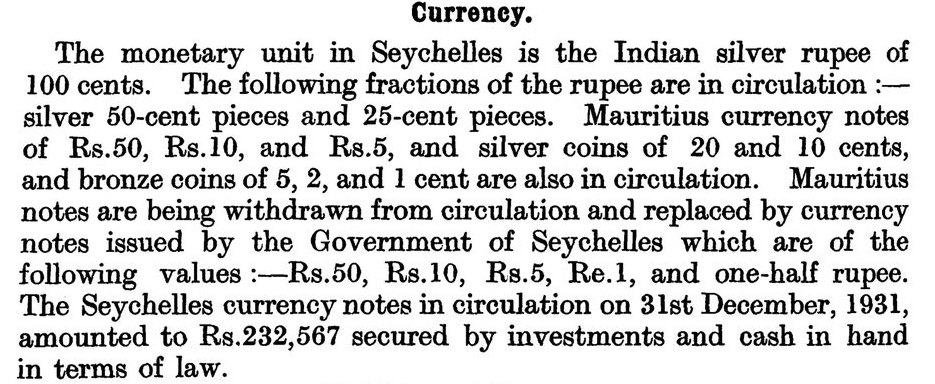
The annual reports for 1921, 1928 and 1929 say nothing of the notes, and the Pick pages give no figure for the years before 1930.
1938 to 1951: coins for the small notes, and King George VI
In July 1938 the Colonial Office approved replacing the 50 cents and 1 rupee notes, described as unhygienic, with coins. The Coinage Ordinance of 1939 (No. 3 of 1939) brought in Seychelles coins to be issued in exchange for them.
Heritage (10 November 2023, lot 24588) says the 50 cents was issued because coin and small money were short in the Seychelles during the Second World War. Governor Logan took office on 30 March 1942, by Harris's list, and signed the King George VI issue: the 5 rupees, 10 rupees and 50 rupees dated 7th April 1942, and the 50 cents and 1 rupee dated 7th July 1943. Harris gives one date, 7 April 1942, for all five values; the Pick pages date the two small ones 7th July 1943. The quantities Harris gives are in the table below. Each value carried on the prefix and the numbering of its King George V note.
On 3 March 1947 the colonial treasurer declared that the coins and notes of other countries, except the 1, 2 and 5 cent coins of Mauritius, were no longer legal tender and were to be exchanged by 31 March 1947.
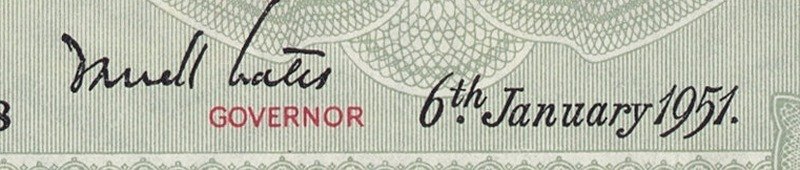
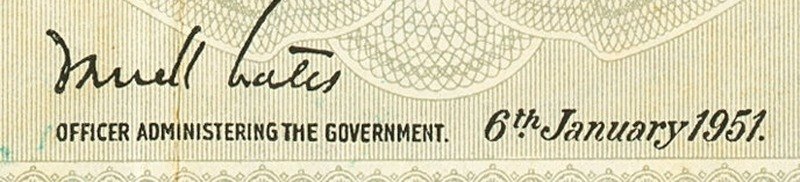
The last King George VI printing is dated 6th January 1951 and signed by J. Darrell Bates, who administered the government between Governors Selwyn-Clarke and Crawford. Harris gives 30,000 notes of 50 cents, A/1 134001 to A/1 164000, and 50,000 of 1 rupee, B/1 200001 to B/1 250000. Some 1 rupee notes call Bates GOVERNOR and others OFFICER ADMINISTERING THE GOVERNMENT. Harris had seen the GOVERNOR notes, called them an error, and wrote that the printers and the Seychelles Treasury had no knowledge of them.
In September 1967 rumours spread that forged King George VI 5 rupees had appeared. Harris reports that some people said the notes had no writing on the back and others pointed to their size. The suspected notes were all numbered between A/3 13000 and A/3 15000 and are the full 6 1/4 by 4 inches; later printings, before A/3 44000 was reached, were made slightly smaller. On 3 October 1967 the government announced that the notes had been examined and were genuine.
1954 to 1975: Queen Elizabeth II
The notes of 1st August 1954, signed by Addis, were the first with printing on the back: palm trees and a tortoise, in purple on the 5 rupees, green on the 10 rupees and black on the 50 rupees. Harris calls the back a poor version of the colony badge. The 50 rupees was redrawn in black on white. Harris says this was done to get rid of the old colouring, and that from habit people went on writing a large 50 on the early black and white notes until about the time the Oxford and Asquith notes appeared.
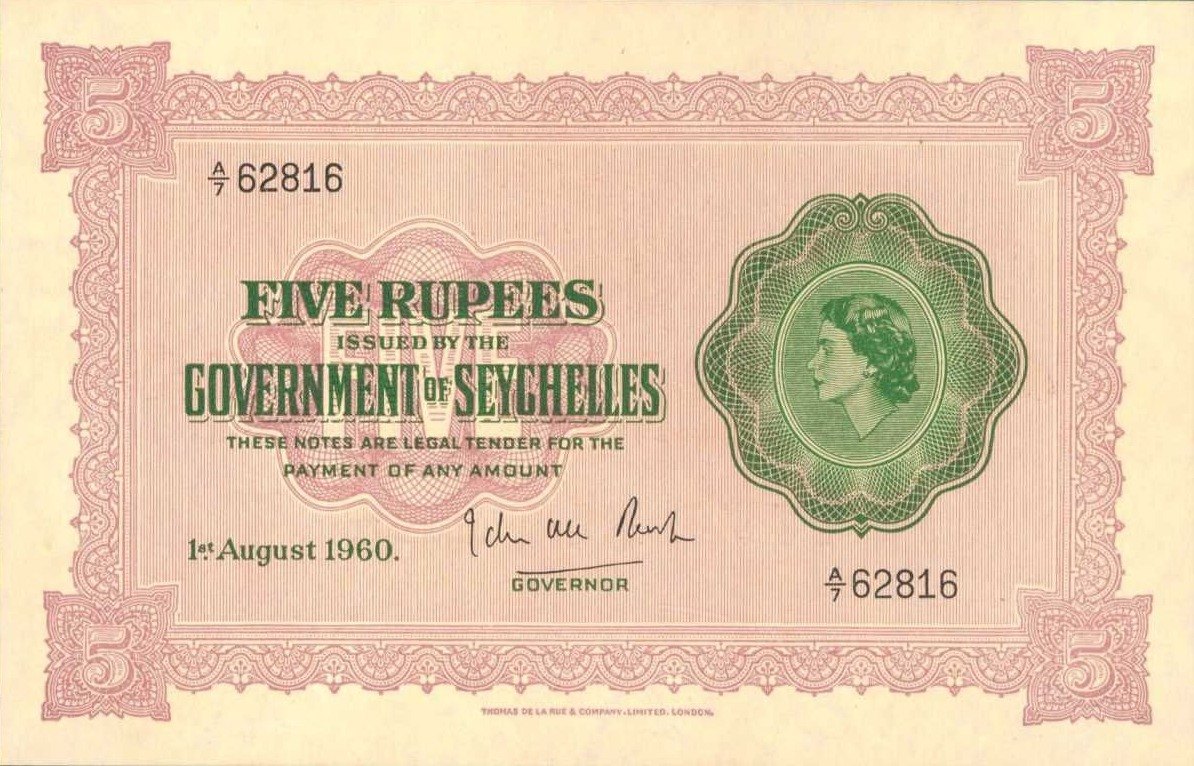
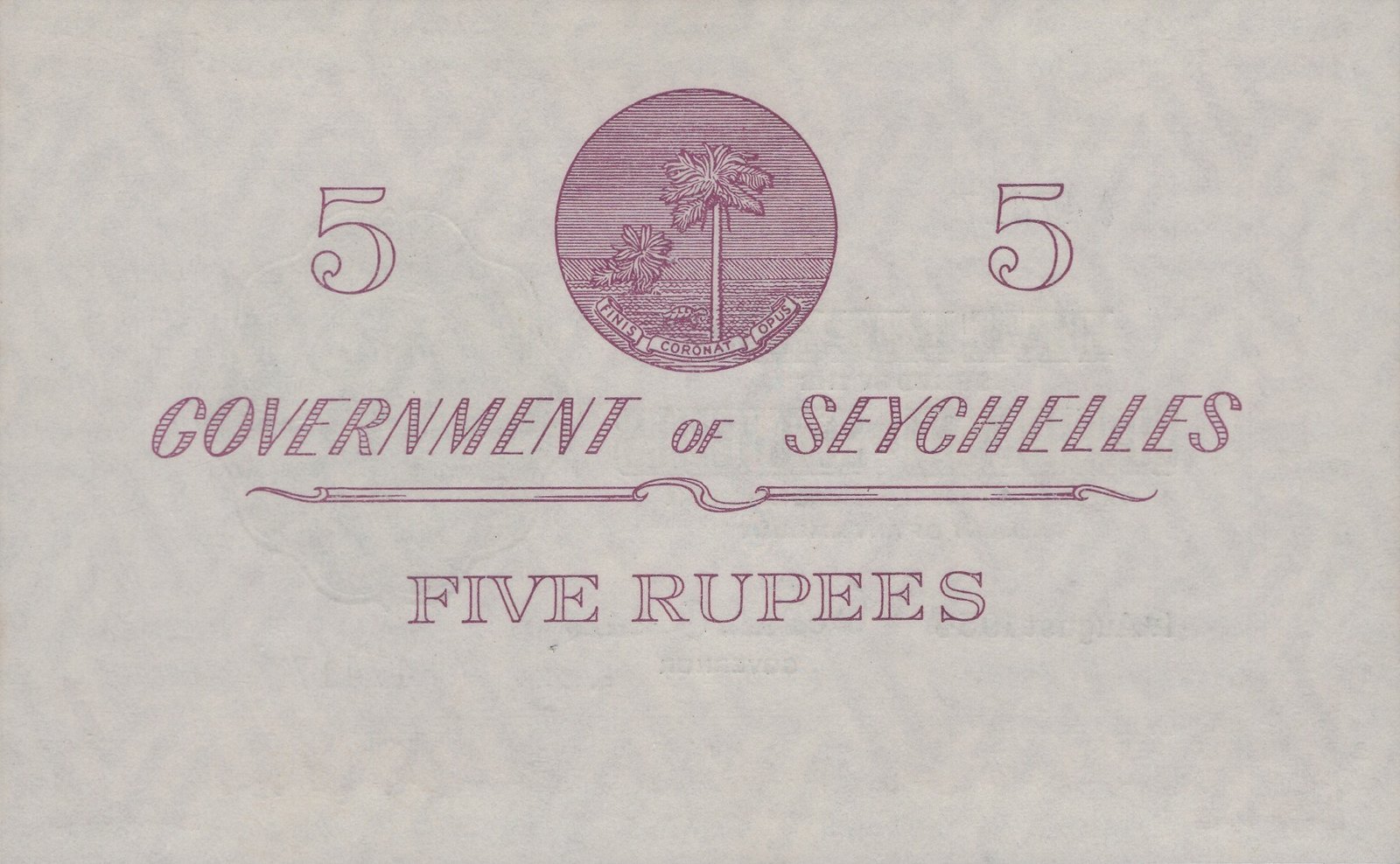
Thorp signed the notes of 1st August 1960. Harris records that Thorp drowned at Grand Anse, Mahe, in 1961 while trying to help other swimmers. The Earl of Oxford and Asquith signed the notes of 1st May 1963 and 1st January 1967, and the 5 rupees is not listed with either date.
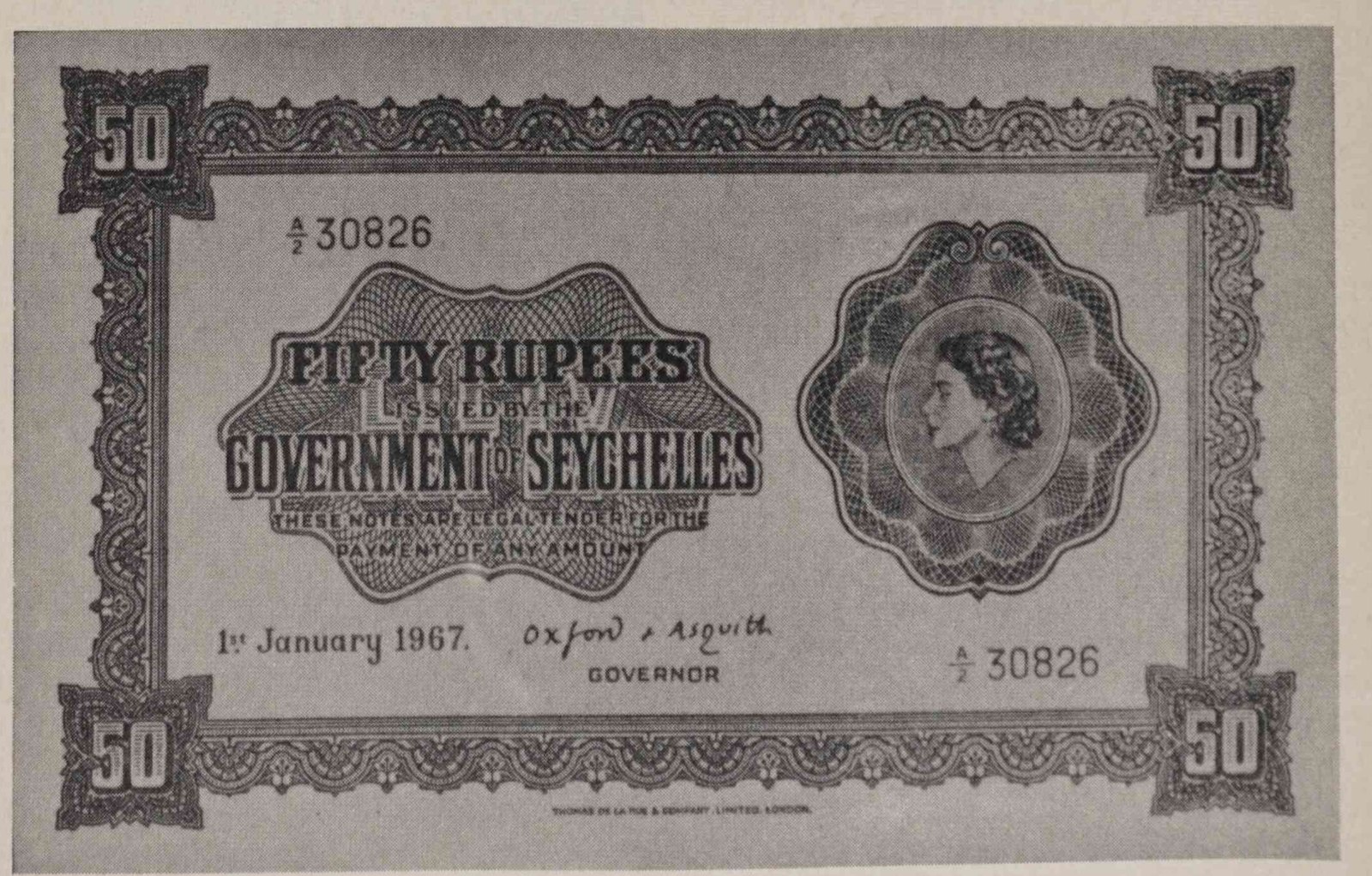
Stack's Bowers (8 May 2025, lot 50553) suspects, from the numbers the house has seen, that 7,500 to 8,000 notes of the 50 rupees of 1954 were printed. Harris gives 8,000.
1968 to 1975: the Bradbury Wilkinson notes
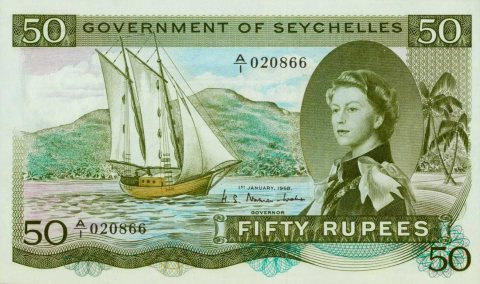
New notes by Bradbury Wilkinson, in five values and with Pietro Annigoni's portrait of the Queen, were issued on 22 July 1968. They are the subject of The Seychelles notes of 1968 to 1975: the designs and the words read in them. The last date on any of them is 1st June 1975, on the 100 rupees.
The text of the Seychelles Currency Ordinance 1974 (No. 12 of 1974, assented to on 7th June 1974) in the Johns Hopkins archive provides for two or three Commissioners of Currency. A feature in the Seychelles Nation of 30 November 2008, paid for by the Central Bank of Seychelles, says that a Currency Commission was set up in 1974 and the Seychelles Monetary Authority in 1978. The Johns Hopkins working paper on the Seychelles by Tanay Agarwal (2016) likewise takes its study from 1914 to 1978. The notes of those later issuers are outside this article.
The Governors on the notes
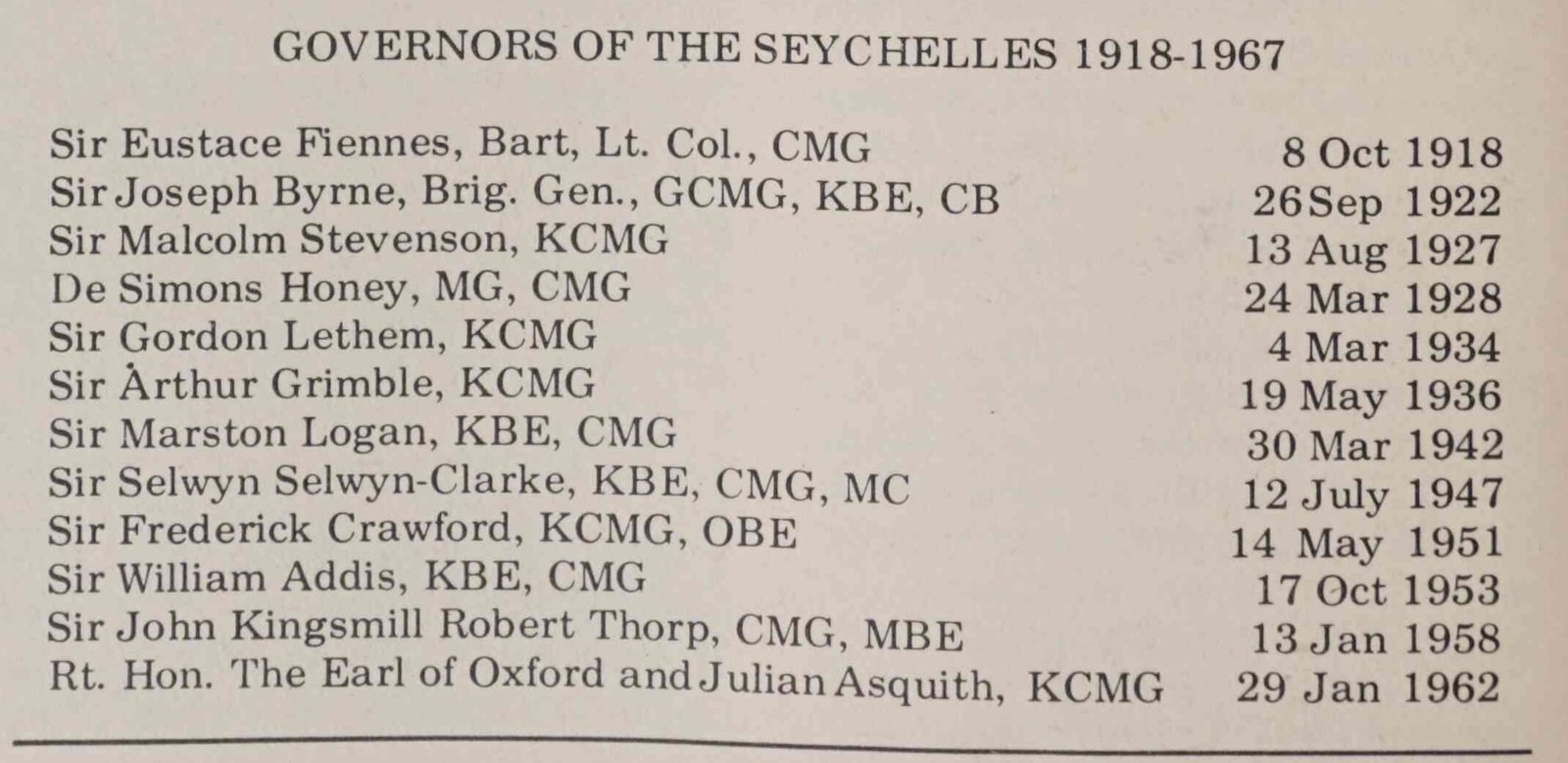
The dates of taking office are those of the list Harris printed in 1969, which is headed 1918 to 1967 and whose last entry is of 1962. The list has "De Simons Honey", and Harris's text has "Thorpe" where the list has Thorp; the Pick pages have Honey and Thorp.
| Signer | Took office (Harris) | Dates on the notes |
|---|---|---|
| Sir Eustace Twisleton-Wykeham-Fiennes | 8 October 1918 | 1st July 1919; 10th November 1919 (local notes, signed by hand) |
| Sir Joseph Byrne | 26 September 1922 | 1st July 1924 |
| Sir Malcolm Stevenson | 13 August 1927 | none; died 27 November 1927 |
| Honey | 24 March 1928 | 6th November 1928 |
| Sir Gordon Lethem | 4 March 1934 | 5th October 1934 |
| Sir Arthur Grimble | 19 May 1936 | no date |
| Sir Marston Logan | 30 March 1942 | 7th April 1942; 20th June 1942 (local 5 rupees, signed by hand); 7th July 1943 |
| Sir Selwyn Selwyn-Clarke | 12 July 1947 | none |
| J. Darrell Bates, administering the government | not in the list | 6th January 1951 |
| Sir Frederick Crawford | 14 May 1951 | none |
| Sir William Addis | 17 October 1953 | 1st August 1954 |
| Sir John Kingsmill Thorp | 13 January 1958 | 1st August 1960 |
| The Earl of Oxford and Asquith | 29 January 1962 | 1st May 1963; 1st January 1967 |
| Hugh Selby Norman-Walker | after the list | 1st January 1968; 1st January 1969 |
| Bruce Greatbatch | after the list | 1st October 1970; 1st January 1971; 1st January 1972; 1st August 1973 |
| Colin Hamilton Allan | after the list | 1st January 1974; 1st June 1975 |
The quantities printed, as Harris gives them
Harris does not say where the figures come from. No Ordinance, annual report or printer's record read here confirms them, and the two cases where they differ from an Ordinance are noted above. Harris gives no quantity for the notes of 1st July 1919, for the 50 cents of 6th November 1928 (only its numbers, A/1 20001 to A/1 30000), for the 1 rupee of 1928, for the 50 cents and 1 rupee of 1934, or for the undated 50 cents and 1 rupee. A hyphen in the table means that Harris gives no figure or that the value is not listed with that date.
| Printing | 50 cents | 1 rupee | 5 rupees | 10 rupees | 50 rupees |
|---|---|---|---|---|---|
| 1st July 1924 (Byrne) | - | 50,000 | - | - | - |
| 6th November 1928 (Honey), as ordered in October 1927 | - | - | 20,000 | 10,000 | 1,000 |
| 5th October 1934 (Lethem) | - | - | 3,000 | - | - |
| No date (Grimble), received mid-1937 | - | - | 35,000 | 8,500 | 800 |
| King George VI (Logan) | 74,000 | 115,000 | 205,000 | 64,000 | 9,000 |
| 6th January 1951 (Bates) | 30,000 | 50,000 | - | - | - |
| 1st August 1954 (Addis) | - | - | 340,000 | 90,000 | 8,000 |
| 1st August 1960 (Thorp) | - | - | 50,000 | 50,000 | 10,000 |
| Oxford and Asquith, first printing | - | - | - | 80,000 | 4,000 |
| Oxford and Asquith, second printing | - | - | - | 30,000 | 15,000 |
Harris lists the two Oxford and Asquith printings under the dates 1st May 1963 and 1st January 1967 without saying in so many words which printing bears which date.
What is not known
- When the De La Rue notes dated 1st July 1919 were ordered and when they arrived.
- Why Harris's 50,000 notes of 1 rupee of 1924 and 10,000 notes of 10 rupees of 1928 exceed the 45,000 and 5,000 of the Ordinances.
- The number of the Ordinance of 1930 on the Mauritius notes and of the two Ordinances of 1932.
- How many undated notes were delivered after mid-1937, if any.
- The day on which any of the notes before 1968 ceased to be legal tender.
Sources
- The Pick pages of the Seychelles in this catalogue.
- Leslie Harris, "Paper Money of Seychelles", Coins: The Magazine of Coin Collecting, volume 16 number 2, February 1969, pages 40 to 44.
- Seychelles Ordinances in the Johns Hopkins archive of currency boards: No. 14 of 1914; No. 13 of 1919; No. 2 of 1924; No. 3 and No. 7 of 1928; No. 2 of 1936; No. 3 of 1939; No. 12 of 1974. See What the currency boards published: Gazettes, laws and reports, 1847-1969.
- Colonial Reports, Annual: Seychelles, the reports for 1909, 1921, 1924, 1928, 1929 and 1930 to 1937.
- An Economic Survey of the Colonial Empire, 1935.
- Stack's Bowers, 8 May 2025, lots 50545, 50548 and 50553; Heritage Auctions, 13 January 2022, lot 28380, and 10 November 2023, lot 24588.
- "New challenges for a new generation: the Central Bank at 30", Seychelles Nation, 30 November 2008.
- Tanay Agarwal, "An Analysis of Seychelles' Currency Board (1914-1978)", Studies in Applied Economics no. 46, Johns Hopkins Institute for Applied Economics, Global Health, and the Study of Business Enterprise, 2016 (title and scope only; the paper itself could not be opened).
Member comments
Log in or register to post a comment.