Three issues of Seychelles notes were set in type and printed in the islands, not in London: the notes of 11th August 1914, those of 10th November 1919 and the 5 rupees of 20th June 1942. This article gathers what the Pick pages, the Ordinances in the Johns Hopkins archive of currency boards, the Colonial Office Lists and Leslie Harris's article "Paper Money of Seychelles" (Coins magazine, February 1969, pages 40 to 44) say about them. The rest of the Colony's notes are told in The paper money of the Seychelles, 1914 to 1975.
August 1914: the run on the bank
Harris tells the story of the first days. News that war had been declared reached the Seychelles on 4 August 1914 at about five in the evening, after the only bank, a branch of the Bank of Mauritius, had closed for the day. When it opened the next morning a few customers began to draw out their deposits, and over the following days the few became a crowd that the bank could not pay. Harris puts the population at under 30,000, and the Mauritius notes then in circulation in the islands at only 75,000 rupees.
The Ordinance of 10 August 1914
The Paper Currency Ordinance of 1914 was enacted by Governor C. R. M. O'Brien on 10 August 1914 and established a Board of Commissioners of Currency. The text in the Johns Hopkins archive is Ordinance No. 14 of 1914, printed in Gazette Extraordinary No. 41 of 11th August 1914, page 257. It allowed up to 180,000 rupees in notes of 5 and 10 rupees and said that the Board might issue no other denomination.
Harris names the Governor who had the Ordinance drawn up as Sir Eustace Fiennes. That does not agree with the Ordinance, and it does not agree with Harris's own list of Governors, which has Fiennes taking office on 8 October 1918.
How the notes of 1914 were made
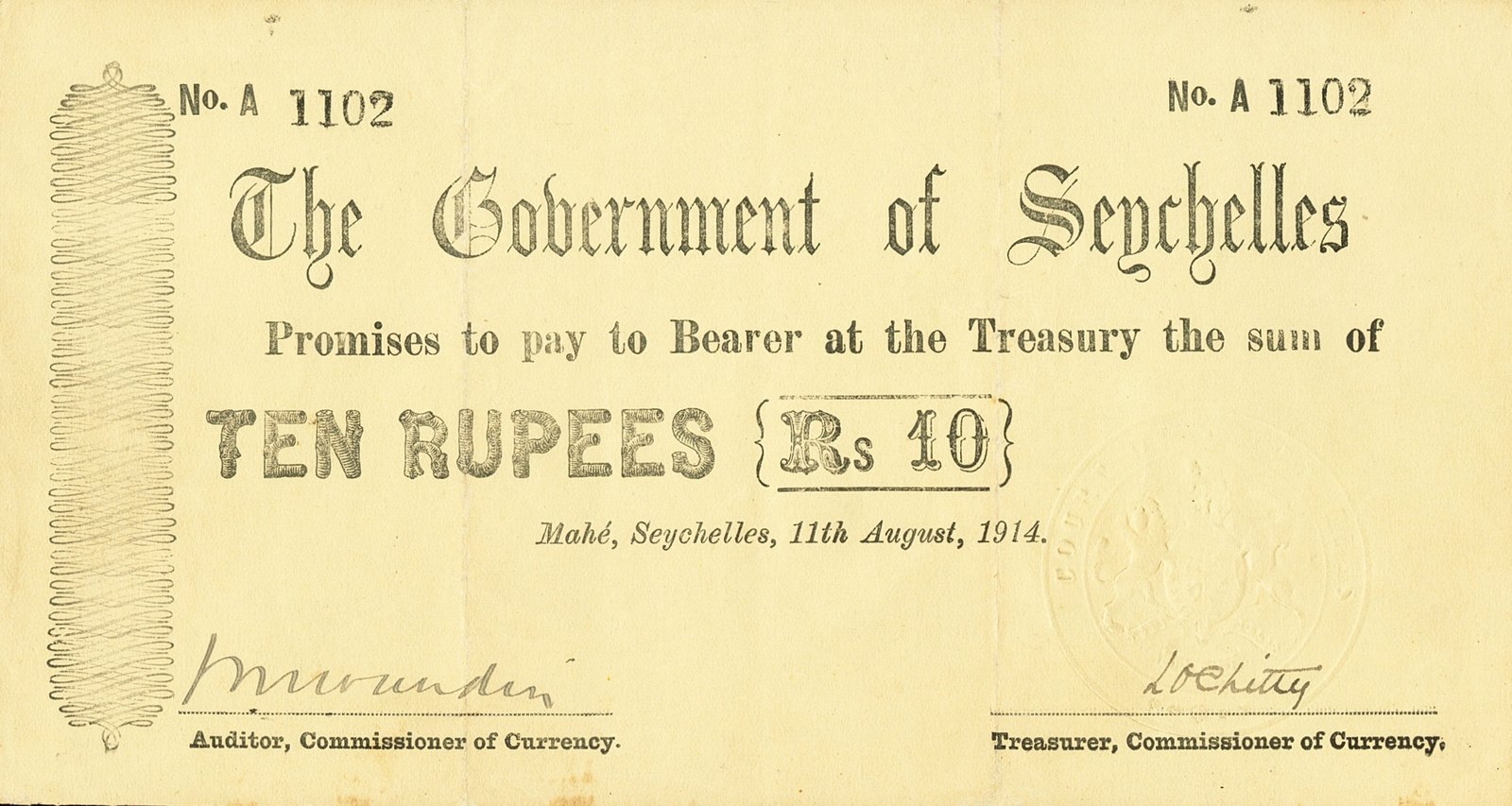
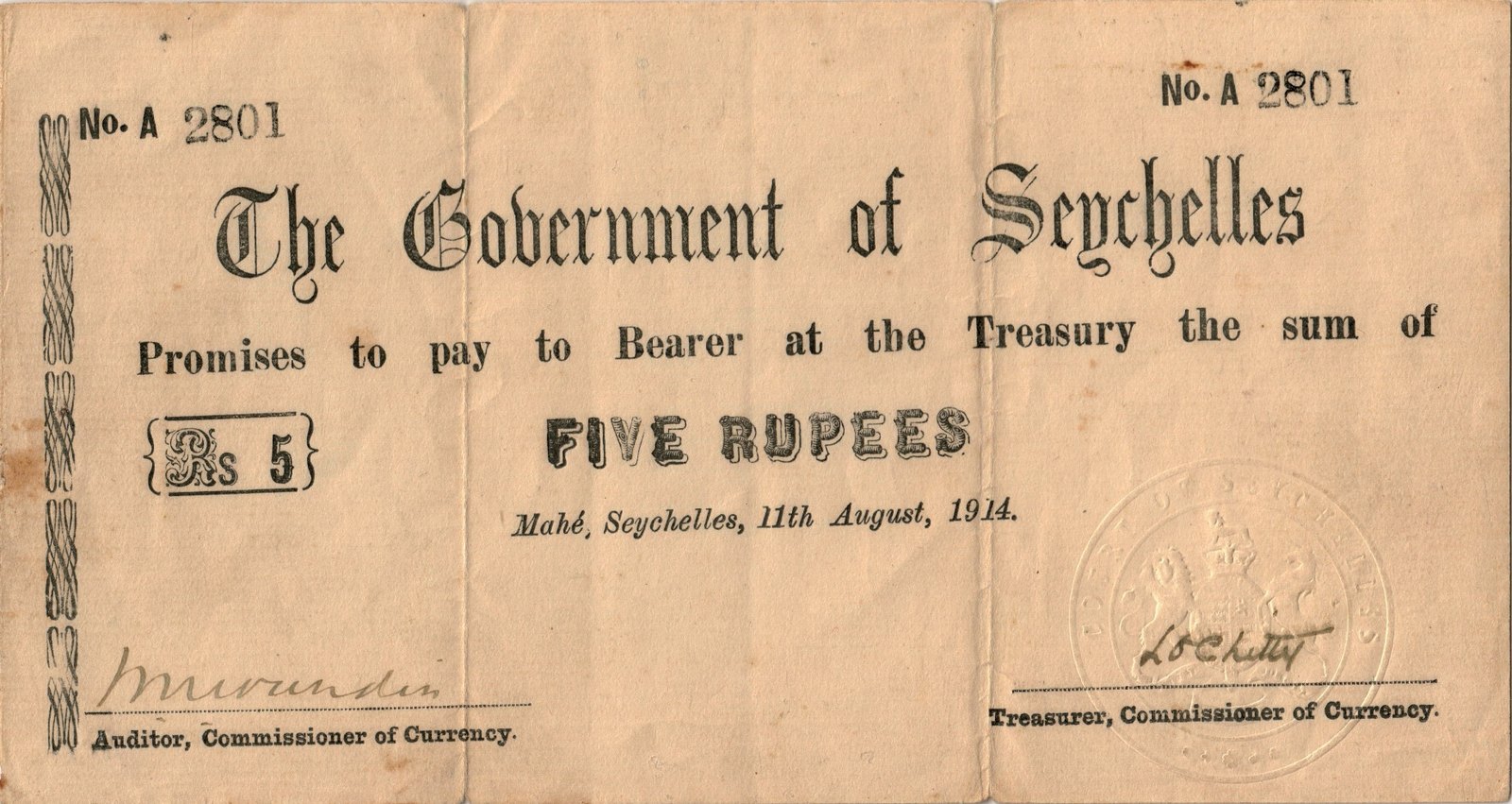
The 5 rupees of 1914 and the 10 rupees of 1914 were typeset and printed locally, 180,000 rupees in all, and are dated 11th August 1914.
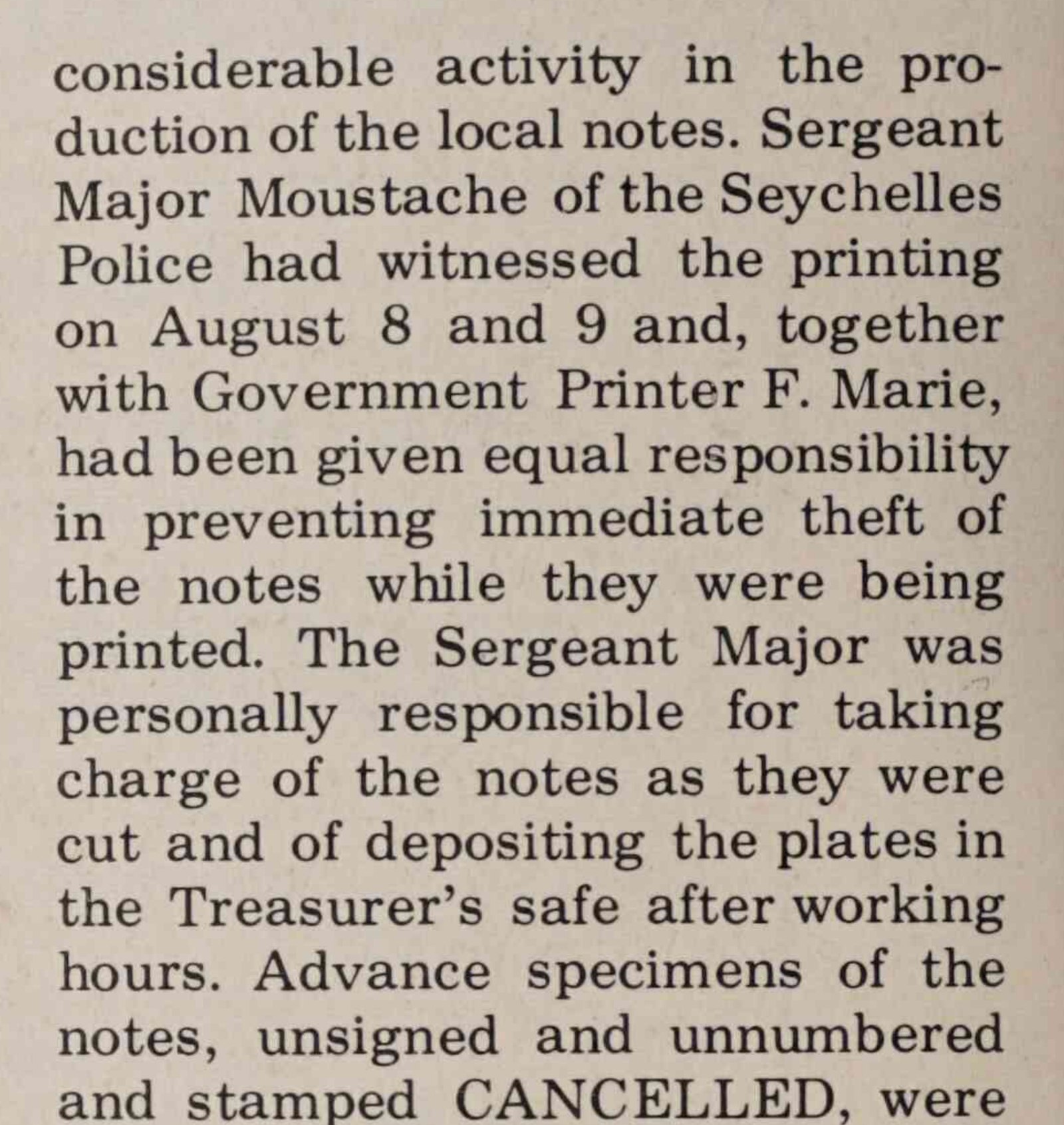
They were printed on 8 and 9 August 1914 by the Government Printer, F. Marie, under police guard. Those are the two days before the Ordinance was assented to. Harris names the police officer as Sergeant Major Moustache of the Seychelles Police, who watched the printing and shared with the Government Printer the duty of seeing that no note was stolen. The sergeant major took charge of the notes as they were cut and locked the plates in the Treasurer's safe each evening. Unsigned and unnumbered specimens stamped CANCELLED were shown at every police station in the Colony.
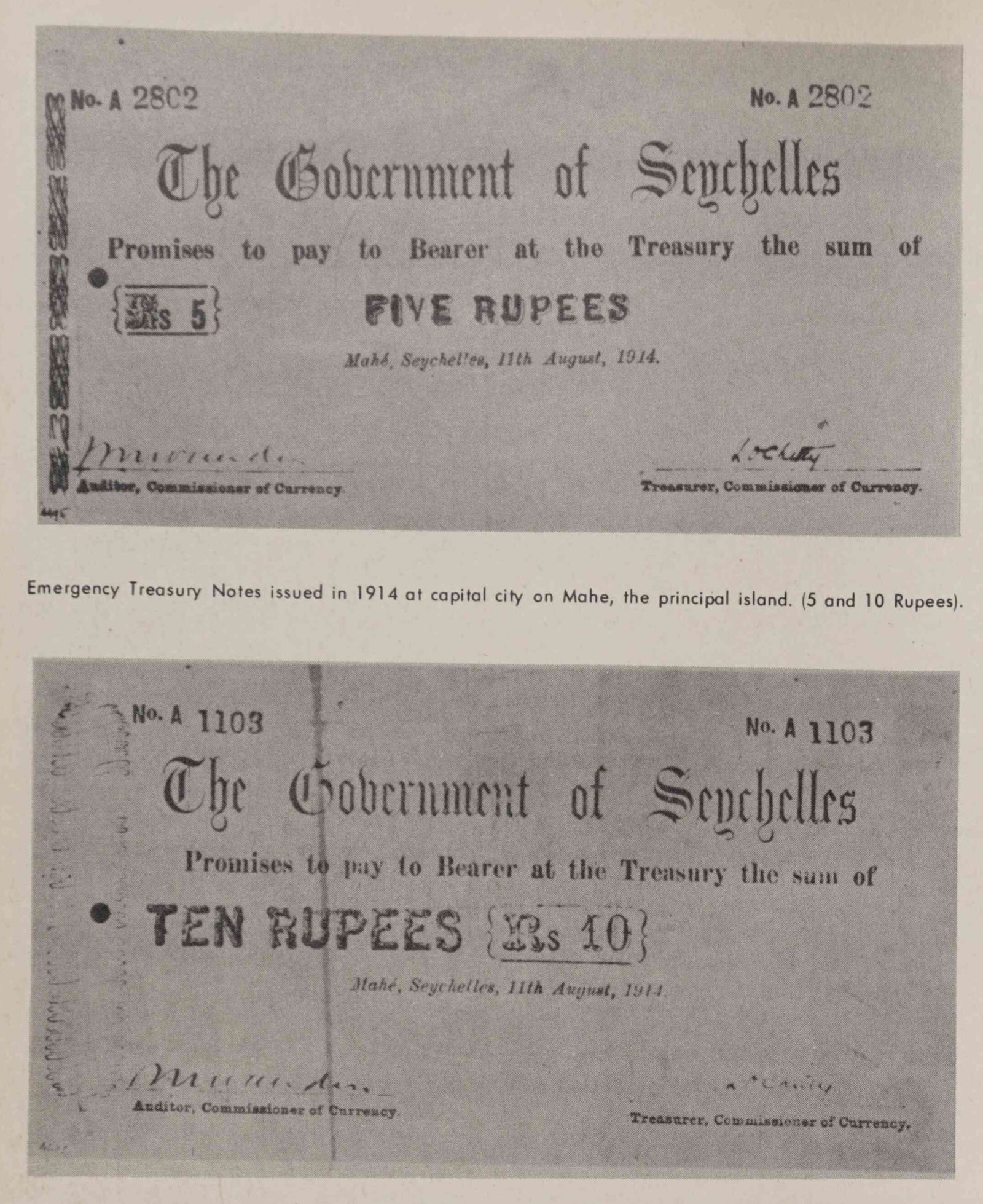
Harris describes the notes as large, eight inches by four and a quarter, and printed on white paper of poor quality. Two of them, a 5 rupees and a 10 rupees, are pictured in the article.
The two signers
Each note was signed by hand by the Auditor and the Treasurer, the two Commissioners of Currency. The Colonial Office Lists give Vaudin as acting Auditor of the Seychelles from 9 May 1912, for the Auditor W. F. Baldwin, and Chitty as Treasurer, Collector of Customs and Manager of the Savings Bank from 27 February 1911. Both therefore held these posts when the notes were signed in August 1914. Harris says the two had only lately been named as the commissioners, and that signing every note by hand was slow work.
Paying the notes, and burning them
Harris writes that a special Seychelles Gazette announced the terms. The notes could not be cashed until six months after their date, and then only for Indian silver rupees.
In 1916 the Ordinance of 1914 was repealed. The printed bill of the Paper Currency (Repeal) Ordinance, 1916, in the Johns Hopkins archive says that from the day it came into force the notes of 1914 were no longer legal tender and could not be cashed at the Treasury; the day is left blank in the bill. The whole issue was burned except for 130 rupees' worth.
Harris wrote in 1969 that the only examples known were one of each value in the Imperial War Museum in London. Heritage Auctions, selling a 10 rupees on 13 January 2022 (lot 28379), said it was the only one in the grading service's population report and the first to be offered at public auction; the description notes restoration.
The 50 cents and 1 rupee of 1914
The catalogues also list a 50 cents and a 1 rupee of 11th August 1914. The Pick pages say plainly what stands against them. The Ordinance allowed notes of 5 and 10 rupees only, and no law before 1919 allowed a 50 cents or a 1 rupee, so the authority for these two notes is not known. Their size is not known and no example has been recorded in collector hands. Harris, too, describes the issue of 1914 as one of 5 and 10 rupees.
November 1919: 50 cents and 1 rupee
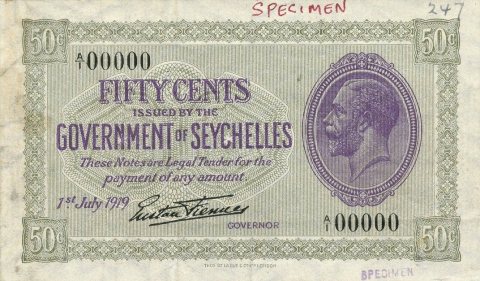
The Paper Currency Ordinance of 1919 (No. 13 of 1919) was assented to on 6th November 1919. It provided 15,000 rupees in 10,000 notes of 50 cents and 10,000 of 1 rupee, to replace coins of the same values. The 50 cents and the 1 rupee were printed locally in November 1919 and signed by hand by the Governor, Sir Eustace Twisleton-Wykeham-Fiennes.
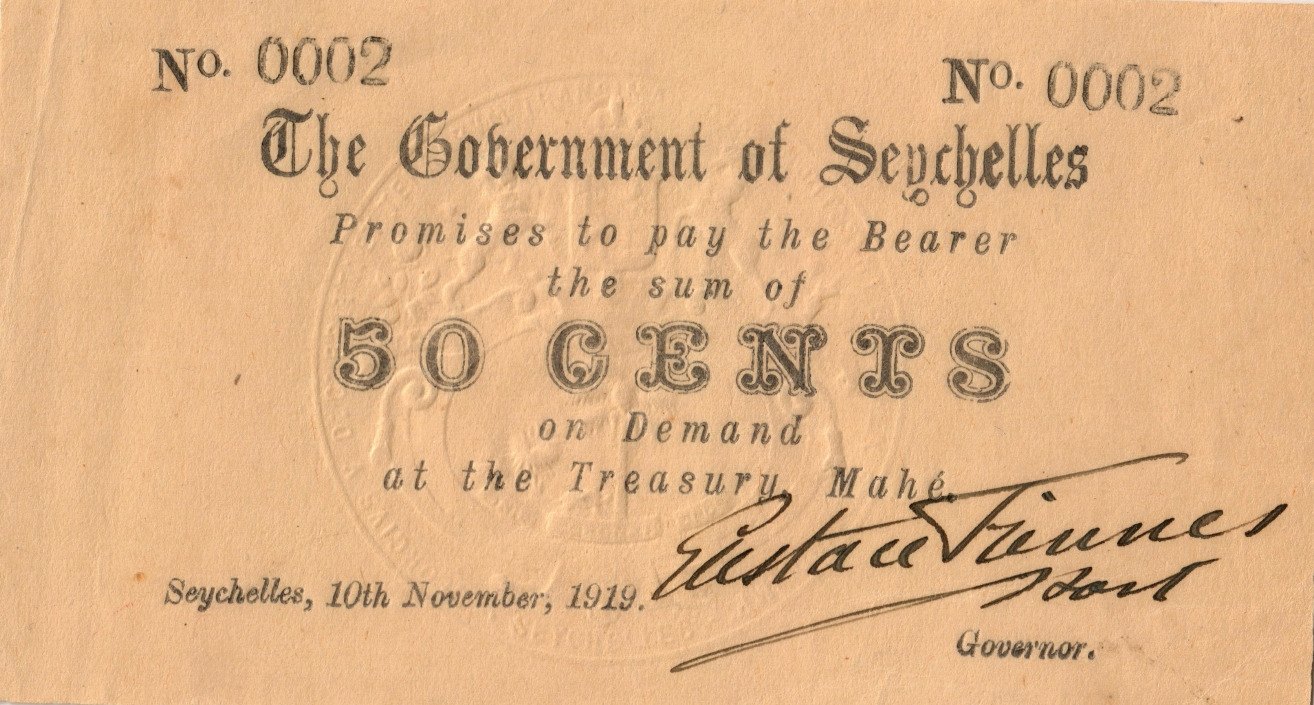
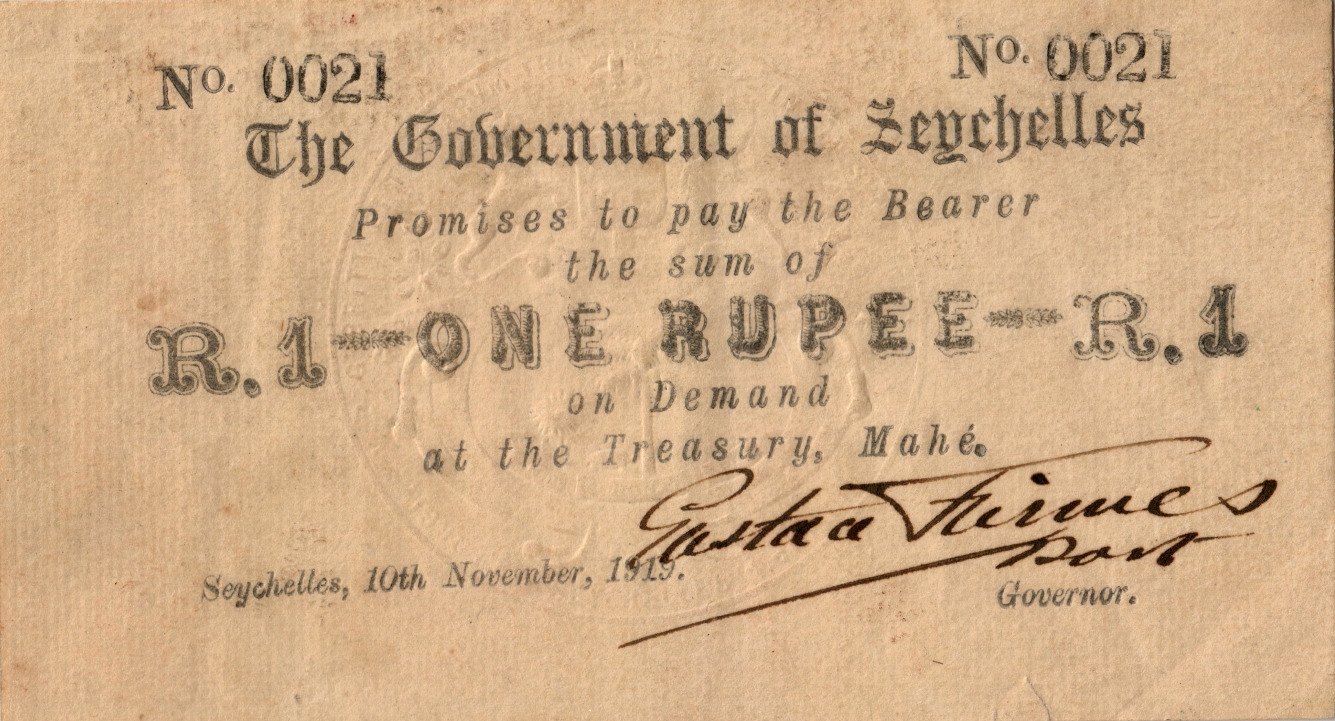
Harris adds the details of the notes themselves:
- They are on plain white paper with no watermark, and the signature reads "Eustace Fiennes, Bart", with the date November 10, 1919.
- The paper of the 50 cents is thinner and poorer than that of the 1 rupee, and only the 1 rupee is embossed with the Colony's seal.
- The 50 cents promises payment on demand at the Treasury, Mahe.
- Harris had seen two notes of 50 cents, numbered 0532 and 0928, and one of 1 rupee, numbered 0028. Each number has four figures.
Two points differ between the sources. Harris only assumes 10,000 notes of each value and calls the evidence not conclusive, where the Ordinance states the number. And Harris gives the size as about 6 1/4 by 3 inches, where the Pick pages have 138 by 75 mm.
Harris knew of no other 50 cents or 1 rupee printed in the Colony.
June 1942: a local 5 rupees
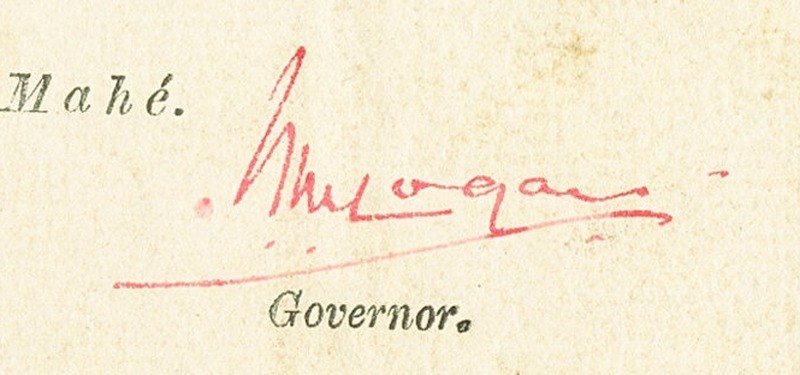
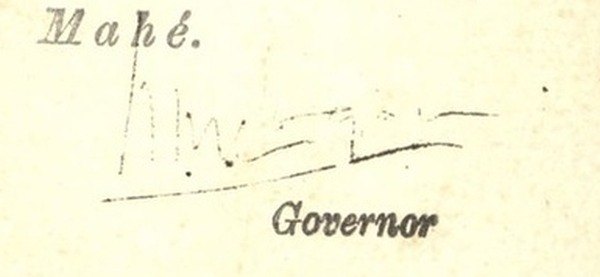
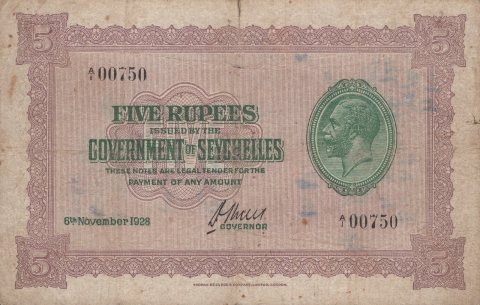
The 5 rupees of 20th June 1942 was printed locally on handcut paper, with an embossed seal and a number without a prefix, and signed by hand by Governor Logan, in red ink on some notes and in black on others.
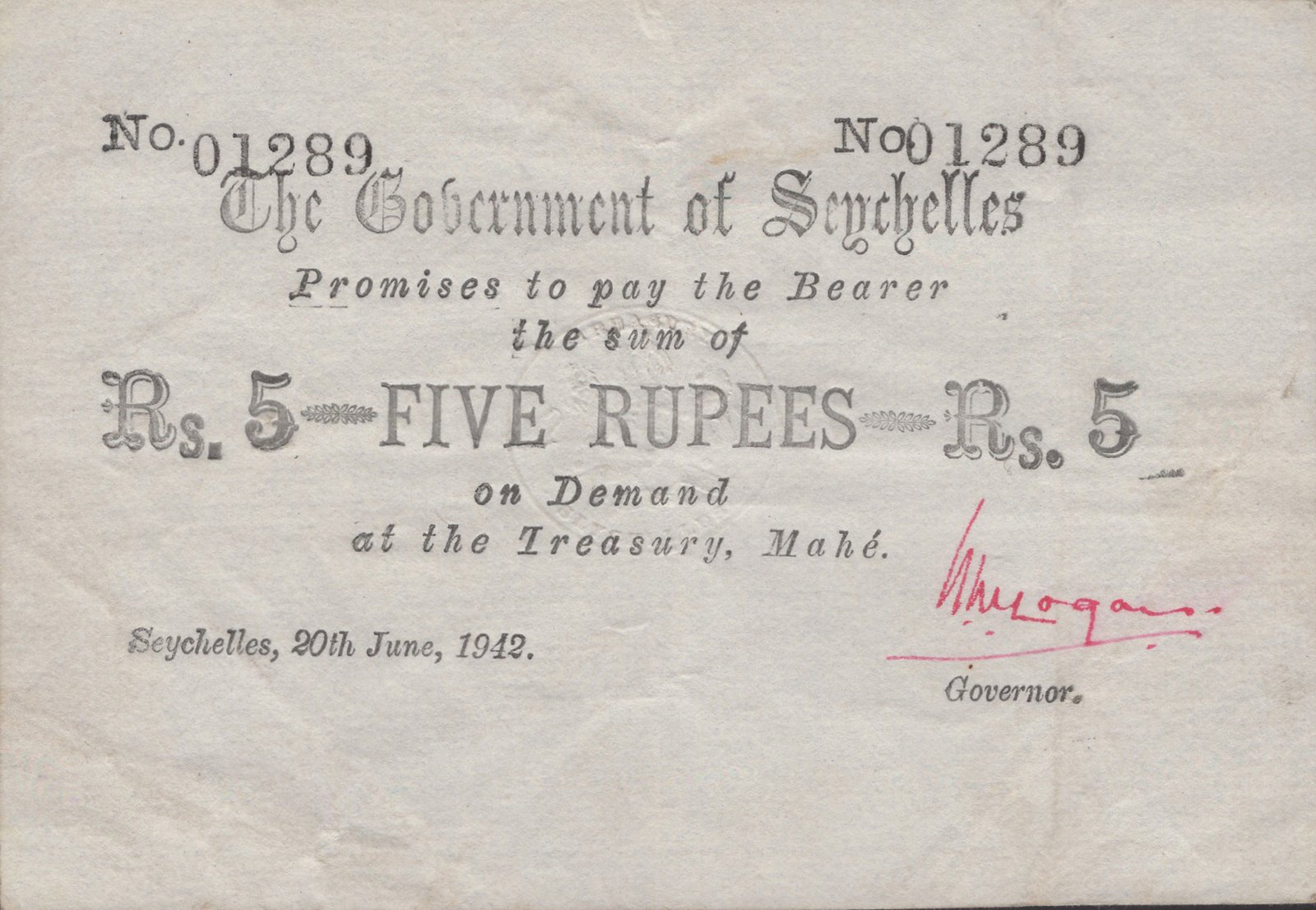
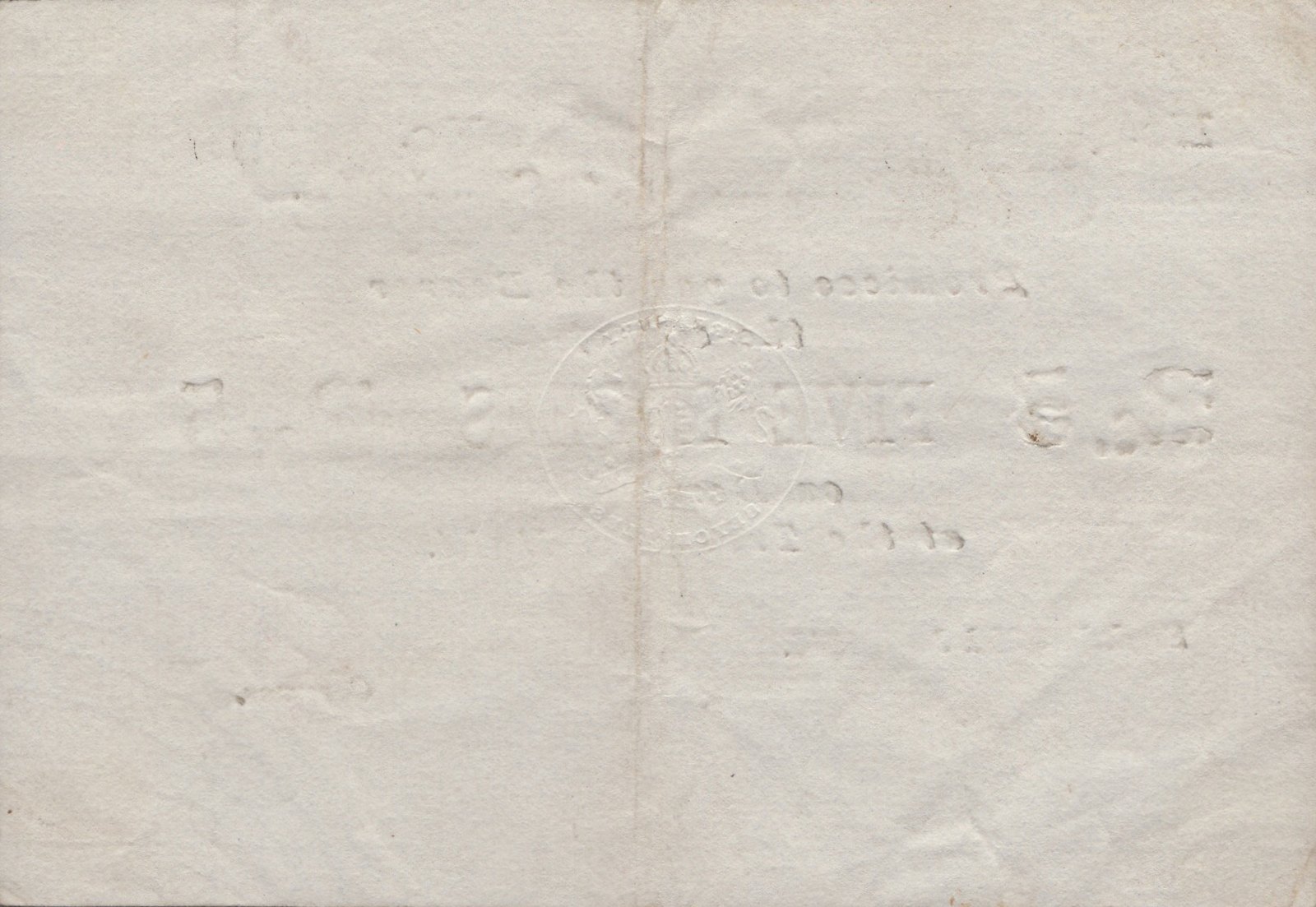
The Pick pages and Harris give three dates around it without joining them. Logan took office on 30 March 1942, by Harris's list. The King George VI 5 rupees printed by De La Rue is dated 7th April 1942, and the printer's approval copy of that issue was approved in pencil on 9 June 1942. The local note is dated 20th June 1942, after that approval. Heritage Auctions (13 January 2022, lot 28381) says the local note was issued before the De La Rue notes could be delivered, that the embossed seal is its only security feature, and that two examples were then in the grading service's population report. No source read here gives the law or notice under which the note was issued, or how many were printed.
Other colonies' notes made in a hurry in the two wars are described in Wartime and occupation: what the design archive keeps from 1914 to 1945.
Sources
- The Pick pages of the Seychelles in this catalogue.
- Leslie Harris, "Paper Money of Seychelles", Coins: The Magazine of Coin Collecting, volume 16 number 2, February 1969, pages 40 to 44.
- Seychelles Ordinance No. 14 of 1914 (Gazette Extraordinary No. 41 of 11th August 1914, page 257); the bill of the Paper Currency (Repeal) Ordinance, 1916; Ordinance No. 13 of 1919: all in the Johns Hopkins archive of currency boards.
- The Colonial Office Lists, for the offices of Vaudin, Baldwin and Chitty.
- Heritage Auctions, 13 January 2022, lots 28379 and 28381.
Member comments
Log in or register to post a comment.