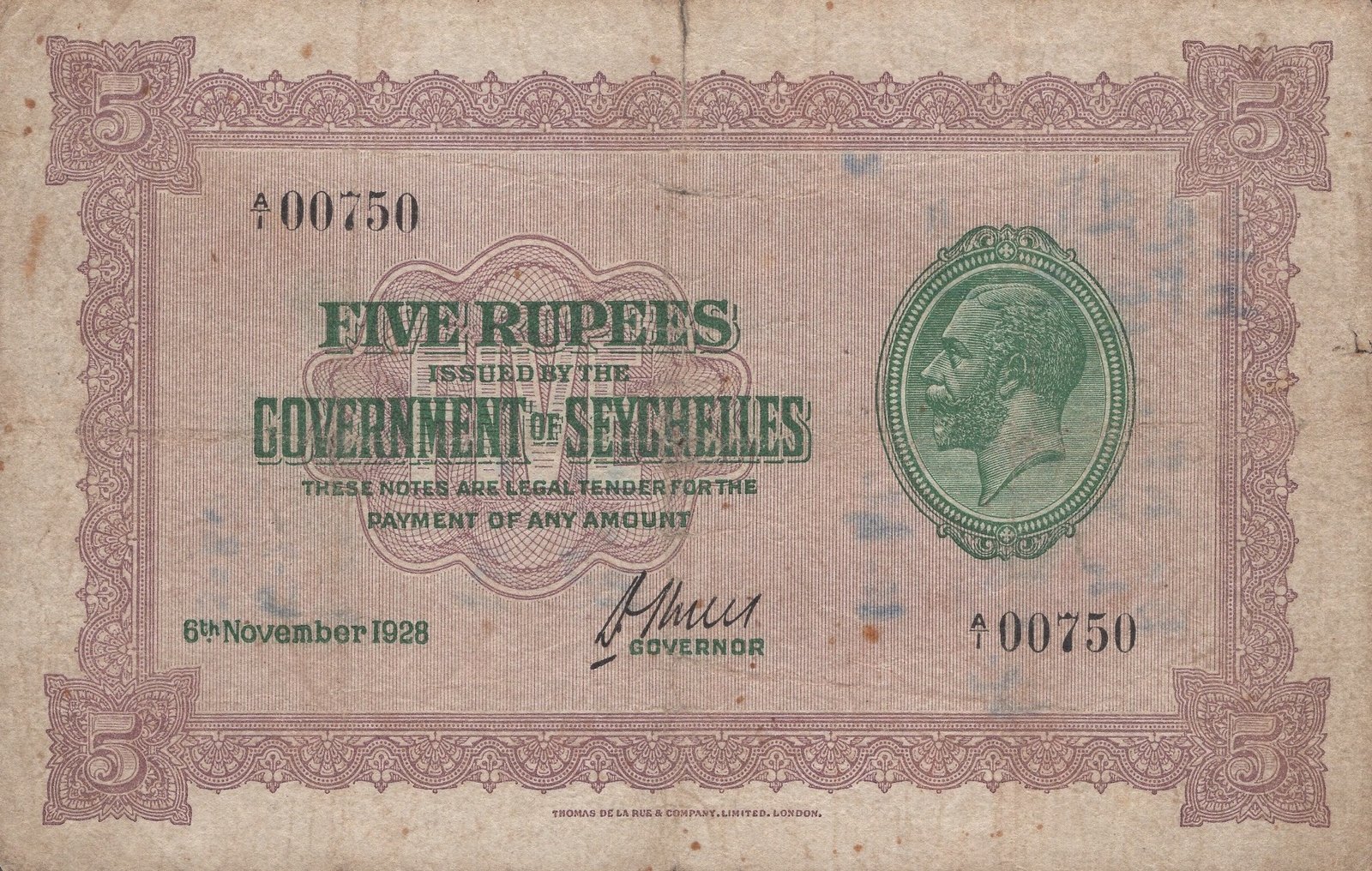
This article sets out the currency laws of the Seychelles in order of time, from the Ordinance of August 1914 to the Seychelles Currency Ordinance of 1974. It is drawn from the texts of the Ordinances kept in the Johns Hopkins archive of currency boards, from the lists of Ordinances printed in the annual reports on the Colony, and from An Economic Survey of the Colonial Empire for 1932, 1933 and 1935. The issues themselves are told in The paper money of the Seychelles, 1914 to 1975; this article looks at what the laws said about cover, payment and the chain of amendments, which the Pick pages give only in part.
Before the first law
The Colony used other people's paper long before it had its own. Reports showing the Present State of Her Majesty's Colonial Possessions for 1877 (published 1879, pages 281 to 282) list among the imports of the Seychelles "Specie (in rupees and currency notes of Mauritius)", to the value of 77,402.86 rupees; this was read in the text of the volume only. The annual report on the Seychelles for 1909 says that Mauritius paper was taken at the Treasury and Indian paper was not. How the Mauritius notes left the Colony is told below.
The laws in order of time
| Law | Date | What it provided | How it was read |
|---|---|---|---|
| Paper Currency Ordinance, No. 14 of 1914 | Assented to 10th August 1914; Gazette Extraordinary No. 41 of 11th August 1914, page 257 | A Board of the Treasurer and the Auditor; up to 180,000 rupees in notes of 5 and 10 rupees, and no other values or sums; notes to bear the signatures of the Commissioners in office on their date and to be stamped; payable only in Indian silver rupees | Page image |
| Paper Currency (Repeal) Ordinance, 1916 | The printed bill; the day of coming into force is left blank | The notes of 1914 to cease to be legal tender and to be no longer payable at the Treasury | The bill only |
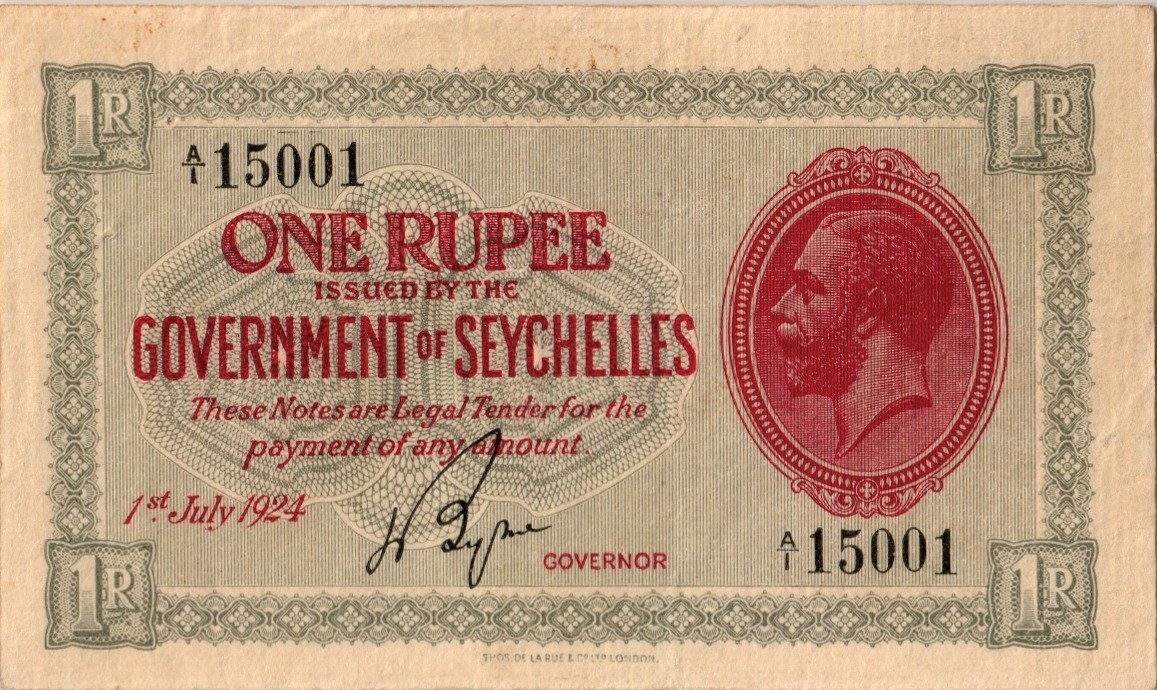
| Paper Currency Ordinance, No. 13 of 1919 | Assented to 6th November 1919 | 15,000 rupees in 10,000 notes of 1 rupee and 10,000 of 50 cents, fully covered by silver; not payable until six months after their date; design approved by the Governor; the Governor's signature or a facsimile of it | Page image |
| Paper Currency (Amendment) Ordinance, No. 2 of 1924 | Assented to 17th July 1924; Gazette No. 29 of 19th July 1924 | The issue raised to 50,000 rupees, as 45,000 notes of 1 rupee and 10,000 of 50 cents; cover one quarter in silver and three quarters in Indian or Mauritius Government notes | Page image |
| Paper Currency Ordinance, 1928 (No. 3 of 1928 in the archive text) | Assented to 30th May 1928 | 250,000 rupees in 10,000 notes of 50 cents, 45,000 of 1 rupee, 20,000 of 5 rupees, 5,000 of 10 rupees and 1,000 of 50 rupees; design approved by the Governor; the Governor's signature or its facsimile | Page image |
| Paper Currency Revised Ordinance, 1928 (No. 7 of 1928 in the archive text and the annual report for 1930; see below) | Assented to 5th November 1928 (page 40) | The Governor may by warrant issue notes of any values and amounts, so long as the total in circulation does not pass 250,000 rupees; the Governor's signature or its facsimile; payable in Indian silver coin or Indian notes | Page image |
| No. 4 of 1929 | 1929 | Amends No. 7 of 1928; what it changed is not recorded | Named in later laws |
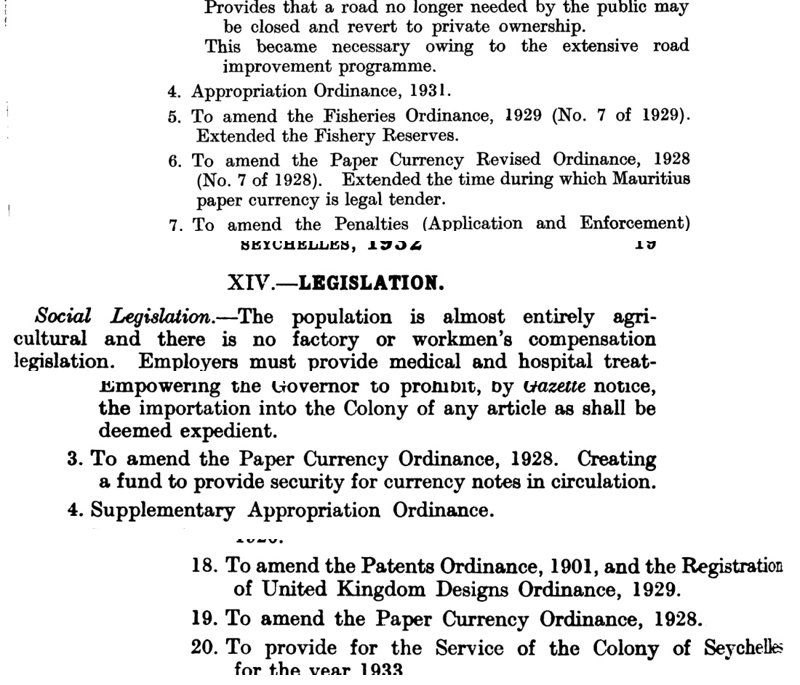
| No. 6 of 1930 | 1930 | Amends No. 7 of 1928: "Extended the time during which Mauritius paper currency is legal tender" | Annual report for 1930, page image |
| No. 3 of 1932 | Assented to 23rd April 1932 (archive text) | Amends the law of 1928: a fund "to provide security for currency notes in circulation" (annual report for 1932, item 3 of its list); the limit raised to 500,000 rupees (the archive text, read by machine only) | Report: page image; Ordinance: text only |
| No. 19 of 1932 | 1932 | "To amend the Paper Currency Ordinance, 1928", with no more said (annual report for 1932, item 19 of its list) | Annual report for 1932, page image |
| No. 25 of 1934 | 1934 | Amends the law of 1928; what it changed is not recorded | Named in the law of 1936 |
| Proclamation | 15th December 1934 | The legal tender of Mauritius notes ended | Economic Survey 1935 and annual report for 1934, page images |
| Seychelles Currency Notes Ordinance, No. 2 of 1936 | Assented to 30th January 1936; Gazette Supplement of 1st February 1936 | The Treasurer issues notes of values and designs approved by the Secretary of State; legal tender for any amount; one rupee for 1s 6d; a Note Security Fund held with the Crown Agents; earlier notes deemed issued under it; repeals the laws of 1928 to 1934 | Text only |
| Coinage Ordinance, No. 3 of 1939 | March 1939 | Seychelles coins, which may be issued in exchange for currency notes; section 16 says nothing in it stops notes under the law of 1936 from being legal tender | Text only |
| Seychelles Currency Ordinance, No. 12 of 1974 | Assented to 7th June 1974 | Two or three Commissioners of Currency, holders of public offices named by the Governor; notes legal tender for any amount; the rupee at 7.5 new pence until fixed by proclamation | Text only |
1914: a board of two, and payment in silver
The Ordinance of 1914 gave the issue to a Board of two officers, the Treasurer and the Auditor, and asked that each note carry the signatures of the Commissioners in office on its date. The 5 rupees and 10 rupees of 11th August 1914 are signed by Vaudin and Chitty. The Colonial Office List for 1919 gives the record of service of William Marshall Vaudin, I.S.O. (1914): acting auditor of the Seychelles from 9th May to 10th November 1907, from 8th February to a day in September 1908 that cannot be read in the text, from 2nd February to 10th April 1911, and from 9th May 1912; acting treasurer from 19th April 1915 to 9th January 1916; treasurer and collector of customs from June 1918. The List for 1918 gives Louis Ogilvy Chitty, I.S.O. (1917), as auditor and inspector of schools in the Seychelles from April 1898, and treasurer, collector of customs and manager of the savings bank from 27th February 1911. The List for 1914 names W. F. Baldwin as the Auditor, for whom Vaudin was acting. All three Lists were read in the text only.
The notes could be paid only in Indian silver rupees. The emergency notes article tells how they were printed and burned. The Ordinance names no 50 cents or 1 rupee, which is why the Pick pages of the 50 cents and 1 rupee of 1914 say their authority is not known.
1919 and 1924: silver, then other governments' notes
The Ordinance of 1919 asked for the small notes to be fully covered by silver and made them payable only six months after their date. Tanay Agarwal's working paper on the Seychelles currency board (Johns Hopkins Institute for Applied Economics, Studies in Applied Economics no. 46, page 3) gives 8th November 1919 as the day the Ordinance was enacted; the text in the archive has the assent on 6th November 1919, four days before the date on the 50 cents and 1 rupee printed in the Colony.
The amendment of July 1924 changed the cover. A quarter was to be held in silver and three quarters in Indian or Mauritius Government notes. From 1924, then, the law had the Colony's own 50 cents and 1 rupee covered in large part by the paper of two other governments.
1928: two Ordinances in one year
Two laws of 1928 stand behind the 5 rupees, 10 rupees and 50 rupees. The Ordinance of 30th May set out each value and its number of notes. The Revised Ordinance of 5th November dropped the list: the Governor might issue any values by warrant, with a ceiling of 250,000 rupees in circulation, payable in Indian silver coin or Indian notes.
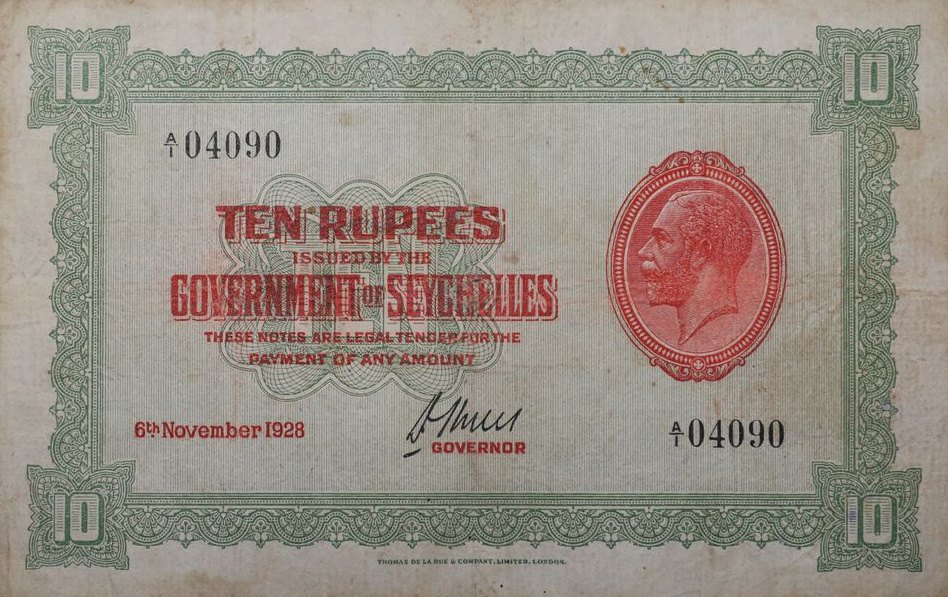
Which of the two is No. 7 of 1928 is not settled. The annual report for 1928 (No. 1450, page 6, read on the page image) lists among the year's nine Ordinances "No. 7.—An Ordinance to amend the Paper Currency of Seychelles" and does not say which law of the year that is. The text in the Johns Hopkins archive gives No. 3 to the Ordinance of 30th May and No. 7 to the Revised Ordinance of 5th November, and the annual report for 1930 names "the Paper Currency Revised Ordinance, 1928 (No. 7 of 1928)". Agarwal's paper (page 3) has the revised Ordinance passed on 30th May 1928, the date the archive gives for No. 3. The Pick pages put no number on either law. The Seychelles Gazette or Blue Book for 1928 would settle it; neither has been read.
1929 to 1934: amendments, the security fund and the end of Mauritius paper
The law of 1928 was amended five times before 1936: No. 4 of 1929, No. 6 of 1930, Nos. 3 and 19 of 1932, and No. 25 of 1934. The law of 1936, in the archive text read by machine, names all five among the laws it repealed. Only two are described in the sources read. No. 6 of 1930 extended the time during which Mauritius paper was legal tender. The annual report for 1932 numbers the year's Ordinances, and its item 3, "To amend the Paper Currency Ordinance, 1928", is described as "Creating a fund to provide security for currency notes in circulation"; that the report's numbers are the Ordinance numbers is likely but not printed as such. The text in the Johns Hopkins archive, read by machine only, has No. 3 of 1932 raising the limit to 500,000 rupees. The Pick pages say "an amending ordinance of 1932" raised the limit, without its number.
The report for 1931 (No. 1609, page 16, read on the page image) gives the notes in circulation at the end of the year as "Rs.232,567 secured by investments and cash in hand in terms of law". The passages of the other years' reports quoted in the records stop at the figure. The yearly figures are in the table of the first article.
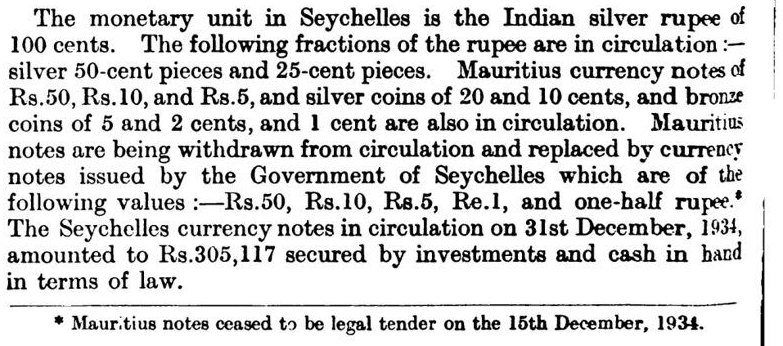
An Economic Survey of the Colonial Empire shows the Colony working towards sterling. The edition for 1932 (Colonial No. 95, published 1934, pages 216 to 217) says there was a local issue of notes and that "Mauritius and Indian currency notes" were also in circulation but were being withdrawn; it was proposed to end the legal tender of Mauritius notes when Mauritius issued its new series. The edition for 1933 (Colonial No. 109, published 1935) adds that proposals were under consideration for a Seychelles rupee linked to sterling at 1s 6d. The edition for 1935 (Colonial No. 126, published 1937, read on the page image) says that the legal tender of Mauritius notes was ended by Proclamation on 15th December 1934, and that in January 1936 the currency was put on a sterling basis at 13.33 rupees to the pound. The annual report for 1934 (No. 1747) gives the same day in a footnote. No source read here gives the number of the Proclamation.

1936: the Treasurer's notes
The Seychelles Currency Notes Ordinance of 1936 swept away the law of 1928 and its five amendments. It gave the issue to the Treasurer, made the designs subject to the Secretary of State, fixed one rupee at 1s 6d, set up a Note Security Fund held with the Crown Agents, and treated the notes already out as issued under it. It came into force on a day to be fixed by proclamation, which no source read here gives. Agarwal's paper (page 3) says the Ordinance was published on 1st February 1936 and named the Colonial Treasurer as Currency Commissioner.
Until November 2026 the Pick pages said that this Ordinance set up a Seychelles Currency Board with a limit of 900,000 rupees. The eight pages of the text in the Johns Hopkins archive, searched by machine, contain neither a board nor that limit, and the pages were changed. A later amendment could have added them; none is in the archive.
1939, 1947 and 1974
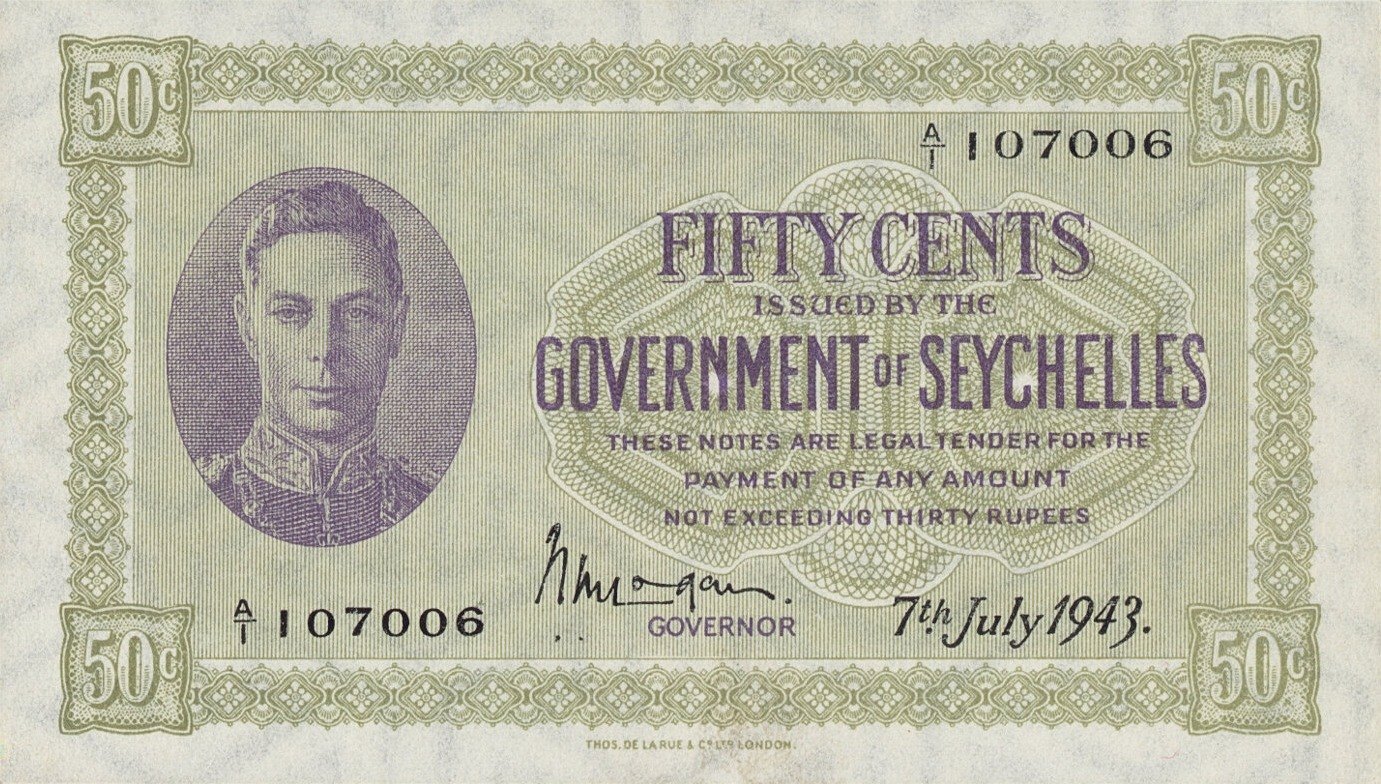
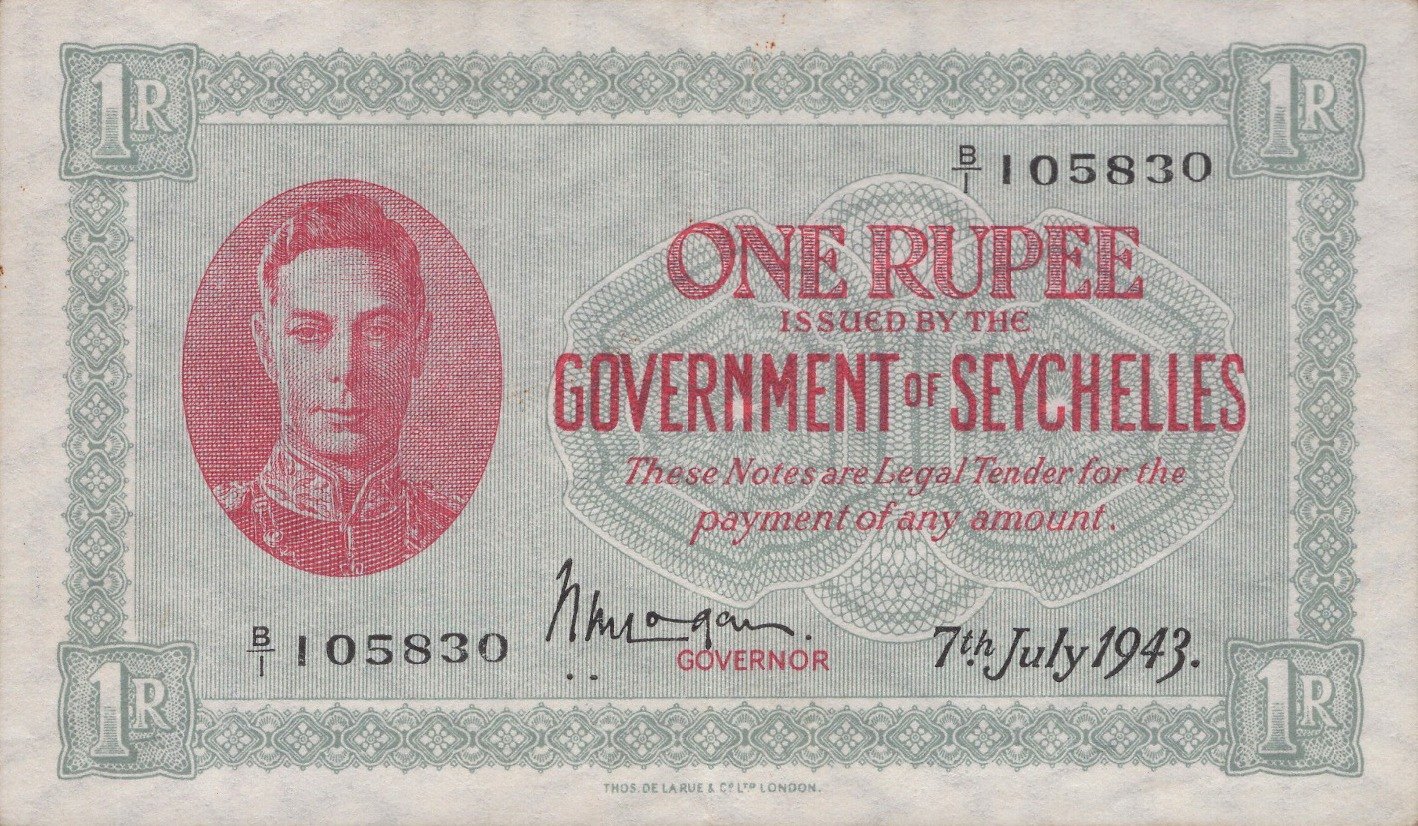
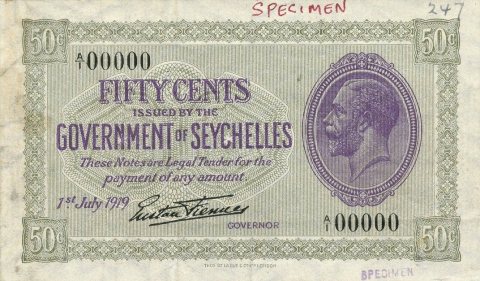
The Pick pages say that in July 1938 the Colonial Office approved replacing the 50 cents and 1 rupee notes with coins. The Coinage Ordinance of 1939 allowed coins to be issued in exchange for notes, but its text does not recall the notes, and section 16 keeps notes issued under the law of 1936 as legal tender. Notes of 50 cents and 1 rupee were printed again, dated 7th July 1943 (50 cents, 1 rupee). If the earlier small notes were recalled, it was by some other order, not in the archive.
On 3rd March 1947, the Pick pages say, the colonial treasurer declared that the coins and notes of other countries, except the 1, 2 and 5 cent coins of Mauritius, were no longer legal tender.
The Seychelles Currency Ordinance of 1974 returned to a board: two or three Commissioners of Currency, holders of public offices named by the Governor. It valued the rupee at 7.5 new pence until a proclamation fixed it. Its text was read by machine only.
What the laws leave open
- The day the Repeal Ordinance of 1916 came into force: the bill leaves it blank.
- What Nos. 4 of 1929, 19 of 1932 and 25 of 1934 changed.
- Which of the two laws of 1928 is No. 7: the archive text and the report for 1930 give the number to the Revised Ordinance, the report for 1928 gives only a title, and Agarwal dates the revised Ordinance to 30th May.
- The number of the Proclamation of 15th December 1934 and of the one that brought the law of 1936 into force.
- Whether any order recalled the George V 50 cents and 1 rupee after 1939.
- When Indian notes ceased to be legal tender in the Colony: the Economic Survey for 1932 says they were being withdrawn, and none of the sources read gives an end.
Sources
- Seychelles Ordinances in the Johns Hopkins archive of currency boards: No. 14 of 1914 (Gazette Extraordinary No. 41 of 11th August 1914, page 257); the bill of the Paper Currency (Repeal) Ordinance, 1916; No. 13 of 1919; No. 2 of 1924 (Gazette No. 29 of 19th July 1924); No. 3 and No. 7 of 1928; No. 2 of 1936; No. 3 of 1939; No. 12 of 1974.
- Tanay Agarwal, working paper on the Seychelles currency board, Studies in Applied Economics no. 46, Johns Hopkins Institute for Applied Economics, pages 2 to 3.
- Colonial Reports, Annual, Seychelles: the reports for 1909, 1924, 1928 (No. 1450), 1930 (No. 1560), 1931 (No. 1609), 1932 (No. 1651), 1933, 1934 (No. 1747), 1935, 1936 and 1937.
- An Economic Survey of the Colonial Empire: 1932 (Colonial No. 95, 1934), 1933 (Colonial No. 109, 1935) and 1935 (Colonial No. 126, 1937).
- Reports showing the Present State of Her Majesty's Colonial Possessions, for 1877 (1879), Seychelles, pages 281 to 282.
- The Colonial Office Lists for 1914, 1918 and 1919.
- The Pick pages of the Seychelles in this catalogue.
Member comments
Log in or register to post a comment.