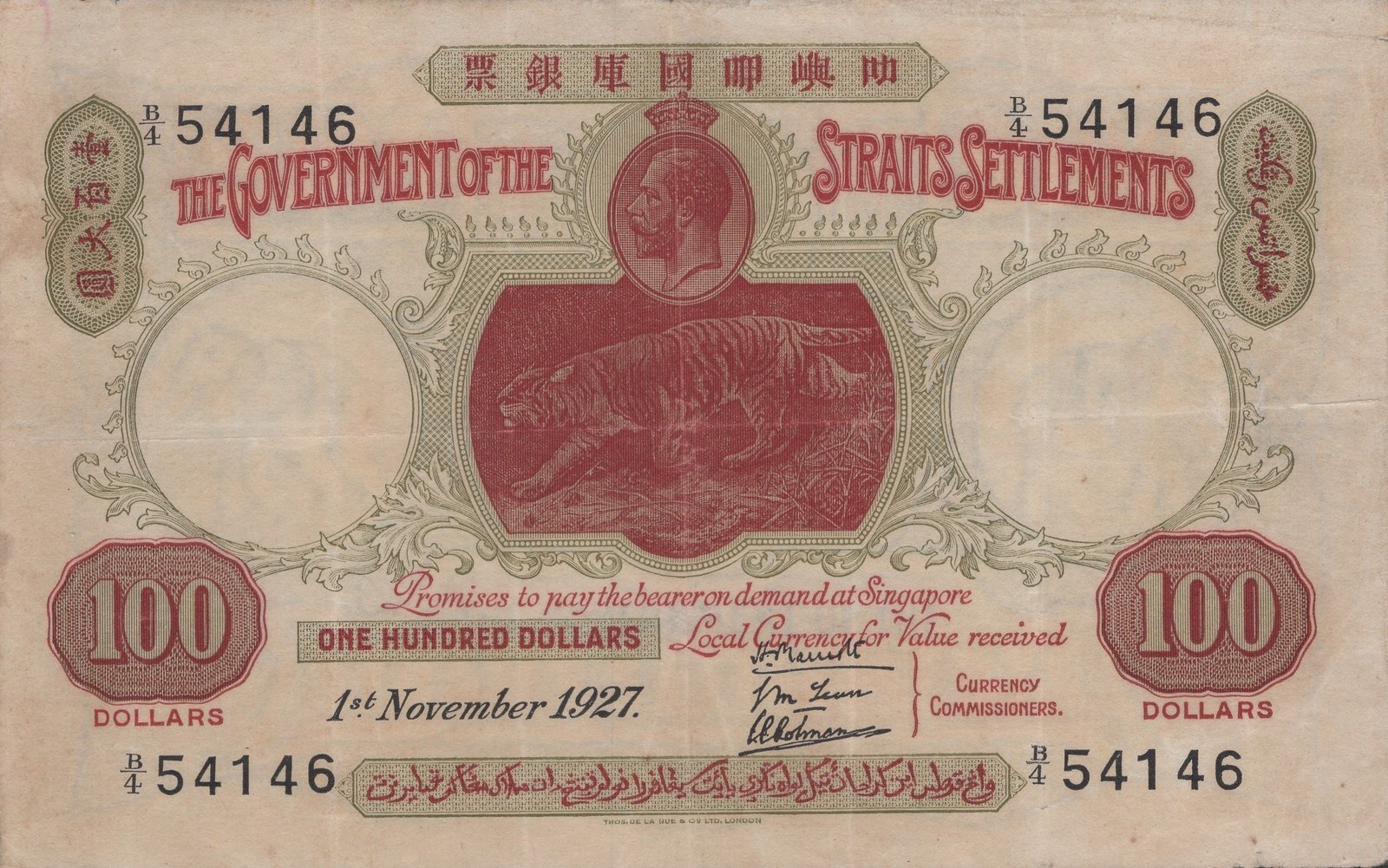
No printing figure from the printers or the Commissioners of Currency is on the Pick pages of the Straits Settlements. What there is comes from two places: the prefixes on the notes themselves, and the descriptions the auction houses wrote when they offered the high values and the printers' archive pieces. This article sets out both. Every house statement is that house's claim and is named with its sale and lot.
100,000 notes to a prefix
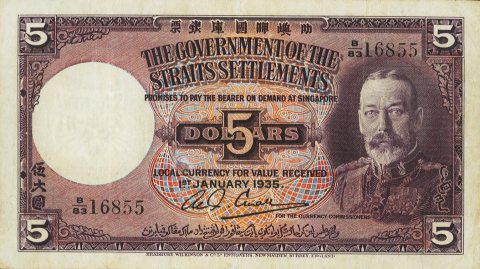
Each prefix of the 5 dollars and 10 dollars of 1931 to 1935 holds 100,000 notes, numbered 00001 to 100000, as the ranges on the printers' specimens show; Heritage (23 June 2021, lot 26533) says the same. Heritage applies the same rule to the older notes. The Pick pages say of its figures for the large 5 dollars and for the 100 dollars of 1925 to 1933 that they are worked out from the prefixes. Every count below is the house's own, named with its sale and lot.
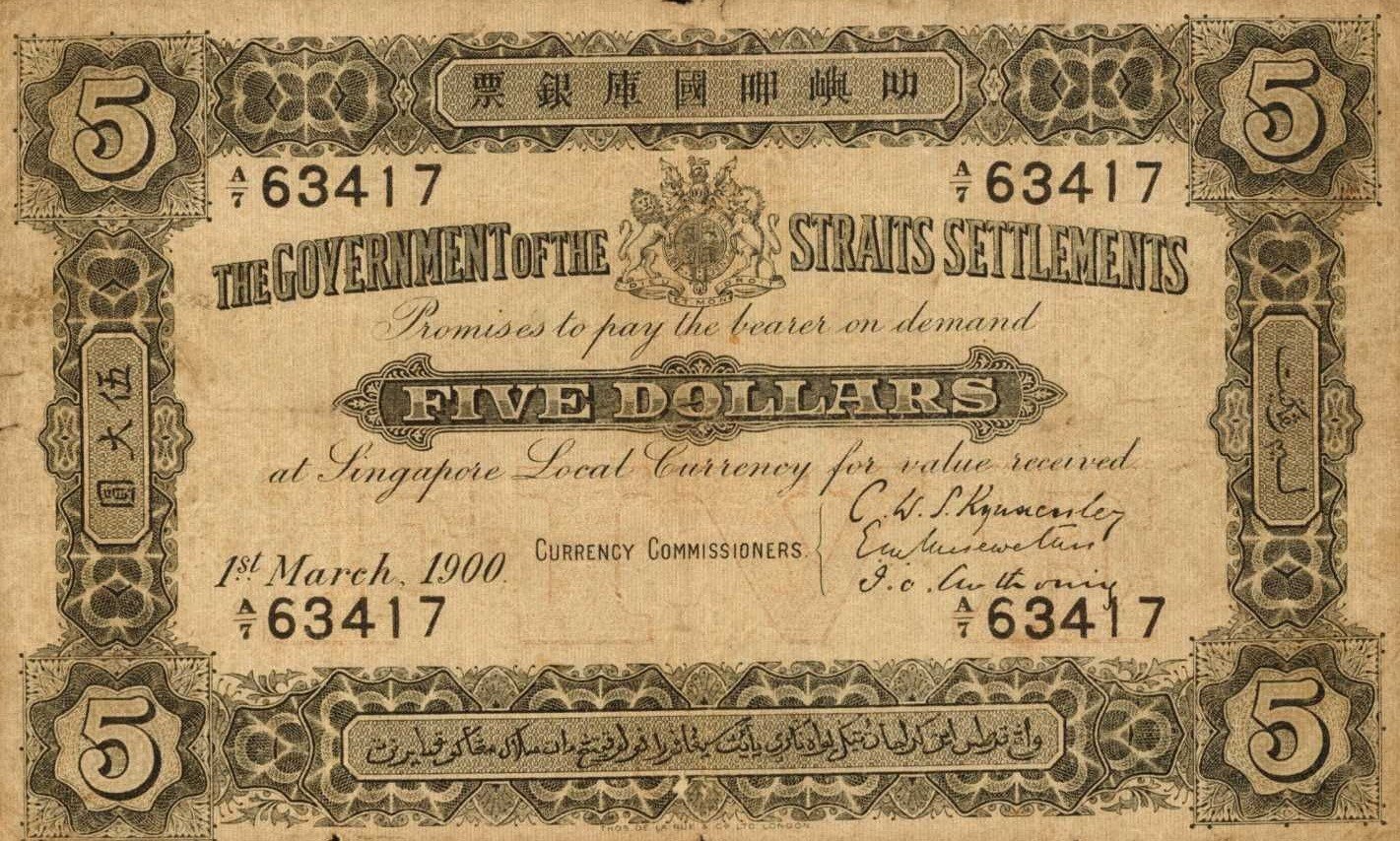
For the large 5 dollars of 1898 and 1900, Heritage (26 March 2026, lot 24501, and its sale of 5 December 2026, lots 11042 and 11043) puts the 1898 date at 500,000 notes at most (prefixes A/1 to A/5) and the 1900 date at 200,000 or fewer (A/6 and A/7).
The 50 and 100 dollars of 1898 to 1909
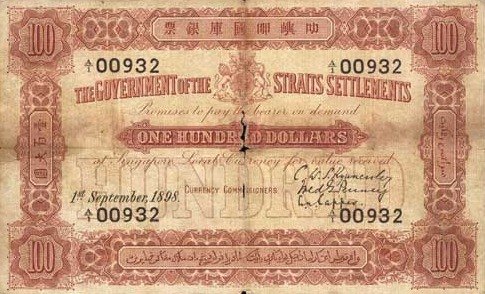
For the 100 dollars, Heritage (sale of 5 December 2026, lot 25010) says perhaps only the prefix A/1 was used for all three dates, so that as few as 100,000 notes of this value were issued. The Pick page gives the prefix A/1 for all three dates: the 1898 note is A/1 00932, the 1901 note that Stack's Bowers offered on 4 April 2018 (lot 60182) is A/1 54319, and the specimen of 1909 is A/1.
The houses do not agree on what is known. Spink (5 July 2008, lot 415) knew of no other 1898 note than A/1 00932. Stack's Bowers in 2018 called 1901 the earliest known date for the type and its note the first issued example the house had seen; the Pick page lists the 1898 date with the note of Spink's sale. Stack's Bowers (25 March 2019, lot 50456) said its 1901 note was then the only one in the PMG population report, and Heritage (20 June 2023, lot 24321) called its note the third genuine example of the value that PMG had graded.
For the 50 dollars of 1898 and 1901, no issued note of 1898 has been recorded. Heritage (20 June 2023, lot 24319) called its note of 1st February 1901 the second that PMG had graded.
The portrait 50 and 100 dollars, 1916 to 1933
These notes have the prefix B, and each date or pair of dates can be followed through it.
| Value and date | Prefix | What the house says |
|---|---|---|
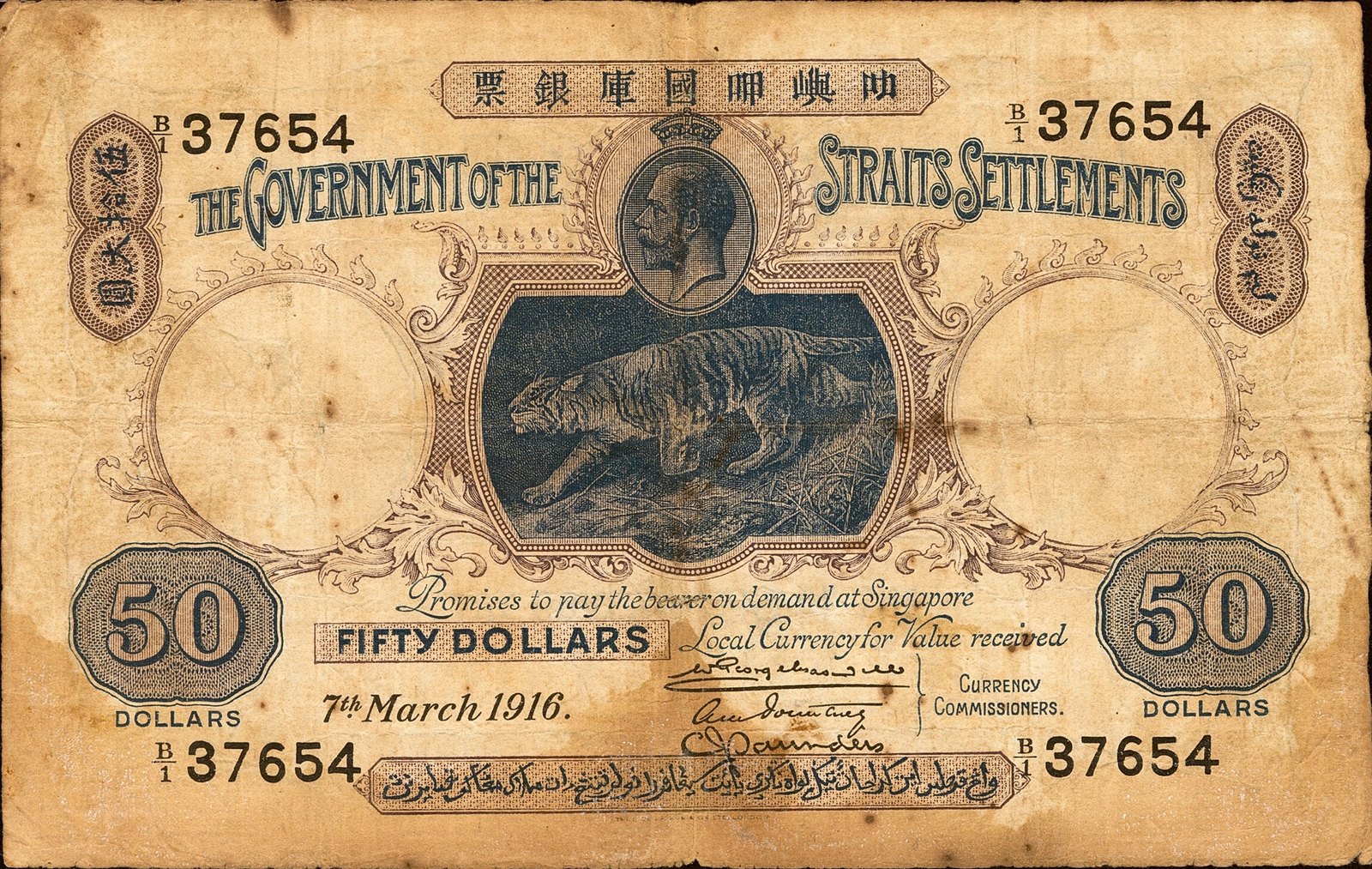
| 50 dollars, 7th March 1916 | B/1 | An issued note, B/1 37654, is in Heritage's sale of 5 December 2026 (lot 11099) |
| 50 dollars, 1st June 1920 | B/2 | At most 100,000 printed (Heritage, sale of 5 December 2026, lot 11098) |
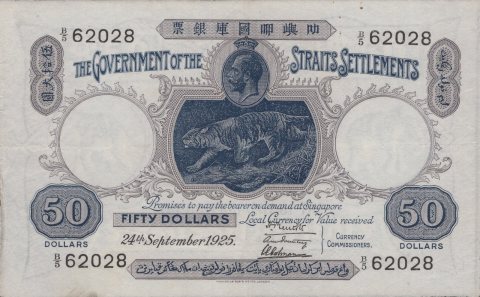
| 50 dollars, 24th September 1925 | B/5, and one note B/4 71276 | no count given |
| 50 dollars, 1st November 1927 | from B/6 (B/6 00023) | At most 100,000 (Heritage, sale of 5 December 2026, lot 11096) |
| 100 dollars, 7th March 1916 | B/1 | At most 100,000 (Heritage, sale of 5 December 2026, lots 11040 and 11041) |
| 100 dollars, 1st June 1920 | B/2 | At most 100,000 (the same lots) |
| 100 dollars, 24th September 1925 | B/3 into B/4, highest seen B/4 47895 | no count given |
| 100 dollars, 1st November 1927 | B/4, lowest seen B/4 51183 | About 50,000, the second half of B/4 (Heritage, sale of 5 December 2026, lots 25008 and 11039; lot 11038 says 50,000 to 60,000) |
Heritage adds that as few as 400,000 notes of 100 dollars were made across the four dates from 1916 to 1927. For the 50 dollars of 1916 and 1920 the photograph of B/1 37654 shows the date 7th March 1916, the three signatures and the serial number, with no specimen marks. For the 100 dollars of 1916 and 1920, Stack's Bowers (14 August 2017, lot 50152) offered B/1 26601 of 1916 and said it was the first note of the type the house had handled.
Of the later dates, no issued 50 dollars of 1st October 1930 or 8th December 1933 has been seen, and no issued 100 dollars of 8th December 1933. The specimens of those dates carry the prefix B/6 for the 50 dollars and B/5 for the 100 dollars. The page for the 50 dollars names no note with the prefix B/3.
The 1,000 and 10,000 dollars
The 1,000 dollars of 17th March 1911 is known from specimens with the prefix A/1. Spink (5 July 2008, lot 0A) sold the note numbered A/1 00001, with the three signatures, a black SPECIMEN overprint and a partial CANCELLED perforation, found with an envelope marked SPECIMEN / ON HIS MAJESTY'S SERVICE. Spink called it a new discovery, not recorded by Tan, C.C. Chan or Pick. The house took it to be the first note of the issue, taken from the top of the delivery and marked as a specimen for reference so that it could not be spent. Noonans (23 March 2024, lot 38), offering the A/1 00000 specimen from the Frank Goon Collection, thought it unlikely that more than a handful were made.
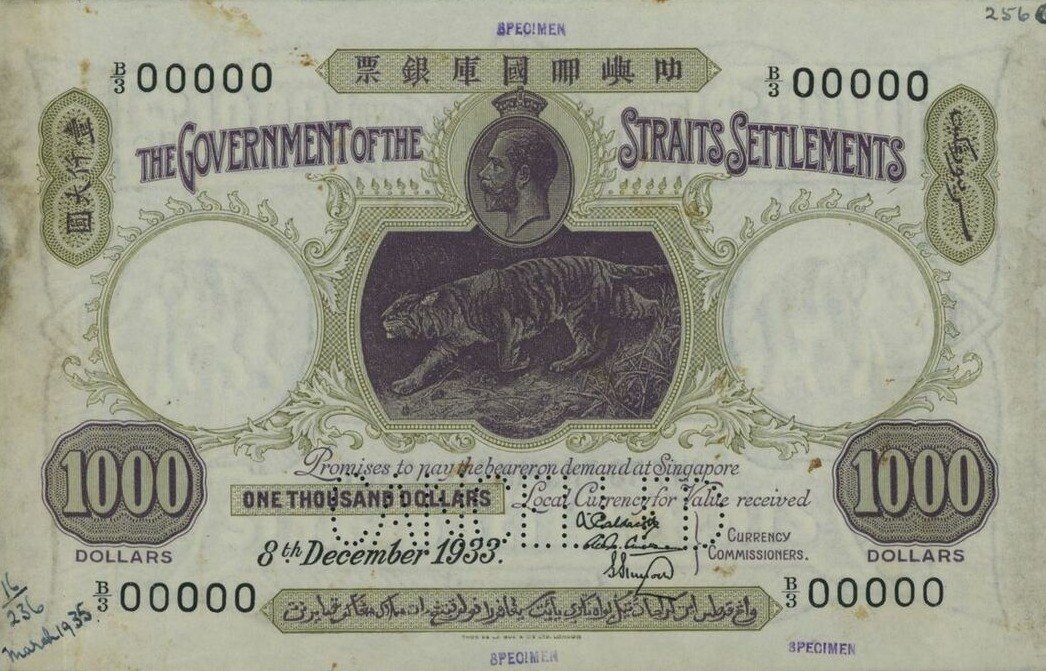
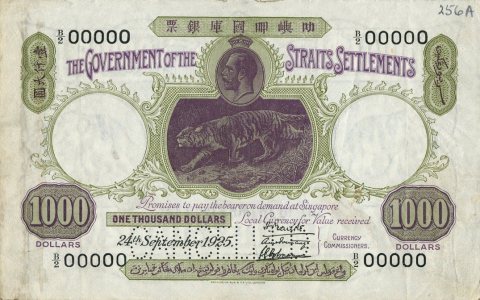
The 1,000 dollars of 1919 to 1933 and the 10,000 dollars are known only from specimens. A specimen of the 1,000 dollars dated 8th December 1933, numbered B/3 00000, was offered by Stack's Bowers (5 October 2023, lot 22200) and by Spink (8 October 2024, lot 448); Stack's Bowers said PMG had graded two notes of the type. A specimen and a proof of the 10,000 dollars carry the requisition mark 95/19.
The model of 1915 for the portrait notes
Spink (9 January 2022, lot 4190) offered a printer's model for a 100 dollars dated 1st March 1915, with the King at top left, the tiger and the serial number A/7 00000. Spink's description says the model was the pattern for all the portrait notes from 50 dollars upward. The house lists the changes marked on it: the three signatures struck through, the date later moved on by a year, and the serial changed to a new series, so that the notes of 1916 begin at B/1. A line at the foot reads "Signatures Black. Design for $10 and above to be used with Watermark No. 7". Spink reads this to mean that the 10 dollars was then meant to have the portrait design too; the 10 dollars kept its old design until 1924.
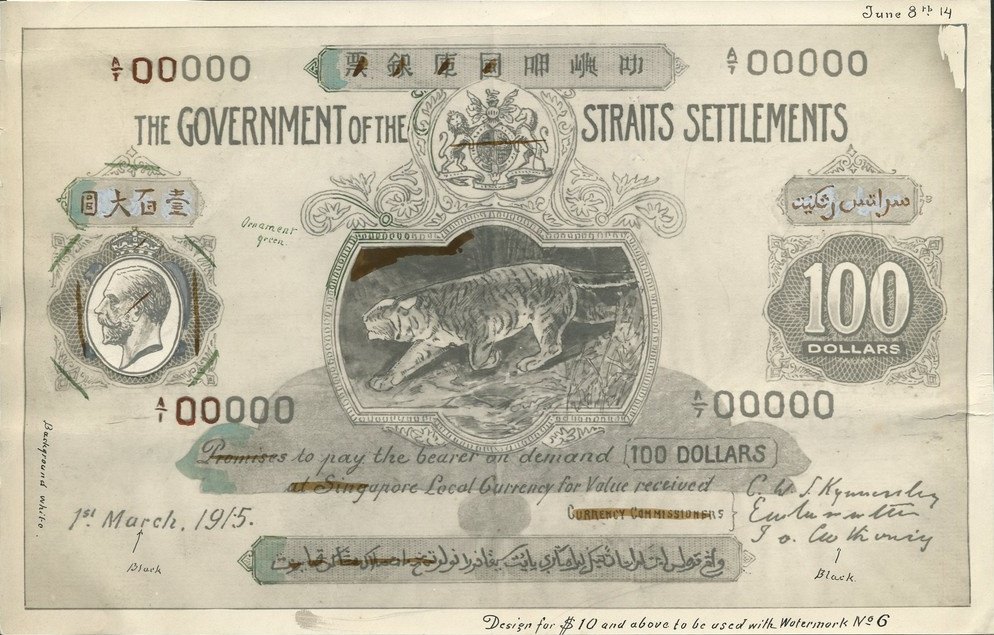
The same description says the 1,000 and 10,000 dollars are believed to have been first issued in 1916. The Pick pages give 1st September 1919 as the first date of both.
The proofs of 1925 and the colour trials
Stack's Bowers offered two pairs of front and back proofs of the 1925 series on 5 October 2023, and its descriptions give the notes written on them. On the 5 dollars (lot 22196) the back is marked as the original proof K, approved for colour on 20th August 1925. On the 10 dollars (lot 22197) the front is a C proof dated 12th June 1925, approved subject to a change in the colour of the scroll work beside the Royal Arms, which is light blue on the proof and purple on the issued note; the back is the original D proof, approved by a letter of 9th July. The house concludes that these were the last or nearly the last proofs before printing. The notes carry the date 1st January 1925; the marks on these proofs are dated June to August 1925.
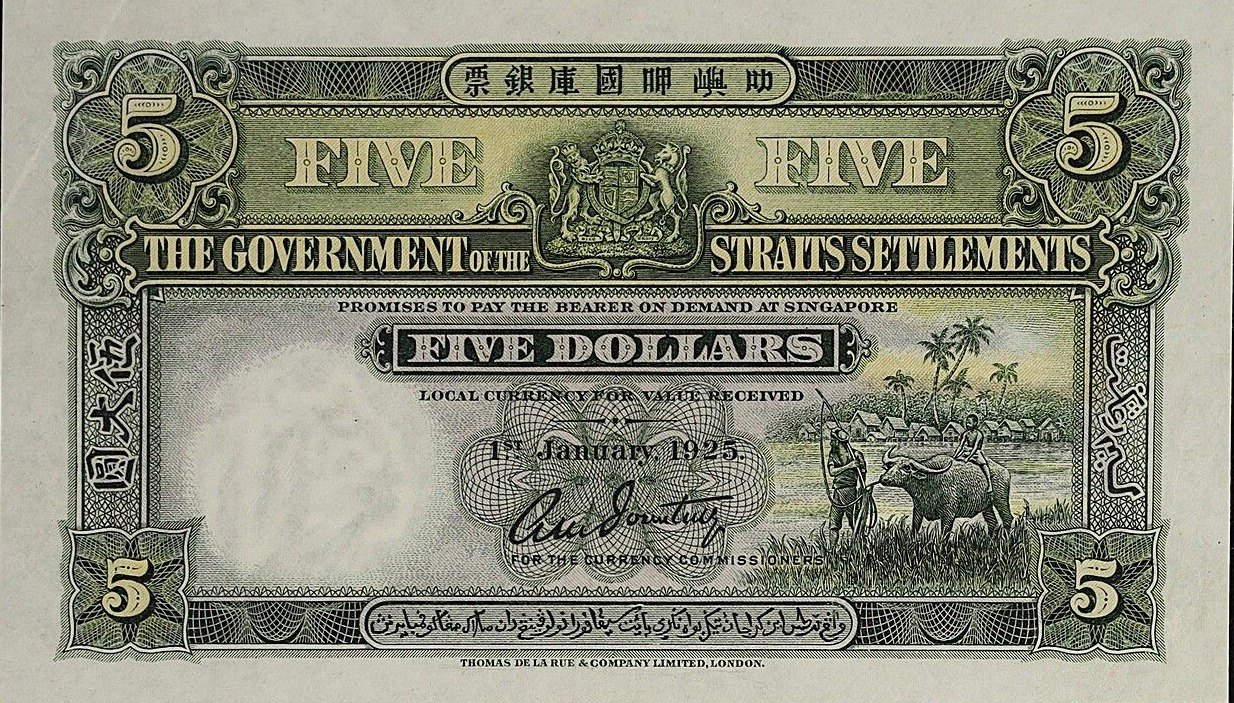
The 1925 colour trials of the 5 dollars are printed on paper watermarked with the head of King George V, not the tiger head of the issued notes. Stack's Bowers (25 March 2019, lot 50460) offered a colour trial of the 1 dollar of 1925 in blue and green, where the issued note is red, with the printer's oval stamp on the front.
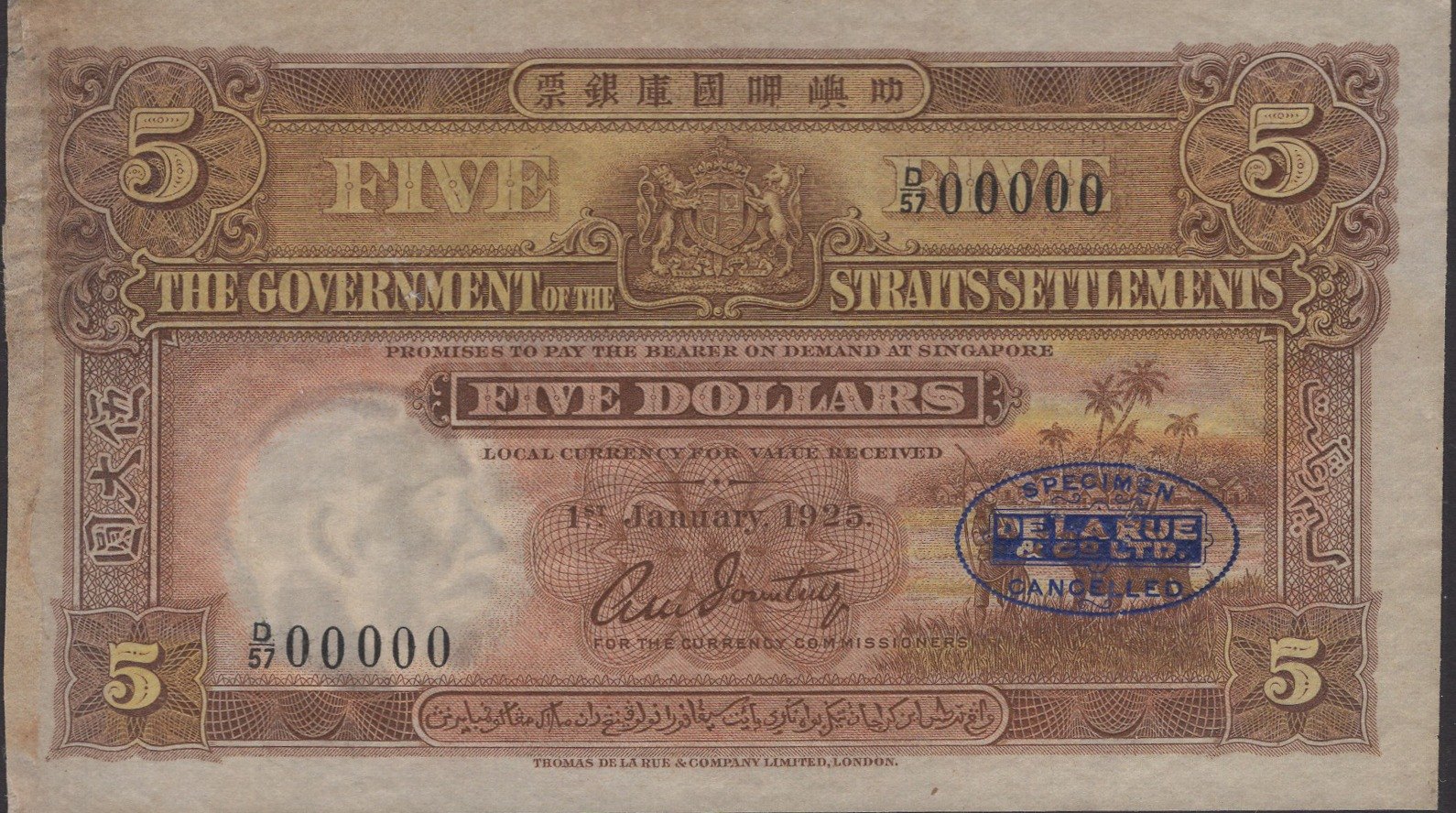
For the series of 1931 to 1935, Heritage (11 December 2021, lot 26529) offered a front and back colour trial of the 1 dollar in orange and brown, with the perforated cancellation of Bradbury Wilkinson, and said PMG had graded one other. Stack's Bowers (19 April 2024, lot 31126) offered a pair for the 5 dollars in grey-green on orange and said PMG had graded three pairs. The archival photograph of a 10 dollars dated December 1929 is followed in From sketch to note.
Specimens made for each print run
Noonans (23 March 2024, lots 68 and 74) says only two of the printers' archive specimens of the 5 and 10 dollars of 1931 to 1935 were made for each print run. They are perforated CANCELLED and have the order number and date inked in the top margin. These are the pieces whose number ranges fix the prefix blocks of each date on the Pick pages. No such specimen of the 10 dollars of 1932 is recorded.
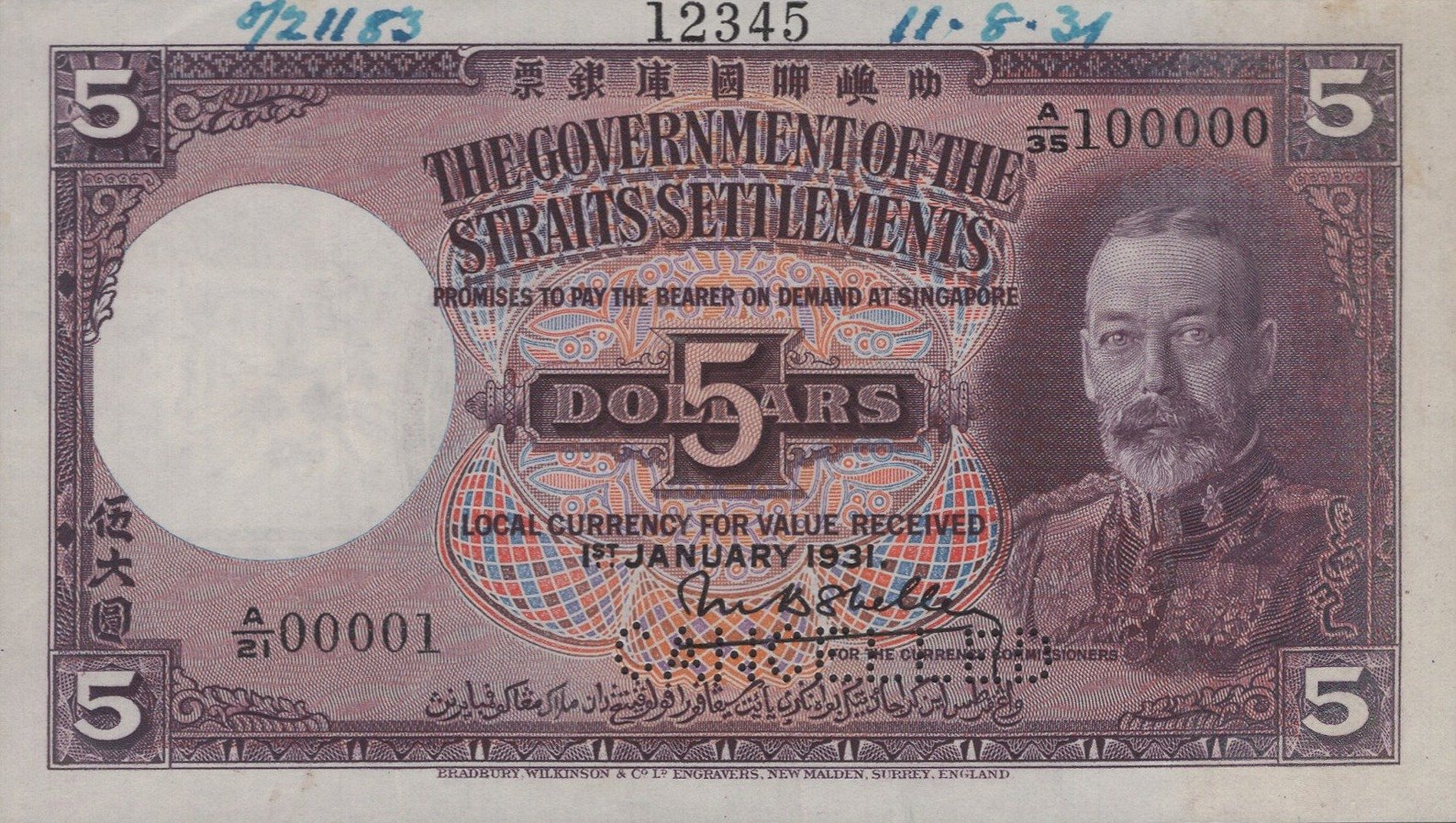
One specimen was made the other way round. Heritage (26 June 2019, lot 26770) describes a 10 dollars of 1st January 1930, prefix E/5, as an issued note that had circulated and was then perforated CANCELLED four times and stamped in purple.
Counts from the grading service
Two Heritage descriptions give counts from the PMG population report at the time of the sale. For the 1 dollar dated 1925 (11 December 2021, lot 26523): almost 560 notes graded, 22 of them Uncirculated. In the description of a 10 dollars dated 1935 (11 December 2021, lot 26536): nearly 725 graded examples, two of them graded higher than Choice Uncirculated 63; the description does not say whether the count is of that date or of the whole type. These are counts of notes sent for grading, not of notes that survive.
Sources
- The Pick pages of the notes named.
- Heritage Auctions: 26 June 2019, lot 26770; 23 June 2021, lot 26533; 11 December 2021, lots 26523, 26529 and 26536; 20 June 2023, lots 24319 and 24321; 26 March 2026, lot 24501; sale of 5 December 2026, lots 11038 to 11043, 11096, 11098, 11099, 25008 and 25010.
- Spink: 5 July 2008, lots 0A and 415; 9 January 2022, lot 4190; 8 October 2024, lot 448.
- Stack's Bowers: 14 August 2017, lot 50152; 4 April 2018, lot 60182; 25 March 2019, lots 50456 and 50460; 5 October 2023, lots 22196, 22197 and 22200; 19 April 2024, lot 31126.
- Noonans: 23 March 2024, lots 38, 68 and 74.
Member comments
Log in or register to post a comment.