For a few years after the First World War the notes of the Government of India passed in Mauritius beside the Colony's own, and in 1920 there were more of them in the island than of the Mauritius Government's notes. We have read three of the yearly printed reports on the Colony, those for 1921, 1922 and 1929, against what our pages already told from the Mauritius Blue Books and the Mauritius Almanac. The reports add how many notes were brought in and sent out again, which Indian notes were meant, and five more years of the Colony's own note circulation. This article puts the figures in one place, from 1919 to 1933.
The source
The Colonial Reports - Annual are the printed reports that each colony sent every year to the Secretary of State. They were sold by H.M. Stationery Office, and each has a number. Three are used here: No. 1149, Mauritius 1921; No. 1179, Mauritius 1922; and No. 1503, Mauritius 1929. Each has a part headed "Currency and Banking" or "Currency". The note figures are for the financial year, 1st July to 30th June; the notes brought in and sent out are counted with the trade of the calendar year.
The counts of Indian notes in the Colony are not in these reports. They are on our pages from the Mauritius Blue Books for 1920 to 1924 and the Mauritius Almanac for 1920, and we repeat them as the pages give them.
Two kinds of notes
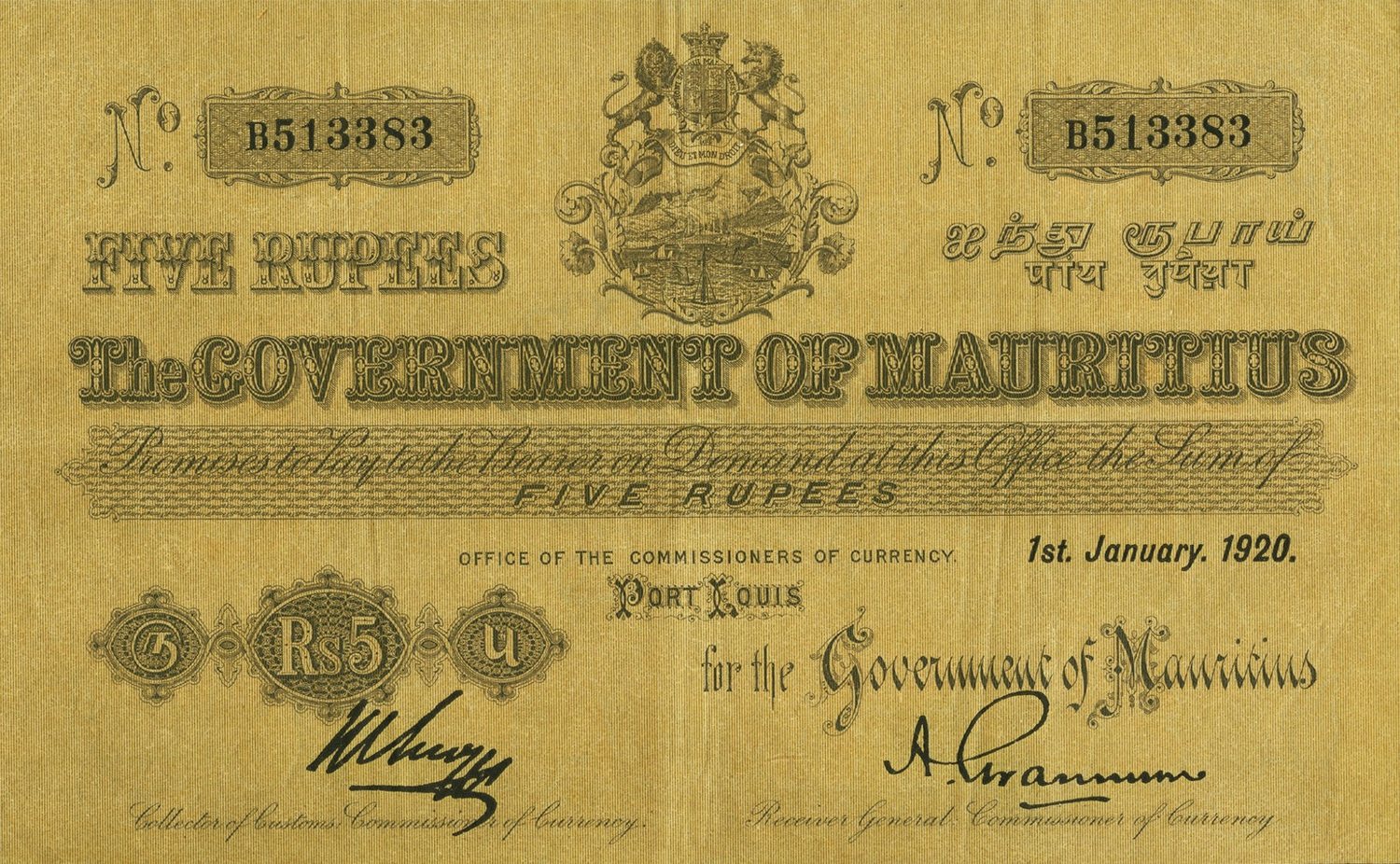
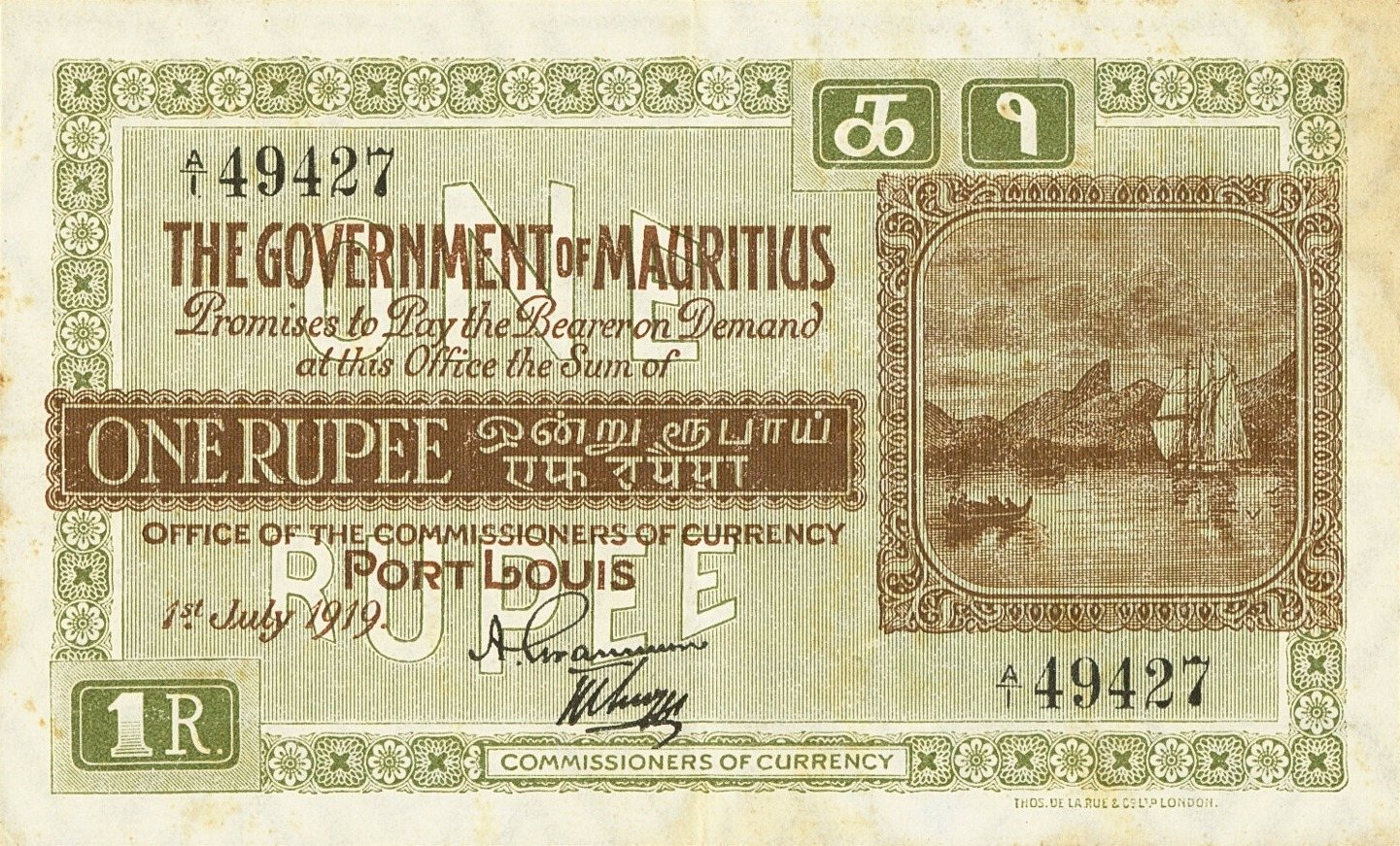
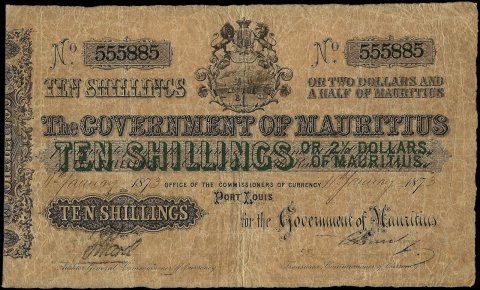
The Colony's own notes of these years were four: the 5 rupees, the 10 rupees, the 50 rupees and, since April 1920, the 1 rupee. Under the law of 1876 they were payable on demand in silver rupees of India. Indian Government currency notes were legal tender beside them under Ordinance 30 of 1920.
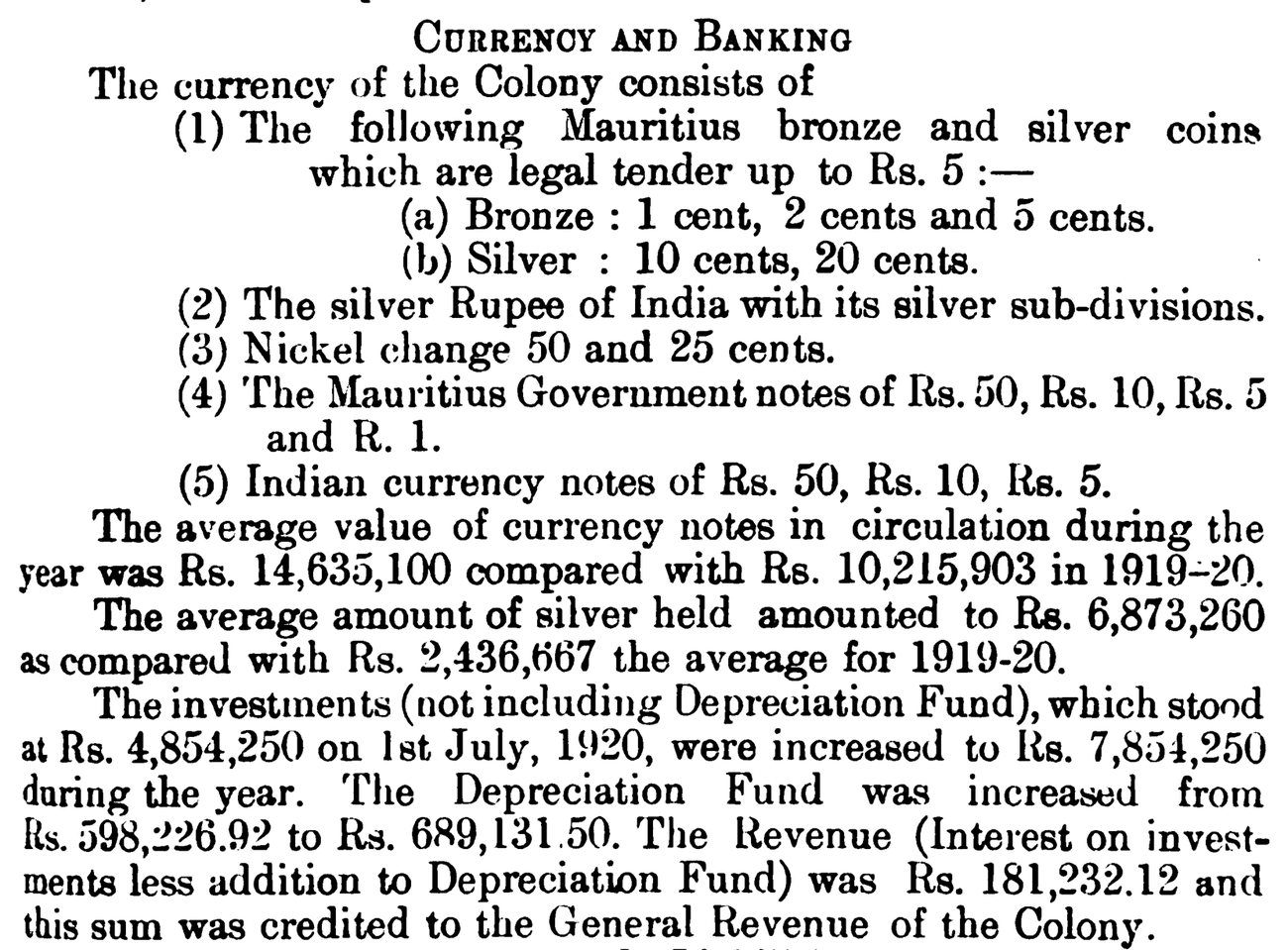
The report for 1921 sets the two side by side in its list of what "the currency of the Colony consists of": "(4) The Mauritius Government notes of Rs. 50, Rs. 10, Rs. 5 and R. 1. (5) Indian currency notes of Rs. 50, Rs. 10, Rs. 5." The report for 1922 has the same two lines. The three values are those of the Colony's own larger notes.
In and out again
The Blue Book for 1920 counts 14,206,250 rupees of Mauritius notes of 1, 5, 10 and 50 rupees in circulation. Indian notes in the Colony that year came to 15,578,200 rupees. By our arithmetic that is 1,371,950 rupees more than the Colony's own.
The report for 1921 shows the notes still coming. Of 21,371,270 rupees of "specie" imported in the year, 21,234,920 rupees "were notes and chiefly Indian notes".
A year later the stream had turned: the report for 1922 has only 340,425 rupees of specie imported and 11,280,897 rupees exported, "of which Rs. 9,745,672 in Indian notes". The Blue Books then count what was left in the Colony: 10,650,000 rupees of Indian notes at the end of 1922, 6,000,000 at the end of 1923 and 93,500 at the end of 1924.
The Colony's own notes
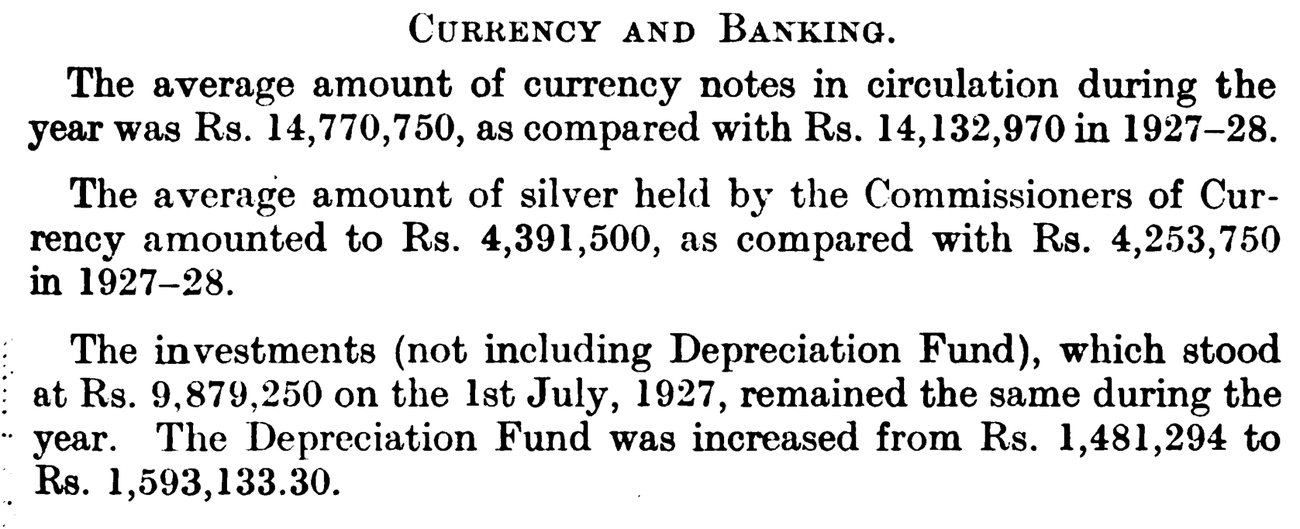
While the Indian notes came and went, the Colony's own issue doubled and fell back. Each report gives the average value of currency notes in circulation during the financial year, and that of the year before. The three reports give five years; the others are on our pages from later annual reports, rounded, and we give them as the pages do.
| Year, July to June | Average value of notes in circulation | From |
|---|---|---|
| 1919-20 | 10,215,903 rupees | report for 1921, No. 1149 |
| 1920-21 | 14,635,100 rupees | reports for 1921 and 1922 |
| 1921-22 | 20,360,013 rupees | report for 1922, No. 1179 |
| 1922-23 | 19.2 million rupees | our pages |
| 1923-24 to 1925-26 | between 15.2 and 15.6 million rupees each year | our pages |
| 1926-27 | not found | no report read |
| 1927-28 | 14,132,970 rupees | report for 1929, No. 1503 |
| 1928-29 | 14,770,750 rupees | report for 1929, No. 1503 |
| 1929-30 | 14.7 million rupees | our pages |
| 1930-31 | 7.5 million rupees | our pages |
| 1931-32 | 7.3 million rupees | our pages |
| 1932-33 | 7.9 million rupees | our pages |
The average of 1921-22 is almost exactly twice that of 1919-20. The Blue Book totals agree with it: 20,806,250 rupees of Mauritius notes at the end of 1921, and 15,199,250 at the end of 1923. The second fall is sharper: between 1929-30 and 1930-31 the average was nearly halved.
What stood behind the notes
The Commissioners of Currency held silver in Mauritius and investments in England. The silver held was 2,436,667 rupees on average in 1919-20, 6,873,260 in 1920-21 and 10,005,494 in 1921-22, about half the notes then out by our arithmetic. In 1928-29 it was 4,391,500 rupees.
The investments, "not including Depreciation Fund", stood at 4,854,250 rupees on 1st July 1920. They were raised to 7,854,250 during 1920-21 and to 9,879,250 during 1921-22, and the report for 1929 has them at the same 9,879,250 rupees. A Depreciation Fund was kept beside them: 689,131 rupees 50 cents at the end of 1920-21, 770,857 rupees 76 cents a year later and 1,593,133 rupees 30 cents on 30th June 1929. The interest, less what was added to that Fund, went to the Colony's revenue: 397,635 rupees in 1928-29.
Still legal tender in 1929
By the end of 1924 the Blue Book found only 93,500 rupees of Indian notes in the Colony. The law had not followed. The report for 1929 lists the currency in six heads, the last two being "(5) The Mauritius Government notes of R. 1, Rs. 5, Rs. 10, and Rs. 50. (6) The currency notes of the Government of India of all denominations." Heads (4), (5) and (6), the silver rupee and both kinds of notes, "are legal tender to any amount". This is new to our pages: years after the Blue Books had all but stopped finding Indian notes, they could still be tendered for any sum.
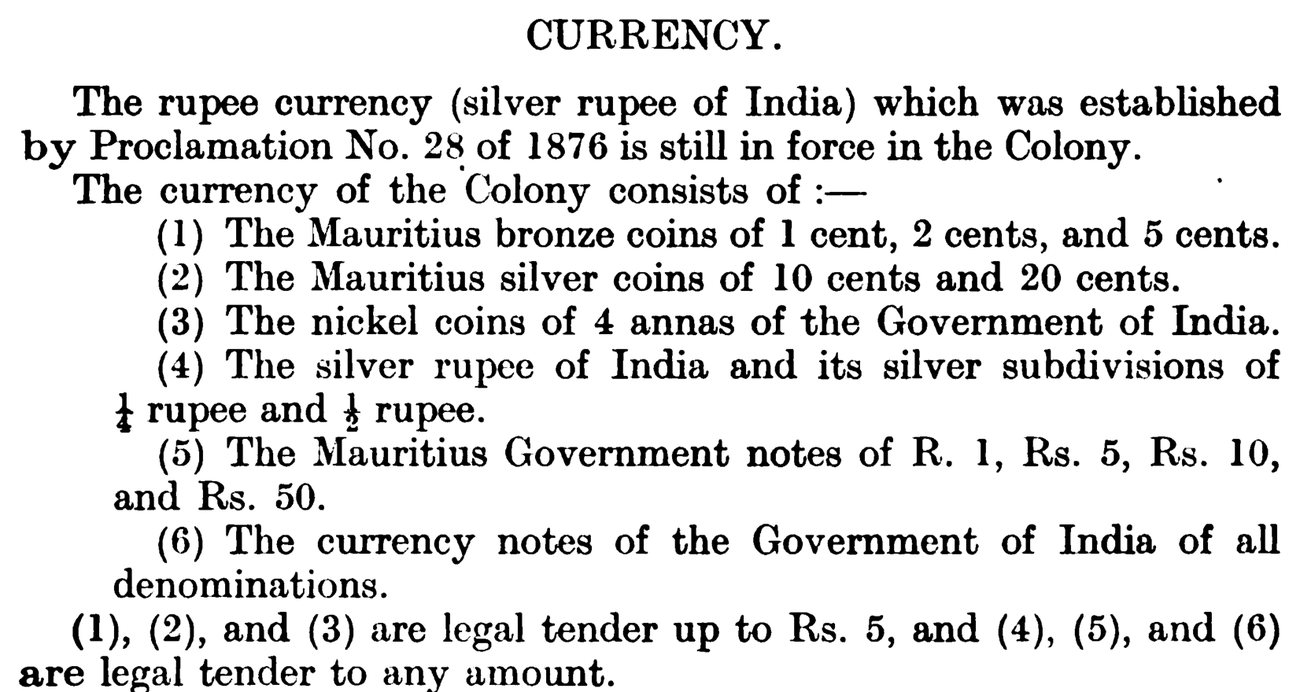
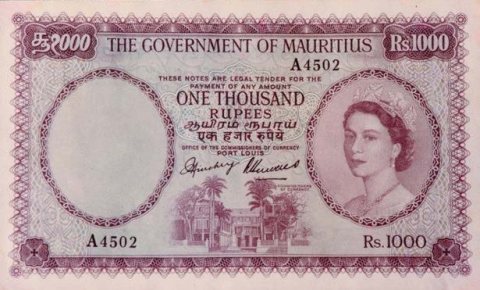
The same list is the record of the Colony's own values. In 1921, 1922 and 1929 they are 50, 10, 5 and 1 rupees and no others. The 1 rupee is still there in 1929. No note of 1,000 rupees is named in any of the three reports; our pages have the first of that value issued in November 1936.
The end, 1934
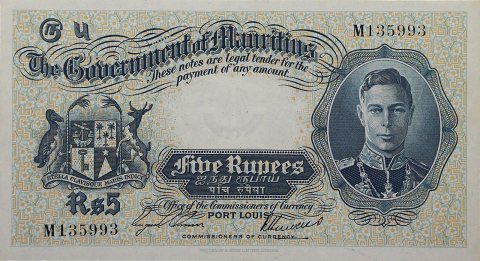
The end is told on our pages from the annual reports of the 1930s. The Mauritius Currency Notes Ordinance 1934 put a paper rupee tied to sterling in place of the Indian rupee. New notes were introduced on 23rd August 1934, among them a new 5 rupees, and Proclamation 21 of 1st September 1934 ended the legal tender of every earlier Mauritius issue on 15th December 1934. When the old notes were called in, the Commissioners of Currency reckoned that about 1,000,000 rupees of them had been destroyed in circulation by fire and floods and would never be presented. The surplus of the funds, 3,398,185 rupees, passed to the Colony's revenue.
What the reports do not say
- Why the Indian notes came and left. The reports count them and give no reason. We draw none.
- How much was Indian. The 21,234,920 rupees of 1921 is "chiefly" Indian notes, no closer, and no report splits them by value.
- Three values or all. The lists of 1921 and 1922 name Indian notes of 50, 10 and 5 rupees; the list of 1929 says "all denominations". Whether the law changed between them or only the wording, the reports do not show. The text of Ordinance 30 of 1920 and of any later amendment would settle it.
- When the Indian notes ceased to be legal tender. None of the three reports says, and our pages do not have it. The Ordinance of 1934 and the Proclamations of that year are the place to look.
- Which Indian notes. The reports name values only, no pattern or issue, so we link no Indian note here.
- 1926-27. We have no report that gives the average for that year. The reports for 1926 and 1927 would fill the row, and would give exact figures for the rounded rows beside it.
- The Commissioners. None of the three reports names a Commissioner of Currency or says anything of notes destroyed or withdrawn.
Member comments
Log in or register to post a comment.