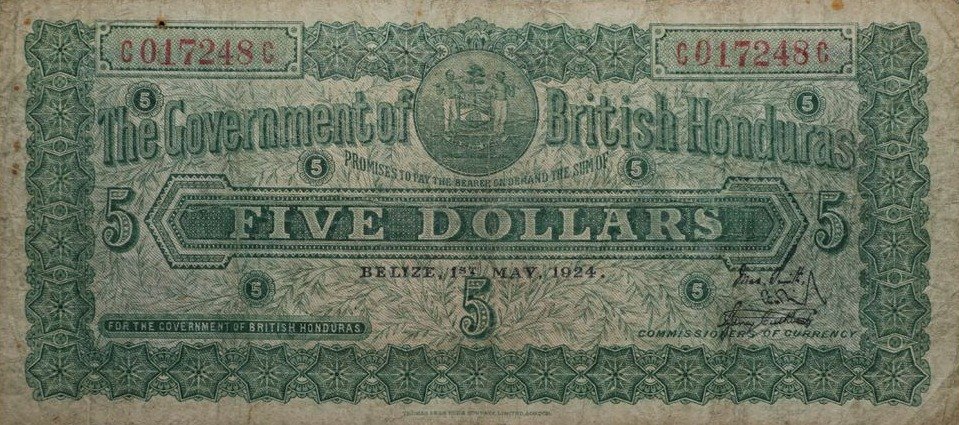
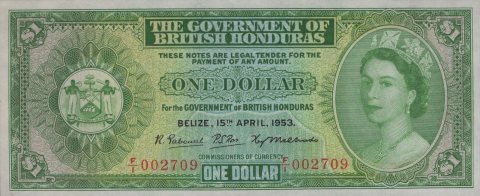
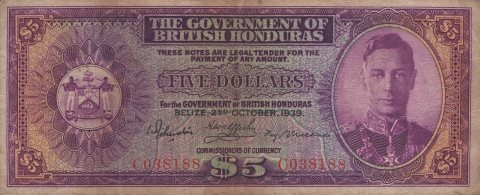
Each year the Government of British Honduras sent London an annual report, and most of them have a short paragraph on the currency. This article reads that paragraph through, report by report, for the years the Colonial Office volumes held for this catalogue cover: 1908 to 1931, then 1946 to 1950. Beside them stand the Blue Book for 1914, the Economic Surveys of the colonies for 1932 and 1951, a Government booklet of about 1953 and the volume on British Honduras in the Corona Library (1968). For each report the article says whether it was read on the page image or only in the machine-read text. No report pictures a note or gives a serial number.
The value-by-value counts of notes for 1946 to 1950 are in the King George VI notes of 1939 to 1952, and the Board's own half-yearly statements are in the Board's statements in the Gazette.
1908 to 1913: six values, then four
The reports for 1908 (No. 631, pp. 7 and 8) and 1911 (No. 733, p. 8), both read on the page image, open with the same sentence: "Under Ordinance 32 of 1894 currency notes have been issued for sums of $1, $2, $5, $10, $50, and $100." The report for 1908 then gives the reserve: against the 123,993 dollars of notes in circulation on 31st December 1908, the Commissioners of Currency held 87,029 dollars 48 cents in gold in the Colony and 36,963 dollars 52 cents in investments in England, "in accordance with the provisions of the law". The report for 1911 gives 161,433 dollars on 31st December 1911 and no reserve.

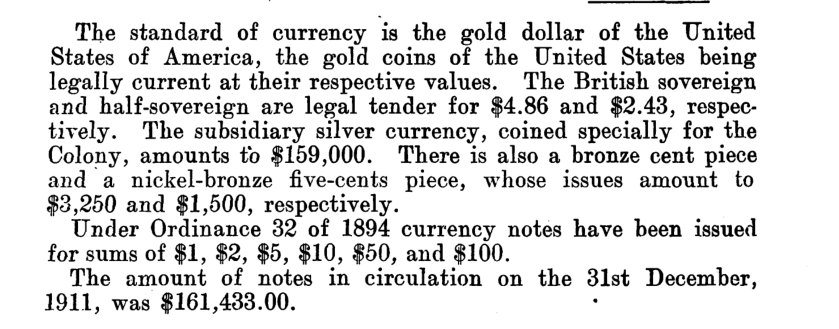
The report for 1912 (page image) names the values as 1, 2, 10, 50 and 100 dollars, leaving out the 5 dollars, and gives 162,783 dollars on 31st December 1912. It also records that Ordinance No. 20 of 1911, "relating to currency notes", had been disallowed by the Crown. The report for 1913 (page image) names all six values again and adds: "The $50 and $100 notes have been withdrawn from circulation." It gives 149,754 dollars on 31st December 1913.
The sentence on the six values is a standing one, carried from report to report, so the reports of 1908 and 1911 do not prove that the 50 and 100 dollars were still in use. The report for 1913 is the first that says they were not. The Pick pages of the 50 dollars and 100 dollars of 1895 carry its words.
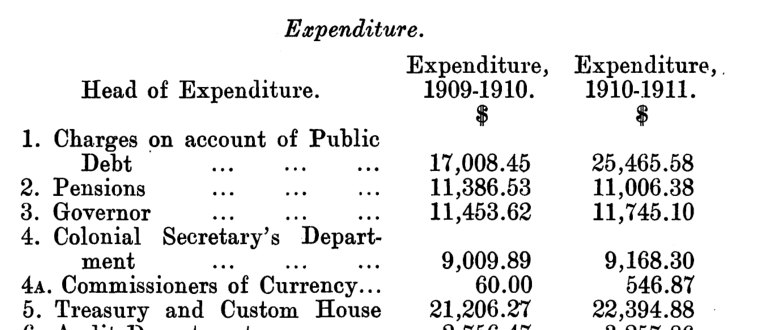
The colony's accounts in these reports have a head of expenditure for the Commissioners of Currency: nothing in 1906-7, 670 dollars 75 cents in 1907-8, 60 dollars in 1909-10 and 546 dollars 87 cents in 1910-11 (reports for 1908 and 1911, page images). The Blue Book for 1914 (text only) has the same head, numbered 4a, with about 993 dollars and 1,307 dollars in its two columns; the years of the columns are not certain in the machine-read text. None of these says what the money was spent on.
1922 to 1932: four values, United States notes and the Royal Bank
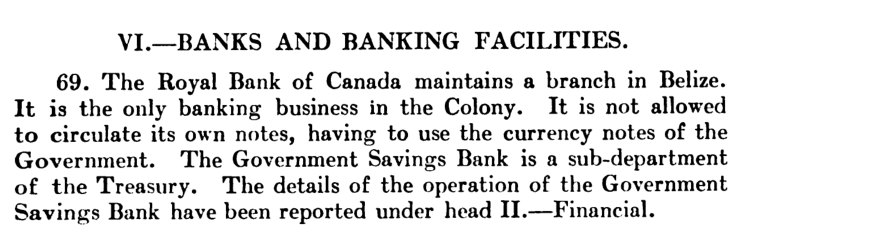
From the report for 1922 on, the reports read name only four values. The report for 1922 (No. 1181, paragraph 43, p. 12, page image) says: "There is a paper currency of tens, fives, twos and one dollar issued by the Government. Notes of the United States of America circulate freely." Paragraph 69 (p. 17) says the Royal Bank of Canada kept a branch in Belize, the only banking business in the Colony, and "is not allowed to circulate its own notes, having to use the currency notes of the Government."
The reports for 1925 to 1928 and 1930 and the Economic Survey for 1932 (page image) name the same four values. The report for 1929 (text only) adds that the note issue was administered by the Currency Commissioners, and that the gold and other securities behind it were "for the time being" in the custody of the Royal Bank of Canada. The report for 1931 (page image) says the same, and that the bank had no note issue of its own. The Economic Survey for 1932 calls the notes "temporarily inconvertible" and says they passed at par with the paper money of the United States.
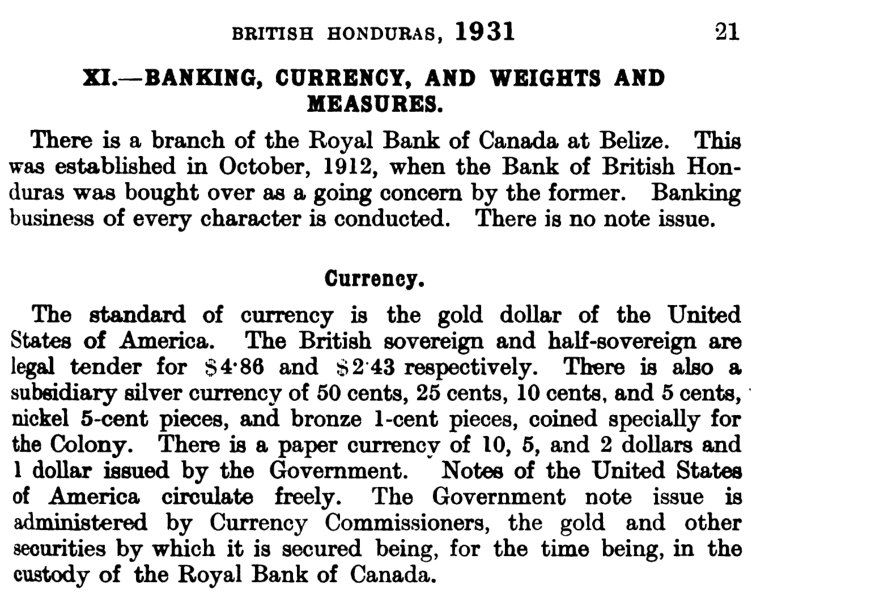
No report of these years names the 50 or 100 dollars of 1924 and 1928. The Pick pages of the 1 dollar, 2 dollars, 5 dollars and 10 dollars of that issue give the figures below; those of the 50 dollars and 100 dollars say that the reports name only the four lower values.
The figures in circulation, 1908 to 1966
Every figure of Government notes in circulation that the reports and books read give, with the day each one is for.
| Day | Notes in circulation | Source | Read on |
|---|---|---|---|
| 31st December 1908 | 123,993 dollars | annual report for 1908 | page image |
| 31st December 1911 | 161,433 dollars | annual report for 1911 | page image |
| 31st December 1912 | 162,783 dollars | annual report for 1912 | page image |
| 31st December 1913 | 149,754 dollars | annual report for 1913 | page image |
| 31st March 1923 | 224,544 dollars | annual report for 1922 | page image |
| 31st March 1925 | 224,544 dollars | the next report in the bound volume of Nos. 1232 to 1277 (the report for 1924, as the Pick pages call it) | page image |
| 31st March 1926 | 429,846 dollars | annual report for 1925 | page image |
| 31st March 1927 | 406,607 dollars | annual report for 1926 | page image |
| 31st March 1928 | 357,102 dollars | annual report for 1927 | page image in one place, text in another |
| 31st December 1939 | 283,536 dollars | annual reports for 1946 to 1950 | text only |
| end of 1946 | 809,888 dollars | annual report for 1946 | text only |
| end of 1947 | 811,398 dollars | annual report for 1947 | text only |
| end of 1948 | 832,331 dollars | annual report for 1948 | text only |
| end of 1949 | 837,643 dollars | annual report for 1949 | text only |
| end of 1950 | 1,044,949 dollars | annual report for 1950 | text only |
| 1960 | 2,189,000 dollars | Corona Library, 1968 | text only |
| 1961 | 2,983,000 dollars | Corona Library, 1968 | text only |
| 1962 | 2,847,000 dollars | Corona Library, 1968 | text only |
| 1963 | 3,048,000 dollars | Corona Library, 1968 | text only |
| 1964 | 3,232,000 dollars | Corona Library, 1968 | text only |
| 1965 | 3,522,000 dollars | Corona Library, 1968 | text only |
| 1966 | 3,730,000 dollars | Corona Library, 1968 | text only |
The reports give no figure for 1914 to 1922, for 1929 to 1938, or for 1951 to 1959 among the volumes held. The report for 1950 says its figure was 207,306 dollars more than a year before. The Economic Survey of the Colonial Territories for 1951 (text only) gives the counts for 1950 in agreement with the report, except that its machine-read text has 37,641 notes of 2 dollars where the report has 57,641; the amount, 115,282 dollars, is the same in both.
The same figure two years apart
The figure of 224,544 dollars is printed twice, as the De La Rue notes of 1894 to 1928 note. The report for 1922 dates it 31st March 1923, with a reserve of 89,607 dollars in gold and 134,937 dollars in British and Colonial investments that together make up the same sum. The next report in the bound volume prints the same paragraph with the same figure and the same reserve, dated 31st March 1925. The Pick pages of 1924 to 1928 give both dates. Which date is right is not settled: the report for 1923, which would settle it, was in a volume read in November and is not on this computer now.
1946 to 1950: the Board's stock of new notes
The report for 1946 (text only) says that notes of 1, 2, 5 and 10 dollars issued by the Currency Commissioners were legal tender to any amount. The reports for 1946 to 1950 (all text only) also account each year for the Board's reserve of unissued notes, the stock from which new notes were paid out.
| Year | Stock at the start of the year | New notes received | Notes issued in the year | Stock on 31st December |
|---|---|---|---|---|
| 1946 | 315,000 dollars | not given | not given | 265,000 dollars |
| 1947 | 265,000 dollars | 1,050,000 dollars, in December 1947 | 99,000 dollars | 1,216,000 dollars |
| 1948 | not given separately | not given | 142,000 dollars | 1,074,000 dollars |
| 1949 | not given separately | not given | 194,000 dollars | 880,000 dollars |
| 1950 | 880,000 dollars | 375,000 dollars | 514,000 dollars | 751,000 dollars |
The report for 1946 says the stock "is to be supplemented by the Commissioners with an order of notes of a more distinctive colouring". The report for 1947 says the new notes arrived in December 1947, "making the total stock $1,315,000". These are the notes dated 30th January 1947, and the Pick pages find that the 1,050,000 dollars is the sum of their specimen ranges in the four values. The 375,000 dollars of 1950 is, by the same reckoning on the pages, the printing of the 1, 2 and 5 dollars dated 1st November 1949. On that ground the page of the 10 dollars holds that its row of 1949 (P-27c) most likely never existed, as the King George VI notes set out. The reports themselves do not name the dates of the notes received.
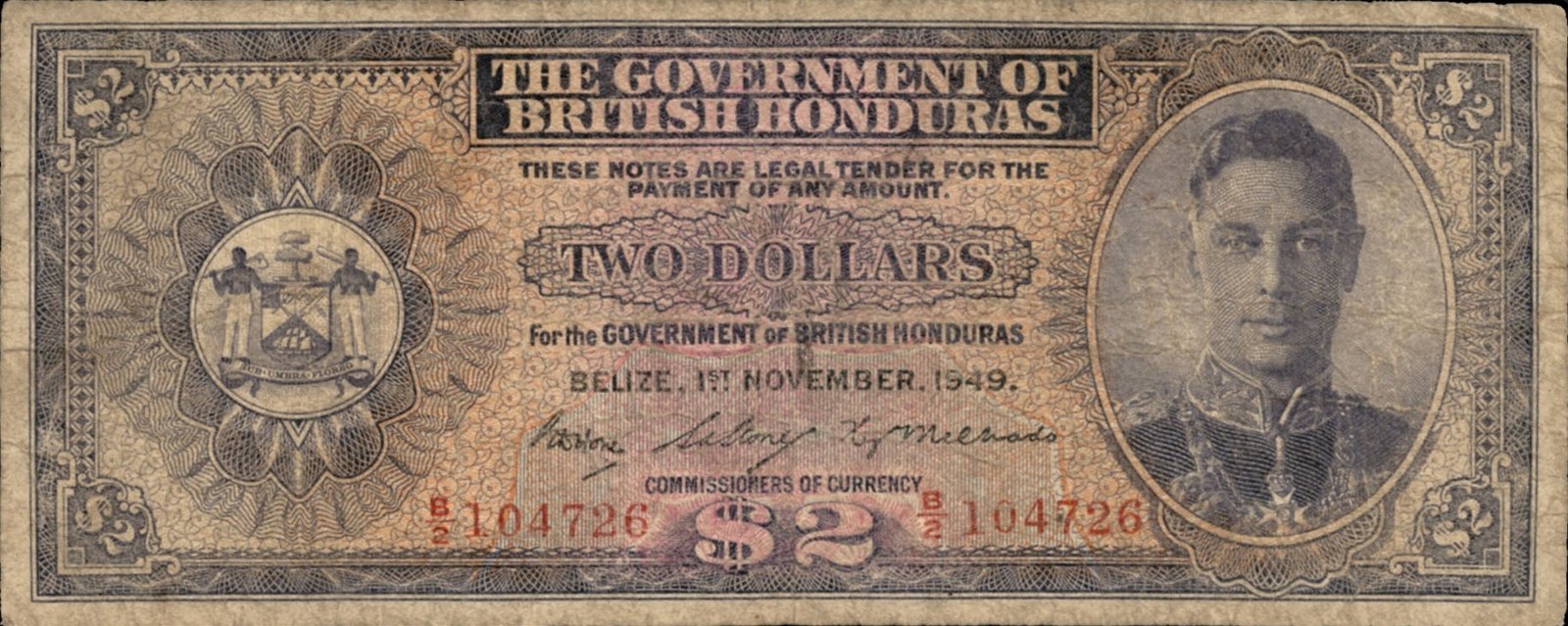
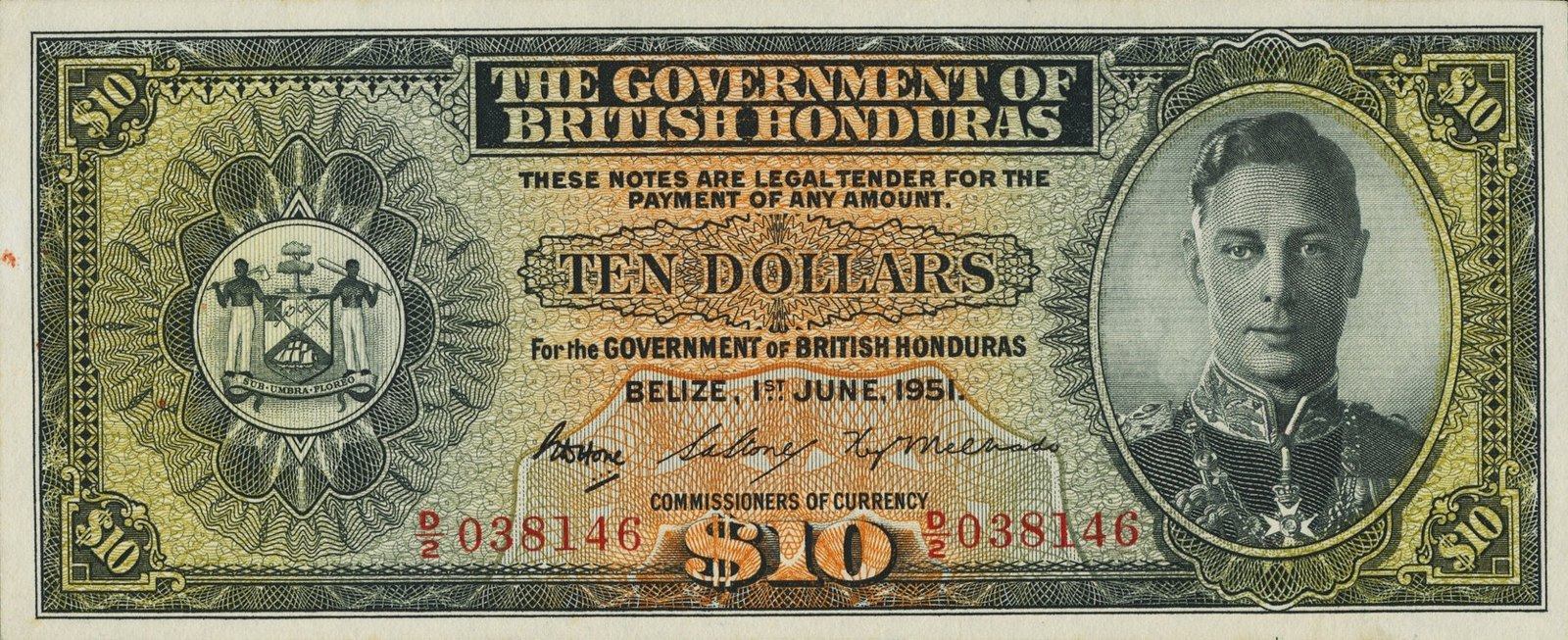
The report for 1947 also says that 50,000 dollars of fifty and twenty-five cent pieces, held in 1946 at a specie value of 15,000 dollars, were sent to the Royal Mint during 1947 to be sold as bullion. The Board's statement of 31st December 1940 had shown specie of 50,000 dollars in the Note Security Fund. Whether these were the same coins is not said.
The report for 1949 tells how the dollar, left at par with the United States dollar when sterling was devalued in September 1949, was fixed at 4 dollars to the pound on 31st December 1949. The accounts in the report for 1950 carry a "Special grant to make good losses of Commissioners of Currency" of 891,095 dollars, without saying what the losses were. The law of the change is told in the laws behind the notes.
After 1950
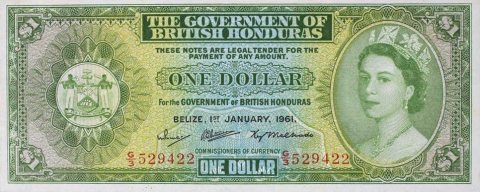
A small Government booklet in the Gazette pages held, dated by its library to about 1953 (p. 18, page image), gives the rate as 4 dollars to the pound and 7 British Honduras dollars to 5 United States dollars, and names notes of 1, 2, 5 and 10 dollars. It does not name the 20 dollars, whose first date is 1st December 1952. The library's date is a guess, and the text may have been written before the 20 dollars was paid out.
The Corona Library book of 1968 (pp. 127 to 129, text only) names notes of 1, 2, 5, 10 and 20 dollars, gives the figures of 1960 to 1966 in the table above, says that from 1954 the Commissioners could invest part of the fund in securities of the colony, and that the dollar was devalued by 14.3 per cent in November 1967.
Not settled: bank notes before 1937
On bank notes the Corona Library book says something no other source read says. By its account, the Bank of British Honduras was founded in 1904 by a group of local financiers and issued private notes in dollars; the Royal Bank of Canada bought it in 1912, took over the notes in circulation and "continued to issue bills until 1937", when the function of providing currency "passed out of private hands".
The annual reports say otherwise for the years they cover: in 1922 the Royal Bank "is not allowed to circulate its own notes", and the report for 1931, which says the bank's branch at Belize was established in October 1912 when it bought the Bank of British Honduras as a going concern, also says it had no note issue. The same book dates the founding of the "Currency Commission" to 1937 and says nothing of the Government notes of 1894 to 1937. The catalogue lists no note of the Bank of British Honduras or of the Royal Bank of Canada for the colony. A note of either bank, or the bank returns in the Blue Books of 1904 to 1912, which were not among the volumes read, would settle it.
Sources
- Colonial Reports, Annual, British Honduras: No. 631 (1908), No. 733 (1911), the reports for 1912 and 1913, No. 1181 (1922), the reports bound in the volume of Nos. 1232 to 1277, the reports for 1925, 1926, 1927, 1928, 1929, 1930 and 1931.
- Colonial Office, Annual Reports on British Honduras for 1946, 1947, 1948, 1949 and 1950.
- The Blue Book of British Honduras for 1914.
- An Economic Survey of the Colonial Empire (1932); An Economic Survey of the Colonial Territories 1951, volume IV.
- A Government booklet on British Honduras of about 1953, p. 18.
- British Honduras (The Corona Library, 1968), pp. 127 to 129.
- The British Honduras Gazette, statement of the Board of Commissioners of Currency for 31st December 1940.
- The Pick pages of this catalogue, P-12 to P-19 and P-24 to P-27.
Member comments
Log in or register to post a comment.