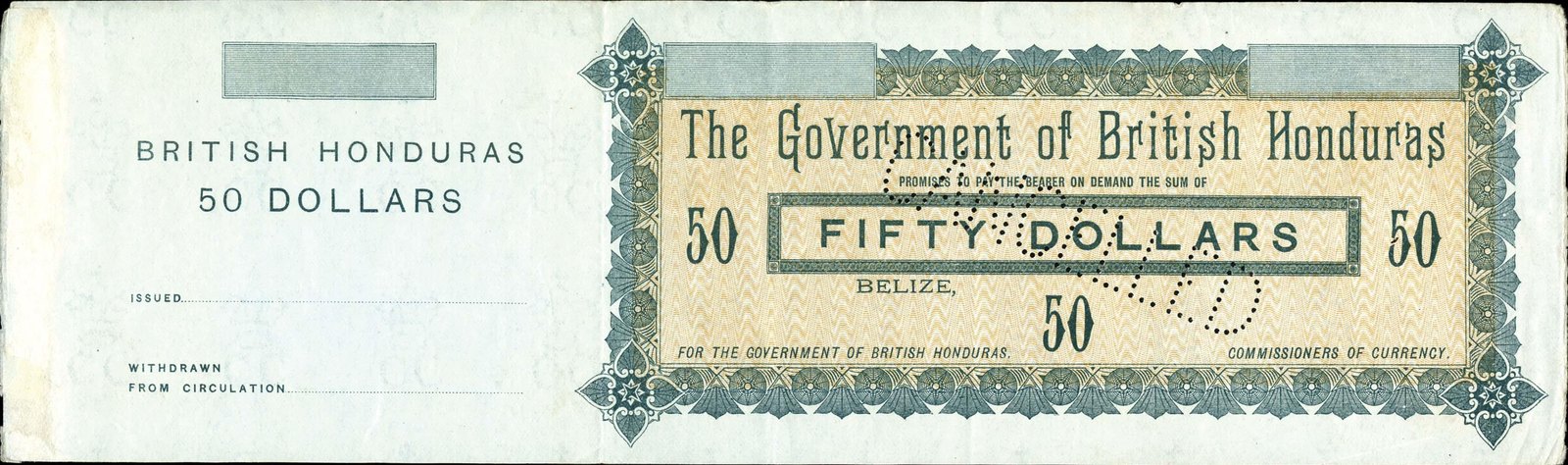
The notes of British Honduras rest on a short run of laws. This article puts them in order of time, from the plan for "silver certificates" of 1892 to the devaluation of 1967. It is drawn from Chalmers' History of Currency in the British Colonies (1893), the newspaper The Angelus of 1894, the Blue Book for 1914, the colony's annual reports, the text of the British Honduras Currency Notes Ordinance, 1937, and the notices of the British Honduras Gazette from 1938 to 1950. Most of these laws are known only by their titles and dates. Where a text was read, the article says so; where only a title was seen, it says that too. The notes themselves are set out in the paper money of British Honduras, 1894 to 1973.
Before 1894: no bank and no paper money
Chalmers, writing in 1893 (A History of Currency in the British Colonies, chapter X, p. 146, read on the page image), says the colony had no bank and no paper money. Chalmers quotes the annual report for 1892 (Colonial Reports, Annual No. 19): the Government contemplated issuing "silver certificates, based on a specie reserve and investments". A footnote on the same page adds that the only paper issues of which any evidence could be found were paper tokens put in circulation by the Chinese some ten or twelve years before, when small change was short. The report for 1892 itself is not among the Colonial Office volumes read for this catalogue; it is known here only from Chalmers.


1894: the despatch and the two Ordinances of 5th October
The Angelus, a newspaper of Belize, printed in 1894 (p. 133, read on the page image; the day of the issue is not on the page) the gist of a despatch from the Secretary of State for the Colonies to the Governor. The gold dollar of the United States was to be the standard of the new currency, and the British sovereign legal tender at 4 dollars 86 cents. The despatch approved "the issue of Treasury Notes", recommended a special silver coinage for the colony, and declared that the notes and the silver and nickel coins of the United States would not be legal tender.
A later issue of The Angelus (p. 218, read on the page image) reports that the Legislative Council passed two Ordinances on 5th October 1894, the Coinage Ordinance and the Currency Note Ordinance, and that the Governor assented the same day. By the newspaper's summary, currency notes signed by the Commissioners of Currency were to be issued for 1, 2, 5, 10, 50 and 100 dollars "and any multiple of 100", and holders were entitled to payment in gold or silver coin, but need not take more than 10 dollars in silver. The old silver currency was demonetised from 15th October 1894, at 50 cents of the new money for each old dollar. The list of values has no 25 dollars, which agrees with the Pick page of the 25 dollars that was drawn and never issued.
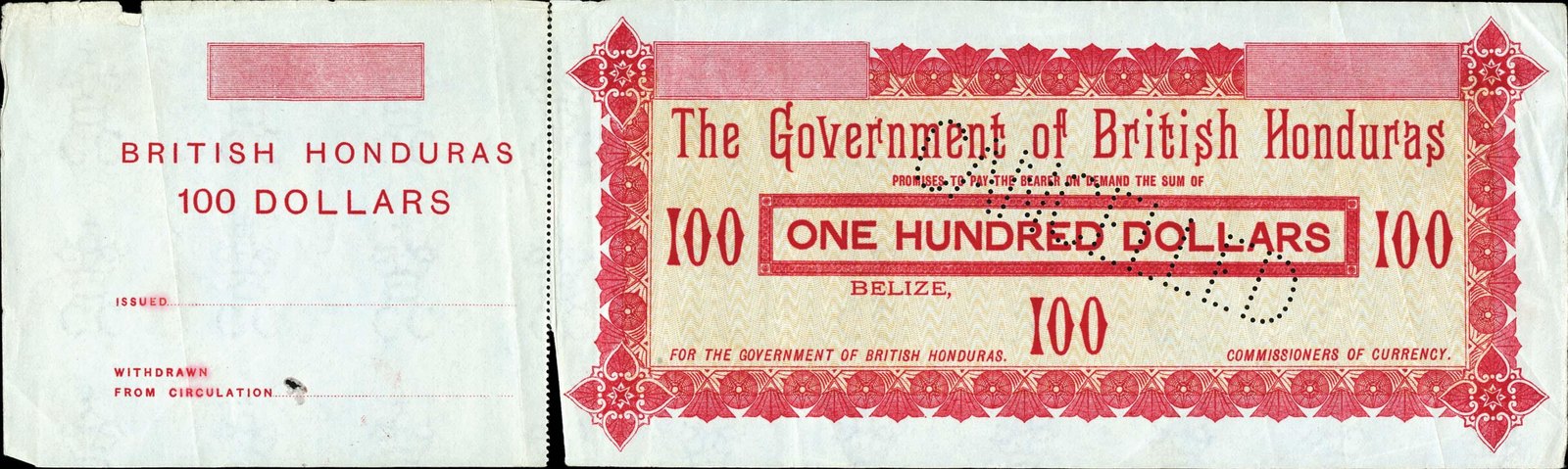
The sources give two numbers for the law of 1894, and none read says which number belongs to which of the two Ordinances of 5th October 1894. The Blue Book for 1914 (read in the text only) names both. In its currency return it says "Ordinance No. 31 of 1894 regulates the currency", with gold coins legal tender to any amount and silver to ten dollars. In its return of public bodies it gives the Commissioners of Currency as set up by "Ordinance No. 32 of 1894", the Ordinance "which provides for the issue of Government Paper Currency". The annual reports for 1908, 1911, 1912 and 1913 also say the notes were issued "under Ordinance No. 32 of 1894". The working paper on the British Honduras currency board in the Johns Hopkins archive of currency boards (No. 60, pp. 2 and 3) gives No. 32 of 1894 as the law that set up the Board and made the dollar equal to the United States gold dollar, with notes issued against United States gold coin and paid in silver or gold on demand. The Central Bank of Belize names Ordinance No. 31 of 1894 as the law that put the currency on a gold basis, as the first article reports. No text of either Ordinance has been read, so the question stays open.
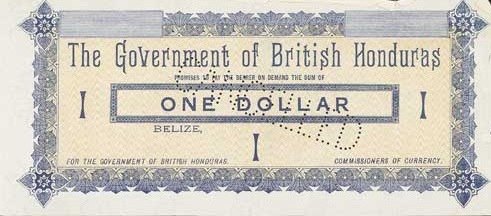
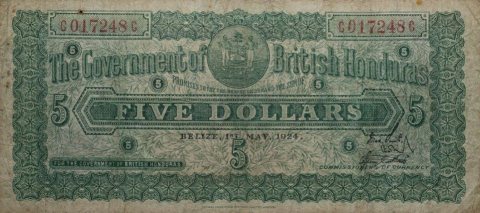
The first notes, the 1 dollar and the five higher values, had their date applied by a circular datestamp; on the recorded 1 dollar it reads BELIZE, 17 October 1894, as the Pick page gives it.
1911 to 1928: a law disallowed, gold suspended, a consolidation
- Ordinance No. 20 of 1911, "relating to currency notes", was disallowed by the Crown early in 1912. The annual report for 1912 (read on the page image) records this and does not say what the Ordinance contained.
- Ordinance No. 24 of 1914 suspended the conversion of notes into gold after the gold stock had been sent to the United States for safety. This is from the Johns Hopkins working paper No. 60 only; the Ordinance itself has not been seen. The Economic Survey of the Colonial Empire for 1932 (read on the page image) still calls the notes "temporarily inconvertible" and says they passed at par with United States paper money.
- 26th March 1916 is the day to which the Ordinance of 1937 counts the old notes (below). Neither that Ordinance nor any other source read says why that day was chosen.
- Chapter 35 of the Consolidated Laws of 1924, the Currency Notes Ordinance, as amended by Ordinance No. 30 of 1928, was the law in force until 1937. Both are known only because the Ordinance of 1937 names them in its repeal clause.
1937: the British Honduras Currency Notes Ordinance (No. 1 of 1937)
The text of this Ordinance is the one law of the series that was read in full (its number and dates on the page image). It was passed on 8th January 1937 and assented to on 16th January 1937, and was to come into force on a day to be proclaimed. Its terms, as read:
- a Board of three: the Colonial Secretary, the Treasurer, and one person named by the Governor who held no office of profit under the Crown;
- the values and the design of the notes to be approved by the Secretary of State;
- notes to be issued at one dollar for each United States dollar lodged with the Board's agents in New Orleans or New York;
- the Governor might demonetise notes by proclamation, and the holders were then to be paid by the Treasurer;
- the Currency Notes Ordinance of Chapter 35, as amended by No. 30 of 1928, was repealed.
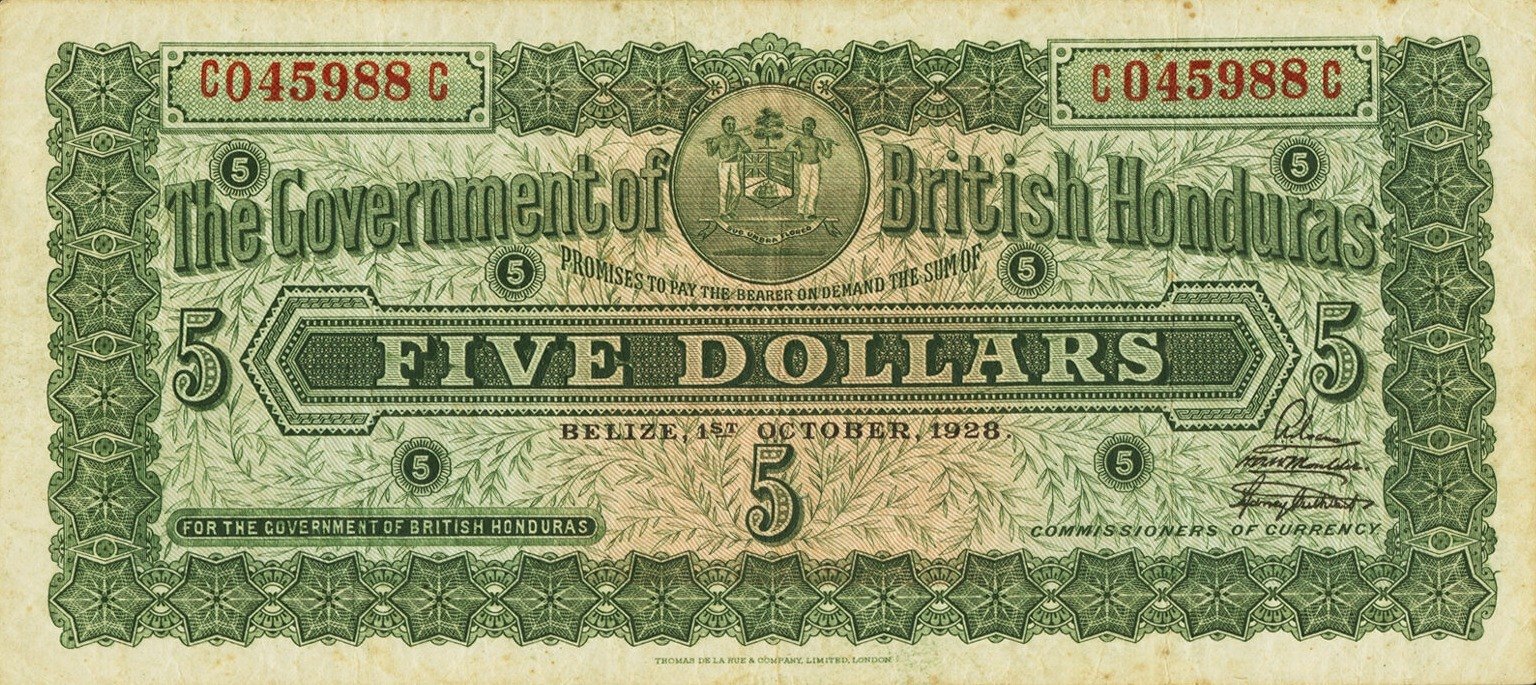
A Schedule, under section 15 (p. 8), lists the notes issued before 26th March 1916 that were still to be treated as issued under the new Ordinance, value by value, with letters A to F and their number ranges. This is the source of the figures on the Pick pages of the notes of 1895 to 1920; the table is in the De La Rue notes of 1894 to 1928.
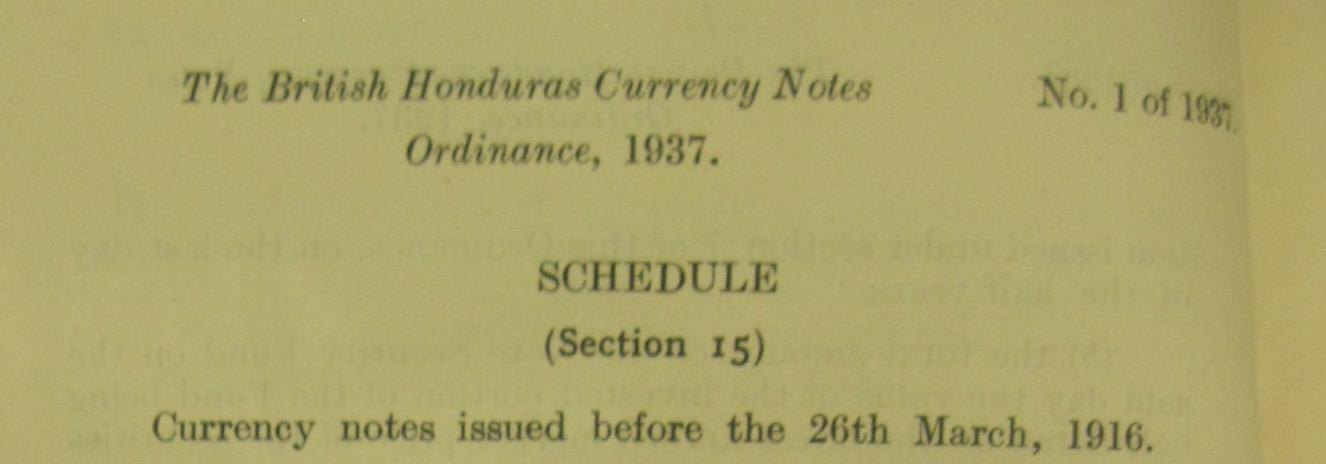
The Schedule does not give the design or the date of the notes. The 1894 notes recorded carry the letters U and V, which are not among the Schedule's letters. The Pick pages concerned are the 1 dollar of P-7, P-8 and P-9, the 2 dollars, the 5 dollars, the 10 dollars, the 50 dollars and the 100 dollars. A book of 1968, British Honduras in the Corona Library (pp. 127 and 128, read in the text only), says the "Currency Commission" was founded on 29th January 1937. The Ordinance itself gives 8th and 16th January.
1938 to 1940: proclamation, regulations, demonetisation
- Proclamation No. 71 of 1938, "Bringing into operation the British Honduras Currency Notes Ordinance, 1937", is listed in the Gazette of 17th December 1938 (p. 450, read on the page image). The day the Ordinance took effect is in the Proclamation itself, which was not on the page held.
- The Currency Regulations, 1939 (Statutory Rule and Order No. 11 of 1939, published 11th February 1939) were made under section 14 of the Ordinance. Regulation 2 let the Board appoint Currency Officers and Regulation 17 provided for a Board of Survey. A notice of 27th March 1939 cites them once as "Currency Regulations, 1937 (S. R. & O. No. 11 of 1937)", a slip in the Gazette.
- Statutory Rule and Order No. 27 of 1939, a Proclamation headed "Demonetisation of Notes", is listed in the index of the Gazette for 1939 at page 176. That page was not among those held. The day comes from the Board's statement for 30th June 1940, which heads the old notes "Old Issue", "demonitised 1st May, 1940", under S. R. & O. 27/1939. The Pick pages of the 1 dollar of 1924 and 1928 and the other values of that issue carry 1st May 1940 in their withdrawal field. Whether the Proclamation named the notes of 1894 to 1920 as well is not known until its text is seen.
- Ordinance No. 30 of 1939 amended the Ordinance of 1937. A notice of 4th April 1940 (read in the text only) says His Majesty would not be advised to disallow it.
- Ordinance No. 5 of 1940, the British Honduras Currency Notes (Amendment) Ordinance, 1940, was assented to on 1st October 1940 (Gazette p. 333); its bill was published on 31st August 1940 (p. 292), and the notice that the Crown would not disallow it is No. 711 of 21st December 1940 (p. 430).
The contents of the amendments of 1939 and 1940 are not on the pages held.
1949 and 1950: the dollar linked to sterling
The annual report for 1949 (read in the text only) says that when the pound was devalued against the United States dollar in September 1949, the British Honduras dollar alone in the Colonial Empire was left at par with the United States dollar, so that its value against sterling moved "from $4.03 to $2.80 to the £". On the last day of the year it was linked to sterling at 4 dollars to the pound. This was done by an alteration of the Currency Notes Ordinance. The unofficial members of the Legislative Council all voted against the bill, and the Governor declared it passed under section 15 of the British Honduras Constitution Ordinance (No. 13 of 1935). The report for 1950 gives the day as 31st December 1949.
The Gazette adds three things (read on the page images, except the memorial's line on the notes beyond the borders, read in the text only):
- the amending law was Ordinance No. 30 of 1949, and the notice that the Crown would not disallow it is dated 23rd August 1950;
- a memorial of 6th January 1950, signed by J. A. Smith, M.L.C., as chairman and George Price, M.C.C., as secretary of the People's Committee, protested at "The British Honduran Currency Notes (Amendment) Ordinance of 1949", enacted against the unanimous unofficial vote, and complained that the notes were no longer acceptable beyond the colony's borders;
- the official reply said that the export of British Honduras currency notes was already an offence under the Defence Finance Regulations, so that they could not lawfully be tendered outside the colony in any case.
The accounts in the annual report for 1950 (read in the text only) show a "Special grant to make good losses of Commissioners of Currency" of 891,095 dollars. The page does not say what the losses were.
After 1950
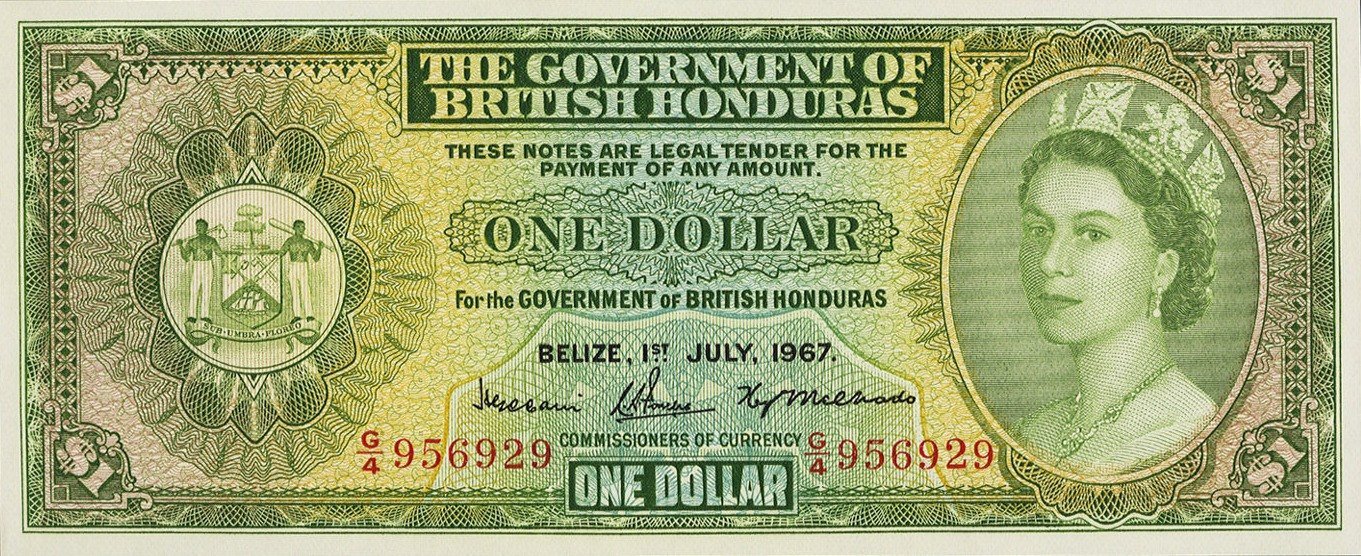
The Corona Library book of 1968 (p. 129, read in the text only) says that from 1954 the Commissioners could invest part of the currency fund in securities of the colony, and that the British Honduras dollar was devalued by 14.3 per cent in November 1967. It names no law for either. The same book says nothing of the Government notes of 1894 to 1937. The end of the Board in 1976 and the demonetisation of its notes in 1981 are told in the paper money of Belize, 1974 to 2025 and the Government of Belize notes of 1974 to 1976.
What is still not known
- The text of the two Ordinances of 1894, and so which number belongs to which.
- What Ordinance No. 20 of 1911 proposed, and why it was disallowed.
- The text of Ordinance No. 24 of 1914, seen only through a working paper.
- The day Proclamation No. 71 of 1938 brought the Ordinance of 1937 into force.
- The text of the Proclamation of 1939 (Gazette 1939, p. 176): which notes it named and how holders were to be paid.
- What the amendments No. 30 of 1939 and No. 5 of 1940 changed.
Sources
- R. Chalmers, A History of Currency in the British Colonies (London, 1893), p. 146, quoting the annual report on British Honduras for 1892.
- The Angelus (Belize), 1894, pp. 133 and 218.
- The Blue Book of British Honduras for 1914: the currency return and the return of public bodies.
- The annual reports on British Honduras for 1908, 1911, 1912, 1913, 1949 and 1950; the Economic Survey of the Colonial Empire for 1932.
- The British Honduras Currency Notes Ordinance, 1937 (No. 1 of 1937), with its Schedule under section 15.
- The British Honduras Gazette: 17th December 1938, p. 450; 27th March 1939, p. 156; the index for 1939, p. xvii; 4th April 1940, p. 126; 17th August 1940, p. 281; 31st August 1940, p. 292; 1st October 1940, p. 333; 21st December 1940, p. 430; 23rd August 1950, p. 392; Supplements of 1950, pp. 25 to 28.
- The Johns Hopkins archive of currency boards: working paper No. 60, on the British Honduras currency board, pp. 2 and 3.
- British Honduras (The Corona Library, 1968), pp. 127 to 129.
Member comments
Log in or register to post a comment.