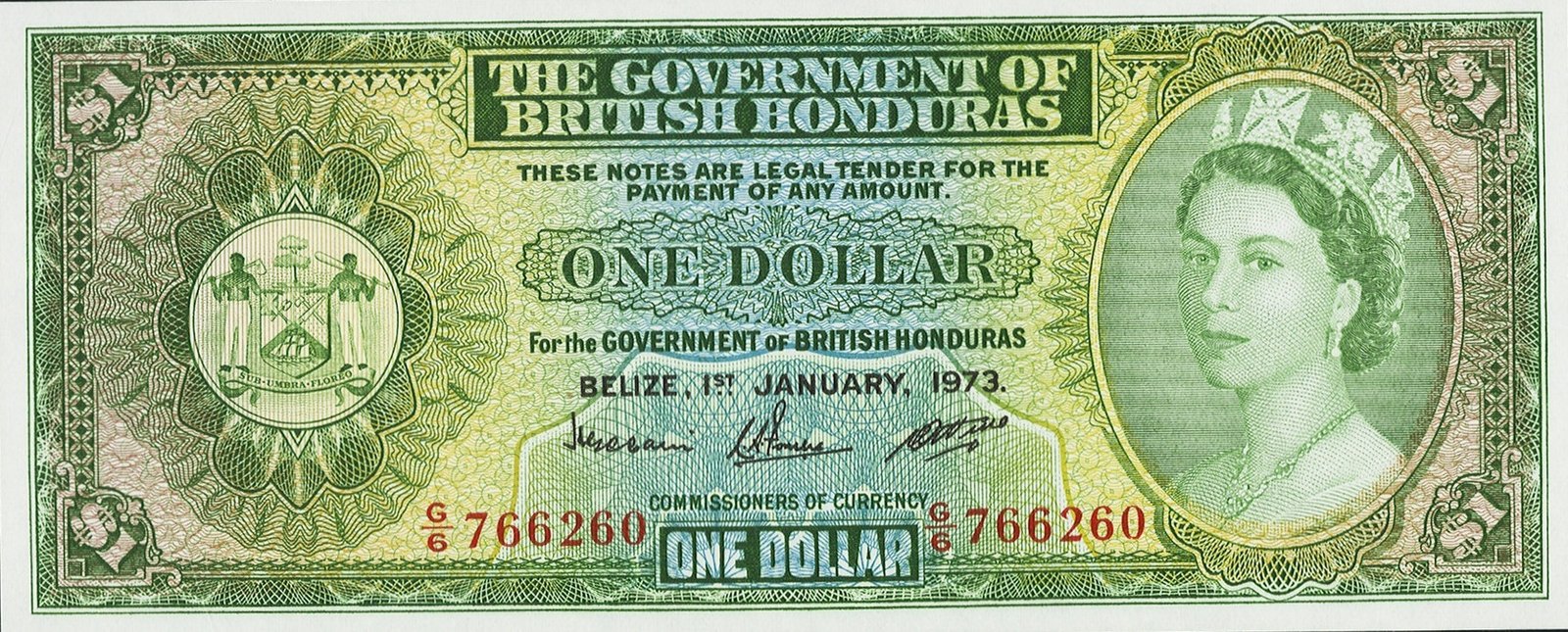
This article sets out the notes of British Honduras in order of time, from the first Government notes of October 1894 to the last date printed before the notes were headed Belize, 1st January 1973. It is drawn from the Pick pages of this catalogue, which rest on the colony's annual reports, the Colonial Office List, the British Honduras Gazette and the printers' specimens, from the auction houses' descriptions of single lots, and from two pages of the Central Bank of Belize.
Three further articles go deeper: the De La Rue notes of 1894 to 1928, the King George VI notes of 1939 to 1952 and the signers of the notes.
Before the notes
Before 1894 the colony had no bank and no paper money. The colony's annual report quoted in Chalmers' History of Currency in the British Colonies (1893) says the government was then considering "silver certificates" backed by a specie reserve and investments.

The Central Bank of Belize says the same on its page History of Currency: up to 1894 there was no paper currency, and up to 14 October 1894 the coins in circulation were principally South and Central American and American silver dollars.
The law of 1894 and the first issue
Sources mention that the first notes were issued under Ordinance No. 32 of 1894, which set up the Commissioners of Currency and made the dollar equal to the United States gold dollar. The annual reports for 1908 and 1911 also name Ordinance 32 of 1894. The Central Bank of Belize gives another number: its page says that by Ordinance No. 31 of 1894 the currency was established on a gold basis. The text of the Ordinance is not quoted on the Pick pages, so the number is left open here.
The first issue was printed by Thomas de la Rue in six values: 1 dollar, 2 dollars, 5 dollars, 10 dollars, 50 dollars and 100 dollars. The notes are uniface. They were issued from a counterfoil book, with handwritten signatures, and the date was applied by a circular city datestamp. The recorded 1 dollar is stamped BELIZE, 17 October 1894. The Central Bank's page History of Currency speaks of a local note issue of 1, 2, 5 and 10 dollars and gives no year for it; its page on the Government of British Honduras notes gives the first issue six values, as the Pick pages do.
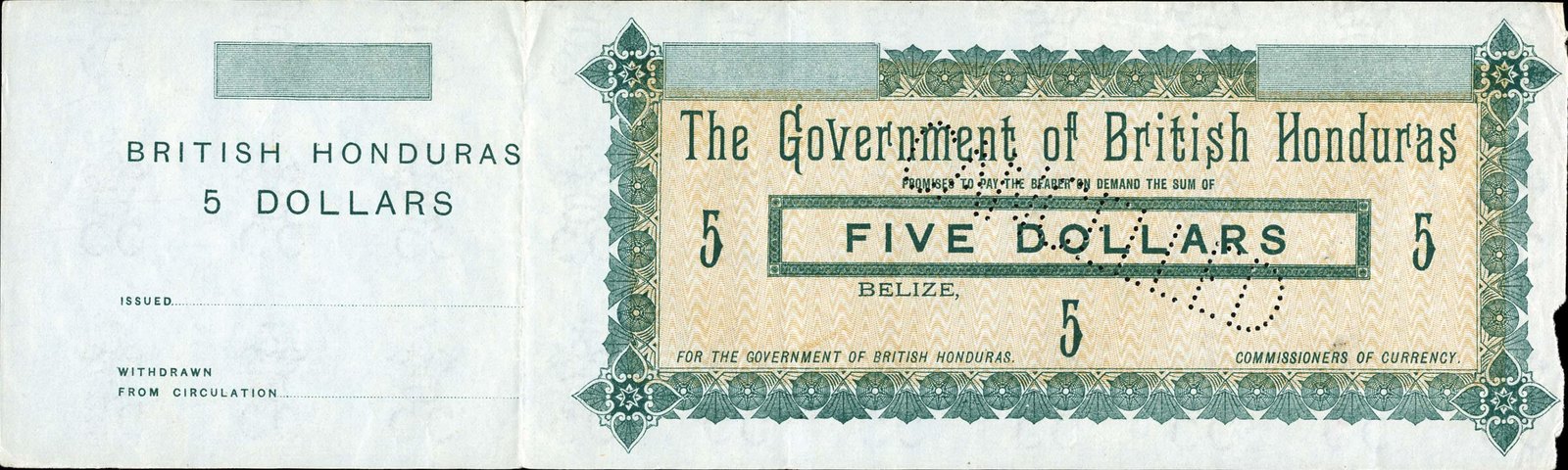
Stack's Bowers, describing lot 30070 of its sale of 12 January 2018, says three issued 1 dollar notes are known, that no issued note of the five higher values has been seen, and that the issue was withdrawn and destroyed after only two months. The Pick pages record no issued note of the 2, 5, 10, 50 or 100 dollars.
A 25 dollars was drawn and never issued. It is known only from a pair of essays on board, the face and the proposed back, both annotated JULY 3/94.
The notes of 1895 to 1920
A second design is dated 1st January 1895. It has the arms at top centre and was printed by Thomas de la Rue without the printer's imprint. There are again six values: the 1 dollar, on three pages by signature and date (P-7, P-8 and P-9), the 2 dollars, the 5 dollars, the 10 dollars, the 50 dollars and the 100 dollars.
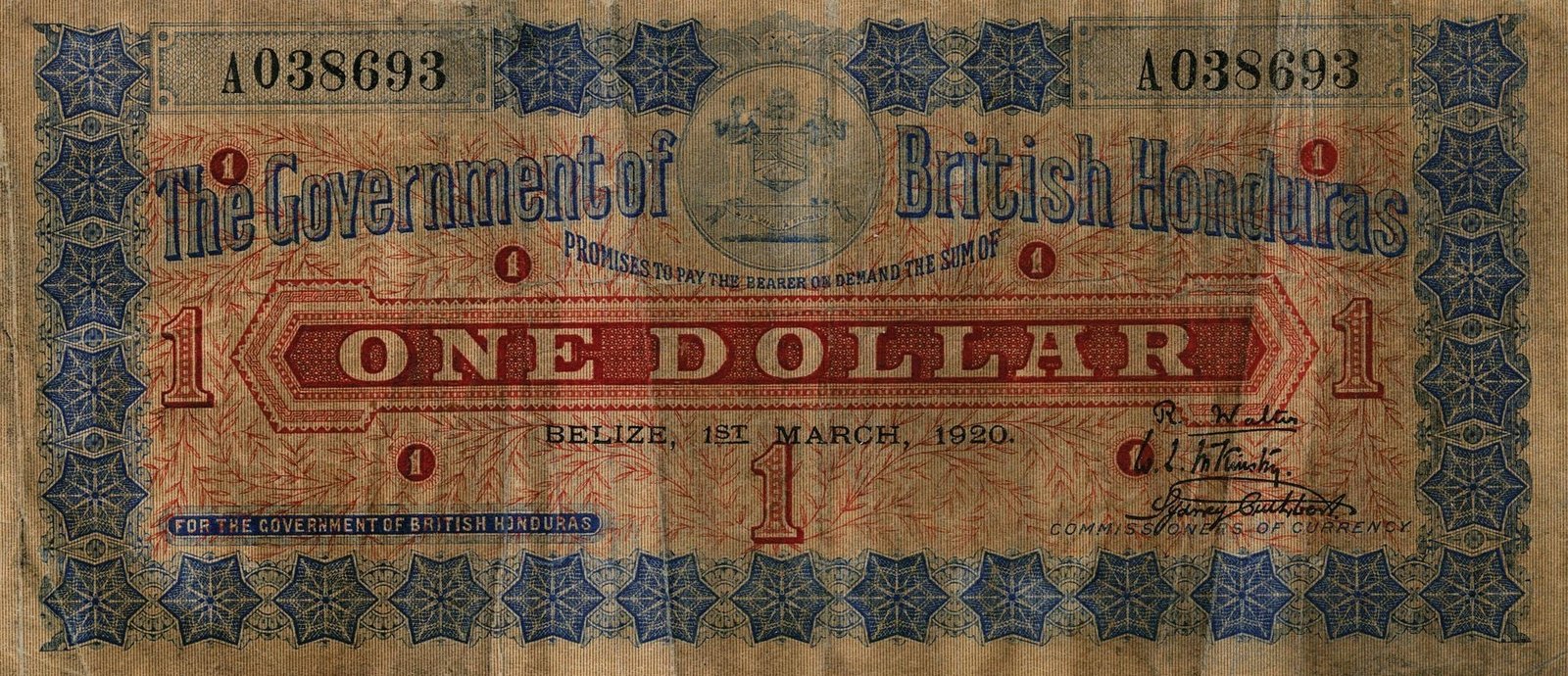
The design was reprinted with new dates: 3rd September 1901 on the 1 dollar, 23rd February 1904 on the 2 dollars, 1st December 1910 on the 2, 5 and 10 dollars, 1st May 1912 on the 1 and 2 dollars, 1st April 1919 on the 2 dollars and 1st March 1920 on the 1 dollar.
Sources mention how many notes of each value were issued before 26th March 1916, from 700 each of the 50 and 100 dollars to 47,500 of the 2 dollars. The annual report for 1913 says the 50 and 100 dollars notes had by then been withdrawn from circulation.
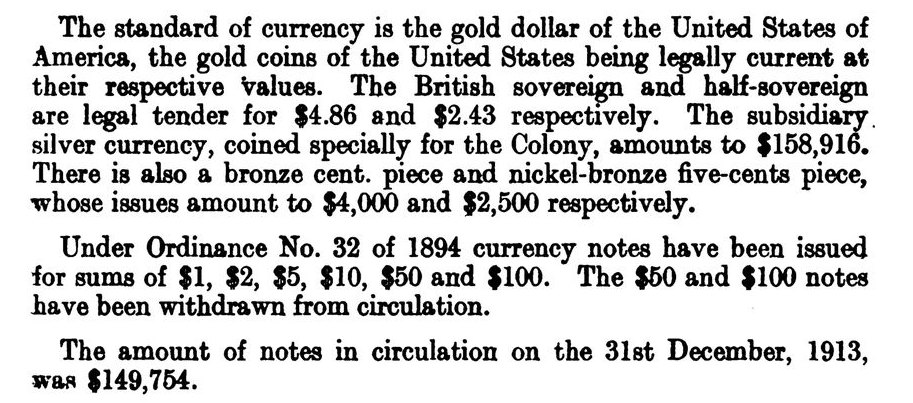
The annual report for 1922 says the Colony's only bank, the Royal Bank of Canada, was not allowed to circulate notes of its own and had to use the Government's, while notes of the United States circulated freely.
The notes of 1924 and 1928
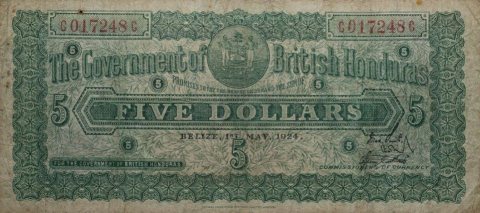
The notes dated 1st May 1924 and 1st October 1928 copy the design of 1895. On the 1 dollar two things are new: the ONE DOLLAR panel at the centre is dark blue-green in place of red, and the lower margin carries the imprint THOMAS DE LA RUE & COMPANY LIMITED, LONDON. Six values are listed: 1 dollar, 2 dollars, 5 dollars, 10 dollars, 50 dollars and 100 dollars. The annual reports for 1922, 1925 to 1928 and 1930 and the Economic Survey of the Colonial Empire for 1932 name only the 10, 5, 2 and 1 dollar notes as the colony's paper currency, and no issued 50 or 100 dollars of these dates is recorded.
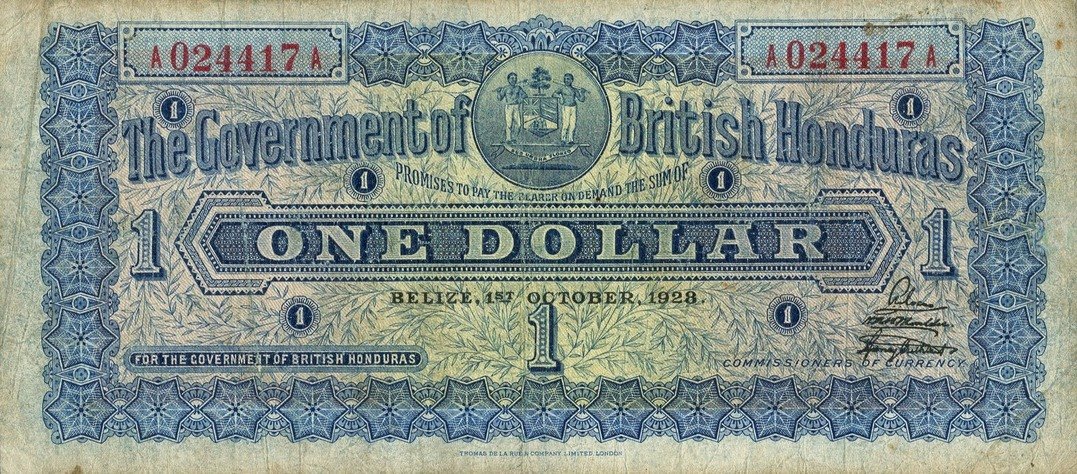
The statement of the Board of Commissioners of Currency for 30th June 1940, printed in the British Honduras Gazette, heads the notes of before 1939 as demonetised on 1st May 1940.
The King George VI notes of 1939 to 1952
The next notes were issued under the British Honduras Currency Notes Ordinance, 1937 (No. 1 of 1937), by a Board of the Colonial Secretary, the Treasurer and one member from outside the public service, with the dollar kept at par with the United States dollar.
They are a new design by a new printer, Bradbury Wilkinson: the arms at left and the portrait of King George VI at right, in four values. The first printings are dated 2nd October 1939 and 15th April 1942: 1 dollar, 2 dollars, 5 dollars and 10 dollars. The Board's half-yearly statements in the Gazette show when they came into use: the statement of 31st December 1939 still lists only the old notes, and that of 30th June 1940 has notes of all four values taken into issue.
The annual reports say the Commissioners decided in 1946 to order notes of a more distinctive colouring, and that the whole printing dated 30th January 1947, worth 1,050,000 dollars, reached the colony in December 1947. These are the 1 dollar, 2 dollars, 5 dollars and 10 dollars of 1947 to 1952. Later dates are 1st November 1949, 1st June 1951 on the 10 dollars and 1st February 1952.
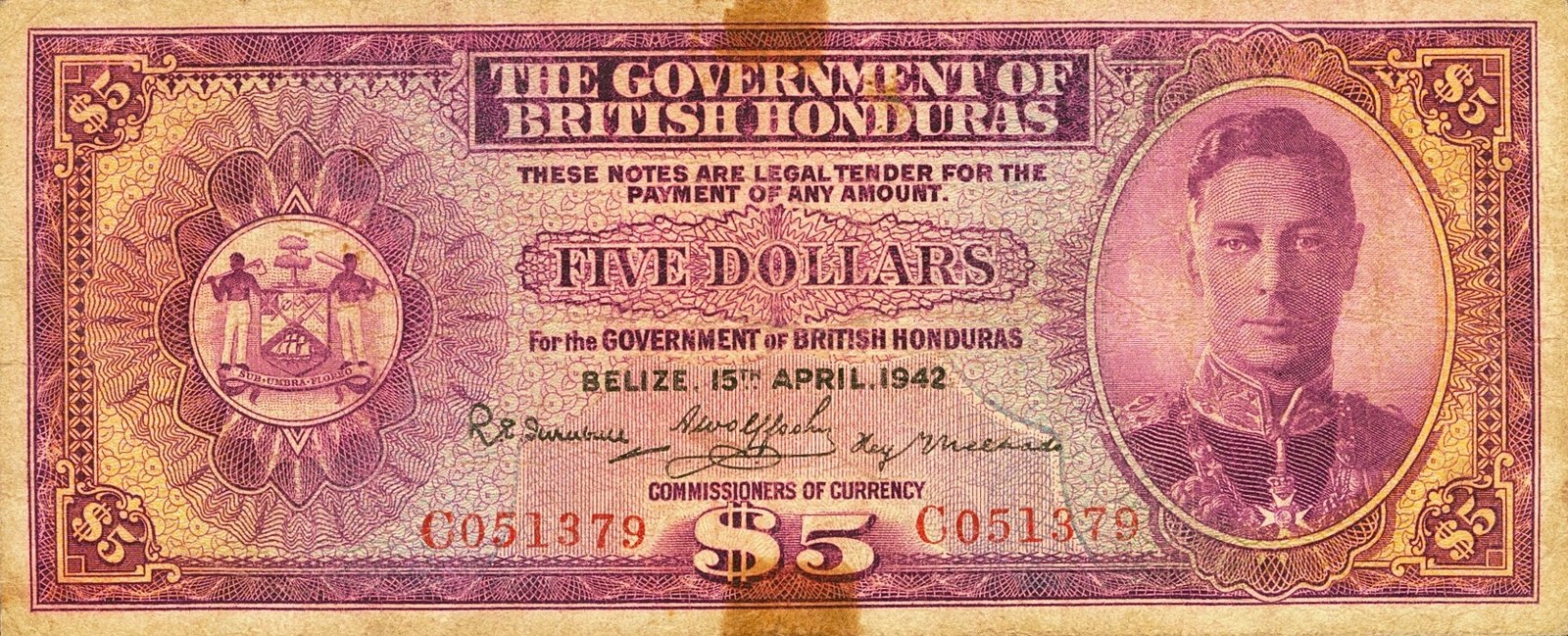
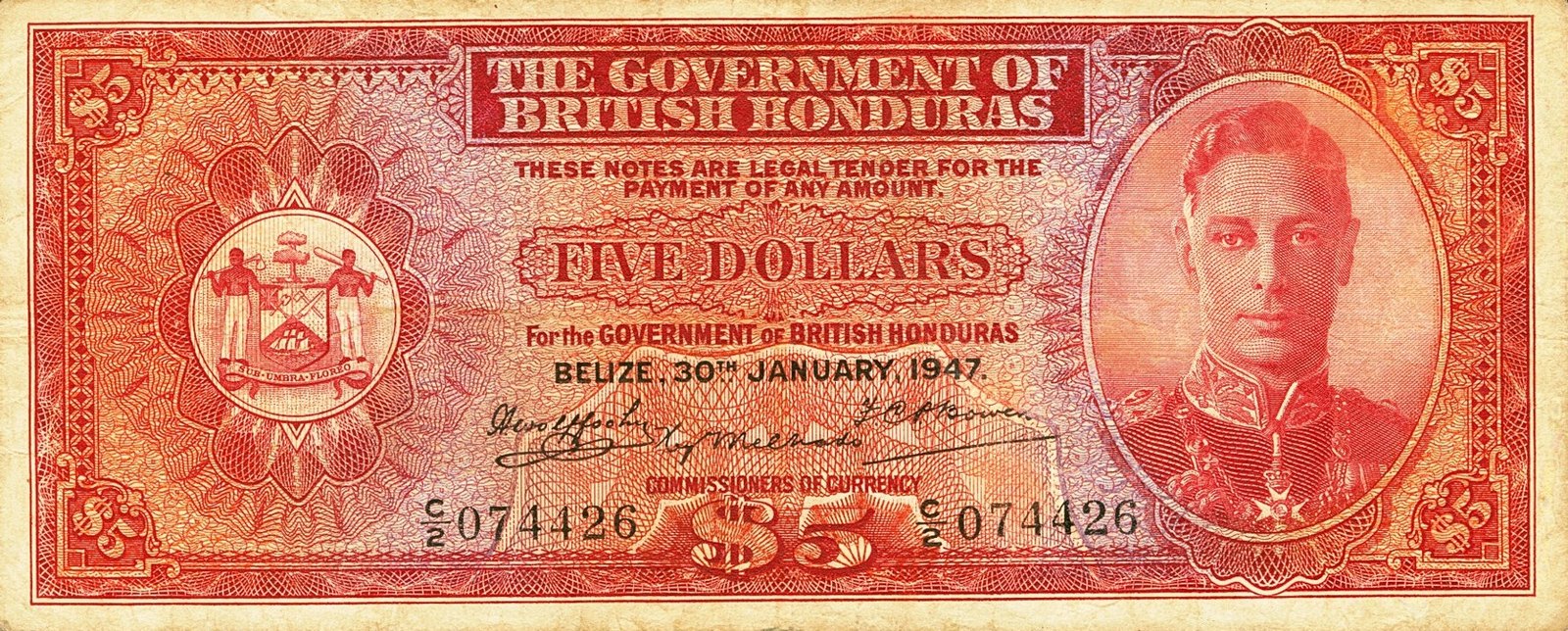
The value of the dollar changed while these notes were current. When sterling was devalued in September 1949 the British Honduras dollar stayed at par with the United States dollar. On 31st December 1949 it was fixed at 4 dollars to the pound by an amendment of the Currency Notes Ordinance, which the Governor declared passed under reserve powers after every unofficial member of the Legislative Council had voted against it (annual report for 1949).
The Queen Elizabeth II notes of 1952 to 1973
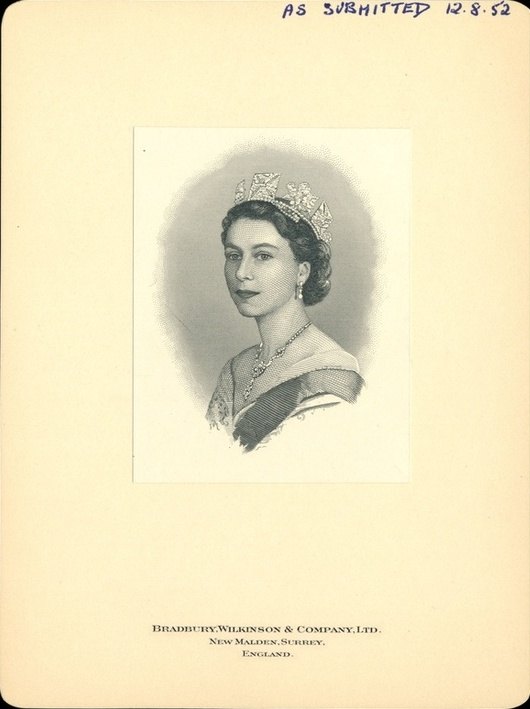
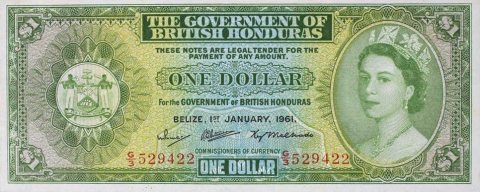
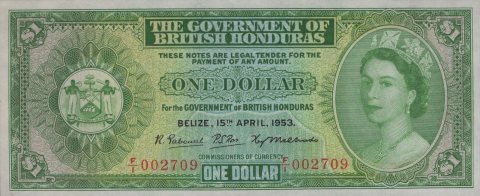
The last notes headed THE GOVERNMENT OF BRITISH HONDURAS keep the layout of the George VI notes, with the arms at left and the portrait of Queen Elizabeth II at right. Sources mention that the portrait follows a 1952 photograph by Dorothy Wilding, engraved by Bradbury Wilkinson. A fifth value was added, the 20 dollars, and it alone carries the first date, 1st December 1952, signed by Hone, Ross and Melhado. The 1 dollar, 2 dollars, 5 dollars and 10 dollars begin on 15th April 1953.
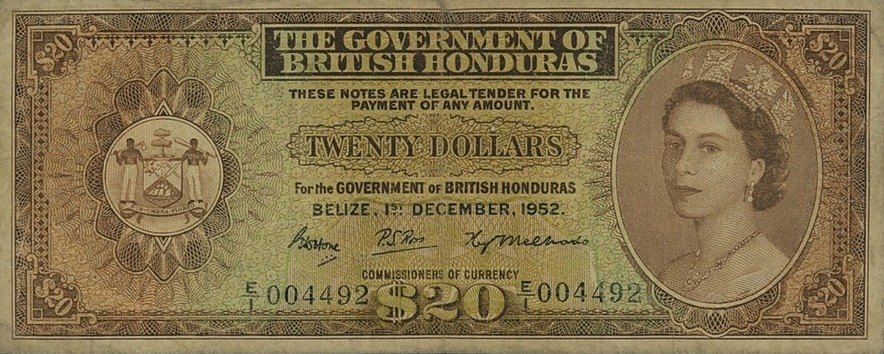
The dates of the issued rows on the Pick pages are these.
| Value | Printed dates |
|---|---|
| 1 dollar | 15th April 1953; 15th January 1955; 1st March 1956; 1st October 1958; 1st January 1961; 1st November 1961; 1st April 1964; 1st May 1965; 1st July 1967; 1st January 1969; 1st May 1969; 1st June 1970; 1st January 1971; 1st January 1972; 1st January 1973 |
| 2 dollars | 15th April 1953; 15th January 1955; 1st March 1956; 1st October 1958; 1st October 1960; 1st November 1961; 1st April 1964; 1st May 1965; 1st January 1971; 1st January 1972; 1st January 1973 |
| 5 dollars | 15th April 1953; 1st October 1956; 1st January 1958; 1st October 1958; 1st October 1960; 1st November 1961; 1st April 1964; 1st May 1965; 1st January 1970; 1st January 1971; 1st January 1973 |
| 10 dollars | 15th April 1953; 1st January 1956; 1st January 1958; 1st October 1958; 1st March 1960; 1st October 1960; 1st November 1961; 1st April 1964; 1st May 1965; 1st May 1969; 1st January 1971; 1st January 1973 |
| 20 dollars | 1st December 1952; 1st October 1958; 1st March 1960; 1st November 1961; 1st May 1965; 1st May 1969; 1st January 1970; 1st January 1971; 1st January 1973 |
Two of these dates are open. No 2 dollars dated 1st October 1960 is recorded, and no specimen range covers the numbers where it would fall. The 10 dollars of 1st January 1956 is a date that sources mention; the printer's specimen ranges run on from 15th April 1953 to 1st January 1958 without a gap, and no note of that date has been recorded.
Each value has its own prefix. The 1 dollar is F/1 on 15th April 1953 and then runs from G/1 to G/6. The 2 dollars is F/1 on 15th April 1953, H/1 from 15th January 1955 and H/2 on 1st January 1973. The 5 dollars is F/1 from 1953, runs into F/2 in the printing of 1st May 1965, and is F/2 in 1970 and 1973. Every 10 dollars is F/1 and every 20 dollars is E/1. The printer's specimens carry the range of numbers printed for each date, and the Pick pages list them with the varieties.
The houses give printing figures for some dates. Stack's Bowers, on 17 January 2025 (lot 20064), says the 1 dollar date of 1st January 1969 was soon replaced by the date of 1st May 1969 and that only 200,000 notes were printed for circulation; the Pick page finds that this fits the range G/5 175,001 to G/5 375,000 on a specimen in Lyn Knight's sale of 12 March 2012 (lot 2796). For the 2 dollars of 1st March 1956, Heritage (27 March 2025, lot 24065) says only 50,000 notes were printed, and Lyn Knight (12 March 2012, lot 2797) reads the same figure from the specimen range. Heritage, on 9 November 2023 (lot 24125), says only a few hundred thousand 20 dollars notes were issued in 20 years. Heritage also reported, on 7 January 2016 (lot 26049), that a small hoard of uncirculated 2 dollars of 1st November 1961 had recently come onto the market.
The notes carry three signatures. Melhado signs every 1 dollar to 1971 and Cattouse signs from 1st January 1972. By the Colonial Office List, Vickers was Colonial Secretary from 1953, Oates Financial Secretary from 1955, and Porcher Chief Secretary and Cottrell Financial Secretary from 1960. The signers of each date are set out in the article on the signers.
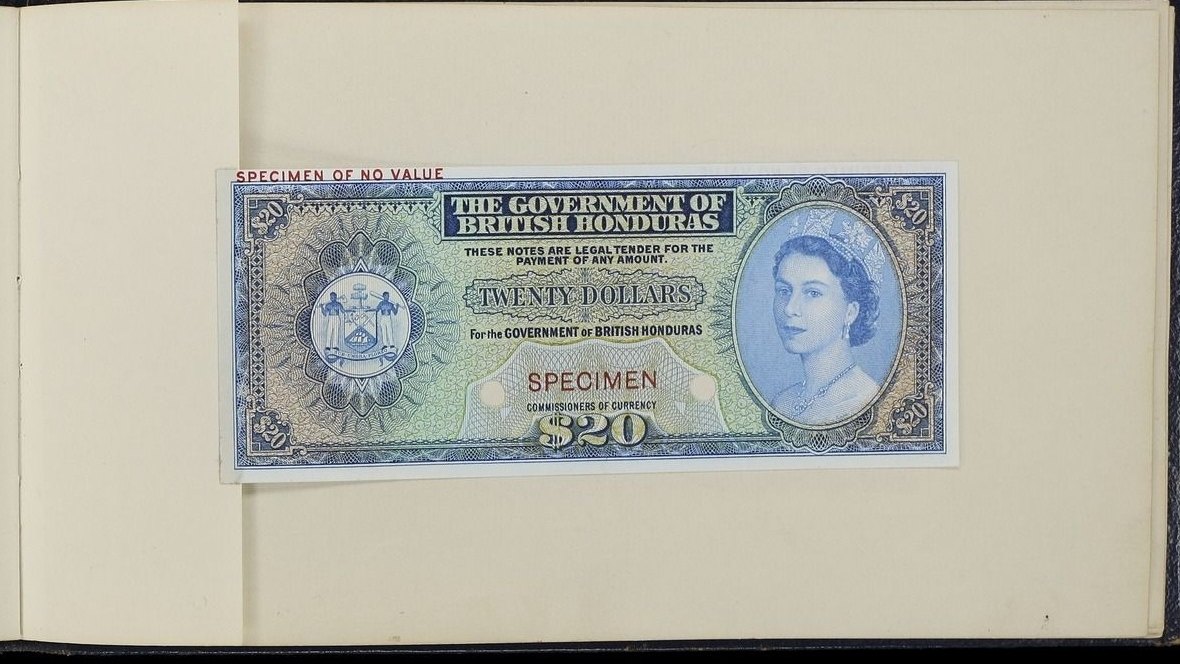
Colour trial specimens exist of all five values. Stack's Bowers, on 7 May 2026 (lot 51055), offered a Bradbury Wilkinson album of 32 mounted colour trial specimens of many countries, British Honduras among them, and dated the album to the last few years of the 1960s. The same house, on 22 April 2009 (lots 459 to 461), described an undated specimen of the 20 dollars as taken from a sample book long ago, and undated specimens of the 5 and 10 dollars as marked for colour on the top edge.
After 1973
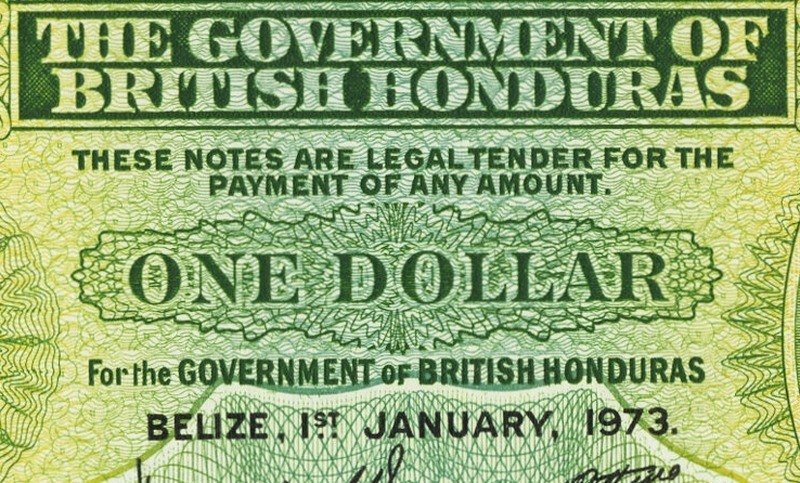
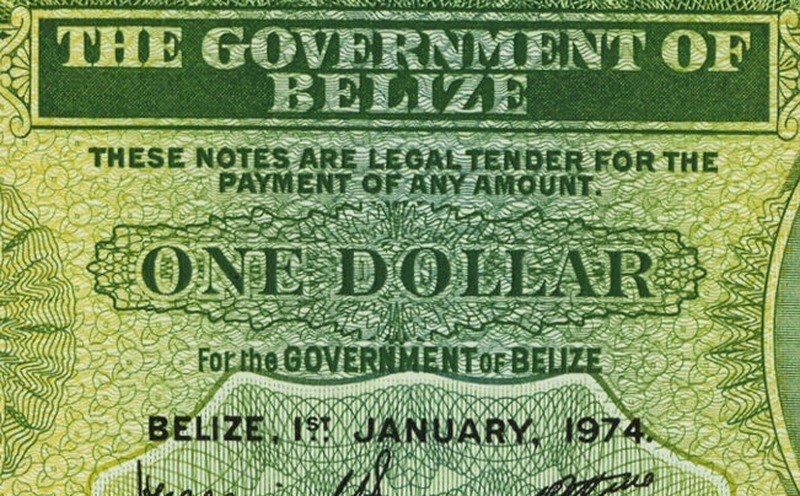
This was the last series before the country was renamed Belize in 1973. The Belize notes of 1974 to 1976 (1975 and 1976 on the 5 dollars) repeat the design, and the heading decides between them: THE GOVERNMENT OF BRITISH HONDURAS on these notes, THE GOVERNMENT OF BELIZE on the later ones. The place name BELIZE before the date is printed on both. The later notes have their own articles, beginning with the Government of Belize notes of 1974 to 1976 and the paper money of Belize, 1974 to 2025.
The Central Bank of Belize says on its page History of Currency that the Board of Commissioners of Currency operated from 1894 to 1976, and on its page on the Government of British Honduras notes that on 1 January 1981 the Monetary Authority of Belize demonetised all notes issued by the Board under the Currency Ordinance 1965. By the second page the Government of British Honduras notes are not legal tender of Belize and are redeemable only at the Central Bank.
The Bank counts four issues. Its second takes the notes of 1895, 1912, 1924 and 1928 together, and its third takes the notes of 1939, 1942, 1947, 1949 and 1951 together. The Pick pages divide each of those in two: the notes of 1895 to 1920 from those of 1924 and 1928 by the imprint and the colours, and the notes of 1939 and 1942 from those of 1947 to 1952 by the colours.
What the sources do not give
- The number of the Ordinance of 1894 differs between the sources, 32 or 31.
- The Pick pages give no day of withdrawal for the notes of 1894 or of 1895 to 1920. The Board's statement of 1940 speaks of the notes of before 1939 as one old issue.
- No source on the pages states how many notes of 1924 and 1928 were printed.
- For the notes of 1939 to 1973 the numbers printed are known only from the ranges on the printer's specimens, and not every date has a specimen.
- The pages give most signers by surname only.
Sources
- The Pick pages of this catalogue for British Honduras, P-1 to P-32 and the two unlisted pages.
- Chalmers, History of Currency in the British Colonies (1893), quoting the colony's annual report.
- The annual reports on British Honduras for 1908, 1911, 1913, 1922, 1925 to 1928, 1930, 1946 to 1950; the Economic Survey of the Colonial Empire for 1932.
- The Colonial Office List.
- The British Honduras Gazette: the half-yearly statements of the Board of Commissioners of Currency, 1939 to 1942.
- Stack's Bowers, 22 April 2009, lots 459 to 461; 12 January 2018, lot 30070; 17 January 2025, lot 20064; 7 May 2026, lot 51055.
- Heritage Auctions, 7 January 2016, lot 26049; 9 November 2023, lot 24125; 27 March 2025, lot 24065.
- Lyn Knight, 12 March 2012, lots 2796 and 2797.
- Central Bank of Belize, "History of Currency", https://centralbank.org.bz/history-of-belize-currency
- Central Bank of Belize, "Government of British Honduras Notes", https://centralbank.org.bz/home/core-functions/currency/demonetized-historical-currency/government-of-british-honduras-notes
Member comments
Log in or register to post a comment.