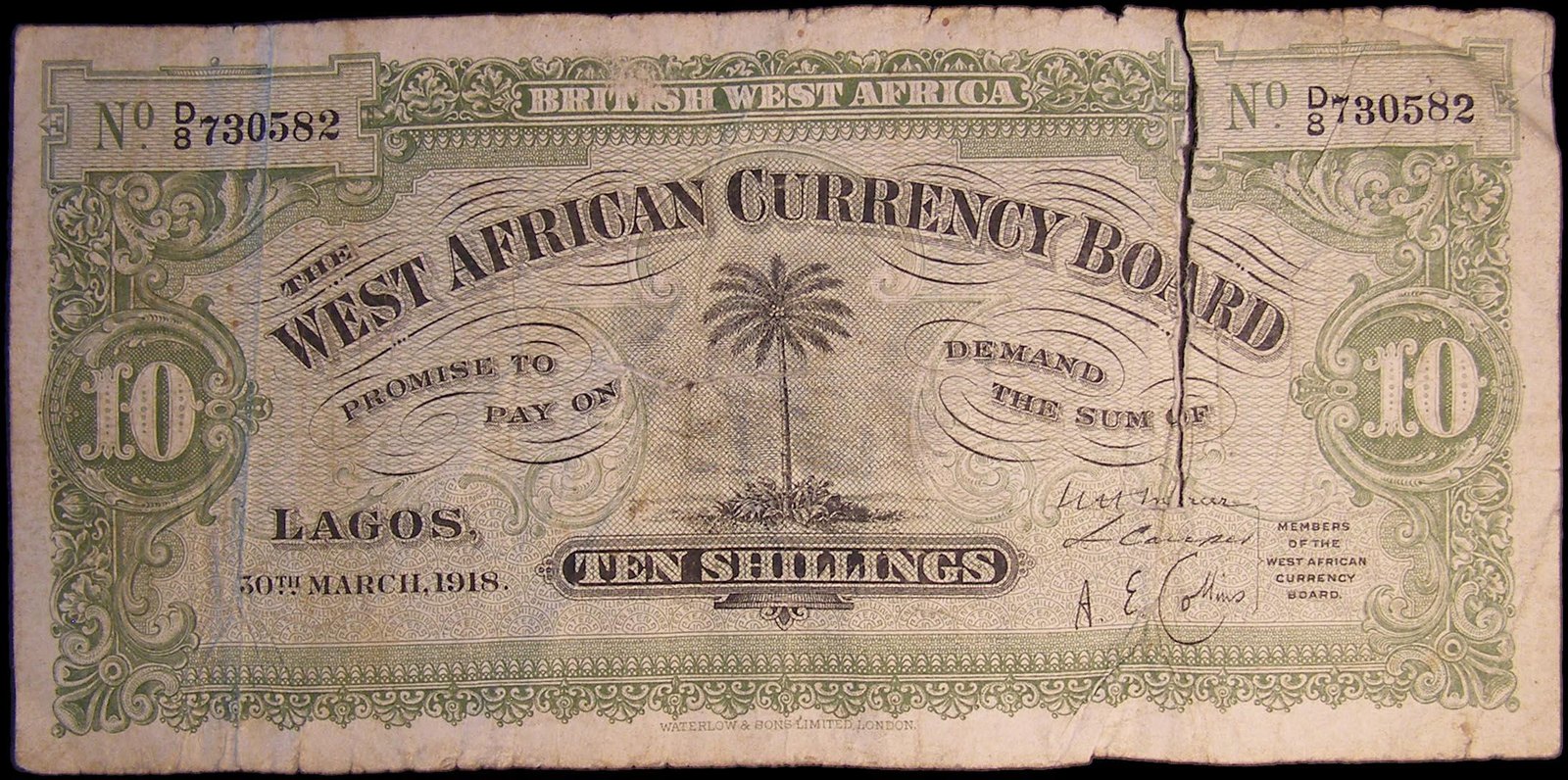
The notes of British West Africa were issued by one Board in London, but each colony had its own laws on them. This article sets out every law on the Board's notes that the owner's filed research records name: the lists of Ordinances in the Blue Books of Nigeria, the Gold Coast and Sierra Leone, the colonial annual reports, the Nigeria Handbook of 1919, the Colonial Office Lists and Hansard. Where a Blue Book gives only the title of a law, so does this article. The story of the notes themselves is in The notes of the West African Currency Board, 1916 to 1962, and what came before them in Before the Board's notes and beside them.
The laws in order of time
"Page image" means the entry was read on a picture of the printed page; "text" means it was read only in the text layer of a scan, where a digit or a date can slip.
| Date | Colony | Law, as the source names it | What the source says it did | Source | Read on |
|---|---|---|---|---|---|
| printed 1914 | The Board | The Board's first constitution | Covered coin only | Board's report to 30th June 1914, Appendix I | not recorded |
| 15th December 1915 | Gold Coast | Ordinance No. 27 of 1915 | Made the United Kingdom 20 and 10 shilling notes legal tender, as a temporary measure | Colonial Office List 1918, p. 469; Gold Coast Blue Book 1921 | text; page image (1921) |
| 1915 | Nigeria | Ordinance No. 27 of 1915 (Currency Notes (Legal Tender)) | Declared British currency notes legal tender in Nigeria; the Handbook adds that they had practically no circulation there | Nigeria Handbook 1919, pp. 40 and 196 | page image |
| 1915 | Sierra Leone | An Ordinance on the currency notes issued under the Currency and Bank Notes Act, 1914 | Number and day not readable | Sierra Leone Blue Book 1915, p. 52 | text |
| 3rd April 1916 | Nigeria | The Currency Notes Ordinance, 1916 (No. 11 of 1916) | Authorised the issue of the Board's notes; they could be changed for coin at the Bank of British West Africa in Lagos | Nigeria Blue Book 1916, list of Ordinances; Nigeria Handbook 1919, pp. 40 and 41 | page image |
| 4th November 1918 | Gold Coast | Ordinance No. 34 of 1918 | Empowered the Governor in Council to issue a Proclamation declaring the Board's notes legal tender | Gold Coast Blue Book 1918, list of Ordinances | page image |
| 1918, days unreadable | Gold Coast | Two Proclamations, for the Colony and for Ashanti | Declared the Board's notes legal tender | Gold Coast Blue Book 1918, p. 58 | text |
| 23rd November 1918 | Sierra Leone | An Ordinance to make Currency Notes issued by the West African Currency Board Legal Tender in Sierra Leone | As its title says; sent to London with despatch No. 396 of 12th December | Sierra Leone Blue Book 1918, p. 49 | page image |
| 31st December 1918 | Gold Coast | Ordinance No. 39 of 1918 | "To prohibit certain acts tending to depreciate currency" | Gold Coast Blue Book 1918, list of Ordinances | page image |
| 31st December 1918 | Sierra Leone | An Ordinance | Forbade discounting currency notes or paying a premium on silver coin | Sierra Leone Blue Book 1918, p. 49 | text |
| 1919 | Nigeria | Ordinance No. 6 of 1919 and Order in Council No. 15 of 1919 | Suspended for a time, because of the silver shortage, the right to change the notes for coin | Nigeria Handbook 1919, pp. 40 and 41 | page image |
| 1919, days detached | Nigeria | A Currency Offences Ordinance and two amendments; a Currency Notes (Amendment) Ordinance | Titles only | Nigeria Blue Book 1919, p. 59 | text |
| 1924 | Sierra Leone | Chapters 46 and 48, Laws of Sierra Leone, 1924 | The authority the Blue Books cite for the legal tender notes | Sierra Leone Blue Book 1934 | page image |
| 1928 | Nigeria | The Coins Ordinance, 1928 (No. 6 of 1928) | "Provides for the proper control of the export from, the import into and the circulation within, Nigeria of coins and notes" | Nigeria annual report 1928 | page image |
| 1933 | Sierra Leone | Import Prohibition Order in Council, No. 4 of 1933 | Forbade the import of goods resembling the colony's legal tender notes or coins | Sierra Leone Blue Books 1933 and 1934 | text |
| 1933 | Gold Coast | A rule among the prohibited imports | Barred any article with a design imitating British or West African currency notes | Gold Coast Blue Book 1933-34, p. 12 | text |
| 29th March 1934 | Gold Coast | Ordinance No. 11 of 1934, amending the Currency Ordinance | Title only | Gold Coast Blue Books for 1934 to 1936, list of laws | text |
| 7th December 1934 | Sierra Leone | Currency Notes (Repeal) Ordinance | What it repealed is not said; sent with despatch No. 541 of 7th December 1934 | Sierra Leone Blue Book 1934, p. 75 | page image |
| about 1935 | Nigeria | A law, not named | Made it an offence to ask printers to print forged West African notes | Nigeria annual report 1935, p. 80 | page image |
| 25th June 1935 | Gold Coast | The Currency Order, 1935 (Order in Council B1) | Title only | Gold Coast Blue Books for 1934 to 1936, list of laws | text |
| 16th December 1936 | Sierra Leone | Counterfeit Currency Ordinance (No. 18 of 1936) | In force from that day; title only | Sierra Leone Blue Book 1936, p. 77 | page image |
| 16th December 1936 | Sierra Leone | Currency Notes (West African Board) (Legal Tender) (Amendment) Ordinance (No. 20 of 1936) | In force from that day; what it amended is not said | Sierra Leone Blue Book 1936, p. 77 | page image |
| 21st December 1936 | Gold Coast | Currency (Amendment) Ordinance, No. 45 of 1936 | Title only | Gold Coast Blue Books for 1934 to 1936, list of laws | text |
| 1938 | Nigeria | A rule among the prohibited imports | Imitations of the Board's notes or coins | Nigeria Blue Book 1938, p. 11 | text |
How the Board's notes became legal tender
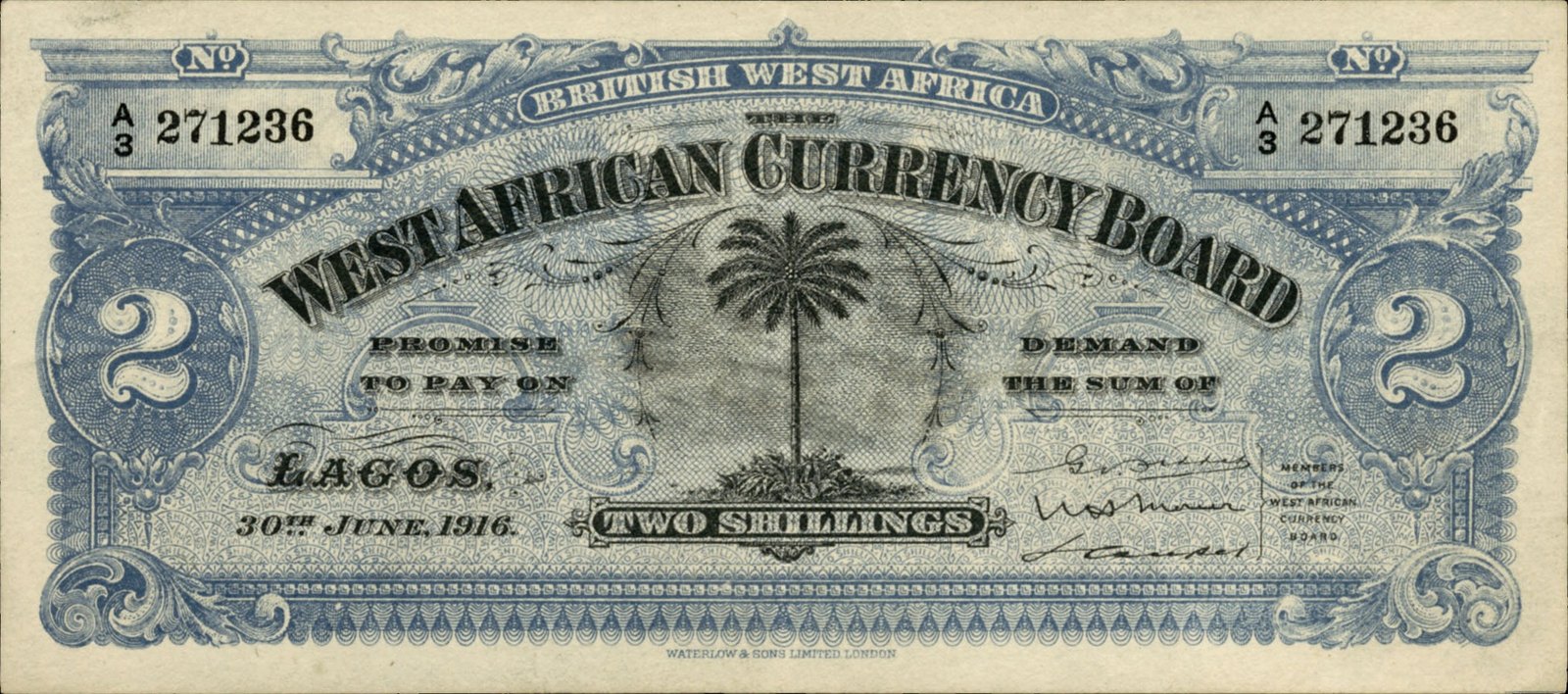
The table shows the order in which the colonies acted. The notes came out in Nigeria under that colony's own Ordinance of 3rd April 1916. Kerry Rodgers, writing in Bank Note Reporter in November 2004 after David Vice, says they were issued experimentally in the Gold Coast and Sierra Leone in September 1916. The Colonial Office List for 1918 (p. 469) says of the Gold Coast that the notes "were introduced experimentally but have not yet been made legal tender". The List for 1919 (p. 480) changes this to "have since been made legal tender".

On these sources, the Board's notes passed in the Gold Coast and Sierra Leone from 1916 until the laws of November 1918 without being legal tender there. The Board's report for the year ended 30th June 1918 says the 2 shillings was issued in Sierra Leone in October 1917, before the Ordinance of 23rd November 1918.
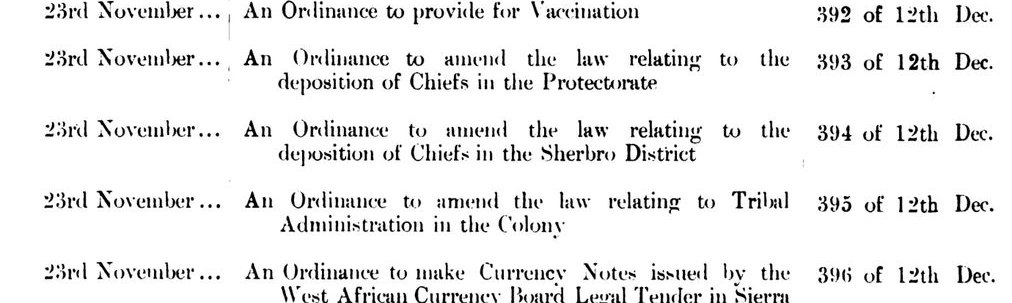
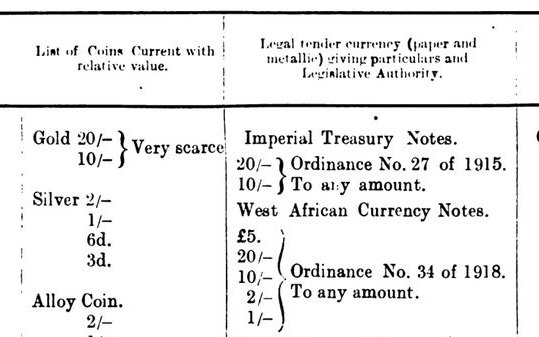
The Gold Coast law of 4th November 1918 is worded as a power, not as a declaration: it let the Governor in Council declare the notes legal tender by Proclamation. The Blue Book for 1918 lists two such Proclamations, for the Colony and for Ashanti, but their days cannot be read in the text. The Gold Coast Blue Book for 1921 cites only "Ordinance No. 34 of 1918" in its legal tender table, for notes of 5 pounds, 20, 10, 2 and 1 shillings, "to any amount".
No Ordinance of the Gambia on the Board's notes appears in the records. The Board's report for 1917-18 says only that the notes were introduced there in March 1918.
What the legal tender lists show, and what they do not
Each Blue Book has a section on currency with a column for "Legal tender currency ... giving particulars and Legislative Authority". The lists change slowly, and they name what the law made legal tender, not what was in people's hands.
- The Nigeria Blue Book for 1922 lists the Board's notes of 5 pounds, 20, 10, 2 and 1 shillings under Ordinance No. 11 of 1916, and adds that the 2 and 1 shilling notes "are being withdrawn from circulation" (read on the page image). The Blue Book for 1921 has the same list without the remark.
- The Gold Coast Blue Book for 1922-23 still lists all five values as legal tender (text).
- Sierra Leone's Blue Books for 1925, 1926, 1927 and 1928 still list the 5 pounds, 1 pound, 10 shillings, 2 shillings and 1 shilling as unlimited legal tender. From the Blue Book for 1930 only the 1 pound and 10 shillings are listed (text).
- The Gold Coast Blue Book for 1933-34 lists the 5 pounds, 20 shillings and 10 shillings as legal tender to any amount, under Chapter 32, the Currency Ordinance (text). The Gold Coast Blue Book for 1937 (p. 117) lists the Board's notes of 5 pounds, 20, 10, 2 and 1 shillings as legal tender to any amount.
The Colonial Office List for 1925 says the 5 pounds, 2 and 1 shillings had all been withdrawn, and the Gold Coast Handbook of 1928 says the same. No record read names a law or a day that ended the legal tender of the 1 shilling, 2 shillings or 5 pounds in any of the four colonies. The catalogue's pages for the 1 shilling, the 2 shillings and the 5 pounds of 1919 give their withdrawal, not a demonetisation.
Laws against forgery
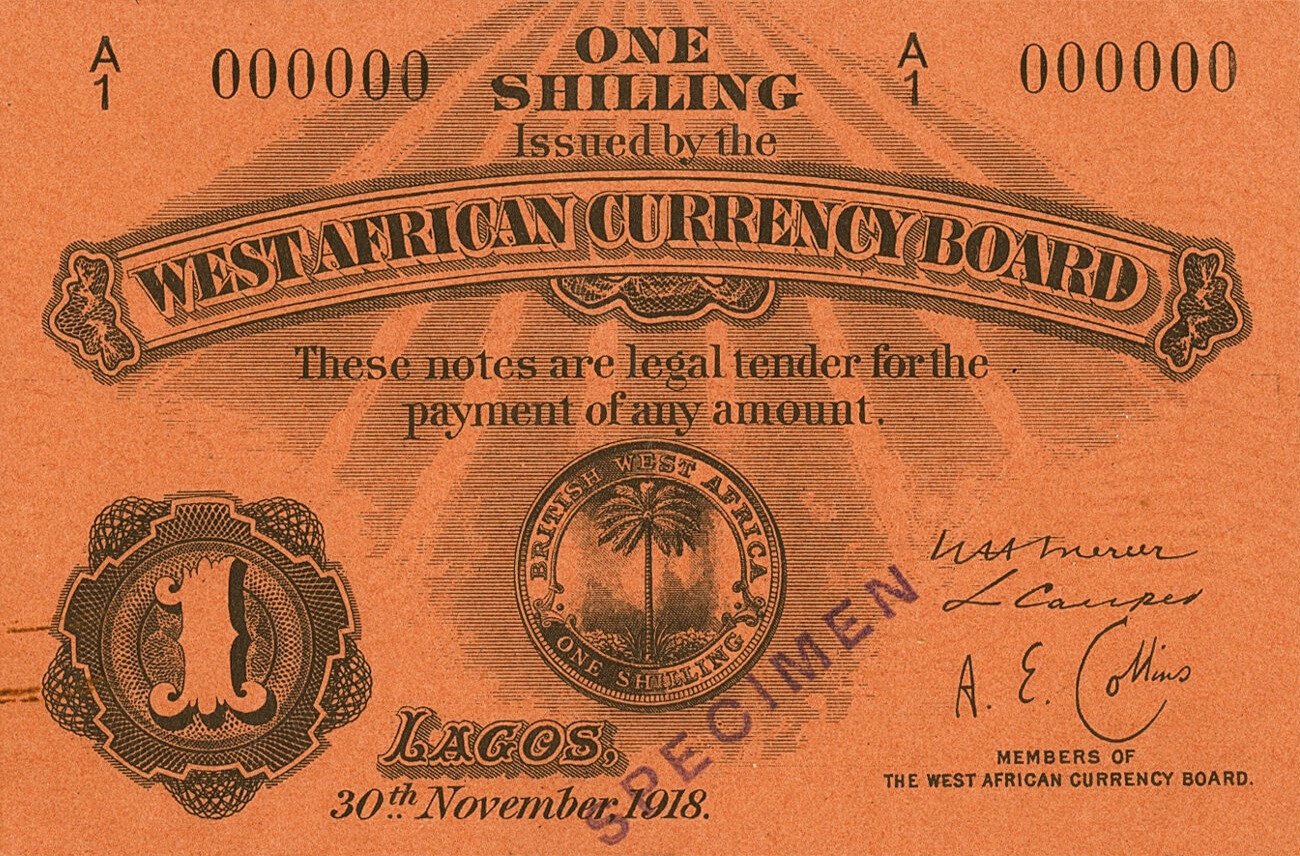
Three kinds of law in the table are aimed at forgers. The Gold Coast Ordinance of 31st December 1918 "to prohibit certain acts tending to depreciate currency" may belong here, though its title alone does not say. In 1933 Sierra Leone and the Gold Coast barred the import of goods that imitated their currency notes, and Nigeria's Blue Book for 1938 lists imitations of the Board's notes among prohibited imports. Nigeria's annual report for 1935 (p. 80) says that "numerous enquiries" had been sent to printers abroad with the aim of having forged West African notes printed, and that a law now made such enquiries an offence. Sierra Leone passed a Counterfeit Currency Ordinance in 1936.
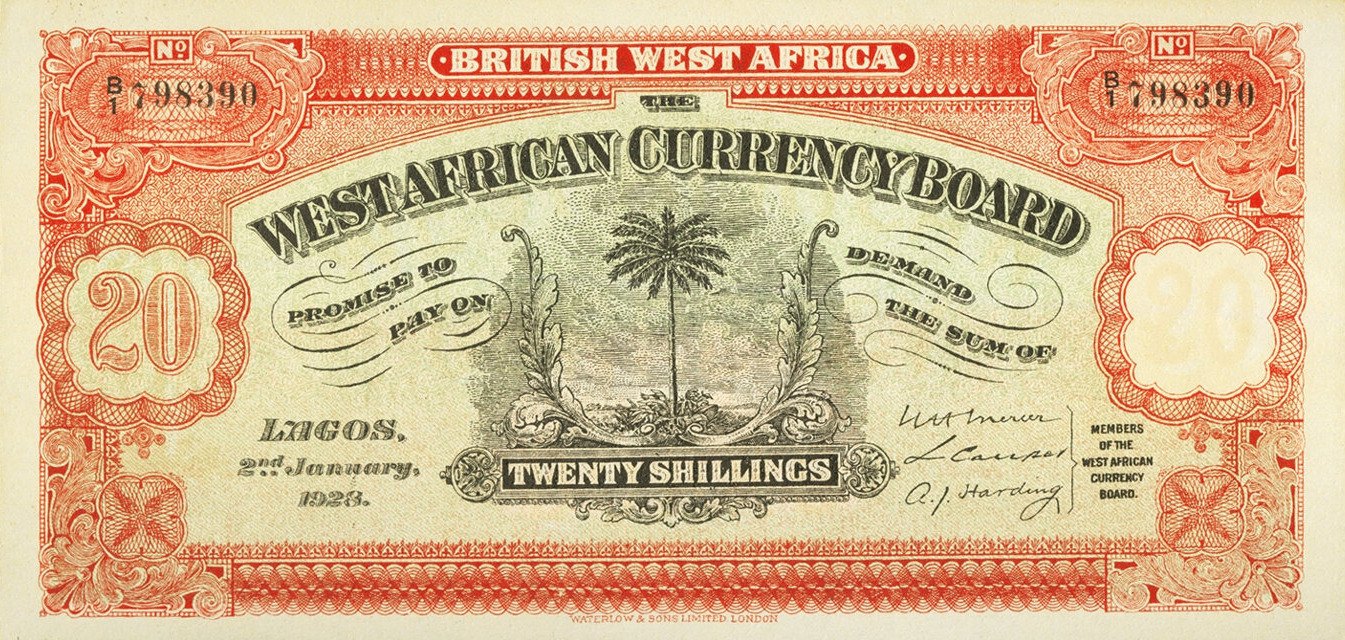
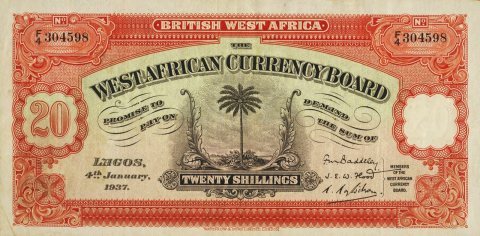
Which of the Gold Coast laws of 1934 to 1936 dealt with forgery, if any, is not known: the Blue Book gives only their titles. The forged notes themselves are described on the page for the 20 shillings of 1928 to 1952.
The end of the Board's notes
The records hold little law on the end. Hansard for 20th July 1955 records the Government's answer that a territory starting its own currency would redeem the Board's withdrawn currency in sterling, and that this was not tied to independence. Hansard for the same day gives the Board's assets at 30th June 1955 as 99,902,000 pounds, with a surplus of 7,064,000 pounds. The Nigeria annual report for 1957 (pp. 23 and 24, read in the text) names the report of J. B. Loynes of the Bank of England, printed in Lagos in 1957, on a Nigerian central bank and currency. The Colonial Office List for 1963 says the Board's currency was then legal tender only in the Gambia and Sierra Leone. The days on which the notes were exchanged in Ghana and Nigeria are given on the page for the 20 shillings of 1962, without a named source.
What the records do not give
- The text of any of these laws. The Blue Books give titles, numbers and days; the contents come only where a handbook or report describes them.
- The days of the two Gold Coast Proclamations of 1918.
- Any law of the Gambia on the Board's notes.
- What the Sierra Leone Repeal Ordinance of 1934 and Amendment Ordinance of 1936 changed, and what the Gold Coast laws of 1934 to 1936 changed.
- A law or day that ended the legal tender of the withdrawn values.
Sources
- Report of the West African Currency Board to 30th June 1914, Appendix I; Report for the year ended 30th June 1918 (Cmd. 15).
- Nigeria: Blue Books for 1916, 1919, 1921, 1922 and 1938; Nigeria Handbook of 1919, pp. 40, 41 and 196; annual reports for 1928, 1935 and 1957.
- Gold Coast: Blue Books for 1918, 1921, 1922-23, 1933-34, 1934, 1935, 1936 and 1937; Gold Coast Handbook of 1928.
- Sierra Leone: Blue Books for 1915, 1918, 1925 to 1928, 1930, 1933, 1934 and 1936.
- The Colonial Office Lists for 1918 (p. 469), 1919 (p. 480), 1925 and 1963.
- Hansard, House of Commons, 20th July 1955.
- Kerry Rodgers, after David Vice, in Bank Note Reporter, November 2004, p. 89.
Member comments
Log in or register to post a comment.