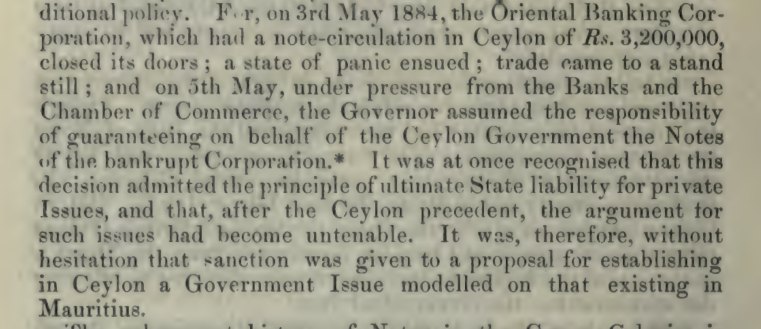
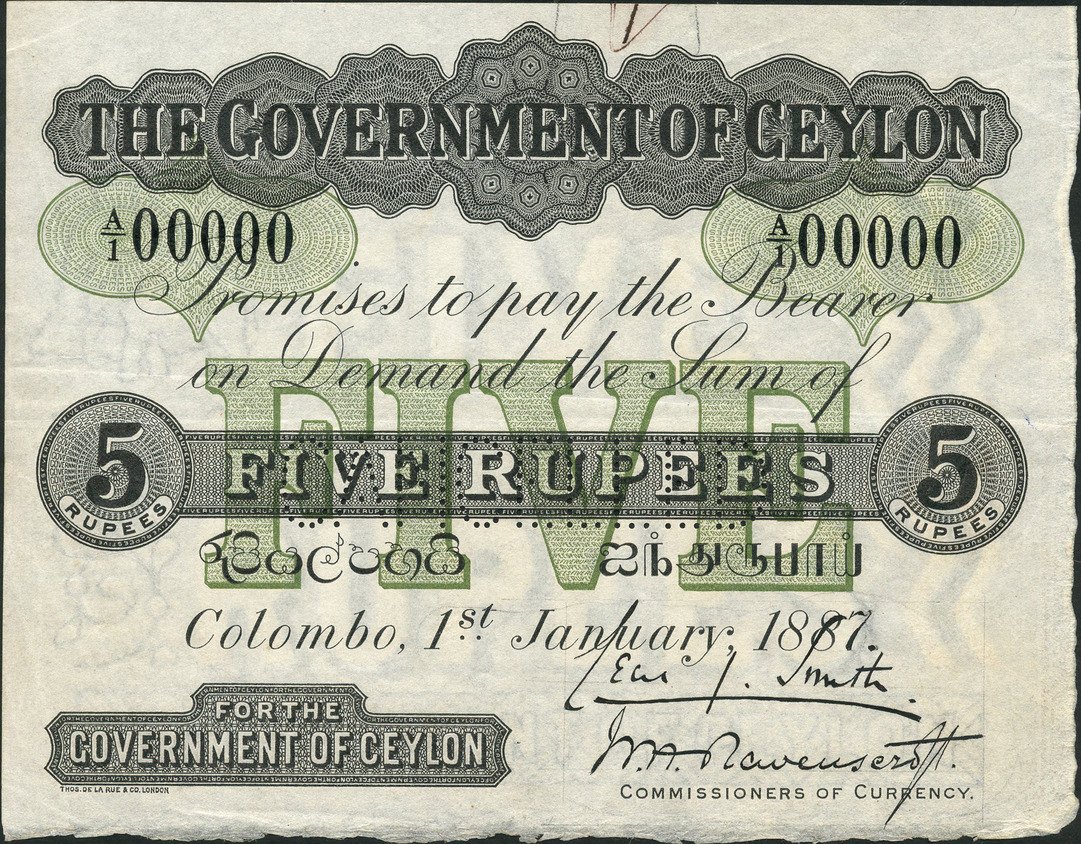
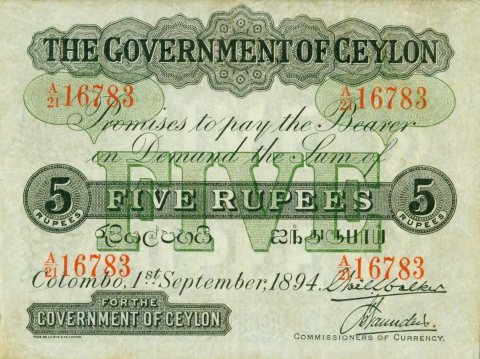
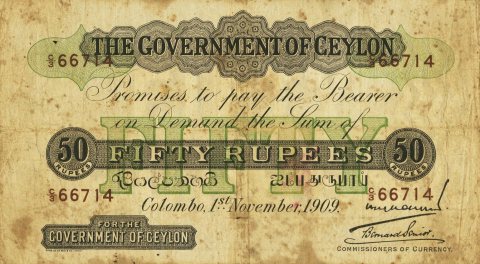
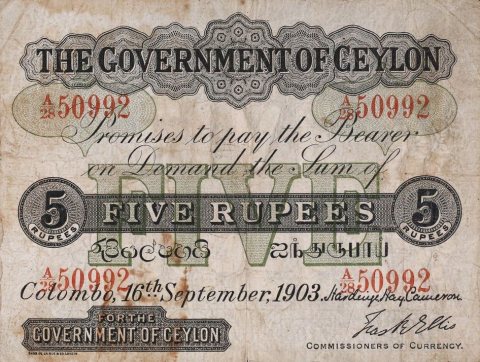
The catalogue begins Ceylon with the Government notes dated 1st January 1885, the 5 rupees, 10 rupees and 50 rupees, and has no page for the notes of the banks that came before them. This article gathers what official papers say of those bank notes: evidence given to an Indian commission in 1866, the Ceylon despatches and Council papers of 1884 to 1886, the Blue Books, and Chalmers' History of Currency in the British Colonies (1893). How the Government's own notes were planned is told in Planning Ceylon's first government notes.
The banks and the end of the Treasury's own notes
A circular of the Currency Department of the Central Bank of Ceylon, dated 15th March 1984, is reproduced on notes.lakdiva.org.lk, the collectors' site kept by Kavan Ratnatunga. As the site gives it, the circular says that Ordinance No. 23 of 1844 let private banks issue notes on payment of a yearly fee of 20 pounds. It names the Bank of Ceylon, founded in 1841, and the Western Bank of India among the first to do so, and says that the Oriental Bank Corporation and the Chartered Mercantile Bank, founded in 1851 and 1858, issued notes as well. This is the statement of a collectors' site giving a later summary: the ordinance itself was not read, and neither was the circular in print.
With bank notes in use the Government gave up its own paper. A memorandum by J. F. Dickson in Sessional Paper I of 1886 quotes a Government Minute of 28th December 1855, issued by Governor Sir H. Ward: the whole of the Treasury notes in circulation on 1st January 1856 would be withdrawn as they came into the hands of the Government, and sent to England to be cancelled. The Blue Book for 1885 still counts Rs. 8,920 of old Treasury notes as outstanding.
1865: the Oriental Bank's own account
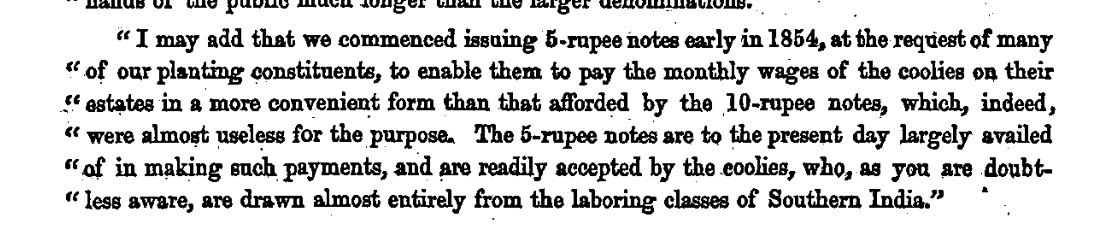
In February 1866 Major Hyde, Mint Master at Calcutta and Head Commissioner of Currency, gave evidence to the commission that inquired into the Indian paper currency Act of 1861. To support a 5 rupee note for India, Hyde handed in a memorandum from the Manager of the Oriental Bank in Ceylon (Report of the Commission on Act XIX of 1861, volume II, printed pages 15 and 16). The Manager wrote that the bank "commenced issuing 5-rupee notes early in 1854, at the request of many of our planting constituents", and that at the up-country branches, where only notes of 5 and 10 rupees were issued, the 5 rupees made up more than half of the whole.
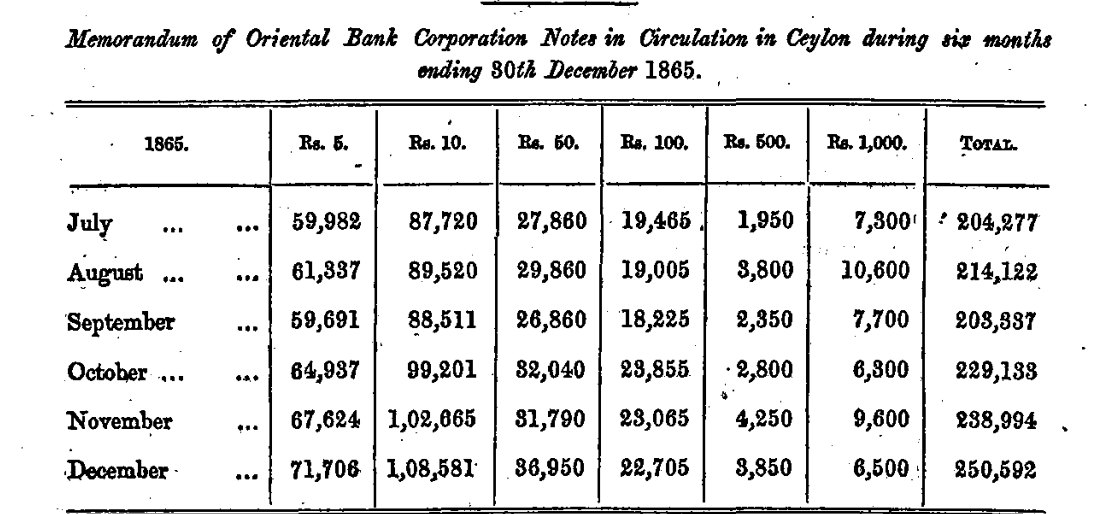
The memorandum is printed under the heading "Memorandum of Oriental Bank Corporation Notes in Circulation in Ceylon during six months ending 30th December 1865". It has one line for each month from July to December 1865, a column for each of six note values and a column of totals.
| 1865 | Rs. 5 | Rs. 10 | Rs. 50 | Rs. 100 | Rs. 500 | Rs. 1,000 | Total |
|---|---|---|---|---|---|---|---|
| July | 59,982 | 87,720 | 27,860 | 19,465 | 1,950 | 7,300 | 204,277 |
| August | 61,337 | 89,520 | 29,860 | 19,005 | 3,800 | 10,600 | 214,122 |
| September | 59,691 | 88,511 | 26,860 | 18,225 | 2,350 | 7,700 | 203,337 |
| October | 64,937 | 99,201 | 32,040 | 23,855 | 2,800 | 6,300 | 229,133 |
| November | 67,624 | 1,02,665 | 31,790 | 23,065 | 4,250 | 9,600 | 238,994 |
| December | 71,706 | 1,08,581 | 36,950 | 22,705 | 3,850 | 6,500 | 250,592 |
The figures are copied as printed, with the Indian grouping of the digits in two places. The unit of this table is not known. Neither the heading nor the columns name one: the columns are headed only by the value of the note. The Manager's letter calls the paper a memorandum "giving the amounts and the several denominations of the notes", and says that by it the 5 rupee notes made up rather less than one-third of the whole amount in circulation, so the figures are amounts and not numbers of notes. But several of them are not whole multiples of the rupee value at the head of their column (19,465 under 100 rupees, 59,982 under 5 rupees), so they cannot simply be read as rupees. Until the unit is settled from another paper, no total for the bank's circulation in 1865 should be taken from this table. What it does show is that the bank had six values out in 1865, the same six that the Government's ordinance provided for in 1884.
A second witness, W. Anderson of the Oriental Bank, was asked on 27th February 1866 about the currency of Ceylon. Anderson's answer was no: Anderson had never been there in office and knew little of the particulars, but said that the currency was chiefly bank notes and silver, both English and Indian.

May 1884: three counts of the Oriental Bank's notes
The Oriental Bank Corporation closed on 3rd May 1884. The papers give the notes it then had out in Ceylon three times, and the three do not agree.
| Source | Oriental Bank notes in circulation in Ceylon |
|---|---|
| Address of the Legislative Council to the Governor, 17th November 1884 | Rs. 3,211,085 |
| Sir J. Douglas's memorandum of 9th September 1884 | 351,000 notes, Rs. 3,110,000 |
| Chalmers, A History of Currency in the British Colonies (1893), page 36 | Rs. 3,200,000 |
The members of the Executive Council explained the first two in a memorandum printed in Sessional Paper I of 1886: Lord Derby's despatch gave Rs. 3,110,000, "but the official returns of the bank show that the amount was Rs. 3,211,085". Setting aside Rs. 11,085, they took the sum to be provided for as 32 lacs of rupees, which is the round figure Chalmers prints. The page of the 5 rupees gives Chalmers' figure.
The Douglas memorandum also divides the notes by value.
| Notes of | Rs. 5 | Rs. 10 | Rs. 50 | Rs. 100 | Rs. 500 | Rs. 1,000 |
|---|---|---|---|---|---|---|
| Number, as printed | 140,700 | 173,700 | 44,800 | 4,337 | 690 | 19 |
| Value, as printed | Rs. 1,203,500 | Rs. 1,737,000 | Rs. 224,000 | Rs. 433,700 | Rs. 34,500 | Rs. 19,000 |
This table is misprinted in the Sessional Paper. The values against the 5, 50 and 500 rupees do not answer to the numbers of notes beside them, and it is not known which of each pair is wrong. The lines for 10, 100 and 1,000 rupees are consistent. The memorandum's own comment is that the notes of 100, 500 and 1,000 rupees "had no practical circulation" and were kept as a store of money.
The same address of 17th November 1884 gives the notes of "the only other Bank with a note currency", the Chartered Mercantile Bank of India, London, and China, as Rs. 921,495.
The guarantee and the cost of it
Chalmers (page 36) says that on 5th May 1884, "under pressure from the Banks and the Chamber of Commerce", the Governor took on the responsibility of guaranteeing the notes of the bankrupt corporation on behalf of the Ceylon Government. Chalmers adds that in the Straits Settlements the Colonial Government did not follow the Ceylon precedent, and that the other banks there cashed the Oriental Bank's local notes in self-defence.

Ordinance No. 26 of 1884 allowed up to 160,000 pounds to be raised by debentures "to be applied to the redemption of such Oriental Bank Notes as were guaranteed by the Government of this Colony". The guaranteed notes could be changed for Government notes from 15th February to 31st March 1885 (Lord Derby's despatch of 20th February 1885), and the page of the 5 rupees records that Oriental Bank notes ceased to be legal tender after 31st March 1885. The estimates for 1885 allowed Rs. 1,500 for counters to count the bank's notes as they were redeemed.
The Government's statements of assets and liabilities then carry the money laid out on the bank's notes as an advance, and show it being recovered.
| Day | Advances for the redemption of Oriental Bank Corporation notes | Source |
|---|---|---|
| 1st January 1886 | Rs. 625,152.50 | Blue Book for 1885; Sessional Papers of 1886 |
| 1st January 1887 | Rs. 156,288.14 | Blue Book for 1886; Sessional Papers of 1887 |
| 1st January 1888 | Rs. 156,288.14 | Blue Book for 1887 |
| 1st January 1889 | Rs. 156,288.14 | Blue Book for 1889 |
| 1st January 1890 | Rs. 156,288.14 | Blue Book for 1889 |
| 1st January 1891 | Rs. 39,072.05 | Blue Book for 1890 |
The statements do not say when the last of the advance was cleared, and they give no count of the Oriental Bank notes handed in.
The end of the bank issues
The Colonial Office wrote to the Treasury on 8th September 1884 that the powers of note issue granted to the Chartered Mercantile Bank by its charter "will not be renewable on its expiration in 1888". The bank's notes were gone from circulation before that. The Blue Book for 1885 explains a fall in the stamp duty that the banks paid on their notes by the withdrawal of bank notes from circulation, and the Blue Book for 1887 gives the note circulation of every bank in the Colony as nil.
| Blue Book | Banks doing business in Ceylon | Their notes in circulation |
|---|---|---|
| 1887 | Chartered Mercantile Bank, Bank of Madras, National Bank of India, New Oriental Bank Corporation | Nil |
| 1891 | the banks, now with the private Hatton Bank | Nil |
| 1893 | Mercantile Bank of India, Bank of Madras, National Bank of India, Hongkong and Shanghai Bank | Nil |
| 1900 | not named here | Nil |
From 1887 the Government's notes were the only paper money in the returns.
What collectors have recorded of the bank notes
The catalogue lists none of these notes, so the following is given only as a guide to where they have been written about and seen.
- Kavan Ratnatunga's article on the Ceylon branch of the Chartered Mercantile Bank of India, London & China, in the IBNS Journal, volume 60, number 1, pictures among others a 5 shillings of the Mercantile Bank from before its charter, issued at Kandy, an unsigned 10 shillings remainder, and a cancelled 100 rupees of Galle dated 1st July 1880 from the HSBC archive.
- The same writer's collectors' site notes.lakdiva.org.lk, on its page "Watermarks on British Ceylon BankNotes", shows the watermarks of Treasury notes of 1, 2 and 5 pounds of the 1850s, of notes of the Asiatic Banking Corporation of 1864 to 1866, of a 50 rupees of the Chartered Mercantile Bank issued at Kandy in 1870, and of Oriental Bank notes of 5 rupees of Colombo and 10 rupees of Galle from the years 1870 to 1884. It also lists a 2 pounds of the Bank of Ceylon of 1844, for which it says a picture of the watermark is still wanted.
- Herbert I. Melnick's sale of the Stanley Gibbons Collection, Part V (20 December 1982), lot 2145, was a note of 10 shillings or 5 rupees of 1865.
- The inventory that Ruth Hill kept of the Hill collection lists a 10 shillings or 5 rupees dated 1st May 1866, a 5 rupees dated 1st November 1873 and a 5 rupees dated 1st January 1881 that the ledger calls a Newera Ellia issue. Of a note dated 3rd August 1822 the ledger says that notes with that date are fictitious.
What the papers do not give
No paper read gives the number of Oriental Bank notes redeemed, a count by value that can be trusted for 1884, the values or the dates of the Chartered Mercantile Bank's notes, or the day on which that bank's last notes were paid. The Blue Books of 1885 to 1894 give no figures for bank notes other than the word nil.
Sources
- Report of the Commission on Act XIX of 1861 (the Indian paper currency), volume II, 1867: the evidence of Major Hyde, 6th February 1866, question 68, with the memorandum of the Manager of the Oriental Bank, Ceylon, printed pages 15 and 16; the evidence of W. Anderson, 27th February 1866, question 384.
- Ceylon Sessional Paper I of 1886, "Despatches relating to the issue of currency notes by the Government of Ceylon": Sir J. Douglas's memorandum of 9th September 1884; the Colonial Office to the Treasury, 8th September 1884; the memorandum of the members of the Executive Council; J. F. Dickson's memorandum; Lord Derby's despatch of 20th February 1885.
- Proceedings of the Legislative Council of Ceylon, 1884: the Address of the Council to the Governor, 17th November 1884; the assent to Ordinance No. 26 of 1884.
- Ceylon Sessional Paper XIII of 1884, report on the Supply Bill for 1885.
- Ceylon Blue Books for 1885, 1886, 1887, 1889, 1890, 1891, 1893 and 1900, and the statements of assets and liabilities in the Sessional Papers of 1886 and 1887.
- Robert Chalmers, A History of Currency in the British Colonies (London, 1893), page 36 and pages 387 to 388.
- Currency Museum Circular No. 7, Currency Department, Central Bank of Ceylon, 15th March 1984, as given on the collectors' site notes.lakdiva.org.lk at Early Paper Money Systems of Lanka; the same site's pages Watermarks on British Ceylon BankNotes and WaterMarks on Lankan Currency. Read in a copy saved on 4th November 2026 and opened online on 24th November 2026.
- Kavan Ratnatunga, article on the Chartered Mercantile Bank of India, London & China, Ceylon Branch, IBNS Journal, volume 60, number 1.
- Herbert I. Melnick, The Stanley Gibbons Collection, Part V, 20 December 1982, lot 2145.
- The inventory ledgers of Ruth Hill, sheet for Ceylon.
Member comments
Log in or register to post a comment.