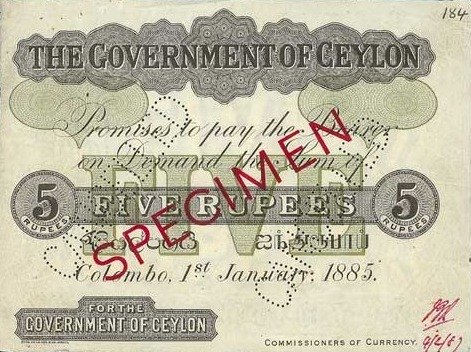
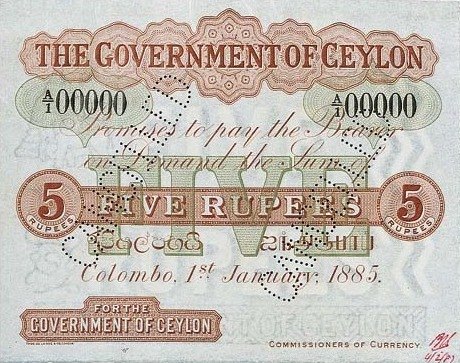
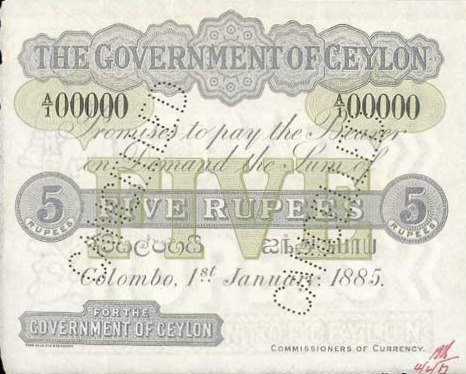
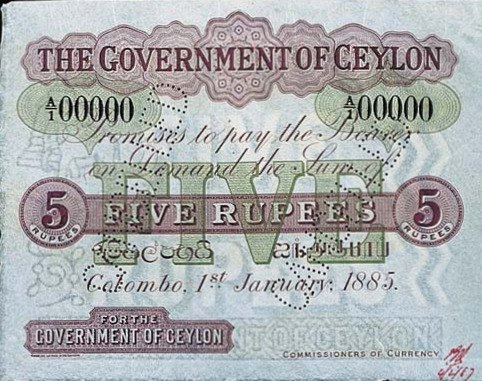
The first rupee notes of the Government of Ceylon, the 5 rupees, 10 rupees and 50 rupees dated 1st January 1885, were planned in the months after the Oriental Bank Corporation closed in May 1884. This article follows that planning in order of time from the papers of the Legislative Council: the despatches printed as Sessional Paper I of 1886, the Council's proceedings of 1884 and the estimates. The first order itself, the law and the yearly circulation are set out in Ceylon's first government rupee notes, 1884 to 1926; what is told there is only touched on here.
May to September 1884: the proposal and London's terms
The Oriental Bank Corporation closed on 3rd May 1884. Opening the session of the Legislative Council on 15th October 1884, the Governor said that at once a telegram had gone to the Secretary of State for the Colonies, asking that the privilege of a note issue be withheld from any bank that might replace the Oriental Bank, and that a proposal for an issue of notes by the Government had followed by the next mail. The speech adds that it was only "after a long correspondence" that "the reluctant assent of the Lords of the Treasury" had been obtained (Proceedings of the Legislative Council, 15th October 1884).
The proposal is Governor Gordon's despatch No. 175 to the Earl of Derby, written at The Pavilion, Kandy, on 10th May 1884. It suggested notes of a smaller value than the 5 rupees that was then the lowest bank note, "say of Rs. 2·50", beside the existing values. The draft Ordinance sent with despatch No. 286 of 28th July 1884 still allowed a note of 2 rupees 50 cents in its 3rd clause (Sessional Paper I of 1886).
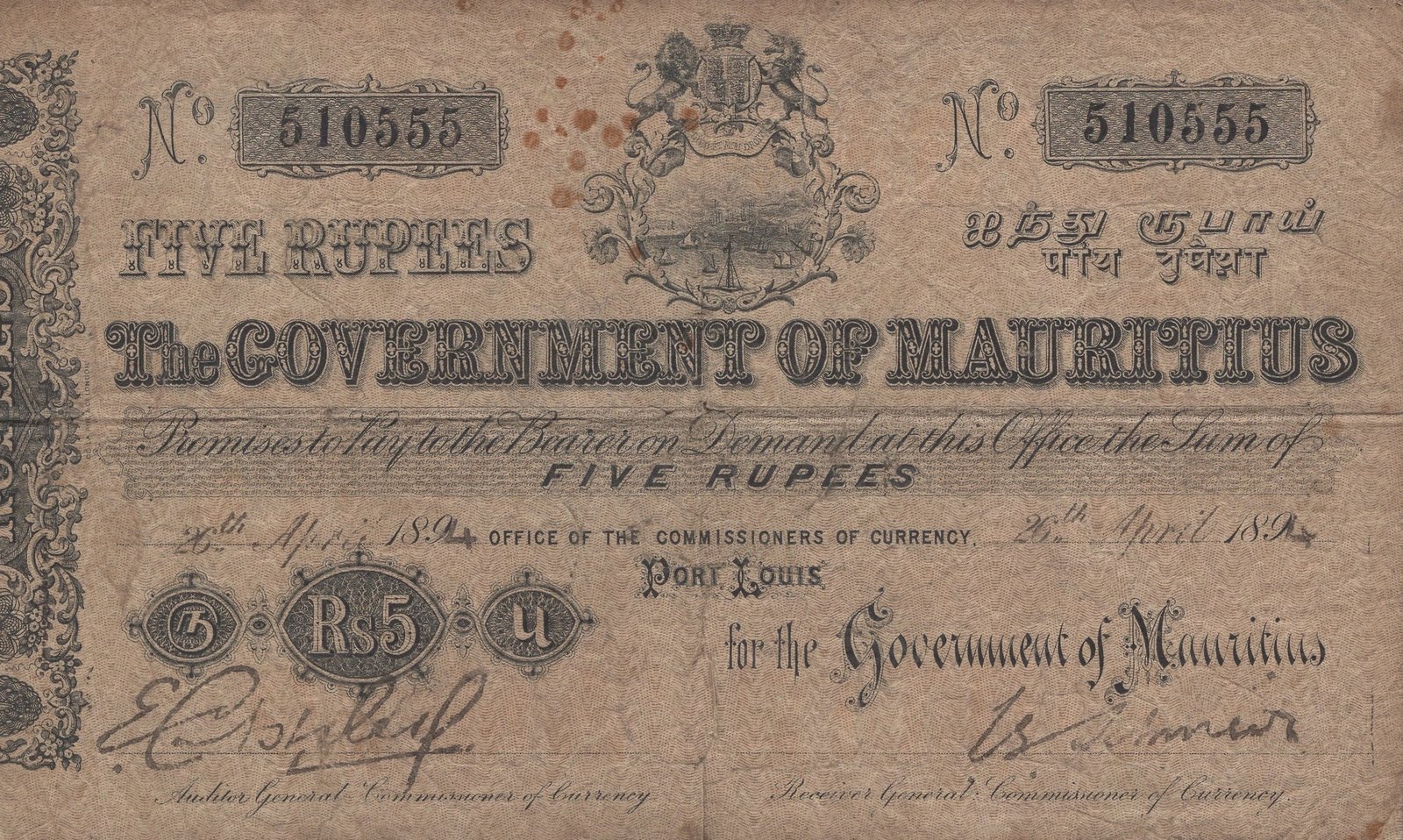
London answered on 8th September 1884. Lord Derby's telegram of that day approved the proposal in principle, told the Governor to follow the example of the Mauritius notes, and ruled that no note should be of less than five rupees. The Colonial Office's letter to the Treasury of the same day says the five rupee note "now current in Ceylon" would be kept and would be the lowest value of the new notes, and that the notes should be legal tender everywhere in Ceylon except at the Colombo office of the Currency Commissioners, the one place where they were paid.
A witness before the Currency Commission of 1902, heard under the heading of J. H. Templer, Crown Counsel, remembered the matter differently: that the Treasury in London had condemned a 5 rupee note and advised nothing below 10 rupees (minutes of evidence, Sessional Paper V of 1903). That is one person's recollection, given in 1902. The papers of 1884 show five rupees fixed as the lowest value.
9th September 1884: the memorandum on the notes
The memorandum headed "as to supplying the Ceylon Government with a note issue", by Sir J. Douglas and dated 9th September 1884, is the one paper that describes the notes themselves. It records "a lengthened consultation with Mr. Warren De La Rue" and sets out what was decided.
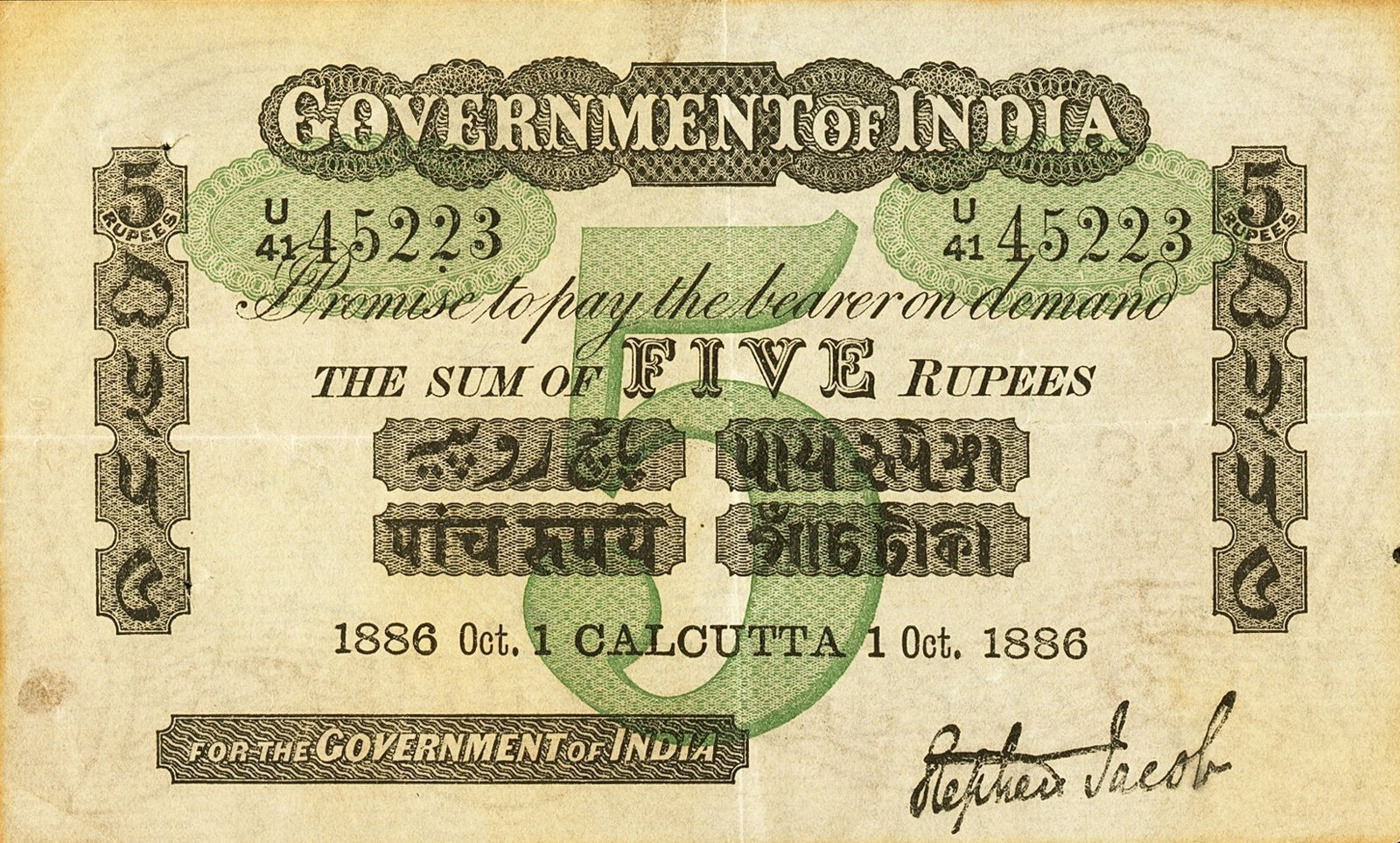
- The pattern. The Indian Government note was taken as the model, not the Oriental Bank's issue of two years before. Two reasons are given: the printing and colouring of the bank's note almost hid the watermark, and an elaborate copper plate of that kind would have taken three or four months to prepare.
- Protection against forgery. The note was to rely mainly on its watermark, "as in India", on a white paper chosen to make the watermark stand out. A certain amount of microscopic writing was to be added, and the note was to be "super-printed", as Indian notes were.
- Signatures and numbers. The notes were to bear the signatures of two Commissioners of Currency, "as in Mauritius", and to be numbered.
- Sizes. The sizes were to follow the existing practice of the Oriental Bank and the Chartered Mercantile Bank.
- Values. The memorandum saw no reason for a note above 50 rupees. The bank's notes of 100, 500 and 1,000 rupees, it says, "had no practical circulation" and were held, not passed.
On delivery the memorandum says that De La Rue promised 250,000 notes of 10 and 5 rupees by 15th December and 250,000 more by the end of the year. The 50 rupees was "a matter of comparatively minor importance", and its preparation was not pressed. Lord Derby's telegram of the day before had already told the Governor that half the notes were promised for shipment on 15th December and the rest on 31st December, "earliest possible date".
The second supply
The same memorandum looks past the first stock of 510,000 notes. As soon as the first 500,000 notes had been sent, a further supply was to follow of, "say", 100,000 notes of 5 rupees, 150,000 notes of 10 rupees and 15,000 notes of 50 rupees.
These are plans and promises of September 1884. The papers print no invoice and no record of what arrived, so they do not show whether the second supply was ordered in those numbers. The pages of the notes give the serial ranges of the notes dated 1st January 1885, and those agree with the first stock.
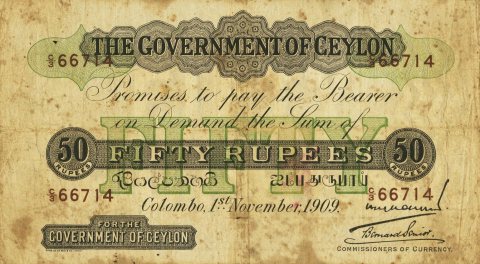
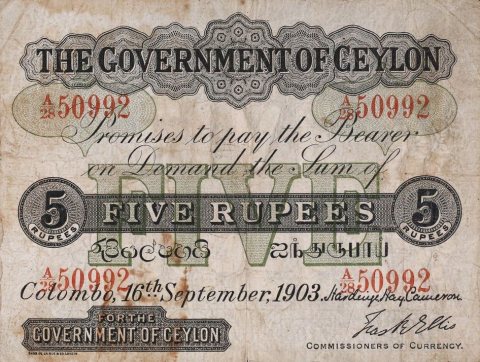
On the design the correspondence of 1884 says only that there was no time to have one prepared, and no plate or drawing of a note follows it in the printed papers.
October to December 1884: the Council
On 15th October 1884 the Governor told the Council that the notes "are now being printed, and will be ready for issue in Ceylon before the close of the month of February". Holders of Oriental Bank notes were to have the choice, during a period fixed by Proclamation, of Government notes or the full value in silver at the Treasury.
The draft law went between Colombo and London while the notes were printed. A Colonial Office letter to the Treasury of 15th October 1884 deals with its section 2, under which the deputies or representatives of the Colonial Secretary, the Treasurer and the Auditor-General act as Currency Commissioners in the absence of those officers. On 12th November 1884 the Colonial Office sent the Treasury the wording of section 4: the Commissioners might issue and re-issue promissory notes of the Government of Ceylon, payable to bearer on demand, up to the whole amount of coin and securities in their hands, for five, ten and fifty rupees. The Treasury approved it the same day and it was telegraphed to the Governor on 13th November.
A sub-committee of the Council reported on the Bill on 18th November 1884 (Sessional Paper XII of 1884). Its members were J. F. Dickson, Acting Colonial Secretary, R. W. D. Moir, Acting Treasurer, F. R. Saunders, P. Ramanathan, F. M. Mackwood and R. A. Bosanquet. Beside adding the 100, 500 and 1,000 rupees, the report made two changes that bear on the notes:
- the forgery clause, clause 23, was widened to cover "any facsimile of the signatures of any of the Commissioners";
- in clause 18 the limit of the Depreciation Fund, kept against losses on the invested reserve, was set at twenty per cent.
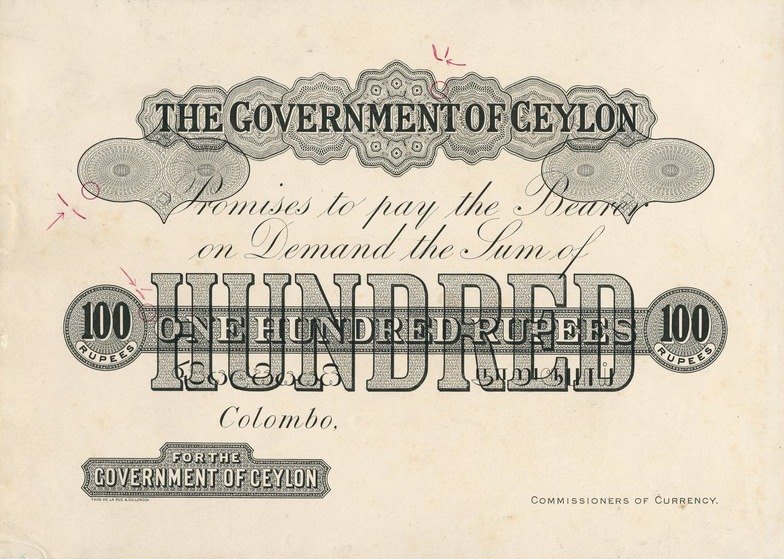
The Bill was read a third time and passed at the meeting of 10th December 1884, and the Governor's assent to it as Ordinance No. 32 of 1884, "An Ordinance to provide for the issue of Government Paper Currency", was announced on 17th December 1884. In the same session Ordinance No. 26 of 1884 allowed up to 160,000 pounds to be raised by debentures to redeem the Oriental Bank notes the Government had guaranteed.
What was voted for the notes
The estimates show what the issue was expected to cost. The report on the Supply Bill for 1885 (Sessional Paper XIII of 1884) adds these items.
| Item in the estimates for 1885 | Rupees |
|---|---|
| Expenses of the note issue in England | 25,080 |
| Treasury, for the note issue: a clerk | 700 |
| Treasury, for the note issue: a kanakapillai | 500 |
| Treasury, for the note issue: a counter | 240 |
| Cost of counters on the redemption of Oriental Bank notes | 1,500 |
The Blue Book for 1885 says the cost of the currency notes was charged to Miscellaneous Services that year and gives no separate sum. The estimates for 1887 carry a further Rs. 5,000 for the expenses of the note issue in England. None of these papers names the printer, and none says how many notes the money bought.
February and March 1885: the exchange
Lord Derby's despatch No. 40 of 20th February 1885 quotes the telegram sent on 12th February. The reserve was to be handed to trustees under clause 15 of the Ordinance, the Commissioners could not issue paper beyond the coin and securities they held under clause 4, and the Governor was to telegraph in good time before the "cover of 2,740,000 rupees" was used up. Holders of Oriental Bank notes could demand Government notes for them at any time between 15th February and 31st March 1885, and a further Rs. 460,000 might have to be raised to cover an issue of Rs. 3,200,000. The figure reads 160,000 or 460,000 on the scan of that page; the next page prints "Rs. 460,000 or thereabouts" clearly.
A Colonial Office letter to the Crown Agents of 13th February 1885 names the trustees: Sir Robert Herbert and Mr. Wingfield, jointly with the Crown Agents, on behalf of the Currency Commissioners. The reserve put into their names was 43,600 pounds. The same letter speaks of a dividend on the Oriental Bank's estate paid to the Government in silver, in Ceylon, on the 1st of that month.
The members of the Executive Council had reckoned the sum to be provided for at 32 lacs of rupees: about 12 lacs to be met by dividends, at eight shillings in the pound, and 20 lacs by loan (memorandum signed by J. C. McLeod, John F. Dickson, E. Fleming, W. D. Wright and R. W. D. Moir).
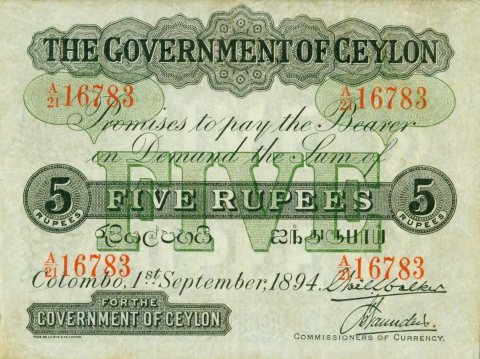
At the end of the first year Rs. 4,192,165 in Government notes were in circulation. The statement of assets and liabilities for 1st January 1886 shows the same sum as an advance to the Currency Commissioners, Rs. 625,152.50 advanced for the redemption of Oriental Bank notes, and a temporary loan of Rs. 388,473.51 due to the Crown Agents. A paper on the progress of Ceylon during the Queen's reign, printed for the Jubilee of 1887, puts it in one line: "In 1885 Currency Notes were first issued by the Government."
On 13th January 1886 F. M. Mackwood gave notice in the Council of a question on the revenue from the money invested as security for the note issue, and asked that the despatches on the note issue be laid on the table. The despatches used here are printed as Sessional Paper I of 1886.
What the papers do not give
- The printer's charge, an invoice, or the number of notes received in 1885.
- A drawing, proof or description of the finished note.
- The text of Ordinance No. 32 of 1884 as passed. Only its passage and single sections of the draft are printed in these volumes.
- Whether the second supply of September 1884 was ordered as planned.
- The day the first note was paid out. The notes are dated 1st January 1885, and the exchange for Oriental Bank notes ran from 15th February.
Sources
- Ceylon Sessional Paper I of 1886, "Despatches relating to the issue of currency notes by the Government of Ceylon": Governor Gordon to the Earl of Derby, No. 175 of 10th May 1884 and No. 286 of 28th July 1884; Lord Derby's telegram and despatch No. 267 of 8th September 1884; the Colonial Office to the Treasury, 8th September, 15th October and 12th November 1884; Sir J. Douglas's memorandum of 9th September 1884; the memorandum of the members of the Executive Council; Lord Derby's despatch No. 40 of 20th February 1885; the Colonial Office to the Crown Agents, 13th February 1885.
- Proceedings of the Legislative Council of Ceylon: the Governor's speech of 15th October 1884; the meetings of 10th and 17th December 1884; the meeting of 13th January 1886.
- Ceylon Sessional Paper XII of 1884, report of the sub-committee on the Government Paper Currency Bill, 18th November 1884.
- Ceylon Sessional Paper XIII of 1884, report of the sub-committee on the Supply Bill for 1885, Appendix B; the report on the Supply Bill for 1887.
- Ceylon Blue Book for 1885, and the statement of assets and liabilities of the Ceylon Government on 1st January 1885 and 1st January 1886 (Sessional Papers of 1886).
- The paper on the progress of Ceylon during the Queen's reign, Sessional Papers of 1887.
- Ceylon Sessional Paper V of 1903, minutes of evidence of the Currency Commission.
Member comments
Log in or register to post a comment.